
Psalms 89:11

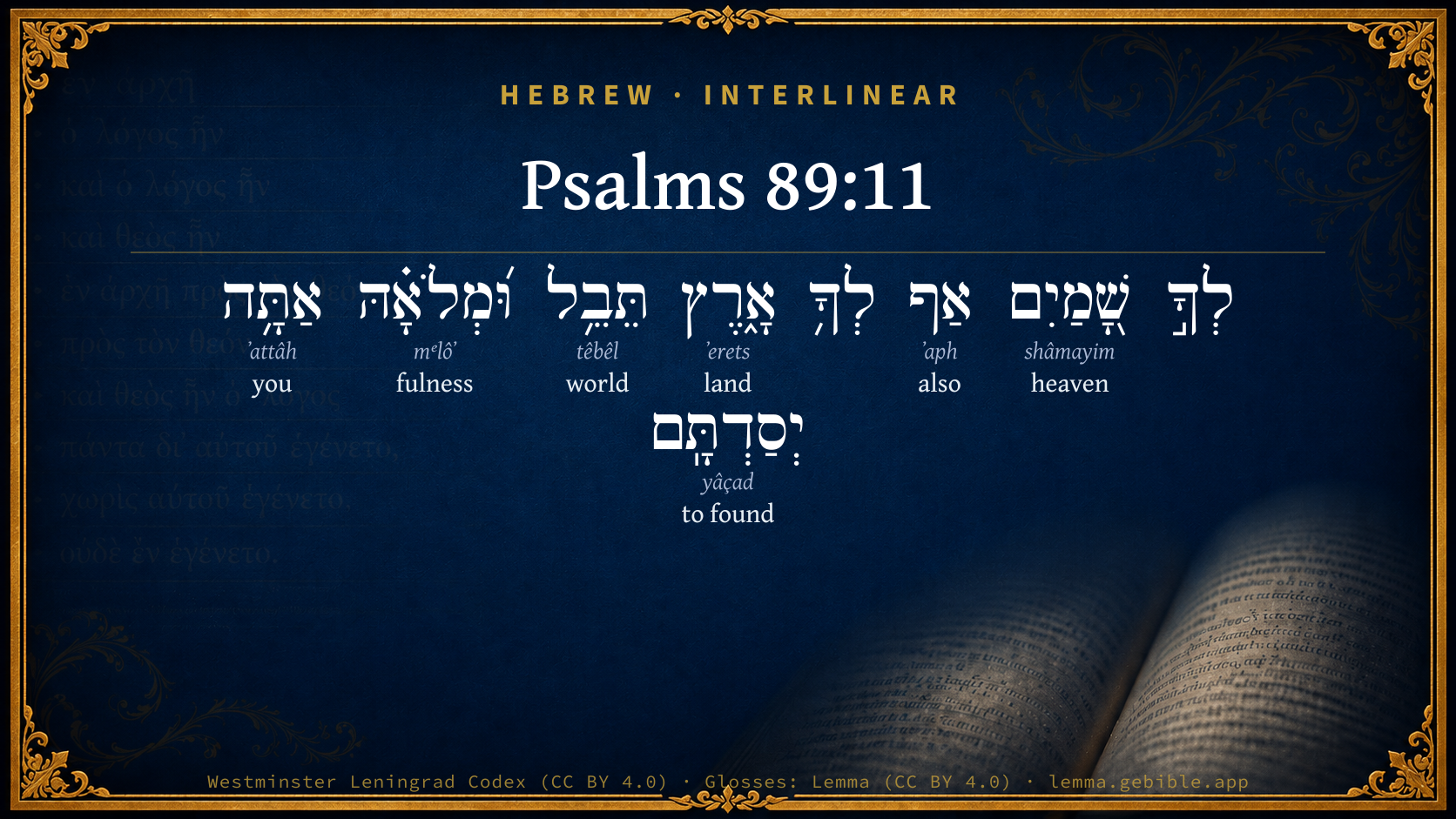
Hebrew (Westminster Leningrad Codex) Psalms 89:11 appears in the Hebrew Old Testament. The text above is from the Westminster Leningrad Codex. Each word links to its Strong’s number, a concise gloss, and parsing drawn from the Open Scriptures Hebrew Bible morphology. Click any word for its full Brown-Driver-Briggs (BDB) entry.
Download image
Cite this verse

Psalms 89:11 (World English Bible). Public Domain. Lemma interlinear Bible study tool, https://lemma.gebible.app/v/psalms/89/11.

Show BibTeX & RIS
BibTeX
RIS
English Translation
The heavens are yours. The earth also is yours; The world and its fullness. You have founded them.
World English Bible · Public Domain
Download a study sheet

One document with this verse’s original text, its word-by-word gloss line, the meaning frame, cross-references with their text, attributed commentary, and full source and license credits — printable, and it pastes into notes with its structure intact.

This verse Autodidact and up

Study sheet (.html) Plain text (.txt)

A passage Seminary Student

Up to 50 verses in one chapter. A passage sheet keeps up to 6 commentary sources and 12 cross-references per verse, in the order this page ranks them, and says so on the sheet whenever that leaves anything out. Ask for a single verse and you get the Autodidact verse sheet above.

Everything on this page stays free to read, with no account — the sheet is a download of what is already on screen, not access to it.

Want to remove ads? Support Godless Engineer
Compare translations 3

The same verse in 3 English versions, stacked beneath the original-language interlinear above. Click any original word for its lexicon entry.

Each is an independent rendering of the whole verse — the interlinear is not word-aligned to these translations.

Highlighted words mark where these versions differ — a whole-verse word diff, not a word-by-word alignment.

  • World English Bible Public Domain
    The heavens are yours. The earth also is yours; The world and its fullness. You have founded them.
  • King James Version Public Domain
    The heavens are thine, the earth also is thine: as for the world and the fulness thereof, thou hast founded them.
  • unfoldingWord Literal Text CC BY-SA 4.0
    To you the heavens, also to you, the earth; the world and its fullness, you, you founded them.

unfoldingWord Literal Text — © unfoldingWord, licensed CC BY-SA 4.0. Word-aligned USFM3 via Door43 (git.door43.org/unfoldingWord/en_ult).

Versions to compare (up to 4)

3 of 4 selected

Show all 18 translations

Every available English version of this verse, each an independent rendering of the whole verse.

  • World English Bible Public Domain
    The heavens are yours. The earth also is yours; The world and its fullness. You have founded them.
  • Berean Standard Bible Public Domain
    The heavens are Yours, and also the earth. The earth and its fullness You founded.
  • Majority Standard Bible Public Domain
    The heavens are Yours, and also the earth. The earth and its fullness You founded.
  • King James Version Public Domain
    The heavens are thine, the earth also is thine: as for the world and the fulness thereof, thou hast founded them.
  • American Standard Version (1901) Public Domain
    The heavens are thine, the earth also is thine: The world and the fulness thereof, thou hast founded them.
  • Revised Version (1885) Public Domain
    The heavens are thine, the earth also is thine: the world and the fulness thereof, thou hast founded them.
  • Geneva Bible (1599) Public Domain
    The heauens are thine, the earth also is thine: thou hast layde the foundation of the world, and all that therein is.
  • Douay-Rheims (1899) Public Domain
    Thou hast humbled the proud one, as one that is slain: with the arm of thy strength thou hast scattered thy enemies.
  • Young's Literal Translation Public Domain
    Thine `are' the heavens -- the earth also `is' Thine, The habitable world and its fulness, Thou hast founded them.
  • Literal Standard Version CC BY-SA 4.0
    The heavens [are] Yours, || The earth [is] also Yours, || The habitable world and its fullness, || You have founded them.
  • Unlocked Literal Bible CC BY-SA 4.0
    The heavens belong to you, and the earth also. You made the world and all it contains.
  • unfoldingWord Literal Text CC BY-SA 4.0
    To you the heavens, also to you, the earth; the world and its fullness, you, you founded them.
  • Darby Bible Public Domain
    Thine are the heavens, the earth also is thine; the world and its fulness, *thou* hast founded them.
  • World Messianic Bible Public Domain
    The heavens are yours. The earth also is yours, the world and its fullness. You have founded them.
  • Webster's Bible Public Domain
    \\89:10\\Thou hast broken Rahab in pieces, as one that is slain; thou hast scattered thy enemies with thy strong arm.
  • Free Bible Version CC BY-SA 4.0
    The heavens belong to you, and the earth too; you made the world and everything in it.
  • Bible in Basic English Public Domain
    Yours are the heavens, and the earth is yours; you have made the world, and everything which is in it.
  • JPS Tanakh (1917) Public Domain
    (89-12) Thine are the heavens, Thine also the earth; the world and the fulness thereof, Thou hast founded them.

Literal Standard Version (2020), Covenant Press — licensed CC BY-SA 4.0. Text via the HelloAO Bible API (eBible.org). Unlocked Literal Bible (unfoldingWord) — licensed CC BY-SA 4.0. Text via the HelloAO Bible API (eBible.org). unfoldingWord Literal Text — © unfoldingWord, licensed CC BY-SA 4.0. Word-aligned USFM3 via Door43 (git.door43.org/unfoldingWord/en_ult). Free Bible Version, Dr. Jonathan Gallagher — licensed CC BY-SA 4.0. Text via the HelloAO Bible API (eBible.org).

Word by word

More ways to search: Search by grammar → Find every occurrence → Compare this word →

Practice this passage: Drill this verse → Learn its vocabulary →

About this verse

These counts appear in no published source. They are computed here, from the morphology-tagged text and Lemma’s own curated glosses. What Lemma adds →

9
words
7
distinct lemmas
Wisdom
section

Shared distinctive vocabulary

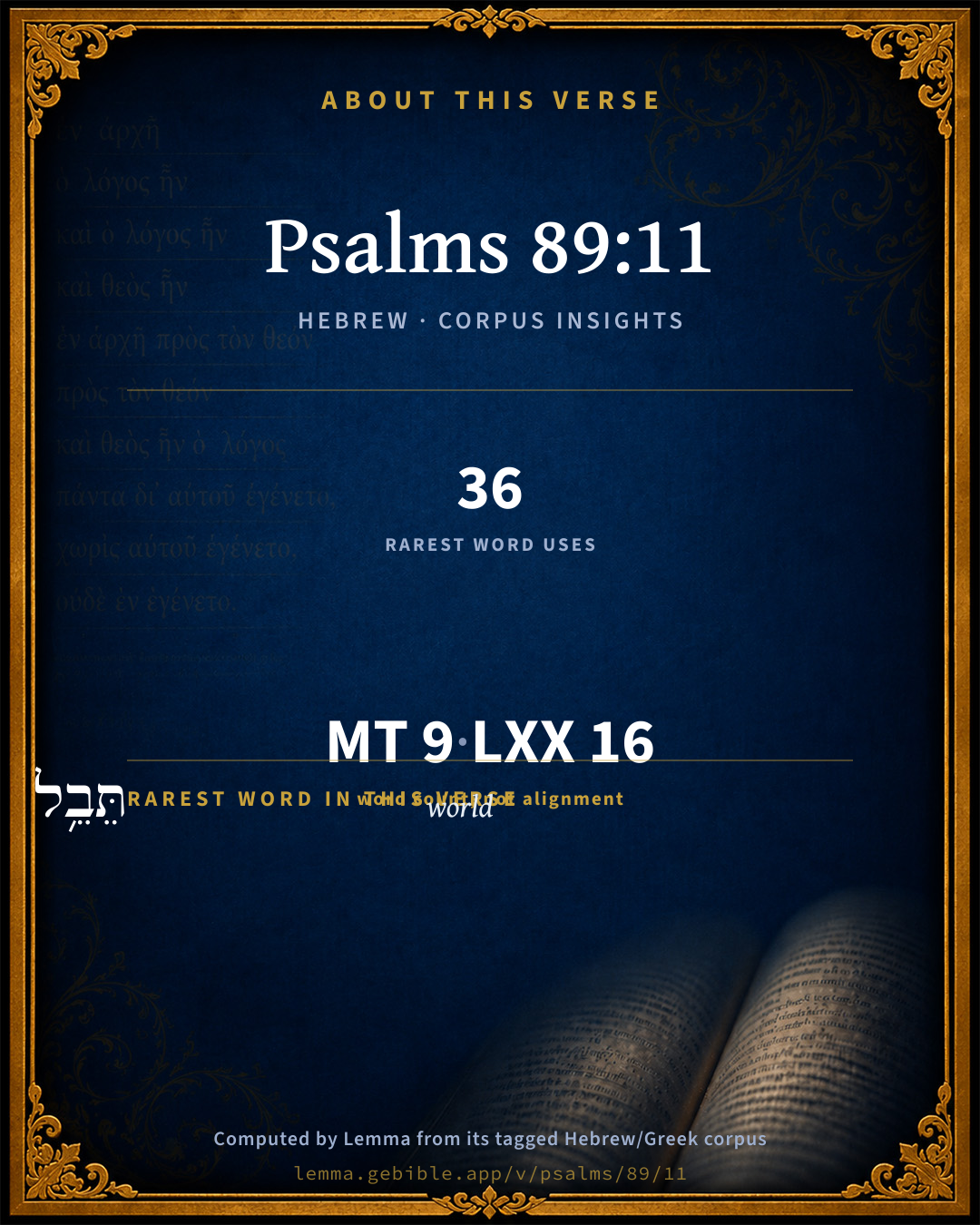
תֵּבֵ֥ל world H8398 occurs in 36 verses of the Hebrew Bible. Also found in:

Grammatical profile

  • 1 verb
  • 4 nouns
  • 1 pronoun
  • 2 prepositions
  • 1 particle

Verb forms

  • יְסַדְתָּֽם Qal · Perfect

Hebrew & Septuagint length

In English translation the verse runs 18 words from the Hebrew and 19 from the Septuagint (LXX English) — closely comparable.

A rough comparison of the two English renderings, which tokenize alike — not a word-level alignment.

Word counts can differ between the Hebrew and the Greek without any difference in meaning — e.g. the Hebrew direct-object marker אֵת has no separate Greek word, and Greek often adds the article ὁ.

In the original languages it is 9 Hebrew tokens and 16 Greek tokens — but the two are counted differently (Hebrew bundles its prefixes and suffixes into one token; the Greek is in lemma form), so that isn’t a like-for-like length.

Cross-references

9

Topical passages linked to Psalms 89:11 in the Treasury of Scripture Knowledge — connected by theme and wording, ordered by reader-vote popularity; previews shown in the World English Bible.

  • 1 Chronicles 29:11 Yours, Yahweh, is the greatness, the power, the glory, the victory, and the majesty: for all that is in the heavens and in the earth is yours. Yours is the kingdom, Yahweh, and you are exalted as head above all.
  • Genesis 1:1 In the beginning God created the heavens and the earth.
  • Psalms 115:16 The heavens are the heavens of Yahweh; But the earth has he given to the children of men.
  • Psalms 24:1–2 The earth is Yahweh's, with its fullness; The world, and those who dwell therein.
  • 1 Corinthians 10:26 for "the earth is the Lord's, and its fullness."
  • Psalms 50:12 If I were hungry, I would not tell you, For the world is mine, and all that is in it.
  • Genesis 2:1 The heavens and the earth were finished, and all the host of them.
  • Job 41:11 Who has first given to me, that I should repay him? Everything under the heavens is mine.
  • 1 Corinthians 10:28 But if anyone says to you, "This was offered to idols," don't eat it for the sake of the one who told you, and for the sake of conscience. For "the earth is the Lord's, and all its fullness."

Cross-references courtesy of OpenBible.info (CC BY 4.0).

Hebrew and Greek witnesses Masoretic Hebrew ↔ Greek Septuagint

The same verse in the two great witnesses to the Old Testament, shown verse-for-verse.

You’re reading Greek Psalm 88 (Hebrew Psalm 89). The Septuagint counts the superscription, so verse numbers can differ from the Hebrew — chapter-level alignment, not verse-by-verse. Numbering follows Rahlfs.

These are two independent witnesses, not word-aligned to each other, and the Septuagint is shown in lemma (dictionary) form.

Hebrew Psalms 89:11 Masoretic · Westminster Leningrad Codex

לְךָ֣ שָׁ֭מַיִם אַף לְךָ֥ אָ֑רֶץ תֵּבֵ֥ל וּ֝מְלֹאָ֗הּ אַתָּ֥ה יְסַדְתָּֽם

The heavens are yours. The earth also is yours; The world and its fullness. You have founded them.

World English Bible · Public Domain

Greek LXX Greek Psalm 88:11 Septuagint · lemma form

σύ ταπεινόω ὡς τραυματίας ὑπερήφανος καί ἐν ὁ βραχίων ὁ δύναμις σύ διασκορπίζω ὁ ἐχθρός σύ

The heavens are your, and the earth is your: you have founded the world, and the fullness of it.

LXX2012 (modern English Septuagint) · Public Domain

Hebrew: Westminster Leningrad Codex (CC BY 4.0). Greek: Septuagint (public domain); English from LXX2012 (modern English Septuagint) (Public Domain). How the Septuagint differs from the Hebrew →

Commentary

Notes on Psalms 89:11 from classic Christian and Jewish commentators (each source and its license shown beneath its notes). The classic Christian expositions comment on the surrounding passage and are grouped to its opening verse, so a note may address several verses; the Jewish commentaries on the Tanakh (Rashi and others) are per-verse, so they appear only where the commentator wrote on this verse.

Lemma curates 59 commentaries, every one of them public domain or Creative Commons licensed, each selected and text-cleaned for this edition rather than reprinted as found. About our sources →

Trapp's Complete Commentary

John Trapp

Psa 89:11 The heavens [are] thine, the earth also [is] thine: [as for] the world and the fulness thereof, thou hast founded them.

Ver. 11. The heavens are thine, the earth also is thine] Thou madest them by thy power, and thou maintainest them by thy providence; thou doest whatsoever thou wilt in both, Psa 115:3.

As for the world, &c.] See Psa 24:1; Psa 50:12.

John Trapp, A Commentary or Exposition upon All the Books of the Old and New Testament (1647–1656) — public domain. Text from a community e-Sword module.

The Biblical Illustrator

Joseph S. Exell

Psa_89:11

The heavens are Thine, the earth also is Thine.

The affluence of God

God owns the whole universe.

I. He holds His vast property by absolute right. He produced all.

II. He holds His vast property in perpetuity. All that men fictitiously call their property must pass from their hands. But God holds on His property untransferred and untransferable.

III. He holds His vast properly for benevolent ends. Men hold what they call their property generally for selfish ends, for their own aggrandizement and gratification. But God for the good of all His creatures

1. A lesson to human legislators. Their grand object should be to secure to the people, to the utmost of their power, the full use of the blessings of nature.

2. A lesson to all. Whatever we have is not ours but His. We hold it but in trust. (Homilist.)

The Biblical Illustrator, edited by Joseph S. Exell (c. 1880s–1900s) — public domain. Text from a community e-Sword module.

Joseph Benson's Commentary

Psa 89:11-12. The earth also is thine, and the fulness thereof — All the creatures wherewith it is replenished, as Psa 24:1; Psa 50:12. Thou hast founded them — They are all thy creatures, and of consequence are wholly subject to thy power and pleasure; and therefore all the monarchs and kingdoms of the earth cannot hinder thee from making good thy promise to the house and kingdom of David. The north and the south thou hast created them — That is, the northern and southern parts of the world, yea, even the remotest ends thereof, though not yet known to us, were made and are ruled by thee. Tabor and Hermon — Two eminent mountains in the land of Canaan; Tabor in the west, and within Jordan, Hermon on the east, and without Jordan. By which he may intend either, 1st, The western and eastern parts of the world, and so all the four parts of it are contained in this verse. Or, 2d, Only the several parts of the land of Canaan, both within Jordan and without it. And the mountains may be named rather than the valleys, because, when their fertility is expressed, the fertility of the valleys is more strongly supposed. Shall rejoice — Shall be fruitful and prosperous, and so give their inhabitants cause to rejoice; in thy name — In or by thy favour, and the fruits thereof.

Joseph Benson's Commentary on the Old and New Testaments (1811–1818) — public domain. Text from a community e-Sword module.

J. A. Alexander on Psalms

Joseph Addison Alexander

12. (Psa 89:11) To thee (belongs) heaven, also to thee earth, the world and its fulness, thou didst found them. The power of God is now described as universal and creative. Heaven and earth is the usual comprehensive phrase for the whole frame of nature or material universe. The last clause is evidently borrowed from Ps. xxiv. 1. Its fulness, that which occupies and fills it, its contents and its inhabitants. The verb to found suggests the two ideas of creation and sustentation. He not only called them into being, but made them permanent or lasting. See below, on Psa 104:5. The world, the cultivated and productive earth, as opposed to the desolate and barren sea. The English Bible, following the masoretic accents, construes the world and its fulness as absolute nominatives. A simpler construction is to put them in apposition with heaven and earth, and refer the pronoun at the end to all these antecedents.

Joseph Addison Alexander, The Psalms Translated and Explained (1850) — public domain. Text from a community e-Sword module.

Adam Clarke's Commentary

Verse 11. The heavens are thine] Thou art the Governor of all things, and the Disposer of all events.

The world] The terraqueous globe.

And the fullness] All the generations of men. Thou hast founded them-thou hast made them, and dost sustain them.

After this verse, the Editio Princeps of the Hebrew Bible, printed at Soncini, 1488, adds: -

לילה לך אף יום לך lailah lecha aph yom lecha

ושמש מאור הכינות אתה vashamesh maor hachinotha attah

To thee is the day; also to thee is the night:

Thou hast prepared the light and the sun.

But these same words are found in Ps 74:16.

Adam Clarke's Commentary on the Bible (1810–1826) — public domain. Text from a community e-Sword/MySword module.

John Calvin's Commentaries

11 The heavens are thine, the earth also is thine. He again repeats, the third time, that the same God who had been the deliverer of the chosen people exercises supreme dominion over the whole world. From the fact that God created all things, he concludes, that it is He who actually presides over, and controls whatever takes place in heaven and in earth. It would be absurd to suppose, that the heavens, having been once created by God, should now revolve by chance, and that things should be thrown into confusion upon the earth either at the will of men, or at random, when it is considered that it belongs to God to maintain and govern whatever he has created; unless, like the heathen, we would imagine that he enjoys himself in beholding all the works of his hand, in this beautiful theater of the heaven and the earth, without giving himself any farther trouble about them. In speaking of the south and the north, and also of the mountains, Tabor and Hermon, the prophet accommodates his language to the unrefined apprehension of the common people: as if he had said, there is no part of the fabric of the world which does not reverence and honor its Creator. I also connect with this the next verse, which affirms, that the arm of God is furnished with power, his hand with strength, and that his right hand is exalted Some resolve the two last clauses of the verse into the form of a prayer, Strengthen thy hand, lift up thy right hand; but this seems too much removed from the mind of the prophet, who, with the simple view of encouraging all the godly, celebrates the inconceivable power of God.

John Calvin's Commentaries (1540-1563) — public domain. Text from the Calvin Translation Society English edition (1840s-50s) via the Christian Classics Ethereal Library (ccel.org). Calvin's coverage is partial (roughly two-thirds of the Bible); uncommented books and verses are honest gaps, never fabricated. The 19th-century editor's footnotes and remarks are omitted so the notes are faithfully Calvin's own voice.

The Cambridge Bible for Schools and Colleges

gen. ed. J. J. S. Perowne

11. THINE are the heavens, THINE also the earth:

The world and the fulness thereof, THOU hast founded them.

Cp. Psa_24:1-2; Psa_50:12; Psa_78:69; Job_38:4; Pro_3:19.

The Cambridge Bible for Schools and Colleges (gen. ed. J. J. S. Perowne; Cambridge University Press, 1878–1918) — public domain. Text from a community e-Sword module.

John Gill's Exposition

The two extreme parts of the world, the northern and southern poles, whether inhabited or uninhabited, are created by the Lord, to answer some purpose or another; see Job 26:7.

Tabor and Hermon shall rejoice in thy name; Tabor was a mountain in the western part of Galilee, in the tribe of Zebulun, Jos 19:12. This mountain, according to Mr. Maundrell (a), stands by itself in the plain of Esdraelon, about 1200 to 1800 yards within the plain; it has a plain area at top, most fertile and delicious, of an oval figure, extended about six hundred yards in breadth, and twice that in length; this area is enclosed with trees on all parts, except towards the south, in which there are in several places cisterns of good water. It is generally thought to be the mountain Christ was transfigured upon before his disciples; and if so, it might then be said to rejoice in his name, when he appeared in so glorious a form upon it; Moses and Elias talking with him, and a voice from the excellent Glory declaring him his beloved Son; and especially the disciples rejoiced in his name there and then, who could say, It is good for us to be here, Mat 17:1. Hermon was a mountain called by the Sidonians Sirion, and by the Amorites Shenir, Deu 3:8 and was in the east; and so Mr. Maundrell (b), speaking of Tabor, says, not many miles eastward you see Mount Hermon, at the foot of which is seated Nain, famous for our Lord's raising the widow's son there, Luk 7:11, there was an Hermon near Mount Tabor, thought likely to be here meant; but, be these mountains where and what they may, they were no doubt very high and fruitful ones, clothed with fruitful trees and grass, and covered with flocks; which made the proprietors and all the beholders rejoice in the goodness, wisdom, and power of God: the Targum in the king's Bible gives the four quarters very truly,

"the desert of the north, and the inhabitants of the south, thou hast created; Tabor on the west, and Hermon on the east, praise in thy name.''

(a) Journey from Aleppo to Jerusalem, p. 113, 114, Ed. 7. (b) Journey from Aleppo to Jerusalem, p. 115, Ed. 7.

John Gill's Exposition of the Whole Bible (1746–1763) — public domain (CC PDM 1.0). Text via the HelloAO Bible API.

Albert Barnes' Notes on the Bible

The heavens are thine - Are thy work; and, therefore, thy property - the highest conception of property being that which is derived from creation. It is also implied here that as all things belong to God, he has a right to dispose of them as he pleases.

The earth also is thine - The earth itself, as made by thee; all that the earth produces, as having sprung out of that which thou hast made. The entire proprietorship is in thee.

As for the world - In the use of this word, the earth is spoken of as inhabitable, meaning that the earth and all that dwell upon it belong to God.

And the fulness thereof - All that it produces; what constitutes its enireness. That is, the earth itself considered as earth, or as a mass of matter; and all that springs from it; all that constitutes the earth, with all its mountains, seas, rivers, people, animals, minerals, harvests, cities, towns, monuments - the productions of nature, the works of power, and the achievements of art. Compare the notes at Psa 24:1.

Thou hast founded them - They all have their foundation in thee; that is, thou hast caused them all to exist. They have no independent and separate basis on which to rest.

Albert Barnes' Notes on the Bible (1834–1885) — public domain. Text from a community e-Sword/MySword module.

Matthew Poole's English Annotations

The fulness thereof; all the creatures wherewith it is replenished, as Psa 24:1; 50:12.

Thou hast founded them; they are all thy creatures, and therefore wholly subject to thy power and pleasure; and therefore all the monarchs and kingdoms of the earth cannot hinder thee from making good thy promise to the house and kingdom of David.

Matthew Poole's English Annotations on the Holy Bible (1683–1685) — public domain. Text from a community e-Sword/MySword module.

The Treasury of David

Charles H. Spurgeon

Ver. 11. The heavens are thine, the earth also is thine. All things are alike God'srebellious earth as well as adoring heaven. Let us not despair of the kingdom of truth; the Lord has not abdicated the throne of earth or handed it over to the sway of Satan.

As for the world and the fulness thereof, thou hast founded them. The habitable and cultivated earth, with all its produce, owns the Lord to be both its Creator and Sustainer, builder and upholder.

Ver. 11. The heavens are thine, the earth also is thine. Therefore we praise thee, therefore we trust in thee, therefore we will not fear what man can do against us. Matthew Henry.

Ver. 11.

1. God's possession of heaven, the model of his possession of earth.

2. God's possession of earth most certain, and its manifestation in the future most sure.

3. The course of action suggested to his people by the two facts.

Psalms 89:12*

Charles H. Spurgeon's The Treasury of David (1869–1885) — public domain. Psalms only. Text from a community e-Sword/MySword module.

Whedon's Commentary on the Bible

Daniel D. Whedon

11. The heavens are thine—The universe is again, as in Psa_89:5, brought in to illustrate the power of God over all things.

Daniel D. Whedon (gen. ed.), Commentary on the Old and New Testaments (1874–1909) — public domain. Text from a community e-Sword module.

The Pulpit Commentary

The heavens are thine. (comp. Psa_8:3 Psa_33:6 Psa_115:16) The earth also is thine. (see Psa_24:1) As for the world and the fulness thereof, thou hast founded them. (see Psa_50:12)

The Pulpit Commentary (1880–1919), ed. H.D.M. Spence-Jones & Joseph S. Exell — public domain. Text from a community e-Sword module.

unfoldingWord translationNotes

Door43 World Missions Community

the north and the south

The writer uses the words "north" and "south" together to mean that God created everything everywhere. (See: Merism)

Tabor and Hermon rejoice in your name

Tabor is a mountain southwest of the sea of Galilee and Hermon is a mountain northeast of the sea of Galilee. The writer describes these mountains as if they were persons who could rejoice. AT: "It is as if Mount Tabor and Mount Hermon were rejoicing in your name" (See: Personification and How to Translate Names)

in your name

Here "name" represents the whole person. AT: "in you" (See: Metonymy)

translationWords

heaven

create

Mount Hermon

joy

name

unfoldingWord translationNotes — © Distant Shores Media and the Door43 World Missions Community, licensed CC BY-SA 4.0. Source: git.door43.org/Door43/en_tn.

Rashi

Rabbi Shlomo Yitzchaki (Rashi)

Rahab Egypt.

Rashi on the Tanakh — English translations: “The Judaica Press complete Tanach with Rashi, translated by A. J. Rosenberg” (CC BY 4.0); “Pentateuch with Rashi's commentary by M. Rosenbaum and A.M. Silbermann, 1929-1934” (public domain); “The Metsudah Tanach series, Lakewood, N.J” (CC BY 4.0); and “The Book of Joshua, Metsudah Publications, 1997” (CC BY 4.0). Text via Sefaria.

Lesson kit

Teaching starters — assembled from the data on this page, not authored interpretation. Every prompt links to the verse data it draws on. Edit before teaching.

Psalms, in the Wisdom, opens this verse with 9 words (7 distinct Hebrew lemmas). Its most distinctive word is têbêl (“world”). A historical commentator’s framing appears above. Read the whole chapter for the surrounding context.

Discussion questions

  1. What does “world” (têbêl) contribute to the verse as a whole?
  2. How does 1 Samuel 2:8, which shares the word «world», read alongside this verse?
  3. The translations on this page render this verse differently — a whole-verse word diff, not a word-by-word alignment. What might account for the different wordings?
  4. «יְסַדְתָּֽם» is a Qal Perfect verb. How does that grammatical form shape the action described?
  5. Compare how Trapp's Complete Commentary and The Biblical Illustrator read this verse. Where do they agree or differ?

Things to notice

Reading settings

Reading text

Shown beneath each verse's original-language words.

Old Testament
Old Testament edition

Read the OT as the Masoretic Hebrew (MT) or the Greek Septuagint (LXX).

English shown for the Greek Septuagint (in the Hebrew ↔ Greek comparison).

Comparing translations? Open the Compare panel on any verse page to stack up to four side by side.