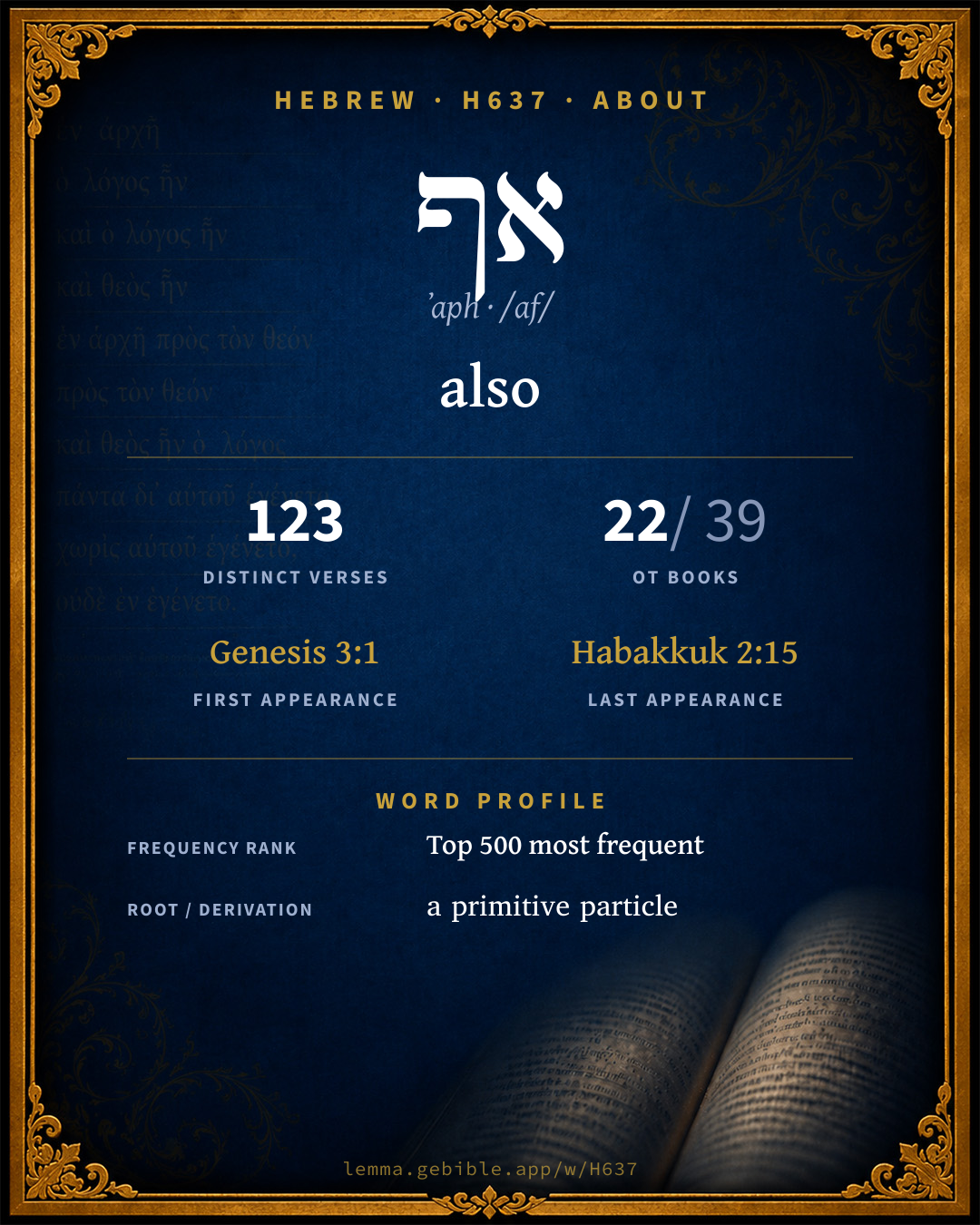
אַף
also
also: yea, though fuller range ↓
Full lexicon entry — Brown-Driver-Briggs (BDB)
From Brown-Driver-Briggs (BDB)
Where this word appears
Grammar key — what these labels mean
Part of speech
- Particle
- A short function word — article, negation, interrogative, the sign of the direct object, and the like.
Every verse where H637 appears in the Book of 2 Kings — 2 distinct verses. Click any verse to open its interlinear word-by-word view. Verse text shown in the World English Bible for context — . Each verse’s Hebrew form is shown with its reference; the English is not keyword-highlighted, since the data carries no word-level English alignment. Use “Compare translations” on any verse to read it across multiple English versions. This concordance covers the Hebrew Bible; Septuagint (Greek Old Testament) occurrences are not indexed here.
2 Kings
- 2 Kings 2:14 אַף ptcl acc He took the mantle of Elijah that fell from him, and struck the waters, and said, Where is Yahweh, the God of Elijah? and when he also had struck the waters, they were divided here and there; and Elisha went over.
- 2 Kings 5:13 וְ/אַ֛ף conj + adv His servants came near, and spoke to him, and said, My father, if the prophet had bid you do some great thing, wouldn't you have done it? how much rather then, when he says to you, Wash, and be clean?
About this entry
At a glance — auto-summarized from this page’s data, not written by a person. Every figure links to its source below. This summary describes the numbers; it doesn’t interpret them.
The Hebrew word אף centers on the idea of “also.” First canonically at Genesis 3:1, it enters the text early. It turns up in 123 verses across 22 books, a common footprint. Beyond “also” it also covers “yea” and “though” — see its full sense range. It clusters with אף under a shared root. Dig into 123-verse concordance and the renderings breakdown below.
Gloss history
Strong's 1890 vs modern scholarship
About this word
Strong's H637 catalogs a Hebrew word from the Hebrew Old Testament.
These counts are not copied from any lexicon or concordance. They are computed here, from the morphology-tagged Hebrew Old Testament. What Lemma adds →
- 123
- distinct verses
- The word appears in 123 distinct verses.
- 22 / 39
- OT books
- The word appears in 22 of 39 Old Testament books.
- #332
- by frequency
- Top 500 most frequent Hebrew words (rank 332 of 8,640 Hebrew words by occurrence).
View all 123 occurrences in the concordance →
By section of the Old Testament
By traditional corpus
Conventional, traditional groupings — biblical authorship is debated, so this is a traditional corpus grouping, not an authorship claim. Each share is this word’s portion of its verses in that division of the Hebrew canon. Each figure is a share of the word’s 123 distinct verses.
- Writings (Ketuvim) 63 verses · 51%
- Prophets (Nevi'im) 39 verses · 32%
- Torah (Pentateuch) 21 verses · 17%
How translations render this word
Counts come from each version’s own published word-to-Strong’s tagging or interlinear alignment — an approximate guide to how each version renders this word, not a word-level alignment the data otherwise carries. Because each total is that version’s own tagged count, the per-version totals vary from one another and need not match the appearance or distinct-verse counts above. These counts may also differ from a printed concordance because Lemma counts each distinctly tagged rendering and does not collapse phrase taggings into a single head-word total. This is a fixed set of word-tagged versions (KJV, ASV, BSB, ULT) and does not change with the reading translation you choose elsewhere. Each version’s license is shown beside its name below (and on Sources).
BDB lists this Strong’s number as 3 distinct words (homographs). Each count above pools all of them and is not split by sense — see the Senses section below. A low-frequency rendering may belong to a different one of those words, not the primary meaning.
- King James Version†: Yea 2×
- American Standard Version†: Yea 3×, How much more 2×, I also 2×
- Berean Standard Bible†: And 12×, Indeed 9×, How much more 7×
- unfoldingWord Literal Text†: Indeed 50×, Also 38×, Even 9×
King James Version Public Domain
Renders H637 across 17† tagged occurrences — most commonly:
Plus 15 renderings that appear only once — usually multi-word phrases or single function words the recovered tagging swept in, not distinct renderings.
American Standard Version Public Domain
Renders H637 across 17† tagged occurrences — most commonly:
Plus 10 renderings that appear only once — usually multi-word phrases or single function words the recovered tagging swept in, not distinct renderings.
Berean Standard Bible Public Domain
Renders H637 across 108† tagged occurrences — most commonly:
Plus other, less common renderings. Plus 31 renderings that appear only once — usually multi-word phrases or single function words the recovered tagging swept in, not distinct renderings. Not rendered by a distinct English word in 24 further occurrences.
unfoldingWord Literal Text CC BY-SA 4.0
Renders H637 across 141† tagged occurrences — most commonly:
Plus 20 renderings that appear only once — usually multi-word phrases or single function words the recovered tagging swept in, not distinct renderings.
Senses in the full BDB
What do BDB’s symbols mean?
BDB uses these scholarly abbreviations:
| Symbol | Meaning |
|---|---|
| 𝔊 | the Septuagint (the ancient Greek translation, LXX) |
| 𝔙 | the Vulgate (the Latin translation) |
| 𝔖 | the Syriac version (the Peshitta) |
| 𝔗 | the Targum (the Aramaic translation) |
| ψ | the Psalms |
| √ | root (the underlying root or stem) |
| ‖ | parallel passage (a synonymous or contrasted parallel) |
| † | the dagger: every passage where the word occurs is cited |
The 5 senses and sub-senses the full Brown-Driver-Briggs lexicon distinguishes for this word, in lexicon order (not ranked by frequency), with BDB’s own verbatim wording and sub-sense lettering. Shown in Hebrew script with BDB’s own scholarly abbreviations. The condensed entry is in the Lexicon Entry tab. See also the Forms in the corpus table below.
אף I
- 1. nostril, as organ of breathing Gn 2:7; 7:22; Jb 27:3 cf. Nu 11:20; 2 S 22:9 = ψ 18:9 cf. Is 65:5; Is 2:22; La 4:20; Ez 38:18 (del. Co) Am 4:10; רוּחַ אַפֶּיךָ (of י׳) i.e. wind Ex 15:8; cf. נִשְׁמַת רוּחַ אַפּוֹ 2 S 22:16 = ψ 18:16 (vid. also sub 3); nose sg. Ct 7:5, 9; Ez 8:17; 23:25; Pr 30:33 (where play upon diff. meaning of אַף & אַפַּיִם): (a) as organ of smelling Dt 33:10 ψ 115:6; (b) as place of ring for ornament Gn 24:47; Is 3:21 Ez 16:12; (c) as place of ring or hook for captive 2 K 19:28 = Is 37:29; for beasts, e.g. swine Pr 11:22; hippopot. Jb 40:24; crocod. v 26. e.g. Genesis 2:7
- 2. Du face (especially in phrase אַפַּיִם אַרְצָה) Gn 19:1; 42:6; 48:12 Nu 22:31; 1 S 20:41; 24:9; 25:41; 28:14; 2 S 14:4, 33; 18:28; 24:20; 1 K 1:23, 31; Is 49:23; 1 Ch 21:21; 2 Ch 7:3; 20:18; Ne 8:6 also Gn 3:19; גֹּבַהּ אַפּוֹ pride of his countenance ψ 10:4; לְאַפֵּי before, loc. sense (cf. לִפְנֵי) 1 S 25:23; אַפָּ֑יִם 1 S 1:5 read אֶפֶס 𝔊 We Dr (q.v.) e.g. Genesis 19:1
- 3. mostly anger, human Gn 27:45; 49:6, 7 + (45 times); oftener divine Ex 32:12; Dt 9:19; 2 K 24:20 + (177 times); often subj. חָרָה (וַיִּ֫חַר etc.) his anger was kindled Gn 30:2; 39:19; Ex 4:14; 22:23; 32:10, 11 +; in various combinations, especially חֲרוֹן אַף fierceness of anger Ex 32:12; Nu 25:4; 32:14 +; cf. חֳרִי־אַף 1 S 20:34; בַּעַל־אַף Pr 22:24 given to anger; אֶרֶךְ אַפַּיִם slow to anger Ex 34:6; Nu 14:18; Ne 9:17 + 7 times of God; Pr 14:29; 15:18; 16:32 of man; אֹרֶךְ א׳ 25:15. e.g. Genesis 27:45
אף II conj. denoting addition, especially of something greater, also, yea (so Ph. Aramaic ܐܳܦ, אַף, אוֹף
- 1. very rare in plain prose (in which גַּם is more usual): Gn 40:16 (with pron., as rather often) I also in my dream, Nu 16:14 Dt 2:11, 20 2 S 20:14 (v. Dr) 2 K 2:14 Est 5:12; more freq. in poetry, especially as introducing emphatically a new thought Dt 33:3, 20, 28 1 S 2:7 ψ 16:6, 7, 9; 18:49; 65:14 they shout for joy, yea, they sing! 68:9, 17; 74:16; 89:28; 93:1 Pr 22:19; 23:28 +; or in more elevated prose style, Lv 26:16, 24, 28, 41; and 25 times in the impassioned rhetoric of Is 2 (40:24–48:15), e.q. 40:24; 41:10, 26; 42:13; 43:7, 19; 46:11 yea, I have spoken, I will also bring it to pass; I have purposed, I will also do it! 48:12, 15. Implying something surprising or unexpected, even, indeed Jb 14:3; 15:4. וְאַף and also Lv 26:39, 40, 42, 44 Dt 15:17 Hb 2:15 ψ 68:19 1 Ch 8:32 = 9:38 2 Ch 12:5 Ne 2:18; 13:15; and even Jb 19:4 וְאַף־אָמְנָם שָׁגִיתִי and even indeed (if) I have erred … With הֲ, הַאַף indeed …? really …? †Gn 18:13, 23 wilt thou indeed sweep away the righteous with the wicked? v 24 Am 2:11 Jb 34:17; 40:8. In contrast to a preceding thought (expressed or implied) but, nay ψ 44:10; 58:3; cf. Ju 5:29. e.g. Genesis 40:16
- 2. (Equally in prose and poetry) with ref. to a preceding sentence, yea, à fortiori, the more so (= how much more! after an affirm. clause; = how much less! after a neg. one): †2 S 4:10 f. when one told me, Saul is dead … I took hold of him and slew him … אַף כִּי־אֲנָשִׁים רְשָׁעִים הָרְגוּ וג׳ à fortiori, how much more (should I do so), when wicked men have slain a righteous person, etc.! Ez 14:21 (Ew Hi) 15:5 Pr 21:27 (in all these passages כִּי = when) Jb 4:19. So וְאַף †1 S 23:3 2 K 5:13 … וְאַף כִּי־אָמַר אֵלֶיךָ and the more (= and how much rather), when he hath said to thee, etc. More commonly in this sense strengthened by כִּי (q.v.), v. infr. e.g. 2 Samuel 4:10
Senses from the full Brown-Driver-Briggs lexicon (Brown, Driver, Briggs; Oxford 1906 — public domain), digitized via Sefaria, supplemented by the OpenScriptures HebrewLexicon (CC BY 4.0). Full attribution on Sources.
Word origin
I. n.m. Gn 30:2 nostril, nose, face, anger (Assyrian appu, face Floodiii. 27, 29 cf. Hpt KAT2Gloss, Arabic أَنْفٌ, Ethiopic አንፍ nose; Aramaic ܐܰܦܶܐ, אַנְפִּין face)—abs. ψ 78:21 +; cstr. Gn 27:45 +; sf. אַפִּי Ex 22:23 +, etc.; du. אַפַּיִם Pr 14:17 +; אַפָּיו Gn 2:7 + etc.;—In Hex JE (Jos 7:1 P? 23:16 D?).
III. conj. denoting addition, especially of something greater, also, yea (so Ph. Aramaic ܐܳܦ, אַף, אוֹף; cf. فَ ).
— Brown-Driver-Briggs (Oxford 1906, public domain), digitized via Sefaria, supplemented by the OpenScriptures HebrewLexicon (CC BY 4.0). See Sources.
Origin: a primitive particle
Jastrow Dictionary
A second Hebrew/Aramaic lexicon for comparison, covering Aramaic and post-biblical (Talmudic, Targumic, Midrashic) usage that the biblical-Hebrew BDB does not. Matched by lemma rather than by Strong’s number, so a lemma may carry more than one Jastrow headword (shown separately below), and the entries cover usage well beyond the Bible.
אַף I
- also, too. Keth. 6ᵇ; a. fr. אף הוא the same. Aboth II, 6.—אף על פי (abbr. אע"פ) prop. even following the dictation of; אף על גב (abbr. אע"ג) prop. even on the top of, = notwithstanding, although (the former mostly in Mishnah, the latter in Gemara). Keth. V, 1 אע"פ שאמרו וכ׳ although the Rabbis have said; a. fr.—Meg. 3ᵃ אע"ג דאיהו לא חזא although he does not see it; a. v. fr.—אף על פי כן nevertheless. Snh. 98ᵃ; a. fr.—Chald. same. Targ. O. Num. XVI, 13; a. e. V. אוּף.
אַף II
- v. אָנַף) prop. breath, hence
- 1. nose. Midr. Till. to Ps. XVIII, 5 (interpret, ăfafuni, ib.) הגיעו הצרות עד א׳ the troubles have risen up to the nose.
- 2. panting, anger.—Du. אַפַּיִם. Y. Taan. II, 65ᵇ bot. ארך אף … ארך אפים וכ׳, it does not read (Jonah IV, 2), Slow of anger but of angers, which means that He is long suffering both to the righteous and the wicked; a. fr. e.g. Jonah 4:2
- 3. pr. n. m. Af, allegorical name of the angel administering justice., allegorical name of the angel administering justice. Ex. R. s. 41 end; s. 44; Deut. R. s. 3.—
- *4. overheated condition, wearines. Maksh. III, 8 בשעת האף when the animal is overheated, Var. יַחַף q. v.
אַף III
- , only in du. אַפַּיִם face (cheeks).
A Dictionary of the Targumim, the Talmud Babli and Yerushalmi, and the Midrashic Literature (Marcus Jastrow; London, Luzac, 1903) — Public Domain. Digitized via Sefaria. Digitized via Sefaria. Full attribution on Sources.
Forms in the corpus
The 30 distinct written forms H637 takes in the Hebrew Bible, most frequent first — each parse links to that state’s occurrences in the concordance. Hebrew forms include their vowel points and cantillation, so a single lemma takes many written forms.
| Form | Parsing | Example | Uses |
|---|---|---|---|
| אַף | Particle, Accusative | Deuteronomy 2:11 | 62 |
| אַ֣ף | Particle, Accusative | Esther 5:12 | 12 |
| אַ֝֗ף | Particle, Accusative | Proverbs 9:2 | 8 |
| וְ/אַף | Adverb | 1 Chronicles 8:32 | 7 |
| אַ֚ף | Particle, Accusative | Deuteronomy 33:3 | 6 |
| אַ֭ף | Particle, Accusative | Job 9:14 | 4 |
| אַ֥ף | Particle, Accusative | Ecclesiastes 2:9 | 3 |
| הַ/אַ֥ף | Adverb | Genesis 18:13 | 2 |
| אַ֕ף | Particle, Accusative | 1 Kings 8:27 | 2 |
| אַ֗ף | Particle, Accusative | 1 Samuel 14:30 | 2 |
| אַ֤ף | Particle, Accusative | Job 4:19 | 2 |
| וְ/אַ֕ף | Adverb | 1 Samuel 21:5 | 2 |
| וְ/אַ֛ף | Adverb | 2 Kings 5:13 | 2 |
| וְ/אַ֥ף | Adverb | Deuteronomy 15:17 | 2 |
| וְ/אַ֨ף | Adverb | 2 Samuel 16:11 | 2 |
| וְ/אַף֙ | Adverb | Habakkuk 2:5 | 2 |
| אַ֖ף | Particle, Accusative | Isaiah 48:12 | 1 |
| אַ֛ף | Particle, Accusative | Isaiah 40:24 | 1 |
| אַ֞ף | Particle, Accusative | 2 Samuel 4:11 | 1 |
| אַ֡ף | Particle, Accusative | Numbers 16:14 | 1 |
| הַ/אַ֣ף | Adverb | Genesis 18:23 | 1 |
| הַ/אַ֤ף | Adverb | Genesis 18:24 | 1 |
| הַ/אַ֬ף | Adverb | Job 34:17 | 1 |
| הַ֭/אַף | Adverb | Job 40:8 | 1 |
| וְ/אַ֖ף | Adverb | Deuteronomy 31:27 | 1 |
| וְ/אַ֗ף | Adverb | Ezekiel 23:40 | 1 |
| וְ/אַ֣ף | Adverb | Habakkuk 2:15 | 1 |
| וְ/אַ֤ף | Adverb | Job 36:16 | 1 |
| וְ/אַף֩ | Adverb | Leviticus 26:42 | 1 |
| וְ֠/אַף | Adverb | Isaiah 44:19 | 1 |
Same root — word family
Other BDB entries built from the same root as H637, grouped by Strong’s listed origin. These share a root / origin per the lexicon — not necessarily a shared meaning. Each links to that word’s own entry.
Derived from this word
Compare all same-root words → They share a root, not necessarily a meaning.
Septuagint verse parallels
This word appears in 115 verses that also exist in the Greek Old Testament (Septuagint), out of the 123 Hebrew verses it occurs in. You can read those verses in Greek by switching the Old Testament edition to the Septuagint.
Read these verses in the Septuagint
- Genesis 3:1
- Leviticus 26:16
- Numbers 16:14
- Deuteronomy 2:11
- Judges 5:29
- 1 Samuel 2:7
- 2 Samuel 4:11
- 1 Kings 8:27
- 2 Kings 2:14
- 1 Chronicles 8:32
- 2 Chronicles 6:18
- Esther 5:12
This is a verse-level parallel only — the same verses exist in both the Hebrew and Greek Old Testaments. No word-level Hebrew↔Greek correspondence is claimed: the data carries no such alignment, so no Greek word is shown as this Hebrew word’s translation. Coverage is not total — the Septuagint omits the deuterocanon and renumbers the Psalms, so some Hebrew verses have no direct Greek parallel.