
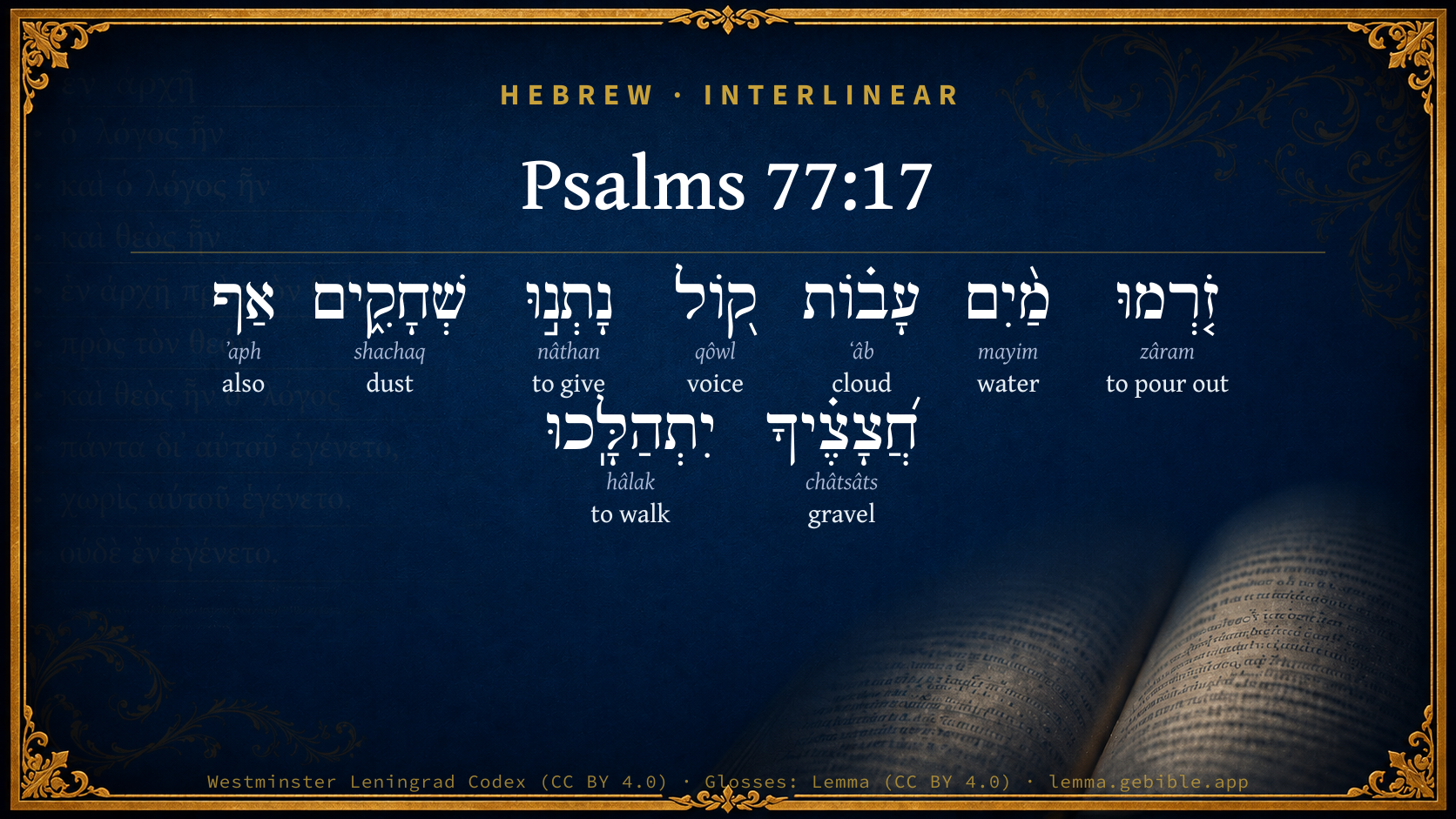
Psalms 77:17

Hebrew (Westminster Leningrad Codex) Psalms 77:17 appears in the Hebrew Old Testament. The text above is from the Westminster Leningrad Codex. Each word links to its Strong’s number, a concise gloss, and parsing drawn from the Open Scriptures Hebrew Bible morphology. Click any word for its full Brown-Driver-Briggs (BDB) entry.
Download image
Cite this verse

Psalms 77:17 (World English Bible). Public Domain. Lemma interlinear Bible study tool, https://lemma.gebible.app/v/psalms/77/17.

Show BibTeX & RIS
BibTeX
RIS
English Translation
The clouds poured out water. The skies resounded with thunder. Your arrows also flashed around.
World English Bible · Public Domain
Highlights
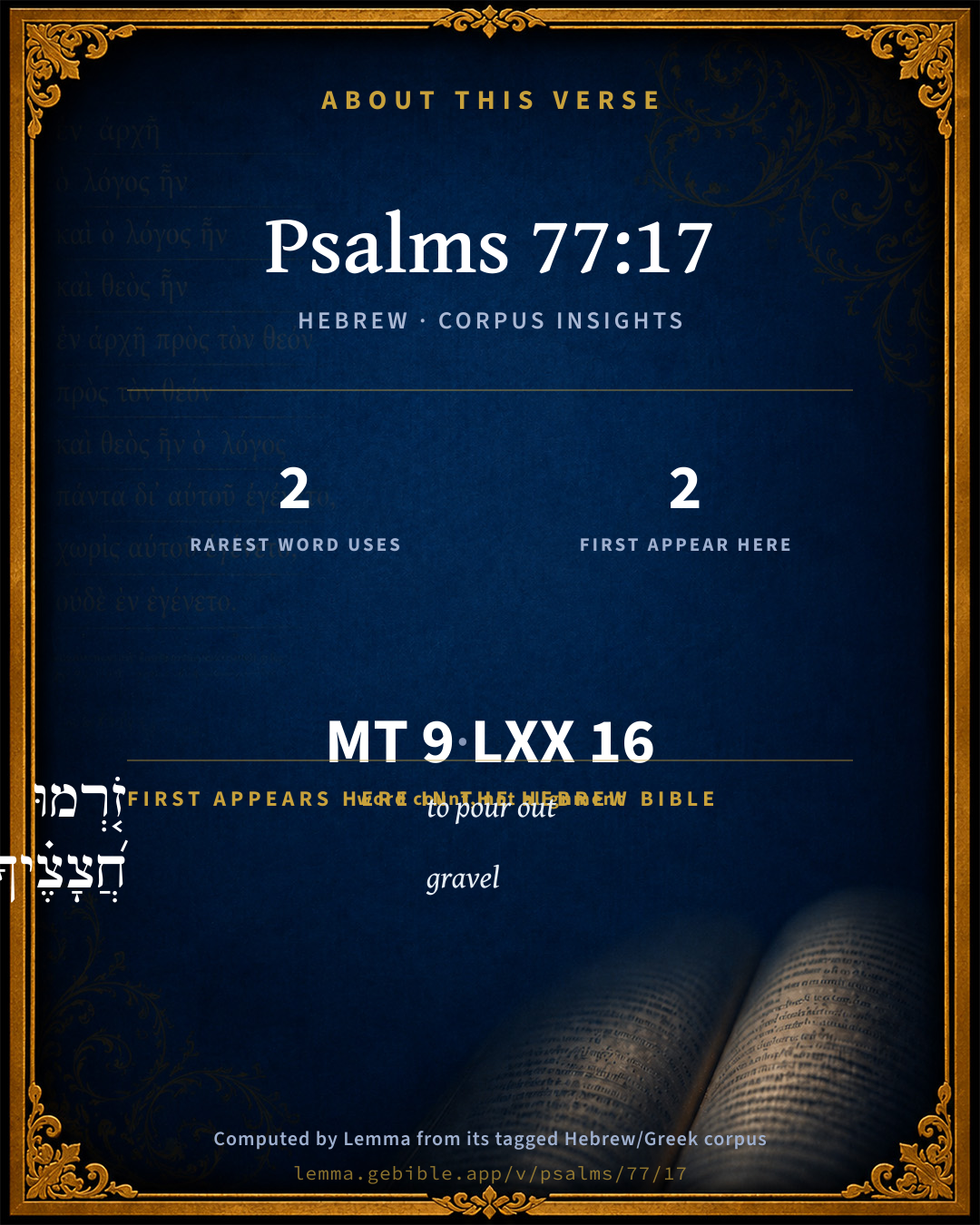
  • 2 first appearances in the Hebrew Bible
Full analysis ↓
Download a study sheet

One document with this verse’s original text, its word-by-word gloss line, the meaning frame, cross-references with their text, attributed commentary, and full source and license credits — printable, and it pastes into notes with its structure intact.

This verse Autodidact and up

Study sheet (.html) Plain text (.txt)

A passage Seminary Student

Up to 50 verses in one chapter. A passage sheet keeps up to 6 commentary sources and 12 cross-references per verse, in the order this page ranks them, and says so on the sheet whenever that leaves anything out. Ask for a single verse and you get the Autodidact verse sheet above.

Everything on this page stays free to read, with no account — the sheet is a download of what is already on screen, not access to it.

Want to remove ads? Support Godless Engineer
Compare translations 3

The same verse in 3 English versions, stacked beneath the original-language interlinear above. Click any original word for its lexicon entry.

Each is an independent rendering of the whole verse — the interlinear is not word-aligned to these translations.

Highlighted words mark where these versions differ — a whole-verse word diff, not a word-by-word alignment.

  • World English Bible Public Domain
    The clouds poured out water. The skies resounded with thunder. Your arrows also flashed around.
  • King James Version Public Domain
    The clouds poured out water: the skies sent out a sound: thine arrows also went abroad.
  • unfoldingWord Literal Text CC BY-SA 4.0
    The clouds poured down water; the skies gave a sound; your arrows also flew about.

unfoldingWord Literal Text — © unfoldingWord, licensed CC BY-SA 4.0. Word-aligned USFM3 via Door43 (git.door43.org/unfoldingWord/en_ult).

Versions to compare (up to 4)

3 of 4 selected

Show all 18 translations

Every available English version of this verse, each an independent rendering of the whole verse.

  • World English Bible Public Domain
    The clouds poured out water. The skies resounded with thunder. Your arrows also flashed around.
  • Berean Standard Bible Public Domain
    The clouds poured down water; the skies resounded with thunder; Your arrows flashed back and forth.
  • Majority Standard Bible Public Domain
    The clouds poured down water; the skies resounded with thunder; Your arrows flashed back and forth.
  • King James Version Public Domain
    The clouds poured out water: the skies sent out a sound: thine arrows also went abroad.
  • American Standard Version (1901) Public Domain
    The clouds poured out water; The skies sent out a sound: Thine arrows also went abroad.
  • Revised Version (1885) Public Domain
    The clouds poured out water; the skies sent out a sound: thine arrows also went abroad.
  • Geneva Bible (1599) Public Domain
    The cloudes powred out water: the heauens gaue a sounde: yea, thine arrowes went abroade.
  • Douay-Rheims (1899) Public Domain
    The waters saw thee, O God, the waters saw thee: and they were afraid, and the depths were troubled.
  • Young's Literal Translation Public Domain
    Poured out waters have thick clouds, The skies have given forth a noise, Also -- Thine arrows go up and down.
  • Literal Standard Version CC BY-SA 4.0
    Thick clouds have poured out waters, || The skies have given forth a noise, || Also—Your arrows go up and down.
  • Unlocked Literal Bible CC BY-SA 4.0
    The clouds poured down water; the cloudy skies gave voice; your arrows flew about.
  • unfoldingWord Literal Text CC BY-SA 4.0
    The clouds poured down water; the skies gave a sound; your arrows also flew about.
  • Darby Bible Public Domain
    The thick clouds poured out water; the skies sent out a sound, yea, thine arrows went abroad:
  • World Messianic Bible Public Domain
    The clouds poured out water. The skies resounded with thunder. Your arrows also flashed around.
  • Webster's Bible Public Domain
    \\77:16\\The waters saw thee, O God, the waters saw thee; they were afraid: the depths also were disturbed.
  • Free Bible Version CC BY-SA 4.0
    The clouds poured rain down; the skies crashed with thunder; your lightning flew like arrows.
  • Bible in Basic English Public Domain
    The clouds sent out water; the skies gave out a sound; truly, your arrows went far and wide.
  • JPS Tanakh (1917) Public Domain
    (77-18) The clouds flooded forth waters; the skies sent out a sound; Thine arrows also went abroad.

Literal Standard Version (2020), Covenant Press — licensed CC BY-SA 4.0. Text via the HelloAO Bible API (eBible.org). Unlocked Literal Bible (unfoldingWord) — licensed CC BY-SA 4.0. Text via the HelloAO Bible API (eBible.org). unfoldingWord Literal Text — © unfoldingWord, licensed CC BY-SA 4.0. Word-aligned USFM3 via Door43 (git.door43.org/unfoldingWord/en_ult). Free Bible Version, Dr. Jonathan Gallagher — licensed CC BY-SA 4.0. Text via the HelloAO Bible API (eBible.org).

Word by word

More ways to search: Search by grammar → Find every occurrence → Compare this word →

Practice this passage: Drill this verse → Learn its vocabulary →

About this verse

These counts appear in no published source. They are computed here, from the morphology-tagged text and Lemma’s own curated glosses. What Lemma adds →

9
words
9
distinct lemmas
Wisdom
section

Notable vocabulary

The rarest word here is זֹ֤רְמוּ to pour out H2229 — appearing just 2 times in the whole Hebrew Bible.

First appearance in Scripture

These words make their first canonical appearance in the Hebrew Bible here:

  • זֹ֤רְמוּ to pour out H2229
  • חֲ֝צָצֶ֗יךָ gravel H2687

Shared distinctive vocabulary

זֹ֤רְמוּ to pour out H2229 occurs in 2 verses of the Hebrew Bible. Also found in:

Grammatical profile

  • 3 verbs
  • 5 nouns
  • 1 particle

Verb forms

  • זֹ֤רְמוּ Poel · Perfect
  • נָתְנ֣וּ Qal · Perfect
  • יִתְהַלָּֽכוּ Hithpael · Imperfect

Hebrew & Septuagint length

In English translation the verse runs 15 words from the Hebrew and 17 from the Septuagint (LXX English) — closely comparable.

A rough comparison of the two English renderings, which tokenize alike — not a word-level alignment.

Word counts can differ between the Hebrew and the Greek without any difference in meaning — e.g. the Hebrew direct-object marker אֵת has no separate Greek word, and Greek often adds the article ὁ.

In the original languages it is 9 Hebrew tokens and 16 Greek tokens — but the two are counted differently (Hebrew bundles its prefixes and suffixes into one token; the Greek is in lemma form), so that isn’t a like-for-like length.

Cross-references

7

Topical passages linked to Psalms 77:17 in the Treasury of Scripture Knowledge — connected by theme and wording, ordered by reader-vote popularity; previews shown in the World English Bible.

  • Psalms 18:14 He sent out his arrows, and scattered them; Yes, great lightning bolts, and routed them.
  • Judges 5:4 Yahweh, when you went forth out of Seir, When you marched out of the field of Edom, The earth trembled, the sky also dropped, Yes, the clouds dropped water.
  • 2 Samuel 22:15 He sent out arrows, and scattered them; Lightning, and confused them.
  • Psalms 68:8–9 The earth trembled. The sky also poured down rain at the presence of the God of Sinai-- At the presence of God, the God of Israel.
  • Psalms 68:33 To him who rides on the heaven of heavens, which are of old; Behold, he utters his voice, a mighty voice.
  • Psalms 144:6 Throw out lightning, and scatter them. Send out your arrows, and rout them.
  • Habakkuk 3:11 The sun and moon stood still in the sky, At the light of your arrows as they went, At the shining of your glittering spear.

Cross-references courtesy of OpenBible.info (CC BY 4.0).

Hebrew and Greek witnesses Masoretic Hebrew ↔ Greek Septuagint

The same verse in the two great witnesses to the Old Testament, shown verse-for-verse.

You’re reading Greek Psalm 76 (Hebrew Psalm 77). The Septuagint counts the superscription, so verse numbers can differ from the Hebrew — chapter-level alignment, not verse-by-verse. Numbering follows Rahlfs.

These are two independent witnesses, not word-aligned to each other, and the Septuagint is shown in lemma (dictionary) form.

Hebrew Psalms 77:17 Masoretic · Westminster Leningrad Codex

זֹ֤רְמוּ מַ֨יִם עָב֗וֹת ק֭וֹל נָתְנ֣וּ שְׁחָקִ֑ים אַף חֲ֝צָצֶ֗יךָ יִתְהַלָּֽכוּ

The clouds poured out water. The skies resounded with thunder. Your arrows also flashed around.

World English Bible · Public Domain

Greek LXX Greek Psalm 76:17 Septuagint · lemma form

ὁράω σύ ὕδωρ ὁ θεός ὁράω σύ ὕδωρ καί φοβέω καί ταράσσω ἄβυσσος πλῆθος ἦχος ὕδωρ

There was an abundant sound of waters: the clouds uttered a voice; for your arrows went abroad.

LXX2012 (modern English Septuagint) · Public Domain

Hebrew: Westminster Leningrad Codex (CC BY 4.0). Greek: Septuagint (public domain); English from LXX2012 (modern English Septuagint) (Public Domain). How the Septuagint differs from the Hebrew →

Commentary

Notes on Psalms 77:17 from classic Christian and Jewish commentators (each source and its license shown beneath its notes). The classic Christian expositions comment on the surrounding passage and are grouped to its opening verse, so a note may address several verses; the Jewish commentaries on the Tanakh (Rashi and others) are per-verse, so they appear only where the commentator wrote on this verse.

Lemma curates 59 commentaries, every one of them public domain or Creative Commons licensed, each selected and text-cleaned for this edition rather than reprinted as found. About our sources →

Trapp's Complete Commentary

John Trapp

Psa 77:17 The clouds poured out water: the skies sent out a sound: thine arrows also went abroad.

Ver. 17. The clouds poured out water, the skies, &c.] Calvin taketh this to be a description of that hideous tempest, Exo 9:18-26, the seventh plague of Egypt. But others with more probability hold, that the prophet here hath respect to that very time mentioned in the former verse, when the Lord looked upon the host of the Egyptians out of the fiery and cloudy pillar, and so troubled and turmoiled them with stormy tempests, that their chariot wheels fell off, and themselves sank as lead in the mighty waters, Exo 14:24-25; Exo 15:10. Of these terrible tempests mention is made also by Justin.

John Trapp, A Commentary or Exposition upon All the Books of the Old and New Testament (1647–1656) — public domain. Text from a community e-Sword module.

Geneva Bible (1599)

Geneva Bible translators

That is, thundered and lightninged.

Geneva Bible (1599) marginal notes — public domain. Text via Bolls.life.

Adam Clarke's Commentary

Verse 17. The clouds poured out water] It appears from this that there was a violent tempest at the time of the passage of the Red Sea. There was a violent storm of thunder, lightning, and rain. These three things are distinctly marked here.

1. "The skies sent out a sound:" the THUNDER.

2. "Thine arrows went abroad:" the LIGHTNING.

3. "The clouds poured out water:" the RAIN. In the next verse we have,

4. An EARTHQUAKE: "The earth trembled and shook," Ps 77:18.

Adam Clarke's Commentary on the Bible (1810–1826) — public domain. Text from a community e-Sword/MySword module.

John Calvin's Commentaries

17. The clouds poured out waters. As the noun מים, mayim, cannot be taken in the construct state, the verb, I have no doubt, is put transitively; but it makes little difference as to the sense, whether we take this view, or read as if מים, mayim, were in the construct state and the verb passive; that is, whether we read, The clouds poured out waters, or, The waters of the clouds were poured out. The meaning obviously is, that not only the sea and the river Jordan, but also the waters which were suspended in the clouds, yielded to God the honor to which he is entitled, the air, by the concussion of the thunder, having poured forth copious showers. The object is to show, that, to whatever quarter men turn their eyes, the glory of God is illustriously manifested, that it is so in every part of creation, above and beneath, from the height of heaven to the depths of the sea. What history is here referred to is involved in some degree of uncertainty. Perhaps it is that which is recorded in Exodus 9:23; where we are informed, that hail mingled with thunder and lightning was one of the dreadful plagues inflicted upon the Egyptians. The arrows which went abroad are, no doubt, to be taken metaphorically for lightnings. With this verse we are to connect the following, in which it is said, that the voice of the thunder was heard in the air, and that the lightnings illumined the world, so that the earth trembled The amount is, that at the departure of the people from Egypt, ample testimony was borne to the power of God, both to the eyes and the ears of men; peals of thunder having been heard in every quarter of the heavens, and the whole sky having shone with flashes of lightning, while at the same time the earth was made to tremble.

John Calvin's Commentaries (1540-1563) — public domain. Text from the Calvin Translation Society English edition (1840s-50s) via the Christian Classics Ethereal Library (ccel.org). Calvin's coverage is partial (roughly two-thirds of the Bible); uncommented books and verses are honest gaps, never fabricated. The 19th-century editor's footnotes and remarks are omitted so the notes are faithfully Calvin's own voice.

The Cambridge Bible for Schools and Colleges

gen. ed. J. J. S. Perowne

17. God came in storm and earthquake. So the poet develops the thought of Exo_14:24-25. Cp. Psa_18:7 ff; Psa_97:3 ff.; and the parallel passage in Hab_3:10-11, where tempest (R.V.) is the cognate substantive to the verb rendered poured out here.

sent out a sound] Better (cp. Hab.), uttered a voice, i.e. thundered. God’s arrows are the flashes of lightning.

The Cambridge Bible for Schools and Colleges (gen. ed. J. J. S. Perowne; Cambridge University Press, 1878–1918) — public domain. Text from a community e-Sword module.

John Gill's Exposition

The clouds poured out water,.... This, with some other circumstances which follow, are not related by Moses in the history of this affair; but as they are here recorded by an inspired penman, there is no doubt to be made of the truth of them; besides Josephus (a) relates the same things; he says, that at the time when the Egyptians were drowned in the Red sea, rains descended from heaven, and there were terrible thunders, lightnings, and thunderbolts; this was when the Lord looked through the cloud, and troubled the host of the Egyptians, Exo 14:24,

the skies sent out a sound; or the airy clouds, the lighter ones, and which were higher in the heavens, as the others before mentioned were thick clouds, full of water, and hung lower; these were thunderclouds, and thunder is the sound which they sent forth, as in the following verse:

thine arrows also went abroad: that is, lightnings, as in Psa 18:14, so Aben Ezra; but Kimchi interprets them of hailstones.

(a) Antiqu. l. 2. c. 16. sect. 3.

John Gill's Exposition of the Whole Bible (1746–1763) — public domain (CC PDM 1.0). Text via the HelloAO Bible API.

Albert Barnes' Notes on the Bible

The clouds poured out water - Margin, “The clouds were poured forth with water.” The translation in the text is the more correct. This is a description of a storm; but to what particular storm in history does not appear. It was evidently some exhibition of the divine greatness and power in delivering the children of Israel, and may have referred to the extraordinary manifestation of God at Mount Sinai, amidst lightnings, and thunders, and tempests. Exo 19:16. For a general description of a storm, as illustrating this passage, see Job 36:26-33, notes; Job 37:1-5, notes; and Psa 29:1-11.

The skies sent out a sound - The voice of thunder, which seems to come from the sky.

Thine arrows also - The lightnings - compared with burning or ignited arrows. Such arrows were anciently used in war. They were bound round with rags, and dipped in some combustible substance - as turpentine - and shot into houses, grain-fields, haystacks, or towns, for the purpose of setting them on fire. It was not unnatural to compare the rapid lightnings with such blazing arrows.

Went abroad - They moved rapidly in all directions.

Albert Barnes' Notes on the Bible (1834–1885) — public domain. Text from a community e-Sword/MySword module.

Matthew Poole's English Annotations

The clouds poured out water, when the Israelites passed over the sea; in respect whereof the Israelites are said to have been baptized in the cloud (i.e. sprinkled with water poured forth from the clouds) and in the sea, 1Co 10:2.

Thine arrows; either hail-stones, or rather lightnings or thunder-bolts, which are called Gods arrows, Psa 18:14; 144:6.

Matthew Poole's English Annotations on the Holy Bible (1683–1685) — public domain. Text from a community e-Sword/MySword module.

The Treasury of David

Charles H. Spurgeon

Ver. 17. The clouds poured out water. Obedient to the Lord, the lower region of the atmosphere yielded its aid to overthrow the Egyptian host. The cloudy chariots of heaven hurried forward to discharge their floods.

The skies sent out a sound. From the loftier aerial regions thundered the dread artillery of the Lord of Hosts. Peal on peal the skies sounded over the heads of the routed enemies, confusing their minds and adding to their horror.

Thine arrows also went abroad. Lightnings flew like bolts from the bow of God. Swiftly, hither and thither, went the red tongues of flame, on helm and shield they gleamed; anon with blue bale fires revealing the innermost caverns of the hungry sea which waited to swallow up the pride of Mizraim. Behold, how all the creatures wait upon their God, and show themselves strong to overthrow his enemies.

Whole Psalm. See Psalms on "Ps 77:1" for further information.

Charles H. Spurgeon's The Treasury of David (1869–1885) — public domain. Psalms only. Text from a community e-Sword/MySword module.

Whedon's Commentary on the Bible

Daniel D. Whedon

17. The clouds poured out water—The rain refers to the desert life of the people, not to the passage of the Red Sea, which was not in a thunderstorm. Psa_68:7-9, where see note.

A sound—Thunder.

Arrows—Lightnings. A beautiful poetic conception. Psa_77:18; Hab_3:11; Psa_18:14

Daniel D. Whedon (gen. ed.), Commentary on the Old and New Testaments (1874–1909) — public domain. Text from a community e-Sword module.

The Pulpit Commentary

The clouds poured out water. The description here becomes more poetical than historical, unless, indeed, we may suppose that the writer possessed, besides what is said in Exodus, some traditional account of the passage. The skies sent out a sound; or, "uttered a voice the voice of the thunder, beyond a doubt (compare next verse). Thine arrows also went abroad; i.e. lightnings darted hither and thither. (see Psa_18:14 2Sa_22:15)

The Pulpit Commentary (1880–1919), ed. H.D.M. Spence-Jones & Joseph S. Exell — public domain. Text from a community e-Sword module.

John Wesley's Explanatory Notes

Poured - When the Israelites passed over the sea. Arrows - Hail-stones or lightnings.

John Wesley, Explanatory Notes Upon the Whole Bible (1754–1765) — public domain. Text via the GEBible commentary corpus.

Rashi

Rabbi Shlomo Yitzchaki (Rashi)

The waters perceived You [The] mighty [waters perceived You] when You were revealed by the sea.

Rashi on the Tanakh — English translations: “The Judaica Press complete Tanach with Rashi, translated by A. J. Rosenberg” (CC BY 4.0); “Pentateuch with Rashi's commentary by M. Rosenbaum and A.M. Silbermann, 1929-1934” (public domain); “The Metsudah Tanach series, Lakewood, N.J” (CC BY 4.0); and “The Book of Joshua, Metsudah Publications, 1997” (CC BY 4.0). Text via Sefaria.

Lesson kit

Teaching starters — assembled from the data on this page, not authored interpretation. Every prompt links to the verse data it draws on. Edit before teaching.

Psalms, in the Wisdom, opens this verse with 9 words (9 distinct Hebrew lemmas). Its most distinctive word is zâram (“to pour out”). A historical commentator’s framing appears above. Read the whole chapter for the surrounding context.

Discussion questions

  1. What does “to pour out” (zâram) contribute to the verse as a whole?
  2. 2 words here appear for the first time in Scripture. What is being introduced at this debut?
  3. Psalms 90:5 shares the word «to pour out» with this verse. How do the two illuminate each other?
  4. These translations render this verse differently; the difference is in the English rendering, not the original. What questions does that raise?
  5. The verb «זֹ֤רְמוּ» is Poel Perfect. How does its form color the action?
  6. Reading how Trapp's Complete Commentary and Geneva Bible (1599) read this verse, where do the two commentators agree and where do they part?

Things to notice

Reading settings

Reading text

Shown beneath each verse's original-language words.

Old Testament
Old Testament edition

Read the OT as the Masoretic Hebrew (MT) or the Greek Septuagint (LXX).

English shown for the Greek Septuagint (in the Hebrew ↔ Greek comparison).

Comparing translations? Open the Compare panel on any verse page to stack up to four side by side.