
Psalms 119:3

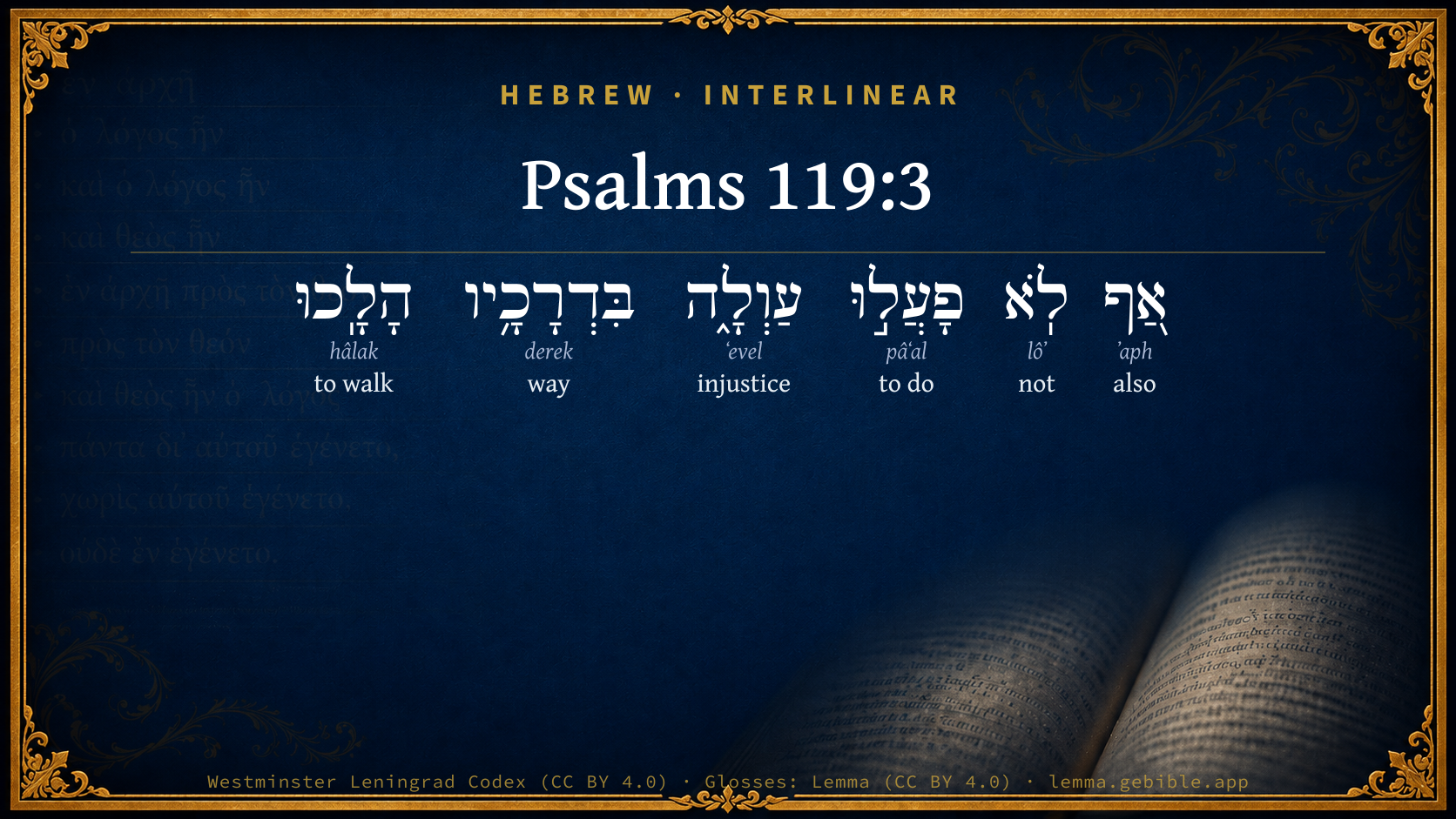
Hebrew (Westminster Leningrad Codex) Psalms 119:3 appears in the Hebrew Old Testament. The text above is from the Westminster Leningrad Codex. Each word links to its Strong’s number, a concise gloss, and parsing drawn from the Open Scriptures Hebrew Bible morphology. Click any word for its full Brown-Driver-Briggs (BDB) entry.
Download image
Cite this verse

Psalms 119:3 (World English Bible). Public Domain. Lemma interlinear Bible study tool, https://lemma.gebible.app/v/psalms/119/3.

Show BibTeX & RIS
BibTeX
RIS
English Translation
Yes, they do nothing wrong. They walk in his ways.
World English Bible · Public Domain
Download a study sheet

One document with this verse’s original text, its word-by-word gloss line, the meaning frame, cross-references with their text, attributed commentary, and full source and license credits — printable, and it pastes into notes with its structure intact.

This verse Autodidact and up

Study sheet (.html) Plain text (.txt)

A passage Seminary Student

Up to 50 verses in one chapter. A passage sheet keeps up to 6 commentary sources and 12 cross-references per verse, in the order this page ranks them, and says so on the sheet whenever that leaves anything out. Ask for a single verse and you get the Autodidact verse sheet above.

Everything on this page stays free to read, with no account — the sheet is a download of what is already on screen, not access to it.

Want to remove ads? Support Godless Engineer
Compare translations 3

The same verse in 3 English versions, stacked beneath the original-language interlinear above. Click any original word for its lexicon entry.

Each is an independent rendering of the whole verse — the interlinear is not word-aligned to these translations.

Highlighted words mark where these versions differ — a whole-verse word diff, not a word-by-word alignment.

  • World English Bible Public Domain
    Yes, they do nothing wrong. They walk in his ways.
  • King James Version Public Domain
    They also do no iniquity: they walk in his ways.
  • unfoldingWord Literal Text CC BY-SA 4.0
    Surely they do not practice injustice; they walk in his ways.

unfoldingWord Literal Text — © unfoldingWord, licensed CC BY-SA 4.0. Word-aligned USFM3 via Door43 (git.door43.org/unfoldingWord/en_ult).

Versions to compare (up to 4)

3 of 4 selected

Show all 17 translations

Every available English version of this verse, each an independent rendering of the whole verse.

  • World English Bible Public Domain
    Yes, they do nothing wrong. They walk in his ways.
  • Berean Standard Bible Public Domain
    They do no iniquity; they walk in His ways.
  • Majority Standard Bible Public Domain
    They do no iniquity; they walk in His ways.
  • King James Version Public Domain
    They also do no iniquity: they walk in his ways.
  • American Standard Version (1901) Public Domain
    Yea, they do no unrighteousness; They walk in his ways.
  • Revised Version (1885) Public Domain
    Yea, they do no unrighteousness; they walk in his ways.
  • Geneva Bible (1599) Public Domain
    Surely they woorke none iniquitie, but walke in his waies.
  • Young's Literal Translation Public Domain
    Yea, they have not done iniquity, In His ways they have walked.
  • Literal Standard Version CC BY-SA 4.0
    Indeed, they have not done iniquity, || They have walked in His ways.
  • Unlocked Literal Bible CC BY-SA 4.0
    They do no wrong; they walk in his ways.
  • unfoldingWord Literal Text CC BY-SA 4.0
    Surely they do not practice injustice; they walk in his ways.
  • Darby Bible Public Domain
    Who also do no unrighteousness: they walk in his ways.
  • World Messianic Bible Public Domain
    Yes, they do nothing wrong. They walk in his ways.
  • Webster's Bible Public Domain
    They also do no iniquity: they walk in his ways.
  • Free Bible Version CC BY-SA 4.0
    They don't do what's wrong; they walk in his ways.
  • Bible in Basic English Public Domain
    They do no evil; they go in his ways.
  • JPS Tanakh (1917) Public Domain
    Yea, they do no unrighteousness; they walk in His ways.

Literal Standard Version (2020), Covenant Press — licensed CC BY-SA 4.0. Text via the HelloAO Bible API (eBible.org). Unlocked Literal Bible (unfoldingWord) — licensed CC BY-SA 4.0. Text via the HelloAO Bible API (eBible.org). unfoldingWord Literal Text — © unfoldingWord, licensed CC BY-SA 4.0. Word-aligned USFM3 via Door43 (git.door43.org/unfoldingWord/en_ult). Free Bible Version, Dr. Jonathan Gallagher — licensed CC BY-SA 4.0. Text via the HelloAO Bible API (eBible.org).

Word by word

More ways to search: Search by grammar → Find every occurrence → Compare this word →

Practice this passage: Drill this verse → Learn its vocabulary →

About this verse

These counts appear in no published source. They are computed here, from the morphology-tagged text and Lemma’s own curated glosses. What Lemma adds →

6
words
6
distinct lemmas
Wisdom
section

Shared distinctive vocabulary

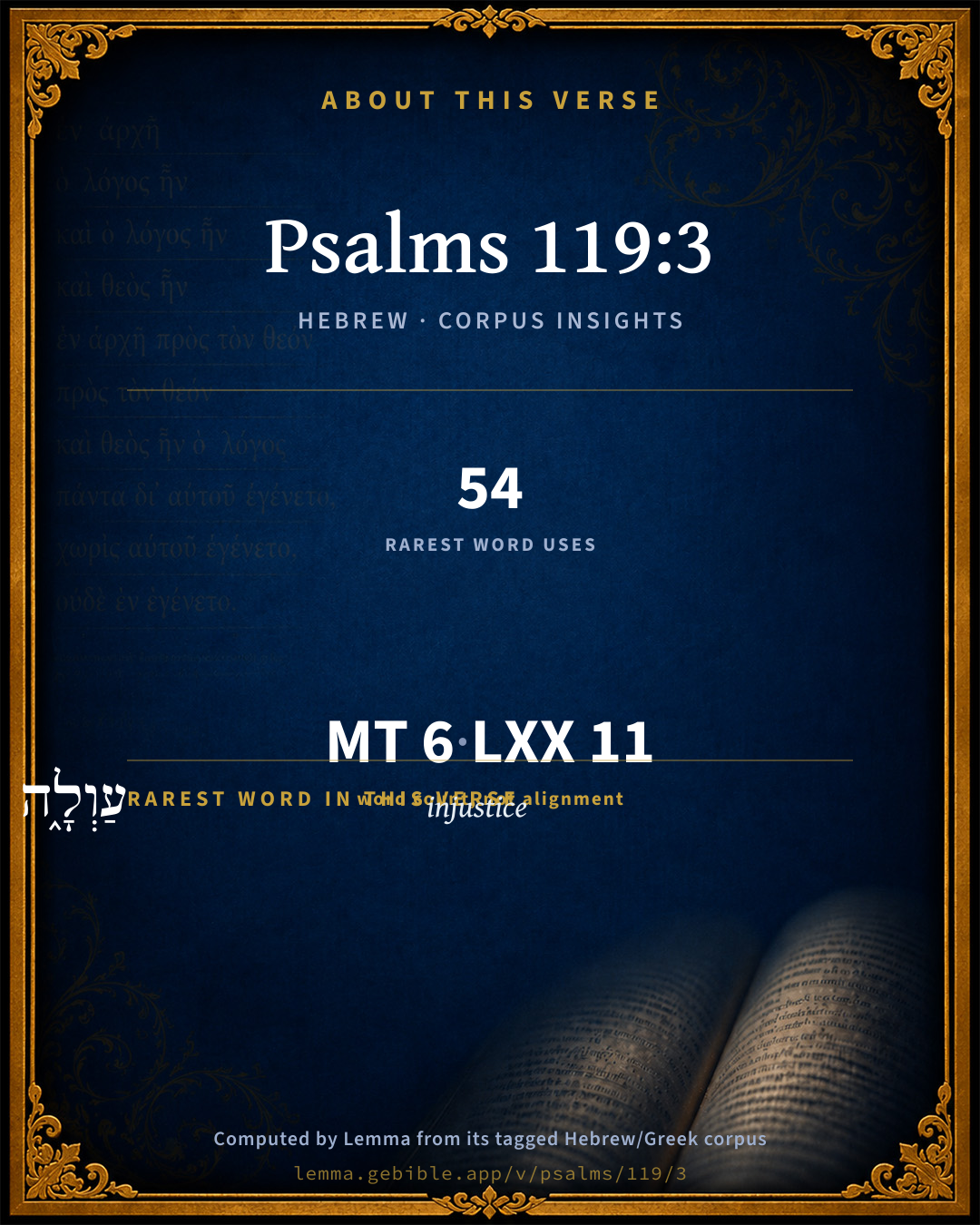
עַוְלָ֑ה injustice H5766 occurs in 51 verses of the Hebrew Bible. Also found in:

Grammatical profile

  • 2 verbs
  • 2 nouns
  • 2 particles

Verb forms

  • פָעֲל֣וּ Qal · Perfect
  • הָלָֽכוּ Qal · Perfect

Hebrew & Septuagint length

In English translation the verse runs 10 words from the Hebrew and 11 from the Septuagint (LXX English) — closely comparable.

A rough comparison of the two English renderings, which tokenize alike — not a word-level alignment.

Word counts can differ between the Hebrew and the Greek without any difference in meaning — e.g. the Hebrew direct-object marker אֵת has no separate Greek word, and Greek often adds the article ὁ.

In the original languages it is 6 Hebrew tokens and 11 Greek tokens — but the two are counted differently (Hebrew bundles its prefixes and suffixes into one token; the Greek is in lemma form), so that isn’t a like-for-like length.

Cross-references

2

Topical passages linked to Psalms 119:3 in the Treasury of Scripture Knowledge — connected by theme and wording, ordered by reader-vote popularity; previews shown in the World English Bible.

  • 1 John 5:18 We know that whoever is born of God doesn't sin, but he who was born of God keeps himself, and the evil one doesn't touch him.
  • 1 John 3:9 Whoever is born of God doesn't commit sin, because his seed remains in him; and he can't sin, because he is born of God.

Cross-references courtesy of OpenBible.info (CC BY 4.0).

Hebrew and Greek witnesses Masoretic Hebrew ↔ Greek Septuagint

The same verse in the two great witnesses to the Old Testament, shown verse-for-verse.

You’re reading Greek Psalm 118 (Hebrew Psalm 119). The Septuagint counts the superscription, so verse numbers can differ from the Hebrew — chapter-level alignment, not verse-by-verse. Numbering follows Rahlfs.

These are two independent witnesses, not word-aligned to each other, and the Septuagint is shown in lemma (dictionary) form.

Hebrew Psalms 119:3 Masoretic · Westminster Leningrad Codex

אַ֭ף לֹֽא פָעֲל֣וּ עַוְלָ֑ה בִּדְרָכָ֥יו הָלָֽכוּ

Yes, they do nothing wrong. They walk in his ways.

World English Bible · Public Domain

Greek LXX Greek Psalm 118:3 Septuagint · lemma form

οὐ γάρ ὁ ἐργάζομαι ὁ ἀνομία ἐν ὁ ὁδός αὐτός πορεύομαι

For they that work iniquity have not walked in his ways.

LXX2012 (modern English Septuagint) · Public Domain

On this verse, The Cambridge Bible for Schools and Colleges discusses the Septuagint’s reading. Read the note in Commentary ↓

Hebrew: Westminster Leningrad Codex (CC BY 4.0). Greek: Septuagint (public domain); English from LXX2012 (modern English Septuagint) (Public Domain). How the Septuagint differs from the Hebrew →

Commentary

Notes on Psalms 119:3 from classic Christian and Jewish commentators (each source and its license shown beneath its notes). The classic Christian expositions comment on the surrounding passage and are grouped to its opening verse, so a note may address several verses; the Jewish commentaries on the Tanakh (Rashi and others) are per-verse, so they appear only where the commentator wrote on this verse.

Lemma curates 59 commentaries, every one of them public domain or Creative Commons licensed, each selected and text-cleaned for this edition rather than reprinted as found. About our sources →

Trapp's Complete Commentary

John Trapp

Psa 119:3 They also do no iniquity: they walk in his ways.

Ver. 3. They also do no iniqaity] i.e. No wilful wickedness; as do those workers of iniquity, whose whole trade it is, and whose whole life is nothing else but one continued web of wickedness, spun out and made up by the hands of the devil and the flesh, an evil spinner, and a worse weaver.

They walk in his ways] Without cessation or cespitation.

John Trapp, A Commentary or Exposition upon All the Books of the Old and New Testament (1647–1656) — public domain. Text from a community e-Sword module.

J. A. Alexander on Psalms

Joseph Addison Alexander

3. (Psa 119:3) (Who) also do not practise wrong, (but) in his ways walk. This verse both limits and completes the one before it, by shewing that no zeal in seeking God can be acceptable, if coupled with a wicked life. In his ways, not in those of his enemies, nor even in their own.

Joseph Addison Alexander, The Psalms Translated and Explained (1850) — public domain. Text from a community e-Sword module.

Geneva Bible (1599)

Geneva Bible translators

For they are ruled by God’s Spirit and embrace no doctrine but his.

Geneva Bible (1599) marginal notes — public domain. Text via Bolls.life.

Adam Clarke's Commentary

Verse 3. They also do no iniquity] They avoid all idolatry, injustice, and wrong; and they walk in God's ways, not in those ways to which an evil heart might entice them, nor those in which the thoughtless and the profligate tread.

Adam Clarke's Commentary on the Bible (1810–1826) — public domain. Text from a community e-Sword/MySword module.

John Calvin's Commentaries

3. Surely they do not work iniquity The statement, that they who follow God as their guide do not work iniquity, may seem to be a mere common-place, and universally admitted truth. The prophet has two reasons for making it; first, to teach us that our life must be entirely under the direction of God; and, secondly, that we may more diligently and carefully attend to his doctrine. It is acknowledged by every one, that those who render obedience to God are in no danger of going astray, and yet every one is found turning aside to his own ways. Does not such licentiousness or presumption palpably demonstrate that they have a greater regard for their own devices than for the unerring law of God? And after all, as often as a man happens to fall, is not the plea of inadvertence instantly alleged, as if none ever sinned knowingly and voluntarily; or as if the law of God, which is an antidote to all delinquencies, because it keeps all our vicious propensities in check, did not furnish us with sufficient wisdom to put us upon our guard? The prophet, therefore, very justly declares, that those who are instructed in the law of God, cannot set up the plea of ignorance when they fall into sin, seeing they are willfully blind. Were they to attend carefully to God’s voice, they would be well fortified against all the snares of Satan. To strike them with terror, he informs them in the fourth verse, that God demands a rigid observance of the law; from which it may be gathered, that he will not suffer the contemners of it to escape with impunity. Besides, by speaking to God in the second person, he places him before our eyes as a Judge.

John Calvin's Commentaries (1540-1563) — public domain. Text from the Calvin Translation Society English edition (1840s-50s) via the Christian Classics Ethereal Library (ccel.org). Calvin's coverage is partial (roughly two-thirds of the Bible); uncommented books and verses are honest gaps, never fabricated. The 19th-century editor's footnotes and remarks are omitted so the notes are faithfully Calvin's own voice.

The Cambridge Bible for Schools and Colleges

gen. ed. J. J. S. Perowne

3. ’Imrâh, ‘saying,’ or collectively ‘sayings,’ LXX λόγιον (19 times), is a poetical synonym for dâbâr, rare in prose, but found in Isa_5:24 in parallelism with tôrâh. Cp. Deu_33:9.

3. This verse is to be connected with the preceding one:

Yea, have wrought no unrighteousness,

Have walked in his ways.

The Cambridge Bible for Schools and Colleges (gen. ed. J. J. S. Perowne; Cambridge University Press, 1878–1918) — public domain. Text from a community e-Sword module.

John Gill's Exposition

They also do no iniquity,.... Not that they are free from indwelling sin, nor from the acts of sin, nor that what they do are not sins; but they do not make a trade of sinning, it is not the course of their lives; nor do they do iniquity with that ease and pleasure, without reluctance and remorse, as others do: or rather as new creatures, as born again, they do not and cannot commit sin; for the new man is pure, spiritual, and holy; and nothing can come out of that, or be done by it, which is the contrary. This is a distinct I from the old man, or corrupt nature, to which all the actions of sin are to be ascribed; see Jo1 3:9;

they walk in his ways; in the ways of God and Christ, into which they are guided and directed, and where they are kept, and in which they find both pleasure and profit. Here end the descriptive characters of good and happy men.

John Gill's Exposition of the Whole Bible (1746–1763) — public domain (CC PDM 1.0). Text via the HelloAO Bible API.

Albert Barnes' Notes on the Bible

They also do no iniquity - See the notes at 1Jo 3:9. The meaning is, that they are righteous; their character is that they do that which is right. It cannot mean that all persons who are religious are actually and absolutely perfect - for no man would hold this opinion; no one does hold it. It is general language such as is commonly used to describe an upright or righteous man. The declaration is true of all who are the friends of God - or, who are truly; religious - in the following senses:

(1) That they are habitually and characteristically righteous;

(2) That they intend to do right - for a man who deliberately purposes to do wrong - to lead a life of sin and disobedience, cannot be a pious man.

(3) That when they do err, it is not the result of intention, or the design of their life, but because they are tempted; are overcome with passion; are led by the power of their native corruption of heart to act contrary to their better judgment and their true character.

See Rom 7:14-17. On the other hand, it is true that a man who is not characteristically righteous; who is not an upright man in his dealings; who is not true, and honest, and temperate, and just, and benevolent, cannot be a child of God and heir of heaven. No exactness of orthodoxy, and no fervour of emotion, and no zeal in the cause of religion, can constitute true piety without this.

They walk in his ways - Habitually; constantly; characteristically. They are not merely honest, upright, and just in their dealings with men, but they walk in the ways of God; they are religious.

Albert Barnes' Notes on the Bible (1834–1885) — public domain. Text from a community e-Sword/MySword module.

Matthew Poole's English Annotations

Do no iniquity; or, are not workers of iniquity, i.e. do not knowingly, and resolvedly, and industriously, and customarily continue in sinful courses. So this phrase is understood Job 31:3; 34:8; Psa 5:5; 6:8; 125:5; Pro 10:29; Luk 13:27; otherwise there is not a just man upon earth that sinneth not, Ecc 7:20.

They walk: this is their constant practice, and the general course of their lives, which is commonly signified by walking, as Psa 1:1, and every where.

In his ways; in the paths which God hath prescribed to them.

Matthew Poole's English Annotations on the Holy Bible (1683–1685) — public domain. Text from a community e-Sword/MySword module.

The Treasury of David

Charles H. Spurgeon

Ver. 3. They also do no iniquity. Blessed indeed would those men be of whom this could be asserted without reserve and without explanation: we shall have reached the region of pure blessedness when we altogether cease from sin. Those who follow the word of God do no iniquity, the rule is perfect, and if it be constantly followed no fault will arise. Life, to the outward observer, at any rate, lies much in doing, and he who in his doings never swerves from equity, both towards God and man, has hit upon the way of perfection, and we may be sure that his heart is right. See how a whole heart leads to the avoidance of evil, for the Psalmist says, "That seek him with the whole heart. They also do no iniquity." We fear that no man can claim to be absolutely without sin, and yet we trust there are many who do not designedly, wilfully, knowingly, and continuously do anything that is wicked, ungodly, or unjust. Grace keeps the life righteous as to act even when the Christian has to bemoan the transgressions of the heart. Judged as men should be judged by their fellows, according to such just rules as men make for men, the true people of God do no iniquity: they are honest, upright, and chaste, and touching justice and morality they are blameless. Therefore are they happy.

They walk in his ways. They attend not only to the great main highway of the law, but to the smaller paths of the particular precepts. As they will perpetrate no sin of commission, so do they labour to be free from every sin of omission. It is not enough to them to be blameless, they wish also to be actively righteous. A hermit may escape into solitude that he may do no iniquity, but a saint lives in society that he may serve his God by walking in his ways. We must be positively as well as negatively right: we shall not long keep the second unless we attend to the first, for men will be walking one way or another, and if they do not follow the path of God's law they will soon do iniquity. The surest way to abstain from evil is to be fully occupied in doing good. This verse describes believers as they exist among us: although they have their faults and infirmities, yet they hate evil, and will not permit themselves to do it; they love the ways of truth, right and true godliness, and habitually they walk therein. They do not claim to be absolutely perfect except in their desires, and there they are pure indeed, for they pant to be kept from all sin, and to be led into all holiness.

Ver. 3. They also do no iniquity. If it be demanded here, How is it that they who walk in God's ways work no iniquity? Is there any man who lives, and sins not? And if they be not without sin, how then are they to be blessed? The answer is, as the apostle says of our knowledge, "We know but in part": so is it true of our felicity on earth, we are blessed but in a part. It is the happiness of angels that they never sinned; it is the happiness of triumphant saints, that albeit they have been sinners, yet now they sin no more; but the happiness of saints militant is, that our sins are forgiven us; and that albeit sin remains in us, yet it reigns not over us; it is done in us, but not by our allowance: "I do the evil which I would not." "Not I, but sin that dwells in me, "Ro 7:17.

To the doing of iniquity, these three things must concur; first, a purpose to do it; next, a delight in doing it; thirdly, a continuance in it; which three in God's children never concur; for in sins done in them by the old man, the new man makes his exceptions and protestations against them. It is not I, says he; and so far is he from delighting in them, that rather his soul is grieved with them; even as Lot, dwelling among the Sodomites, was vexed by hearing and seeing their unrighteous deeds. In a word, the children of God are rather sufferers of sin against their wills than actors of it with their wills: like men spiritually oppressed by the power of their enemy; for which they sigh and cry unto God. "Miserable man that I am! who shall deliver me from the body of this death?" And in this sense it is that the apostle saith, "He who is born of God sinneth not" (1Jo 3:9). William Cowper.

Ver. 3. They also do no iniquity. The blessedness of those who walk in the law: they do or have done no wickedness: but walk or have always walked in his ways. Throughout the Psalm it may be noticed that sometimes the present tense is employed indicating present action: sometimes the perfect to indicate past and present time: Ps 119:10-11, 13-14, 21, 51-61, 101-102, 131, 145, 147. The Speaker's Commentary, 1873.

Ver. 3. They also do no iniquity. That is, they make not a trade and common practice thereof. Slip they do, through the infirmity of the flesh, and subtlety of Satan, and the allurements of the world; but they do not ordinarily and customably go forward in unlawful and sinful courses. In that the Psalmist setteth down this as a part (and not the least part neither) of blessedness, that they work none iniquity, which walk in his ways:the doctrine to be learned here is this, that it is a marvellous great prerogative to be freed from the bondage of sin. Richard Greenham.

Ver. 3. They do no iniquity. All such as are renewed by grace, and reconciled to God by Christ Jesus; to these God imputeth no sin to condemnation, and in his account they do no iniquity. Notable is that which is said of David, "He kept my commandments, and followed me with all his heart, and did that only which was right in mine eyes" (1Ki 14:8). How can that be? We may trace David by his failings, they are upon record everywhere in the word; yet here a veil is drawn upon them; God laid them not to his charge. There is a double reason why their failings are not laid to their charge. Partly, because of their general state, they are in Christ, taken into favour through him, and "there is no condemnation to them that are in Christ" (Ro 8:1), therefore particular errors and escapes do not alter their condition; which is not to be understood as if a man should not be humbled, and ask God pardon for his infirmities; no, for then they prove iniquities and they will lie upon record against him. It was a gross fancy of the Valentinians, who held that they were not defiled with sin, whatsoever they committed; though base and obscene persons, yet still they were as gold in the dirt. No, no, we are to recover ourselves by repentance, to sue out the favour of God. When David humbled himself, and had repented, then saith Nathan, "The Lord hath put away thy sin" (2Sa 12:13). Partly, too, because their bent and habitual inclination is to do otherwise. They set themselves to comply with God's will, to seek and serve the Lord, though they are clogged with many infirmities. A wicked man sinneth with deliberation and delight, his bent is to do evil, he makes "provision for lusts" (Ro 13:14), and "serves" them by a voluntary subjection (Tit 3:3). But those that are renewed by grace are not "debtors" to the flesh, they have taken another debt and obligation, which is to serve the Lord (Ro 8:12).

Partly, too, because their general course and way is to do otherwise. Everything works according to its form; the constant actions of nature are according to the kind. So the new creature, his constant operations are according to grace. A man is known by his custom, and the course of his endeavours shows what is his business. If a man be constantly, easily, frequently carried away to sin, it discovers the habit of his soul, and the temper of his heart. Meadows may be overflowed, but marsh ground is drowned with every return of the tide. A child of God may be occasionally carried away, and act contrary to the inclination of the new nature; but when men are drowned and overcome by the return of every temptation, it argues a habit of sin.

And partly, because sin never carries sway completely, but it is opposed by dislikes and resistances of the new nature. The children of God make it their business to avoid all sin, by watching, praying, mortifying: "I said I will take heed to my ways, that I sin not with my tongue" (Ps 39:1), and thus there is a resistance of the sin. God hath planted graces in their hearts, the fear of his Majesty, that works a resistance; and therefore there is not a full allowance of what they do. This resistance sometimes is more strong, then the temptation is overcome: "How can I do this wickedness, and sin against God?" (Ge 39:9). Sometimes it is more weak, and then sin carries it, though against the will of the holy man: "The evil which I hate, that do I" (Ro 7:15, 18). It is the evil which they hate; they protest against it; they are like men which are oppressed by the power of the enemy. And then there is a remorse after the sin: David's heart smote him. It grieves and shames them that they do evil. Tenderness goes with the new nature: Peter sinned foully, but he went out and wept bitterly. Thomas Manton.

Ver. 3. They that have mortified their sins live in the contrary graces. Hence it is that the Psalmist saith, that they work no iniquity, but walk in thy paths. First, they crucify all their sins, "they do no iniquity": secondly, as they do no iniquity, so they follow all the ways of God, contrary to that iniquity: as they give up all the ways of sin, so they take up all the ways of grace. It is a rule in divinity, that grace takes not away nature that is, grace comes not to take away a man's affections, but to take them up. William Fenner, 1600-1640.

Ver. 3. They walk in his ways. It reproves those that rest in negatives. As it was said of a certain emperor, he was rather not vicious than virtuous. Many men, all their religion runs upon nots:"I am not as this publican" (Lu 18:11). That ground is naught, though it brings not forth briars and thorns, if it yields not good increase. Not only the unruly servant is cast into hell, that beat his fellow servant, that ate and drank with the drunken; but the idle servant that wrapped up his talent in a napkin. Meroz is cursed, not for opposing and fighting, but for not helping (Jud 5:23). Dives did not take away food from Lazarus, but he did not give him of his crumbs. Many will say, I set up no other gods; aye, but dost thou love, reverence, and obey the true God? For if not, thou dost fail in the first commandment. As to the second, thou sayest, I abhor idols; but dost thou delight in ordinances? I do not swear and rend the name of God by cursed oaths; aye, but dost thou glorify God, and honour him? I do not profane the Sabbath; but dost thou sanctify it? Thou dost not plough and dance; but thou art idle, and toyest away the Sabbath. Thou dost not wrong thy parents; but dost thou reverence them? Thou dost not murder; but dost thou do good to thy neighbour? Thou art no adulterer; but dost thou study temperance and a holy sobriety in all things? Thou art no slanderer; but art thou tender of thy neighbour's honour and credit, as of thy own? Usually men cut off half their bill, as the unjust steward bade his lord's debtor set down fifty when he owed a hundred. We do not think of sins of omission. If we are not drunkards, adulterers, and profane persons, we do not think what it is to omit respect to God, and reverence for his holy Majesty. Thomas Manton.

Ver. 3. They walk in his ways. Not in those of his enemies, nor even in their own. Joseph Addison Alexander, 1860.

Ver. 3. They walk in his ways. Habitually, constantly, characteristically. They are not merely honest, upright, and just in their dealings with men; but they walk in the ways of God; they are religious. Albert Barnes, 1798-1870.

Ver. 3. They also do no iniquity. They work no iniquity

1. Purpose of heart;

2. Delight;

3. Perseverance;

4. Nor at all when heart is fully sanctified unto God; Christ dwelling in it by faith casting out sin. Adam Clarke.

Ver. 3. The relation between negative and positive virtue. Or with God the best preventive of iniquity.

Psalms 119:4*

Charles H. Spurgeon's The Treasury of David (1869–1885) — public domain. Psalms only. Text from a community e-Sword/MySword module.

The Pulpit Commentary

They also do no iniquity: they walk in his ways. Positive righteousness includes negative. Those who walk always in God"s Law (ver. 1) will, a fortiori, keep clear of all iniquity.

The Pulpit Commentary (1880–1919), ed. H.D.M. Spence-Jones & Joseph S. Exell — public domain. Text from a community e-Sword module.

unfoldingWord translationNotes

Door43 World Missions Community

General Information:

Most of this psalm is addressed to God, and the words "you" and "your" almost always refer to him.

They do no wrong

They do not disobey Yahweh.

they walk in his ways

"they walk in Yahweh's ways." Here their behavior is spoken of as "walking," and the way God wants them to behave is spoken of as "his ways." AT: "they behave as Yahweh wants them to"

keep your instructions

"obey all the things that you have declared that we should do"

carefully observe them

This is to carefully know and understand the commandments and to obey those commandments.

unfoldingWord translationNotes — © Distant Shores Media and the Door43 World Missions Community, licensed CC BY-SA 4.0. Source: git.door43.org/Door43/en_tn.

Rashi

Rabbi Shlomo Yitzchaki (Rashi)

Not only have they committed no injustice They are praiseworthy if all this is in them.

they walked in His ways Although they committed no injustice, their reward is incomplete unless they walked in His ways. And so he says (above 43:15): “Shun evil and do good.” Even though you shun evil, everything is not complete unless you do good. Midrash Aggadah.

Rashi on the Tanakh — English translations: “The Judaica Press complete Tanach with Rashi, translated by A. J. Rosenberg” (CC BY 4.0); “Pentateuch with Rashi's commentary by M. Rosenbaum and A.M. Silbermann, 1929-1934” (public domain); “The Metsudah Tanach series, Lakewood, N.J” (CC BY 4.0); and “The Book of Joshua, Metsudah Publications, 1997” (CC BY 4.0). Text via Sefaria.

Lesson kit

Teaching starters — assembled from the data on this page, not authored interpretation. Every prompt links to the verse data it draws on. Edit before teaching.

Psalms, in the Wisdom, opens this verse with 6 words (6 distinct Hebrew lemmas). Its most distinctive word is ʻevel (“injustice”). A historical commentator’s framing appears above. Read the whole chapter for the surrounding context.

Discussion questions

  1. How does “injustice” (ʻevel) shape what this verse is saying?
  2. Leviticus 19:15 shares the word «injustice» with this verse. How do the two illuminate each other?
  3. The translations on this page render this verse differently — a whole-verse word diff, not a word-by-word alignment. What might account for the different wordings?
  4. The verb «פָעֲל֣וּ» is Qal Perfect. How does its form color the action?
  5. Reading how Trapp's Complete Commentary and J. A. Alexander on Psalms read this verse, where do the two commentators agree and where do they part?

Things to notice

Reading settings

Reading text

Shown beneath each verse's original-language words.

Old Testament
Old Testament edition

Read the OT as the Masoretic Hebrew (MT) or the Greek Septuagint (LXX).

English shown for the Greek Septuagint (in the Hebrew ↔ Greek comparison).

Comparing translations? Open the Compare panel on any verse page to stack up to four side by side.