
Job 41:24

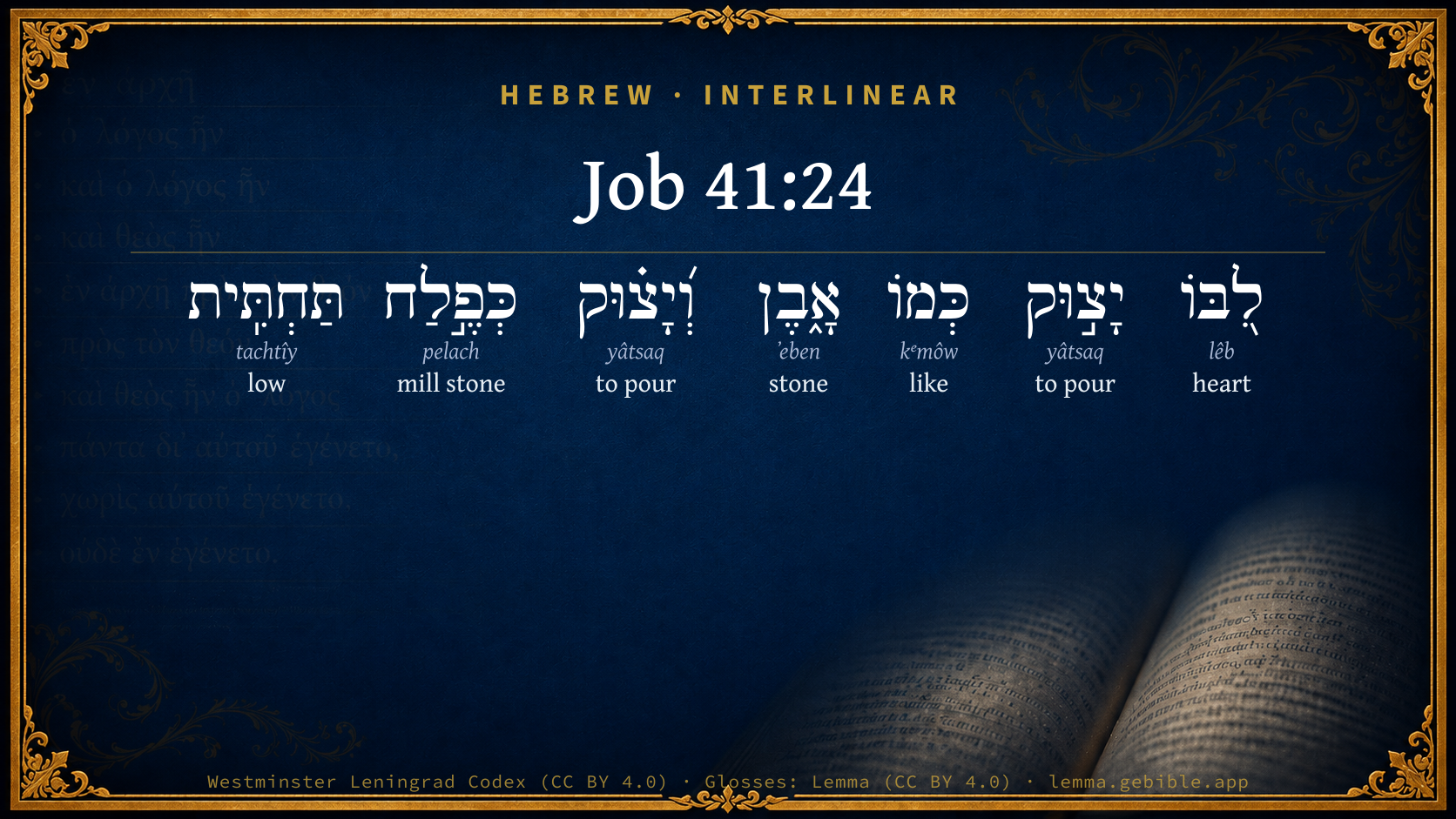
Hebrew (Westminster Leningrad Codex) Job 41:24 appears in the Hebrew Old Testament. The text above is from the Westminster Leningrad Codex. Each word links to its Strong’s number, a concise gloss, and parsing drawn from the Open Scriptures Hebrew Bible morphology. Click any word for its full Brown-Driver-Briggs (BDB) entry.
Download image
Cite this verse

Job 41:24 (World English Bible). Public Domain. Lemma interlinear Bible study tool, https://lemma.gebible.app/v/job/41/24.

Show BibTeX & RIS
BibTeX
RIS
English Translation
His heart is as firm as a stone, Yes, firm as the lower millstone.
World English Bible · Public Domain
Download a study sheet

One document with this verse’s original text, its word-by-word gloss line, the meaning frame, cross-references with their text, attributed commentary, and full source and license credits — printable, and it pastes into notes with its structure intact.

This verse Autodidact and up

Study sheet (.html) Plain text (.txt)

A passage Seminary Student

Up to 50 verses in one chapter. A passage sheet keeps up to 6 commentary sources and 12 cross-references per verse, in the order this page ranks them, and says so on the sheet whenever that leaves anything out. Ask for a single verse and you get the Autodidact verse sheet above.

Everything on this page stays free to read, with no account — the sheet is a download of what is already on screen, not access to it.

Want to remove ads? Support Godless Engineer
Compare translations 3

The same verse in 3 English versions, stacked beneath the original-language interlinear above. Click any original word for its lexicon entry.

Each is an independent rendering of the whole verse — the interlinear is not word-aligned to these translations.

Highlighted words mark where these versions differ — a whole-verse word diff, not a word-by-word alignment.

  • World English Bible Public Domain
    His heart is as firm as a stone, Yes, firm as the lower millstone.
  • King James Version Public Domain
    His heart is as firm as a stone; yea, as hard as a piece of the nether millstone.
  • unfoldingWord Literal Text CC BY-SA 4.0
    Its heart is hard like stone; yes, it is hard like a lower millstone.

unfoldingWord Literal Text — © unfoldingWord, licensed CC BY-SA 4.0. Word-aligned USFM3 via Door43 (git.door43.org/unfoldingWord/en_ult).

Versions to compare (up to 4)

3 of 4 selected

Show all 18 translations

Every available English version of this verse, each an independent rendering of the whole verse.

  • World English Bible Public Domain
    His heart is as firm as a stone, Yes, firm as the lower millstone.
  • Berean Standard Bible Public Domain
    His chest is as hard as a rock, as hard as a lower millstone!
  • Majority Standard Bible Public Domain
    His chest is as hard as a rock, as hard as a lower millstone!
  • King James Version Public Domain
    His heart is as firm as a stone; yea, as hard as a piece of the nether millstone.
  • American Standard Version (1901) Public Domain
    His heart is as firm as a stone; Yea, firm as the nether millstone.
  • Revised Version (1885) Public Domain
    His heart is as firm as a stone; yea, firm as the nether millstone.
  • Geneva Bible (1599) Public Domain
    In the earth there is none like him: hee is made without feare.
  • Douay-Rheims (1899) Public Domain
    There is no power upon earth that can be compared with him who was made to fear no one.
  • Young's Literal Translation Public Domain
    His heart `is' firm as a stone, Yea, firm as the lower piece.
  • Literal Standard Version CC BY-SA 4.0
    His heart [is] firm as a stone, || Indeed, firm as the lower piece.
  • Unlocked Literal Bible CC BY-SA 4.0
    His heart is as hard as a stone— indeed, as hard as a lower millstone.
  • unfoldingWord Literal Text CC BY-SA 4.0
    Its heart is hard like stone; yes, it is hard like a lower millstone.
  • Darby Bible Public Domain
    His heart is firm as a stone, yea, firm as the nether [millstone].
  • World Messianic Bible Public Domain
    His heart is as firm as a stone, yes, firm as the lower millstone.
  • Webster's Bible Public Domain
    \\41:33\\Upon earth there is not his like, who is made without fear.
  • Free Bible Version CC BY-SA 4.0
    Its heart is rock-hard, like a millstone.
  • Bible in Basic English Public Domain
    On earth there is not another like him, who is made without fear.
  • JPS Tanakh (1917) Public Domain
    (41-16) His heart is as firm as a stone; yea, firm as the nether millstone.

Literal Standard Version (2020), Covenant Press — licensed CC BY-SA 4.0. Text via the HelloAO Bible API (eBible.org). Unlocked Literal Bible (unfoldingWord) — licensed CC BY-SA 4.0. Text via the HelloAO Bible API (eBible.org). unfoldingWord Literal Text — © unfoldingWord, licensed CC BY-SA 4.0. Word-aligned USFM3 via Door43 (git.door43.org/unfoldingWord/en_ult). Free Bible Version, Dr. Jonathan Gallagher — licensed CC BY-SA 4.0. Text via the HelloAO Bible API (eBible.org).

Word by word

More ways to search: Search by grammar → Find every occurrence → Compare this word →

Practice this passage: Drill this verse → Learn its vocabulary →

About this verse

These counts appear in no published source. They are computed here, from the morphology-tagged text and Lemma’s own curated glosses. What Lemma adds →

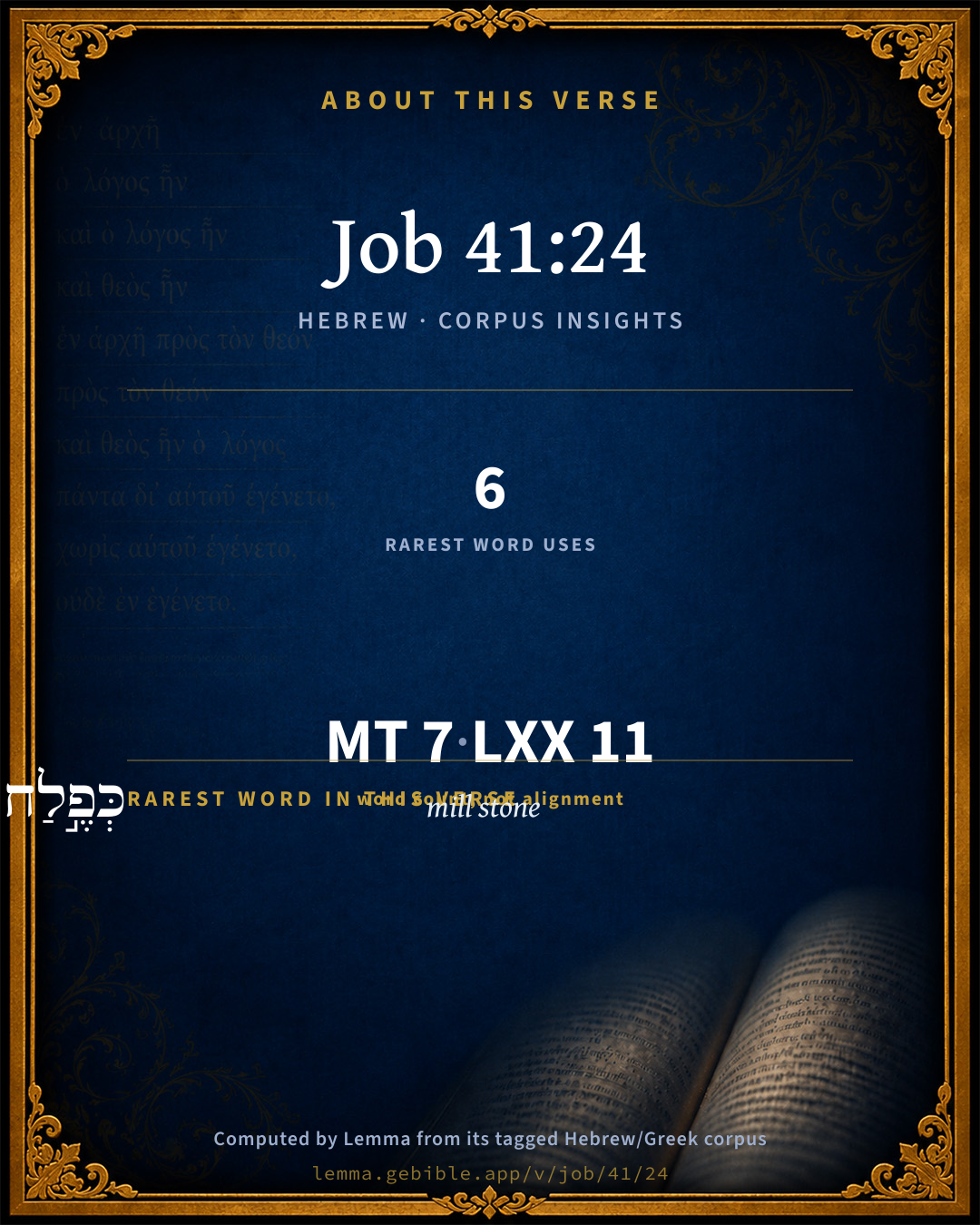
7
words
6
distinct lemmas
Wisdom
section

Notable vocabulary

The rarest word here is כְּפֶ֣לַח mill stone H6400 — appearing just 6 times in the whole Hebrew Bible.

Shared distinctive vocabulary

כְּפֶ֣לַח mill stone H6400 occurs in 6 verses of the Hebrew Bible. Also found in:

Grammatical profile

  • 2 verbs
  • 3 nouns
  • 1 adjective
  • 1 preposition

Verb forms

  • יָצ֣וּק Qal · Participle Passive
  • וְ֝יָצ֗וּק Qal · Participle Passive

Repetition

A word recurs within this verse — often emphatic in Hebrew:

  • יָצ֣וּק to pour H3332 ×2

Hebrew & Septuagint length

In English translation the verse runs 14 words from the Hebrew and 17 from the Septuagint (LXX English) — closely comparable.

A rough comparison of the two English renderings, which tokenize alike — not a word-level alignment.

Word counts can differ between the Hebrew and the Greek without any difference in meaning — e.g. the Hebrew direct-object marker אֵת has no separate Greek word, and Greek often adds the article ὁ.

In the original languages it is 7 Hebrew tokens and 11 Greek tokens — but the two are counted differently (Hebrew bundles its prefixes and suffixes into one token; the Greek is in lemma form), so that isn’t a like-for-like length.

Cross-references

3

Topical passages linked to Job 41:24 in the Treasury of Scripture Knowledge — connected by theme and wording, ordered by reader-vote popularity; previews shown in the World English Bible.

  • Isaiah 48:4 Because I knew that you are obstinate, and your neck is an iron sinew, and your brow brass;
  • Jeremiah 5:3 O Yahweh, don't your eyes look on truth? you have stricken them, but they were not grieved; you have consumed them, but they have refused to receive correction: they have made their faces harder than a rock; they have refused to return.
  • Zechariah 7:12 Yes, they made their hearts as hard as flint, lest they might hear the law, and the words which Yahweh of Hosts had sent by his Spirit by the former prophets. Therefore great wrath came from Yahweh of Hosts.

Cross-references courtesy of OpenBible.info (CC BY 4.0).

Hebrew and Greek witnesses Masoretic Hebrew ↔ Greek Septuagint

The same verse in the two great witnesses to the Old Testament, shown verse-for-verse.

These are two independent witnesses, not word-aligned to each other, and the Septuagint is shown in lemma (dictionary) form.

Hebrew Job 41:24 Masoretic · Westminster Leningrad Codex

לִ֭בּוֹ יָצ֣וּק כְּמוֹ אָ֑בֶן וְ֝יָצ֗וּק כְּפֶ֣לַח תַּחְתִּֽית

His heart is as firm as a stone, Yes, firm as the lower millstone.

World English Bible · Public Domain

Greek LXX Job 41:24 Septuagint · lemma form

ὁ δέ τάρταρος ὁ ἄβυσσος ὥσπερ αἰχμάλωτος λογίζομαι ἄβυσσος εἰς περίπατος

There is nothing upon the earth like to him, formed to be sported with by my angels.

LXX2012 (modern English Septuagint) · Public Domain

On this verse, Haydock's Catholic Bible Commentary discusses the Septuagint’s reading. Read the note in Commentary ↓

Hebrew: Westminster Leningrad Codex (CC BY 4.0). Greek: Septuagint (public domain); English from LXX2012 (modern English Septuagint) (Public Domain). How the Septuagint differs from the Hebrew →

Commentary

Notes on Job 41:24 from classic Christian and Jewish commentators (each source and its license shown beneath its notes). The classic Christian expositions comment on the surrounding passage and are grouped to its opening verse, so a note may address several verses; the Jewish commentaries on the Tanakh (Rashi and others) are per-verse, so they appear only where the commentator wrote on this verse.

Lemma curates 59 commentaries, every one of them public domain or Creative Commons licensed, each selected and text-cleaned for this edition rather than reprinted as found. About our sources →

Trapp's Complete Commentary

John Trapp

Job 41:24 His heart is as firm as a stone; yea, as hard as a piece of the nether [millstone].

Ver. 24. His heart is as firm as a stone] He is corpore et corde validissimus. Of the sword fish, Plutarch saith, that he hath a sword, but not a heart to use it, μαχαιραν μεν εχει, εχει, καρδιαν δε μη εχει. But the whale hath courage to his bulk: his heart is as firm as a stone, as his head (saith Scaliger) is as hard as a flint. In the hearts of some creatures, saith Aristotle, is found a bony or grisly hardness; but the whale’s heart is all as it were a bone; and this bone as a stone.

As a piece of the nether millstone] Metae, upon which the whole weight lieth. The Greek call it ονος μυλικος, Mat 18:6, the mill ass; because it is the bigger and harder of the two. The Vulgate here for the nether millstone hath the smith’s anvil, which, by hammering, is made harder.

John Trapp, A Commentary or Exposition upon All the Books of the Old and New Testament (1647–1656) — public domain. Text from a community e-Sword module.

Jamieson, Fausset & Brown

Robert Jamieson, A. R. Fausset & David Brown

heart--"In large beasts which are less acute in feeling, there is great firmness of the heart, and slower motion" [BOCHART]. The nether millstone, on which the upper turns, is especially hard.

Jamieson, Fausset & Brown — Commentary Critical and Explanatory on the Whole Bible (1871) — public domain (CC PDM 1.0). Text via the HelloAO Bible API.

Adam Clarke's Commentary

Verse 24. Hard as a piece of the nether millstone.] Which is required to be harder than that which runs above.

Adam Clarke's Commentary on the Bible (1810–1826) — public domain. Text from a community e-Sword/MySword module.

Ellicott's Commentary for English Readers

(24) His heart—i.e., his nature, his disposition. This seems to be the meaning, rather than the physical organ of life.

A Bible Commentary for English Readers, edited by Charles John Ellicott (1878–1897) — public domain. Text from a community e-Sword module.

The Cambridge Bible for Schools and Colleges

gen. ed. J. J. S. Perowne

24. The second clause reads,

Yea, firm as the nether millstone.

Gen. “as hard as the nether millstone.” The term “firm,” lit. cast, is repeated from the first clause (cf. Job_41:23). The nether millstone, bearing all the pressure upon it, needs to be harder even than the upper stone.

The Cambridge Bible for Schools and Colleges (gen. ed. J. J. S. Perowne; Cambridge University Press, 1878–1918) — public domain. Text from a community e-Sword module.

John Gill's Exposition

When he raiseth up himself,.... Not out of the waters, but above the surface of them, so as that his large bulk, his terrible jaws and teeth, are seem;

the mighty are afraid; not only fishes and other animals, but men, and these the most stouthearted and courageous, as mariners and masters of vessels;

by reason of breakings they purify themselves: either because of the breaches of the sea made through the lifting up of this creature, threatening the overturning of vessels; or of the breaches of men's hearts through fear, they are thrown into a vomiting, and purging both by stool and urine, which are often the effects of fear, so Ben Gersom; or they acknowledge themselves sinners, or expiate themselves, endeavouring to do it by making confession of sin, declaring repentance for it, praying for forgiveness of it, and promising amendment; which is frequently the case of seafaring men in distress; see Jon 1:4.

John Gill's Exposition of the Whole Bible (1746–1763) — public domain (CC PDM 1.0). Text via the HelloAO Bible API.

Albert Barnes' Notes on the Bible

His heart is as firm as a stone - As hard; as solid. Bochart remarks that the word “heart” here is not to be regarded as denoting the “courage” of the animal, as it sometimes does, but the heart literally. The statement occurs in the description of the various parts of the animal, and the object is to show that there was special firmness or solidity in every one of his members. There is special firmness or strength needed in the “hearts” of all animals, to enable them to propel the blood through the arteries of the body; and in an animal of the size of the crocodile, it is easy to see that the heart must be made capable of exerting vast force. But there is no reason to suppose that the affirmation here is made on the supposition that there is need of extraordinary strength in the heart to propel the blood. The doctrine of the circulation of the blood was not then known to mankind, and it is to be presumed that the argument here would be based on what “was” known, or what might be easily observed. The presumption therefore is, that the statement here is based on what had been “seen” of the remarkable compactness and firmness of the heart of the animal here referred to. Probably there was nothing so unique in the heart of the crocodile that this description would be applicable to that animal alone, but it is such doubtless as would apply to the heart of any animal of extraordinary size and strength.

Yea, as hard as a piece of the nether millstone - The mills commonly used in ancient times were hand-mills; see a description of them in the notes at Mat 24:41. Why the lower stone was the hardest, is not quite apparent. Perhaps a more solid stone might have been chosen for this, because it was supposed that there was more wear on the lower than the upper stone, or because its weight would make the machine more solid and steady.

Albert Barnes' Notes on the Bible (1834–1885) — public domain. Text from a community e-Sword/MySword module.

Haydock's Catholic Bible Commentary

Power. Hebrew and Septuagint, "none like him on earth," for bulk. --- One. Septuagint, "made to be played with, or beaten, by my angels." (Haydock)

George Leo Haydock (1774–1849), Haydock's Catholic Family Bible and Commentary, 1859 edition — public domain. Excludes Psalms (Douay-Rheims chapter numbering differs from Protestant) and Deuterocanonical books (Catholic canon only).

Matthew Poole's English Annotations

His heart; either,

1. That part of the body is most firm, and hard, and strong. Or,

2. His courage is invincible; he is void of fear for himself, and of compassion to others, which is oft called hardness of heart.

Hard as a piece of the nether millstone; which being to bear the weight of the upper, ought to be the harder and stronger of the two.

Matthew Poole's English Annotations on the Holy Bible (1683–1685) — public domain. Text from a community e-Sword/MySword module.

Whedon's Commentary on the Bible

Daniel D. Whedon

24. Hard… millstone — Hard as the nether millstone. This was, in general, compact and heavy, often made of sandstone, and quite thick, while the upper one, having to be driven round by the hand, was made lighter, and of more porous texture. The hardness spoken of may be the cold, sluggish action of the heart, that characterizes all the saurians, which, on this account, are distinguished as cold-blooded; or the disposition of the reptile, of which AElian says, he is the most pitiless of animals.

Daniel D. Whedon (gen. ed.), Commentary on the Old and New Testaments (1874–1909) — public domain. Text from a community e-Sword module.

The Pulpit Commentary

His heart is firm as a stone. Some regard this as intended physically, and note that the great saurians, with their cold and sluggish circulation, have hearts which are comparatively torpid, not contracting or expanding readily. Others take the "stony heart" to mean a fierce and obstinate disposition. In either case, the description will well suit the crocodile. Yea, as hard as a piece of the nether millstone. A repetition and slight exaggeration of the preceding idea.

The Pulpit Commentary (1880–1919), ed. H.D.M. Spence-Jones & Joseph S. Exell — public domain. Text from a community e-Sword module.

John Wesley's Explanatory Notes

Nether mill-stone - Which being to bear the weight of the upper, ought to be the harder and stronger of the two.

John Wesley, Explanatory Notes Upon the Whole Bible (1754–1765) — public domain. Text via the GEBible commentary corpus.

Rashi

Rabbi Shlomo Yitzchaki (Rashi)

He makes a path shine after him When he swims and floats in the sea, he makes the path of the deep shine, for at the time he swims, there is no water because of the speed of his swimming.

he considers the deep to be hoary To him, the deep is considered to be weak and feeble.

to be hoary The weakness of old age and hoariness.

Rashi on the Tanakh — English translations: “The Judaica Press complete Tanach with Rashi, translated by A. J. Rosenberg” (CC BY 4.0); “Pentateuch with Rashi's commentary by M. Rosenbaum and A.M. Silbermann, 1929-1934” (public domain); “The Metsudah Tanach series, Lakewood, N.J” (CC BY 4.0); and “The Book of Joshua, Metsudah Publications, 1997” (CC BY 4.0). Text via Sefaria.

Lesson kit

Teaching starters — assembled from the data on this page, not authored interpretation. Every prompt links to the verse data it draws on. Edit before teaching.

Job, in the Wisdom, opens this verse with 7 words (6 distinct Hebrew lemmas). Its most distinctive word is pelach (“mill stone”). A historical commentator’s framing appears above. Read the whole chapter for the surrounding context.

Discussion questions

  1. The word pelach carries the sense “mill stone.” How does it shape the verse?
  2. Judges 9:53 shares the word «mill stone» with this verse. How do the two illuminate each other?
  3. “to pour” occurs 2× in this one verse. What is the effect of the repetition?
  4. The translations on this page render this verse differently — a whole-verse word diff, not a word-by-word alignment. What might account for the different wordings?
  5. The verb «יָצ֣וּק» is Qal Participle Passive. How does its form color the action?
  6. Reading how Trapp's Complete Commentary and Jamieson, Fausset & Brown read this verse, where do the two commentators agree and where do they part?

Things to notice

Reading settings

Reading text

Shown beneath each verse's original-language words.

Old Testament
Old Testament edition

Read the OT as the Masoretic Hebrew (MT) or the Greek Septuagint (LXX).

English shown for the Greek Septuagint (in the Hebrew ↔ Greek comparison).

Comparing translations? Open the Compare panel on any verse page to stack up to four side by side.