
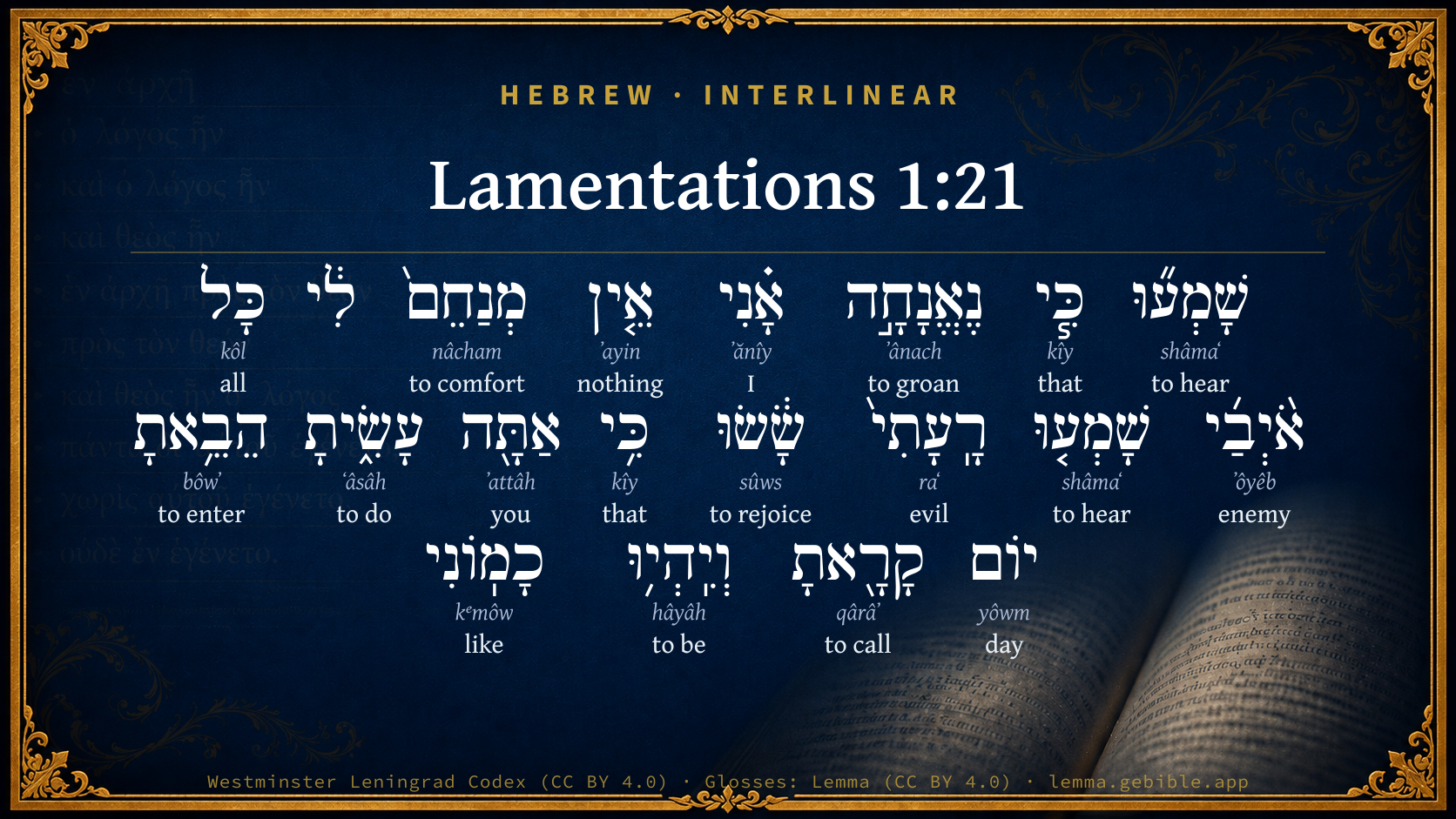
Lamentations 1:21

Hebrew (Westminster Leningrad Codex) Lamentations 1:21 appears in the Hebrew Old Testament. The text above is from the Westminster Leningrad Codex. Each word links to its Strong’s number, a concise gloss, and parsing drawn from the Open Scriptures Hebrew Bible morphology. Click any word for its full Brown-Driver-Briggs (BDB) entry.
Download image
Cite this verse

Lamentations 1:21 (World English Bible). Public Domain. Lemma interlinear Bible study tool, https://lemma.gebible.app/v/lamentations/1/21.

Show BibTeX & RIS
BibTeX
RIS
English Translation
They have heard that I sigh; there is none to comfort me; All my enemies have heard of my trouble; they are glad that you have done it: You will bring the day that you have proclaimed, and they shall be like me.
World English Bible · Public Domain
Download a study sheet

One document with this verse’s original text, its word-by-word gloss line, the meaning frame, cross-references with their text, attributed commentary, and full source and license credits — printable, and it pastes into notes with its structure intact.

This verse Autodidact and up

Study sheet (.html) Plain text (.txt)

A passage Seminary Student

Up to 50 verses in one chapter. A passage sheet keeps up to 6 commentary sources and 12 cross-references per verse, in the order this page ranks them, and says so on the sheet whenever that leaves anything out. Ask for a single verse and you get the Autodidact verse sheet above.

Everything on this page stays free to read, with no account — the sheet is a download of what is already on screen, not access to it.

Want to remove ads? Support Godless Engineer
Compare translations 3

The same verse in 3 English versions, stacked beneath the original-language interlinear above. Click any original word for its lexicon entry.

Each is an independent rendering of the whole verse — the interlinear is not word-aligned to these translations.

Highlighted words mark where these versions differ — a whole-verse word diff, not a word-by-word alignment.

  • World English Bible Public Domain
    They have heard that I sigh; there is none to comfort me; All my enemies have heard of my trouble; they are glad that you have done it: You will bring the day that you have proclaimed, and they shall be like me.
  • King James Version Public Domain
    They have heard that I sigh: there is none to comfort me: all mine enemies have heard of my trouble; they are glad that thou hast done it: thou wilt bring the day that thou hast called, and they shall be like unto me.
  • unfoldingWord Literal Text CC BY-SA 4.0
    They have heard that I am groaning; there is no comforter for me. All my enemies have heard of my calamity; they have rejoiced, because you have done it. You have brought the day you proclaimed, and let them be like me. TAW

unfoldingWord Literal Text — © unfoldingWord, licensed CC BY-SA 4.0. Word-aligned USFM3 via Door43 (git.door43.org/unfoldingWord/en_ult).

Versions to compare (up to 4)

3 of 4 selected

Show all 18 translations

Every available English version of this verse, each an independent rendering of the whole verse.

  • World English Bible Public Domain
    They have heard that I sigh; there is none to comfort me; All my enemies have heard of my trouble; they are glad that you have done it: You will bring the day that you have proclaimed, and they shall be like me.
  • Berean Standard Bible Public Domain
    People have heard my groaning, but there is no one to comfort me. All my enemies have heard of my trouble; they are glad that You have caused it. May You bring the day You have announced, so that they may become like me.
  • Majority Standard Bible Public Domain
    People have heard my groaning, but there is no one to comfort me. All my enemies have heard of my trouble; they are glad that You have caused it. May You bring the day You have announced, so that they may become like me.
  • King James Version Public Domain
    They have heard that I sigh: there is none to comfort me: all mine enemies have heard of my trouble; they are glad that thou hast done it: thou wilt bring the day that thou hast called, and they shall be like unto me.
  • American Standard Version (1901) Public Domain
    They have heard that I sigh; there is none to comfort me; All mine enemies have heard of my trouble; they are glad that thou hast done it: Thou wilt bring the day that thou hast proclaimed, and they shall be like unto me.
  • Revised Version (1885) Public Domain
    They have heard that I sigh; there is none to comfort me; all mine enemies have heard of my trouble; they are glad that thou hast done it: thou wilt bring the day that thou hast proclaimed, and they shall be like unto me.
  • Geneva Bible (1599) Public Domain
    They haue heard that I mourne, but there is none to comfort mee: all mine enemies haue heard of my trouble, and are glad, that thou hast done it: thou wilt bring the day, that thou hast pronounced, and they shalbe like vnto me.
  • Douay-Rheims (1899) Public Domain
    Sin. They have heard that I sigh, and there is none to comfort me: all my enemies have heard of my evil, they have rejoiced that thou hast done it: thou hast brought a day of consolation, and they shall be like unto me.
  • Young's Literal Translation Public Domain
    They have heard that I have sighed, There is no comforter for me, All my enemies have heard of my calamity, They have rejoiced that Thou hast done `it', Thou hast brought in the day Thou hast called, And they are like to me.
  • Literal Standard Version CC BY-SA 4.0
    They have heard that I have sighed, || There is no comforter for me, || All my enemies have heard of my calamity, || They have rejoiced that You have done [it], || You have brought in the day You have called, || And they are like to me.
  • Unlocked Literal Bible CC BY-SA 4.0
    They have heard my groaning, but there is no one to comfort me. All my enemies have heard of my trouble and they are glad that you have done it. You have brought the day you promised; now let them become like me.
  • unfoldingWord Literal Text CC BY-SA 4.0
    They have heard that I am groaning; there is no comforter for me. All my enemies have heard of my calamity; they have rejoiced, because you have done it. You have brought the day you proclaimed, and let them be like me. TAW
  • Darby Bible Public Domain
    They have heard that I sigh: I have no comforter: all mine enemies have heard of my calamity; they are glad that thou hast done it. Thou wilt bring the day that thou hast called, and they shall be like unto me.
  • World Messianic Bible Public Domain
    “They have heard that I sigh. There is no one to comfort me. All my enemies have heard of my trouble. They are glad that you have done it. You will bring the day that you have proclaimed, and they will be like me.
  • Webster's Bible Public Domain
    They have heard that I sigh: there is none to comfort me: all my enemies have heard of my trouble; they are glad that thou hast done it: thou wilt bring the day that thou hast called, and they shall be like me.
  • Free Bible Version CC BY-SA 4.0
    People hear me groaning, but no one comes to comfort me. All my enemies have heard about the bad things that have happened to me, and they're delighted that it was you who did it. Please bring about the day of judgment that you promised so they can end up like me.
  • Bible in Basic English Public Domain
    Give ear to the voice of my grief; I have no comforter; all my haters have news of my troubles, they are glad because you have done it: let the day of fate come when they will be like me.
  • JPS Tanakh (1917) Public Domain
    They have heard that I sigh, there is none to comfort me; all mine enemies have heard of my trouble, and are glad, for Thou hast done it; Thou wilt bring the day that Thou hast proclaimed, and they shall be like unto me.

Literal Standard Version (2020), Covenant Press — licensed CC BY-SA 4.0. Text via the HelloAO Bible API (eBible.org). Unlocked Literal Bible (unfoldingWord) — licensed CC BY-SA 4.0. Text via the HelloAO Bible API (eBible.org). unfoldingWord Literal Text — © unfoldingWord, licensed CC BY-SA 4.0. Word-aligned USFM3 via Door43 (git.door43.org/unfoldingWord/en_ult). Free Bible Version, Dr. Jonathan Gallagher — licensed CC BY-SA 4.0. Text via the HelloAO Bible API (eBible.org).

Word by word

More ways to search: Search by grammar → Find every occurrence → Compare this word →

Practice this passage: Drill this verse → Learn its vocabulary →

נֶאֱנָחָ֣ה
ʼânach
H584
“groaned”
Verb, Niphal, Participle Passive, Feminine, Singular, Absolute
Part of Speech
Verb
Stem
Niphal
Form
Participle Passive
Gender
Feminine
Number
Singular
State
Absolute
Full BDB Definition

Origin: a primitive root

TWOT: 127

(Niphal) sigh, groan (in pain or grief), gasp - moan (of cattle)
  1. שָׁמְע֞וּ shâmaʻ H8085 “to hear” Verb, Qal, Perfect, 3rd Person, Common, Plural
  2. כִּ֧י kîy H3588 “that” Conjunction
  3. אָ֗נִי ʼănîy H589 “I” Pronoun, Personal, 1st Person, Common, Singular
  4. אֵ֤ין ʼayin H369 “nothing” Particle, Negative
  5. מְנַחֵם֙ nâcham H5162 “comforting” Verb, Piel, Participle Active, Masculine, Singular, Absolute
  6. כָּל kôl H3605 “all of” Noun, Common, Masculine, Singular, Construct
  7. אֹ֨יְבַ֜י ʼôyêb H341 “enemy · me” Verb, Qal, Participle Active, Masculine, Plural, Construct + Suffix, Personal, 1st Person, Common, Singular
  8. שָׁמְע֤וּ shâmaʻ H8085 “to hear” Verb, Qal, Perfect, 3rd Person, Common, Plural
  9. רָֽעָתִי֙ raʻ H7451 “evil · my” Noun, Common, Feminine, Singular, Construct + Suffix, Personal, 1st Person, Common, Singular
  10. שָׂ֔שׂוּ sûws H7797 “to rejoice” Verb, Qal, Perfect, 3rd Person, Common, Plural
  11. כִּ֥י kîy H3588 “that” Conjunction
  12. אַתָּ֖ה ʼattâh H859 “you” Pronoun, Personal, 2nd Person, Masculine, Singular
  13. עָשִׂ֑יתָ ʻâsâh H6213 “to do” Verb, Qal, Perfect, 2nd Person, Masculine, Singular
  14. הֵבֵ֥אתָ bôwʼ H935 “to enter” Verb, Hiphil, Perfect, 2nd Person, Masculine, Singular
  15. יוֹם yôwm H3117 “day” Noun, Common, Masculine, Singular, Absolute
  16. קָרָ֖אתָ qârâʼ H7121 “to call” Verb, Qal, Perfect, 2nd Person, Masculine, Singular
  17. וְיִֽהְי֥וּ hâyâh H1961 “and · to be” Conjunction + Verb, Qal, Imperfect, 3rd Person, Masculine, Plural
  18. כָמֽוֹנִי kᵉmôw H3644 “like · me” Preposition + Suffix, Personal, 1st Person, Common, Singular

About this verse

These counts appear in no published source. They are computed here, from the morphology-tagged text and Lemma’s own curated glosses. What Lemma adds →

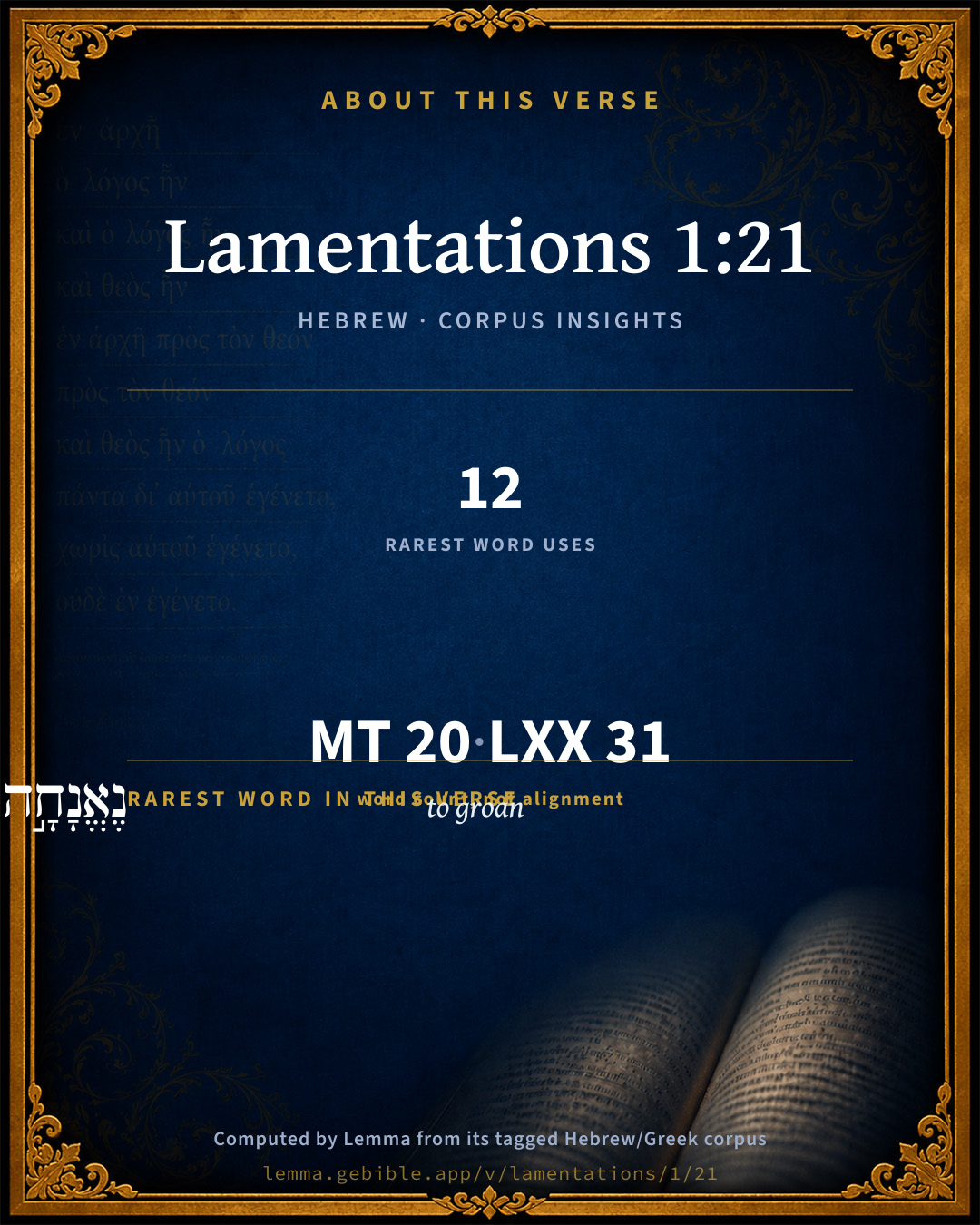
20
words
17
distinct lemmas
Prophets
section

Notable vocabulary

The rarest word here is נֶאֱנָחָ֣ה to groan H584 — appearing just 12 times in the whole Hebrew Bible.

Shared distinctive vocabulary

נֶאֱנָחָ֣ה to groan H584 occurs in 11 verses of the Hebrew Bible. Also found in:

Grammatical profile

  • 10 verbs
  • 3 nouns
  • 2 pronouns
  • 2 prepositions
  • 2 conjunctions
  • 1 particle

Verb forms

  • שָׁמְע֞וּ Qal · Perfect
  • נֶאֱנָחָ֣ה Niphal · Participle Passive
  • מְנַחֵם֙ Piel · Participle Active
  • אֹ֨יְבַ֜י Qal · Participle Active
  • שָׁמְע֤וּ Qal · Perfect
  • שָׂ֔שׂוּ Qal · Perfect
  • עָשִׂ֑יתָ Qal · Perfect
  • הֵבֵ֥אתָ Hiphil · Perfect
  • קָרָ֖אתָ Qal · Perfect
  • וְיִֽהְי֥וּ Qal · Imperfect

Repetition

Words recur within this verse — often emphatic in Hebrew:

  • שָׁמְע֞וּ to hear H8085 ×2
  • כִּ֧י that H3588 ×2

Hebrew & Septuagint length

In English translation the verse runs 43 words from the Hebrew and 46 from the Septuagint (LXX English) — closely comparable.

A rough comparison of the two English renderings, which tokenize alike — not a word-level alignment.

Word counts can differ between the Hebrew and the Greek without any difference in meaning — e.g. the Hebrew direct-object marker אֵת has no separate Greek word, and Greek often adds the article ὁ.

In the original languages it is 20 Hebrew tokens and 31 Greek tokens — but the two are counted differently (Hebrew bundles its prefixes and suffixes into one token; the Greek is in lemma form), so that isn’t a like-for-like length.

Cross-references

34

Topical passages linked to Lamentations 1:21 in the Treasury of Scripture Knowledge — connected by theme and wording, ordered by reader-vote popularity; previews shown in the World English Bible.

  • Lamentations 1:8 Jerusalem has grievously sinned; therefore she is become as an unclean thing; All who honored her despise her, because they have seen her nakedness: Yes, she sighs, and turns backward.
  • Psalms 35:15 But in my adversity, they rejoiced, and gathered themselves together. The attackers gathered themselves together against me, and I didn't know it. They tore at me, and didn't cease.
  • Jeremiah 50:11 Because you are glad, because you rejoice, O you who plunder my heritage, because you are wanton as a heifer that treads out [the grain], and neigh as strong horses;
  • Lamentations 1:16 For these things I weep; my eye, my eye runs down with water; Because the comforter who should refresh my soul is far from me: My children are desolate, because the enemy has prevailed.
  • Lamentations 1:22 Let all their wickedness come before you; Do to them, as you have done to me for all my transgressions: For my sighs are many, and my heart is faint.
  • Lamentations 2:15 All that pass by clap their hands at you; They hiss and wag their head at the daughter of Jerusalem, [saying], Is this the city that men called The perfection of beauty, The joy of the whole earth?
  • Jeremiah 51:24 I will render to Babylon and to all the inhabitants of Chaldea all their evil that they have done in Zion in your sight, says Yahweh.
  • Lamentations 1:2 She weeps sore in the night, and her tears are on her cheeks; Among all her lovers she has none to comfort her: All her friends have dealt treacherously with her; they are become her enemies.
  • Lamentations 1:4 The ways of Zion do mourn, because none come to the solemn assembly; All her gates are desolate, her priests do sigh: Her virgins are afflicted, and she herself is in bitterness.
  • Lamentations 4:21–22 Rejoice and be glad, daughter of Edom, that dwell in the land of Uz: The cup shall pass through to you also; you shall be drunken, and shall make yourself naked.
  • Micah 7:9–10 I will bear the indignation of Yahweh, Because I have sinned against him, Until he pleads my case, and executes judgment for me. He will bring me forth to the light. I will see his righteousness.
  • Deuteronomy 32:41–43 If I whet my glittering sword, My hand take hold on judgment; I will render vengeance to my adversaries, Will recompense those who hate me.
  • Psalms 37:13 The Lord will laugh at him, For he sees that his day is coming.
  • Psalms 38:16 For I said, "Don't let them gloat over me, Or exalt themselves over me when my foot slips."
  • Psalms 137:7–9 Remember, Yahweh, against the children of Edom, The day of Jerusalem; Who said, "Raze it! Raze it even to its foundation!"
  • Isaiah 13:1–14 The burden of Babylon, which Isaiah the son of Amoz did see.
  • Isaiah 47:1–15 Come down, and sit in the dust, virgin daughter of Babylon; sit on the ground without a throne, daughter of the Chaldeans: for you shall no more be called tender and delicate.
  • Isaiah 51:22–23 Thus says your Lord Yahweh, and your God who pleads the cause of his people, Behold, I have taken out of your hand the cup of staggering, even the bowl of the cup of my wrath; you shall no more drink it again:
  • Jeremiah 25:17–29 Then took I the cup at Yahweh's hand, and made all the nations to drink, to whom Yahweh had sent me:
  • Jeremiah 30:16 Therefore all those who devour you shall be devoured; and all your adversaries, everyone of them, shall go into captivity; and those who despoil you shall be a spoil, and all who prey on you will I give for a prey.
  • Jeremiah 46:1–28 The word of Yahweh which came to Jeremiah the prophet concerning the nations.
  • Jeremiah 48:27 For wasn't Israel a derision to you? was he found among thieves? for as often as you speak of him, you wag the head.
  • Jeremiah 50:15 Shout against her round about: she has submitted herself; her bulwarks are fallen, her walls are thrown down; for it is the vengeance of Yahweh: take vengeance on her; as she has done, do to her.
  • Jeremiah 50:29 Call together the archers against Babylon, all those who bend the bow; encamp against her round about; let none of it escape: recompense her according to her work; according to all that she has done, do to her; for she has been proud against Yahweh, against the Holy One of Israel.
  • Jeremiah 50:31 Behold, I am against you, you proud one, says the Lord, Yahweh of Hosts; for your day is come, the time that I will visit you.
  • Jeremiah 51:49 As Babylon has caused the slain of Israel to fall, so at Babylon shall fall the slain of all the land.
  • Lamentations 1:11–12 All her people sigh, they seek bread; They have given their pleasant things for food to refresh the soul: Look, Yahweh, and see; for I am become abject.
  • Ezekiel 25:1–17 The word of Yahweh came to me, saying,
  • Ezekiel 26:2 Son of man, because Tyre has said against Jerusalem, Aha, she is broken: the gate of the peoples; she is turned to me; I shall be replenished, now that she is laid waste:
  • Joel 3:14 Multitudes, multitudes in the valley of decision! For the day of Yahweh is near, in the valley of decision.
  • Amos 1:1–15 The words of Amos, who was among the herdsmen of Tekoa, which he saw concerning Israel in the days of Uzziah king of Judah, and in the days of Jeroboam the son of Joash king of Israel, two years before the earthquake.
  • Obadiah 1:12–13 But don't look down on your brother in the day of his disaster, and don't rejoice over the children of Judah in the day of their destruction. Don't speak proudly in the day of distress.
  • Habakkuk 2:15–17 "Woe to him who gives his neighbor drink, pouring your inflaming wine until they are drunk, so that you may gaze at their naked bodies!
  • Revelation 18:6 Return to her just as she returned, and repay her double as she did, and according to her works. In the cup which she mixed, mix to her double.

Cross-references courtesy of OpenBible.info (CC BY 4.0).

Hebrew and Greek witnesses Masoretic Hebrew ↔ Greek Septuagint

The same verse in the two great witnesses to the Old Testament, shown verse-for-verse.

These are two independent witnesses, not word-aligned to each other, and the Septuagint is shown in lemma (dictionary) form.

Hebrew Lamentations 1:21 Masoretic · Westminster Leningrad Codex

שָׁמְע֞וּ כִּ֧י נֶאֱנָחָ֣ה אָ֗נִי אֵ֤ין מְנַחֵם֙ לִ֔י כָּל אֹ֨יְבַ֜י שָׁמְע֤וּ רָֽעָתִי֙ שָׂ֔שׂוּ כִּ֥י אַתָּ֖ה עָשִׂ֑יתָ הֵבֵ֥אתָ יוֹם קָרָ֖אתָ וְיִֽהְי֥וּ כָמֽוֹנִי

They have heard that I sigh; there is none to comfort me; All my enemies have heard of my trouble; they are glad that you have done it: You will bring the day that you have proclaimed, and they shall be like me.

World English Bible · Public Domain

Greek LXX Lamentations 1:21 Septuagint · lemma form

ἀκούω δή ὅτι στενάζω ἐγώ οὐ εἰμί ὁ παρακαλέω ἐγώ πᾶς ὁ ἐχθρός ἐγώ ἀκούω ὁ κακός ἐγώ καί χαίρω ὅτι σύ ποιέω ἐπιἄγω ἡμέρα καλέω καιρός καί γίγνομαι ὅμοιος ἐγώ

CHSEN. Hear, I pray you, for I groan: there is none to comfort me: all my enemies have heard of my afflictions, and rejoice because you have done it: you have brought on the day, you have called the time: they are become like to me.

LXX2012 (modern English Septuagint) · Public Domain

On this verse, The Pulpit Commentary discusses the Septuagint’s reading. Read the note in Commentary ↓

Hebrew: Westminster Leningrad Codex (CC BY 4.0). Greek: Septuagint (public domain); English from LXX2012 (modern English Septuagint) (Public Domain). How the Septuagint differs from the Hebrew →

Commentary

Notes on Lamentations 1:21 from classic Christian and Jewish commentators (each source and its license shown beneath its notes). The classic Christian expositions comment on the surrounding passage and are grouped to its opening verse, so a note may address several verses; the Jewish commentaries on the Tanakh (Rashi and others) are per-verse, so they appear only where the commentator wrote on this verse.

Lemma curates 59 commentaries, every one of them public domain or Creative Commons licensed, each selected and text-cleaned for this edition rather than reprinted as found. About our sources →

Trapp's Complete Commentary

John Trapp

Lam 1:21 They have heard that I sigh: [there is] none to comfort me: all mine enemies have heard of my trouble; they are glad that thou hast done [it]: thou wilt bring the day [that] thou hast called, and they shall be like unto me.

Ver. 21. They have heard that I sigh,.] My friends have, and yet they pity me not: this was a great vexation, and is much complained of. See Lam 1:2; Lam 1:16-17; Lam 1:19.

All mine enemies have heard of my trouble: they are glad.] This επιχαιρεκακια is the devil’s disease: the wicked compose comedies out of the saints’ tragedies, and revel in their ruins. But God’s people, in this case, have a double comfort: (1.) That God hath done it, and not the enemy; that he hath a holy hand in all the troubles that befall them. (2.) That their enemies shall not escape scot-free, but be soundly punished.

That thou hast done it.] Or, But thou hast done it; and sure we are thou wilt not overdo.

Thou wilt bring the day that thou hast called.] The dismal day of vengeance that thou hast threatened Babylon with, especially by Isaiah and Jeremiah.

And they shall be like unto me.] Their future desolation is my present consolation.

John Trapp, A Commentary or Exposition upon All the Books of the Old and New Testament (1647–1656) — public domain. Text from a community e-Sword module.

Joseph Benson's Commentary

Lam 1:21-22. They have heard that I sigh — The nations contiguous to me, Egypt and others, that before pretended to be my friends and allies, have been no strangers to my bitter afflictions, which have forced sighs from me; but there is none to comfort me — None of them can or will relieve my distress, but abandon me as in a desperate situation. They are glad that thou hast done it — They have even expressed gladness at the calamities that have befallen me; and they please themselves with the thought that thou our God, of whose favour and protection we used to boast, shouldst forsake us, and give us up as a prey to our enemies. Thou wilt bring the day that thou hast called, &c. — The day when thou wilt execute thy judgments upon the Babylonians, and our other enemies and false friends, will certainly come at the time thou hast determined for that purpose. “We have here again the like turn of phrase as in the first line of this period; for the meaning evidently is, that the enemies of Jerusalem would in the end find little cause for their triumph, since the same Almighty Being, who had caused her evil day to come, had declared that, after a while, they should also suffer the like fate. Thou that hast brought the day [of adversity upon me] hast pronounced, that they shall become even as I.” — Blaney. Let all their wickedness come before thee — Let it appear that though thou hast chastened us for our sins, our enemies have still greater ones to answer and be punished for.

Joseph Benson's Commentary on the Old and New Testaments (1811–1818) — public domain. Text from a community e-Sword module.

Tyndale Open Study Notes

Tyndale Open Resources

1:21 the day you promised: The poet’s spirit was heartened by the belief that God would set up a day when everyone—oppressors and victims—would be judged justly (see Isa 13:6, 9; Jer 46:10-12, 27-28; Amos 5:18-20; Obad 1:15; 1 Thes 5:2-3; 2 Thes 2:2).

Tyndale Open Study Notes — © Tyndale Open Resources, licensed CC BY-SA 4.0. Text via the HelloAO Bible API.

Jamieson, Fausset & Brown

Robert Jamieson, A. R. Fausset & David Brown

they are glad that thou hast done it--because they thought that therefore Judah is irretrievably ruined (Jer 40:3).

the day . . . called--(but) thou wilt bring on them the day of calamity which thou hast announced, namely, by the prophets (Jer. 50:1-46; Jer 48:27).

like . . . me--in calamities (Psa 137:8-9; Jer 51:25, &c.).

Jamieson, Fausset & Brown — Commentary Critical and Explanatory on the Whole Bible (1871) — public domain (CC PDM 1.0). Text via the HelloAO Bible API.

Adam Clarke's Commentary

Verse 21. They have heard that I sigh] My affliction is public enough; but no one comes to comfort me.

They are glad that thou hast done it] On the contrary, they exult in my misery; and they see that THOU hast done what they were incapable of performing.

Thou wilt bring the day that thou hast called, and they shall be like unto me.] Babylon shall be visited in her turn; and thy judgments poured out upon her shall equal her state with my own. See the last six chapters of the preceding prophecy for the accomplishment of this prediction.

Adam Clarke's Commentary on the Bible (1810–1826) — public domain. Text from a community e-Sword/MySword module.

John Calvin's Commentaries

The verb שמעו, shemou, is put down twice, but at the beginning without a nominative case: hence the sentence is defective, until in the second clause the word איבי aibi, is expressed. Jeremiah evidently says, that enemies had heard of the evils under which the people labored, even that they were sighing, and that no one showed them any kindness; for it is commonly the case that sympathy is manifested towards the miserable. By this circumstance he amplifies the grievousness of their punishment, there being no one, as before said, to administer any consolation. But it is repeated, that enemies had heard; for as there is nothing more bitter than reproaches, we seek in adversities to withdraw ourselves in a manner from the observation of men; but our evil is especially doubled, when we become a spectacle to enemies; for they derive joy from our adversities, and then exult over us. When, therefore, the chosen people said, that enemies had heard, they thus showed that nothing could be added to their miseries: They have heard, then, that I was sighing and that no one comforted me. Who had heard? all mine enemies; and they have rejoiced that thou hast done it

Jeremiah seems to intimate, that their enemies, being fully persuaded that God was displeased with his people, did on this account more freely rejoice; and at the same time they believed that it was all over with those miserable people with whom God was displeased. But I know not whether this view is well grounded. I indeed do not reject it, nor will I dispute with any one who may hold that the enemies rejoiced, because they thought that God was become the enemy of that people, whom he had before chosen and also protected: nor is this view unsuitable; for the reprobate then fully triumph when they can boast that God is adverse to us. But when no such thought comes to their minds, they yet cease not to rejoice when they see that we are oppressed and afflicted. Though, then, they may not think of God’s hand, yet they rejoice that it is done; that is, they rejoice that we are distressed, though they understand not who the author is. We may then take the meaning simply to be, that the enemies of the Church rejoiced at that calamity, without considering who the author of it was.

But, why is it expressed that God had done it? even to shew that while the ungodly think that fortune is unfavorable to us, it; is our duty to cast our eyes on God, for we ought not to judge of things according to their blindness. As, then, they ascribe not to God the glory due to him when they do not acknowledge him as judge, it ever behooves us to see by the eyes of faith what is hid from the natural perceptions of men, even that nothing happens to us except through the righteous judgment of God. Though, then, enemies had not wisdom to know how it was that the Church was afflicted, yet it behooved the Church itself to use by means of faith such a language as this, that God had done it; they rejoiced that thou hast done it

And it follows, Thou hast brought the day which thou hast called, or proclaimed; for קרא, kora, has sometimes this meaning. In short, the faithful now confess not only that they were afflicted by God’s hand, but also that what the prophets had so often threatened, and what had been despised, was now fulfilled. For we have seen with what pertinacity that people rejected the threatenings given by the prophets: God had often exhorted them to repent, and also had proclaimed or fixed a time for them, but without effect. Therefore the faithful now reflect on what had not been sufficiently known before, even that the day was brought which had been often proclaimed. And thus they confessed, not only that they were worthy of punishment., but that it was the proper time for them to be chastised, as they had not repented after having been so often warned.

He adds, But they themselves shall be as I am. Here the future tense may be considered as optative, for presently a prayer follows which confirms this view. But we may also take the meaning to be simply this, — that the faithful began to take courage, as they looked forward to the time when God would render to the wicked according to their proud and disdainful exultation’s. It follows, —

John Calvin's Commentaries (1540-1563) — public domain. Text from the Calvin Translation Society English edition (1840s-50s) via the Christian Classics Ethereal Library (ccel.org). Calvin's coverage is partial (roughly two-thirds of the Bible); uncommented books and verses are honest gaps, never fabricated. The 19th-century editor's footnotes and remarks are omitted so the notes are faithfully Calvin's own voice.

Ellicott's Commentary for English Readers

(21) They are glad that thou hast done it . . .—Historically the words refer to the conduct of nations like the Edomites, as described in Psa_137:7.

Thou wilt bring the day that thou hast called.—Better, proclaimed. By some commentators the first verb is taken as a perfect, “Thou hast brought,” and the “day” is that of vengeance upon Judah. With the rendering of the Authorised version the clause coheres better with that which follows, and the “day” is that of the punishment of the exulting foes.

A Bible Commentary for English Readers, edited by Charles John Ellicott (1878–1897) — public domain. Text from a community e-Sword module.

The Cambridge Bible for Schools and Colleges

gen. ed. J. J. S. Perowne

21. The second and third lines are metrically irregular, as failing to fulfil the conditions of the “limping rhythm” of the Ḳinah. (See Intr. p. 321 f.) Löhr accordingly transposes “They are glad … done it” and “Thou wilt bring … proclaimed.”

They have heard] This verb has perhaps been assimilated to the “have heard” of the next line. If so, by a very slight change in MT., we get an imperative, Hear thou. Cp. the imperative “Behold” at the commencement of Lam_1:20.

Thou wilt bring] lit. Thou hast brought (a prophetic perfect). The day here spoken of is the day of retribution for Judah’s enemies. Cp. Jer_25:17-26, in which passage Jerusalem and the neighbouring nations are all united in the same figure, as drinking in common of the cup of God’s wrath. For the use of “day” in the sense of destined time Greenup quotes Chaucer, Channones Yemannes Tale, II. I5 f.

The arrangement of the second and third lines of the v. in MT. is metrically irregular. Löhr is probably right in transposing two clauses, and thus reading,

“All mine enemies have heard of my trouble, thou hast brought the day that thou didst proclaim;

They are glad that thou hast done it, let them be like unto me.”

He thus makes “the day” to be that of Judah’s fall as foretold by the prophets, and makes the last clause expressive of a wish. It has also been suggested that for “Thou wilt bring” we should read the imperative, Bring thou.

The Cambridge Bible for Schools and Colleges (gen. ed. J. J. S. Perowne; Cambridge University Press, 1878–1918) — public domain. Text from a community e-Sword module.

John Gill's Exposition

They have heard that I sigh: there is none to comfort me,.... That is, the nations, as the Targum; the neighbouring ones, those that were her confederates and allies; the same with her lovers, as before, as Aben Ezra observes; these being near her, knew full well her sorrowful and distressed condition, being as it were within the hearing of her sighs and groans; and yet none of them offered to help her, or so much as to speak a comfortable word to her:

all mine enemies have heard of my trouble; not only her friends, but foes; meaning the Tyrians, Edomites, Moabites, and Ammonites, and as the following description of them shows; for it must design others from the Chaldeans, that were the immediate cause of it:

they are glad that thou hast done it; brought all this ruin and destruction on Jerusalem, which could never have been done, if the Lord had not willed it; and at this the above mentioned nations rejoiced; see Eze 25:3; there being a considerable stop on the word glad, it may be rendered, as by some, "they are glad; but thou hast done it" (n); not they, but thou; and therefore must be patiently bore, and quietly submitted to, it being the Lord's doing:

thou wilt bring the day that thou hast called; the time of, he destruction of, he Chaldeans, who had the chief hand in the ruin of the Jewish nation, and of those that rejoiced at it; which time was fixed by the Lord, and proclaimed and published by his prophets, and would certainly and exactly come, as and when it was pointed out: some (o) take it to be a wish or prayer, that God would bring it, as he had declared; though others interpret it in a quite different sense, "thou hast brought the day" (p); meaning on herself, the determined destruction; so the Targum,

"thou hast brought upon me the day of vengeance; thou hast called a time upon me to my desolation:''

and they shall be like unto me; in the same distressed, desolate, and sorrowful condition, being brought to ruin and destruction; which afterwards was the case of the Chaldeans, and all the other nations.

(n) "laetati sunt; sed tu fecisti", Grotius. (o) "Utinam induceres diem", so some in Vatablus. (p) "adduxisti diem", V. L. Pagninus, Montanus; "induxisti aut inducis", Vatablus.

John Gill's Exposition of the Whole Bible (1746–1763) — public domain (CC PDM 1.0). Text via the HelloAO Bible API.

Albert Barnes' Notes on the Bible

They have heard ... - Or, “They heard that I sigh,” that I have “no comforter.”

Thou wilt bring the day ... - literally, thou hast brought “the day thou hast proclaimed, and they shall be like unto me.” The day of Judah’s punishment was the proof that the nations now triumphing over Jerusalem’s fall would certainly be visited.

Albert Barnes' Notes on the Bible (1834–1885) — public domain. Text from a community e-Sword/MySword module.

Haydock's Catholic Bible Commentary

Done it. They conclude that I am cast off for ever. But when I shall be comforted, their turn will come; (Calmet) or rather they will feel the scourge soon after me. --- Consolation. Hebrew, "which thou hast appointed." (Haydock) (Chap. xlviii. 26., &c., and Ezechiel xxv., &c.)

George Leo Haydock (1774–1849), Haydock's Catholic Family Bible and Commentary, 1859 edition — public domain. Excludes Psalms (Douay-Rheims chapter numbering differs from Protestant) and Deuterocanonical books (Catholic canon only).

Matthew Poole's English Annotations

The nations contiguous to me, Egypt, &c., those that before courted me, as pretended friends, have been no strangers to my bitter afflictions, that have brought forth sighs from me; but there is none of them can or will comfort me, but give me over as in a desperate case. The Edomites, Ob 1, &c., and Moabites, and other heathen nations, with whom I have had hostility, they are glad at the great misery that hath befallen me. But thou hast declared thy pleasure for their destruction also, and hast by me proclaimed it, Jer 49:1, and thou shalt in that day bring them into as sad a condition as the church of the Jews are now in. As they seldom in themselves feel those miseries which they have felt and compassionated in others; so men hardly escape their own share at last in those evils which they have rejoiced to see brought upon God’s people.

Matthew Poole's English Annotations on the Holy Bible (1683–1685) — public domain. Text from a community e-Sword/MySword module.

The Pulpit Commentary

Thou wilt bring. The Hebrew has, "Thou hast brought;" it is the perfect of prophetic certitude, which represents an event certainly foreseen as if it had already taken place. Ewald, however, takes this to be the precative, a variety of the perfect which certainly exists in Arabic, but has not been quite satisfactorily shown to exist in Hebrew (see Driver, "Hebrew Tenses," 13. The day that thou hast called; i.e. foretold by the prophets. (comp. Jer_25:17-26) But very probably we should read, with the Septuagint," Thou wilt bring the day; thou wilt call the fit time.

A wicked gladness.

I THE WRONG FEELING WITH REGARD TO SUFFERING FOR SIN. People are here represented as rejoicing over the sufferings of others. Not that they take delight in suffering as suffering, but those who suffered were their enemies. Those now suffering had once inflicted suffering on others. They had been a source of danger, provoking jealousy, and producing humiliation. Hence, when Israel fell into all this solitude and misery, other peoples not only failed to pity, but even positively rejoiced. This was just what might be expected, and even if some of the heathen nations said, "This serves Israel right for neglecting Jehovah," it was certainly nothing more than the simple truth. The wrong thing was the exultant feeling, the gladness of heart over all this suffering. There is no fear but what we shall sympathize with tile suffering of the innocent, the pain coming from some accident or disease; but when it is an evil doer who suffers, then we are only too easily betrayed into language expressing gladness of heart. And we should never be glad with respect to any suffering whatever. Let it be remembered, too, that gladness is only one out of several possible wrong attitudes with respect to suffering. If while others are suffering for their sins we allow ourselves to get into any of these wrong attitudes with respect to them, then our unchristian state of mind may prove a very serious obstacle in the way of their repentance and amendment. The censuring, lecturing spirit must be guarded against, and also the spirit that looks down as from a position of superior goodness. We must restore others in a spirit of meekness, considering ourselves, lest we also be tempted.

II THE RIGHT FEELING WITH REGARD TO SUFFERING FOR SIN. The absence of the wrong feeling can only be secured by the presence of the right one. If selfish gladness, the gladness springing from envy and jealousy, is to be kept out, it must be by constantly cultivating pity for all suffering. Pity is to be the very first feeling with which all suffering is contemplated. Pity must, indeed, be well under control, and never allowed to open the way for a greater suffering by taking away a lesser one, but it must always be the prevailing feeling. Then also we must take care to rejoice with the rejoicing. It increases the happiness of others to know that we are glad because of their happiness Our work as Christians is only part done in removing the evil; our thoughts are to be chiefly fixed on producing and establishing the good with all its fruits so pleasant to the spiritual eye, so pleasant to the taste of the inner man. The enemies of Israel saw Israel fallen, and rejoiced that Jehovah had done this. When we see the fallen lifted up and walking along in the strength of Christ, let us rejoice exceedingly because of what the Father of our Lord Jesus Christ has done. It is worth all our efforts to keep out of our hearts mean satisfaction because of the disappointments and confusion of others. Y.

The Pulpit Commentary (1880–1919), ed. H.D.M. Spence-Jones & Joseph S. Exell — public domain. Text from a community e-Sword module.

John Wesley's Explanatory Notes

They - The neighbouring nations. Like me - But thou hast foretold their destruction also, and hast by me proclaimed it: and thou shalt in that day bring them into as sad a condition as I am in now.

John Wesley, Explanatory Notes Upon the Whole Bible (1754–1765) — public domain. Text via the GEBible commentary corpus.

unfoldingWord translationNotes

Door43 World Missions Community

General Information:

In this section Jerusalem is portrayed as a woman speaking about herself. (See: Personification)

They have heard my groaning

"People have heard my groaning." Jerusalem continues to speak as if she were a woman. (See: Personification)

you have done it

Here the word "you" refers to Yahweh.

You have brought the day you promised

The phrase "the day" is an idiom that refers to a specific event happening. AT: "You have done what you have promised" (See: Idiom)

now let them become like me

This is a request for Jerusalem's enemies to suffer as the people of Jerusalem have. AT: "now let them suffer like me" (See: Assumed Knowledge and Implicit Information)

Let all their wickedness come before you

This is a request for Yahweh to judge Jerusalem's enemies for their wickedness. The phrase "come before you" is an idiom. AT: "Pay attention to all of the wickedness they have committed" or "Judge them for all of their wickedness" (See: Idiom)

deal with them as you have dealt with me

This is a request for Yahweh to punish Jerusalem's enemies as he punished the people of Jerusalem. AT: "punish them as you have punished me" (See: Assumed Knowledge and Implicit Information)

my heart is faint

Here the "heart" represents the whole person. AT: "I am faint" (See: Synecdoche)

translationWords

comfort

adversary

joy

evil

torment

transgress

heart

unfoldingWord translationNotes — © Distant Shores Media and the Door43 World Missions Community, licensed CC BY-SA 4.0. Source: git.door43.org/Door43/en_tn.

Rashi

Rabbi Shlomo Yitzchaki (Rashi)

that You have done it You caused them to hate me when You separated me from their food and from their drink and from intermarrying with them. Had I intermarried with them, they would have had compassion upon me and upon their daughters’ sons.

You had brought the day that You proclaimed If only You had brought upon them the appointed day that You proclaimed upon me.

and let them be like me in distress.

Rashi on the Tanakh — English translations: “The Judaica Press complete Tanach with Rashi, translated by A. J. Rosenberg” (CC BY 4.0); “Pentateuch with Rashi's commentary by M. Rosenbaum and A.M. Silbermann, 1929-1934” (public domain); “The Metsudah Tanach series, Lakewood, N.J” (CC BY 4.0); and “The Book of Joshua, Metsudah Publications, 1997” (CC BY 4.0). Text via Sefaria.

Lesson kit

Teaching starters — assembled from the data on this page, not authored interpretation. Every prompt links to the verse data it draws on. Edit before teaching.

Lamentations, in the Prophets, opens this verse with 20 words (17 distinct Hebrew lemmas). Its most distinctive word is ʼânach (“to groan”). A historical commentator’s framing appears above. Read the whole chapter for the surrounding context.

Discussion questions

  1. How does “to groan” (ʼânach) shape what this verse is saying?
  2. How does Exodus 2:23, which shares the word «to groan», read alongside this verse?
  3. What does the repetition of “to hear” (2× in this one verse) do in this verse?
  4. These translations render this verse differently. What is at stake in choosing one wording over another?
  5. «שָׁמְע֞וּ» is a Qal Perfect verb. How does that grammatical form shape the action described?
  6. Compare how Trapp's Complete Commentary and Joseph Benson's Commentary read this verse. Where do they agree or differ?

Things to notice

Reading settings

Reading text

Shown beneath each verse's original-language words.

Old Testament
Old Testament edition

Read the OT as the Masoretic Hebrew (MT) or the Greek Septuagint (LXX).

English shown for the Greek Septuagint (in the Hebrew ↔ Greek comparison).

Comparing translations? Open the Compare panel on any verse page to stack up to four side by side.