Psalms 50:21

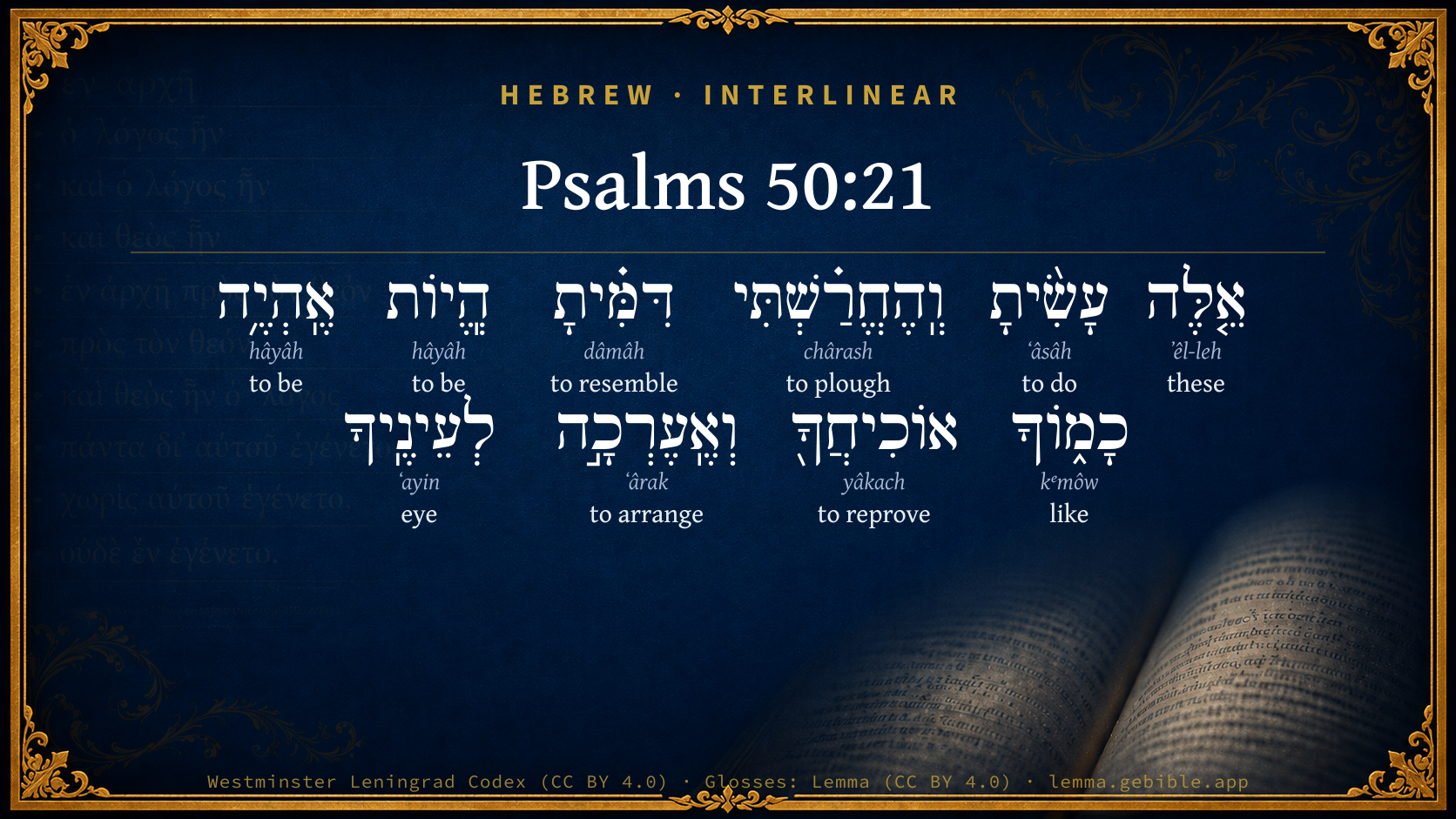
Hebrew (Westminster Leningrad Codex) Psalms 50:21 appears in the Hebrew Old Testament. The text above is from the Westminster Leningrad Codex. Each word links to its Strong’s number, a concise gloss, and parsing drawn from the Open Scriptures Hebrew Bible morphology. Click any word for its full Brown-Driver-Briggs (BDB) entry.
Download image
Cite this verse

Psalms 50:21 (World English Bible). Public Domain. Lemma interlinear Bible study tool, https://lemma.gebible.app/v/psalms/50/21.

Show BibTeX & RIS
BibTeX
RIS
English Translation
You have done these things, and I kept silent. You thought that the "I AM" was just like you. I will rebuke you, and accuse you in front of your eyes.
World English Bible · Public Domain
Download a study sheet

One document with this verse’s original text, its word-by-word gloss line, the meaning frame, cross-references with their text, attributed commentary, and full source and license credits — printable, and it pastes into notes with its structure intact.

This verse Autodidact and up

Study sheet (.html) Plain text (.txt)

A passage Seminary Student

Up to 50 verses in one chapter. A passage sheet keeps up to 6 commentary sources and 12 cross-references per verse, in the order this page ranks them, and says so on the sheet whenever that leaves anything out. Ask for a single verse and you get the Autodidact verse sheet above.

Everything on this page stays free to read, with no account — the sheet is a download of what is already on screen, not access to it.

Want to remove ads? Support Godless Engineer
Compare translations 3

The same verse in 3 English versions, stacked beneath the original-language interlinear above. Click any original word for its lexicon entry.

Each is an independent rendering of the whole verse — the interlinear is not word-aligned to these translations.

Highlighted words mark where these versions differ — a whole-verse word diff, not a word-by-word alignment.

  • World English Bible Public Domain
    You have done these things, and I kept silent. You thought that the "I AM" was just like you. I will rebuke you, and accuse you in front of your eyes.
  • King James Version Public Domain
    These things hast thou done, and I kept silence; thou thoughtest that I was altogether such an one as thyself: but I will reprove thee, and set them in order before thine eyes.
  • unfoldingWord Literal Text CC BY-SA 4.0
    You have done these, but I have been silent. You thought the being of I AM like you. I will accuse you, and let me array to your eyes.

unfoldingWord Literal Text — © unfoldingWord, licensed CC BY-SA 4.0. Word-aligned USFM3 via Door43 (git.door43.org/unfoldingWord/en_ult).

Versions to compare (up to 4)

3 of 4 selected

Show all 18 translations

Every available English version of this verse, each an independent rendering of the whole verse.

  • World English Bible Public Domain
    You have done these things, and I kept silent. You thought that the "I AM" was just like you. I will rebuke you, and accuse you in front of your eyes.
  • Berean Standard Bible Public Domain
    You have done these things, and I kept silent; you thought I was just like you. But now I rebuke you and accuse you to your face.
  • Majority Standard Bible Public Domain
    You have done these things, and I kept silent; you thought I was just like you. But now I rebuke you and accuse you to your face.
  • King James Version Public Domain
    These things hast thou done, and I kept silence; thou thoughtest that I was altogether such an one as thyself: but I will reprove thee, and set them in order before thine eyes.
  • American Standard Version (1901) Public Domain
    These things hast thou done, and I kept silence; Thou thoughtest that I was altogether such a one as thyself: `But' I will reprove thee, and set `them' in order before thine eyes.
  • Revised Version (1885) Public Domain
    These things hast thou done, and I kept silence; thou thoughtest that I was altogether such an one as thyself: but I will reprove thee, and set them in order before thine eyes.
  • Geneva Bible (1599) Public Domain
    These things hast thou done, and I held my tongue: therefore thou thoughtest that I was like thee: but I will reproue thee, and set them in order before thee.
  • Douay-Rheims (1899) Public Domain
    these things hast thou done, and I was silent. Thou thoughtest unjustly that I should be like to thee: but I will reprove thee, and set before thy face.
  • Young's Literal Translation Public Domain
    These thou didst, and I kept silent, Thou hast thought that I am like thee, I reprove thee, and set in array before thine eyes.
  • Literal Standard Version CC BY-SA 4.0
    These you did, and I kept silent, || You have thought that I am like you, || I reprove you, and set in array before your eyes.
  • Unlocked Literal Bible CC BY-SA 4.0
    You have done these things, but I have kept silent, so you thought that I was someone just like yourself. But I will reprove you and bring up, right before your eyes, all the things you have done.
  • unfoldingWord Literal Text CC BY-SA 4.0
    You have done these, but I have been silent. You thought the being of I AM like you. I will accuse you, and let me array to your eyes.
  • Darby Bible Public Domain
    These [things] hast thou done, and I kept silence; thou thoughtest that I was altogether as thyself: [but] I will reprove thee, and set [them] in order before thine eyes.
  • World Messianic Bible Public Domain
    You have done these things, and I kept silent. You thought that I was just like you. I will rebuke you, and accuse you in front of your eyes.
  • Webster's Bible Public Domain
    These things hast thou done, and I kept silence; thou thoughtest that I was altogether such an one as thyself: but I will reprove thee, and set them in order before thine eyes.
  • Free Bible Version CC BY-SA 4.0
    I kept quiet when you did these things. You thought I was someone just like you. But now I confront you, and bring my charges against you.
  • Bible in Basic English Public Domain
    These things have you done, and I said nothing; it seemed to you that I was such a one as yourself; but I will make a protest against you, and put them in order before your eyes.
  • JPS Tanakh (1917) Public Domain
    These things hast thou done, and should I have kept silence? Thou hadst thought that I was altogether such a one as thyself; but I will reprove thee, and set the cause before thine eyes.

Literal Standard Version (2020), Covenant Press — licensed CC BY-SA 4.0. Text via the HelloAO Bible API (eBible.org). Unlocked Literal Bible (unfoldingWord) — licensed CC BY-SA 4.0. Text via the HelloAO Bible API (eBible.org). unfoldingWord Literal Text — © unfoldingWord, licensed CC BY-SA 4.0. Word-aligned USFM3 via Door43 (git.door43.org/unfoldingWord/en_ult). Free Bible Version, Dr. Jonathan Gallagher — licensed CC BY-SA 4.0. Text via the HelloAO Bible API (eBible.org).

Word by word

More ways to search: Search by grammar → Find every occurrence → Compare this word →

Practice this passage: Drill this verse → Learn its vocabulary →

דִּמִּ֗יתָ
dâmâh
H1819
“to resemble”
Verb, Piel, Perfect, 2nd Person, Masculine, Singular
Part of Speech
Verb
Stem
Piel
Form
Perfect
Person
2nd Person
Gender
Masculine
Number
Singular
Full BDB Definition

Origin: a primitive root

TWOT: 437

to be like, resemble - (Qal) to be like, resemble - (Piel) - to liken, compare - to imagine, think - (Hithpael) to make oneself like - (Niphal)
  1. אֵ֤לֶּה ʼêl-leh H428 “these” Pronoun, Demonstrative, Common, Plural
  2. עָשִׂ֨יתָ ʻâsâh H6213 “to do” Verb, Qal, Perfect, 2nd Person, Masculine, Singular
  3. וְֽהֶחֱרַ֗שְׁתִּי chârash H2790 “and · to plough” Conjunction + Verb, Hiphil, Sequential Perfect, 1st Person, Common, Singular
  4. הֱֽיוֹת hâyâh H1961 “to be” Verb, Qal, Infinitive Construct
  5. אֶֽהְיֶ֥ה hâyâh H1961 “to be” Verb, Qal, Imperfect, 1st Person, Common, Singular
  6. כָמ֑וֹךָ kᵉmôw H3644 “like · you” Preposition + Suffix, Personal, 2nd Person, Masculine, Singular
  7. אוֹכִיחֲךָ֖ yâkach H3198 “to reprove · you” Verb, Hiphil, Imperfect, 1st Person, Common, Singular + Suffix, Personal, 2nd Person, Masculine, Singular
  8. וְאֶֽעֶרְכָ֣ה ʻârak H6186 “and · to arrange” Conjunction + Verb, Qal, Cohortative, 1st Person, Common, Singular
  9. לְעֵינֶֽיךָ ʻayin H5869 “to/for · eyes · your” Preposition + Noun, Common, Both, Dual, Construct + Suffix, Personal, 2nd Person, Masculine, Singular

About this verse

These counts appear in no published source. They are computed here, from the morphology-tagged text and Lemma’s own curated glosses. What Lemma adds →

10
words
9
distinct lemmas
Wisdom
section

Shared distinctive vocabulary

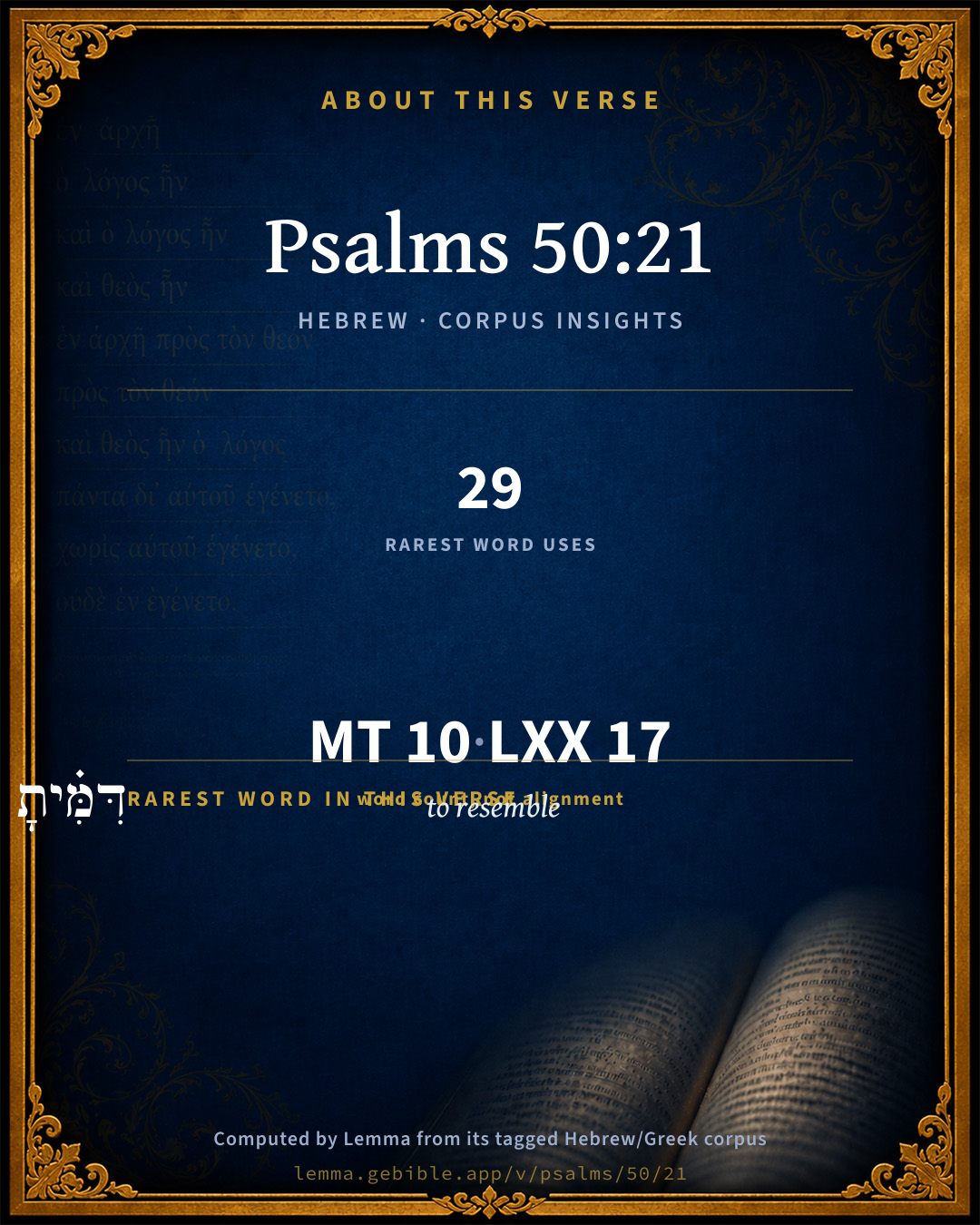
דִּמִּ֗יתָ to resemble H1819 occurs in 27 verses of the Hebrew Bible. Also found in:

Grammatical profile

  • 7 verbs
  • 1 noun
  • 1 pronoun
  • 1 preposition

Verb forms

  • עָשִׂ֨יתָ Qal · Perfect
  • וְֽהֶחֱרַ֗שְׁתִּי Hiphil · Sequential Perfect
  • דִּמִּ֗יתָ Piel · Perfect
  • הֱֽיוֹת Qal · Infinitive Construct
  • אֶֽהְיֶ֥ה Qal · Imperfect
  • אוֹכִיחֲךָ֖ Hiphil · Imperfect
  • וְאֶֽעֶרְכָ֣ה Qal · Cohortative

Repetition

A word recurs within this verse — often emphatic in Hebrew:

  • הֱֽיוֹת to be H1961 ×2

Hebrew & Septuagint length

In English translation the verse runs 31 words from the Hebrew and 28 from the Septuagint (LXX English) — closely comparable.

A rough comparison of the two English renderings, which tokenize alike — not a word-level alignment.

Word counts can differ between the Hebrew and the Greek without any difference in meaning — e.g. the Hebrew direct-object marker אֵת has no separate Greek word, and Greek often adds the article ὁ.

In the original languages it is 10 Hebrew tokens and 17 Greek tokens — but the two are counted differently (Hebrew bundles its prefixes and suffixes into one token; the Greek is in lemma form), so that isn’t a like-for-like length.

Cross-references

20

Topical passages linked to Psalms 50:21 in the Treasury of Scripture Knowledge — connected by theme and wording, ordered by reader-vote popularity; previews shown in the World English Bible.

  • Romans 2:4–5 Or do you despise the riches of his goodness, forbearance, and patience, not knowing that the goodness of God leads you to repentance?
  • Proverbs 29:1 He who is often rebuked and stiffens his neck Will be destroyed suddenly, with no remedy.
  • Isaiah 57:11 Of whom have you been afraid and in fear, that you lie, and have not remembered me, nor laid it to your heart? Haven't I held my peace even of long time, and you don't fear me?
  • Psalms 94:7–11 They say, "Yah will not see, Neither will Jacob's God consider."
  • Ecclesiastes 12:14 For God will bring every work into judgment, with every hidden thing, whether it is good, or whether it is evil.
  • Psalms 90:8 You have set our iniquities before you, Our secret sins in the light of your presence.
  • Ecclesiastes 8:11–12 Because sentence against an evil work is not executed speedily, therefore the heart of the sons of men is fully set in them to do evil.
  • Isaiah 42:14 I have long time held my peace; I have been still, and refrained myself: [now] will I cry out like a travailing woman; I will gasp and pant together.
  • Psalms 50:3 Our God comes, and does not keep silent. A fire devours before him. It is very tempestuous around him.
  • Psalms 73:11 They say, "How does God know? Is there knowledge in the Most High?"
  • 1 Corinthians 4:5 Therefore judge nothing before the time, until the Lord comes, who will both bring to light the hidden things of darkness, and reveal the counsels of the hearts. Then each man will get his praise from God.
  • Isaiah 40:15–18 Behold, the nations are as a drop of a bucket, and are accounted as the small dust of the balance: Behold, he takes up the isles as a very little thing.
  • Amos 8:7 Yahweh has sworn by the pride of Jacob, "Surely I will never forget any of their works.
  • Isaiah 26:10 Let favor be shown to the wicked, yet will he not learn righteousness; in the land of uprightness will he deal wrongfully, and will not see the majesty of Yahweh.
  • Revelation 3:19 As many as I love, I reprove and chasten. Be zealous therefore, and repent.
  • Psalms 109:1–3 God of my praise, don't remain silent,
  • 2 Peter 3:9 The Lord is not slow concerning his promise, as some count slowness; but is patient with us, not wishing that any should perish, but that all should come to repentance.
  • Exodus 3:14 God said to Moses, "I AM WHO I AM," and he said, "You shall tell the children of Israel this: "I AM has sent me to you."
  • Numbers 23:19 God is not a man, that he should lie, Neither the son of man, that he should repent: Has he said, and will he not do it? Or has he spoken, and will he not make it good?
  • Psalms 50:8 I don't rebuke you for your sacrifices. Your burnt offerings are continually before me.

Cross-references courtesy of OpenBible.info (CC BY 4.0).

Hebrew and Greek witnesses Masoretic Hebrew ↔ Greek Septuagint

The same verse in the two great witnesses to the Old Testament, shown verse-for-verse.

You’re reading Greek Psalm 49 (Hebrew Psalm 50). The Septuagint counts the superscription, so verse numbers can differ from the Hebrew — chapter-level alignment, not verse-by-verse. Numbering follows Rahlfs.

These are two independent witnesses, not word-aligned to each other, and the Septuagint is shown in lemma (dictionary) form.

Hebrew Psalms 50:21 Masoretic · Westminster Leningrad Codex

אֵ֤לֶּה עָשִׂ֨יתָ וְֽהֶחֱרַ֗שְׁתִּי דִּמִּ֗יתָ הֱֽיוֹת אֶֽהְיֶ֥ה כָמ֑וֹךָ אוֹכִיחֲךָ֖ וְאֶֽעֶרְכָ֣ה לְעֵינֶֽיךָ

You have done these things, and I kept silent. You thought that the "I AM" was just like you. I will rebuke you, and accuse you in front of your eyes.

World English Bible · Public Domain

Greek LXX Greek Psalm 49:21 Septuagint · lemma form

οὗτος ποιέω καί σιγάω ὑπολαμβάνω ἀνομία ὅτι εἰμί σύ ὅμοιος ἐλέγχω σύ καί παραἵστημι κατά πρόσωπον σύ

These things you did, and I kept silence: you thought wickedly that I should be like you, but I will reprove you, and set your offenses before you.

LXX2012 (modern English Septuagint) · Public Domain

Hebrew: Westminster Leningrad Codex (CC BY 4.0). Greek: Septuagint (public domain); English from LXX2012 (modern English Septuagint) (Public Domain). How the Septuagint differs from the Hebrew →

Commentary

Notes on Psalms 50:21 from classic Christian and Jewish commentators (each source and its license shown beneath its notes). The classic Christian expositions comment on the surrounding passage and are grouped to its opening verse, so a note may address several verses; the Jewish commentaries on the Tanakh (Rashi and others) are per-verse, so they appear only where the commentator wrote on this verse.

Lemma curates 59 commentaries, every one of them public domain or Creative Commons licensed, each selected and text-cleaned for this edition rather than reprinted as found. About our sources →

Trapp's Complete Commentary

John Trapp

Psa 50:21 These [things] hast thou done, and I kept silence; thou thoughtest that I was altogether [such an one] as thyself: [but] I will reprove thee, and set [them] in order before thine eyes.

Ver. 21. These things hast thou done, and I kept silence] I suffered them, seemed to wink at them, bearing with thine evil manners.

Thou thoughtest that I was altogether such an one as thyself] A good fellow, an approver, an abetter of thy lewd pranks and practices. Cogitabas quod Ehiah erat sicut tu, so Kimchi reads it. This is the evil use that wicked men make of God’s patience, they transform him into an idol after their own fancy, they have base and bald conceits of him.

But I will reprove thee, and set them in order before thee] Thou shalt see them once in their ugly hue, to thy conversion or confusion. Men’s actions are in print in heaven, and unless they make their peace with the Judge in his privy chamber of mercy, and so stop his open judicial proceedings in court, he will one day read them aloud in the ears of all the world. Meanwhile God looketh upon old sins (which he seemed to wink at) as now presently committed (for as there is no beginning of eternity, so no succession), and whatsoever he hath threatened, whatever arrows are in the bow string, will one day fly and hit, and strike deep. Woe be to men! God shall break up that filthy sink of sin that is in them; surely they will then be as little able to bear the stench thereof as Judas was, who sought help of a halter.

John Trapp, A Commentary or Exposition upon All the Books of the Old and New Testament (1647–1656) — public domain. Text from a community e-Sword module.

The Biblical Illustrator

Joseph S. Exell

Psa_50:21

These things hast thou done, and I kept silence.

The silence of God

I. Divine silence maintained. He does indeed speak to you by the eloquence of creation; by the kind lips of providence; by His own inspired Word, warning, inviting, entreating and persuading you to seek Christ. But he does not speak to you in the same startling way now as He will speak to you in the world to come. His present silence is a proof of His long-suffering. He is not willing that any of us should perish, tie is anxious that we should all come to repentance. How wrong, therefore, is it for any to abuse this silence!

II. Divine silence broken. The forbearance of God only encouraged the Jews in their rebellious conduct. At length the Lord made the Roman armies the instruments of His correction. He then indeed reproved them, and showed them the things they had done, in rejecting and crucifying the Lord of glory. And what God then did towards the impenitent Jews He will hereafter do to all who lived and died in sin.

III. Application.

1. The duty of mutual forbearance.

2. The blessedness of cheerful resignation. (C. Clayton, M. A.)

Gods silence

In this psalm we have a graphic representation of a court of justice: the judge, the court-house, the guards, the criminals. The accusations are of two kinds. Some are arraigned for formalism; others for grievous crimes. It is in connection with these that God says, I kept silence. Concerning the silences of God, there is that which is--

I. The effect of his patience. He is slow to anger, but this silence will not be for ever. Our duty is told in (Rom_2:4).

II. A judicial infliction. See Saul, whom God answered no more. Ephraim was let alone. Christ silent before Herod. And so with hardened sinners now. Let us pray, Be not silent unto me, O God, but, etc.

III. The appointment of his wisdom. Secret things belong unto the Lord our God. We are to trust when we cannot understand.

IV. A temporary discipline. His children wander, and God hides His face to lead them to repent. The power of silence is very great. Be still, and know that I am God. Aaron held his peace. (W. G. Lewis.)

The Creator and the Son of Man

I. God fully observes the development of human sin, This evident--

1. From His nature (Psa_139:1-24.).

2. From the declaration of the Bible (Psa_94:9-11).

3. From the universal consciousness of sinners: they feel that God knows their sins.

4. From the retribution that has overtaken sinners even in this world.

II. For a time he forbears with the enormity of human sin. I kept silence.

1. The spiritual improvement of humanity requires this, and--

2. The mediation of Christ explains it.

III. He thoroughly understands the reason of human sin. Thou thoughtest, etc.

1. Sinners act as if they could conceal their sins from God as from man.

2. As if God thinks lightly of sin, or that time will make him, as it makes men, forget sin.

IV. He will assuredly award punishment for human sin. cf. Ecc_8:11-13. In that day God will set mans sins in order.

1. As to their real character.

2. Their terrible influence.

3. Their true desert. Sin, therefore, must either be punished or pardoned, as it can be in Christ. (David Thomas, D. D.)

The forbearance of God

It is true God keeps silence. We might expect as soon as the sin is committed, as soon as the lie has passed the lips, or while it is trembling on the tongue, the lightning flash of God would strike him down dead, or when the false oath is uttered, that God would make His thunderbolt strike the wretch to the dust! He is not a man, and therefore His are not the ways of man. Oh: the power of the silence of the omnipotent and infinite God, who could in a moment smite to ruin, to atoms, to annihilation the universe He has called into being, and yet poor, wicked, foolish worms dare to dash themselves upon the thick bosses of His buckler, and to rush on in sin and iniquity as a war-horse rushes into battle. But the day is coming--God has appointed a day in the which He will judge the world; and that day, that hour no one knoweth; and yet there is the day, there is the hour, therefore God says--and this is the issue of such sad misconstruction, if persevered in--I will reprove thee, and set them in order before thine eyes. Some He sets them before in darkness and despair. I have seen a few such cases, and they are terrible to witness, when a man awakes up to see the catalogue of his sins and he has no hope, but is given up to despair, and is abandoned by God; then a man has a foretaste of the worm that never dieth. What must it be to have them set before us when it is too late? Oh! what a dark panorama of eternity passes before the mind, when, in the lurid light of eternity, a man reads the dread catalogue! Then turn to the Lord, now. (Hugh Stowell, M. A.)

God keeping and breaking silence

I. Gods keeping silence. Now, our God is Jesus Christ. And, therefore, if we judge of what He will do by what He has done, this silence was to be expected from. Him. It is all of a piece with His conduct while upon earth. After the Divine intelligence which our Lord showed when He was twelve years of age, we read nothing more about Him until He was thirty. Many things must have gone on around Him which pained Him, and stirred within Him His zeal for His Fathers honour; but the time was not yet come for Him to take notice of them. Now, what does such keeping silence mean?

1. That He seems to take no notice of the wickedness of men. It does often seem so. How many persons daily bring themselves by drunkenness and other shameful vices to a level lower than that of the beasts that perish! How are the poor ground down by their employers, as if those employers had a property in their flesh and sinews; nay, in their very life! How are Gods Sabbaths broken continually, the Sunday being spent by many thousands among us, at best in perfect idleness, and at worst in a state of sottishness and stupidity! Shall not I visit for these things? saith the Lord. And yet He holds His hand for the present, and merely stands by, looking on.

2. Another meaning of Gods keeping silence is, that He does not now-a-days interfere with the order of nature. He lets things take their course, in heaven and earth. This was not so in the olden time, of which the Bible tells us. We read of miracles, that is, of changes of the order of nature, both in the New Testament and in the Old. But miracles are only for a season; and it is not in reason that they should be otherwise. When God had some new tidings to tell to the world, which they could not have found out by their own sense and wit, He gave to the men whom He sent with the message the power of working miracles. The miracles were a sort of bell which they rung in the ears of their generation, that people might listen to what they had to say, and believe that it came from heaven.

3. But since we know God to be grievously displeased with sin, there is something awful in His keeping silence while it is committed under His eye. If a child comes home conscious of having offended a parent, and the parent says nothing all that night, but merely looks very grave, the child is more frightened than he would be by a sharp rebuke or severe punishment; for if such rebuke or punishment were inflicted, he would, at least, know the worst; but when the parent is silent he knows not what may be hanging over him. In countries where earthquakes happen, a dead silence always goes before the earthquake. Nature seems hushed into an awful stillness, as if she were holding her breath at the thought of the coming disaster. So it is with Gods silencer It will be followed, when it seems deepest, by the earthquake of His judgments. And so the holy apostle writes to the Thessalonians: When they shall say Peace and safety (from the fact of Gods being so still and so dumb), then sudden destruction cometh upon them as travail upon a woman with child, and they shall not escape.

II. Gods breaking silence. Our God shall come, and shall not keep silence. We have seen that there was a great blaze of miracles when the Jewish dispensation was first set up, when Israel was called out of Egypt, and settled in the Holy Land. After they were fairly settled, God, for a long time, kept silence. And the silence waxed deeper and deeper, when the people were restored to their own lands after the Babylonish captivity, until at length His judgment came in the overthrow of Jerusalem, and the break-up of Israels national life. Josephus has some wonderful statements about that awful time. Now, so will it be with the Christian Church. At the first there was a blaze of miracles, as with Israel, but ever since God has been keeping silence: God never interferes, so men think and say. Now, one day, when these men are crying, Peace and safety, God will confound them by breaking silence. When our Lord comes the second time to earth, a far brighter blaze of miracles will shine around Him than that which ushered in His first appearance. The whole frame of nature will be rent in twain, as the veil of the temple formerly was, and we shall get a glimpse through the great cleft into the world of spirits; we shall see those things which here we have been called upon to believe without seeing--an innumerable company of angels, and a great white throne prepared for judgment, and Him who sitteth thereon. Examine your hearts as to whether you are among those who, when the Lord is thus manifested, will love His appearing? Is there no cherished sin, no darling lust, which you would dread above all things to have dragged into the light of His countenance, and laid naked and open under his eye? (Dean Goulburn.)

Abuse of the long-suffering of God

I. How the long-suffering or silence of God ought to be interpreted. Its perversion and abuse are most unnatural. This will be seen when we consider the principles on which God bases this administration. They are--

1. The appointment of a state of moral exercise and probation. Sudden punishment would render this impossible.

2. That we may see the evil of sin in itself as well as in its punishment. This also requires time.

3. That He may honour the sacrifice and intercession of His Son.

4. That He may manifest His love in seeking our recovery.

II. The corrupt perversion of this doctrine by sinful man. They think that God is like themselves.

1. Most men live in a state of almost total indifference to their actions; they are in almost entire ignorance both of God and of themselves.

2. Others are unbelievers, infidels.

3. Others take partial views of sin, and, so long as external morality and the ordinary law be not violated, they see no reason for penalty.

4. Religious formalists, who think that God is pleased with mere ceremonies and outward things.

III. The fatal result of all this. I will reprove thee, and, etc. Our sins shall be arrayed--

1. In their number.

2. In full light (Psa_90:8).

3. As connected with their root, in the heart.

4. In their relations, for sins are related to each other. (R. Watson.)

Thou thoughtest that I was altogether such as one as thyself.

Ideas of God

I. The natural tendency of the human mind is to think of Gods nature as corresponding in some way with that of man. The anthropomorphic representations of God in the Bible appeal to this natural disposition of the human mind. Made originally in the image of God, we naturally think Him the image of ourselves.

II. The exercise of this tendency plunges the human mind into egregious errors.

1. The savages ideal of his God is like himself--revengeful, cruel, destructive. As nations get civilized and refined, they associate corresponding passions to their own with their representations of the deities they worship--e, g. Greece and Rome. A theologian with an arbitrary and iron disposition will speak and write of God as Sovereign--arbitrary and inexorable. A theologian with a tender and benevolent disposition will write and speak of God as a gracious Father, full of pity and love.

2. We need to be on our guard; we have elements and materials for our conception of God

(1) in our own consciousness,

(2) in the works of nature, and

(3) in the written Word; but all will be an apocrypha and not an apocalypse, without the light that comes along the pathway of intelligent obedience and unwavering faith.

III. This tendency is the shadow of a glorious fact that has occurred in the history of our world. In the Incarnation God took upon Himself the likeness of man, but He did not become altogether like unto ourselves. Christ was superior to the highest and best of men--unique, incomparable in purity and power. (F. W. Brown.)

Mans conception of God

1. The state of a man makes his thought, and this thought has its influence on the present life and its prospects. Idolatry has its fictions of God, which are frauds upon men, who sink Him into grosser and more bestial forms. Superstition knows the same perversity, ascribing to God thoughts and practices that are unworthy His nature, concocted in a morbid imagination; ,as unreal as a system of belief would be which recorded your conceptions of men or your Maker formed in sleep while suffering from the nightmare. There is a tendency and habit of weakness to form God weak-minded; of cruelty to conceive of Him as cruel. To the pure He is pure, and to the froward, froward. To the prurient all is impure, and to the fraudulent all is deceit. The mummeries of worship, the follies of priestcraft, futile prevarications, cunning compromises and the stratagems of love and of war show this same fact in human life. Now transfer this lesson to the facts of another world.

2. Dire retribution may arise by simple reproduction: Keep the Word closed and every line and letter of your creed hidden, and look out over the face of the earth. You see various forms of animal life below, but none above, man. Before a closed Bible and a silenced Gospel what precludes the prospect that human life is to go to lower and yet lower grades according to its bent and bias? You see the loftiest summit rise from the plain and from among the uplands; and you see it steadily crumble and fall lower. What is there more congruous than the notion of transmigration? If there be evolution, there surely is devolution, a degradation of species. Nature teaches it. The spirit of man goeth--where? That of the brute--where? With the Bible closed we cannot answer. If there be no Gospel, no Heaven, no hell, no resurrection, no redemption, still there is no proof that there is no future. If you do not go upward, you do not prove that there is no downward. What is your hope? Where is your God? Is He a deceiver and the world full of illusions, with no relief, no redress, no rescue, no resurrection and nothing of us to be? Is your God fate? If so, hell, as men have printed it, is but a trifle to what is now already; just as when the merciless breakers dash the drowning man in their seething, swirling eddies, the glare of the volcano in the distance or a raging conflagration is nothing; just as the news of the burning of all his property is nothing to one about to swing from the gibbet. What is your God? Will He be what you make Him now? He is not what unbelief represents Him to be, but He is in Christ reconciling the world unto Himself. Open now the Bible, build your altar, bind the sacrifice! Acquaint thyself with Him and be at peace, for this is life eternal to know Him! (H. S. Carpenter, D. D.)

We see as we are--in God

Some one has said, In the beginning of Scripture we read that God said, Let us make man in our image, after our likeness; and, all through history, man has been saying, Let us make God in our image, after our likeness. How apt the observation is, let the gods many of paganism, and the gods many of Christianity, testify. Men see as they are, and not otherwise.

1. What does the suspicious, distrustful person make God to be? He projects upon the Divine character his own character; and suspicion must therefore be a leading feature in the character of his deity. His God is a suspicious being, never trusting His creatures, but always distrusting them, and the suspicious deity has no friends.

2. What is the God of the selfish man like? His religion must be simply a branch of his selfishness--a thing of all take and no give. Can his God be the God who so loved the world, etc., and whose better blessedness it is to give rather than to receive?

3. What is the God of the hard, unforgiving man? A stern Shylock, for ever unbending as adamant, in his clamour for the pound of flesh. Without a moments hesitation, and without a thrill of pity, he can consign his best friend to a hopeless future, and think he glorifies the Divine justice thereby. Pity the man who can be content with such a conception of God.

4. What about the God of the superstitious? His God is perpetually his foe, and never his friend. He cannot help being a slave, in the service of such a deity. His one ambition is to appease His wrath, or court His favour. He must keep on good terms with a God so vengeful, that he may escape the punishment and receive the reward.

5. A grand, gentlemanly deity is the God of the mammon-worshipper. Majesty and dignity are in His every step. Almightiness encompasses His way. Marvellous display, imposing grandeur impresses His devotees. His robe--the rainbow; His crown--a circlet of stars; His chariot--the wind; His horses--the fiery coursers of the sun. What more magnificent and effective than such a God! But nothing attractive, nothing loveable about Him.

6. Contrast with these the God of the Gospels--the God of the simple, true and pure heart. His God is the good shepherd following the lost sheep out into the wilderness, the wise husbandman refusing to rush in wildly to pluck up the tares which an enemy hath sown in his wheat field, the yearning parent going out eagerly to meet the returning prodigal and anticipating his penitence and his pleading in the glorious glow of his merciful joy. These are the very highest attributes, of the highest and fairest earth has ever seen. These are some of the lights of the Exalted One in whom all fulness dwells. So the simple Christian clothes his God in that garment of salvation, and he walks side by side with Him on the earth, in the spirit of Him who said, I and the Father are One. (J. E. Hill, B. D.)

I will reprove thee, and set them in order before thine eyes.--

Conviction of sin

It is possible to misinterpret the moral government of God, and many do so. It seems to some as if the world were so arranged as to offer facilities for sin. For sin is rampant everywhere, and yet God seems to take no notice, He does not interfere to prevent or to chastise. Now, if we let crime and wrong pass unreproved, our moral sensibilities become deadened, and we become culpably indifferent to the just principles of righteousness. On the other hand, if a mans sense of right is strong, and his moral sensibilities properly quick, he will not be able to control the expression of his resentment against what is an outrage on common decency or justice. But since God sees far worse things and more of them than any man can see, and yet does not intervene, we are apt practically to form some very false conclusions about His character, though few would have the temerity to state them. We feel as if God could not think so very seriously of sin when He contemplates it with such composure. Surely if sin were so very terrible an evil its consequences would be more apparent; it does not seem such a very appalling or abhorrent thing to us, and apparently neither does it seem so to God. And this is because men misunderstand and misinterpret the majestic silence of God. I kept silence--this has been Gods rule, and upon it men presume. To guard against this let us seek to have a true view of this characteristic of the Divine government. Why does God keep silence, and show Himself patient as well as strong, although He be provoked every day? Not because He is indifferent to sin, and not because He does not intend to punish it, but because He has ordained certain conditions for our probation here, and He is not so inconsistent as to reverse them. Man was created by God in His own image, in this respect above all others, that he possessed from the first a power of independent volition, a capacity of free-will, by the right and dutiful exercise of which he was to be raised to his proper destiny, and fitted to share the glories of the Divine Being. Man, therefore, must not be forced to act rightly. If a highwayman demands your money with a pistol at your ear, you may exercise your will in handing him your purse, but it is hardly a free will. If an officer of justice catches you when you were just preparing to appropriate your neighbours property, your will may decide in this instance to be honest, but it is hardly a free will. And so God keeps silence, lets men do as they like, not coercing them by prompt penalty every time they transgress. How solemn and impressive is this silence of God. Slight natures may easily be stirred and goaded into frenzy, but it takes much more to awaken those of a grave and resolute character. But when such are moved, then their indignation is terrible. A silent God is not to be despised and trifled with. And lest His silence should mislead us, He does on rare occasions break His rule of silence. And because this is so unusual it is all the more impressive. A gentleman came up to me in the streets of Liverpool a few years ago, and told me of an incident in my dear fathers ministry, of which he was an eye-witness, many years before. Your father, said he, was preaching on a then vacant spot of ground near where St: Georges Hall now stands. Directly opposite the place where he was standing an ungodly publican, finding his business interfered with, came out, and endeavoured to interrupt the proceedings, mimicking the preachers manner and gestures, and using very horrible language. I remember, said the gentleman, how solemnly your dear father turned round upon him and said, Take care, my friend, it is not me, but my Master that you are mocking, and remember you cannot mock God with impunity; take care lest you draw down upon your head His just vengeance. He afterwards announced that he would preach in the same spot the next Sunday afternoon, which he did; and as he gave out his text, you may imagine the feeling of awe that settled down upon the crowd as they saw a hearse draw up to the door of the public-house to carry away the corpse of that very man who one short week before had been defying God and insulting His messenger. Why are such things allowed from time to time to happen? Because God has made a mistake in keeping silence? Nay, verily; but because He sees it necessary from time to time to remind us that, though silent, He is not blind, and though self-controlled, He is not unconcerned. Now, the curse which came on the world when Adam sinned, and afterwards the flood, and chief of all the death of our Lord Jesus Christ--these are three stupendous facts in human history in which we may say, God has broken silence. The cross of Calvary is Gods reproof to a world, and from that cross there sounds forth through all time the admonition, Now consider this, ye that forget God. And God has sent His Holy Spirit especially to carry on this work of reproof, and when He lays hold upon us it soon comes to pass that there is nothing left in our past life that we can bear to look upon. We begin to see ourselves as God sees us, and therefore we abhor ourselves and repent in dust and ashes. In one way or other these solemn words of God will be fulfilled, I will reprove thee, and set before thee in order the things that thou hast done. Ere yet that terrible reproof break your heart, and the thunder of Gods voice shake the ground from under your feet, and leave you sinking in despair, yield to the gentler tones of His convicting mercy. Confess yourself a guilty, ruined sinner, and claim that pardon which shall cancel the record that is against you, and purge your mortal archives. (W. H. M. H. Aitken, M. A.)

The sinners mistakes exposed and reproved

I. The manner in which God treats impenitent sinners during the present life. He is continually speaking to them in His Word, inviting, counselling and warning them to repent and flee from the wrath to come; nor does he fail often to speak to them in the same manner, by the voice of conscience. But, as a Judge, he usually observes the most profound silence. If it be asked, why God thus keeps silence; I answer, because this life is a season of trial and probation. Men are placed in this world, that they may show what is in their hearts, and thus discover their true characters. He sets before them in the works of creation sufficient evidence of His existence and perfections; He lays them under obligations to love and thank Him by the blessings of His providence; He clearly prescribes their duty, and gives them directions for its performance, in His Word; He places conscience in their breasts, as an overseer and monitor; and then, wrapped up in His own invisibility, sits silent and unseen, to notice and record their conduct.

II. The opinions which sinners form of God, in consequence of his thus keeping silence. Thou thoughtest that I was altogether such an one as thyself. It is their opinions of His moral character, of His views and feelings with respect to themselves and their conduct, to which the assertion refers. In this respect every unawakened sinner supposes, or at least acts as if he supposed, that God is altogether such an one as himself. Feeling no immediate tokens of Gods displeasure, he flatters himself that God is not displeased. Finding it easy to justify himself, and satisfy his own conscience, he fancies that it will be equally easy to satisfy God, and justify his conduct at His bar.

III. The measures which God will employ to convince sinners that he is not such an one as themselves. I will reprove thee, and set them in order before thine eyes. This He will do at the judgment-day.

1. It implies giving the sinner a clear and full view of all the sins of his life, in thought, word and deed, in the order in which they were committed. Such a view no sinner has of himself in the present life. He is guilty of ten thousand thousand sins, which he does not even suspect to be sins.

2. It implies giving him a view of all their aggravations. All the mercies he received, all the afflictions which were sent to rouse him, all the opportunities, privileges, warnings and means of grace with which he was favoured; all the sermons which he heard, and all the secret checks which he experienced from his own conscience, and from the strivings of Gods Spirit, will then be set before him, to show that he sinned wilfully and knowingly, against light and against love, and that he is, therefore, without excuse.

3. It implies giving him a full view of their dreadful malignity and criminality. Of this sinners see nothing in this world. They do not see what an infinitely great and glorious Being that God is against whom sin is committed. They do not see what an infinitely precious, lovely, and all-sufficient Saviour they are rejecting. They do not see what a heaven they are forfeiting, nor into what a hell they are plunging themselves by sin. They do not realize how short is time in comparison with eternity, nor how worthless the body when compared with the soul. But at the judgment-day they will behold every object in its true light.

IV. What improvement careless sinners ought to make of these awfully alarming truths. They should be led by them to consideration. It is owing to forgetfulness of God, and to the neglect of considering these important truths, that sinners live as they do. They consider not in their hearts, says Jehovah, that I remember all their wickedness. Is not this the case with respect to some of you? (E. Payson, D. D.)

The Biblical Illustrator, edited by Joseph S. Exell (c. 1880s–1900s) — public domain. Text from a community e-Sword module.

Joseph Benson's Commentary

Psa 50:21. These things hast thou done, and I kept silence — I did not express my displeasure against thee in such grievous judgments as thou didst deserve. Or, I was deaf: I conducted myself like one that did not hear thy sinful speeches, nor see, or take any notice of thy wicked actions. And thou thoughtest, &c. — Thou didst misconstrue and abuse my patience and long-suffering, as if it had proceeded from my not noticing, or not regarding thy evil courses, or from my approving of them; and therefore thou didst grow more audacious and impudent in sin. But I will reprove thee — I will quickly undeceive thee, and convince thee of the contrary, to thy cost; and set them, thy sins, in order before thine eyes — I will bring to thy remembrance, and lay upon thy conscience, all thy sins in full number, and in their order, with all their circumstances of aggravation: and thou shalt then see and know that I particularly observed and hated them all, and that none of them shall go unpunished. Thus the psalmist, as from the mouth of God, foretels the destruction of the impenitent Jews; who, having received the law of God, and the ordinances of his worship and service, and entered into a solemn covenant with him, would not be reformed by the warnings and exhortations of Moses or the prophets, nor by the preaching and miracles of Christ and his apostles; and, therefore, after a long series of lesser judgments and calamities, of which we have a circumstantial account in their history, at last suffered an infliction of wrath and vengeance sufficient to make the ears of every one that heareth it to tingle.

Joseph Benson's Commentary on the Old and New Testaments (1811–1818) — public domain. Text from a community e-Sword module.

J. A. Alexander on Psalms

Joseph Addison Alexander

21. (Psa 50:21) These things hast thou done, and I have held my peace; thou hast imagined I was just like thyself. I will reprove thee, and array (thy sins) before thine eyes. God is described as silent when he does not interpose with his reproofs or manifest his displeasure. See above, on Psa 28:1. Imagined; the Hebrew verb originally means to liken or compare, and another of the same form to be silent, so that it is peculiarly appropriate in this place, where the mention of God's silence immediately precedes, and the imagining referred to was a false assimilation of the Most High to the sinner himself. Just like, or exactly like, the intensive adverb corresponding to the emphatic repetition of the verb in Hebrew. In our idiom, an adversative particle is almost indispensable between the clauses; but the more abrupt transition is congenial with the spirit and usage of the Hebrew language. Array, arrange, set in order, so that none shall be omitted or overlooked. See above, on Psa 5:4 (3). Before thine eyes, literally to thine eyes, or to thy face, again implying that the sight of them is not to be avoided. This declaration of severe fidelity forms an appropriate conclusion to the second lesson of the psalm, or that in which the mask is stripped off from the vicious hypocrite, who professes to serve God while he lives in the grossest violation of his precepts, as in the first part (ver. 7-15) it was torn from the formal hypocrite, who satisfies himself with a mere outward and mechanical performance of rites designed to be significant of spiritual and devout affections.

Joseph Addison Alexander, The Psalms Translated and Explained (1850) — public domain. Text from a community e-Sword module.

Tyndale Open Study Notes

Tyndale Open Resources

50:21 Because he is patient, God remained silent.

Tyndale Open Study Notes — © Tyndale Open Resources, licensed CC BY-SA 4.0. Text via the HelloAO Bible API.

Geneva Bible (1599)

Geneva Bible translators

I will write all thy wicked deeds in a roll, and make thee to read and acknowledge them, whither thou wilt or no.

Geneva Bible (1599) marginal notes — public domain. Text via Bolls.life.

Jamieson, Fausset & Brown

Robert Jamieson, A. R. Fausset & David Brown

God, no longer (even in appearance) disregarding such, exposes their sins and threatens a terrible punishment.

Jamieson, Fausset & Brown — Commentary Critical and Explanatory on the Whole Bible (1871) — public domain (CC PDM 1.0). Text via the HelloAO Bible API.

Adam Clarke's Commentary

Verse 21. These things hast thou done] My eye has been continually upon you, though my judgments have not been poured out: and because I was silent, thou didst suppose I was such as thyself; but I will reprove thee, &c. I will visit for these things.

Adam Clarke's Commentary on the Bible (1810–1826) — public domain. Text from a community e-Sword/MySword module.

John Calvin's Commentaries

21 These things hast thou done Hypocrites, until they feel the hand of God against them, are ever ready to surrender themselves to a state of security, and nothing is more difficult than to awaken their apprehensions. By this alarming language the Psalmist aims at convincing them of the certainty of destruction should they longer presume upon the forbearance of God, and thus provoke his anger the more, by imagining that he can favor the practice of sin. The greatest dishonor which any can cast upon his name is that of impeaching his justice. This hypocrites may not venture to do in an open manner, but in their secret and corrupt imagination they figure God to be different from what he is, that they may take occasion from his conceived forbearance to indulge a false peace of mind, and escape the disquietude which they could not fail to feel were they seriously persuaded that God was the avenger of sin. We have a sufficient proof in the supine security which hypocrites display, that they must have formed such false conceptions of God. They not only exclude from their thoughts his judicial character, but think of him as the patron and approver of their sins. The Psalmist reprehends them for abusing the goodness and clemency of God, in the way of cherishing a vain hope that they may transgress with impunity. He warns them, that ere long they will be dragged into the light, and that those sins which they would have hidden from the eyes of God would be set in all their enormity before their view. He will set the whole list of their sins in distinct order, for so I understand the expression, to set in order, before their view, and force them upon their observation.

John Calvin's Commentaries (1540-1563) — public domain. Text from the Calvin Translation Society English edition (1840s-50s) via the Christian Classics Ethereal Library (ccel.org). Calvin's coverage is partial (roughly two-thirds of the Bible); uncommented books and verses are honest gaps, never fabricated. The 19th-century editor's footnotes and remarks are omitted so the notes are faithfully Calvin's own voice.

Ellicott's Commentary for English Readers

(21) The forbearance of God (intended to give room for repentance, Rom_2:4) is misconstrued. Men come to think the Divine Being as indifferent to evil as themselves.

That I was altogether.—We might render, that I was actually.

And set them in order.—The insertion of “them,” referring back to “these things,” is rather confusing. Better supply thine offences. All the sins of the wicked are marshalled before them.

A Bible Commentary for English Readers, edited by Charles John Ellicott (1878–1897) — public domain. Text from a community e-Sword module.

The Cambridge Bible for Schools and Colleges

gen. ed. J. J. S. Perowne

21. When thou didst these things, and I kept silence, refraining from immediate condemnation of thy conduct by condign punishment, thou didst mistake longsuffering for indifference, and think that I cared as little as thyself for the laws of morality.

that I was] This rendering hardly represents the original, which means that I should be or prove myself. It is the same word Ehyeh, I am, or I will be, which is found in Exo_3:14, in God’s proclamation of Himself as the Self-revealing One, ‘I will be that I will be.’ The wicked man degrades his conception of God into a reflection of himself, and fancies that Jehovah as He reveals Himself will prove to be only like a man.

set them in order] All the offences of which thou art guilty. The word is a forensic term, used of drawing up the various counts of an indictment. Cp. Job_23:4; Job_33:5.

The Cambridge Bible for Schools and Colleges (gen. ed. J. J. S. Perowne; Cambridge University Press, 1878–1918) — public domain. Text from a community e-Sword module.

John Gill's Exposition

Now consider this,.... The evils that had been committed, and repent of them; for repentance is an after thought and reconsideration of sin, and humiliation for it; that the Lord, was not like them, not an approver of sin, but a reprover for it; and what would be their latter end, what all this would issue in, in case of impenitence;

ye that forget God; that there is a God, his being, perfections, word, works, and benefits;

lest I tear you in pieces; as a lion, leopard, or bear; see Hos 13:7; which was accomplished in the destruction of Jerusalem; when both their civil and ecclesiastical state were torn in pieces; their city and temple levelled with the ground, and not one stone left upon another; and they scattered about in the earth;

and there be none to deliver; which denotes their utter and irreparable ruin, till the time comes they shall turn to the Lord; see Isa 42:22.

John Gill's Exposition of the Whole Bible (1746–1763) — public domain (CC PDM 1.0). Text via the HelloAO Bible API.

Albert Barnes' Notes on the Bible

These things hast thou done, and I kept silence - Compare the notes at Isa 18:4. The meaning is, that while they did these things - while they committed these abominations - he did not interfere. He did not come forth in his anger to destroy them. He had borne all this with patience. He had borne this until it was now time that he should interpose Isa 18:3, and state the true principles of his government, and warn then of the consequences of such a course of sin and hypocrisy. Compare the notes at Act 17:30.

Thou thoughtest that I was altogether such an one as thyself - The idea here is, that they thought or imagined that God was just like themselves in the matter under consideration, and they acted under this impression; or, in other words, the fair interpretation of their conduct was that they thus regarded God. That is, they supposed that “God” would be satisfied with the “forms” of religion, as “they” were; that all he required was the proper offering of sacrifice, according to “their” views of the nature of religion; that he did not regard principle, justice, pure morality, sincerity, even as they themselves did not; and that he would not be strict to punish sin, or to reprove them for it, if these forms were kept up, even as “they” were not disposed to be rigid on the subject of sin.

But I will reprove thee - I will rebuke thee alike for thy sins, and for this view of the nature of religion.

And set them in order - literally, I will “array” them; that is, I will draw them out to view in their appropriate ranks and orders, as soldiers are drawn up in martial array. They shall be so arranged and classified that they may be seen distinctly.

Before thine eyes - So that they may be plainly seen. The meaning is, that they would have a clear and impressive view of them: they would be made to see them as they were. This might be done then, as it is done now, either

(a) by their being set before their minds and hearts, so that they would see and feel the enormity of sin, to wit, by conviction for it; or

(b) by sending such punishment on them for their sins that they might “measure” the guilt and the number of their transgressions by the penalties which would be inflicted.

In some way all sinners will yet be made to see the nature and the extent of their guilt before God.

Albert Barnes' Notes on the Bible (1834–1885) — public domain. Text from a community e-Sword/MySword module.

Matthew Poole's English Annotations

I kept silence; I did not express my displeasure against thee in such grievous judgments as thou didst deserve. Or, I was deaf; I carried myself like one that did not hear thy sinful speeches, nor see or take any notice of thy wicked actions. And thou didst misconstrue and abuse this my patience and long-suffering, as if it had proceeded from my ignorance, or regardlessness, or approbation of thy evil courses, which I seemed by my connivance to justify or allow, and thereupon didst grow more audacious and impudent in sin. See Ecc 11:9; Isa 26:10; Rom 2:4,5.

I will reprove thee, not with verbal, but real reproofs, i.e. by severe punishments, as this word is used, Job 13:10; Psa 6:1; 38:1; 39:11, and oft elsewhere. I will quickly undeceive and convince thee of the contrary to thy cost.

Set them in order before thine eyes; I will bring to thy remembrance, and lay upon thy conscience, all thy sins, in full number and in their order, with all their circumstances; and thou shalt then see and know that I diligently observed and hated them all, and that none of them shall go unpunished.

Matthew Poole's English Annotations on the Holy Bible (1683–1685) — public domain. Text from a community e-Sword/MySword module.

The Treasury of David

Charles H. Spurgeon

Ver. 21. These things hast thou done, and I kept silence. No swift judgment overthrew the sinnerlongsuffering reigned; no thunder was heard in threatening, and no bolt of fire was hurled in execution. Thou thoughtest that I was altogether such an one as thyself. The inference drawn from the Lord's patience was infamous; the respited culprit thought his judge to be one of the same order as himself. He offered sacrifice, and deemed it accepted; he continued in sin, and remained unpunished, and therefore he rudely said, "Why need believe these crazy prophets? God cares not how we live so long as we pay our tithes. Little does he consider how we get the plunder, so long as we bring a bullock to his altar." What will not men imagine of the Lord? At one time they liken the glory of Israel to a calf, and anon unto their brutish selves. But I will reprove thee. At last I will break silence and let them know my mind. And set them in order before thine eyes. I will marshall thy sins in battle array. I will make thee see them, I will put them down item by item, classified and arranged. Thou shalt know that if silent awhile, I was never blind or deaf. I will make thee perceive what thou hast tried to deny. I will leave the seat of mercy for the throne of judgment, and there I will let thee see how great the difference between thee and me.

Ver. 21. These things hast thou done, and I kept silence. Neither sleep nor slumber, nor connivance, nor neglect of anything can be incident to God. Because he doth not execute present judgment and visible destruction upon sinners, therefore blasphemy presumptuously inferswill God trouble himself about such petty matters? So they imagined of their imaginary Jupiter. Non vacat exiguis rebus adesse Jovem. What a narrow and finite apprehension this is of God! He that causes and produces every actionshall he not be present at every action? What can we do without him, that cannot move but in him? He that taketh notice of sparrows, and numbers the seeds which the very ploughman thrusts in the ground, can any action of man escape his knowledge, or slip from his contemplation? He may seem to wink at things, but never shuts his eyes. He doth not always manifest a reprehensive knowledge, yet he always retains an apprehensive knowledge. Though David smote not Shimei cursing, yet he heard Shimei cursing. As judges often determine to hear, but do not hear to determine; so though God does not see to like, ye he likes to see. Thomas Adams.

Ver. 21. Thou thoughtest that I was altogether such an one as thyself. Such is the blindness and corruption of our nature, that we have very deformed and misshapen thoughts of him, till with the eye of faith we see his face in the glass of the word; and therefore Mr. Perkins affirms, that all men who ever came of Adam (Christ alone excepted) are by nature atheists; because at the same time that they acknowledge God, they deny his power, presence, and justice, and allow him to be only what pleaseth themselves. Indeed, it is natural for every man to desire to accommodate his lusts with a conception of God as may be most favourable to and suit best with them. God charges some for this: Thou thoughtest that I was altogether such an one as thyself. Sinners do with God as the Ethiopians do with angels, whom they picture with black faces that they may be like themselves. William Gurnall.

Ver. 21. Thou thoughtest that I was altogether such an one as thyself. This men do when they plead for sins as little, as venial, as that which is below God to take notice of; because they themselves think it so, therefore God must think it so too. Man, with a giant like pride, would climb into the throne of the Almighty, and establish a contradiction to the will of God by making his own will, and not God's, the square and rule of his actions. This principle commenced and took date in Paradise, where Adam would not depend upon the will of God revealed to him, but upon himself and his own will, and thereby makes himself as God. Stephen Charnock.

Ver. 21. I will set them in order before thine eyes. This is to be understood more militari, when sins shall be set in rank and file, in bloody array against thy soul; or more forensi, when they shall be set in order as so many indictments for thy rebellion and treason. Stephen Charnock.

Ver. 21. And set them in order before thine eyes: as if he should say, Thou thoughtest all thy sins were scattered and dispersed; that there was not a sin to be found; that they should never be rallied and brought together; but I assure thee I will make an army of those sins, a complete army of them, I will set them in rank and file before thine eyes; and see how thou canst behold, much less contend with, such an host as they. Take heed therefore you do not levy war against your own souls; that's the worst of all civil or interstine wars. If an army of divine terrors be so fearful, what will an army of black, hellish sins be? when God shall bring whole regiments of sins against youhere a regiment of oaths, there a regiment of lies, there a third of false dealings, here a troop of filthy actions, and there a legion of unclean or profane thoughts, all at once fighting against thy life and everlasting peace. Joseph Caryl.

Ver. 21. Atheists do mock at those Scriptures which tell us that we shall give account of all our deeds; but God shall make them find the truth of it in that day of their reckoning. It is as easy for him to make their forgetful minds remember as to create the minds in them. When he applies his register to their forgetful spirits they shall see all their forgotten sins. When the printer presseth clean paper upon his oiled irons, it receiveth the print of every letter: so when God shall stamp their minds with his register, they shall see all their former sins in a view. The hand was ever writing against Belshazzar, as he was ever sinning, though he saw it not till the cup was filled: so is it to the wicked; their sins are numbered, and themselves weighed, and see not till they be divided by a fearful wakening. William Struther.

Ver. 21. (last clause). God setteth his sins in order before his eyes. Imprimis, the sin of his conception. Item, the sins of his childhood. Item, of his youth. Item, of his man's estate, etc. Or, Imprimis, sins against the first table. Item, sins against the second; so many of ignorance, so many of knowledge, so many of presumption, severally sorted by themselves. He committed sins confusedly, huddling them up in heaps; but God sets them in order, and methodizes them to his hands. Thomas Fuller.

Ver. 21.

1. God leaves men for a time to themselves.

2. They judge of God on this account by themselves.

3. He will in due time reveal their whole selves to themselves. "I will reprove, "etc. G. R.

Ver. 21,23. Note the alternative; a life rightly ordered now, or sins set in order hereafter.

Psalms 50:22*

Ver. 21,23. Note the alternative; a life rightly ordered now, or sins set in order hereafter.

Charles H. Spurgeon's The Treasury of David (1869–1885) — public domain. Psalms only. Text from a community e-Sword/MySword module.

Whedon's Commentary on the Bible

Daniel D. Whedon

21. I kept silence—The delay of judgment caused them to infer that God took no judicial notice of their sins. Thou thoughtest, etc.—Here is the common delusion of sin. The more corrupt the heart, the less sinful will sin appear; and such persons form their estimates of the divine character by comparison with themselves.

Set them in order before thine eyes—The setting “in order” is a judicial opening and arranging the case, as to law, fact, and testimony. See Job_13:18; Job_23:4. When God shall do this “every mouth shall be stopped, and all the world become guilty before God.” Rom_3:19

Daniel D. Whedon (gen. ed.), Commentary on the Old and New Testaments (1874–1909) — public domain. Text from a community e-Sword module.

The Pulpit Commentary

These things hast thou done, and I kept silence; thou thoughtest that I was altogether such a one as thyself. Because God did not interpose openly to punish the sins committed, the transgressor dared to imagine him to be indifferent to sin, "such a one as himself no holier, no purer, no more averse to evil. But I will reprove thee, and set them in order before thine eyes. But now the time is come when I shall no longer keep silence; I shall openly "reprove" thee, and marshal in set order before thee all the wicked deeds which thou hast done. God, as Calvin says, "will lay before them in exact order a full catalogue of their misdeeds, which they must read and own, whether they will or not.

Thoughts of God.

"Thou thoughtest... as thyself." What a man thinks in his heart of God is the turning-point of life and character. If we think "all things are naked and opened," etc., (Heb_4:13) that we really "have to do" with God, this must needs tell on our whole view of life, from its greatest affairs to its least. If we think God takes no note of sin, we shall be careless of sin. If we think of God as severe, implacable, unjust, we may fear him, but cannot love him. If we think of him as loving and merciful, "faithful and just to forgive," etc., (1Jn_1:9) we shall learn to "love him, because he first loved us"; (1Jn_4:19) and loving, shall obey. And if we think of him as holy, we shall hate sin, and strive after holiness. (Heb_12:14) Let us note

(1) the wrong thought of God here rebuked;

(2) the equally dangerous opposite error;

(3) the truth, which in a distorted, imperfect form, is to be found in both.

I THE ERROR OF BRINGING DOWN OUR THOUGHTS OF GOD TO THE LEVEL OF HUMAN NATURE measuring God by man. "Thou thoughtest," etc. This is the germ of idolatry. Man"s nature makes him a worshipper. His reason demands God. His heart cries out for God. His weakness needs God. But his sinfulness shrinks from a righteous and holy God. (see St. Paul"s account of the matter, Rom_1:19-25) But those to whom this warning is spoken are not idolaters, any more than they are atheists. They "declare God"s statutes" and "take his covenant in their mouth." Professed members of his Church, even teachers in it. But "in works they deny him". (Tit_1:16) Looking at this psalm as predictive, its first fulfilment was when our Saviour denounced the hypocrites of this day; as in Mt 24. Its final fulfilment will be that of which he speaks in Mat_7:21-23. (The whole second chapter of Romans is a commentary on this psalm) How is such self-deceiving hypocrisy possible? Through false thoughts of God. Men persuade themselves that he does not mean what he says; will not be hard on them; is too indulgent really to punish sin. Not only a fatal error, but one that adds to other sins that of insulting the Most High! Terrible to think that men may set up an idol in their own thoughts a false view of God"s character and dealings, as unlike God as Baal or Juggernaut!

II THE OPPOSITE ERROR IS THAT OF SUPPOSING THAT GOD IN NO RESPECT RESEMBLES MAN; OR MAN, GOD. That there is nothing in our nature conscience, reason, affections from which we may infer some correspondence in "the Father of spirits." God is thus removed out of all reach of our knowledge, sympathy, love; and even trust and obedience. This is the error to which men are most prone in our own day, especially men of cultured intellect and science. They see themselves surrounded by an order so stupendous, laws so unchangeable, worlds and systems so remote, so ancient, so infinite to our feeble thought, that the Creator seems infinitely removed lost in the greatness of his own works. The world by wisdom knows not God. If such men worship, it is not the God revealed in the Bible and in Christ, but an idol not of sense or imagination, but intellect Infinite," "the Absolute," "the Stream of tendency making for righteousness," "the Unknowable.

III IN BOTH THESE ERRORS THERE IS A CERTAIN AMOUNT OF TRUTH. But only half the truth. Half-truths are often the most deadly errors, when mistaken for whole truths. But truth is not found by flying from one error to the opposite extreme. The truth contained, but concealed and distorted, in idolatry, is that man"s nature has something akin to God, so that man can converse with God. The truth contained, but perverted, in the philosophy which declares God to be "unknowable," is that our knowledge of him, though real and true, must needs be very limited. Finite minds cannot comprehend the Infinite.

The narrow limits of our knowledge of God, and its necessary imperfection, are amply taught in the Bible. (see Exo_3:13, 14 Isa_40:25 Isa_55:8, Isa_55:9) But the main efforts and purpose of the Bible, from first to last, is not to weigh us down with God"s incomprehensible greatness, but to lift us up and bring us near to him. Its opening page shows us, not God in the likeness of man, but man created in the image of God. Then the Scripture goes on to reveal God

(1) by providence, dealing with individuals as well as nations and the race;

(2) by law, binding us to him in duty and obedience;

(3) by promise, binding himself to us in a personal moral relation, which we personally enter into by faith; by

(4) miracle, making nature, where only dead law seems to reign, reveal his living presence, power, and love;

(5) by inspiration, communicating in human thought and speech all that we most need to know of him. Lastly, all these meet and are perfected in Christ. (Heb_1:1-3Jo Heb 1:18 Heb 14:9)

The Pulpit Commentary (1880–1919), ed. H.D.M. Spence-Jones & Joseph S. Exell — public domain. Text from a community e-Sword module.

John Wesley's Explanatory Notes

Kept silence - I did not express my displeasure against thee in such judgments as thou didst deserve. Thoughtest - Thou didst misconstrue my patience and long-suffering, as if it had proceeded from my approbation of thy evil courses. Set in order - I will bring to thy remembrance, and lay upon thy conscience all thy sins.

John Wesley, Explanatory Notes Upon the Whole Bible (1754–1765) — public domain. Text via the GEBible commentary corpus.

unfoldingWord translationNotes

Door43 World Missions Community

you thought that I was someone just like yourself

Since God had kept silent and not yet rebuked the wicked people for their actions, they thought that God approved of what they did. AT: "you thought that I was someone who acts just like you do" (See: Assumed Knowledge and Implicit Information)

reprove

tell someone he is guilty of doing wrong

bring up ... all the things you have done

God speaks of listing all of the evil things that they have done. AT: "list ... all the things you have done" (See: Idiom)

right before your eyes

Here, to be "before your eyes" means that it is in a place where they can see. This means that they will not be able to deny the charges that God brings against them. AT: "right in front of you" or "so that you can not deny them" (See: Idiom)

you who forget God

God speaks of the wicked rejecting him as if they have forgotten him. He speaks of himself in the third person. AT: "you who reject me" (See: Metaphor and First, Second, or Third Person)

I will tear you to pieces

God speaks of destroying the wicked as if he were a lion eating its prey. AT: "I will destroy you" (See: Metaphor)

unfoldingWord translationNotes — © Distant Shores Media and the Door43 World Missions Community, licensed CC BY-SA 4.0. Source: git.door43.org/Door43/en_tn.

Rashi

Rabbi Shlomo Yitzchaki (Rashi)

you thought You thought that I would be like you, to condone your evil deeds; (and others explain: you thought that I do not know what is hidden.)

Rashi on the Tanakh — English translations: “The Judaica Press complete Tanach with Rashi, translated by A. J. Rosenberg” (CC BY 4.0); “Pentateuch with Rashi's commentary by M. Rosenbaum and A.M. Silbermann, 1929-1934” (public domain); “The Metsudah Tanach series, Lakewood, N.J” (CC BY 4.0); and “The Book of Joshua, Metsudah Publications, 1997” (CC BY 4.0). Text via Sefaria.

Lesson kit

Teaching starters — assembled from the data on this page, not authored interpretation. Every prompt links to the verse data it draws on. Edit before teaching.

Psalms, in the Wisdom, opens this verse with 10 words (9 distinct Hebrew lemmas). Its most distinctive word is dâmâh (“to resemble”). A historical commentator’s framing appears above. Read the whole chapter for the surrounding context.

Discussion questions

  1. What does “to resemble” (dâmâh) contribute to the verse as a whole?
  2. Numbers 33:56 shares the word «to resemble» with this verse. How do the two illuminate each other?
  3. “to be” occurs 2× in this one verse. What is the effect of the repetition?
  4. These translations render this verse differently; the difference is in the English rendering, not the original. What questions does that raise?
  5. The verb «עָשִׂ֨יתָ» is Qal Perfect. How does its form color the action?
  6. Reading how Trapp's Complete Commentary and The Biblical Illustrator read this verse, where do the two commentators agree and where do they part?

Things to notice

Reading settings

Reading text

Shown beneath each verse's original-language words.

Old Testament
Old Testament edition

Read the OT as the Masoretic Hebrew (MT) or the Greek Septuagint (LXX).

English shown for the Greek Septuagint (in the Hebrew ↔ Greek comparison).

Comparing translations? Open the Compare panel on any verse page to stack up to four side by side.