
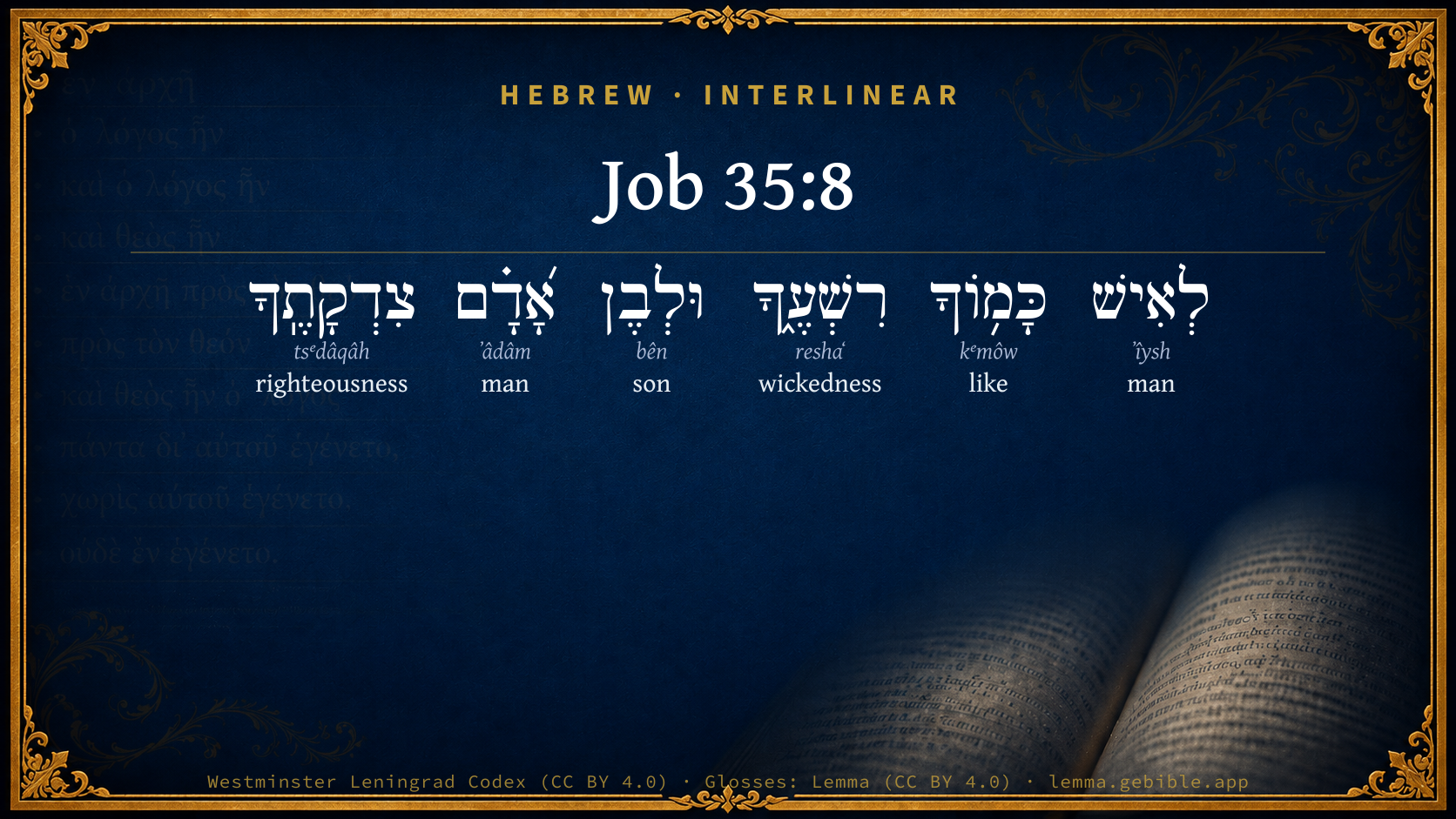
Job 35:8

Hebrew (Westminster Leningrad Codex) Job 35:8 appears in the Hebrew Old Testament. The text above is from the Westminster Leningrad Codex. Each word links to its Strong’s number, a concise gloss, and parsing drawn from the Open Scriptures Hebrew Bible morphology. Click any word for its full Brown-Driver-Briggs (BDB) entry.
Download image
Cite this verse

Job 35:8 (World English Bible). Public Domain. Lemma interlinear Bible study tool, https://lemma.gebible.app/v/job/35/8.

Show BibTeX & RIS
BibTeX
RIS
English Translation
Your wickedness may hurt a man as you are; And your righteousness may profit a son of man.
World English Bible · Public Domain
Download a study sheet

One document with this verse’s original text, its word-by-word gloss line, the meaning frame, cross-references with their text, attributed commentary, and full source and license credits — printable, and it pastes into notes with its structure intact.

This verse Autodidact and up

Study sheet (.html) Plain text (.txt)

A passage Seminary Student

Up to 50 verses in one chapter. A passage sheet keeps up to 6 commentary sources and 12 cross-references per verse, in the order this page ranks them, and says so on the sheet whenever that leaves anything out. Ask for a single verse and you get the Autodidact verse sheet above.

Everything on this page stays free to read, with no account — the sheet is a download of what is already on screen, not access to it.

Want to remove ads? Support Godless Engineer
Compare translations 3

The same verse in 3 English versions, stacked beneath the original-language interlinear above. Click any original word for its lexicon entry.

Each is an independent rendering of the whole verse — the interlinear is not word-aligned to these translations.

Highlighted words mark where these versions differ — a whole-verse word diff, not a word-by-word alignment.

  • World English Bible Public Domain
    Your wickedness may hurt a man as you are; And your righteousness may profit a son of man.
  • King James Version Public Domain
    Thy wickedness may hurt a man as thou art; and thy righteousness may profit the son of man.
  • unfoldingWord Literal Text CC BY-SA 4.0
    Your wickedness to a man like you, and your righteousness to a son of man.

unfoldingWord Literal Text — © unfoldingWord, licensed CC BY-SA 4.0. Word-aligned USFM3 via Door43 (git.door43.org/unfoldingWord/en_ult).

Versions to compare (up to 4)

3 of 4 selected

Show all 18 translations

Every available English version of this verse, each an independent rendering of the whole verse.

  • World English Bible Public Domain
    Your wickedness may hurt a man as you are; And your righteousness may profit a son of man.
  • Berean Standard Bible Public Domain
    Your wickedness affects only a man like yourself, and your righteousness only a son of man.
  • Majority Standard Bible Public Domain
    Your wickedness affects only a man like yourself, and your righteousness only a son of man.
  • King James Version Public Domain
    Thy wickedness may hurt a man as thou art; and thy righteousness may profit the son of man.
  • American Standard Version (1901) Public Domain
    Thy wickedness `may hurt' a man as thou art; And thy righteousness `may profit' a son of man.
  • Revised Version (1885) Public Domain
    Thy wickedness may hurt a man as thou art; and thy righteousness may profit a son of man.
  • Geneva Bible (1599) Public Domain
    Thy wickednesse may hurt a man as thou art: and thy righteousnes may profite ye sonne of man.
  • Douay-Rheims (1899) Public Domain
    Thy wickedness may hurt a man that is like thee: and thy justice may help the son of man.
  • Young's Literal Translation Public Domain
    For a man like thyself `is' thy wickedness, And for a son of man thy righteousness.
  • Literal Standard Version CC BY-SA 4.0
    For a man like yourself [is] your wickedness, || And for a son of man your righteousness.
  • Unlocked Literal Bible CC BY-SA 4.0
    Your wickedness may hurt a man, as you are a man, and your righteousness might benefit another son of man.
  • unfoldingWord Literal Text CC BY-SA 4.0
    Your wickedness to a man like you, and your righteousness to a son of man.
  • Darby Bible Public Domain
    Thy wickedness [may affect] a man as thou [art], and thy righteousness a son of man.
  • World Messianic Bible Public Domain
    Your wickedness may hurt a man as you are, and your righteousness may profit a son of man.
  • Webster's Bible Public Domain
    Thy wickedness may hurt a man as thou art: and thy righteousness may profit the son of man.
  • Free Bible Version CC BY-SA 4.0
    No—your sins only affect people like yourself, and whatever good you do only affects them too.
  • Bible in Basic English Public Domain
    Your evil-doing may have an effect on a man like yourself, or your righteousness on a son of man.
  • JPS Tanakh (1917) Public Domain
    Thy wickedness concerneth a man as thou art; and thy righteousness a son of man.

Literal Standard Version (2020), Covenant Press — licensed CC BY-SA 4.0. Text via the HelloAO Bible API (eBible.org). Unlocked Literal Bible (unfoldingWord) — licensed CC BY-SA 4.0. Text via the HelloAO Bible API (eBible.org). unfoldingWord Literal Text — © unfoldingWord, licensed CC BY-SA 4.0. Word-aligned USFM3 via Door43 (git.door43.org/unfoldingWord/en_ult). Free Bible Version, Dr. Jonathan Gallagher — licensed CC BY-SA 4.0. Text via the HelloAO Bible API (eBible.org).

Word by word

More ways to search: Search by grammar → Find every occurrence → Compare this word →

Practice this passage: Drill this verse → Learn its vocabulary →

About this verse

These counts appear in no published source. They are computed here, from the morphology-tagged text and Lemma’s own curated glosses. What Lemma adds →

6
words
6
distinct lemmas
Wisdom
section

Shared distinctive vocabulary

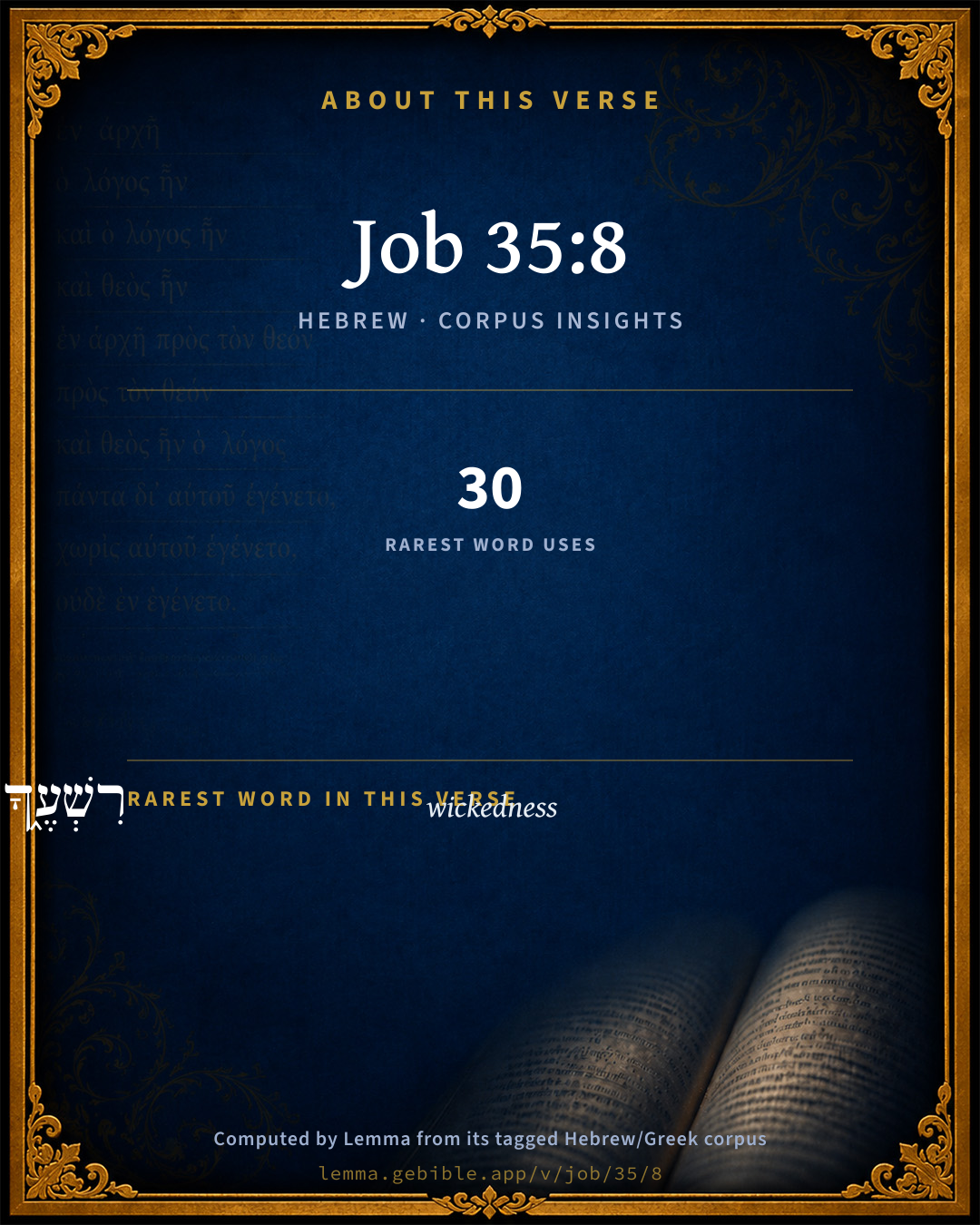
רִשְׁעֶ֑ךָ wickedness H7562 occurs in 29 verses of the Hebrew Bible. Also found in:

Grammatical profile

  • 5 nouns
  • 1 preposition

Hebrew & Septuagint length

In English translation the verse runs 18 words from the Hebrew and 18 from the Septuagint (LXX English) — the same length.

A rough comparison of the two English renderings, which tokenize alike — not a word-level alignment.

Word counts can differ between the Hebrew and the Greek without any difference in meaning — e.g. the Hebrew direct-object marker אֵת has no separate Greek word, and Greek often adds the article ὁ.

Cross-references

13

Topical passages linked to Job 35:8 in the Treasury of Scripture Knowledge — connected by theme and wording, ordered by reader-vote popularity; previews shown in the World English Bible.

  • Genesis 12:2 I will make of you a great nation. I will bless you, and make your name great. You will be a blessing.
  • Genesis 18:24–33 What if there are fifty righteous within the city? Will you consume and not spare the place for the fifty righteous who are therein?
  • Genesis 19:29 It happened, when God destroyed the cities of the plain, that God remembered Abraham, and sent Lot out of the midst of the overthrow, when he overthrew the cities in which Lot lived.
  • Joshua 7:1–5 But the children of Israel committed a trespass in the devoted thing; for Achan, the son of Carmi, the son of Zabdi, the son of Zerah, of the tribe of Judah, took of the devoted thing: and the anger of Yahweh was kindled against the children of Israel.
  • Joshua 22:20 Didn't Achan the son of Zerah commit a trespass in the devoted thing, and wrath fell on all the congregation of Israel? and that man didn't perish alone in his iniquity.
  • Job 42:8 Now therefore, take to yourselves seven bulls and seven rams, and go to my servant Job, and offer up for yourselves a burnt offering; and my servant Job shall pray for you, for I will accept him, that I not deal with you according to your folly. For you have not spoken of me the thing that is right, as my servant Job has."
  • Psalms 106:23 Therefore he said that he would destroy them, Had Moses, his chosen, not stood before him in the breach, To turn away his wrath, so that he wouldn't destroy them.
  • Psalms 106:30 Then Phinehas stood up, and executed judgment, So the plague was stopped.
  • Ecclesiastes 9:18 Wisdom is better than weapons of war; but one sinner destroys much good.
  • Ezekiel 22:30 I sought for a man among them, who should build up the wall, and stand in the gap before me for the land, that I should not destroy it; but I found none.
  • Jonah 1:12 He said to them, "Take me up, and throw me into the sea. Then the sea will be calm for you; for I know that because of me this great tempest is on you."
  • Acts 27:24 saying, 'Don't be afraid, Paul. You must stand before Caesar. Behold, God has granted you all those who sail with you.'
  • Hebrews 11:7 By faith, Noah, being warned about things not yet seen, moved with godly fear, prepared an ark for the saving of his house, through which he condemned the world, and became heir of the righteousness which is according to faith.

Cross-references courtesy of OpenBible.info (CC BY 4.0).

Hebrew and Greek witnesses Masoretic Hebrew ↔ Greek Septuagint

The same verse in the two great witnesses to the Old Testament, shown verse-for-verse.

These are two independent witnesses, not word-aligned to each other, and the Septuagint is shown in lemma (dictionary) form.

Hebrew Job 35:8 Masoretic · Westminster Leningrad Codex

לְאִישׁ כָּמ֥וֹךָ רִשְׁעֶ֑ךָ וּלְבֶן אָ֝דָ֗ם צִדְקָתֶֽךָ

Your wickedness may hurt a man as you are; And your righteousness may profit a son of man.

World English Bible · Public Domain

Greek LXX Job 35:8 Septuagint · lemma form

ἀνήρ ὁ ὅμοιος σύ ὁ ἀσέβεια σύ καί υἱός ἄνθρωπος ὁ δικαιοσύνη σύ

Your ungodliness may affect a man who is like to you; or your righteousness a son of man.

LXX2012 (modern English Septuagint) · Public Domain

Hebrew: Westminster Leningrad Codex (CC BY 4.0). Greek: Septuagint (public domain); English from LXX2012 (modern English Septuagint) (Public Domain). How the Septuagint differs from the Hebrew →

Commentary

Notes on Job 35:8 from classic Christian and Jewish commentators (each source and its license shown beneath its notes). The classic Christian expositions comment on the surrounding passage and are grouped to its opening verse, so a note may address several verses; the Jewish commentaries on the Tanakh (Rashi and others) are per-verse, so they appear only where the commentator wrote on this verse.

Lemma curates 59 commentaries, every one of them public domain or Creative Commons licensed, each selected and text-cleaned for this edition rather than reprinted as found. About our sources →

Trapp's Complete Commentary

John Trapp

Job 35:8 Thy wickedness [may hurt] a man as thou [art]; and thy righteousness [may profit] the son of man.

Ver. 8. Thy wickedness may hurt a man as thou art] Wicked men are many ways mischievous to others; and have much to answer for their other men’s sins. How many are undone by their murders, adulteries, robberies, false testimonies, blasphemies, and other rotten speeches, to the corrupting of good manners! &c. What hurt is done daily by the devil’s factors, to men’s souls, bodies, names, estates! Besides that they betray the land wherein they live into the hands of divine justice, while they do wickedly with both hands earnestly, Mic 7:3; that I speak not of the manifold miseries they pull upon themselves.

And thy righteousness may profit the son of man] Thyself and others; for the just liveth by his own faith; he maketh a living of it, and a good one too. And as for his charity, it is the mother of all manner of good works, whereof others have the benefit. Papists, and some as silly, have shrunk up charity to a hand’s breadth, to giving of alms. But besides that, a good man draweth out, not only his sheaf, but his soul to the hungry. He also warneth the unruly, comforteth the feeble-minded, supporteth the weak, and tradeth all his talents for the good of others, 1Th 5:14. He is a common blessing to all that are about him. As Plutarch said of the neighbouring villages of Rome, in Numa’s time, That sucking in the air of that city, they breathed δικαιοσυνην, righteousness; so may it be said of the city of God, and her citizens.

John Trapp, A Commentary or Exposition upon All the Books of the Old and New Testament (1647–1656) — public domain. Text from a community e-Sword module.

Adam Clarke's Commentary

Verse 8. Thy wickedness may hurt] It is better to translate this literally:

To a man like thyself is thy wickedness:

And to the son of man, thy righteousness:

That is: -

Thou mayest injure thyself and others by thy wickedness,

And thou mayest benefit both by thy righteousness;

But God thou canst neither hurt nor profit.

Adam Clarke's Commentary on the Bible (1810–1826) — public domain. Text from a community e-Sword/MySword module.

The Cambridge Bible for Schools and Colleges

gen. ed. J. J. S. Perowne

8. The verse reads literally: thy wickedness is to (touches, affects) a man as thou art, and thy righteousness is to one of mankind, i. e. thyself who art a man; for it cannot touch God who is exalted above such influence.

The Cambridge Bible for Schools and Colleges (gen. ed. J. J. S. Perowne; Cambridge University Press, 1878–1918) — public domain. Text from a community e-Sword module.

Albert Barnes' Notes on the Bible

Thy wickedness may hurt a Man as thou art - That is, it may injure him, but not God. He is too far exalted above man, and too independent of man in his sources of happiness, to be affected by what he can do. The object of the whole passage Job 35:6-8 is, to show that God is independent of people, and is not governed in his dealings with them on the principles which regulate their conduct with each other. One man may be greatly benefited by the conduct of another, and may feel under obligation to reward him for it; or he maybe greatly injured in his person, property, or reputation, by another, and will endeavor to avenge himself. But nothing of this kind can happen to God. If he rewards, therefore, it must be of his grace and mercy, not because he is laid under obligation; if he inflicts chastisement, it must be because people deserve it, and not because God has been injured. In this reasoning Elihu undoubtedly refers to Job, whom he regards as having urged a “claim” to a different kind of treatment, because he supposed that he “deserved” it. The general principle of Elihu is clearly correct, that God is entirely independent of human beings; that neither our good nor evil conduct can effect his happiness, and that consequently his dealings with us are those of impartial justice.

Albert Barnes' Notes on the Bible (1834–1885) — public domain. Text from a community e-Sword/MySword module.

Matthew Poole's English Annotations

If God were such a one as thou art, he might have benefit or hurt by thine actions; but being an infinite, independent, and self-sufficient Being, he is far exalted above all thy good or evil.

Matthew Poole's English Annotations on the Holy Bible (1683–1685) — public domain. Text from a community e-Sword/MySword module.

Whedon's Commentary on the Bible

Daniel D. Whedon

8. Thy wickedness… son of man — The original reads more tersely, For a man like thyself is thy wickedness; and for a son of man thy righteousness. Man, and not God, loses or gains according as man is wicked or righteous. The comment of Clement, in one of his homilies, is befitting: “Him they profit nothing, but they save themselves: him they injure not, but they are destroyed.”

Daniel D. Whedon (gen. ed.), Commentary on the Old and New Testaments (1874–1909) — public domain. Text from a community e-Sword module.

The Pulpit Commentary

Thy wickedness may hurt a man as thou art; and thy righteousness may profit the son (rather, a son) of man. Job must not think, Elihu means, that, because his good actions benefit and his bad actions injure his fellow men, therefore they must also in the one case injure and in the other benefit God. The cases are not parallel. God is too remote, too powerful, too great, to be touched by his actions. Job has done wrong, therefore, to expect that God would necessarily reward his righteousness by prosper us, happy life, and worse to complain because his expectations have been disappointed. It is of his mere spontaneous goodness and bounty that God rewards the godly.

The Pulpit Commentary (1880–1919), ed. H.D.M. Spence-Jones & Joseph S. Exell — public domain. Text from a community e-Sword module.

Rashi

Rabbi Shlomo Yitzchaki (Rashi)

a man like yourself your wickedness or your righteousness can and will benefit. Observe [that there are] many wicked men. who,...

Rashi on the Tanakh — English translations: “The Judaica Press complete Tanach with Rashi, translated by A. J. Rosenberg” (CC BY 4.0); “Pentateuch with Rashi's commentary by M. Rosenbaum and A.M. Silbermann, 1929-1934” (public domain); “The Metsudah Tanach series, Lakewood, N.J” (CC BY 4.0); and “The Book of Joshua, Metsudah Publications, 1997” (CC BY 4.0). Text via Sefaria.

Lesson kit

Teaching starters — assembled from the data on this page, not authored interpretation. Every prompt links to the verse data it draws on. Edit before teaching.

Job, in the Wisdom, opens this verse with 6 words (6 distinct Hebrew lemmas). Its most distinctive word is reshaʻ (“wickedness”). A historical commentator’s framing appears above. Read the whole chapter for the surrounding context.

Discussion questions

  1. How does “wickedness” (reshaʻ) shape what this verse is saying?
  2. How does Deuteronomy 9:27, which shares the word «wickedness», read alongside this verse?
  3. These translations render this verse differently; the difference is in the English rendering, not the original. What questions does that raise?
  4. Compare how Trapp's Complete Commentary and Adam Clarke's Commentary read this verse. Where do they agree or differ?

Things to notice

Reading settings

Reading text

Shown beneath each verse's original-language words.

Old Testament
Old Testament edition

Read the OT as the Masoretic Hebrew (MT) or the Greek Septuagint (LXX).

English shown for the Greek Septuagint (in the Hebrew ↔ Greek comparison).

Comparing translations? Open the Compare panel on any verse page to stack up to four side by side.