
Psalms 63:5

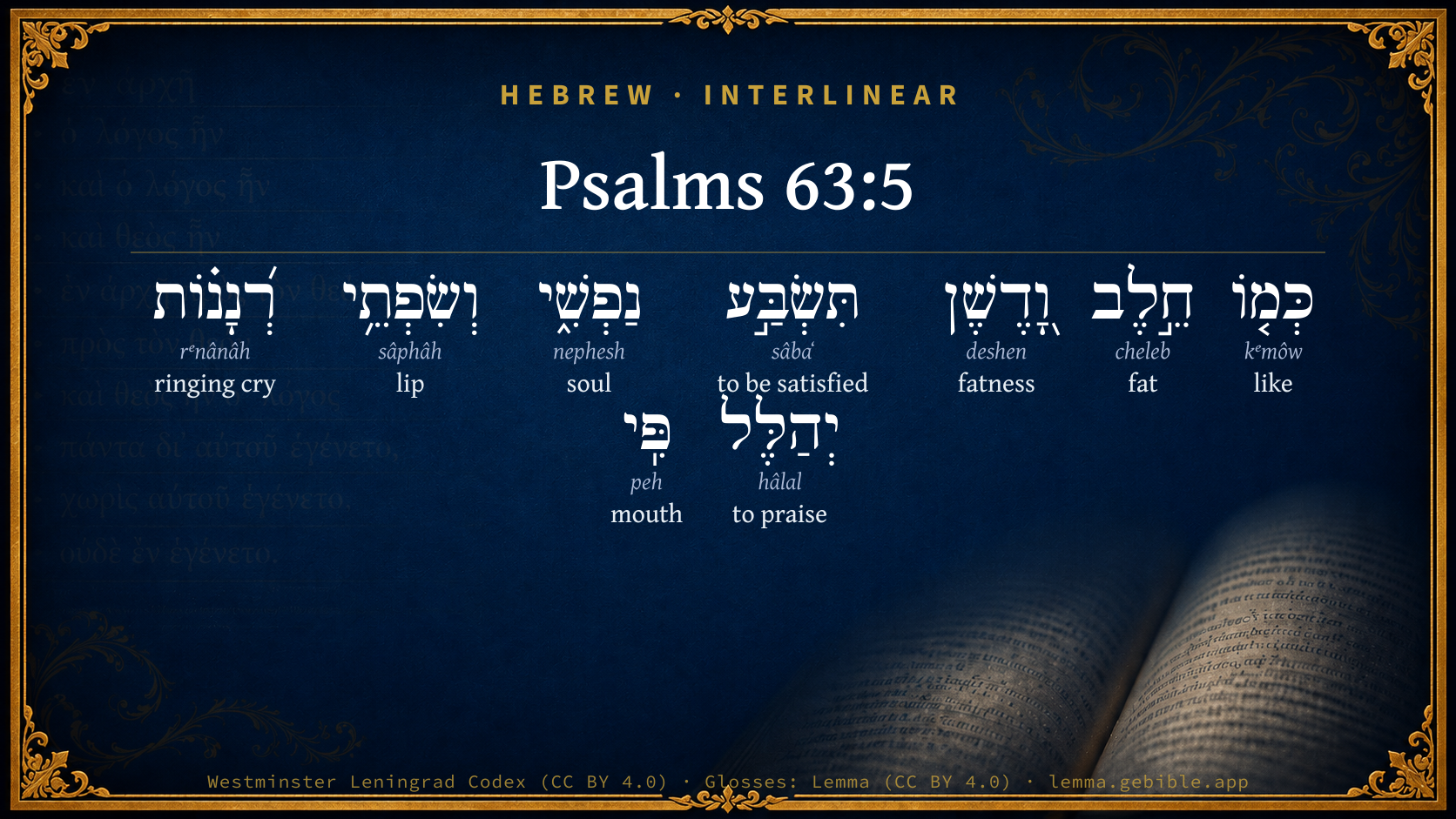
Hebrew (Westminster Leningrad Codex) Psalms 63:5 appears in the Hebrew Old Testament. The text above is from the Westminster Leningrad Codex. Each word links to its Strong’s number, a concise gloss, and parsing drawn from the Open Scriptures Hebrew Bible morphology. Click any word for its full Brown-Driver-Briggs (BDB) entry.
Download image
Cite this verse

Psalms 63:5 (World English Bible). Public Domain. Lemma interlinear Bible study tool, https://lemma.gebible.app/v/psalms/63/5.

Show BibTeX & RIS
BibTeX
RIS
English Translation
My soul shall be satisfied as with the richest food. My mouth shall praise you with joyful lips,
World English Bible · Public Domain
Download a study sheet

One document with this verse’s original text, its word-by-word gloss line, the meaning frame, cross-references with their text, attributed commentary, and full source and license credits — printable, and it pastes into notes with its structure intact.

This verse Autodidact and up

Study sheet (.html) Plain text (.txt)

A passage Seminary Student

Up to 50 verses in one chapter. A passage sheet keeps up to 6 commentary sources and 12 cross-references per verse, in the order this page ranks them, and says so on the sheet whenever that leaves anything out. Ask for a single verse and you get the Autodidact verse sheet above.

Everything on this page stays free to read, with no account — the sheet is a download of what is already on screen, not access to it.

Want to remove ads? Support Godless Engineer
Compare translations 3

The same verse in 3 English versions, stacked beneath the original-language interlinear above. Click any original word for its lexicon entry.

Each is an independent rendering of the whole verse — the interlinear is not word-aligned to these translations.

Highlighted words mark where these versions differ — a whole-verse word diff, not a word-by-word alignment.

  • World English Bible Public Domain
    My soul shall be satisfied as with the richest food. My mouth shall praise you with joyful lips,
  • King James Version Public Domain
    My soul shall be satisfied as with marrow and fatness; and my mouth shall praise thee with joyful lips:
  • unfoldingWord Literal Text CC BY-SA 4.0
    As fat and fatness my soul will be full, and lips of joyful shouts my mouth will praise.

unfoldingWord Literal Text — © unfoldingWord, licensed CC BY-SA 4.0. Word-aligned USFM3 via Door43 (git.door43.org/unfoldingWord/en_ult).

Versions to compare (up to 4)

3 of 4 selected

Show all 18 translations

Every available English version of this verse, each an independent rendering of the whole verse.

  • World English Bible Public Domain
    My soul shall be satisfied as with the richest food. My mouth shall praise you with joyful lips,
  • Berean Standard Bible Public Domain
    My soul is satisfied as with the richest of foods; with joyful lips my mouth will praise You.
  • Majority Standard Bible Public Domain
    My soul is satisfied as with the richest of foods; with joyful lips my mouth will praise You.
  • King James Version Public Domain
    My soul shall be satisfied as with marrow and fatness; and my mouth shall praise thee with joyful lips:
  • American Standard Version (1901) Public Domain
    My soul shall be satisfied as with marrow and fatness; And my mouth shall praise thee with joyful lips;
  • Revised Version (1885) Public Domain
    My soul shall be satisfied as with marrow and fatness; and my mouth shall praise thee with joyful lips;
  • Geneva Bible (1599) Public Domain
    My soule shalbe satisfied, as with marowe and fatnesse, and my mouth shall praise thee with ioyfull lippes,
  • Douay-Rheims (1899) Public Domain
    Thus will I bless thee all my life long: and in thy name I will lift up my hands.
  • Young's Literal Translation Public Domain
    As `with' milk and fatness is my soul satisfied, And `with' singing lips doth my mouth praise.
  • Literal Standard Version CC BY-SA 4.0
    As [with] milk and fatness is my soul satisfied, || And [with] singing lips my mouth praises.
  • Unlocked Literal Bible CC BY-SA 4.0
    It will be as if I ate a meal of marrow and fatness; with joyful lips my mouth will praise you,
  • unfoldingWord Literal Text CC BY-SA 4.0
    As fat and fatness my soul will be full, and lips of joyful shouts my mouth will praise.
  • Darby Bible Public Domain
    My soul is satisfied as with marrow and fatness, and my mouth shall praise [thee] with joyful lips.
  • World Messianic Bible Public Domain
    My soul shall be satisfied as with the richest food. My mouth shall praise you with joyful lips,
  • Webster's Bible Public Domain
    \\63:4\\Thus will I bless thee while I live: I will lift up my hands in thy name.
  • Free Bible Version CC BY-SA 4.0
    You satisfy me more than the richest food; I will praise you with joyful songs.
  • Bible in Basic English Public Domain
    My soul will be comforted, as with good food; and my mouth will give you praise with songs of joy;
  • JPS Tanakh (1917) Public Domain
    (63-6) My soul is satisfied as with marrow and fatness; and my mouth doth praise Thee with joyful lips;

Literal Standard Version (2020), Covenant Press — licensed CC BY-SA 4.0. Text via the HelloAO Bible API (eBible.org). Unlocked Literal Bible (unfoldingWord) — licensed CC BY-SA 4.0. Text via the HelloAO Bible API (eBible.org). unfoldingWord Literal Text — © unfoldingWord, licensed CC BY-SA 4.0. Word-aligned USFM3 via Door43 (git.door43.org/unfoldingWord/en_ult). Free Bible Version, Dr. Jonathan Gallagher — licensed CC BY-SA 4.0. Text via the HelloAO Bible API (eBible.org).

Word by word

More ways to search: Search by grammar → Find every occurrence → Compare this word →

Practice this passage: Drill this verse → Learn its vocabulary →

About this verse

These counts appear in no published source. They are computed here, from the morphology-tagged text and Lemma’s own curated glosses. What Lemma adds →

9
words
9
distinct lemmas
Wisdom
section

Notable vocabulary

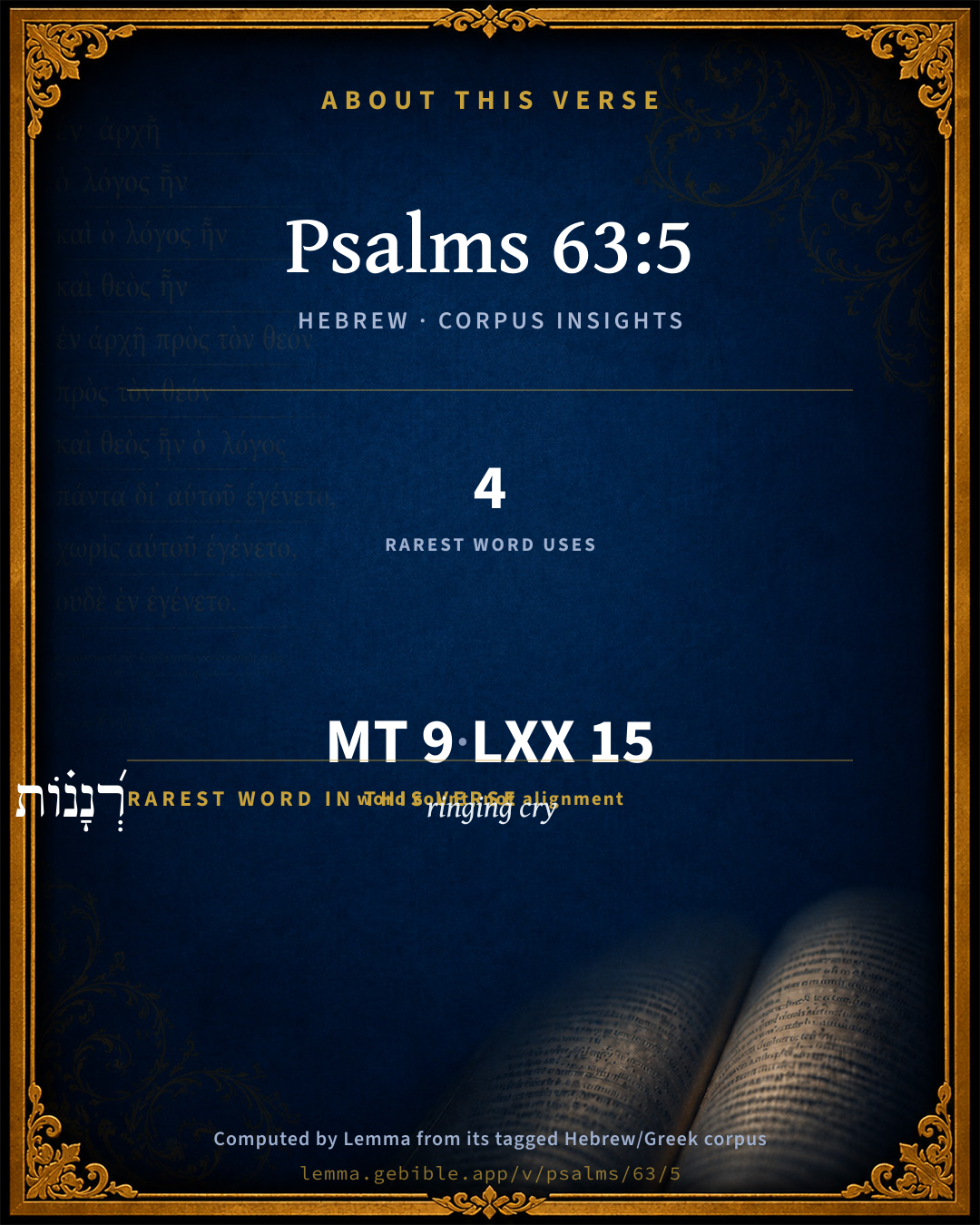
The rarest word here is רְ֝נָנ֗וֹת ringing cry H7445 — appearing just 4 times in the whole Hebrew Bible.

Shared distinctive vocabulary

רְ֝נָנ֗וֹת ringing cry H7445 occurs in 4 verses of the Hebrew Bible. Also found in:

Grammatical profile

  • 2 verbs
  • 6 nouns
  • 1 preposition

Verb forms

  • תִּשְׂבַּ֣ע Qal · Imperfect
  • יְהַלֶּל Piel · Imperfect

Hebrew & Septuagint length

In English translation the verse runs 18 words from the Hebrew and 18 from the Septuagint (LXX English) — the same length.

A rough comparison of the two English renderings, which tokenize alike — not a word-level alignment.

Word counts can differ between the Hebrew and the Greek without any difference in meaning — e.g. the Hebrew direct-object marker אֵת has no separate Greek word, and Greek often adds the article ὁ.

In the original languages it is 9 Hebrew tokens and 15 Greek tokens — but the two are counted differently (Hebrew bundles its prefixes and suffixes into one token; the Greek is in lemma form), so that isn’t a like-for-like length.

Cross-references

14

Topical passages linked to Psalms 63:5 in the Treasury of Scripture Knowledge — connected by theme and wording, ordered by reader-vote popularity; previews shown in the World English Bible.

  • Psalms 36:7–9 How precious is your loving kindness, God! The children of men take refuge under the shadow of your wings.
  • Isaiah 25:6 In this mountain will Yahweh of Hosts make to all peoples a feast of fat things, a feast of wines on the lees, of fat things full of marrow, of wines on the lees well refined.
  • Psalms 17:15 As for me, I shall see your face in righteousness; I shall be satisfied, when I awake, with seeing your form.
  • Psalms 43:4 Then I will go to the altar of God, To God, my exceeding joy. I will praise you on the harp, God, my God.
  • Ezra 3:11–13 They sang one to another in praising and giving thanks to Yahweh, [saying], For he is good, for his loving kindness endures forever toward Israel. All the people shouted with a great shout, when they praised Yahweh, because the foundation of the house of Yahweh was laid.
  • Psalms 118:14–15 Yah is my strength and song. He has become my salvation.
  • Psalms 135:3 Praise Yah, for Yahweh is good. Sing praises to his name, for that is pleasant.
  • Psalms 65:4 Blessed is one whom you choose, and cause to come near, That he may live in your courts. We will be filled with the goodness of your house, Your holy temple.
  • Psalms 71:23 My lips shall shout for joy! My soul, which you have redeemed, sings praises to you!
  • Revelation 19:5–7 A voice came forth from the throne, saying, "Give praise to our God, all you his servants, you who fear him, the small and the great!"
  • Jeremiah 31:4 Again will I build you, and you shall be built, O virgin of Israel: again shall you be adorned with your tambourines, and shall go forth in the dances of those who make merry.
  • Psalms 104:34 Let your meditation be sweet to him. I will rejoice in Yahweh.
  • Psalms 149:1–3 Praise Yahweh! Sing to Yahweh a new song, His praise in the assembly of the saints.
  • Song of Solomon 1:4 Take me away with you. Let us hurry. The king has brought me into his chambers. Friends We will be glad and rejoice in you. We will praise your love more than wine! Beloved They are right to love you.

Cross-references courtesy of OpenBible.info (CC BY 4.0).

Hebrew and Greek witnesses Masoretic Hebrew ↔ Greek Septuagint

The same verse in the two great witnesses to the Old Testament, shown verse-for-verse.

You’re reading Greek Psalm 62 (Hebrew Psalm 63). The Septuagint counts the superscription, so verse numbers can differ from the Hebrew — chapter-level alignment, not verse-by-verse. Numbering follows Rahlfs.

These are two independent witnesses, not word-aligned to each other, and the Septuagint is shown in lemma (dictionary) form.

Hebrew Psalms 63:5 Masoretic · Westminster Leningrad Codex

כְּמ֤וֹ חֵ֣לֶב וָ֭דֶשֶׁן תִּשְׂבַּ֣ע נַפְשִׁ֑י וְשִׂפְתֵ֥י רְ֝נָנ֗וֹת יְהַלֶּל פִּֽי

My soul shall be satisfied as with the richest food. My mouth shall praise you with joyful lips,

World English Bible · Public Domain

Greek LXX Greek Psalm 62:5 Septuagint · lemma form

οὕτως εὐλογέω σύ ἐν ὁ ζωή ἐγώ ἐν ὁ ὄνομα σύ αἴρω ὁ χείρ ἐγώ

Let my soul be filled as with marrow and fatness; and my joyful lips shall praise your name.

LXX2012 (modern English Septuagint) · Public Domain

Hebrew: Westminster Leningrad Codex (CC BY 4.0). Greek: Septuagint (public domain); English from LXX2012 (modern English Septuagint) (Public Domain). How the Septuagint differs from the Hebrew →

Commentary

Notes on Psalms 63:5 from classic Christian and Jewish commentators (each source and its license shown beneath its notes). The classic Christian expositions comment on the surrounding passage and are grouped to its opening verse, so a note may address several verses; the Jewish commentaries on the Tanakh (Rashi and others) are per-verse, so they appear only where the commentator wrote on this verse.

Lemma curates 59 commentaries, every one of them public domain or Creative Commons licensed, each selected and text-cleaned for this edition rather than reprinted as found. About our sources →

Trapp's Complete Commentary

John Trapp

Psa 63:5 My soul shall be satisfied as [with] marrow and fatness; and my mouth shall praise [thee] with joyful lips:

Ver. 5. My soul shall be satisfied as with marrow and fatness] Heb. as with fatness and fatness; bis, ad corroborandum, saith Aben Ezra, q.d. I shall be top full of comfort, animo adipe et medullis sanctissimarum deliciarum tuarum saginato. A soul taken up with God’s praises cannot but over abound exceedingly with joy, Ita ut inter Dei laudationem et nostram consolationem sit quasi circulus perpetuus et infinitus, saith one; praises increase joy, and joy causeth perpetual praises.

And my mouth shall praise thee with joyful lips] Heb. with lips of jubilations or exultations, labiis canoris, as if I were in a rapture of ecstasy, Toto gutture laudes tuas personabo.

John Trapp, A Commentary or Exposition upon All the Books of the Old and New Testament (1647–1656) — public domain. Text from a community e-Sword module.

The Biblical Illustrator

Joseph S. Exell

Psa_63:5-6

My soul shall be satisfied as with marrow and fatness; and my mouth shall praise Thee with joyful lips.

A taste for devotion

I. What we understand by the piety of taste and sentiment. Suppose two pupils of a philosopher, both emulous to make a proficiency in science; both attentive to the maxims of their master; both surmounting the greatest difficulties to retain a permanent impression of what they hear. But the one finds study a fatigue like the man tottering under a burden; to him study is a severe and arduous task; he hears because he is obliged to hear what is dictated. The other, on the contrary, enters into the spirit of study; its pains are compensated by its pleasures; he loves truth for the sake of truth; and not for the sake of the encomiums conferred on literary characters and the preceptors of science. So he who has a speculative piety, and he who has a piety of taste and sentiment, are both sincere in their efforts; both devoted to their duty; both pure in purpose; and both alike engaged in studying his precepts, and in reducing them to practice; but oh, how different is their state! The one prays because he is awed by his wants, and because prayer is the resource of the wretched. The other prays because the exercise of prayer transports him to another world; because it vanishes the objects which obstruct his divine reflections; and because it strengthens those ties which unite him to that God whose love constitutes all his consolation and all his treasure.

II. What judgment we should pass upon ourselves when destitute of the heartfelt piety we have just described.

1. When the privation is general; when a conviction of duty, and the motives of hope and fear are ever requisite to enforce the exercises of religion; when we have to force ourselves to read Gods Word, to pray, to study His perfections, and to participate of the pledges of His love in the Holy Sacrament. It is not very likely that a regenerate soul should be always abandoned to the difficulties and duties imposed by religion, that it should never experience those comforts conferred by the Holy Spirit, which make them a delight.

2. The privation of divine comforts should induce us to pass severe strictures on ourselves, when we do not make the required efforts to be delivered from so sad a state.

III. The causes which deprive us of the piety of taste and sentiment.

1. With the exception of those called heroes in the world, mankind seldom sacrifice their ease, their sensuality, their effeminacy, to high notions, to ambition, and the love of glory. And how often have the heroes themselves sacrificed all their laurels, their reputation, and their trophies to the charm of some sensible pleasure?

2. The imagination captivates both the senses and the understanding. A good which is not sensible; a good even which has no existence, is contemplated as a reality, provided it have the decorations proper to strike the imagination.

3. A present, or at least, an approximate good, excites, for the most part, more vehement desires, than a good which is absent, or whose enjoyment is deferred to a remote period.

4. Recollection is a substitute for presence; I would say, that a good in the possession of which we have found delight, pro, duces in the heart, though absent, much the same desires, as that which is actually present.

5. A good, ascertained and fully known by experience, is much more capable of inflaming our desires, than a good of which we have but an imperfect notion, and which is known only by the report of others.

6. All things being equal, we prefer a good of easy acquisition, to one which requires care and fatigue.

7. A good beyond our reach, a good that we do not possess, and that we have no hope so to do, does not excite any desire.

8. Avocations fill the capacity of the soul. (Jas. Saurin.)

The saint assuring himself of satisfaction in God

I. General observations concerning satisfying the new creation.

1. Their souls need to be satisfied.

2. That which satisfies the soul comes from above,

3. There is enough in God to satisfy the soul.

4. The Lord hath satisfied the soul.

5. The Lord promises to satisfy the soul (Psa_132:15; Psa_37:19; Psa_22:26; Isa_58:11; Psa_36:8).

These, and all the promises of God, are faithful sayings, and pleadable at the foot of His throne. In believing and pleading them, the race of new creatures, who exercise themselves unto godliness, will be forward to confess, where it is proper to tell their experience, that their souls have been satisfied as with marrow and fatness.

II. Show what is in the goodness and lovingkindness of God to satisfy the soul, as with marrow and fatness. Marrow is an oily substance which is enclosed in some of the bones of certain animals. It strengthens them, and promotes their growth, and the health and vigour of the whole body. Fatness, in the language of Scripture, is used to signify the best of anything. The fatness of the earth is a soil which, under the influence of the heavens, bringeth forth abundantly. The fatness of the olive is a tree that bears the best and greatest abundance of fruit. And the fatness of the house of God is the abundance of grace, which enriches and satisfies the souls of His people.

1. The glory of the attributes of God satisfies the soul.

2. The soul is satisfied with the truth of the Word of God.

3. The beauties in the works of God satisfy the soul.

4. The richness of the gifts of God satisfies the soul.

5. The variety of blessings in the fulness of God is satisfying to the soul.

III. Show on what grounds new creatures assure their hearts of the satisfying of their soul, as with marrow and fatness, in God everywhere.

1. The excellence of His lovingkindness.

2. The richness of His goodness--a treasury that is never shut, and never empty.

3. The freeness of His mercy--an attribute which is satisfying to the souls of the poor and needy everywhere.

4. The might of His power.

5. The glory of His holiness.

6. The truth of His faithfulness. The regular and uninterrupted succession of summer and winter, cold and heat, day and night, is a demonstration of the faithfulness of God in ruling the heavens according to His own establiShment; and ground to our faith to assure our hearts, that His establishment with Christ is firm and sure.

7. The uncertainty of His unchangeableness.

8. The prevalence of mediation. The promises of God in Christ the Mediator are all yea and amen, and pleadable in His name. On this ground we assure our hearts that His promises in Him shall be performed, and our souls satisfied in their performance as with marrow and fatness. (A. Shanks.)

Satisfaction found in God

We can have as much of God as we desire. There is a quest which finds its object with absolute certainty, and which finds its object simultaneously with the quest. And Chose two things, the certainty and the immediateness with which the thirst of the soul after God passes into a satisfied fruition of the soul in God, are what are taught us here in our text; and what you and I, if we comply with the conditions, may have as our own blessed experience. There is one search about which it is true that it never fails to find; the certainty that the soul thirsting after God shall be satisfied with God results at once from His nearness to us, and His infinite willingness to give Himself, which He is only prevented from carrying into act by our obstinate refusal to open our hearts by desire, It takes all a mans indifference to keep God out of his heart, For in Him we live, and move, and have our being, and that Divine love, which Christianity teaches us to see on the throne of the universe, is but infinite longing for self-communication,. Gods love is an infinite desire to give Himself. If only we open our hearts--and nothing opens them so wide as longing--He will pour in, as surely as the atmosphere streams in through every chink and cranny, as surely as if some great black rock that stands on the margin of the sea is blasted away, the waters will flood over the sands behind it. So, unless we keep God out, by not wishing Him in, in He will come. The certitude that we possess Him when we desire Him is as absolute. As swift as Marconis wireless message across the Atlantic and its answer, so immediate is the response from Heaven to the desire from earth. What a contrast that is to all our experiences! Is there anything else about which we can say, I am quite sure that if I want it I shall have it. I am quite sure that when I want it I have it? Nothing! There may be wells to which a man has to go, as the Bedouin in the desert has to go, with empty water-skins, many a days journey, and it comes to be a fight between the physical endurance of the man and the weary distance between him and the spring. Many a mans bones, and many a camels, lie on the track to the wells, who lay down gasping and black-lipped, and died before they reached them. We all know what it is to have longing desires which have cost us many an effort, and efforts and desires have both been in vain. Is it not blessed to be sure that there is One whom to long for is immediately to possess? Then there is the other thought here, too, that when we have God we have enough. That is not true about anything else. There is always something lacking in all other satisfactions. They address themselves to sides, and angles, and faces of our complex nature; they leave all the others unsatisfied. The table that is spread in the world, at which various longings and capacities seat themselves as guests, always fails to provide for some of them, and whilst some, and those especially of the lower type, are feasting full, there sits by their side another guest, who finds nothing on the table to satisfy his hunger. But if my soul thirsts for God, my soul shall be satisfied when I get Him. (A. Maclaren, D. D.)

The saint delighting in praise

I. The theme of praise.

1. The Lord Himself.

2. His name.

3. His power.

4. His mercy.

5. His lovingkindness.

6. His holiness.

7. His goodness.

8. His faithfulness.

9. His word.

10. His wonders.

II. The expression of praise.

1. By words.

2. By voices.

3. By actions.

III. The cheerfulness which enlivens the exercise of godly men in praising the Lord.

1. Cheerfulness arises from God and the things of God, which are themes of our praise.

2. Cheerfulness in praise arises from the anointing and sealing of the Holy Spirit.

3. Cheerfulness in praise arises from the blessings with which it enriches experience. The Lord is good and kind to His people in their glorifying Him with praise, and shows them His salvation.

4. Cheerfulness in praise arises from hope of acceptance in the beloved. This hope is lively and joyful, founded in the mediation of the great High Priest of our profession, Christ Jesus, and confirmed with promises sprinkled with His blood.

In conclusion, observe--

1. The mouth of the man of piety is his organ of praise. Regeneration renews the whole man after the image of God, but creates no faculties and members. By this grace the faculties and members are renewed, and fitted to the dignified uses for which they were originally created; and in these uses are, Or ought to be, employed by pious men, every day, and everywhere.

2. In using their mouth as their organ of praise, the lips of men of piety are anointed with oil of joy.

3. The exercise of pious men on earth is continued in heaven. (A. Shanks.)

Praising God with joyful lips

There are three things which do here open the mouths and lips of such as David was--

1. Joy; that is a spreading affection, which does not keep within its bounds, but does dilate and expatiate itself, that others may joy with it; and so here, it is joyful lips. David did so please himself in the expectation of those gracious opportunities which he now prays for, as that he promises himself a great deal of joy and rejoicing from them.

2. Love, and that to others with whom he conversed. This, it made him to speak likewise, that having found this sweetness in his own soul, he might make others likewise in some degree partakers of it. Now, while he was in the wilderness, he was solitary, and all alone by himself, he wanted the opportunity; when he came into the sanctuary, he hoped to have the mutual benefit of the communion of saints; and so in this respect should come with his mouth to praise God with joyful lips.

3. Thankfulness likewise to God. This it does also vent itself here. My mouth shall praise Thee, that is, celebrate Thy goodness towards me. It is the best recompense which we can make to God for all His favours and kindnesses to us, even to praise Him, and bless Him for them. (T. Horton, D. D.)

The Biblical Illustrator, edited by Joseph S. Exell (c. 1880s–1900s) — public domain. Text from a community e-Sword module.

The Treasury of David

Charles H. Spurgeon

Ver. 5. My soul shall be satisfied as with marrow and fatness. Though unable to feast on the sacrifice at thine altar, my soul shall even here be filled with spiritual joys, and shall possess a complete, a double contentment. There is in the love of God a richness, a sumptuousness, a fulness of soul filling joy, comparable to the richest food with which the body can be nourished. The Hebrews were more fond of fat than we are, and their highest idea of festive provision is embodied in the two words, marrow and fatness: a soul hopeful in God and full of his favour is thus represented as feeding upon the best of the best, the dainties of a royal banquet.

And my mouth shall praise thee with joyful lips. More joy, more praise. When the mouth is full of mercy, is should also be full of thanksgiving. When God gives us the marrow of his love, we must present to him the marrow of our hearts. Vocal praise should be rendered to God as well as mental adoration; others see our mercies, let them also hear our thanks.

Ver. 5. My soul shall be satisfied as with marrow and fatness. My soul shall be satisfied as if I had received all that is intimated by the rich pieces of the peace offering. Andrew A. Bonar, on Le 3:9-10.

Ver. 5. My soul shall be satisfied with fatness and fatness: so the Hebrew hath it; that is, my soul shall be full of comfort, it shall be filled up to the brim with pleasure and delight, in the remembrance and enjoyment of God upon my bed, or upon my beds, in the plural, as the Hebrew hath it. David had many a hard bed and many a hard lodging, whilst he was in his wilderness condition. It oftentimes so fell out that he had nothing but the bare ground for his bed, and the stones for his pillow, and the hedges for his curtains, and the heavens for his canopy; yet, in this condition, God was sweeter than marrow and fatness to him; though his bed was never so hard, yet in God he had full satisfaction and content. Jeremiah 14; Php 4:9. Thomas Brooks.

Ver. 5. There is that in a gracious God and in communion with him, which give abundant satisfaction to a soul. Ps 36:8 65:4. And there is that in a gracious soul, which takes abundant satisfaction in God, and in communion with him. Matthew Henry.

Ver. 5. Sanctified Knowledge, saith, There is an infinite fulness in Christ, the fulness of a fountain. Faith saith, This is all for me, for he is my husband; then Prayer saith, If all this be thine, I will go and fetch it for thee; and Thankfulness says, I will return praise to God for it (and that's better than the receiving of mercies): My soul shall be satisfied as with marrow and fatness; and my mouth shall praise thee with joyful lips. Matthew Lawrence, in "The Use and Practice of Faith, "1657.

Ver. 5. In the words which I have chosen as the subject of discourse, the psalmist expresses his humble expectation of having his soul feasted in the sanctuary. I intend, first, to show how the Lord satisfies the souls of men as with marrow and fatness; and, secondly, to point out the reason which believers have to conclude that they shall be thus satisfied in the ordinances of divine worship.

I. I will endeavour, then, in the first place, to show how

the Lord sanctifies the souls of men as with marrow and

fatness. And, in general, it may be observed, that he

imparts such satisfaction by condescending to hold

communion with them. This is the feast which our Lord

promises to every sinner who opens his heart to receive

him: "Behold, I stand at the door and knock: if any man

hear my voice, and open the door, I will come in to him,

and will sup with him, and he with me." Re 3:20.

This was also the banquet to which the spouse of Christ was

admitted, when she said, "He brought me to the banqueting

house, and his banner over me was love." So 2:4. More

particularly,

1. The Lord satisfies the souls of his people as with marrow and fatness, by feasting them with the flesh and blood of Jesus Christ. The Son of God became incarnate, shed his blood, and fulfilled all righteousness, that he might be food for our souls. "The Word was made flesh, and dwelt among us." Joh 1:14. And in his incarnate person he is living bread to us, bread that gives spiritual and eternal life to our souls, and effectually prevents them from perishing...

2. The Lord satisfies the souls of his people was with marrow and fatness, by showing them his glory in the face of Christ. By this means the psalmist David desired and expected to have his soul feasted, as we learn from the second verse of this Psalm: "To see thy power and thy glory, so as I have seen thee in the sanctuary." ...A saving sight of the glory of God in our Immanuel must be inexpressibly comfortable; it is a feast to the soul, and is productive of joy unspeakable and full of glory...

3. The Lord satisfies the souls of his people as with marrow and fatness, by shedding abroad his love in their hearts. This was another way in which David expected to have his soul feasted. He had felt the sweetness of divine love, he had tasted that the Lord was gracious; he knew by happy experience that his lovingkindness was sweeter than all the comforts of life; and he hoped to be blessed with further experience of his love, with such experience as would warm his heart, and afford matter of a new song of praise to God: and thus he expected to be satisfied as with marrow and fatness. He says, therefore, in the third verse of this Psalm, Because thy lovingkindness is better than life, my lips shall praise thee...

4. The Lord satisfies the souls of his people as with marrow and fatness, when he feasts them with new covenant promises. He hath given us exceeding great and precious promises; promises which are filled with all the fulness of God, and which are all in Christ, yea, and amen, to the glory of God. These promises are published to us all in the gospel, that we may embrace them by faith. But, alas! so great is the folly of men, that they put from them these words of grace, and judge themselves unworthy of everlasting life. Such folly is natural even to the people of God as well as others... But when the rock of Israel, in a day of power, speaks these promises to them, they no longer reject, but cordially receive them in Christ, and gladly feast upon them. Then his words are found, and they eat them; and his word is the joy and rejoicing of their hearts...

5. The Lord also satisfies the souls of his people, by filling them with the Spirit. We are famishing while we are in a state of nature, "having not the Spirit; "for while without the Spirit, we are also without Christ. But when the Lord puts his Spirit within us, then our starving souls begin to be feasted; for this blessed Spirit shows us the things of Christ, and applies him to us; by which means we are enabled to eat his flesh, and drink his blood. And after the Holy Ghost is thus given, he is never taken away... It is the promise of our Redeemer, that, if a man believe on him, "out of his belly shall flow rivers of living water; "and "this spake he of the Spirit, which they that believe on him should receive." Joh 7:38-39.

6. The Lord satisfies his people as with marrow and fatness, when he revives former experiences of his kindness. Often he gives them so to speak, a new feast upon an old experience...

II. I now proceed to point out some of the reasons which

believers have to conclude that their souls shall be

satisfied in the ordinances of divine worship. And,

1. They may reasonably found such a conclusion upon the divine goodness.

2. Believers may ground an expectation of being satisfied as with marrow and fatness, on the incarnation, the humiliation, and the death of Christ.

3. The fulness laid up in Christ is also a good foundation for such a hope.

4. Believers may also conclude from the divine promise that their souls shall be satisfied as with marrow and fatness.

5. From their being blessed with the spiritual appetite.

6. Their former experience of the Lord's satisfying them, may also encourage believers to hope that he will again satisfy them, as with marrow and fatness. Outline of a Sermon, by John Fraser (1745-1818).

Ver. 5.: --

Ever full, but hungry ever,

What they have, they still desire;

Never suffer surfeit's loathing

Nor yet famine's torments dire:

Hungering still, they eat, and eating,

Still the sacred food require. Peter Damiano (988-1072).

Ver. 5-6. David had his sweetmeats and heavenly junkets in the night, when the eyes of others were closed, and saw not the charger which was sent from above for his spiritual refreshment. His solitary meditations brought him more solace and comfort than the whole creation could afford him: When I remember thee upon my bed, and meditate on thee in the night watches, my soul shall be satisfied as with marrow and fatness. Communion with God in secret is a heaven upon earth. What food can compare with the hidden manna? Some persons have excellent banquets in their closets. That bread which the saints eat in secret, how pleasant is it! Ah! what stranger can imagine the joy, the melody, which even the secret tears of the saints cause! Believers find rich mines of silver and gold in solitary places; they fetch up precious jewels out of secret holes, out of the bottom of the ocean, where are no inhabitants. Naturalists observe that those fish are sweetest which lie hid. Saints have often sweet joy and refreshment in secret; they have meat to eat, which the world knoweth not of. The fig tree, olive, and vine would not leave their sweetness, fatness, and cheerfulness, to be kings over other trees. Jud 9:11-13. They that know what it is to enjoy God in secret, would not leave it, or lose it, to be kings or commanders over the whole world. George Swinnock.

Ver. 5-6.

I. The empty vessel filled. How? By meditation.

With what? God's goodness as marrow and fatness. To

what extent? Satisfaction.

II. The full vessel running over. My mouth shall

praise thee with joyful lips. The soul overflows

with praise--joyful praise. G. J. K.

Ver. 5-6. Describe the nature of, and show the intimate connection between

(1) the believer's employments and

(2) his enjoyments. J. S. Bruce.

Psalms 63:6*

Ver. 5-6. See Psalms on "Ps 63:5" for further information.

Ver. 5-6. See Psalms on "Ps 63:5" for further information.

I. The empty vessel filled. How? By meditation.

With what? God's goodness as marrow and fatness. To

what extent? Satisfaction.

II. The full vessel running over. My mouth shall

praise thee with joyful lips. The soul overflows

with praise--joyful praise. G. J. K.

Ver. 5-6. Describe the nature of, and show the intimate connection between

(1) the believer's employments and

(2) his enjoyments. J. S. Bruce.

Charles H. Spurgeon's The Treasury of David (1869–1885) — public domain. Psalms only. Text from a community e-Sword/MySword module.

Joseph Benson's Commentary

Psa 63:5-6. My soul shall be satisfied — Not only as with bread, which is nourishing; but as with marrow and fatness — Which are pleasant and delicious; namely, when thou shalt fulfil my desire, and bring me to enjoy thee in the sanctuary; though now in my exile I groan and pine away for want of that mercy; and my mouth shall praise thee with joyful lips — I will praise thee openly: I will confess with my mouth as well as believe in my heart: and I will praise thee cheerfully, from a principle of gratitude and holy joy. When I remember thee upon my bed — During the solitude and stillness of the night; a fit season for meditation on the daily repeated and long-continued mercies of God. David was so full of business all day, shifting for his own safety, that he had scarcely leisure to apply himself solemnly to religious exercises; and therefore rather than want time for them he denied himself his necessary sleep. Hebrew, upon my beds, implying that he was frequently obliged to change his bed and lodging, being driven from place to place. In the night watches — In the several seasons of the night, which were divided into three or four watches. When others sleep securely, my sleep is interrupted by perplexity and grief, but my thoughts are fixed on thee. David was now in continual peril of his life, so that we may suppose care and fear often held his eyes waking, and gave him wearisome nights; but then he entertained and comforted himself with thoughts of God and things divine. So ought we to do when sleep departs from our eyes, through pain or sickness of body, or any disturbance of mind.

Joseph Benson's Commentary on the Old and New Testaments (1811–1818) — public domain. Text from a community e-Sword module.

J. A. Alexander on Psalms

Joseph Addison Alexander

6. (Psa 63:5). As (with) marrow and fatness shall my soul be satisfied, and (with) lips of rejoicing shall my mouth praise (thee). He continues the expression of his joyful confidence and hope. Marrow and fatness are used to represent two Hebrew words, both meaning animal fat, here put for rich food, and that for abundant supplies of every kind. Lips of rejoicings may denote either joyful lips, or lips by which rejoicings are uttered. The unconditional engagement to praise God implies, as usual, a firm belief that he will have occasion so to do. See above, on Psa 5:7.

Joseph Addison Alexander, The Psalms Translated and Explained (1850) — public domain. Text from a community e-Sword module.

MacLaren's Expositions of Holy Scripture

Alexander MacLaren

Psalms

THIRST AND SATISFACTION

Psa 63:1, Psa 63:5, Psa 63:8.

It is a wise advice which bids us regard rather what is said than who says it, and there are few regions in which the counsel is more salutary than at present in the study of the Old Testament, and especially the Psalms. This authorship has become a burning question which is only too apt to shut out far more important things. Whoever poured out this sweet meditation in the psalm before us, his tender longings for, and his jubilant possession of, God remain the same. It is either the work of a king in exile, or is written by some one who tries to cast himself into the mental attitude of such a person, and to reproduce his longing and his trust. It may be a question of literary interest, but it is of no sort of spiritual or religious importance whether the author is David or a singer of later date endeavouring to reproduce his emotions under certain circumstances.

The three clauses which I have read, and which are so strikingly identical in form, constitute the three pivots on which the psalm revolves, the three bends in the stream of its thought and emotion. ‘My soul thirsts; my soul is satisfied; my soul follows hard after Thee.’ The three phases of emotion follow one another so swiftly that they are all wrapped up in the brief compass of this little song. Unless they in some degree express our experiences and emotions, there is little likelihood that our lives will be blessed or noble, and we have little right to call ourselves Christians. Let us follow the windings of the stream, and ask ourselves if we can see our own faces in its shining surface.

I. The soul that knows its own needs will thirst after God.

The Psalmist draws the picture of himself as a thirsty man in a waterless land. That may be a literally true reproduction of his condition, if indeed the old idea is correct, that this is a work of David’s; for there is no more appalling desert than that in which he wandered as an exile. It is a land of arid mountains without a blade of verdure, blazing in their ghastly whiteness under the fierce sunshine, and with gaunt ravines in which there are no pools or streams, and therefore no sweet sound of running waters, no shadow, no songs of birds, but all is hot, dusty, glaring, pitiless; and men and beasts faint, and loll out their tongues, and die for want of water. And, says the Psalmist, such is life, if due regard be had to the deepest wants of a soul, notwithstanding all the abundant supplies which are spread in such rich and loving luxuriance around us-we are thirsty men in a waterless land. I need not remind you how true it is that a man is but a bundle of appetites, desires, often tyrannous, often painful, always active. But the misery of it is-the reason why man’s misery is great upon him is-mainly, I suppose, that he does not know what it is that he wants; that he thirsts, but does not understand what the thirst means, nor what it is that will slake it. His animal appetites make no mistakes; he and the beasts know that when they are thirsty they have to drink, and when they are hungry they have to eat, and when they are drowsy they have to sleep. But the poor instinct of the animal that teaches it what to choose and what to avoid fails us in the higher reaches; and we are conscious of a craving, and do not find that the craving reveals to us the source from whence its satisfaction can be derived. Therefore ‘broken cisterns that can hold no water’ are at a premium, and ‘the fountain of living waters’ is turned away from, though it could slake so many thirsts. Like ignorant explorers in an enemy’s country, we see a stream, and we do not stop to ask whether there is poison in it or not before we glue our thirsty lips to it. There is a great old promise in one of the prophets which puts this notion of the misinterpretation of our thirsts, and the mistakes as to the sources from which they can be slaked, into one beautiful metaphor which is obscured in our English version. The prophet Isaiah says, according to our reading, ‘the parched land shall become a pool.’ The word which he uses is that almost technical one which describes the phenomenon known only in Eastern lands, or at least known in them only in its superlative degree; the mirage, where the dancing currents of ascending air simulate the likeness of a cool lake, with palm-trees around it. And, says he, ‘the mirage shall become a pool,’ the romance shall turn into a reality, the mistakes shall be rectified, and men shall know what it is that they want, and shall get it when they know. Brethren! unless we have listened to the teaching from above, unless we have consulted far more wisely and far more profoundly than many of us have ever done the meaning of our own hearts when they cry out, we too shall only be able to take for ours the plaintive cry of the half of this first utterance of the Psalmist, and say despairingly, ‘My soul thirsteth.’ Blessed are they who know where the fountain is, who know the meaning of the highest unrests in their own souls, and can go on to say with clear and true self-revelation, ‘My soul thirsteth for God!’ That is religion. There is a great deal more in Christianity than longing, but there is no Christianity worth the name without it. There is moral stimulus to activity, a pattern for conduct, and so on, in our religion, and if our religion is only this longing-well then, it is worth very little; and I fancy it is worth a good deal less if there is none of this felt need for God, and for more of God, in us.

And so I come to two classes of my hearers; and to the first of them I say, Dear friends! do not mistake what it is that you ‘need,’ and see to it that you turn the current of your longings from earth to God; and to the second of them I say, Dear friends! if you have found out that God is your supreme good, see to it that you live in the good, see to it that you live in the constant attitude of longing for more of that good which alone will slake your appetite.

‘The thirst that from the soul doth rise Doth ask a drink divine,’ and unless we know what it is to be drawn outwards and upwards, in strong aspirations after something-’afar from the sphere of our sorrow,’ I know not why we should call ourselves Christians at all.

But, dear friends! let us not forget that these higher aspirations after the uncreated and personal good which is God have to be cultivated very sedulously and with great persistence, throughout all our changing lives, or they will soon die out, and leave us. There has to be the clear recognition, habitual to us, of what is our good. There has to be a continual meditation, if I may so say, upon the all-sufficiency of that divine Lord and Lover of our souls, and there has to be a vigilant and a continual suppression, and often excision and ejection, of other desires after transient and partial satisfactions. A man who lets all his longings go unchecked and untamed after earthly good has none left towards heaven. If you break up a river into a multitude of channels, and lead off much of it to irrigate many little gardens, there will be no force in its current, its bed will become dry, and it will never reach the great ocean where it loses its individuality and becomes part of a mightier whole. So, if we fritter away and divide up our desires among all the clamant and partial blessings of earth, then we shall but feebly long, and feebly longing, shall but faintly enjoy, the cool, clear, exhaustless gush from the fountain of life-’My soul thirsteth for God!’-in the measure in which that is true of us, and not one hairsbreadth beyond it, in spite of orthodoxy, and professions, and activities, are we Christian people.

II. The soul that thirsts after God is satisfied.

The Psalmist, by the magic might of his desire, changes, as in a sudden transformation scene in a theatre, all the dreariness about him. One moment it is a ‘dry and barren land where no water is’; the next moment a flash of verdure has come over the yellow sand, and the ghastly silence is broken by the song of merry birds. The one moment he is hungering there in the desert; the next, he sees spread before him a table in the wilderness, and his soul is ‘satisfied as with marrow and with fatness,’ and his mouth praises God, whom he possesses, who has come unto him swift, immediate, in full response to his cry. Now, all that is but a picturesque way of putting a very plain truth, which we should all be the happier and better if we believed and lived by, that we can have as much of God as we desire, and that what we have of Him will be enough.

We can have as much of God as we desire. There is a quest which finds its object with absolute certainty, and which finds its object simultaneously with the quest. And these two things, the certainty and the immediateness with which the thirst of the soul after God passes into a satisfied fruition of the soul in God, are what are taught us here in our text; and what you and I, if we comply with the conditions, may have as our own blessed experience. There is one search about which it is true that it never fails to find. The certainty that the soul thirsting after God shall be satisfied with God results at once from His nearness to us, and His infinite willingness to give Himself, which He is only prevented from carrying into act by our obstinate refusal to open our hearts by desire. It takes all a man’s indifference to keep God out of his heart, ‘for in Him we live, and move, and have our being,’ and that divine love, which Christianity teaches us to see on the throne of the universe, is but infinite longing for self-communication. That is the definition of true love always, and they fearfully mistake its essence, and take the lower and spurious forms of it for the higher and nobler, who think of love as being what, alas! it often is, in our imperfect lives, a fierce desire to have for our very own the thing or person beloved. But that is a second-rate kind of love. God’s love is an infinite desire to give Himself. If only we open our hearts-and nothing opens them so wide as longing-He will pour in, as surely as the atmosphere streams in through every chink and cranny, as surely as if some great black rock that stands on the margin of the sea is blasted away, the waters will flood over the sands behind it. So unless we keep God out, by not wishing Him in, in He will come.

The certitude that we possess Him when we desire Him is as absolute. As swift as Marconi’s wireless message across the Atlantic and its answer; so immediate is the response from Heaven to the desire from earth. What a contrast that is to all our experiences! Is there anything else about which we can say ‘I am quite sure that if I want it I shall have it. I am quite sure that when I want it I have it’? Nothing! There may be wells to which a man has to go, as the Bedouin in the desert has to go, with empty water-skins, many a day’s journey, and it comes to be a fight between the physical endurance of the man and the weary distance between him and the spring. Many a man’s bones, and many a camel’s, lie on the track to the wells, who lay down gasping and black-lipped, and died before they reached them. We all know what it is to have longing desires which have cost us many an effort, and efforts and desires have both been in vain. Is it not blessed to be sure that there is One whom to long for is immediately to possess?

Then there is the other thought here, too, that when we have God we have enough. That is not true about anything else. God forbid that one should depreciate the wise adaptation of earthly goods to human needs which runs all through every life! but all that recognised, still we come back to this, that there is nothing here, nothing except God Himself, that will fill all the corners of a human heart. There is always something lacking in all other satisfactions. They address themselves to sides, and angles, and facets of our complex nature; they leave all the others unsatisfied. The table that is spread in the world, at which, if I might use so violent a figure, our various longings and capacities seat themselves as guests, always fails to provide for some of them, and whilst some, and those especially of the lower type, are feasting full, there sits by their side another guest, who finds nothing on the table to satisfy his hunger. But if my soul thirsts for God, my soul will be satisfied when I get Him. The prophet Isaiah modifies this figure in the great word of invitation which pealed out from him, where he says, ‘Ho! everyone that thirsteth, come ye to the waters.’ But that figure is not enough for him, that metaphor, blessed as it is, does not exhaust the facts; and so he goes on, ‘yea, come, buy wine’-and that is not enough for him, that does not exhaust the facts, therefore he adds, ‘and milk.’ Water, wine, and milk; all forms of the draughts that slake the thirsts of humanity, are found in God Himself, and he who has Him needs seek nowhere besides.

Lastly-

III. The soul that is satisfied with God immediately renews its quest.

‘My soul followeth hard after Thee.’ The two things come together, longing and fruition, as I have said. Fruition begets longing, and there is swift and blessed alternation, or rather co-existence of the two. Joyful consciousness of possession and eager anticipation of larger bestowments are blended still more closely, if we adhere to the original meaning of the words of this last clause, than they are in our translation, for the psalm really reads, ‘My soul cleaveth after Thee.’ In the one word ‘cleaveth,’ is expressed adhesion, like that of the limpet to the rock, conscious union, blessed possession; and in the other word ‘after Thee’ is expressed the pressing onwards for more and yet more. But now contrast that with the issue of all other methods of satisfying human appetites, be they lower or be they higher. They result either in satiety or in a tyrannical, diseased appetite which increases faster than the power of satisfying it increases. The man who follows after other good than God, has at the end to say, ‘I am sick, tired of it, and it has lost all power to draw me,’ or he has to say, ‘I ravenously long for more of it, and I cannot get any more.’ ‘He that loveth silver shall not be satisfied with silver, nor he that loveth abundance with increase.’ You have to increase the dose of the narcotic, and as you increase the dose, it loses its power, and the less you can do without it the less it does for you. But to drink into the one God slakes all thirsts, and because He is infinite, and our capacity for receiving Him may be indefinitely expanded; therefore, ‘Age cannot wither, nor custom stale His infinite variety’; but the more we have of God, the more we long for Him, and the more we long for Him the more we possess Him.

Brethren! these are the possibilities of the Christian life; being its possibilities they are our obligations. The Psalmist’s words may well be turned by us into self-examining interrogations and we may-God grant that we do!-all ask ourselves; ‘Do I thus thirst after God?’ ‘Have I learned that, notwithstanding all supplies, this world without Him is a waterless desert? Have I experienced that whilst I call He answers, and that the water flows in as soon as I open my heart? And do I know the happy birth of fresh longings out of every fruition, and how to go further and further into the blessed land, and into my elastic heart receive more and more of the ever blessed God?’ These texts of mine not only set forth the ideal for the Christian life here, but they carry in themselves the foreshadowing of the life hereafter. For surely such a merely physical accident as death cannot be supposed to break this golden sequence which runs through life. Surely this partial and progressive possession of an infinite good, by a nature capable of indefinitely increasing appropriation of, and approximation to it is the prophecy of its own eternal continuance. So long as the fountain springs, the thirsty lips will drink. God’s servants will live till God dies. The Christian life will go on, here and hereafter, till it has reached the limits of its own capacity of expansion, and has exhausted God. ‘The water that I shall give him shall be in him a well of water, springing up into everlasting life.’

Alexander MacLaren, Expositions of Holy Scripture (1904–1910) — public domain. Text from a community e-Sword module.

Geneva Bible (1599)

Geneva Bible translators

The remembrance of thy favor is more sweet unto me than all the pleasures and dainties of the world.

Geneva Bible (1599) marginal notes — public domain. Text via Bolls.life.

Jamieson, Fausset & Brown

Robert Jamieson, A. R. Fausset & David Brown

Full spiritual blessings satisfy his desires, and acts of praise fill his thoughts and time.

Jamieson, Fausset & Brown — Commentary Critical and Explanatory on the Whole Bible (1871) — public domain (CC PDM 1.0). Text via the HelloAO Bible API.

Adam Clarke's Commentary

Verse 5. My soul shall be satisfied] I shall have, in the true worshipping of thee, as complete a sensation of spiritual sufficiency and happiness, so that no desire shall be left unsatisfied, as any man can have who enjoys health of body, and a fulness of all the necessaries, conveniences, and comforts of life.

Adam Clarke's Commentary on the Bible (1810–1826) — public domain. Text from a community e-Sword/MySword module.

John Calvin's Commentaries

5. My soul shall be satisfied as with marrow, etc. In accordance with what was said in the foregoing verse, David expresses his assured persuasion of obtaining a rich and abundant measure of every blessing that could call for thanksgiving and praise. At the period of composing this psalm, he may have been already in the enjoyment of ease and plenty; but there is reason to believe that he cherished the persuasion referred to, even when wandering in the wilderness in a state of poverty and destitution. If we would evidence a strong faith, we must anticipate the divine favor before it has been actually manifested, and when there is no present appearance of its forthcoming. From the instance here set before us, we must learn to be on our guard against despondency, in circumstances when we may see the wicked wallowing and rioting in the abundance of the things of this world, while we ourselves are left to pine under the want of them. David, in the present pressure to which he was exposed, might have given way to despair, but he knew that God was able to fill the hungry soul, and that he could want for nothing so long as he possessed an interest in his favor. It is God’s will to try our patience in this life, by afflictions of various kinds. Let us bear the wrongs which may be done us with meekness, till the time come when all our desires shall be abundantly satisfied. It may be proper to observe, that David, when he speaks in figurative language of being filled with marrow and fatness, does not contemplate that intemperate and excessive indulgence to which ungodly men surrender themselves, and by which they brutify their minds. He looks forward to that moderate measure of enjoyment which would only quicken him to more alacrity in the praises of God.

John Calvin's Commentaries (1540-1563) — public domain. Text from the Calvin Translation Society English edition (1840s-50s) via the Christian Classics Ethereal Library (ccel.org). Calvin's coverage is partial (roughly two-thirds of the Bible); uncommented books and verses are honest gaps, never fabricated. The 19th-century editor's footnotes and remarks are omitted so the notes are faithfully Calvin's own voice.

Ellicott's Commentary for English Readers

(5) Satisfied.—This image of a banquet, which repeats itself so frequently in Scripture, need not be connected with the sacrificial feasts.

A Bible Commentary for English Readers, edited by Charles John Ellicott (1878–1897) — public domain. Text from a community e-Sword module.

The Cambridge Bible for Schools and Colleges

gen. ed. J. J. S. Perowne

5. God feeds the hungry soul with rich and bountiful food (Deu_32:14; Psa_22:26; Psa_23:5; Psa_36:8; Isa_25:6; Isa_55:2; Jer_31:14). Though the language may be derived from the sacrificial feasts, it is indifferent to strict ritual precision, for the fat (A.V. here marrow) was never to be eaten, but was to be burnt on the altar as God’s portion (Lev_3:16-17).

The Cambridge Bible for Schools and Colleges (gen. ed. J. J. S. Perowne; Cambridge University Press, 1878–1918) — public domain. Text from a community e-Sword module.

John Gill's Exposition

My soul shall be satisfied as with marrow and fatness,.... When he should return to the house of the Lord, and partake of the provisions of it, called the fatness of his house; see Gill on Psa 36:8. The phrase denotes the abundance of spiritual refreshment and delight in the word and ordinances, and the great satisfaction had in them; and may have some regard to benefits arising from prayer, as well as other ordinances. Fat was not to be eaten under the legal dispensation, and therefore not to be literally taken; but in the typical and spiritual sense which David understood, and therefore respects that, or otherwise he would speak contrary to the law of God: he refers to those spiritual good things which they typified, and give spiritual pleasure and satisfaction;

and my mouth shall praise thee with joyful lips; such a full meal, such a rich entertainment, calls for abundant thankfulness; which is here signified by the mouth praising the Lord, and doing this with lips of shouting, expressions of joy, songs of praise, jubilee songs. The allusion is to the use of music and singing at festivals; see Isa 5:12.

John Gill's Exposition of the Whole Bible (1746–1763) — public domain (CC PDM 1.0). Text via the HelloAO Bible API.

Albert Barnes' Notes on the Bible

My soul shall be satisfied - See the notes at Psa 36:8. The idea is, that his soul now longed for the service of God as one who is hungry longs for food, or as one who is thirsty longs for drink; and that the time would come when this longing desire would be satisfied. He would engage in the service of God as he desired to do; he would be permitted to enjoy that service without interruption.

As with marrow and fatness - See the notes at Psa 36:8. The words here employed denote rich food; and the comparison is between the pleasure of serving God, and the satisfaction derived from food when one is hungry. It is not uncommon to compare the pleasures of religion with a feast or banquet. Compare Isa 25:6.

And my mouth shall praise thee with joyful lips - Lips full of joy; or, which give utterance to the joy of the heart.

Albert Barnes' Notes on the Bible (1834–1885) — public domain. Text from a community e-Sword/MySword module.

Matthew Poole's English Annotations

When thou shalt fulfil my earnest desire of enjoying thee in the sanctuary; though now in my exile I groan and pine away for want of that mercy.

Matthew Poole's English Annotations on the Holy Bible (1683–1685) — public domain. Text from a community e-Sword/MySword module.

Whedon's Commentary on the Bible

Daniel D. Whedon

5. My soul shall be satisfied—The language is spiritual. “Soul” is here the rational nature—the ego—the same as “thirsted after God,” (Psa_63:1,) and “satisfied,” or satiated, expresses the abundant supply of every desire. This fulness David finds only in God. Joh_1:16.

Marrow and fatness— Synonymous words, literally, fatness and fatness, a figure of a sumptuous banquet of all that is most excellent.

Daniel D. Whedon (gen. ed.), Commentary on the Old and New Testaments (1874–1909) — public domain. Text from a community e-Sword module.

The Pulpit Commentary

My soul shall be satisfied as with marrow and fatness. The "marrow and fatness" of the sacrificial feasts caused a delight to worshippers, which was no doubt partly sensuous. The memory of them occurs to the psalmist, but only as the shadow and emblem of the far deeper joy and satisfaction which he finds in the spiritual worship of the Most High, and especially in the offering of praise and thanksgiving. And my mouth shall praise thee with joyful lips; or, while my mouth praiseth thee (see the Prayer book Version, which brings out the true sense).

The Pulpit Commentary (1880–1919), ed. H.D.M. Spence-Jones & Joseph S. Exell — public domain. Text from a community e-Sword module.

John Wesley's Explanatory Notes

Satisfied - When thou shalt fulfil my earnest desire of enjoying thee in the sanctuary.

John Wesley, Explanatory Notes Upon the Whole Bible (1754–1765) — public domain. Text via the GEBible commentary corpus.

unfoldingWord translationNotes

Door43 World Missions Community

It will be as if I ate a meal of marrow and fatness

Here the writer speaks of knowing and worshiping God as being more satisfying than eating a good meal. AT: "I will be happier than a person who eats a meal of fat and choice food" (See: Simile)

with joyful lips my mouth will praise you

Here "with joyful lips my mouth" represents the whole person who will praise God joyfully. AT: "I will praise you joyfully" (See: Synecdoche)

when I think about you on my bed ... in the night hours

These two clauses have the same meaning. The ideas are repeated to emphasize how much the writer thinks about God. (See: Parallelism)

translationWords

joy

meditate

unfoldingWord translationNotes — © Distant Shores Media and the Door43 World Missions Community, licensed CC BY-SA 4.0. Source: git.door43.org/Door43/en_tn.

Rashi

Rabbi Shlomo Yitzchaki (Rashi)

Then I shall bless You in my lifetime Heb. כן, like אָז, then, because אָז is translated ובכן. That is to say: Then, when I come before You, I shall bless You all the days of my life.

in Your name I shall lift my hands to pray and laud.

Rashi on the Tanakh — English translations: “The Judaica Press complete Tanach with Rashi, translated by A. J. Rosenberg” (CC BY 4.0); “Pentateuch with Rashi's commentary by M. Rosenbaum and A.M. Silbermann, 1929-1934” (public domain); “The Metsudah Tanach series, Lakewood, N.J” (CC BY 4.0); and “The Book of Joshua, Metsudah Publications, 1997” (CC BY 4.0). Text via Sefaria.

Lesson kit

Teaching starters — assembled from the data on this page, not authored interpretation. Every prompt links to the verse data it draws on. Edit before teaching.

Psalms, in the Wisdom, opens this verse with 9 words (9 distinct Hebrew lemmas). Its most distinctive word is rᵉnânâh (“ringing cry”). A historical commentator’s framing appears above. Read the whole chapter for the surrounding context.

Discussion questions

  1. The word rᵉnânâh carries the sense “ringing cry.” How does it shape the verse?
  2. Job 3:7 shares the word «ringing cry» with this verse. How do the two illuminate each other?
  3. These translations render this verse differently; the difference is in the English rendering, not the original. What questions does that raise?
  4. The verb «תִּשְׂבַּ֣ע» is Qal Imperfect. How does its form color the action?
  5. Reading how Trapp's Complete Commentary and The Biblical Illustrator read this verse, where do the two commentators agree and where do they part?

Things to notice

Reading settings

Reading text

Shown beneath each verse's original-language words.

Old Testament
Old Testament edition

Read the OT as the Masoretic Hebrew (MT) or the Greek Septuagint (LXX).

English shown for the Greek Septuagint (in the Hebrew ↔ Greek comparison).

Comparing translations? Open the Compare panel on any verse page to stack up to four side by side.