
Psalms 58:7

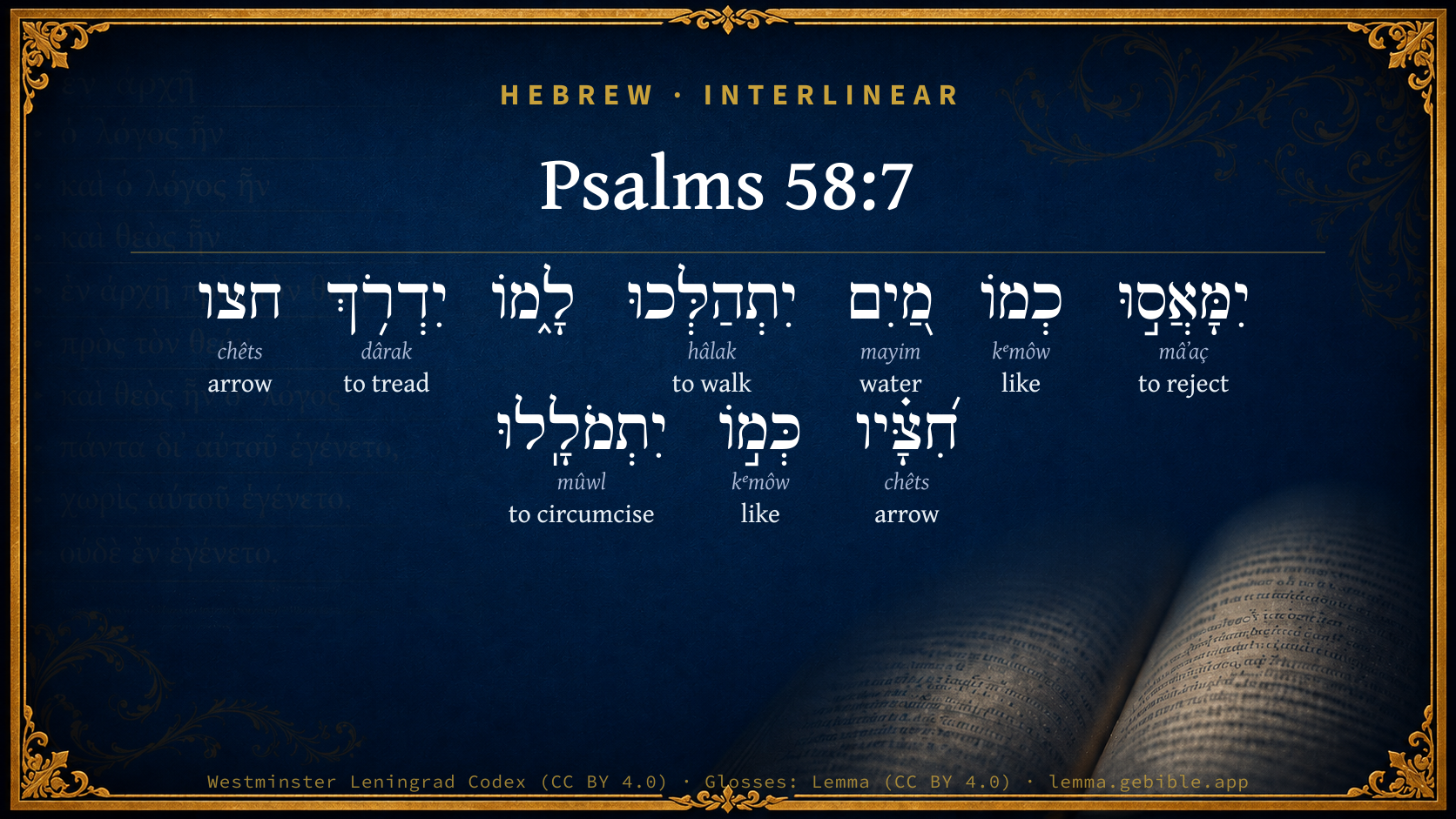
Hebrew (Westminster Leningrad Codex) Psalms 58:7 appears in the Hebrew Old Testament. The text above is from the Westminster Leningrad Codex. Each word links to its Strong’s number, a concise gloss, and parsing drawn from the Open Scriptures Hebrew Bible morphology. Click any word for its full Brown-Driver-Briggs (BDB) entry.
Download image
Cite this verse

Psalms 58:7 (World English Bible). Public Domain. Lemma interlinear Bible study tool, https://lemma.gebible.app/v/psalms/58/7.

Show BibTeX & RIS
BibTeX
RIS
English Translation
Let them vanish as water that flows away. When they draw the bow, let their arrows be made blunt.
World English Bible · Public Domain
Download a study sheet

One document with this verse’s original text, its word-by-word gloss line, the meaning frame, cross-references with their text, attributed commentary, and full source and license credits — printable, and it pastes into notes with its structure intact.

This verse Autodidact and up

Study sheet (.html) Plain text (.txt)

A passage Seminary Student

Up to 50 verses in one chapter. A passage sheet keeps up to 6 commentary sources and 12 cross-references per verse, in the order this page ranks them, and says so on the sheet whenever that leaves anything out. Ask for a single verse and you get the Autodidact verse sheet above.

Everything on this page stays free to read, with no account — the sheet is a download of what is already on screen, not access to it.

Want to remove ads? Support Godless Engineer
Compare translations 3

The same verse in 3 English versions, stacked beneath the original-language interlinear above. Click any original word for its lexicon entry.

Each is an independent rendering of the whole verse — the interlinear is not word-aligned to these translations.

Highlighted words mark where these versions differ — a whole-verse word diff, not a word-by-word alignment.

  • World English Bible Public Domain
    Let them vanish as water that flows away. When they draw the bow, let their arrows be made blunt.
  • King James Version Public Domain
    Let them melt away as waters which run continually: when he bendeth his bow to shoot his arrows, let them be as cut in pieces.
  • unfoldingWord Literal Text CC BY-SA 4.0
    May they be melted like waters run off to them. he treads his arrows, as if they are cut off.

unfoldingWord Literal Text — © unfoldingWord, licensed CC BY-SA 4.0. Word-aligned USFM3 via Door43 (git.door43.org/unfoldingWord/en_ult).

Versions to compare (up to 4)

3 of 4 selected

Show all 18 translations

Every available English version of this verse, each an independent rendering of the whole verse.

  • World English Bible Public Domain
    Let them vanish as water that flows away. When they draw the bow, let their arrows be made blunt.
  • Berean Standard Bible Public Domain
    May they vanish like water that runs off; when they draw the bow, may their arrows be blunted.
  • Majority Standard Bible Public Domain
    May they vanish like water that runs off; when they draw the bow, may their arrows be blunted.
  • King James Version Public Domain
    Let them melt away as waters which run continually: when he bendeth his bow to shoot his arrows, let them be as cut in pieces.
  • American Standard Version (1901) Public Domain
    Let them melt away as water that runneth apace: When he aimeth his arrows, let them be as though they were cut off.
  • Revised Version (1885) Public Domain
    Let them melt away as water that runneth apace: when he aimeth his arrows, let them be as though they were cut off.
  • Geneva Bible (1599) Public Domain
    Let them melt like the waters, let them passe away: when hee shooteth his arrowes, let them be as broken.
  • Douay-Rheims (1899) Public Domain
    God shall break in pieces their teeth in their mouth: the Lord shall break the grinders of the lions.
  • Young's Literal Translation Public Domain
    They are melted as waters, They go up and down for themselves, His arrow proceedeth as they cut themselves off.
  • Literal Standard Version CC BY-SA 4.0
    They are melted as waters, || They go up and down for themselves, || His arrow proceeds as they cut themselves off.
  • Unlocked Literal Bible CC BY-SA 4.0
    Let them melt away as water that runs off; when they shoot their arrows, let them be as though they had no points.
  • unfoldingWord Literal Text CC BY-SA 4.0
    May they be melted like waters run off to them. he treads his arrows, as if they are cut off.
  • Darby Bible Public Domain
    Let them melt away as waters that flow off; when he aimeth his arrows, let them be as blunted:
  • World Messianic Bible Public Domain
    Let them vanish like water that flows away. When they draw the bow, let their arrows be made blunt.
  • Webster's Bible Public Domain
    \\58:6\\Break their teeth, O God, in their mouth: break out the great teeth of the young lions, O LORD.
  • Free Bible Version CC BY-SA 4.0
    May they vanish like water that flows away; when they shoot their arrows may they miss their mark.
  • Bible in Basic English Public Domain
    Let them be turned to liquid like the ever-flowing waters; let them be cut off like the grass by the way.
  • JPS Tanakh (1917) Public Domain
    (58-8) Let them melt away as water that runneth apace; when he aimeth his arrows, let them be as though they were cut off.

Literal Standard Version (2020), Covenant Press — licensed CC BY-SA 4.0. Text via the HelloAO Bible API (eBible.org). Unlocked Literal Bible (unfoldingWord) — licensed CC BY-SA 4.0. Text via the HelloAO Bible API (eBible.org). unfoldingWord Literal Text — © unfoldingWord, licensed CC BY-SA 4.0. Word-aligned USFM3 via Door43 (git.door43.org/unfoldingWord/en_ult). Free Bible Version, Dr. Jonathan Gallagher — licensed CC BY-SA 4.0. Text via the HelloAO Bible API (eBible.org).

Word by word

More ways to search: Search by grammar → Find every occurrence → Compare this word →

Practice this passage: Drill this verse → Learn its vocabulary →

יִתְמֹלָֽלוּ
mûwl
H4135
“to circumcise”
Verb, Hithpael, Imperfect, 3rd Person, Masculine, Plural
Part of Speech
Verb
Stem
Hithpael
Form
Imperfect
Person
3rd Person
Gender
Masculine
Number
Plural
Full BDB Definition

Origin: a primitive root

TWOT: 1161

to circumcise, let oneself be circumcised, cut, be cut off - (Qal) to circumcise - (Niphal) to be circumcised, circumcise oneself - (Hiphil) to cause to be circumcised - of destruction (figuratively) - (Hithpolel) to be cut off - (Polel) cut down
  1. יִמָּאֲס֣וּ mâʼaç H3988 “to reject” Verb, Niphal, Imperfect, 3rd Person, Masculine, Plural
  2. כְמוֹ kᵉmôw H3644 “like” Preposition
  3. מַ֭יִם mayim H4325 “water(s)” Noun, Common, Masculine, Plural, Absolute
  4. יִתְהַלְּכוּ hâlak H1980 “to walk” Verb, Hithpael, Imperfect, 3rd Person, Masculine, Plural
  5. יִדְרֹ֥ךְ dârak H1869 “to tread” Verb, Qal, Imperfect, 3rd Person, Masculine, Singular
  6. חצו chêts H2671 “arrow · his” Noun, Common, Masculine, Singular, Construct + Suffix, Personal, 3rd Person, Masculine, Singular
  7. חִ֝צָּ֗יו chêts H2671 “arrows · his” Noun, Common, Masculine, Plural, Construct + Suffix, Personal, 3rd Person, Masculine, Singular
  8. כְּמ֣וֹ kᵉmôw H3644 “like” Preposition

About this verse

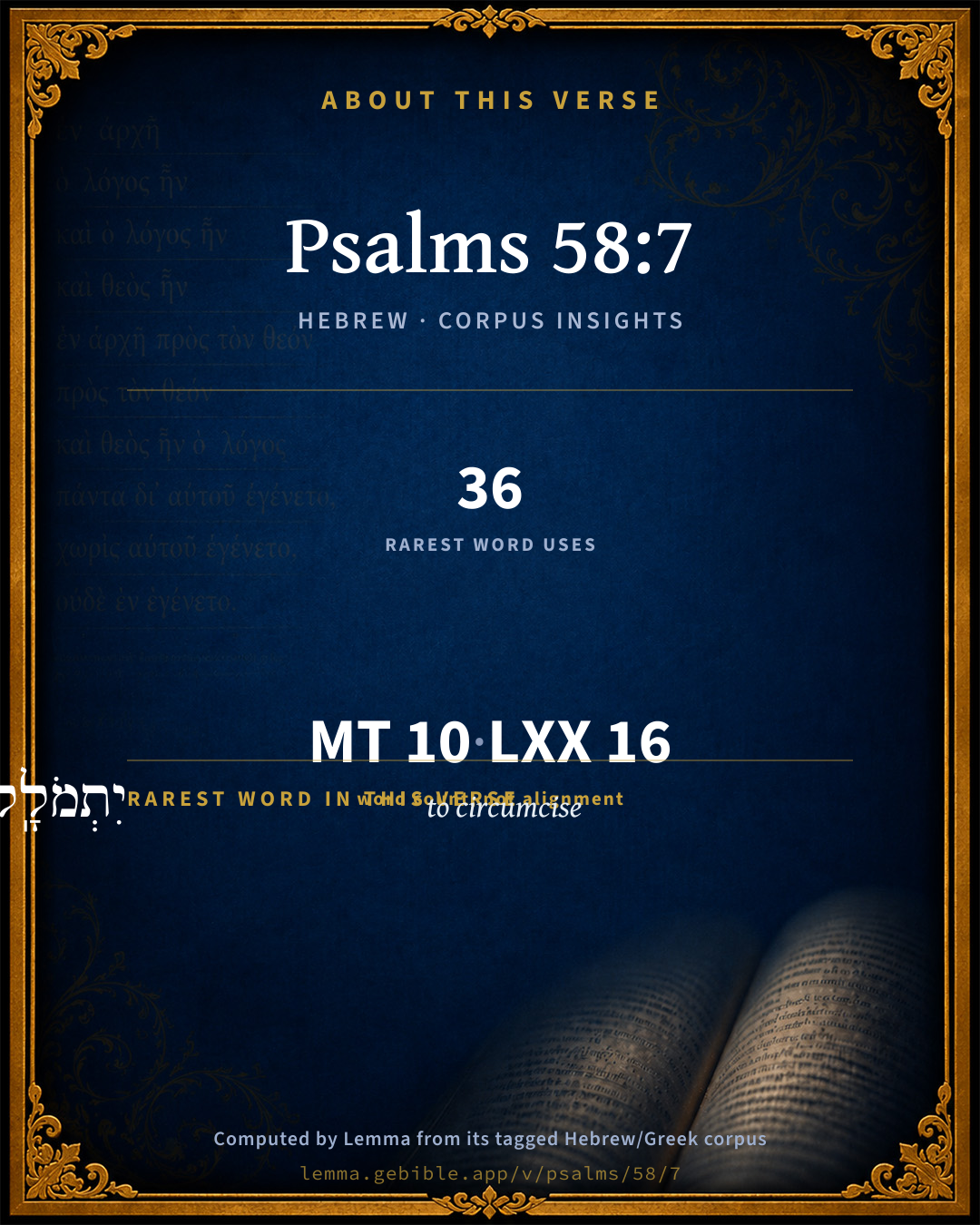
These counts appear in no published source. They are computed here, from the morphology-tagged text and Lemma’s own curated glosses. What Lemma adds →

10
words
7
distinct lemmas
Wisdom
section

Shared distinctive vocabulary

יִתְמֹלָֽלוּ to circumcise H4135 occurs in 32 verses of the Hebrew Bible. Also found in:

Grammatical profile

  • 4 verbs
  • 3 nouns
  • 3 prepositions

Verb forms

  • יִמָּאֲס֣וּ Niphal · Imperfect
  • יִתְהַלְּכוּ Hithpael · Imperfect
  • יִדְרֹ֥ךְ Qal · Imperfect
  • יִתְמֹלָֽלוּ Hithpael · Imperfect

Repetition

Words recur within this verse — often emphatic in Hebrew:

  • כְמוֹ like H3644 ×2
  • חצו arrow H2671 ×2

Hebrew & Septuagint length

In English translation the verse runs 19 words from the Hebrew and 18 from the Septuagint (LXX English) — closely comparable.

A rough comparison of the two English renderings, which tokenize alike — not a word-level alignment.

Word counts can differ between the Hebrew and the Greek without any difference in meaning — e.g. the Hebrew direct-object marker אֵת has no separate Greek word, and Greek often adds the article ὁ.

In the original languages it is 10 Hebrew tokens and 16 Greek tokens — but the two are counted differently (Hebrew bundles its prefixes and suffixes into one token; the Greek is in lemma form), so that isn’t a like-for-like length.

Cross-references

9

Topical passages linked to Psalms 58:7 in the Treasury of Scripture Knowledge — connected by theme and wording, ordered by reader-vote popularity; previews shown in the World English Bible.

  • Joshua 7:5 The men of Ai struck of them about thirty-six men; and they chased them [from] before the gate even to Shebarim, and struck them at the descent; and the hearts of the people melted, and became as water.
  • Psalms 112:10 The wicked will see it, and be grieved. He shall gnash with his teeth, and melt away. The desire of the wicked will perish.
  • Exodus 15:15 Then the chiefs of Edom were dismayed. Trembling takes hold of the mighty men of Moab. All the inhabitants of Canaan are melted away.
  • Joshua 2:9–11 and she said to the men, I know that Yahweh has given you the land, and that the fear of you is fallen on us, and that all the inhabitants of the land melt away before you.
  • Psalms 64:3 Who sharpen their tongue like a sword, And aim their arrows, deadly words,
  • Isaiah 13:7 Therefore shall all hands be feeble, and every heart of man shall melt:
  • 2 Samuel 17:10 Even he who is valiant, whose heart is as the heart of a lion, will utterly melt; for all Israel knows that your father is a mighty man, and those who are with him are valiant men.
  • Psalms 22:14 I am poured out like water. All my bones are out of joint. My heart is like wax; It is melted within me.
  • Psalms 64:7–8 But God will shoot at them. They will be suddenly struck down with an arrow.

Cross-references courtesy of OpenBible.info (CC BY 4.0).

Hebrew and Greek witnesses Masoretic Hebrew ↔ Greek Septuagint

The same verse in the two great witnesses to the Old Testament, shown verse-for-verse.

You’re reading Greek Psalm 57 (Hebrew Psalm 58). The Septuagint counts the superscription, so verse numbers can differ from the Hebrew — chapter-level alignment, not verse-by-verse. Numbering follows Rahlfs.

These are two independent witnesses, not word-aligned to each other, and the Septuagint is shown in lemma (dictionary) form.

Hebrew Psalms 58:7 Masoretic · Westminster Leningrad Codex

יִמָּאֲס֣וּ כְמוֹ מַ֭יִם יִתְהַלְּכוּ לָ֑מוֹ יִדְרֹ֥ךְ חצו חִ֝צָּ֗יו כְּמ֣וֹ יִתְמֹלָֽלוּ

Let them vanish as water that flows away. When they draw the bow, let their arrows be made blunt.

World English Bible · Public Domain

Greek LXX Greek Psalm 57:7 Septuagint · lemma form

ὁ θεός συντρίβω ὁ ὀδούς αὐτός ἐν ὁ στόμα αὐτός ὁ μύλη ὁ λέων συνθλάω κύριος

They shall utterly pass away like water running through: he shall bend his bow till they shall fail.

LXX2012 (modern English Septuagint) · Public Domain

On this verse, Ellicott's Commentary for English Readers discusses the Septuagint’s reading. Read the note in Commentary ↓

Hebrew: Westminster Leningrad Codex (CC BY 4.0). Greek: Septuagint (public domain); English from LXX2012 (modern English Septuagint) (Public Domain). How the Septuagint differs from the Hebrew →

Commentary

Notes on Psalms 58:7 from classic Christian and Jewish commentators (each source and its license shown beneath its notes). The classic Christian expositions comment on the surrounding passage and are grouped to its opening verse, so a note may address several verses; the Jewish commentaries on the Tanakh (Rashi and others) are per-verse, so they appear only where the commentator wrote on this verse.

Lemma curates 59 commentaries, every one of them public domain or Creative Commons licensed, each selected and text-cleaned for this edition rather than reprinted as found. About our sources →

Trapp's Complete Commentary

John Trapp

Psa 58:7 Let them melt away as waters [which] run continually: [when] he bendeth [his bow to shoot] his arrows, let them be as cut in pieces.

Ver. 7. Let them melt away as waters] As snowwaters before the sunbeams, quickly melted, and soon drunk in by the dry earth, Job 24:19. In Peru, they say, there is a river called the diurnal river, or the day river, because it flows with a mighty current in the day, but in the night is dry, because it is not fed by a spring, but caused merely by the melting of the snow, which lieth on the mountains thereabouts.

When he bendeth his bow] i.e. Let him be utterly frustrated, let all his mischievous designs and endeavours be blasted, and come to nothing. In that famous battle between Theodosius and Maximus, Milites nobis qui aderant retulerunt, saith Augustine (De Cit. Dei, l. 5, c. 26), extorta sibi esse de manibus quaecunque iculabantur; cum a Theodosii partibus in adversarios vehemens ventus iret; et non solum quaecunque in cos iaciebantur concitatissime raperet, verum etiam ipsorum tela in eorum corpora retorqueret: the soldiers told us that their darts thrown against the Christians were, by a violent wind, brought back upon themselves. Accordingly some render this hemistich thus: When he bendeth, &c., let him be as they that cut off themselves, Iethmalalu reciprocam habet significationem. Et hoc Saulo contigit.

John Trapp, A Commentary or Exposition upon All the Books of the Old and New Testament (1647–1656) — public domain. Text from a community e-Sword module.

Joseph Benson's Commentary

Psa 58:7. Let them melt away as waters, &c. — As waters arising from melted snow, or great showers, or some other extraordinary cause, which at first run with great force and noise, and throw down all that stands in their way, but are suddenly gone, and run away, and vanish, and return no more. When he — Saul, or any, or every one of mine enemies, as appears from the foregoing or following words; bendeth his bow to shoot his arrows — Taking his aim at the upright in heart; let them — That is, his arrows, be cut in pieces — Let them be like arrows broken, while a man is shooting them. Let them fall at his feet, and never come near the mark.

Joseph Benson's Commentary on the Old and New Testaments (1811–1818) — public domain. Text from a community e-Sword module.

J. A. Alexander on Psalms

Joseph Addison Alexander

8. (Psa 58:7). Let them melt away as waters, let them go their way; let him bend his arrows, as if they were cut off. The optative meaning of these features seems to be determined by the imperatives in Psa 58:6. There is nothing ungrammatical, however, in retaining the strict future sense, and regarding the verse as an expression of strong confidence as to the event. The first verb elsewhere has the sense of being rejected with contempt, and is so used in Ps. 15:9; but as two of its radical letters coincide with those of a verb meaning to be melted, most interpreters prefer this sense. The other might, however, be retained, and the phrase explained to mean that they should be east aside as water, and especially as filthy water, is rejected. Go their way, literally go to their or to themselves. Some understand it to mean for themselves, i. e. for their own benefit, their destruction being represented, by a sort of irony, as all that they have gained by their hostility. Compare the use of the same phrase in Psa 64:5; Psa 66:6. In the next clause, most interpreters assume a sudden change of number, such as frequently occurs in speaking of an ideal person representing a plurality of real individuals. See above, on Psa 58:3; Psa 58:6. He (i.e. the enemy) shall bend his arrows, literally tread them, i. e. bend by treading on them. This expression is applicable strictly to the bow, and it is so applied repeatedly above. See Psa 7:12; Psa 11:2; Psa 37:14. Having thus acquired the secondary sense of fitting, making ready, it is transferred from the bow to the arrows, not only here but in Psa 64:3, below. If the last verb be construed with the arrows as its subject, they would seem to be described as blunted or deprived of their points, and the meaning of the clause is, that the weapons of the enemy take no effect. The whole clause, however, will admit of a different construction, which refers the singular verb and pronoun to God himself, and the plural verb to these rebellious sinners. Let him bend his arrows,as if they were cut off, i.e. so that they may be cut off. Notwithstanding the obscurity of this clause, the connection is preserved unbroken by the obvious meaning of the other.

Joseph Addison Alexander, The Psalms Translated and Explained (1850) — public domain. Text from a community e-Sword module.

Geneva Bible (1599)

Geneva Bible translators

Considering God’s divine power, he showeth that God in a moment can destroy their force whereof they brag.

Geneva Bible (1599) marginal notes — public domain. Text via Bolls.life.

Jamieson, Fausset & Brown

Robert Jamieson, A. R. Fausset & David Brown

which run continually--literally, "they shall go to themselves," utterly depart, as rapid mountain torrents.

he bendeth . . . his arrows--prepares it. The term for preparing a bow applied to arrows (Psa 64:3).

let them . . . pieces--literally, "as if they cut themselves off"--that is, become blunted and of no avail.

Jamieson, Fausset & Brown — Commentary Critical and Explanatory on the Whole Bible (1871) — public domain (CC PDM 1.0). Text via the HelloAO Bible API.

Adam Clarke's Commentary

Verse 7. Let them melt away as waters] Let them be minished away like the waters which sometimes run in the desert, but are soon evaporated by the sun, or absorbed by the sand.

When he bendeth his bow] When my adversaries aim their envenomed shafts against me, let their arrows not only fall short of the mark, but he broken to pieces in the flight. Some apply this to GOD. When he bends his bow against them, they shall all be exterminated.

Adam Clarke's Commentary on the Bible (1810–1826) — public domain. Text from a community e-Sword/MySword module.

Ellicott's Commentary for English Readers

(7, 8) After the types of obstinate and fierce malignity, come four striking images of the fatuity of the wicked man’s projects, and his own imminent ruin. The first of these compares him to water, which, spilt on a sandy soil, sinks into it and melts away. (Comp. 2Sa_14:14.) Perhaps a phenomenon, often described by travellers, was in the poet’s mind, the disappearance of a stream which, after accompanying the track for some time, suddenly sinks into the sand. The words which run continually, even if the Hebrew can bear this meaning, only weaken the figure. The verb is in the reflexive conjugation, and has “to” or “for themselves” added, and seems to be exactly equivalent to our, they walk themselves off. This certainly should be joined to the clause following. Here, too, we must suppose that the sign of comparison, khemô, was dropped out by the copyist in consequence of the lâmô just written, and afterwards being inserted in the margin, got misplaced. We must bring it back, and read:

They are utterly gone, as when

One shoots his arrows.

This figure thus becomes also clear and striking. The arrow once shot is irrevocably gone, probably lost, fit emblem of the fate of the wicked. For the ellipse in bend (literally, tread, see Psa_7:12), comp. Psa_64:3, where also the action properly belonging to the bow is transferred to the arrow.

The words, “Let them be as cut in pieces,” must be carried on to the following verse, which contains two fresh images: So they are cut off (LXX., “are weak “) as shablûl melts; (as) the abortion of a woman passes away without seeing the sun. The word shablûl, by its derivation (bâlal = to pour out) may mean any liquid or moist substance. Hence some understand a watercourse, others (LXX. and Vulg.) wax. The first would weaken the passage by introducing a bald repetition of a previous image. The second is quite intelligible. But the Talmud says shablûl is a slug or shelless snail, and there may be a reference in the passage to the popular notion derived from the slimy track of the creature, that the slug dissolves as it moves, and eventually melts away. Dr. Tristram, however (Nat. Hist. Bib., p. 295), finds scientific support for the image in the myriads of snail shells found in the Holy Land, still adhering, by the calcareous exudation round the orifice, to the surface of the rock, while the animal itself is utterly shrivelled and wasted. The last image presents no difficulty either in language or form, except that the form of the noun woman is unusual.

That they may not.—That this refers to the abortion which passed away without seeing the sun, is certain. The grammatical difficulty of want of concord may be got over by taking abortion as a collective noun.

A Bible Commentary for English Readers, edited by Charles John Ellicott (1878–1897) — public domain. Text from a community e-Sword module.

The Cambridge Bible for Schools and Colleges

gen. ed. J. J. S. Perowne

7. as waters which run continually) R.V., restoring P.B.V., as water that runneth apace: like some torrent that rages wildly for a while when swollen by a sudden storm, and then vanishes entirely (Job_6:15 ff.).

when he bendeth his bow to shoot his arrows] A cumbrous rendering of a peculiar phrase, the verb strictly applicable to the bow being used of the arrows (cp. Psa_64:3). Better as R.V., when he aimeth his arrows. But who is the subject? (1) It may be the wicked man, (as in Psa_64:3); When he aimeth his arrows, let them be as though they were cut off (R.V.), their points broken, and their power to hurt destroyed. (2) It may be God (as in Psa_7:12 f.); when He aimeth His arrows, let them (the wicked) be as it were mowed down. Cp. Psa_90:6. Neither alternative is free from serious difficulties, but the first seems preferable.

The Cambridge Bible for Schools and Colleges (gen. ed. J. J. S. Perowne; Cambridge University Press, 1878–1918) — public domain. Text from a community e-Sword module.

John Gill's Exposition

Let them melt away as waters which run continually,.... Let them be disheartened, and their courage fail them, and let there be no spirit left in them, Jos 7:5; or let them be unstable as water that is continually running, ever upon the flux and motion; let them never be settled, but always changing in their state and circumstances, Gen 49:4; or let them "come to nought", as the Septuagint and Vulgate Latin versions; which is the case of water that runs over or runs away: or "let them be despised", as Jarchi, and the Arabic, Syriac, and Ethiopic versions; being useless and unprofitable, as water is when passed and gone: or let their ruin and destruction be as swift as the gliding water; let them be brought to desolation in a moment; Job 24:18; and let it be irrecoverable, as water running over the cup, and scattering itself, is spilled upon the ground, and cannot be gathered up, Sa2 14:14. The Targum is,

"let them melt in their sins as water;''

when he bendeth his bow to shoot his arrows, let them be as cut in pieces; either when the wicked man bends his bow to shoot his arrows against the righteous; when he devises, his chief against him, shoots out bitter words, and attempts to do hurt unto him; let it be as if the string of his bow and his arrows were all cut to pieces; let all his designs, words, and actions, be without effect, and let not his hand perform his enterprise: or when God bends his bow against the wicked, so Jarchi; and prepares the instruments of death for them, and ordains his arrows against the persecutors, Psa 7:12; let then his and his people's enemies be cut off, as the tops of the ears of corn; as the word used signifies, Job 24:24. The words may be rendered, "let him (God) direct his arrows; as the tops of the ears of corn are cut off" (f); so let them be.

(f) "concidantur, succidantur instar spicarum", Michaelis.

John Gill's Exposition of the Whole Bible (1746–1763) — public domain (CC PDM 1.0). Text via the HelloAO Bible API.

Albert Barnes' Notes on the Bible

Let them melt away as waters which run continually - Let them vanish or disappear as waters that flow off, or floods that run by, and are no more seen. “Perhaps” the allusion here may be to the waters of a torrent that is swollen, which flow off and are lost in the sand, so that they wholly disappear. See the notes at Job 6:15-19. The prayer is, that his enemies might perish or be cut off, and that he might thus be saved from them.

When he bendeth his bow to shoot his arrows - literally, “he treads on his arrows.” See the notes at Psa 11:2. The meaning here is, When he prepares for an attack - or, prepares to make war, as one does who bends his bow, and places his arrow on the string. The allusion here is to the enemies of David, as seeking his life.

Let them be as cut in pieces - That is, Let his arrows be as if they were cut off or “blunted,” so that they will produce no effect. Let them be such, that they will not penetrate and wound.

Albert Barnes' Notes on the Bible (1834–1885) — public domain. Text from a community e-Sword/MySword module.

Matthew Poole's English Annotations

As waters which run continually; as waters arising from melted snow, or great showers, or some other extraordinary cause, which at first run with great force and noise, and throw down all that stands in their way, but are suddenly gone, and run away and vanish, and return no more.

When he bendeth his bow, to wit, any or every one of mine enemies, as appears from the foregoing and following words.

Is cut in pieces, i.e. like arrows broken asunder whilst a man shoots, which can do no hurt.

Matthew Poole's English Annotations on the Holy Bible (1683–1685) — public domain. Text from a community e-Sword/MySword module.

The Treasury of David

Charles H. Spurgeon

Ver. 7. Let them melt away as waters which run continually. Like mountain torrents dried up by the summer heats let them disappear; or like running streams whose waters are swiftly gone, so let them pass away; or like water spilt which none can find again, so let them vanish out of existence. Begone, ye foul streams, the sooner ye are forgotten the better for the universe.

When he bendeth his bow to shoot his arrows, let them be as cut in pieces. When the Lord goes forth to war, let his judgments so tell upon these persecutors that they may be utterly cut in pieces as a mark shattered by many shafts. Or perhaps the meaning is, when the ungodly man marches to the conflict, let his arrows and his bow drop into fragments, the string cut, the bow snapped, the arrows headless, the points blunted; so that the boastful warrior may not have wherewithal to hurt the object of his enmity. In either sense the prayer of the Psalm has often become fact, and will be again fulfilled as often as need arises.

Ver. 7. (first clause). Perowne renders this clause, Let them melt away, as water (which) runneth apace, and says that the reference is to "water running away, and so wasted and lost."

Ver. 7. (first clause). In desert parts of Africa it has afforded much joy to fall in with a brook of water, especially when running in the direction of the journey, expecting it would provide a valuable companion. Perhaps before it accompanied us two miles it became invisible by sinking into the sand; but two miles farther along it would reappear, and raise hopes of its continuance: but after running a few hundred yards, would sink finally into the sand, no more again to rise. John Campbell, 1766-1840.

None.

Psalms 58:8*

Charles H. Spurgeon's The Treasury of David (1869–1885) — public domain. Psalms only. Text from a community e-Sword/MySword module.

Whedon's Commentary on the Bible

Daniel D. Whedon

7. Melt away as waters—The allusion is to winter torrents, and the momentary streams occasioned by showers, which suddenly and totally disappear, having no permanent source of supply, so deceiving the expectation of the traveller and the shepherd as a reliance for animal use. Comp. Job_6:15-20. So deceitful and transient is the prosperity of the wicked!

He bendeth his bow—Literally, he treadeth his arrows, as Psa_64:4, that is, he bends his bow by placing his foot upon it, with the arrow placed upon the string. A description of a mighty bow.

Cut in pieces—Cut in two, or the head of the arrow cut off to render it powerless of effect. Thus futile as a broken arrow from the bow of the mighty shall be the plans and purposes of the haters of God.

Daniel D. Whedon (gen. ed.), Commentary on the Old and New Testaments (1874–1909) — public domain. Text from a community e-Sword module.

The Pulpit Commentary

Let them melt away as waters which run continually; i.e. "let them waste away, and go to naught, like water, that runs off and accomplishes nothing." When he bendeth his bow to shoot his arrows, let them be as cut in pieces; i.e. "let the arrows be as though snapped in two, or headless."

The Pulpit Commentary (1880–1919), ed. H.D.M. Spence-Jones & Joseph S. Exell — public domain. Text from a community e-Sword module.

John Wesley's Explanatory Notes

Melt away - As waters arising from melted snow, which at first run with great force, but are suddenly gone.

John Wesley, Explanatory Notes Upon the Whole Bible (1754–1765) — public domain. Text via the GEBible commentary corpus.

Rashi

Rabbi Shlomo Yitzchaki (Rashi)

molars The inner teeth, called messelers in Old French, molars, grinders.

Rashi on the Tanakh — English translations: “The Judaica Press complete Tanach with Rashi, translated by A. J. Rosenberg” (CC BY 4.0); “Pentateuch with Rashi's commentary by M. Rosenbaum and A.M. Silbermann, 1929-1934” (public domain); “The Metsudah Tanach series, Lakewood, N.J” (CC BY 4.0); and “The Book of Joshua, Metsudah Publications, 1997” (CC BY 4.0). Text via Sefaria.

Lesson kit

Teaching starters — assembled from the data on this page, not authored interpretation. Every prompt links to the verse data it draws on. Edit before teaching.

Psalms, in the Wisdom, opens this verse with 10 words (7 distinct Hebrew lemmas). Its most distinctive word is mûwl (“to circumcise”). A historical commentator’s framing appears above. Read the whole chapter for the surrounding context.

Discussion questions

  1. How does “to circumcise” (mûwl) shape what this verse is saying?
  2. Genesis 17:10 shares the word «to circumcise» with this verse. How do the two illuminate each other?
  3. “like” occurs 2× in this one verse. What is the effect of the repetition?
  4. These translations render this verse differently; the difference is in the English rendering, not the original. What questions does that raise?
  5. The verb «יִמָּאֲס֣וּ» is Niphal Imperfect. How does its form color the action?
  6. Reading how Trapp's Complete Commentary and Joseph Benson's Commentary read this verse, where do the two commentators agree and where do they part?

Things to notice

Reading settings

Reading text

Shown beneath each verse's original-language words.

Old Testament
Old Testament edition

Read the OT as the Masoretic Hebrew (MT) or the Greek Septuagint (LXX).

English shown for the Greek Septuagint (in the Hebrew ↔ Greek comparison).

Comparing translations? Open the Compare panel on any verse page to stack up to four side by side.