
Isaiah 14:10

Hebrew (Westminster Leningrad Codex) Isaiah 14:10 appears in the Hebrew Old Testament. The text above is from the Westminster Leningrad Codex. Each word links to its Strong’s number, a concise gloss, and parsing drawn from the Open Scriptures Hebrew Bible morphology. Click any word for its full Brown-Driver-Briggs (BDB) entry.
Download image
Cite this verse

Isaiah 14:10 (World English Bible). Public Domain. Lemma interlinear Bible study tool, https://lemma.gebible.app/v/isaiah/14/10.

Show BibTeX & RIS
BibTeX
RIS
English Translation
All they shall answer and tell you, Are you also become weak as we? are you become like us?
World English Bible · Public Domain
Download a study sheet

One document with this verse’s original text, its word-by-word gloss line, the meaning frame, cross-references with their text, attributed commentary, and full source and license credits — printable, and it pastes into notes with its structure intact.

This verse Autodidact and up

Study sheet (.html) Plain text (.txt)

A passage Seminary Student

Up to 50 verses in one chapter. A passage sheet keeps up to 6 commentary sources and 12 cross-references per verse, in the order this page ranks them, and says so on the sheet whenever that leaves anything out. Ask for a single verse and you get the Autodidact verse sheet above.

Everything on this page stays free to read, with no account — the sheet is a download of what is already on screen, not access to it.

Want to remove ads? Support Godless Engineer
Compare translations 3

The same verse in 3 English versions, stacked beneath the original-language interlinear above. Click any original word for its lexicon entry.

Each is an independent rendering of the whole verse — the interlinear is not word-aligned to these translations.

Highlighted words mark where these versions differ — a whole-verse word diff, not a word-by-word alignment.

  • World English Bible Public Domain
    All they shall answer and tell you, Are you also become weak as we? are you become like us?
  • King James Version Public Domain
    All they shall speak and say unto thee, Art thou also become weak as we? art thou become like unto us?
  • unfoldingWord Literal Text CC BY-SA 4.0
    All of them will answer and say to you, ‘You also, you have been weakened like us; you have been likened to us!’

unfoldingWord Literal Text — © unfoldingWord, licensed CC BY-SA 4.0. Word-aligned USFM3 via Door43 (git.door43.org/unfoldingWord/en_ult).

Versions to compare (up to 4)

3 of 4 selected

Show all 18 translations

Every available English version of this verse, each an independent rendering of the whole verse.

  • World English Bible Public Domain
    All they shall answer and tell you, Are you also become weak as we? are you become like us?
  • Berean Standard Bible Public Domain
    They will all respond to you, saying, “You too have become weak, as we are; you have become like us!”
  • Majority Standard Bible Public Domain
    They will all respond to you, saying, “You too have become weak, as we are; you have become like us!”
  • King James Version Public Domain
    All they shall speak and say unto thee, Art thou also become weak as we? art thou become like unto us?
  • American Standard Version (1901) Public Domain
    All they shall answer and say unto thee, Art thou also become weak as we? art thou become like unto us?
  • Revised Version (1885) Public Domain
    All they shall answer and say unto thee, Art thou also become weak as we? art thou become like unto us?
  • Geneva Bible (1599) Public Domain
    All they shall crie, and saie vnto thee, Art thou become weake also as we? art thou become like vnto vs?
  • Douay-Rheims (1899) Public Domain
    All shall answer, and say to thee: Thou also art wounded as well as we, thou art become like unto us.
  • Young's Literal Translation Public Domain
    All of them answer and say unto thee, Even thou hast become weak like us! Unto us thou hast become like!
  • Literal Standard Version CC BY-SA 4.0
    All of them answer and say to you, Even you have become weak like us! You have become like to us!
  • Unlocked Literal Bible CC BY-SA 4.0
    They all will speak and say to you, 'You have become as weak as us. You have become like us.
  • unfoldingWord Literal Text CC BY-SA 4.0
    All of them will answer and say to you, ‘You also, you have been weakened like us; you have been likened to us!’
  • Darby Bible Public Domain
    All of them shall answer and say unto thee, Art thou also become powerless as we; art thou become like unto us!
  • World Messianic Bible Public Domain
    They all will answer and ask you, “Have you also become as weak as we are? Have you become like us?”
  • Webster's Bible Public Domain
    All they shall speak and say to thee, Art thou also become weak as we? Art thou become like us?
  • Free Bible Version CC BY-SA 4.0
    They will all speak up and tell you, ‘So you too are as weak as we are—you've become just like us!
  • Bible in Basic English Public Domain
    They all make answer and say to you, Have you become feeble like us? have you been made even as we are?
  • JPS Tanakh (1917) Public Domain
    All they do answer and say unto thee: 'Art thou also become weak as we? Art thou become like unto us?

Literal Standard Version (2020), Covenant Press — licensed CC BY-SA 4.0. Text via the HelloAO Bible API (eBible.org). Unlocked Literal Bible (unfoldingWord) — licensed CC BY-SA 4.0. Text via the HelloAO Bible API (eBible.org). unfoldingWord Literal Text — © unfoldingWord, licensed CC BY-SA 4.0. Word-aligned USFM3 via Door43 (git.door43.org/unfoldingWord/en_ult). Free Bible Version, Dr. Jonathan Gallagher — licensed CC BY-SA 4.0. Text via the HelloAO Bible API (eBible.org).

Word by word

More ways to search: Search by grammar → Find every occurrence → Compare this word →

Practice this passage: Drill this verse → Learn its vocabulary →

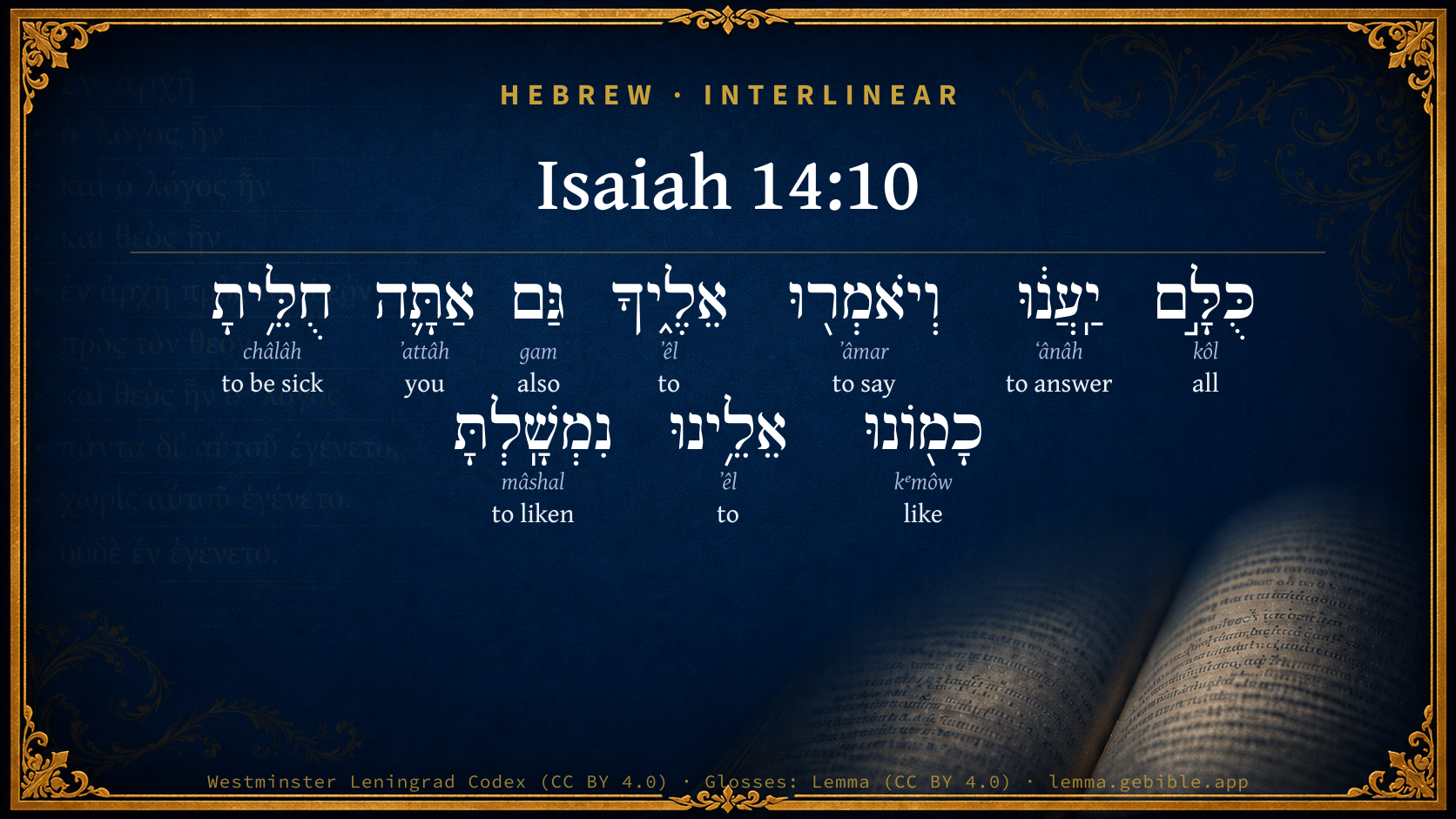
נִמְשָֽׁלְתָּ
mâshal
H4911
“to liken”
Verb, Niphal, Perfect, 2nd Person, Masculine, Singular
Part of Speech
Verb
Stem
Niphal
Form
Perfect
Person
2nd Person
Gender
Masculine
Number
Singular
Full BDB Definition

Origin: denominative from H4912

TWOT: 1258 , 1258b

to represent, liken, be like - (Niphal) to liken, be like, be similar - (Hiphil) to compare - (Hithpael) to become like - to speak in a proverb, use a proverb, speak in parables, speak in sentences of poetry - (Qal) to use a proverb, speak a parable or proverb - (Piel) to make a parable - maker of parables (participle)
  1. כֻּלָּ֣ם kôl H3605 “all · their” Noun, Common, Masculine, Singular, Construct + Suffix, Personal, 3rd Person, Masculine, Plural
  2. יַֽעֲנ֔וּ ʻânâh H6030 “to answer” Verb, Qal, Imperfect, 3rd Person, Masculine, Plural
  3. וְיֹאמְר֖וּ ʼâmar H559 “and · to say” Conjunction + Verb, Qal, Imperfect, 3rd Person, Masculine, Plural
  4. אֵלֶ֑יךָ ʼêl H413 “to · you” Preposition + Suffix, Personal, 2nd Person, Masculine, Singular
  5. גַּם gam H1571 “also” Particle, Accusative
  6. אַתָּ֛ה ʼattâh H859 “you” Pronoun, Personal, 2nd Person, Masculine, Singular
  7. חֻלֵּ֥יתָ châlâh H2470 “to be sick” Verb, Pual, Perfect, 2nd Person, Masculine, Singular
  8. כָמ֖וֹנוּ kᵉmôw H3644 “like · us” Preposition + Suffix, Personal, 1st Person, Common, Plural
  9. אֵלֵ֥ינוּ ʼêl H413 “to · us” Preposition + Suffix, Personal, 1st Person, Common, Plural

About this verse

These counts appear in no published source. They are computed here, from the morphology-tagged text and Lemma’s own curated glosses. What Lemma adds →

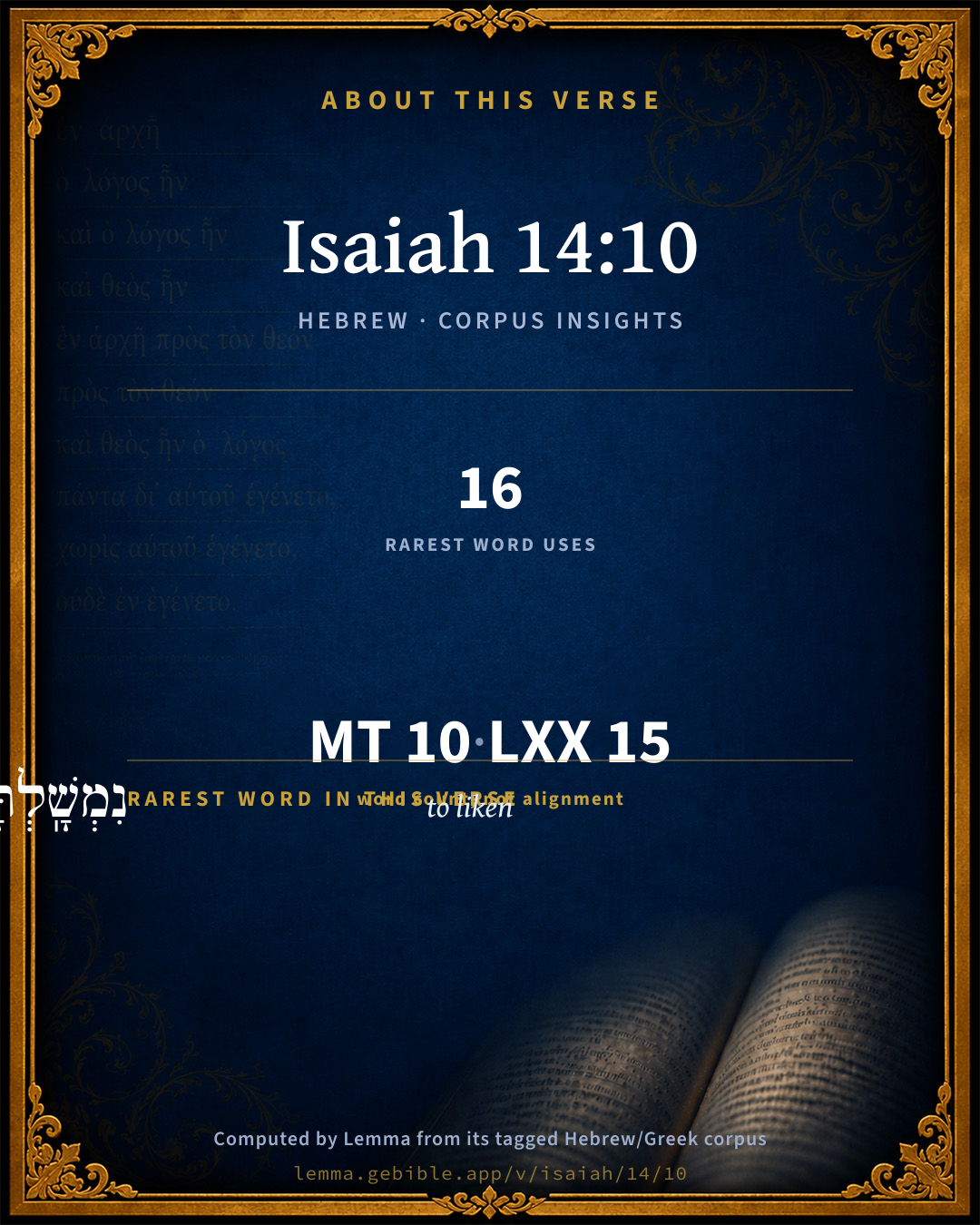
10
words
9
distinct lemmas
Prophets
section

Notable vocabulary

The rarest word here is נִמְשָֽׁלְתָּ to liken H4911 — appearing just 16 times in the whole Hebrew Bible.

Shared distinctive vocabulary

נִמְשָֽׁלְתָּ to liken H4911 occurs in 15 verses of the Hebrew Bible. Also found in:

Grammatical profile

  • 4 verbs
  • 1 noun
  • 1 pronoun
  • 3 prepositions
  • 1 particle

Verb forms

  • יַֽעֲנ֔וּ Qal · Imperfect
  • וְיֹאמְר֖וּ Qal · Imperfect
  • חֻלֵּ֥יתָ Pual · Perfect
  • נִמְשָֽׁלְתָּ Niphal · Perfect

Repetition

A word recurs within this verse — often emphatic in Hebrew:

  • אֵלֶ֑יךָ to H413 ×2

Hebrew & Septuagint length

In English translation the verse runs 19 words from the Hebrew and 21 from the Septuagint (LXX English) — closely comparable.

A rough comparison of the two English renderings, which tokenize alike — not a word-level alignment.

Word counts can differ between the Hebrew and the Greek without any difference in meaning — e.g. the Hebrew direct-object marker אֵת has no separate Greek word, and Greek often adds the article ὁ.

In the original languages it is 10 Hebrew tokens and 15 Greek tokens — but the two are counted differently (Hebrew bundles its prefixes and suffixes into one token; the Greek is in lemma form), so that isn’t a like-for-like length.

Cross-references

6

Topical passages linked to Isaiah 14:10 in the Treasury of Scripture Knowledge — connected by theme and wording, ordered by reader-vote popularity; previews shown in the World English Bible.

  • Psalms 49:6–14 Those who trust in their wealth, And boast in the multitude of their riches--
  • Psalms 49:20 A man who has riches without understanding, Is like the animals that perish.
  • Psalms 82:6–7 I said, "You are gods, All of you are sons of the Most High.
  • Ecclesiastes 2:16 For of the wise man, even as of the fool, there is no memory for ever, seeing that in the days to come all will have been long forgotten. Indeed, the wise man must die just like the fool!
  • Ezekiel 32:21 The strong among the mighty shall speak to him out of the midst of Sheol with those who help him: they are gone down, they lie still, even the uncircumcised, slain by the sword.
  • Luke 16:20–23 A certain beggar, named Lazarus, was laid at his gate, full of sores,

Cross-references courtesy of OpenBible.info (CC BY 4.0).

Hebrew and Greek witnesses Masoretic Hebrew ↔ Greek Septuagint

The same verse in the two great witnesses to the Old Testament, shown verse-for-verse.

These are two independent witnesses, not word-aligned to each other, and the Septuagint is shown in lemma (dictionary) form.

Hebrew Isaiah 14:10 Masoretic · Westminster Leningrad Codex

כֻּלָּ֣ם יַֽעֲנ֔וּ וְיֹאמְר֖וּ אֵלֶ֑יךָ גַּם אַתָּ֛ה חֻלֵּ֥יתָ כָמ֖וֹנוּ אֵלֵ֥ינוּ נִמְשָֽׁלְתָּ

All they shall answer and tell you, Are you also become weak as we? are you become like us?

World English Bible · Public Domain

Greek LXX Isaiah 14:10 Septuagint · lemma form

πᾶς ἀποκρίνω καί εἶπον σύ καί σύ ἁλίσκω ὥσπερ καί ἐγώ ἐν ἐγώ δέ καταλογίζομαι

All shall answer and say to you, You also have been taken, even as we; and you are numbered among us.

LXX2012 (modern English Septuagint) · Public Domain

Hebrew: Westminster Leningrad Codex (CC BY 4.0). Greek: Septuagint (public domain); English from LXX2012 (modern English Septuagint) (Public Domain). How the Septuagint differs from the Hebrew →

Targum (Aramaic paraphrase)

1

The Targum is the ancient Jewish Aramaic paraphrase of the Hebrew Scriptures — an interpretive translation, not the Hebrew text itself. Onkelos (literal) and Pseudo-Jonathan (expansive) render the Torah, and Jonathan the Prophets. Coverage is partial: where no permissively-licensed English translation exists for a verse, only the Aramaic is shown. This is verse-level text, not a word-by-word alignment to the Hebrew.

  1. Targum Jonathan Prophets (Joshua–Malachi)
    כּוּלְהוֹן יְתִיבוּן וְיֵימְרוּן לָךְ אַף אַתְּ מְרַעְתָּא כְוָתָנָא לָנָא דְמִיתָא:

    All of them shall answer and say unto thee, Art thou become sick as we? Unto us, thou hast become like.

    Targum Jonathan — Aramaic: “Mikraot Gedolot” (public domain). English: “Sefaria Community Translation” (CC0 1.0 (public-domain dedication)); “London "Chaldee Paraphrase," 1871” (public domain). Text via Sefaria.

Commentary

Notes on Isaiah 14:10 from classic Christian and Jewish commentators (each source and its license shown beneath its notes). The classic Christian expositions comment on the surrounding passage and are grouped to its opening verse, so a note may address several verses; the Jewish commentaries on the Tanakh (Rashi and others) are per-verse, so they appear only where the commentator wrote on this verse.

Lemma curates 59 commentaries, every one of them public domain or Creative Commons licensed, each selected and text-cleaned for this edition rather than reprinted as found. About our sources →

Trapp's Complete Commentary

John Trapp

Isa 14:10 All they shall speak and say unto thee, Art thou also become weak as we? art thou become like unto us?

Ver. 10. Art thou also become weak as we?] Interrogatio sarcastica et insultabunda. Hast thou also a Hic situs est, here he lies, or Mortuus est, here he died, set upon thy tombstone? This if thou hadst forethought, thou wouldst have better behaved thyself while alive: the meditation of death would have been a death to thy passions, and an allay to thine insolencies. Virgil saith, if swarms of bees meet in the air, they will sometimes fight as it were in a set battle with great violence; but if you cast but a little dust upon them, they will be all presently quiet.

“ Hi motus animorum atque haec certamina tanta,

Pulveris exigui iactu compressa quieseunt. ”

- Georg., lib. iv.

Had Nebuchadnezzar or his successors bethought themselves of their mortality and of death’s impartiality, they would have been more moderate.

John Trapp, A Commentary or Exposition upon All the Books of the Old and New Testament (1647–1656) — public domain. Text from a community e-Sword module.

Tyndale Open Study Notes

Tyndale Open Resources

14:10 weak as we are: The Babylonian king had no power over anyone after death and was unable to leave Sheol. The Israelites will mock this great king who on earth appeared to have no weaknesses.

Tyndale Open Study Notes — © Tyndale Open Resources, licensed CC BY-SA 4.0. Text via the HelloAO Bible API.

Jamieson, Fausset & Brown

Robert Jamieson, A. R. Fausset & David Brown

They taunt him and derive from his calamity consolation under their own (Eze 31:16).

weak--as a shade bereft of blood and life. Rephaim, "the dead," may come from a Hebrew root, meaning similarly "feeble," "powerless." The speech of the departed closes with Isa 14:11.

Jamieson, Fausset & Brown — Commentary Critical and Explanatory on the Whole Bible (1871) — public domain (CC PDM 1.0). Text via the HelloAO Bible API.

Ellicott's Commentary for English Readers

(10) Art thou also become weak as we?—The question implies, of course, an affirmative answer. The king of Babylon, the report of whose coming had roused awe and wonder, is found to be as weak as any of the other Rephaim, the eidôla, or shadowy forms, of Homer (Il, xxiii., 72). With these words the vision of the spectral world ends, and the next verse takes up the taunting song of the liberated Israelites, the language of which is, however, influenced by the imagery of the vision.

A Bible Commentary for English Readers, edited by Charles John Ellicott (1878–1897) — public domain. Text from a community e-Sword module.

John Gill's Exposition

All they shall speak, and say unto thee,.... So they would say, could they speak, and are here represented as if they did:

art thou become also weak as we? who had been more powerful than they, had been too many for them, and had subdued them, and ruled over them, and was not only looked upon as invincible but as immortal, yea, as a deity; and yet now was become "sick", as the word (b) signifies, or by sickness brought to death, and by death enfeebled and rendered weak and without strength, stripped of all natural strength, as well as of all civil power and authority:

art thou become like unto us? who thought himself, and was flattered by others, that there were none like unto him; but now as the rest of the dead, and upon a level with them. So will it be with the Romish antichrist, who now exalts himself above all that is called God, and reigns over the kings of the earth, and shows himself as if he was God, and of whom his parasites say, "who is like unto the beast? who is able to make war with him?" when he shall be consumed by Christ, and cast into the lake of fire with the devil and false prophet, he will be like the kings of the earth deceived by him, and the rest of the worshippers of him, and be as weak as they, Th2 2:4, Rev 20:10.

(b) a "aegrotuss fuit".

John Gill's Exposition of the Whole Bible (1746–1763) — public domain (CC PDM 1.0). Text via the HelloAO Bible API.

Albert Barnes' Notes on the Bible

All they shall speak ... - Language of astonishment that one so proud, and who apparently never expected to die, should be brought down to that humiliating condition. It is a severe taunt at the great change which had taken place in a haughty monarch.

Albert Barnes' Notes on the Bible (1834–1885) — public domain. Text from a community e-Sword/MySword module.

Matthew Poole's English Annotations

Thou, who wast king of kings, and far superior to us in power and authority, that didst neither fear God nor reverence man, that didst slay whom thou wouldst, and keep alive whom thou wouldst, Dan 5:19.

Matthew Poole's English Annotations on the Holy Bible (1683–1685) — public domain. Text from a community e-Sword/MySword module.

Whedon's Commentary on the Bible

Daniel D. Whedon

10. Shall speak — The scene is as if, before his coming, they stood in dread; but his approach revealing his weakness, they become bolder, and venture the expression, on his advance toward them, “Thou art weak as we.” Delitzsch is of opinion that this is all the shades say; that what follows does not belong to them. And on the ground that surprise naturally, after an expressive burst, says but little, this is probably true.

Daniel D. Whedon (gen. ed.), Commentary on the Old and New Testaments (1874–1909) — public domain. Text from a community e-Sword module.

The Pulpit Commentary

Art thou also become weak as we? rather, So thou also art made weak as we! (On the supposed weakness of the dead, see the comment on ver. 9.)

The Pulpit Commentary (1880–1919), ed. H.D.M. Spence-Jones & Joseph S. Exell — public domain. Text from a community e-Sword module.

Keil & Delitzsch

C. F. Keil & F. Delitzsch

And how do they greet this lofty new-comer? "They all rise up and say to thee, Art thou also made weak like us? art thou become like us?" This is all that the shades say; what follows does not belong to them. The pual chullâh (only used here), "to be made sickly, or powerless," signifies to be transposed into the condition of the latter, viz., the Repahim (a word which also occurs in the Phoenician inscriptions, from רפא = רפה, to be relaxed or weary), since the life of the shades is only a shadow of life (cf., εἴδωλα ἄκικυς, and possibly also καμόντες in Homer, when used in the sense of those who are dying, exhausted and prostrate with weakness). And in Hades we could not expect anything more than this expression of extreme amazement. For why should they receive their new comrade with contempt or scorn? From Isa 14:11 onwards, the singers of the mashal take up the song again.

Keil & Delitzsch — Biblical Commentary on the Old Testament (1861–1891) — public domain (CC PDM 1.0). Text via the HelloAO Bible API. (Old Testament only.)

J. A. Alexander on Isaiah

Joseph Addison Alexander

“All of them shall answer and say to thee: thou also art made weak as we, to us art likened!” This is a natural expression of surprise that one so far superior to themselves should now be a partaker of their weakness and disgrace. The interrogative form given to the last clause by all the English versions is entirely arbitrary, and much less expressive than the simple assertion or exclamation preferred by the oldest and latest writers.

Joseph Addison Alexander, The Prophecies of Isaiah (1846–1847; New York: Scribner, 1870–1878) — public domain. Text from a community e-Sword module.

unfoldingWord translationNotes

Door43 World Missions Community

Connecting Statement:

This is part of the taunt song that the Israelites will sing to the king of Babylon. Here they sing about what the dead kings in Sheol will say to him.

They all will speak and say to you

The word "they" refers to the dead kings in Sheol, and the word "you" refers to the king of Babylon.

Your pomp has been brought down to Sheol

The dead kings will speak of the king of Babylon having no more splendor as if his splendor had gone down to Sheol. AT: "Your splendor ended when God sent you here to Sheol" (See: Metaphor)

with the sound of your string instruments

People would make music on string instruments to honor the king. The dead kings will speak of people no longer honoring the king of Babylon with music as if the music went to Sheol. AT: "along with the sound of people playing music to honor you" (See: Metaphor)

Maggots are spread under you

The maggots under his dead body are spoken of as if they were a mat or bed. AT: "You lie on a bed of maggots" or "You lie on many maggots" (See: Metaphor)

worms cover you

The worms all over his body are spoken of as if they were covering him like a blanket. AT: "Worms cover you like a blanket" or "There are worms all over your body" (See: Metaphor)

translationWords

Hades

unfoldingWord translationNotes — © Distant Shores Media and the Door43 World Missions Community, licensed CC BY-SA 4.0. Source: git.door43.org/Door43/en_tn.

Rashi

Rabbi Shlomo Yitzchaki (Rashi)

Have you too become weak like us We are amazed how the misfortune has fallen upon you, that you too have become weak, to be like us, to die.

Rashi on the Tanakh — English translations: “The Judaica Press complete Tanach with Rashi, translated by A. J. Rosenberg” (CC BY 4.0); “Pentateuch with Rashi's commentary by M. Rosenbaum and A.M. Silbermann, 1929-1934” (public domain); “The Metsudah Tanach series, Lakewood, N.J” (CC BY 4.0); and “The Book of Joshua, Metsudah Publications, 1997” (CC BY 4.0). Text via Sefaria.

Ibn Ezra

Rabbi Abraham ibn Ezra

All they, etc. They would, if they could, speak thus.

חלית Art thou become weak. Root חלה to be ill; comp. מחלה illness. (Exod. 15:26)

Ibn Ezra on the Tanakh — English translations: “Sefaria Community Translation” (CC0 1.0 (public-domain dedication)); “Yalkut, Sifsei Chachomim Chumash, Metsudah Publications, 2009” (CC BY 4.0); and “Commentary of Ibn Ezra on Isaiah - trans. by M. Friedlander, 1873” (public domain). Text via Sefaria.

Lesson kit

Teaching starters — assembled from the data on this page, not authored interpretation. Every prompt links to the verse data it draws on. Edit before teaching.

Isaiah, in the Prophets, opens this verse with 10 words (9 distinct Hebrew lemmas). Its most distinctive word is mâshal (“to liken”). A historical commentator’s framing appears above. Read the whole chapter for the surrounding context.

Discussion questions

  1. What does “to liken” (mâshal) contribute to the verse as a whole?
  2. How does Numbers 21:27, which shares the word «to liken», read alongside this verse?
  3. What does the repetition of “to” (2× in this one verse) do in this verse?
  4. These translations render this verse differently; the difference is in the English rendering, not the original. What questions does that raise?
  5. «יַֽעֲנ֔וּ» is a Qal Imperfect verb. How does that grammatical form shape the action described?
  6. Compare how Trapp's Complete Commentary and Tyndale Open Study Notes read this verse. Where do they agree or differ?

Things to notice

Reading settings

Reading text

Shown beneath each verse's original-language words.

Old Testament
Old Testament edition

Read the OT as the Masoretic Hebrew (MT) or the Greek Septuagint (LXX).

English shown for the Greek Septuagint (in the Hebrew ↔ Greek comparison).

Comparing translations? Open the Compare panel on any verse page to stack up to four side by side.