Isaiah 38:19

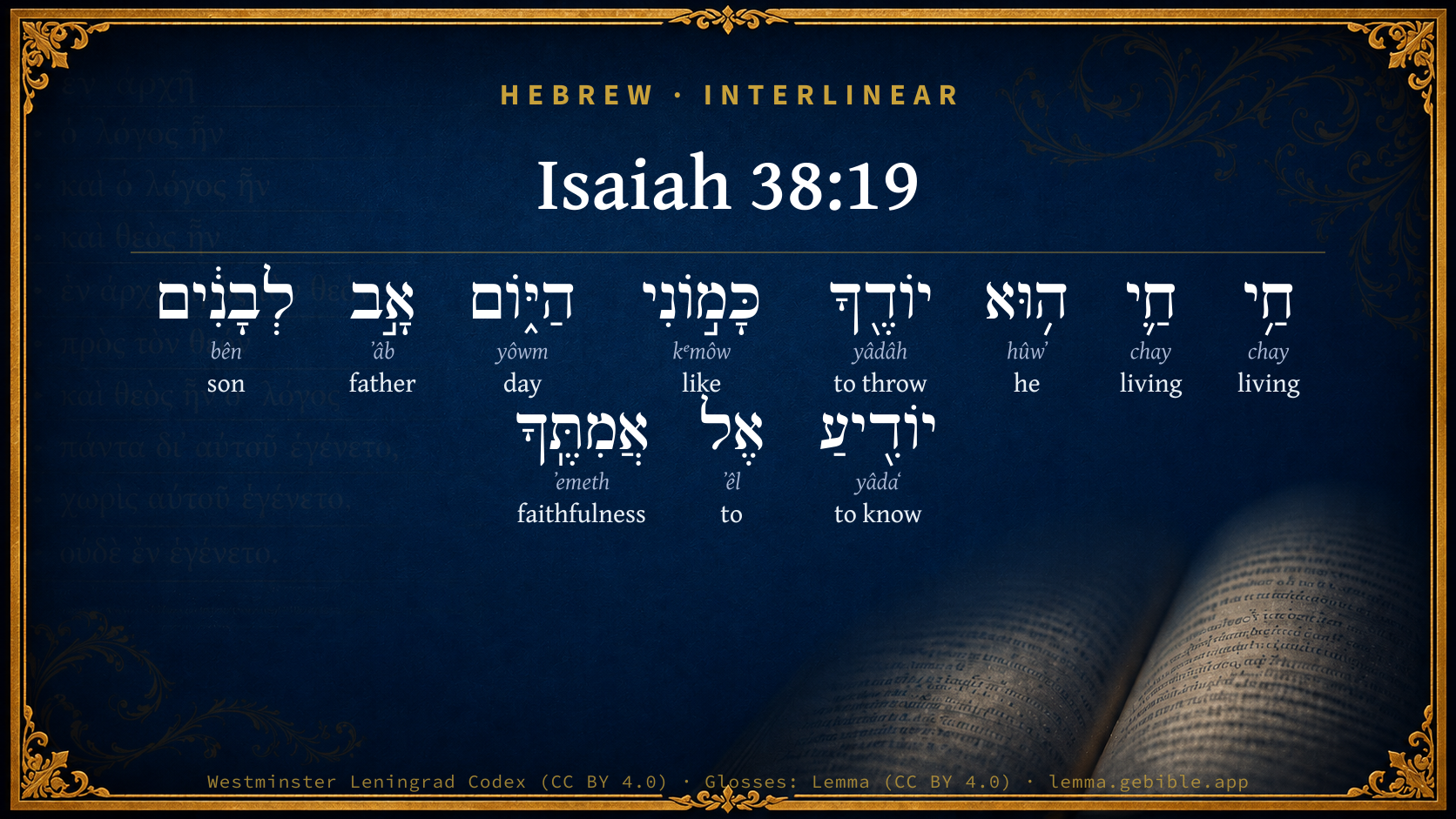
Hebrew (Westminster Leningrad Codex) Isaiah 38:19 appears in the Hebrew Old Testament. The text above is from the Westminster Leningrad Codex. Each word links to its Strong’s number, a concise gloss, and parsing drawn from the Open Scriptures Hebrew Bible morphology. Click any word for its full Brown-Driver-Briggs (BDB) entry.
Download image
Cite this verse

Isaiah 38:19 (World English Bible). Public Domain. Lemma interlinear Bible study tool, https://lemma.gebible.app/v/isaiah/38/19.

Show BibTeX & RIS
BibTeX
RIS
English Translation
The living, the living, he shall praise you, as I do this day: The father to the children shall make known your truth.
World English Bible · Public Domain
Download a study sheet

One document with this verse’s original text, its word-by-word gloss line, the meaning frame, cross-references with their text, attributed commentary, and full source and license credits — printable, and it pastes into notes with its structure intact.

This verse Autodidact and up

Study sheet (.html) Plain text (.txt)

A passage Seminary Student

Up to 50 verses in one chapter. A passage sheet keeps up to 6 commentary sources and 12 cross-references per verse, in the order this page ranks them, and says so on the sheet whenever that leaves anything out. Ask for a single verse and you get the Autodidact verse sheet above.

Everything on this page stays free to read, with no account — the sheet is a download of what is already on screen, not access to it.

Want to remove ads? Support Godless Engineer
Compare translations 3

The same verse in 3 English versions, stacked beneath the original-language interlinear above. Click any original word for its lexicon entry.

Each is an independent rendering of the whole verse — the interlinear is not word-aligned to these translations.

Highlighted words mark where these versions differ — a whole-verse word diff, not a word-by-word alignment.

  • World English Bible Public Domain
    The living, the living, he shall praise you, as I do this day: The father to the children shall make known your truth.
  • King James Version Public Domain
    The living, the living, he shall praise thee, as I do this day: the father to the children shall make known thy truth.
  • unfoldingWord Literal Text CC BY-SA 4.0
    The living, the living! He, he thanks you, like me today; a father makes known to sons about your faithfulness.

unfoldingWord Literal Text — © unfoldingWord, licensed CC BY-SA 4.0. Word-aligned USFM3 via Door43 (git.door43.org/unfoldingWord/en_ult).

Versions to compare (up to 4)

3 of 4 selected

Show all 18 translations

Every available English version of this verse, each an independent rendering of the whole verse.

  • World English Bible Public Domain
    The living, the living, he shall praise you, as I do this day: The father to the children shall make known your truth.
  • Berean Standard Bible Public Domain
    The living, only the living, can thank You, as I do today; fathers will tell their children about Your faithfulness.
  • Majority Standard Bible Public Domain
    The living, only the living, can thank You, as I do today; fathers will tell their children about Your faithfulness.
  • King James Version Public Domain
    The living, the living, he shall praise thee, as I do this day: the father to the children shall make known thy truth.
  • American Standard Version (1901) Public Domain
    The living, the living, he shall praise thee, as I do this day: The father to the children shall make known thy truth.
  • Revised Version (1885) Public Domain
    The living, the living, he shall praise thee, as I do this day: the father to the children shall make known thy truth.
  • Geneva Bible (1599) Public Domain
    But the liuing, the liuing, he shall confesse thee, as I doe this day: the father to the children shall declare thy trueth.
  • Douay-Rheims (1899) Public Domain
    The living, the living, he shall give praise to thee, as I do this day: the father shall make thy truth known to the children.
  • Young's Literal Translation Public Domain
    The living, the living, he doth confess Thee.
  • Literal Standard Version CC BY-SA 4.0
    The living, the living, he confesses You,
  • Unlocked Literal Bible CC BY-SA 4.0
    The living person, the living person, he is the one who gives you thanks, as I do this day; a father makes known to children your trustworthiness.
  • unfoldingWord Literal Text CC BY-SA 4.0
    The living, the living! He, he thanks you, like me today; a father makes known to sons about your faithfulness.
  • Darby Bible Public Domain
    The living, the living, he shall praise thee, as I this day: the father to the children shall make known thy truth.
  • World Messianic Bible Public Domain
    The living, the living, he shall praise you, as I do today. The father shall make known your truth to the children.
  • Webster's Bible Public Domain
    The living, the living, he shall praise thee, as I do this day: the father to the children shall make known thy truth.
  • Free Bible Version CC BY-SA 4.0
    It's only the living who can praise you as I'm doing today. Parents explain to their children how you can be trusted.
  • Bible in Basic English Public Domain
    The living, the living man, he will give you praise, as I do this day: the father will give the story of your mercy to his children.
  • JPS Tanakh (1917) Public Domain
    The living, the living, he shall praise Thee, as I do this day; the father to the children shall make known Thy truth.

Literal Standard Version (2020), Covenant Press — licensed CC BY-SA 4.0. Text via the HelloAO Bible API (eBible.org). Unlocked Literal Bible (unfoldingWord) — licensed CC BY-SA 4.0. Text via the HelloAO Bible API (eBible.org). unfoldingWord Literal Text — © unfoldingWord, licensed CC BY-SA 4.0. Word-aligned USFM3 via Door43 (git.door43.org/unfoldingWord/en_ult). Free Bible Version, Dr. Jonathan Gallagher — licensed CC BY-SA 4.0. Text via the HelloAO Bible API (eBible.org).

Word by word

More ways to search: Search by grammar → Find every occurrence → Compare this word →

Practice this passage: Drill this verse → Learn its vocabulary →

יוֹדֶ֖ךָ
yâdâh
H3034
“to throw · you”
Verb, Hiphil, Imperfect, 3rd Person, Masculine, Singular + Suffix, Personal, 2nd Person, Masculine, Singular
Part of Speech
Verb
Stem
Hiphil
Form
Imperfect
Person
3rd Person
Gender
Masculine
Number
Singular
Full BDB Definition

Origin: a primitive root; used only as denominative from H3027

TWOT: 847

to throw, shoot, cast - (Qal) to shoot (arrows) - (Piel) to cast, cast down, throw down - (Hiphil) - to give thanks, laud, praise - to confess, confess (the name of God) - (Hithpael) - to confess (sin) - to give thanks
  1. חַ֥י chay H2416 “living” Adjective, Adjective, Masculine, Singular, Absolute
  2. חַ֛י chay H2416 “living” Adjective, Adjective, Masculine, Singular, Absolute
  3. ה֥וּא hûwʼ H1931 “he” Pronoun, Personal, 3rd Person, Masculine, Singular
  4. כָּמ֣וֹנִי kᵉmôw H3644 “like · me” Preposition + Suffix, Personal, 1st Person, Common, Singular
  5. הַיּ֑וֹם yôwm H3117 “the · day” Particle, Definite Article + Noun, Common, Masculine, Singular, Absolute
  6. אָ֣ב ʼâb H1 “father” Noun, Common, Masculine, Singular, Absolute
  7. לְבָנִ֔ים bên H1121 “to/for · sons” Preposition + Noun, Common, Masculine, Plural, Absolute
  8. יוֹדִ֖יעַ yâdaʻ H3045 “to know” Verb, Hiphil, Imperfect, 3rd Person, Masculine, Singular
  9. אֶל ʼêl H413 “to” Preposition
  10. אֲמִתֶּֽךָ ʼemeth H571 “faithfulness · your” Noun, Common, Feminine, Singular, Construct + Suffix, Personal, 2nd Person, Masculine, Singular

About this verse

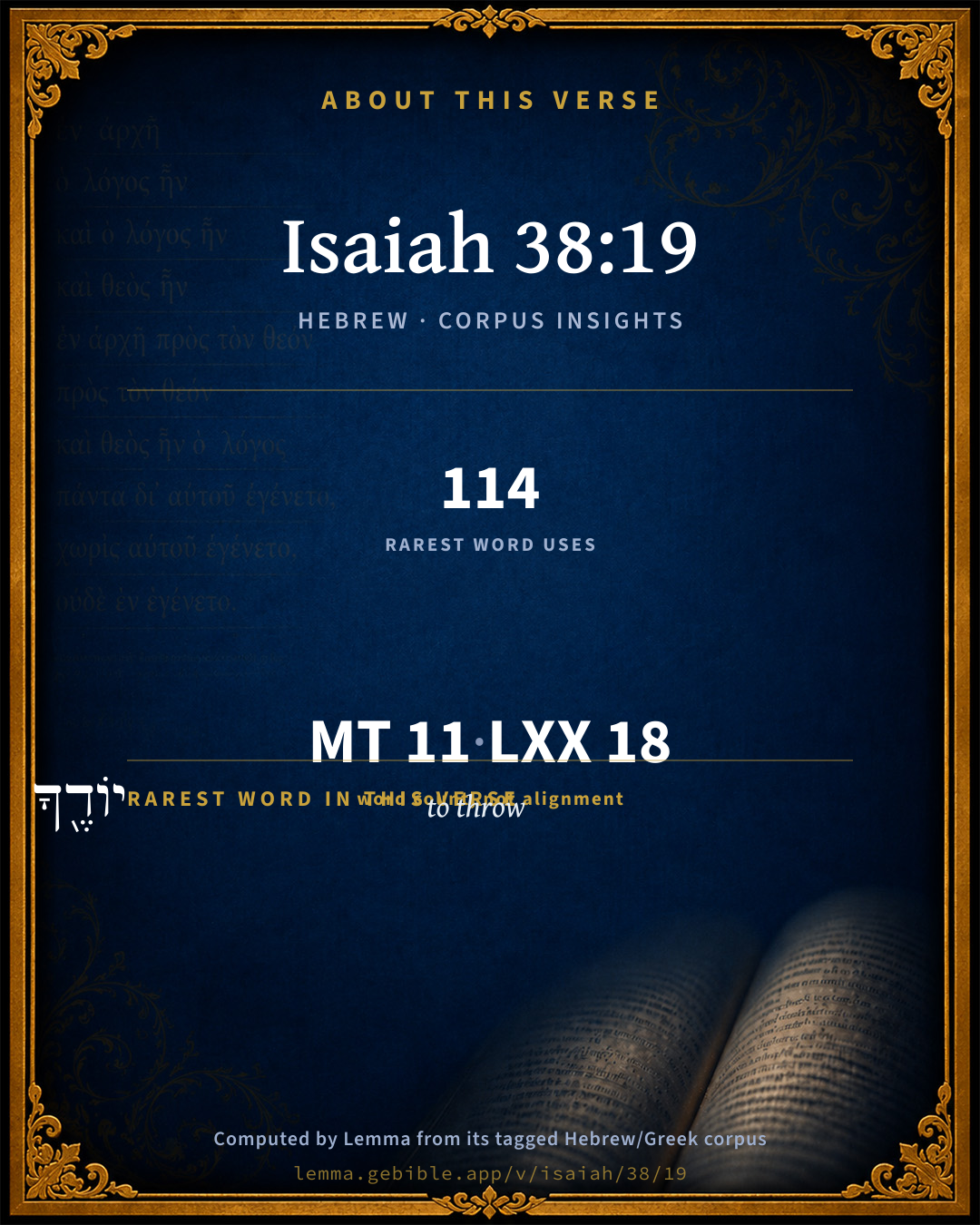
These counts appear in no published source. They are computed here, from the morphology-tagged text and Lemma’s own curated glosses. What Lemma adds →

11
words
10
distinct lemmas
Prophets
section

Grammatical profile

  • 2 verbs
  • 4 nouns
  • 2 adjectives
  • 1 pronoun
  • 2 prepositions

Verb forms

  • יוֹדֶ֖ךָ Hiphil · Imperfect
  • יוֹדִ֖יעַ Hiphil · Imperfect

Repetition

A word recurs within this verse — often emphatic in Hebrew:

  • חַ֥י living H2416 ×2

Hebrew & Septuagint length

In English translation the verse runs 23 words from the Hebrew and 22 from the Septuagint (LXX English) — closely comparable.

A rough comparison of the two English renderings, which tokenize alike — not a word-level alignment.

Word counts can differ between the Hebrew and the Greek without any difference in meaning — e.g. the Hebrew direct-object marker אֵת has no separate Greek word, and Greek often adds the article ὁ.

In the original languages it is 11 Hebrew tokens and 18 Greek tokens — but the two are counted differently (Hebrew bundles its prefixes and suffixes into one token; the Greek is in lemma form), so that isn’t a like-for-like length.

Cross-references

15

Topical passages linked to Isaiah 38:19 in the Treasury of Scripture Knowledge — connected by theme and wording, ordered by reader-vote popularity; previews shown in the World English Bible.

  • Deuteronomy 6:7 and you shall teach them diligently to your children, and shall talk of them when you sit in your house, and when you walk by the way, and when you lie down, and when you rise up.
  • Psalms 119:175 Let my soul live, that I may praise you. Let your ordinances help me.
  • Deuteronomy 4:9 Only take heed to yourself, and keep your soul diligently, lest you forget the things which your eyes saw, and lest they depart from your heart all the days of your life; but make them known to your children and your children's children;
  • Psalms 78:3–6 Which we have heard and known, And our fathers have told us.
  • Genesis 18:19 For I have known him, to the end that he may command his children and his household after him, that they may keep the way of Yahweh, to do righteousness and justice; to the end that Yahweh may bring on Abraham that which he has spoken of him."
  • Exodus 12:26–27 It will happen, when your children ask you, 'What do you mean by this service?'
  • Exodus 13:14–15 It shall be, when your son asks you in time to come, saying, 'What is this?' that you shall tell him, 'By strength of hand Yahweh brought us out from Egypt, from the house of bondage;
  • Deuteronomy 11:19 You shall teach them your children, talking of them, when you sit in your house, and when you walk by the way, and when you lie down, and when you rise up.
  • Joshua 4:21–22 He spoke to the children of Israel, saying, When your children shall ask their fathers in time to come, saying, What mean these stones?
  • Psalms 118:17 I will not die, but live, And declare Yah's works.
  • Psalms 145:4 One generation will commend your works to another, And will declare your mighty acts.
  • Psalms 146:2 While I live, I will praise Yahweh. I will sing praises to my God as long as I exist.
  • Joel 1:3 Tell your children about it, And have your children tell their children, And their children, another generation.
  • Ecclesiastes 9:10 Whatever your hand finds to do, do it with your might; for there is no work, nor device, nor knowledge, nor wisdom, in Sheol, where you are going.
  • John 9:4 I must work the works of him who sent me, while it is day. The night is coming, when no one can work.

Cross-references courtesy of OpenBible.info (CC BY 4.0).

Hebrew and Greek witnesses Masoretic Hebrew ↔ Greek Septuagint

The same verse in the two great witnesses to the Old Testament, shown verse-for-verse.

These are two independent witnesses, not word-aligned to each other, and the Septuagint is shown in lemma (dictionary) form.

Hebrew Isaiah 38:19 Masoretic · Westminster Leningrad Codex

חַ֥י חַ֛י ה֥וּא יוֹדֶ֖ךָ כָּמ֣וֹנִי הַיּ֑וֹם אָ֣ב לְבָנִ֔ים יוֹדִ֖יעַ אֶל אֲמִתֶּֽךָ

The living, the living, he shall praise you, as I do this day: The father to the children shall make known your truth.

World English Bible · Public Domain

Greek LXX Isaiah 38:19 Septuagint · lemma form

ὁ ζάω εὐλογέω σύ ὅς τρόπος καΐἐγώ ἀπό γάρ ὁ σήμερον παιδίον ποιέω ὅς ἀναἀγγέλλω ὁ δικαιοσύνη σύ

The living shall bless you, as I also do: for from this day shall I beget children, who shall declare your righteousness,

LXX2012 (modern English Septuagint) · Public Domain

Hebrew: Westminster Leningrad Codex (CC BY 4.0). Greek: Septuagint (public domain); English from LXX2012 (modern English Septuagint) (Public Domain). How the Septuagint differs from the Hebrew →

Targum (Aramaic paraphrase)

1

The Targum is the ancient Jewish Aramaic paraphrase of the Hebrew Scriptures — an interpretive translation, not the Hebrew text itself. Onkelos (literal) and Pseudo-Jonathan (expansive) render the Torah, and Jonathan the Prophets. Coverage is partial: where no permissively-licensed English translation exists for a verse, only the Aramaic is shown. This is verse-level text, not a word-by-word alignment to the Hebrew.

  1. Targum Jonathan Prophets (Joshua–Malachi)
    דְחַי חַי יוֹדֵי קֳדָמָךְ כְּוָתִי יוֹמָא הָדֵין אֲבָהָן לִבְנֵיהוֹן יְחַווּן גְבוּרְתֵּיךְ וְיוֹדוּן לְמֵימָר דְכָל אִילֵין קְשׁוֹט:

    The living, the living shall praise Thee, as I do this day: the fathers unto their children shall make known Thy might, and They shall confess, saying, that all these things are truth.

    Targum Jonathan — Aramaic: “Mikraot Gedolot” (public domain). English: “Sefaria Community Translation” (CC0 1.0 (public-domain dedication)); “London "Chaldee Paraphrase," 1871” (public domain). Text via Sefaria.

Commentary

Notes on Isaiah 38:19 from classic Christian and Jewish commentators (each source and its license shown beneath its notes). The classic Christian expositions comment on the surrounding passage and are grouped to its opening verse, so a note may address several verses; the Jewish commentaries on the Tanakh (Rashi and others) are per-verse, so they appear only where the commentator wrote on this verse.

Lemma curates 59 commentaries, every one of them public domain or Creative Commons licensed, each selected and text-cleaned for this edition rather than reprinted as found. About our sources →

Trapp's Complete Commentary

John Trapp

Isa 38:19 The living, the living, he shall praise thee, as I [do] this day: the father to the children shall make known thy truth.

Ver. 19. The living, the living, he shall praise thee.] Those that live the life of nature, if withal they live the life of grace, and so are living living, and not "dead while they live": for the wicked cannot praise God; they can say God a thank, and that is all. But as it is with the hand dial - the finger of the dial standeth at twelve, when the dial hath not moved one minute; so though their tongues are forward in praises, yet their hearts stand still. What they do this way is but "dead work."

The father to the son shall make known.] And for this end parents may desire to live longer. Hezekiah did his part, no doubt, by wicked Manasseh, who also at length repented and was saved.

John Trapp, A Commentary or Exposition upon All the Books of the Old and New Testament (1647–1656) — public domain. Text from a community e-Sword module.

The Biblical Illustrator

Joseph S. Exell

Isa_38:19

The living, the living, he shall praise Thee

The right life

The right life is a praise-giving life.

Such a life is--

I. THE MOST HONOURABLE.

II. THE MOST BENEFICIAL TO THE MAN HIMSELF.

III. THE MOST BENEFICIAL TO OTHERS. The father to the children shall make known Thy truth.

IV. THE CONSIDERATION OF THE SHORTNESS OF LIFE OUGHT TO INDUCE US TO SPEND OUR TIME IS PRAISING GOD. Hezekiah felt that the years given him to live on the earth would soon come to an end, hence the emphasis placed on the living, the living. (Homilist.)

The praise of the living

I. THE WORSHIPPER. The living.

II. THE OBJECT AND NATURE OF THE PRAISE RENDERED. The prolongation of life is a legitimate cause for Christian thanksgiving. It is only in our state as the living that we have an opportunity of uttering that which we may term practical and generative praise--a praise which induces others to join us in our work--a praise which begets praise, and tends to propagate itself, by Gods blessing, throughout the length and breadth of an ungrateful world. It is evident that Hezekiah referred to such praise as this; for he says, The father to the children shall make known Thy truth. (D. F.Jarman, B. A.)

The value and use of life

I. THE DUTY OF SERIOUSLY MEDITATING ON OUR BEING MERCIFULLY SPARED among the living. It is right and rational to rejoice in this prolongation of your life; but such rejoicing is useless, unless it be founded on a serious thought of the blessing received. To rejoice in being alive, for the sole selfish enjoyment which you hope to derive from life, is nothing better than the natural instinct of a mere animal.

II. THE IMPORTANCE OF SUCH A BLESSING. There is nothing in creation more amazing than what is called life; a miracle, indeed, perpetually witnessed, and therefore generally overlooked; but curious to be contemplated, and most difficult to be comprehended in its various attendant circumstances.

1. As a mere object of curiosity, a mere piece of machinery, the lowest living creature is above the utmost reach of human intelligence.

2. But how much more important is life when considered as a means of enjoyment.

3. How much higher still does life rise in its interest and importance when considered in connection with an understanding mind.

4. Yet all this is the least of the matter; and if the life of man were nothing more than what we see of it here, wonderful as it is, it would be only as an empty show, or as a fleeting meteor, bursting on the view and gazed at for a moment, but gone for ever, even before it could be understood.

5. But this very fleeting nature of life imparts an additional value to its possession, when viewed in its true light, namely, as connected with an eternal state.

6. How much more exalted still does our idea of life become, when it is connected with salvation!

III. THE WAY IN WHICH YOU SHOULD EXPRESS THIS THANKFULNESS AND USE THIS BLESSING. He shall praise Thee.

1. Nothing can possibly be more clearly right and reasonable than this, that we are bound to live to the praise of that gracious Being by whose power and providence we do live.

2. This, indeed, is the great, the express end for which you were brought into the number of the living; the only occupation also m which you will find any solid happiness m life, namely, to praise or glorify God; to make His will the rule of your life, to make His glory the aim of your life.

3. But these words do evidently express something more than merely the duty of living to the praise of God, and of praising Him the more fervently the longer that He spares us among the living. They seem particularly to proclaim the importance of life on this account alone, that it affords us an opportunity of showing forth the praises of God. So the devout believer feels a relish in life, altogether distinct from his natural instincts or personal enjoyments; namely, in the power which it puts into his hands of praising the gracious Author of his spiritual privileges and eternal hopes. Nor is it enough to say, that he might still better praise God m the heavenly courts. There are calls for this praise more urgent, and opportunities of this praise more direct, even in this mortal scene, than in the eternal state; occasions for bearing your testimony to Gods perfections, which are not required in heaven above; occasions for exercising your great Christian graces of faith and charity, which are not afforded, and which cannot be afforded in a state of perfect holiness and felicity. (J. Brewster.)

The Jew valued the present life

The Jew, in all his thought and religion, showed a keen sense of the value of the present life. The very deficiencies in his religious conceptions seem to arise from this cause. The presence of God in this world seemed to obscure the future from his eyes, just as in later ages the bright vision of the future has thrown the present into the shade. But as the Jewish spirit became saddened by experience the sense of the presence of God in the world became weaker. The Jew did not relax his hold on practical righteousness, but the faith of childhood began to lose its simplicity. His thoughts took a wider range, and began to be directed to the future. The revelation of Christ completed the change for which other influences had helped to prepare the way; and the new faith stood opposed to the old, as the spiritual to the carnal. (W. W. Jackson, M. A.)

The importance of the present life

But has the central conception of early Jewish religion disappeared, or has it only been matured and purified? Is not human life, as we have experience of it here, in the present, with all its cares, and joys, and sorrows, still the great concern of religion? Does it not still afford us the best means of drawing Dear to God, and realising His presence? Does not Christ Himself teach us that our first business is in this life, when He prays to the Father that He should not take the disciples out of the world, but that He should keep them from the evil? (W. W. Jackson, M. A.)

The Christian view of life

1. The feeling which the Jew had entertained on the subject of death differs as widely as possible from that entertained by St. Paul. The change of sentiment had been consummated by Christ, who had abolished death and brought life and immortality to light through the Gospel. The life of the Christian was thenceforth hid with Christ in God. The affections were thenceforth to be set on things above. The opposition between the things of the world and the things of God had been declared. But as soon as the Christian asked himself what was the means by which he could make this view his own, there could be only one reply. He must live after it. He must take the spirit of Christ into the world. But he could rise to the height of his duty here, only by keeping his eye fixed on the pattern in the heavens.

2. This conception of Christian life suggests reflections of two different kinds--

(1) If religion brings harmony and law into human life, then the life which aspires after the ideal of religion is the most complete.

(2) On the other hand, do we always fully accept the human revelation which the teaching of life itself offers to us? Do we recognise the divinity which resides in the pursuits and institutions of secular life? (W. W. Jackson, M. A.)

The peculiar mercy and business of life

I. THE MERCY OF LIFE. The living, the living, he shall praise Thee, &c.

II. WHEREIN THE PECULIAR MERCY OF IT CONSISTS.

1. Ask the carnal man where lies the mercy of life. And--

(1) If he is in prosperity, he reckons the mercy of life lies in that the living man may enjoy the pleasures of sense, mirth, and jollity, and may lay up wealth for him and his; all which stern death robs a man of. But there is not one word of this here.

(2) If he is in adversity, poverty, and sore sickness, he cannot see the mercy of life at all, but thinks they are well that are away, that are out of poverty and pain, and fie at ease in the dust. So crosses make him wish to be away, At best, he reckons it the mercy of life, that he is not where it may be he would be worse, namely, in hell. But there is not a word of all this either in the text.

2. Ask the renewed man in an ill frame of spirit, where lies the mercy of life. If he is in outward prosperity he will be ready to reckon it lies in the comforts of this life. If he is in adversity, the troubles of life are so great, that the mercy of it is small in his view; only heaven bulks in his eyes, and that as a place of rest from trouble. But there is nothing of this either in the text.

3. The decision is, the mercy of life lies in the business of life, to wit, being serviceable for God in the world. The living, the living, he shall praise Thee, &c. Which speaks a high esteem of God and His service, as men count it a favour to serve their prince; and an ardent love to Him, as men delight to serve the interests of those they dearly love. Now, the business of life for which it is desirable, is twofold.

(1) To praise or glorify God in the world.

(2) To propagate His name and praise: The father to the children shall make known Thy truth. It is the special business of life to endeavour that the name of God may bye and be glorified in the world when we are dead. Consider--

(a) What he has access to do for that end; namely, to praise God to the younger sort, that are likely to five after he is gone; especially to his own children.

(b) How he may do it, namely, by making Him known to them as an object worthy of their faith. Shall make known Thy truth. (T. Boston.)

Praising God

I. WHAT PRAISING GOD IS. It is the acknowledging and declaring the glorious excellencies of God, as He has manifested Himself in His word and works, and imports

1. Belief of the Being of God.

2. The knowledge of God.

(1) Of who He is Father, Son, and Holy Ghost, one God.

(2) Of what He is.

(3) Of what He has done.

3. The love of God. Love is the mother of praise.

4. The admiration of God, which is love and esteem raised to a high pitch.

5. Expressing that love and admiration to Him. This is twofold--

(1) Vocal.

(2) Real, by actions, though not accompanied with words.

II. WHAT ARE THE PECULIARITIES OF THE PRAISES OF THE LIVING.

1. They are the praises of the whole man, in soul and body too (1Co_6:20).

2. They are praises which may spread among the living (Col_3:16).

3. They are praises raised by the way to the heavenly kingdom.

4. They are praises of faith, not of sight.

5. They are praises to God amidst much dishonour done to Him. (T. Boston.)

Motives

1. God is the Author of thy life.

2. The Preserver of thy life.

3. The Giver of all thou hast, whereby thou mayest honour Him.

4. God puts opportunities in thine hand for honouring Him.

5. There are some who are deprived of those abilities or occasions ye have to honour God. The pagan world, &c.

6. Ye have forfeited by sin all your abilities, opportunities, and your very life. His patience has suffered us long, &c. Should not this engage us to live to His honour?

7. This was the design of the redemption purchased by Christ (Tit_2:14).

8. It is the design of the sanctification of the Spirit (1Pe_2:9).

9. It is a lost life that is not lived to the honour of God. (T. Boston.)

Thanksgiving and thanksliving

Thanksgiving is good, but thanksliving is better. (M. Henry.)

Ingratitude common

A lady who had heard a great many prayers offered for sick people, in a large city church, said to her husband, Do all the sick people who are prayed for in our church die? Why, no, he answered, of course not; but why do you ask? I supposed that they all died, she said, because I hardly ever heard of one who had got well enough to give thanks! (J. N. Norton.)

The father to the children

Propagating religion

What is it to propagate religion, Gods name and praise, to the rising generation? It implies--

1. The having religion ourselves.

2. The profession of religion.

3. A desire to continue and spread religion in the world.

4. Contributing our endeavours to bring others, and particularly the rising generation, to the knowledge and practice of religion. (T. Boston.)

The father to the children

1. Fathers of the State, to their political children (Isa_49:23).

2. Fathers in the Church, ministers, and other Church officers, to their ecclesiastical children.

3. Fathers of families, to their children, servants, &c.

4. Fathers in gifts or graces to those who are children in these respects in comparison of them (1Jn_2:12-13).

5. Fathers in years to those who are children in respect of age to them 1Ti_5:1-2). (T. Boston.)

The obligation to propagate religion

1. Divine authority (Deu_4:10; Deu_11:19).

2. Gratitude to God.

3. Justice to former generations, who have propagated religion to us.

4. Our own interest.

5. Charity to the rising generation. (T. Boston.)

Claims of children

Socrates once said, Could I climb to the highest place in Athens, I would lift my voice and proclaim, Fellow-citizens, why do ye turn and scrape every stone to gather wealth, and take so little care of your children, to whom one day you must relinquish it all? (Family Circle.)

Parental relationship a medium of Divine revelation

Revelations of Gods faithfulness are precious. They are the ground of human hope. Every life has some peculiar revelation of Gods truth in it. The parental relationship, with its tender solicitudes and loves, furnishes a means of transmission. This duty should be conscientiously performed--

I. THAT THE KNOWLEDGE OF GOD MAY INCREASE FROM AGE TO AGE.

II. THAT THE GRATITUDE OF ONE GENERATION SHOULD GLORIFY GOD BY MINISTERING TO THE MORAL LIFE OF THE NEXT.

III. THAT THE GENERATION FOLLOWING MAY HAVE A SAVING KNOWLEDGE OF GOD, AND TRUST IN HIM. (W. O. Lilley.)

The Biblical Illustrator, edited by Joseph S. Exell (c. 1880s–1900s) — public domain. Text from a community e-Sword module.

Geneva Bible (1599)

Geneva Bible translators

All posterity shall acknowledge, and the fathers according to their duty toward their children shall instruct them in thy graces, and mercies toward me.

Geneva Bible (1599) marginal notes — public domain. Text via Bolls.life.

Jamieson, Fausset & Brown

Robert Jamieson, A. R. Fausset & David Brown

living . . . living--emphatic repetition, as in Isa 38:11, Isa 38:17; his heart is so full of the main object of his prayer that, for want of adequate words, he repeats the same word.

father to the children--one generation of the living to another. He probably, also, hints at his own desire to live until he should have a child, the successor to his throne, to whom he might make known and so perpetuate the memory of God's truth.

truth--faithfulness to His promises; especially in Hezekiah's case, His promise of hearing prayer.

Jamieson, Fausset & Brown — Commentary Critical and Explanatory on the Whole Bible (1871) — public domain (CC PDM 1.0). Text via the HelloAO Bible API.

Adam Clarke's Commentary

Verse 19. Thy truth] אל אמתך el amittecha. A MS. omits אל el; and instead of אל el, an ancient MS. and one edition read את eth. The same mistake as in Ps 2:7.

Adam Clarke's Commentary on the Bible (1810–1826) — public domain. Text from a community e-Sword/MySword module.

Ellicott's Commentary for English Readers

(19) The father to the children . . .—The words are perfectly general, but they receive a special significance from the fact that Hezekiah’s son and successor, Manasseh, who was only twelve years old at his father’s death (2Ki_21:1), was not born till two or three years afterwards. At the time of his illness the king may still have been childless, and the thought that there was no son to take his place may have added bitterness to his grief. “Thy truth,” has here the sense of “faithfulness” rather than of the truth about God which is the object of belief.

A Bible Commentary for English Readers, edited by Charles John Ellicott (1878–1897) — public domain. Text from a community e-Sword module.

The Cambridge Bible for Schools and Colleges

gen. ed. J. J. S. Perowne

19. the father … truth] Cf. Psa_22:30; Psa_48:13-14; Psa_71:18; Psa_78:3-4.

The Cambridge Bible for Schools and Colleges (gen. ed. J. J. S. Perowne; Cambridge University Press, 1878–1918) — public domain. Text from a community e-Sword module.

John Gill's Exposition

The Lord was ready to save me,.... Or, "the Lord to save me (y)"; he was at hand to save him; he was both able and willing to save him; he was a present help in time of need; he arose for his help, and that right early; he very quickly delivered him out of his distress; he, who one day expected death every moment, was the next day in the temple praising God:

therefore will we sing my songs; which were made by him, or concerning him, or which he ordered to be sung, as he did the Psalms of David, Ch2 29:30,

to the stringed instruments: which were touched with the fingers, or struck with a quill or bow; which distinguishes them from wind instruments, which were blown with the mouth; each of these were used in the temple service:

all the days of our life; he had before said "we will sing", meaning his family and his friends with him, his courtiers, princes, and nobles, or he and the singers of Israel; and this he determined to do as long as he and they lived; signifying, that the mercy granted would never be forgotten by him, as well as there would be new mercies every day, which would call for praise and thankfulness: and this he proposed to do

in the house of the Lord; in the temple; not only privately, but publicly; not in his closet and family only, but in the congregation of the people; that the goodness of God to him might be more known, and the praise and glory given him be the greater.

(y) "Dominus ad servandum me", Montanus; "Jehova est ad salvandum me", Cocceius, Vitringa.

John Gill's Exposition of the Whole Bible (1746–1763) — public domain (CC PDM 1.0). Text via the HelloAO Bible API.

Albert Barnes' Notes on the Bible

The living, the living - An emphatic or intensive form of expression, as in Isa 38:11, Isa 38:17. Nothing would express his idea but a repetition of the word, as if the heart was full of it.

The father to the children - One generation of the living to another. The father shall have so deep a sense of the goodness of God that he shall desire to make it known to his children, and to perpetuate the memory of it in the earth.

Albert Barnes' Notes on the Bible (1834–1885) — public domain. Text from a community e-Sword/MySword module.

Matthew Poole's English Annotations

He shall praise thee; they are especially obliged to it, and they only have this privilege.

The father to the children shall make known thy truth; they shall not only praise thee whilst they live, but take care to propagate and perpetuate thy praise and glory to all succeeding generations.

Matthew Poole's English Annotations on the Holy Bible (1683–1685) — public domain. Text from a community e-Sword/MySword module.

Whedon's Commentary on the Bible

Daniel D. Whedon

19. The living, the living — Intensive of those who were conceived as alone able to render active praises to God. One generation of the living to another, was the order in which those of old held that praise to God could be continued. Does this give the clew to Hezekiah’s ground for great mental agitation during his sickness? (He had then no children, if Manasseh was his firstborn.) This granted, we see his anguish to have been because of his pious interest for the religious future of the kingdom.

Daniel D. Whedon (gen. ed.), Commentary on the Old and New Testaments (1874–1909) — public domain. Text from a community e-Sword module.

The Pulpit Commentary

The living. Those who still enjoy the light of day. The repetition is emphatic, and has the force of "the living, and the living only. " The father to the children. Hezekiah may, or may not, have had children himself at the time. Manasseh was not born; but he may have had daughters, or even other sons, who did not survive him. He is not, however, perhaps, thinking of his own ease.

Parental obligation.

"The father to the children shall make known thy truth.

I THAT TRUTH IS THE COMMON HERITAGE OF THE RACE. Of all open and common things truth is that to which our right is most indisputable. The air, the light, the sea, the sky, the beauty of the landscape, etc., are open to us all; but truth, above all these things, is common property.

II THAT REVEALED TRUTH IS PECULIARLY PRECIOUS TO MANKIND. All truth may be said to be "thine to be God"s. For it would never find illustration or apprehension without his action. But the truth which he has specially revealed is more peculiarly his the truth which is contained in his Word, and, most especially, that which was revealed in (and by) his Son. This is the truth which is our very life (ver. 16), raising the fallen, bringing peace to the penitent, calling man into fellowship with God, comforting the afflicted, arming against temptation, preparing for the battle of life and for the hour of. death and the requirements of the eternal world.

III THAT IT IS THE PART OF EVERY PARENT TO COMMUNICATE AND TO ENFORCE THIS TRUTH OF GOD. "The father to the children shall make known," etc.

1. To communicate Divine truth to the young is the parent"s work; for

(1) he has access to his children which no one else can gain, in the time when they are docile and responsive;

(2) he can exert an influence upon them which no one else can acquire;

(3) he has a responsibility laid upon him by God of which no one else can relieve him;

(4) he has an interest in their well-being which no one else possesses, the joy or the sorrow of his later years will depend very largely on the choices they make and the courses they pursue.

2. To instill Divine truth into their minds should be his daily effort. This is to be effected by instruction, by example, by prayer. C.

The Pulpit Commentary (1880–1919), ed. H.D.M. Spence-Jones & Joseph S. Exell — public domain. Text from a community e-Sword module.

J. A. Alexander on Isaiah

Joseph Addison Alexander

“The living, the living, he shall thank Thee, like me (or as I do) to-day; father to sons shall make known, with respect to Thy truth, (i.e., the truth of Thy promises), as in the verse preceding. Only the living could praise God in that way to which the writer was accustomed, and on which his eye is here fixed, with special reference, no doubt, to the external service of the temple. The last clause must be taken in a general sense, as Hezekiah was himself still childless.

Joseph Addison Alexander, The Prophecies of Isaiah (1846–1847; New York: Scribner, 1870–1878) — public domain. Text from a community e-Sword module.

Rashi

Rabbi Shlomo Yitzchaki (Rashi)

The living, the living This is an expression denoting living people; i.e., when they are living people in the world, this one is living and this one is living, thanksgiving emanates from between them. [Other editions: A living one to a living one You are living, and it is proper to give thanksgiving to a living one.]

inform enseigner in French, to teach.

of Your truth (lit., to your truth.) The father informs and directs his son’s thoughts to Your truth, to believe in You.

Rashi on the Tanakh — English translations: “The Judaica Press complete Tanach with Rashi, translated by A. J. Rosenberg” (CC BY 4.0); “Pentateuch with Rashi's commentary by M. Rosenbaum and A.M. Silbermann, 1929-1934” (public domain); “The Metsudah Tanach series, Lakewood, N.J” (CC BY 4.0); and “The Book of Joshua, Metsudah Publications, 1997” (CC BY 4.0). Text via Sefaria.

Ibn Ezra

Rabbi Abraham ibn Ezra

The living, the living. The word חי living is repeated as if to say he who is living, as I do, or he who has recovered from illness. Shall praise thee, shall give thanks in words, in which soul and body appear to unite. According to some the first חי refers to God; but there is no necessity for this assumption.

Thy truth. These acts of truth.

Ibn Ezra on the Tanakh — English translations: “Sefaria Community Translation” (CC0 1.0 (public-domain dedication)); “Yalkut, Sifsei Chachomim Chumash, Metsudah Publications, 2009” (CC BY 4.0); and “Commentary of Ibn Ezra on Isaiah - trans. by M. Friedlander, 1873” (public domain). Text via Sefaria.

Lesson kit

Teaching starters — assembled from the data on this page, not authored interpretation. Every prompt links to the verse data it draws on. Edit before teaching.

Isaiah, in the Prophets, opens this verse with 11 words (10 distinct Hebrew lemmas). Its most distinctive word is yâdâh (“to throw”). A historical commentator’s framing appears above. Read the whole chapter for the surrounding context.

Discussion questions

  1. The word yâdâh carries the sense “to throw.” How does it shape the verse?
  2. Deuteronomy 6:7 shares this passage’s theme. How do the two illuminate each other?
  3. “living” occurs 2× in this one verse. What is the effect of the repetition?
  4. These translations render this verse differently; the difference is in the English rendering, not the original. What questions does that raise?
  5. The verb «יוֹדֶ֖ךָ» is Hiphil Imperfect. How does its form color the action?
  6. Reading how Trapp's Complete Commentary and The Biblical Illustrator read this verse, where do the two commentators agree and where do they part?

Things to notice

Reading settings

Reading text

Shown beneath each verse's original-language words.

Old Testament
Old Testament edition

Read the OT as the Masoretic Hebrew (MT) or the Greek Septuagint (LXX).

English shown for the Greek Septuagint (in the Hebrew ↔ Greek comparison).

Comparing translations? Open the Compare panel on any verse page to stack up to four side by side.