Jeremiah 50:26

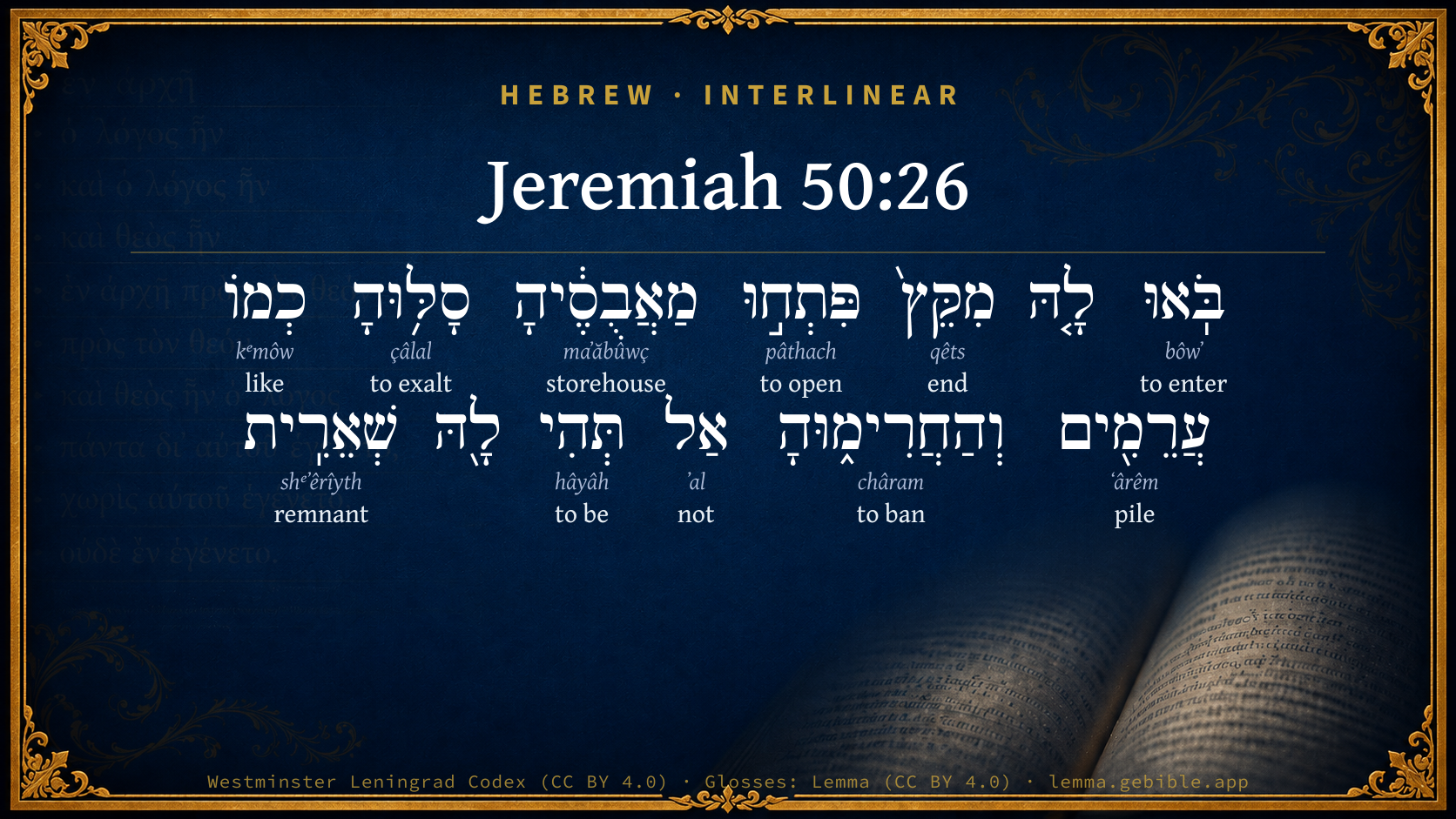
Hebrew (Westminster Leningrad Codex) Jeremiah 50:26 appears in the Hebrew Old Testament. The text above is from the Westminster Leningrad Codex. Each word links to its Strong’s number, a concise gloss, and parsing drawn from the Open Scriptures Hebrew Bible morphology. Click any word for its full Brown-Driver-Briggs (BDB) entry.
Download image
Cite this verse

Jeremiah 50:26 (World English Bible). Public Domain. Lemma interlinear Bible study tool, https://lemma.gebible.app/v/jeremiah/50/26.

Show BibTeX & RIS
BibTeX
RIS
English Translation
Come against her from the utmost border; open her store-houses; cast her up as heaps, and destroy her utterly; let nothing of her be left.
World English Bible · Public Domain
Highlights
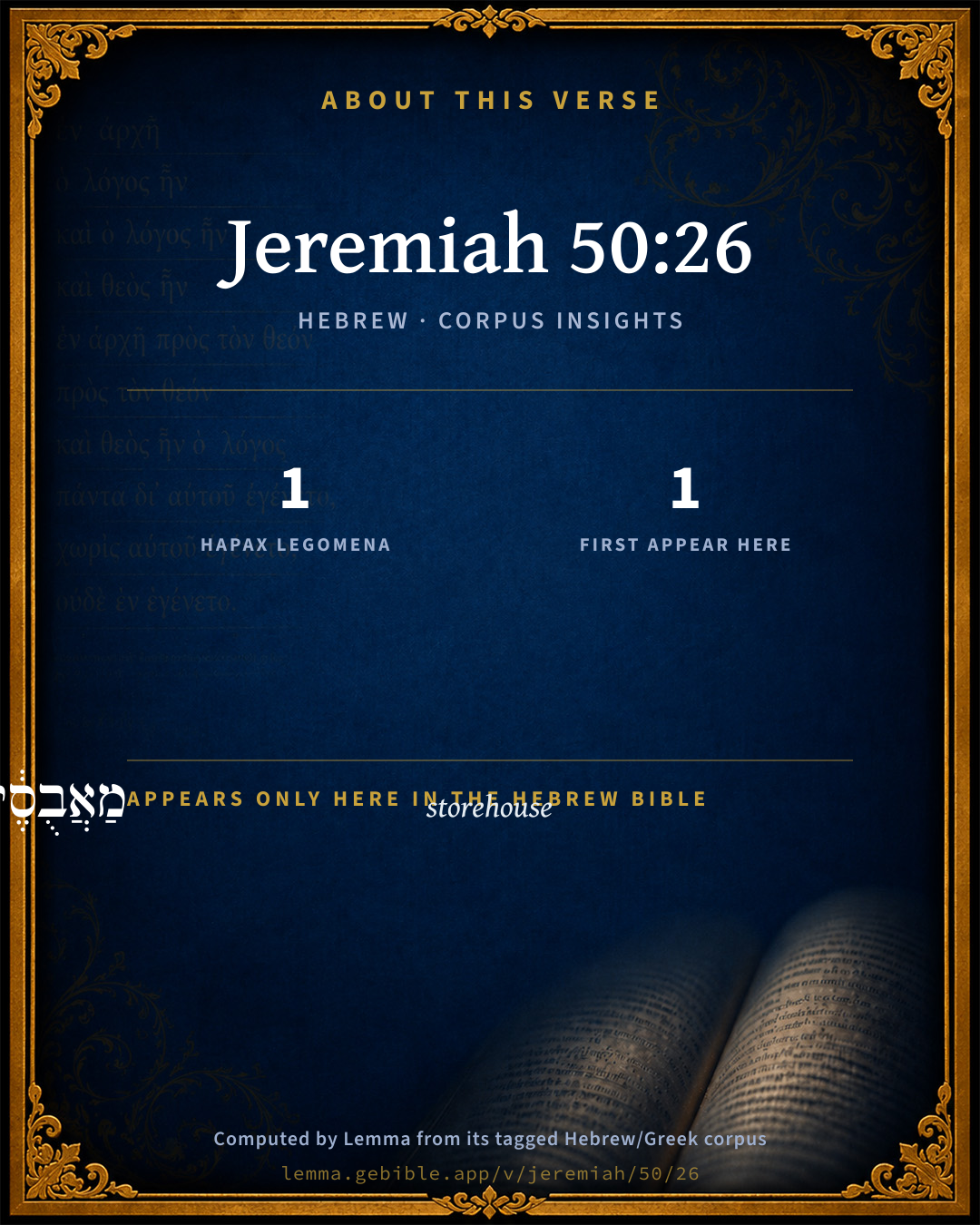
  • 1 hapax legomenon — only here in the Hebrew Bible
  • 1 first appearance in the Hebrew Bible
Full analysis ↓
Download a study sheet

One document with this verse’s original text, its word-by-word gloss line, the meaning frame, cross-references with their text, attributed commentary, and full source and license credits — printable, and it pastes into notes with its structure intact.

This verse Autodidact and up

Study sheet (.html) Plain text (.txt)

A passage Seminary Student

Up to 50 verses in one chapter. A passage sheet keeps up to 6 commentary sources and 12 cross-references per verse, in the order this page ranks them, and says so on the sheet whenever that leaves anything out. Ask for a single verse and you get the Autodidact verse sheet above.

Everything on this page stays free to read, with no account — the sheet is a download of what is already on screen, not access to it.

Want to remove ads? Support Godless Engineer
Compare translations 3

The same verse in 3 English versions, stacked beneath the original-language interlinear above. Click any original word for its lexicon entry.

Each is an independent rendering of the whole verse — the interlinear is not word-aligned to these translations.

Highlighted words mark where these versions differ — a whole-verse word diff, not a word-by-word alignment.

  • World English Bible Public Domain
    Come against her from the utmost border; open her store-houses; cast her up as heaps, and destroy her utterly; let nothing of her be left.
  • King James Version Public Domain
    Come against her from the utmost border, open her storehouses: cast her up as heaps, and destroy her utterly: let nothing of her be left.
  • unfoldingWord Literal Text CC BY-SA 4.0
    Attack her from far away. Open her granaries and pile her up like heaps of grain. Set her apart for destruction. Leave no remnant of her.

unfoldingWord Literal Text — © unfoldingWord, licensed CC BY-SA 4.0. Word-aligned USFM3 via Door43 (git.door43.org/unfoldingWord/en_ult).

Versions to compare (up to 4)

3 of 4 selected

Show all 18 translations

Every available English version of this verse, each an independent rendering of the whole verse.

  • World English Bible Public Domain
    Come against her from the utmost border; open her store-houses; cast her up as heaps, and destroy her utterly; let nothing of her be left.
  • Berean Standard Bible Public Domain
    Come against her from the farthest border. Break open her granaries; pile her up like mounds of grain. Devote her to destruction; leave her no survivors.
  • Majority Standard Bible Public Domain
    Come against her from the farthest border. Break open her granaries; pile her up like mounds of grain. Devote her to destruction; leave her no survivors.
  • King James Version Public Domain
    Come against her from the utmost border, open her storehouses: cast her up as heaps, and destroy her utterly: let nothing of her be left.
  • American Standard Version (1901) Public Domain
    Come against her from the utmost border; open her store-houses; cast her up as heaps, and destroy her utterly; let nothing of her be left.
  • Revised Version (1885) Public Domain
    Come against her from the utmost border, open her storehouses: cast her up as heaps, and destroy her utterly: let nothing of her be left.
  • Geneva Bible (1599) Public Domain
    Come against her from the vtmost border: open her store houses: treade on her as on sheaues, and destroy her vtterly: let nothing of her be left.
  • Douay-Rheims (1899) Public Domain
    Come ye against her from the uttermost borders: open that they may go forth that shall tread her down: take the stones out of the way, and make heaps, and destroy her: and let nothing of her be left.
  • Young's Literal Translation Public Domain
    Come ye in to her from the extremity, Open ye her storehouses, Raise her up as heaps, and devote her, Let her have no remnant.
  • Literal Standard Version CC BY-SA 4.0
    Come in to her from the extremity, || Open her storehouses, || Raise her up as heaps, and devote her, || Let her have no remnant.
  • Unlocked Literal Bible CC BY-SA 4.0
    Attack her from far away. Open her granaries and pile her up like heaps of grain. Set her apart for destruction. Leave no remnant of her.
  • unfoldingWord Literal Text CC BY-SA 4.0
    Attack her from far away. Open her granaries and pile her up like heaps of grain. Set her apart for destruction. Leave no remnant of her.
  • Darby Bible Public Domain
    Come ye against her from every quarter, open her storehouses; pile her up like sheaves, and destroy her utterly: let nothing of her be left.
  • World Messianic Bible Public Domain
    Come against her from the farthest border. Open her storehouses. Cast her up as heaps. Destroy her utterly. Let nothing of her be left.
  • Webster's Bible Public Domain
    Come against her from the utmost border, open her store-houses: cast her up as heaps, and destroy her utterly: let nothing of her be left.
  • Free Bible Version CC BY-SA 4.0
    Come and attack her from every side! Open her granaries; collect the loot you take from her like piles of grain. Set her apart for destruction; don't leave any survivors.
  • Bible in Basic English Public Domain
    Come up against her one and all, let her store-houses be broken open: make her into a mass of stones, give her to the curse, till there is nothing of her to be seen.
  • JPS Tanakh (1917) Public Domain
    Come against her from every quarter, open her granaries, cast her up as heaps, and destroy her utterly; let nothing of her be left.

Literal Standard Version (2020), Covenant Press — licensed CC BY-SA 4.0. Text via the HelloAO Bible API (eBible.org). Unlocked Literal Bible (unfoldingWord) — licensed CC BY-SA 4.0. Text via the HelloAO Bible API (eBible.org). unfoldingWord Literal Text — © unfoldingWord, licensed CC BY-SA 4.0. Word-aligned USFM3 via Door43 (git.door43.org/unfoldingWord/en_ult). Free Bible Version, Dr. Jonathan Gallagher — licensed CC BY-SA 4.0. Text via the HelloAO Bible API (eBible.org).

Word by word

More ways to search: Search by grammar → Find every occurrence → Compare this word →

Practice this passage: Drill this verse → Learn its vocabulary →

מַאֲבֻסֶ֔יהָ
maʼăbûwç
H3965
“storehouses · her”
Noun, Common, Masculine, Plural, Construct + Suffix, Personal, 3rd Person, Feminine, Singular
Part of Speech
Noun
Type
Common
Gender
Masculine
Number
Plural
State
Construct
Full BDB Definition

Origin: from H75

TWOT: 10b

storehouse, granary
  1. בֹּֽאוּ bôwʼ H935 “enter” Verb, Qal, Imperative, 2nd Person, Masculine, Plural
  2. מִקֵּץ֙ qêts H7093 “from · end” Preposition + Noun, Common, Masculine, Singular, Absolute
  3. פִּתְח֣וּ pâthach H6605 “open” Verb, Qal, Imperative, 2nd Person, Masculine, Plural
  4. סָלּ֥וּהָ çâlal H5549 “exalt · her” Verb, Qal, Imperative, 2nd Person, Masculine, Plural + Suffix, Personal, 3rd Person, Feminine, Singular
  5. כְמוֹ kᵉmôw H3644 “like” Preposition
  6. עֲרֵמִ֖ים ʻârêm H6194 “piles” Noun, Common, Feminine, Plural, Absolute
  7. וְהַחֲרִימ֑וּהָ châram H2763 “and · ban · her” Conjunction + Verb, Hiphil, Imperative, 2nd Person, Masculine, Plural + Suffix, Personal, 3rd Person, Feminine, Singular
  8. אַל ʼal H408 “not” Particle, Negative
  9. תְּהִי hâyâh H1961 “to be” Verb, Qal, Jussive, 3rd Person, Feminine, Singular
  10. שְׁאֵרִֽית shᵉʼêrîyth H7611 “remnant” Noun, Common, Feminine, Singular, Absolute

About this verse

These counts appear in no published source. They are computed here, from the morphology-tagged text and Lemma’s own curated glosses. What Lemma adds →

13
words
11
distinct lemmas
Prophets
section

Notable vocabulary

1 hapax legomenon — a word that appears only here in the entire Hebrew Bible:

  • מַאֲבֻסֶ֔יהָ storehouse H3965

First appearance in Scripture

This word makes its first canonical appearance in the Hebrew Bible here:

  • מַאֲבֻסֶ֔יהָ storehouse H3965

Shared distinctive vocabulary

עֲרֵמִ֖ים pile H6194 occurs in 10 verses of the Hebrew Bible. Also found in:

Grammatical profile

  • 5 verbs
  • 4 nouns
  • 3 prepositions
  • 1 particle

Verb forms

  • בֹּֽאוּ Qal · Imperative
  • פִּתְח֣וּ Qal · Imperative
  • סָלּ֥וּהָ Qal · Imperative
  • וְהַחֲרִימ֑וּהָ Hiphil · Imperative
  • תְּהִי Qal · Jussive

Cross-references

18

Topical passages linked to Jeremiah 50:26 in the Treasury of Scripture Knowledge — connected by theme and wording, ordered by reader-vote popularity; previews shown in the World English Bible.

  • Isaiah 14:23 I will also make it a possession for the porcupine, and pools of water: and I will sweep it with the broom of destruction, says Yahweh of Hosts.
  • Isaiah 45:3 and I will give you the treasures of darkness, and hidden riches of secret places, that you may know that it is I, Yahweh, who call you by your name, even the God of Israel.
  • Jeremiah 50:10 Chaldea shall be a prey: all who prey on her shall be satisfied, says Yahweh.
  • Isaiah 5:26 He will lift up a banner to the nations from far, And he will whistle for them from the end of the earth. Behold, they will come speedily and swiftly.
  • Isaiah 10:6 I will send him against a profane nation, and against the people of my wrath will I give him a charge, to take the spoil, and to take the prey, and to tread them down like the mire of the streets.
  • Isaiah 25:10 For in this mountain will the hand of Yahweh rest; and Moab shall be trodden down in his place, even as straw is trodden down in the water of the dung-hill.
  • Isaiah 63:3–4 I have trodden the winepress alone; and of the peoples there was no man with me: yes, I trod them in my anger, and trampled them in my wrath; and their lifeblood is sprinkled on my garments, and I have stained all my clothing.
  • Jeremiah 50:13 Because of the wrath of Yahweh she shall not be inhabited, but she shall be wholly desolate: everyone who goes by Babylon shall be astonished, and hiss at all her plagues.
  • Jeremiah 50:15 Shout against her round about: she has submitted herself; her bulwarks are fallen, her walls are thrown down; for it is the vengeance of Yahweh: take vengeance on her; as she has done, do to her.
  • Jeremiah 50:23 How is the hammer of the whole earth cut apart and broken! how is Babylon become a desolation among the nations!
  • Jeremiah 50:41 Behold, a people comes from the north; and a great nation and many kings shall be stirred up from the uttermost parts of the earth.
  • Jeremiah 51:25–28 Behold, I am against you, destroying mountain, says Yahweh, which destroy all the earth; and I will stretch out my hand on you, and roll you down from the rocks, and will make you a burnt mountain.
  • Jeremiah 51:44 I will execute judgment on Bel in Babylon, and I will bring forth out of his mouth that which he has swallowed up; and the nations shall not flow any more to him: yes, the wall of Babylon shall fall.
  • Jeremiah 51:64 and you shall say, Thus shall Babylon sink, and shall not rise again because of the evil that I will bring on her; and they shall be weary. Thus far are the words of Jeremiah.
  • Micah 7:10 Then my enemy will see it, And shame will cover her who said to me, Where is Yahweh your God? Then my enemy will see me and will cover her shame. Now she will be trodden down like the mire of the streets.
  • Revelation 14:19 The angel thrust his sickle into the earth, and gathered the vintage of the earth, and threw it into the great winepress of the wrath of God.
  • Revelation 18:21–24 A mighty angel took up a stone like a great millstone and cast it into the sea, saying, "Thus with violence will Babylon, the great city, be thrown down, and will be found no more at all.
  • Revelation 19:15 Out of his mouth proceeds a sharp, double-edged sword, that with it he should strike the nations. He will rule them with a rod of iron. He treads the winepress of the fierceness of the wrath of God, the Almighty.

Cross-references courtesy of OpenBible.info (CC BY 4.0).

Hebrew and Greek witnesses Masoretic Hebrew ↔ Greek Septuagint

The same verse in the two great witnesses to the Old Testament, shown verse-for-verse.

These are two independent witnesses, not word-aligned to each other, and the Septuagint is shown in lemma (dictionary) form.

Hebrew Jeremiah 50:26 Masoretic · Westminster Leningrad Codex

בֹּֽאוּ לָ֤הּ מִקֵּץ֙ פִּתְח֣וּ מַאֲבֻסֶ֔יהָ סָלּ֥וּהָ כְמוֹ עֲרֵמִ֖ים וְהַחֲרִימ֑וּהָ אַל תְּהִי לָ֖הּ שְׁאֵרִֽית

Come against her from the utmost border; open her store-houses; cast her up as heaps, and destroy her utterly; let nothing of her be left.

World English Bible · Public Domain

Greek LXX Structure differs

In the Septuagint, Jeremiah is about an eighth shorter than the Hebrew and arranges its material differently — the Oracles Against the Nations (Hebrew chapters 46–51) appear in the middle of the Greek book, after 25:13. Because the chapter and verse boundaries do not line up, a verse-for-verse comparison with the Hebrew is not shown.

A verse-for-verse comparison isn’t shown here because the chapters and verses don’t line up. Switch to the LXX edition with the MT / LXX toggle above to read the Greek directly.

Hebrew: Westminster Leningrad Codex (CC BY 4.0). Greek: Septuagint (public domain); English from a public-domain English Septuagint. How the Septuagint differs from the Hebrew →

Targum (Aramaic paraphrase)

1

The Targum is the ancient Jewish Aramaic paraphrase of the Hebrew Scriptures — an interpretive translation, not the Hebrew text itself. Onkelos (literal) and Pseudo-Jonathan (expansive) render the Torah, and Jonathan the Prophets. Coverage is partial: where no permissively-licensed English translation exists for a verse, only the Aramaic is shown. This is verse-level text, not a word-by-word alignment to the Hebrew.

  1. Targum Jonathan Prophets (Joshua–Malachi)
    עוּלוּ לָהּ מִסִטְרָא פְּתָחוּ אִבּוּלָהָא גְמִירוּ נִכְסָהָא כְּמָא דִמְגַמְרִין יַת עֲרֵימַת עִבּוּרָא כֵּן גַמְרוּהָא לָא יְהֵי לָהּ שְׁאָרָא:

    (no public-domain English translation for this verse)

    Targum Jonathan — Aramaic: “Mikraot Gedolot” (public domain). English: “Sefaria Community Translation” (CC0 1.0 (public-domain dedication)); “London "Chaldee Paraphrase," 1871” (public domain). Text via Sefaria.

Commentary

Notes on Jeremiah 50:26 from classic Christian and Jewish commentators (each source and its license shown beneath its notes). The classic Christian expositions comment on the surrounding passage and are grouped to its opening verse, so a note may address several verses; the Jewish commentaries on the Tanakh (Rashi and others) are per-verse, so they appear only where the commentator wrote on this verse.

Lemma curates 59 commentaries, every one of them public domain or Creative Commons licensed, each selected and text-cleaned for this edition rather than reprinted as found. About our sources →

Trapp's Complete Commentary

John Trapp

Jer 50:26 Come against her from the utmost border, open her storehouses: cast her up as heaps, and destroy her utterly: let nothing of her be left.

Ver. 26. Come against her.] This he speaketh to the Medes and Persians, who, though they were farther remote than they that could hear the prophet, yet God, who spake by him, could and did speak home to their hearts, stirring them up by a secret instinct to do this execution.

John Trapp, A Commentary or Exposition upon All the Books of the Old and New Testament (1647–1656) — public domain. Text from a community e-Sword module.

Geneva Bible (1599)

Geneva Bible translators

Hebrew, from the end.

Geneva Bible (1599) marginal notes — public domain. Text via Bolls.life.

Jamieson, Fausset & Brown

Robert Jamieson, A. R. Fausset & David Brown

from the utmost border--namely, of the earth. Or, from all sides LUDOVICUS DE DIEU].

storehouses--or, "her houses filled with men and goods" [MICHAELIS]. When Cyrus took it, the provisions found there were enough to have lasted for many years.

as heaps--make of the once glorious city heaps of ruins. Vast mounds of rubbish now mark the site of ancient Babylon. "Tread her as heaps of corn which are wont to be trodden down in the threshing-floor" [GROTIUS].

Jamieson, Fausset & Brown — Commentary Critical and Explanatory on the Whole Bible (1871) — public domain (CC PDM 1.0). Text via the HelloAO Bible API.

Adam Clarke's Commentary

Verse 26. Open her store-houses] At the time that Cyrus took the city, it was full of provisions and treasures of all kinds; the walls had suffered no injury; and when the inhabitants heard that the enemy was within, they thought they must have arisen out of the earth in the centre of the city!

Adam Clarke's Commentary on the Bible (1810–1826) — public domain. Text from a community e-Sword/MySword module.

John Calvin's Commentaries

The Prophet again addresses the Persians and the Medes, and encourages them to come against Babylon. We stated yesterday that the prophets are went to speak with authority, because they sustained the person of God; and we mentioned how necessary this mode of speaking was, for the world does not acknowledge that God speaks effectually.

Then he says first, Come ye against her; and then, Open her storehouses The word מאבס, meabes, means a cornhouse or a repository of any kind: hence some render it “granaries.” But it seems to me that the word is thus too much restricted, for the Prophet no doubt speaks of the treasures of Babylon. Now storehouses, (apothecas,) the Greeks call those repositories which contain all sorts of things, not only wine and oil, but goods of merchants, and also money. We call them in French, Arrieres-boutiques, or, magasins. But this word is to be extended to wine, to every kind of fruit, and then to treasures, and also to arms; for they were repositories of arms, of weapons of every kind. It is the same as though Jeremiah had said, that nothing would be so hidden among the Chaldeans but that the Medes and the Persians would find it out.

He then adds, Tread her as heaps. The word ערמים, oremim, means not heaps of stones, but on the contrary, of sheaves. Then he intimates that the Persians and the Medes would act cruelly, and tread them as corn is trodden on the floor. He lastly says, Destroy her utterly, that there way be to her no remnant He seems indirectly to set this in contrast with what God promised always to his people, that there would be some remnant, he then says that nothing would remain when God had executed his vengeance on the Chaldeans. The sum of what is said is, that the punishment of which the Prophet speaks would be such as would obliterate the very name of the Babylonian monarchy. This, as we said yesterday and also previously, was not completed in one day. But when the Prophets speak of God’s judgments, they do not regard only the preludes, but their words extend to the last judgment that awaits all the reprobate. It now follows, —

John Calvin's Commentaries (1540-1563) — public domain. Text from the Calvin Translation Society English edition (1840s-50s) via the Christian Classics Ethereal Library (ccel.org). Calvin's coverage is partial (roughly two-thirds of the Bible); uncommented books and verses are honest gaps, never fabricated. The 19th-century editor's footnotes and remarks are omitted so the notes are faithfully Calvin's own voice.

Ellicott's Commentary for English Readers

(26) Open her storehouses.—The noun is not found elsewhere. Probably granaries would be a better rendering. The word for “heaps” is used in Song Son_7:2; Rth_3:7 for “heaps of corn,” and this is probably its meaning here. In Neh_4:2, however, it is used of heaps of rubbish. The stored-up provisions of the captured city are to be piled up in its open places, as men pile the sheaves of corn after harvest, and burnt (for “destroy” read devote to destruction), as had been done, e.g., in the capture of Jericho and other cities (Jos_6:24; Jos_11:12-13).

Let nothing of her be left.—Literally, let there be no remnant, as in marked contrast with the “remnant” of Israel (Jer_50:20).

A Bible Commentary for English Readers, edited by Charles John Ellicott (1878–1897) — public domain. Text from a community e-Sword module.

The Cambridge Bible for Schools and Colleges

gen. ed. J. J. S. Perowne

26. from the utmost border] better, as mg. from every quarter. Heb. lit. “from the end.”

storehouses] better, as mg. granaries.

cast her up as heaps] “her” meaning the whole contents of the city, including the piled up treasures of grain.

destroy her utterly] See mg. and cp. Deu_13:15 f.

The Cambridge Bible for Schools and Colleges (gen. ed. J. J. S. Perowne; Cambridge University Press, 1878–1918) — public domain. Text from a community e-Sword module.

John Gill's Exposition

Come against her from the utmost border,.... Or, "from the end" (a); from the end of the earth; from the Persian gulf, and the Caspian sea, on which the Persians and Medes bordered; from the most distant countries; for the Medes and Persians, who are here called unto, brought others along with them in their army from places still more remote; for this is not to be understood, with the Targum, of entering into Babylon on one "side"; or, with Jarchi, of beginning at one "end" of the city, that it might not be known, and be taken suddenly:

open her storehouses; where her gold, silver, jewels, and other precious things, lay: or, her barns or "granaries" (b), as the Targum and Kimchi; where the fruits and increase of the earth were laid up; and may figuratively design her cities and fortified places, full of inhabitants, as well as of riches and stores of all kinds:

cast her up as heaps; as heaps of rubbish to make a causeway of, and then tread upon them to make it smooth: or, "as heaps", or "sheaves" (c) of corn; tread upon them as oxen do, and thereby thresh them out; so Jarchi interprets it,

"thresh her as grains of wheat;''

and to this sense the Targum refers,

"consume her substance as they consume heaps of wheat;''

see Rev 18:12;

and destroy her utterly: let nothing of her be left; of the city of Babylon, its inhabitants, wealth, and riches; so complete should the destruction be, Rev 18:8.

(a) "a fine", Vatablus, Montanus, Schmidt; "a fine terrae", Piscator; "ab extremis finibus", Tigurine version, Grotius. (b) "horrea ejus", Montanus, Cocceius; "granaria ejus", Junius & Tremellius, Piscator, Schmidt. (c) "sicut acervos, sub. tritici", Vatablus; "frumenti", Piscator.

John Gill's Exposition of the Whole Bible (1746–1763) — public domain (CC PDM 1.0). Text via the HelloAO Bible API.

Albert Barnes' Notes on the Bible

Against her - Or, to her, in order to plunder her. Her storehouses (literally granaries) are to burst open, the grain piled up in heaps, and finally they are to devote her to destruction, i. e., to burn her wealth with fire.

From the utmost border - (Or, “from the first of you even to the last”).

Let nothing of her be left - literally, let her have no remnant. Contrast Jer 5:10.

Albert Barnes' Notes on the Bible (1834–1885) — public domain. Text from a community e-Sword/MySword module.

Haydock's Catholic Bible Commentary

That. Hebrew, "her granaries; trample on her as on heaps of corn, destroy," &c. He alludes to the custom of oxen trampling out the corn, chap. li. 33.

George Leo Haydock (1774–1849), Haydock's Catholic Family Bible and Commentary, 1859 edition — public domain. Excludes Psalms (Douay-Rheims chapter numbering differs from Protestant) and Deuterocanonical books (Catholic canon only).

Matthew Poole's English Annotations

The prophet in the name of God calleth to the enemies of Babylon, the Medes, to come up from the furthest parts of their dominions, or from all parts, to fight against Babylon; to open the granaries, or store-houses, or treasuries of the Babylonians, and to cast up the cities as

heaps of rubbish, and utterly to destroy the city with such a total destruction that nothing of it should be left.

Matthew Poole's English Annotations on the Holy Bible (1683–1685) — public domain. Text from a community e-Sword/MySword module.

Whedon's Commentary on the Bible

Daniel D. Whedon

26. From the utmost border — And all intervening. The meaning is, let all come.

Storehouses — Literally, granaries.

Cast her up as heaps — Rather, “cast” it — namely, the grain — into heaps, that it may be devoted to destruction.

Daniel D. Whedon (gen. ed.), Commentary on the Old and New Testaments (1874–1909) — public domain. Text from a community e-Sword module.

The Pulpit Commentary

Come against her; rather, Come to her. Dr. Payne Smith infers that Babylon has already fallen, and that the persons addressed are not warriors only, but plunderers of every kind. This is almost too subtle. The prepositions "to" and "against" (literally, upon) are so frequently interchanged. (comp. Jer_46:22 Jer_49:9) From the utmost border; rather, all to gether; it is an idiom expressing universality. Those who are spoken of are regarded as a totality, "from the utmost end" of which its members come. Cast her up as heaps; rather, Cast it up as sheaves; i.e. ransack the repositories of Babylon"s wealth, and heap it up like corn; last of all, destroy her (rather, it) utterly. The verb is a very emphatic one. Its primary meaning is "to cut off, or shut off." Hence kherem, a devoted thing, is applied in the Law to that which is "tabooed," as it were, cut off from any but sacred uses. In Lev_27:21 it is used of a field wholly appropriated to the sanctuary, and in 1Sa_15:21 and 1Ki_20:42 to living beings doomed to destruction. Destruction is generally apart of the meaning; but it is not merely destruction, but an act of homage to the Divine justice.

The Pulpit Commentary (1880–1919), ed. H.D.M. Spence-Jones & Joseph S. Exell — public domain. Text from a community e-Sword module.

John Wesley's Explanatory Notes

Open her store-houses - The granaries, or treasures of the Babylonians.

John Wesley, Explanatory Notes Upon the Whole Bible (1754–1765) — public domain. Text via the GEBible commentary corpus.

Rashi

Rabbi Shlomo Yitzchaki (Rashi)

Come against her from her border From the end of the city, commence upon her, that she not know, and she will be taken suddenly.

open her gates Jonathan renders: אִבּוּלָהָא, her gates, but it has no similar instance [in Scripture]. Menahem (Machbereth p. 14) classifies it as an expression of a manger.

thresh her Heb. סלוה.

stacks Granaries.

Rashi on the Tanakh — English translations: “The Judaica Press complete Tanach with Rashi, translated by A. J. Rosenberg” (CC BY 4.0); “Pentateuch with Rashi's commentary by M. Rosenbaum and A.M. Silbermann, 1929-1934” (public domain); “The Metsudah Tanach series, Lakewood, N.J” (CC BY 4.0); and “The Book of Joshua, Metsudah Publications, 1997” (CC BY 4.0). Text via Sefaria.

Lesson kit

Teaching starters — assembled from the data on this page, not authored interpretation. Every prompt links to the verse data it draws on. Edit before teaching.

Jeremiah, in the Prophets, opens this verse with 13 words (11 distinct Hebrew lemmas). Its most distinctive word is maʼăbûwç (“storehouse”). A historical commentator’s framing appears above. Read the whole chapter for the surrounding context.

Discussion questions

  1. What does “storehouse” (maʼăbûwç) contribute to the verse as a whole?
  2. This verse holds 1 word here found nowhere else in the Hebrew Bible. What might the rare word draw attention to?
  3. The word “storehouse” first appears here in Scripture. What is being introduced at this debut?
  4. Ruth 3:7 shares the word «pile» with this verse. How do the two illuminate each other?
  5. These translations render this verse differently; the difference is in the English rendering, not the original. What questions does that raise?
  6. The verb «בֹּֽאוּ» is Qal Imperative. How does its form color the action?
  7. Reading how Trapp's Complete Commentary and Geneva Bible (1599) read this verse, where do the two commentators agree and where do they part?

Things to notice

  • 1 word in this verse appears nowhere else in the Hebrew Bible.
  • 1 word makes its first canonical appearance in Scripture here.
  • These translations choose different wording for 24 words in this verse.
  • 11 distinct Hebrew lemmas span 13 words in this verse.

Reading settings

Reading text

Shown beneath each verse's original-language words.

Old Testament
Old Testament edition

Read the OT as the Masoretic Hebrew (MT) or the Greek Septuagint (LXX).

English shown for the Greek Septuagint (in the Hebrew ↔ Greek comparison).

Comparing translations? Open the Compare panel on any verse page to stack up to four side by side.