
Hosea 13:7

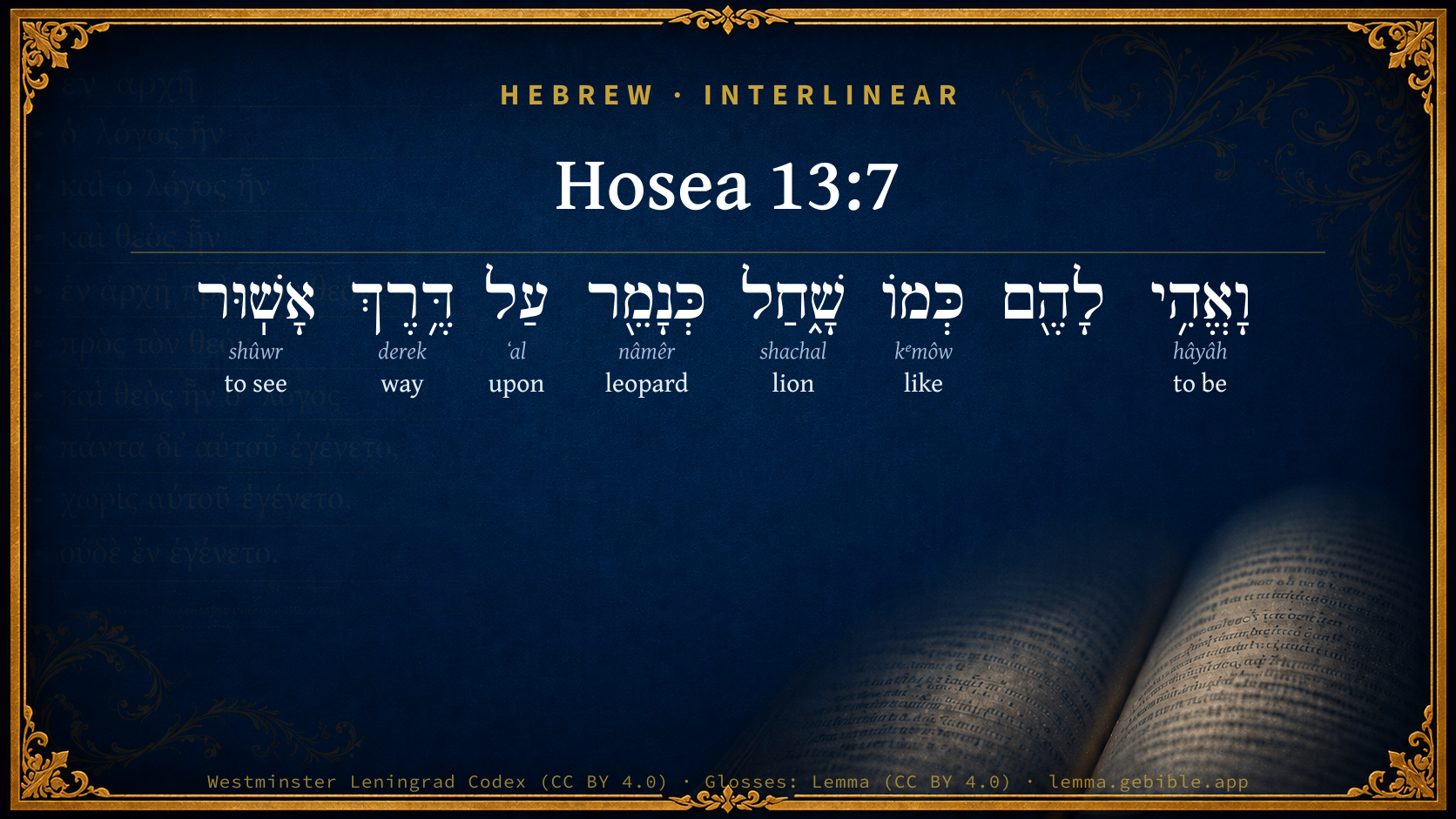
Hebrew (Westminster Leningrad Codex) Hosea 13:7 appears in the Hebrew Old Testament. The text above is from the Westminster Leningrad Codex. Each word links to its Strong’s number, a concise gloss, and parsing drawn from the Open Scriptures Hebrew Bible morphology. Click any word for its full Brown-Driver-Briggs (BDB) entry.
Download image
Cite this verse

Hosea 13:7 (World English Bible). Public Domain. Lemma interlinear Bible study tool, https://lemma.gebible.app/v/hosea/13/7.

Show BibTeX & RIS
BibTeX
RIS
English Translation
Therefore am I to them like a lion; Like a leopard I will lurk by the path.
World English Bible · Public Domain
Download a study sheet

One document with this verse’s original text, its word-by-word gloss line, the meaning frame, cross-references with their text, attributed commentary, and full source and license credits — printable, and it pastes into notes with its structure intact.

This verse Autodidact and up

Study sheet (.html) Plain text (.txt)

A passage Seminary Student

Up to 50 verses in one chapter. A passage sheet keeps up to 6 commentary sources and 12 cross-references per verse, in the order this page ranks them, and says so on the sheet whenever that leaves anything out. Ask for a single verse and you get the Autodidact verse sheet above.

Everything on this page stays free to read, with no account — the sheet is a download of what is already on screen, not access to it.

Want to remove ads? Support Godless Engineer
Compare translations 3

The same verse in 3 English versions, stacked beneath the original-language interlinear above. Click any original word for its lexicon entry.

Each is an independent rendering of the whole verse — the interlinear is not word-aligned to these translations.

Highlighted words mark where these versions differ — a whole-verse word diff, not a word-by-word alignment.

  • World English Bible Public Domain
    Therefore am I to them like a lion; Like a leopard I will lurk by the path.
  • King James Version Public Domain
    Therefore I will be unto them as a lion: as a leopard by the way will I observe them:
  • unfoldingWord Literal Text CC BY-SA 4.0
    So I am to them like a lion; like a leopard along the path I will watch.

unfoldingWord Literal Text — © unfoldingWord, licensed CC BY-SA 4.0. Word-aligned USFM3 via Door43 (git.door43.org/unfoldingWord/en_ult).

Versions to compare (up to 4)

3 of 4 selected

Show all 18 translations

Every available English version of this verse, each an independent rendering of the whole verse.

  • World English Bible Public Domain
    Therefore am I to them like a lion; Like a leopard I will lurk by the path.
  • Berean Standard Bible Public Domain
    So like a lion I will pounce on them; like a leopard I will lurk by the path.
  • Majority Standard Bible Public Domain
    So like a lion I will pounce on them; like a leopard I will lurk by the path.
  • King James Version Public Domain
    Therefore I will be unto them as a lion: as a leopard by the way will I observe them:
  • American Standard Version (1901) Public Domain
    Therefore am I unto them as a lion; as a leopard will I watch by the way;
  • Revised Version (1885) Public Domain
    Therefore am I unto them as a lion: as a leopard will I watch by the way:
  • Geneva Bible (1599) Public Domain
    And I wil be vnto them as a very lyon, and as a leopard in the way of Asshur.
  • Douay-Rheims (1899) Public Domain
    And I will be to them as a lioness, as a leopard in the way of the Assyrians.
  • Young's Literal Translation Public Domain
    And I am to them as a lion, As a leopard by the way I look out.
  • Literal Standard Version CC BY-SA 4.0
    And I am to them as a lion, || I look out as a leopard by the way.
  • Unlocked Literal Bible CC BY-SA 4.0
    I will become like a lion to them; like a leopard I will watch along the path.
  • unfoldingWord Literal Text CC BY-SA 4.0
    So I am to them like a lion; like a leopard along the path I will watch.
  • Darby Bible Public Domain
    And I will be unto them as a lion; as a leopard I will lurk for them by the way;
  • World Messianic Bible Public Domain
    Therefore I am like a lion to them. Like a leopard, I will lurk by the path.
  • Webster's Bible Public Domain
    Therefore I will be to them as a lion: as a leopard by the way will I observe them.
  • Free Bible Version CC BY-SA 4.0
    So I will be like a lion to them, like a leopard I will lie in wait beside the path.
  • Bible in Basic English Public Domain
    So I will be like a lion to them; as a cruel beast I will keep watch by the road;
  • JPS Tanakh (1917) Public Domain
    Therefore am I become unto them as a lion; as a leopard will I watch by the way;

Literal Standard Version (2020), Covenant Press — licensed CC BY-SA 4.0. Text via the HelloAO Bible API (eBible.org). Unlocked Literal Bible (unfoldingWord) — licensed CC BY-SA 4.0. Text via the HelloAO Bible API (eBible.org). unfoldingWord Literal Text — © unfoldingWord, licensed CC BY-SA 4.0. Word-aligned USFM3 via Door43 (git.door43.org/unfoldingWord/en_ult). Free Bible Version, Dr. Jonathan Gallagher — licensed CC BY-SA 4.0. Text via the HelloAO Bible API (eBible.org).

Word by word

More ways to search: Search by grammar → Find every occurrence → Compare this word →

Practice this passage: Drill this verse → Learn its vocabulary →

About this verse

These counts appear in no published source. They are computed here, from the morphology-tagged text and Lemma’s own curated glosses. What Lemma adds →

8
words
7
distinct lemmas
Prophets
section

Notable vocabulary

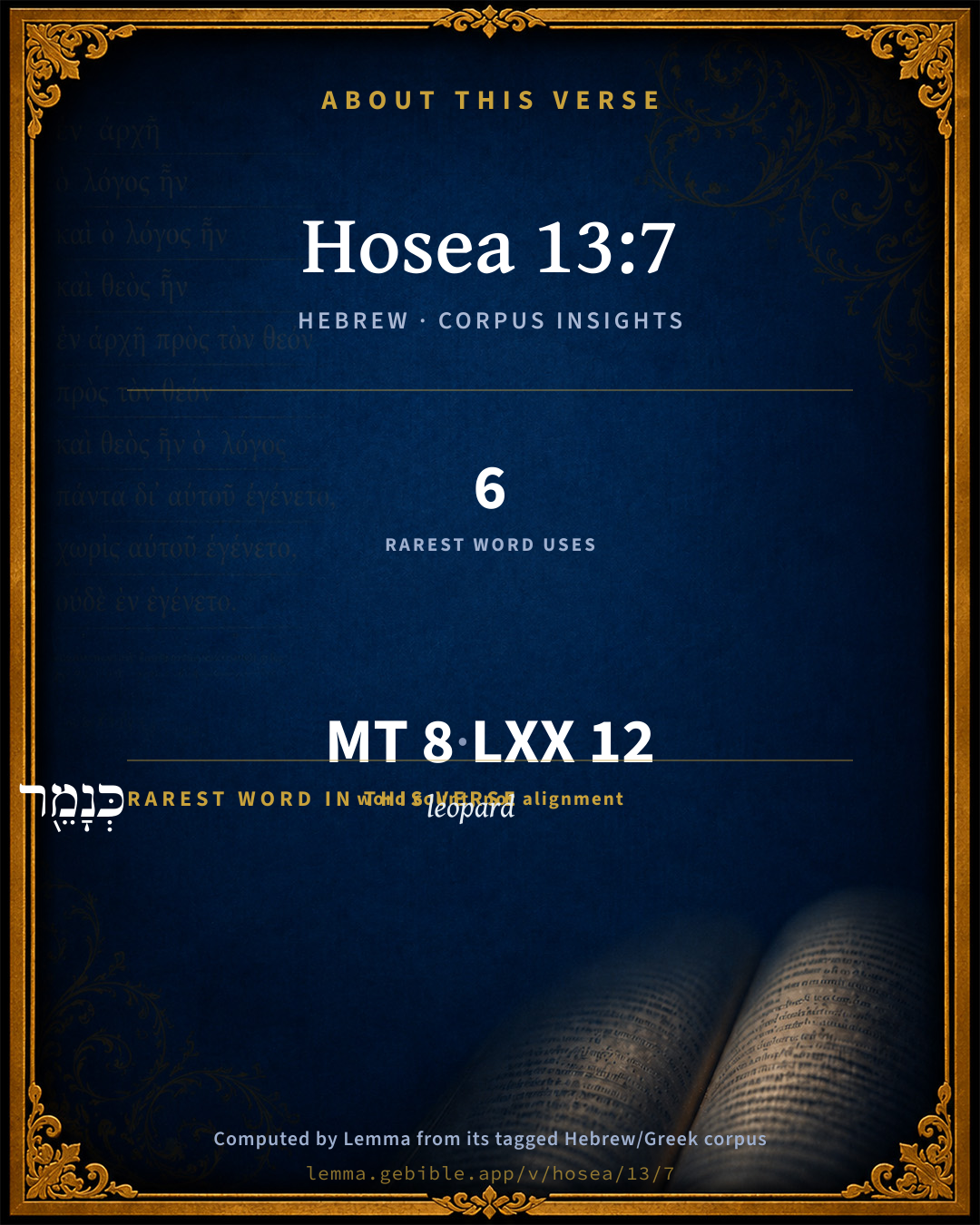
The rarest word here is כְּנָמֵ֖ר leopard H5246 — appearing just 6 times in the whole Hebrew Bible.

Shared distinctive vocabulary

כְּנָמֵ֖ר leopard H5246 occurs in 6 verses of the Hebrew Bible. Also found in:

Grammatical profile

  • 2 verbs
  • 3 nouns
  • 3 prepositions

Verb forms

  • וָאֱהִ֥י Qal · Sequential Imperfect
  • אָשֽׁוּר Qal · Imperfect

Hebrew & Septuagint length

In English translation the verse runs 17 words from the Hebrew and 13 from the Septuagint (LXX English) — closely comparable.

A rough comparison of the two English renderings, which tokenize alike — not a word-level alignment.

Word counts can differ between the Hebrew and the Greek without any difference in meaning — e.g. the Hebrew direct-object marker אֵת has no separate Greek word, and Greek often adds the article ὁ.

In the original languages it is 8 Hebrew tokens and 12 Greek tokens — but the two are counted differently (Hebrew bundles its prefixes and suffixes into one token; the Greek is in lemma form), so that isn’t a like-for-like length.

Cross-references

7

Topical passages linked to Hosea 13:7 in the Treasury of Scripture Knowledge — connected by theme and wording, ordered by reader-vote popularity; previews shown in the World English Bible.

  • Jeremiah 5:6 Therefore a lion out of the forest shall kill them, a wolf of the evenings shall destroy them, a leopard shall watch against their cities; everyone who goes out there shall be torn in pieces; because their transgressions are many, [and] their backsliding is increased.
  • Hosea 5:14 For I will be to Ephraim like a lion, And like a young lion to the house of Judah. I myself will tear in pieces and go away. I will carry off, and there will be no one to deliver.
  • Lamentations 3:10 He is to me as a bear lying in wait, as a lion in secret places.
  • Isaiah 42:13 Yahweh will go forth as a mighty man; he will stir up [his] zeal like a man of war: he will cry, yes, he will shout aloud; he will do mightily against his enemies.
  • Amos 1:2 He said: "Yahweh will roar from Zion, And utter his voice from Jerusalem; And the pastures of the shepherds will mourn, And the top of Carmel will wither."
  • Amos 3:4 Will a lion roar in the thicket, When he has no prey? Does a young lion cry out of his den, If he has caught nothing?
  • Amos 3:8 The lion has roared. Who will not fear? The Lord Yahweh has spoken. Who can but prophesy?

Cross-references courtesy of OpenBible.info (CC BY 4.0).

Hebrew and Greek witnesses Masoretic Hebrew ↔ Greek Septuagint

The same verse in the two great witnesses to the Old Testament, shown verse-for-verse.

These are two independent witnesses, not word-aligned to each other, and the Septuagint is shown in lemma (dictionary) form.

Hebrew Hosea 13:7 Masoretic · Westminster Leningrad Codex

וָאֱהִ֥י לָהֶ֖ם כְּמוֹ שָׁ֑חַל כְּנָמֵ֖ר עַל דֶּ֥רֶךְ אָשֽׁוּר

Therefore am I to them like a lion; Like a leopard I will lurk by the path.

World English Bible · Public Domain

Greek LXX Hosea 13:7 Septuagint · lemma form

καί εἰμί αὐτός ὡς πανθήρ καί ὡς πάρδαλις κατά ὁ ὁδός ἀσσύριος

And I will be to them as a panther, and as a leopard.

LXX2012 (modern English Septuagint) · Public Domain

On this verse, Jamieson, Fausset & Brown discusses the Septuagint’s reading. Read the note in Commentary ↓

Hebrew: Westminster Leningrad Codex (CC BY 4.0). Greek: Septuagint (public domain); English from LXX2012 (modern English Septuagint) (Public Domain). How the Septuagint differs from the Hebrew →

Targum (Aramaic paraphrase)

1

The Targum is the ancient Jewish Aramaic paraphrase of the Hebrew Scriptures — an interpretive translation, not the Hebrew text itself. Onkelos (literal) and Pseudo-Jonathan (expansive) render the Torah, and Jonathan the Prophets. Coverage is partial: where no permissively-licensed English translation exists for a verse, only the Aramaic is shown. This is verse-level text, not a word-by-word alignment to the Hebrew.

  1. Targum Jonathan Prophets (Joshua–Malachi)
    וַהֲוָה מֵימְרִי לְהוֹן כְּלַיְתָא כְּנִמְרָא כָּמָן עַל שְׁבִילָא:

    (no public-domain English translation for this verse)

    Targum Jonathan — Aramaic: “Mikraot Gedolot” (public domain). English: “Sefaria Community Translation” (CC0 1.0 (public-domain dedication)); “London "Chaldee Paraphrase," 1871” (public domain). Text via Sefaria.

Commentary

Notes on Hosea 13:7 from classic Christian and Jewish commentators (each source and its license shown beneath its notes). The classic Christian expositions comment on the surrounding passage and are grouped to its opening verse, so a note may address several verses; the Jewish commentaries on the Tanakh (Rashi and others) are per-verse, so they appear only where the commentator wrote on this verse.

Lemma curates 59 commentaries, every one of them public domain or Creative Commons licensed, each selected and text-cleaned for this edition rather than reprinted as found. About our sources →

Trapp's Complete Commentary

John Trapp

Hos 13:7 Therefore I will be unto them as a lion: as a leopard by the way will I observe [them]:

Ver. 7. Therefore will I be unto them as a lion, as a leopard, &c.] Thus still God proceedeth to use similitudes by the ministry of his prophets, as he did before, Hos 13:3. He here compareth himself (who otherwise is compared to an eagle, bearing her young upon her wings; to a hen, hovering over chickens; to a father, cherishing his children, Exo 19:4 Deu 32:10-11 Mat 23:37) to a lion, yea, to an old lion, which taketh the prey but seldom, and therefore is more ravenous of it when taken; {see Hos 5:14} to a leopard, or panther, that diligently observeth by the way, and lieth in wait for his prey, and useth subtilty, as not being so swift of foot, confer Jer 5:6; to a bear robbed of her whelps, which are very dear to her; to any other cruel creature, Hos 13:8, as the tiger that flieth upon the very picture of a man, and teareth it, or if he cannot come at it, teareth himself for anger. Neither is it for nothing (saith Rivet) that God compareth himself here to all these together; but to show that there was no hope of escape, neither could he that had avoided one danger be safe from another, so dreadful a thing is it to fall into the punishing hands of the living God. Oh consider this, ye that forget God; lest he tear you in pieces, and there be none to deliver you.

John Trapp, A Commentary or Exposition upon All the Books of the Old and New Testament (1647–1656) — public domain. Text from a community e-Sword module.

Tyndale Open Study Notes

Tyndale Open Resources

13:7-8 God had executed judgment on Israel through the Assyrian army, his instrument of punishment. The description of God’s attack speaks of the Assyrians’ cruelty to those they conquered.

Tyndale Open Study Notes — © Tyndale Open Resources, licensed CC BY-SA 4.0. Text via the HelloAO Bible API.

Jamieson, Fausset & Brown

Robert Jamieson, A. R. Fausset & David Brown

(Hos 5:14; Lam 3:10).

leopard--The Hebrew comes from a root meaning "spotted" (compare Jer 13:23). Leopards lurk in thickets and thence spring on their victims.

observe--that is, lie in wait for them. Several manuscripts, the Septuagint, Vulgate, Syriac, and Arabic read, by a slight change of the Hebrew vowel pointing, "by the way of Assyria," a region abounding in leopards and lions. English Version is better.

Jamieson, Fausset & Brown — Commentary Critical and Explanatory on the Whole Bible (1871) — public domain (CC PDM 1.0). Text via the HelloAO Bible API.

Adam Clarke's Commentary

Verse 7. I will be unto them as a lion] שחל shachal is supposed to mean here the black lion, frequent in Ethiopia.

As a leopard] נמר namar, so termed from its spotted skin, for to be spotted is the signification of the root.

Will I observe them] The leopard, tiger, and panther will hide themselves in thick bush-wood, near where they expect any prey to pass; and as soon as it comes near, spring suddenly upon it. To this is the allusion in the text: "By the way will I observe them;" watch for them as the leopard does. They shall be greatly harassed even on their way to Assyria, when going into captivity.

Adam Clarke's Commentary on the Bible (1810–1826) — public domain. Text from a community e-Sword/MySword module.

John Calvin's Commentaries

The Prophet denounces again on the Israelites the vengeance of God; and as they were become torpid through their own flatteries, as we have already often observed, he here describes the terrible judgement of God, that he might strike fear into the obstinate, so that they might at length perceive that they had to do with God, and begin to dread his power. And this, as we have said, was very necessary, when the Prophets intended to awaken hypocrites; for self- confidence so inebriates them, that they hesitate not to despise all the threatenings of God: and this is the reason why he adopts these three similitudes. He first compares God to a lion, then to a leopard, and then to a bear. I will be, he says, like a lion, like a leopard, and then like a bear God, we know, is in his own nature merciful and kind; when he says that he will be like a lion, he puts on as it were another character; but this is done on account of men’s wickedness, as it is said in Psalm 18,

‘With the gentle, thou wilt be gentle; with the perverse, thou wilt be perverse.’

For, though God speaks sharply and severely through his Prophet, he yet expresses what we ought to remember, and that is, that he thus speaks, because we do not allow him to treat us according to his own nature, that is, gently and kindly; and that when he sees us to be obstinate and unnameable, he then contends with us (so to speak) with the like contumacy; not that perversity properly belongs to God, but he borrows this similitude from men, and for this reason, that men may not continue to flatter themselves when he is displeased with them. I shall therefore be like a lion, like a leopard in the way

As to the word Assur, interpreters take it in various ways. Some render it, Assyria, though it is here written with Kamets: but the Hebrews consider it as an appellative, not the name of a place or country. Some again render it thus, “I will look on them,” and derive it from שור, shur, and take אaleph, as designative of the future tense. Others derive it from אשר, asher, and will have it to be in the conjugation Pual: and here they differ again among themselves. Some render it, “I will lay in wait for them:” and others think it to be Shoar, “I will be a layer in wait like a leopard.” But this variety, with regard to the meaning of the passage, is of but little moment; for we see the drift of the Prophet’s object. He intends here to take away from hypocrites their vain confidence, and to terrify them with the apprehension of God’s vengeance which was impending. He therefore says that though God had hitherto spared them, nay, had in a manner kindly cherished them, yet since they continued to provoke his wrath, their condition would soon be very different; for he would come against them like a lion; that is, he would leap on them with the greatest fury; he would also be like a leopard: and a leopard, we know, is a very cruel beast: and, lastly, he compares him to a bereaved she-bear, or, a bereaved bear.

John Calvin's Commentaries (1540-1563) — public domain. Text from the Calvin Translation Society English edition (1840s-50s) via the Christian Classics Ethereal Library (ccel.org). Calvin's coverage is partial (roughly two-thirds of the Bible); uncommented books and verses are honest gaps, never fabricated. The 19th-century editor's footnotes and remarks are omitted so the notes are faithfully Calvin's own voice.

Ellicott's Commentary for English Readers

(7) I will be . . .—More correctly, have become . . . as a panther in the way do I lie in wait. The idea of this and the following verses is that of a Divine judgment suspended over Israel, destined soon to fall with overwhelming ruin (721 B.C.). The English version follows the interpretation of the Targum. But the LXX., Vulg., and Syriac versions are based on a slightly different reading of the text contained in some Hebrew MSS. They render, “as a panther on the way to Assyria.”

A Bible Commentary for English Readers, edited by Charles John Ellicott (1878–1897) — public domain. Text from a community e-Sword module.

The Cambridge Bible for Schools and Colleges

gen. ed. J. J. S. Perowne

7. I will be] Rather, I have become. The evident decay of Israel as a nation shows that the punishment has begun (see Hos_7:8-10).

the leopard] Familiar to the Hebrews and Assyrians under the same name (nâmçr, nimru). Its habit of springing from an ambush is again referred to in Jer_5:6.

by the way will I observe them] According to another pronunciation of the consonants, the Septuagint, Peshito, and Vulgate (supported by some MSS. and many editions of the Hebrew Bible), render ‘in the way to Assyria’, an allusion being supposed to Israel’s dallying with the great northern empire (Hos_5:13). So also Hitzig and Ewald. But the prophet has to deal now with the disease itself, not with a mere symptom.

The Cambridge Bible for Schools and Colleges (gen. ed. J. J. S. Perowne; Cambridge University Press, 1878–1918) — public domain. Text from a community e-Sword module.

John Gill's Exposition

Therefore I will be unto them as a lion, Because of their idolatry, ingratitude, luxury, and especially their forgetfulness of God, which is last mentioned, and with which the words are connected. By this and the following metaphors are set forth the severity of God's judgments upon them for their sins, and their utter destruction by them. Some observe the word (f) here used signifies an old lion, which, though slower in the pursuit of its prey, is more cruel when it has got it; see Hos 5:14;

as a leopard by the way will I observe them; which is a quick sighted, vigilant, crafty, and insidious creature, which lurks in trees, and watches for men and beasts that pass by the way, and seizes on them. The lion makes his onset more openly, this more secretly; and both express the various ways God would take in his providence to chastise these people for their sins, and that he would watch over them to do them hurt, as he had to do them good, and take the proper opportunity of doing it, and execute his purpose with great wrath and fury, to their utter ruin; see Jer 5:6. The Septuagint, Vulgate Latin, Syriac, and Arabic versions, render it, "as a leopard by the way of Assyria" (g), or "the Assyrians"; and so some interpreters take the sense to be, that God would watch them in their way to Assyria for help, and blast their designs, disappoint them of their expected assistance, and surprise them with his judgments; see Hos 5:13; and there was a mountain in Syria, called the mountain of the leopards, where they used to haunt, and from whence they came out to take their prey, to which there is a reference in Sol 4:8; which was two miles from Tripoli (a city of Syria) northward, three from the city Arces southward, and one from Mount Lebanon (h); and such is the vigilance and agility of leopards, that they will sometimes, as Pliny (i) says, mount thick trees, and hide themselves in the branches, and leap at once, and unawares, upon those that pass by, whether men or beasts, as before observed; wherefore, with great propriety, is this simile used. The Targum is, "my word shall be", &c.

(f) "vetus leo", Junius & Tremellius, Piscator. (g) Sept. "in via Assyriormm", V. L. "super via Assyriae", Schmidt; "in via Assyria", Liveleus, Cocceius. (h) Adrichomii Thestrum Terrae Sanct. p. 186. (i) Nat. Hist. l. 10. c. 73.

John Gill's Exposition of the Whole Bible (1746–1763) — public domain (CC PDM 1.0). Text via the HelloAO Bible API.

Albert Barnes' Notes on the Bible

I will be unto them as a lion - They had waxen fat, were full; yet it was, to become themselves a prey. Their wealth which they were proud of, which they abused, allured their enemies. To cut off all hopes of God’s mercy, He says that he will be to them, as those creatures of His, which never spare. The fierceness of the lion, and the swiftness of the leopard, together portray a speedy inexorable chastisement. But what a contrast I He who bare Israel in the wilderness like a Father, who bare them on eagle’s wings, who drew them with the cords of a man, with bands of love, He, the God of mercy and of love, their Father, Protector, Defender, Avenger, He it is who will be their destroyer.

Albert Barnes' Notes on the Bible (1834–1885) — public domain. Text from a community e-Sword/MySword module.

Haydock's Catholic Bible Commentary

Lioness. Septuagint, "panther." I will pursue them even in their captivity.

George Leo Haydock (1774–1849), Haydock's Catholic Family Bible and Commentary, 1859 edition — public domain. Excludes Psalms (Douay-Rheims chapter numbering differs from Protestant) and Deuterocanonical books (Catholic canon only).

Matthew Poole's English Annotations

Therefore; since they have so abused my gifts by luxury, pride, and atheistical forgetfulness of me, of what I had done for them, what I deserved and expected from them, I will use them as is meet, and take my revenge upon them.

I will be unto them; unthankful, apostates, idolaters, sottish drunkards, belly-gods, who live to eat and drink, and forget me.

As a lion: see Hos 5:14; that is, in his fullest strength, of a middle age, swift in pursuing, and that can continue the chase till he overtake his prey; and which is strong, courageous, and proud of his strength and success; that will dreadfully roar over his prey, as if he challenged any one to attempt its rescue.

As a leopard; a very fierce, swift, sly, and watchful creature, Jer 5:6; Hab 1:8. Observe them; watch for them, that I may be sure to take them.

Matthew Poole's English Annotations on the Holy Bible (1683–1685) — public domain. Text from a community e-Sword/MySword module.

Whedon's Commentary on the Bible

Daniel D. Whedon

7, 8. The flock, Israel, despised the good shepherd; now he will transform himself into a beast of prey seeking to devour the sheep.

Lion — See on Hos_5:14.

Leopard — Mentioned on account of its fierceness (compare Isa_11:6). Leopards are still found in Mount Lebanon, though in small numbers.

Will I observe them — R.V., “will I watch by the way,” waiting for the proper moment to spring. “It (the leopard) is specially noted for the patience with which it waits… expecting its prey, upon which it springs with deadly precision” (compare Jer_5:6). Several of the ancient versions and some of the Hebrew manuscripts read, “in the way to Assyria” (Hos_5:13; Hos_7:12). This would require only a slight change, but the other is to be preferred,

Bear — When the country was covered with more abundant forests than at present bears were more numerous in Palestine; they are still quite numerous in the wilder regions of the Lebanon and Anti-Lebanon, rarer in the mountains east of the Jordan, and very rare in western Palestine (compare Lam_3:10; Van Lennep, Bible Lands, 259ff.).

Bereaved of her whelps — And therefore even more ferocious than usual (2Sa_17:8; Pro_17:12).

The caul of their heart — Literally, the inclosure of the heart. In popular language probably equivalent to breast.

There — In the very spot where he seizes the prey. There will be no delay.

Like a lion — R.V., “lioness.” It is difficult to distinguish between the different words for lion used in Hebrew; the one used here is thought to denote the female, but this is not beyond question.

The wild beast shall tear them — The beasts will assist Jehovah in despoiling Israel. “The end of the verse suggests a battlefield, where beasts of prey attack the corpses as the last avengers of God.” Certainly the whole is to be understood as a figurative description of the judgment about to fall.

Daniel D. Whedon (gen. ed.), Commentary on the Old and New Testaments (1874–1909) — public domain. Text from a community e-Sword module.

The Pulpit Commentary

Vers. 7, 8. These verses teach that the result of their sins is inevitable destruction, and that Jehovah, merciful and gracious though he is, has now divested himself of all compassion on them. The appropriateness of the terrible figures here employed arises from the fact that Israel had been compared in the previous verse to a flock fed and filled in a luxuriant pasture; the punishment of that flock is now fitly compared to "the tearing in pieces and devouring of that fattened flock by wild beasts." The beasts in question are a lion, a leopard, a bear, a lioness, and fierce wild beasts in general.

Therefore I will be unto them as a lion. The verb, yhiaw is the future changed into the preterit or past tense by vav consecutive, and marks the consequence of forgetting God. So Aben Ezra: "The preterit in reference to the evils which Jehovah brought upon them." While the past thus implies that the punishment has commenced, the futures which follow denote its continuance. Rosenm regards the preterit hero as prophetic and continuative, and paraphrases the meaning by, "I have at length become and have been, and shall continue to be to them." He considers the reference of the preterit to be to past disasters, especially the various defeats sustained by Israel at the hand of the Syrians (2Ki_8:12 2Ki_10:32) and the Assyrians. (2Ki_15:29) He also very aptly compares Isa_63:7-10 in relation to the subject in hand. The Prophet Isaiah, after relating the loving-kindnesses of the Lord and his praises and his great goodness to the house of Israel on the one hand, and their rebellion and vexing his Holy Spirit on the other hand, adds, "Therefore he was turned to be their enemy, and he fought against them." As a leopard by the way will I observe them. The lion and the leopard are frequently conjoined, as animals of like natural ferocity, by the ancients both in sacred and secular writings. The outlook on the way is for the purpose of springing upon the passers-by. The word rWva is properly

(1) the future of rW to look around, and thence, to lie in wait; but

(2) some, taking the initial aleph as radical and the word as participle of rva, translate it by trodden way," that is, away trodden and frequented by men and animals. The LXX and Vulgate again, also Jerome, Hitzig, and Ewald,

(3) translate it by" on the way of the Assyrians," either referring to the time when they would be led captive by the Assyrians or when they persisted in going thither to sue for aid. But the name of Assyria is always written rW as Rashi rightly observes: "In every place where yva occurs in Scripture (i.e. as a proper name) it has daghesh (i.e. in the shin); yet here it has raphe, to show that it is not the name of a place, but a verb: "I observe and keep watch," as "I shall observe him, but not nigh"." (Num_24:17) Kimchi explains the verse as follows: "Because they have forgotten me, I also have rejected them, and have left them in the hand of the peoples; and have become to them like a lion or leopard, which observes the way, and is prepared to tear whatever passes by it on the way. Just so have I been to them, for I have caused their enemies to rule over them, and they have not had power to deliver themselves from their hand until they returned to me, and I took pity upon them."

The Pulpit Commentary (1880–1919), ed. H.D.M. Spence-Jones & Joseph S. Exell — public domain. Text from a community e-Sword module.

John Wesley's Explanatory Notes

Observe them - Watch for them, that I might be sure to take them.

John Wesley, Explanatory Notes Upon the Whole Bible (1754–1765) — public domain. Text via the GEBible commentary corpus.

Keil & Delitzsch

C. F. Keil & F. Delitzsch

"And I became like a lion to them; as a leopard by the wayside do I lie in wait. Hos 13:8. I fall upon them as a bear robbed of its young, and tear in pieces the enclosure of their heart, and eat them there like a lioness: the beast of the field will tear them in pieces." The figure of the pasture which made Israel full (Hos 13:6) is founded upon the comparison of Israel to a flock (cf. Hos 4:16). The chastisement of the people is therefore represented as the tearing in pieces and devouring of the fattened flock by wild beasts. God appears as a lion, panther, etc., which fall upon them (cf. Hos 5:14). ואהי does not stand for the future, but is the preterite, giving the consequence of forgetting God. The punishment has already begun, and will still continue; we have therefore from אשׁוּר onwards imperfects or futures. אשׁוּר, from שׁוּר, to look round, hence to lie in wait, as in Jer 5:26. It is not to be changed into 'Asshur, as it is by the lxx and Vulgate. סגור לבּם, the enclosure of their heart, i.e., their breast. Shâm (there) points back to ‛al-derekh (by the way).

Keil & Delitzsch — Biblical Commentary on the Old Testament (1861–1891) — public domain (CC PDM 1.0). Text via the HelloAO Bible API. (Old Testament only.)

unfoldingWord translationNotes

Door43 World Missions Community

General Information:

Yahweh is speaking.

like a lion ... like a leopard ... as a bear ... as a lion ... as a wild beast

These are wild animals that attack and kill other animals. Yahweh continues to say that he will destroy his people for their sins. (See: Simile)

as a bear that is robbed of her cubs

The words "would attack" are left out because they are understood. This can be stated in active form. AT: "like a bear would attack an animal that takes her cubs" (See: Ellipsis and Active or Passive)

as a lion

The words "would devour them" are left out because they are understood. AT: "as a lion would devour them" (See: Ellipsis)

translationWords

lions

leopard

devour

beast

unfoldingWord translationNotes — © Distant Shores Media and the Door43 World Missions Community, licensed CC BY-SA 4.0. Source: git.door43.org/Door43/en_tn.

Rashi

Rabbi Shlomo Yitzchaki (Rashi)

by the way I will lurk Heb. אָשּׁוּר. Every instance of אָשּׁוּר in Scripture is punctuated with a “dagesh,” but this one is “weak,” since it is not a place name but it means, “I will lurk and ambush.” Comp. (Num. 24:17) “I see him (אֲשּׁוּרֶנוּ) but not near.”

Rashi on the Tanakh — English translations: “The Judaica Press complete Tanach with Rashi, translated by A. J. Rosenberg” (CC BY 4.0); “Pentateuch with Rashi's commentary by M. Rosenbaum and A.M. Silbermann, 1929-1934” (public domain); “The Metsudah Tanach series, Lakewood, N.J” (CC BY 4.0); and “The Book of Joshua, Metsudah Publications, 1997” (CC BY 4.0). Text via Sefaria.

Lesson kit

Teaching starters — assembled from the data on this page, not authored interpretation. Every prompt links to the verse data it draws on. Edit before teaching.

Hosea, in the Prophets, opens this verse with 8 words (7 distinct Hebrew lemmas). Its most distinctive word is nâmêr (“leopard”). A historical commentator’s framing appears above. Read the whole chapter for the surrounding context.

Discussion questions

  1. What does “leopard” (nâmêr) contribute to the verse as a whole?
  2. How does Song of Solomon 4:8, which shares the word «leopard», read alongside this verse?
  3. These translations render this verse differently. What is at stake in choosing one wording over another?
  4. «וָאֱהִ֥י» is a Qal Sequential Imperfect verb. How does that grammatical form shape the action described?
  5. Compare how Trapp's Complete Commentary and Tyndale Open Study Notes read this verse. Where do they agree or differ?

Things to notice

Reading settings

Reading text

Shown beneath each verse's original-language words.

Old Testament
Old Testament edition

Read the OT as the Masoretic Hebrew (MT) or the Greek Septuagint (LXX).

English shown for the Greek Septuagint (in the Hebrew ↔ Greek comparison).

Comparing translations? Open the Compare panel on any verse page to stack up to four side by side.