
2 Chronicles 6:14

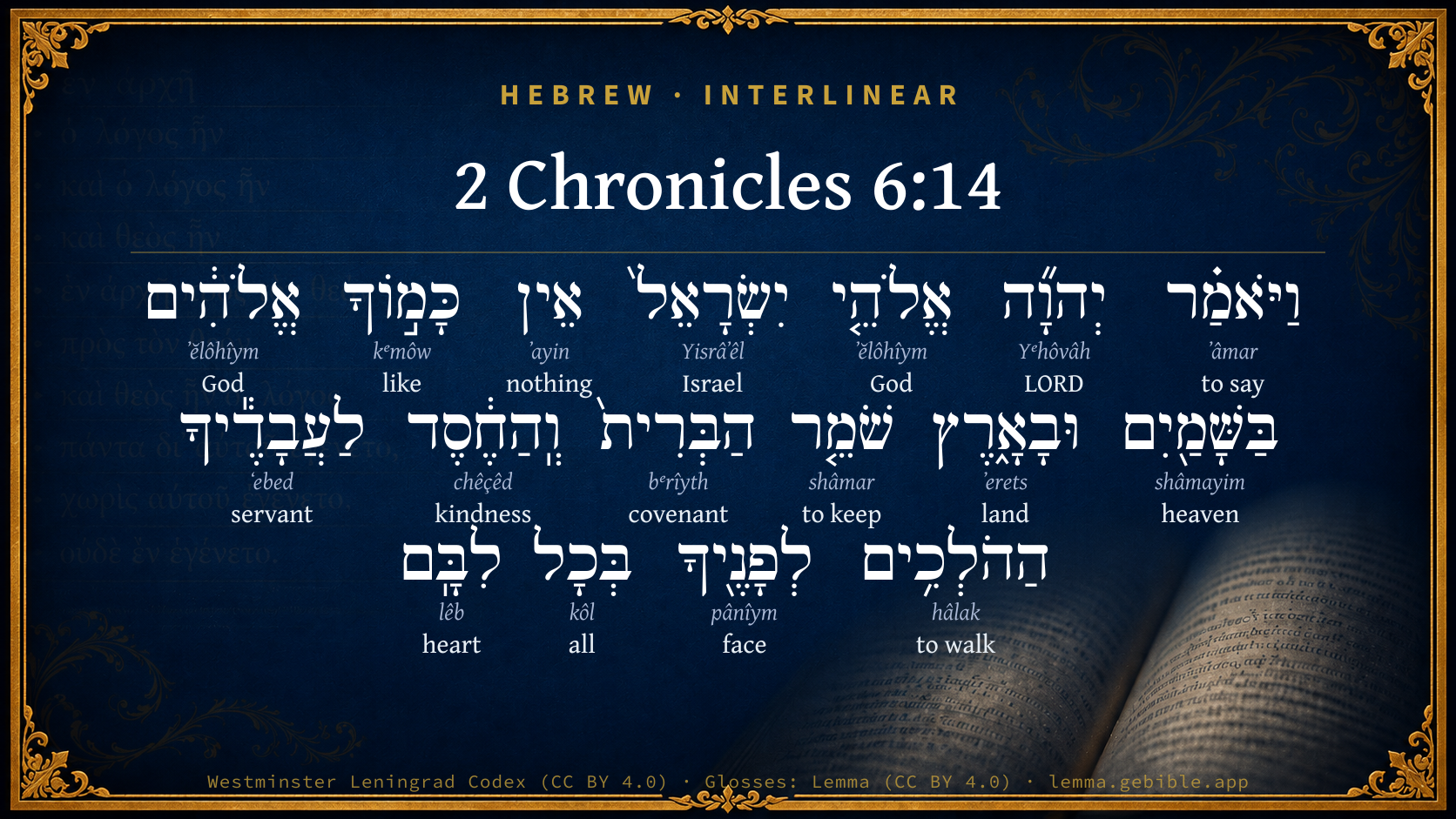
Hebrew (Westminster Leningrad Codex) 2 Chronicles 6:14 appears in the Hebrew Old Testament. The text above is from the Westminster Leningrad Codex. Each word links to its Strong’s number, a concise gloss, and parsing drawn from the Open Scriptures Hebrew Bible morphology. Click any word for its full Brown-Driver-Briggs (BDB) entry.
Download image
Cite this verse

2 Chronicles 6:14 (World English Bible). Public Domain. Lemma interlinear Bible study tool, https://lemma.gebible.app/v/2-chronicles/6/14.

Show BibTeX & RIS
BibTeX
RIS
English Translation
and he said, Yahweh, the God of Israel, there is no God like you, in heaven, or on earth; who keep covenant and loving kindness with your servants, who walk before you with all their heart;
World English Bible · Public Domain
Download a study sheet

One document with this verse’s original text, its word-by-word gloss line, the meaning frame, cross-references with their text, attributed commentary, and full source and license credits — printable, and it pastes into notes with its structure intact.

This verse Autodidact and up

Study sheet (.html) Plain text (.txt)

A passage Seminary Student

Up to 50 verses in one chapter. A passage sheet keeps up to 6 commentary sources and 12 cross-references per verse, in the order this page ranks them, and says so on the sheet whenever that leaves anything out. Ask for a single verse and you get the Autodidact verse sheet above.

Everything on this page stays free to read, with no account — the sheet is a download of what is already on screen, not access to it.

Want to remove ads? Support Godless Engineer
Compare translations 3

The same verse in 3 English versions, stacked beneath the original-language interlinear above. Click any original word for its lexicon entry.

Each is an independent rendering of the whole verse — the interlinear is not word-aligned to these translations.

Highlighted words mark where these versions differ — a whole-verse word diff, not a word-by-word alignment.

  • World English Bible Public Domain
    and he said, Yahweh, the God of Israel, there is no God like you, in heaven, or on earth; who keep covenant and loving kindness with your servants, who walk before you with all their heart;
  • King James Version Public Domain
    And said, O LORD God of Israel, there is no God like thee in the heaven, nor in the earth; which keepest covenant, and showest mercy unto thy servants, that walk before thee with all their hearts:
  • unfoldingWord Literal Text CC BY-SA 4.0
    And he said, “Yahweh, God of Israel, there is not like you a god in the heavens or on the earth, one who keeps the covenant and covenant faithfulness to your servants, walking before you with all their heart;

unfoldingWord Literal Text — © unfoldingWord, licensed CC BY-SA 4.0. Word-aligned USFM3 via Door43 (git.door43.org/unfoldingWord/en_ult).

Versions to compare (up to 4)

3 of 4 selected

Show all 18 translations

Every available English version of this verse, each an independent rendering of the whole verse.

  • World English Bible Public Domain
    and he said, Yahweh, the God of Israel, there is no God like you, in heaven, or on earth; who keep covenant and loving kindness with your servants, who walk before you with all their heart;
  • Berean Standard Bible Public Domain
    and said: “O LORD, God of Israel, there is no God like You in heaven or on earth, keeping Your covenant of loving devotion with Your servants who walk before You with all their hearts.
  • Majority Standard Bible Public Domain
    and said: “O LORD, God of Israel, there is no God like You in heaven or on earth, keeping Your covenant of loving devotion with Your servants who walk before You with all their hearts.
  • King James Version Public Domain
    And said, O LORD God of Israel, there is no God like thee in the heaven, nor in the earth; which keepest covenant, and showest mercy unto thy servants, that walk before thee with all their hearts:
  • American Standard Version (1901) Public Domain
    and he said, O Jehovah, the God of Israel, there is no God like thee, in heaven, or on earth; who keepest covenant and lovingkindness with thy servants, that walk before thee with all their heart;
  • Revised Version (1885) Public Domain
    and he said, O LORD, the God of Israel, there is no God like thee, in the heaven, or in the earth; who keepest covenant and mercy with thy servants, that walk before thee with all their heart:
  • Geneva Bible (1599) Public Domain
    And sayd, O Lord God of Israel, there is no God like thee in heauen nor in earth, which keepest couenant, and mercie vnto thy seruants, that walke before thee with all their heart.
  • Douay-Rheims (1899) Public Domain
    He said: O Lord God of Israel, there is no God like thee in heaven nor in earth: who keepest covenant and mercy with thy servants, that walk before thee with all their hearts:
  • Young's Literal Translation Public Domain
    and saith, `O Jehovah God of Israel, there is not like Thee a god in the heavens and in the earth, keeping the covenant and the kindness for Thy servants who are walking before Thee with all their heart;
  • Literal Standard Version CC BY-SA 4.0
    and says, “O YHWH God of Israel, there is not like You a god in the heavens and in the earth, keeping the covenant and the kindness for Your servants who are walking before You with all their heart;
  • Unlocked Literal Bible CC BY-SA 4.0
    He said, “Yahweh, God of Israel, there is no God like you in the heavens or on the earth, who keeps covenant and steadfast love with your servants who walk before you with all their heart;
  • unfoldingWord Literal Text CC BY-SA 4.0
    And he said, “Yahweh, God of Israel, there is not like you a god in the heavens or on the earth, one who keeps the covenant and covenant faithfulness to your servants, walking before you with all their heart;
  • Darby Bible Public Domain
    and said, Jehovah, God of Israel! there is no God like thee, in the heavens or on the earth, who keepest covenant and mercy with thy servants that walk before thee with all their heart;
  • World Messianic Bible Public Domain
    Then he said, “LORD, the God of Israel, there is no God like you in heaven or on earth—you who keep covenant and loving kindness with your servants who walk before you with all their heart;
  • Webster's Bible Public Domain
    And said, O LORD God of Israel, there is no God like thee in the heaven, nor on the earth; who keepest covenant, and showest mercy to thy servants, that walk before thee with all their hearts:
  • Free Bible Version CC BY-SA 4.0
    He said, “Lord God of Israel, there is no god like you in heaven or on earth, keeping your agreement of trustworthy love with your servants who follow you with complete devotion.
  • Bible in Basic English Public Domain
    And he said, O Lord, the God of Israel, there is no God like you in heaven or on earth; keeping faith and mercy unchanging for your servants, while they go in your ways with all their hearts;
  • JPS Tanakh (1917) Public Domain
    and he said: 'O LORD, the God of Israel, there is no God like Thee, in the heaven, or in the earth; who keepest covenant and mercy with Thy servants, that walk before Thee with all their heart;

Literal Standard Version (2020), Covenant Press — licensed CC BY-SA 4.0. Text via the HelloAO Bible API (eBible.org). Unlocked Literal Bible (unfoldingWord) — licensed CC BY-SA 4.0. Text via the HelloAO Bible API (eBible.org). unfoldingWord Literal Text — © unfoldingWord, licensed CC BY-SA 4.0. Word-aligned USFM3 via Door43 (git.door43.org/unfoldingWord/en_ult). Free Bible Version, Dr. Jonathan Gallagher — licensed CC BY-SA 4.0. Text via the HelloAO Bible API (eBible.org).

Word by word

More ways to search: Search by grammar → Find every occurrence → Compare this word →

Practice this passage: Drill this verse → Learn its vocabulary →

כָּמ֣וֹךָ
kᵉmôw
H3644
“like · you”
Preposition + Suffix, Personal, 2nd Person, Masculine, Singular
Part of Speech
Preposition
Full BDB Definition

Origin: a form of the prefix "k-", but used separately [compare H3651 ]

TWOT: TWOT - 938

like, as, the like of which (adverb) - when, according as, as it were (conjunction)
  1. וַיֹּאמַ֗ר ʼâmar H559 “and · to say” Conjunction + Verb, Qal, Sequential Imperfect, 3rd Person, Masculine, Singular
  2. יְהוָ֞ה Yᵉhôvâh H3068 “LORD” Noun, Proper
  3. אֱלֹהֵ֤י ʼĕlôhîym H430 “God(s) of” Noun, Common, Masculine, Plural, Construct
  4. יִשְׂרָאֵל֙ Yisrâʼêl H3478 “Israel” Noun, Proper
  5. אֵין ʼayin H369 “nothing” Particle, Negative
  6. אֱלֹהִ֔ים ʼĕlôhîym H430 “God(s)” Noun, Common, Masculine, Plural, Absolute
  7. בַּשָּׁמַ֖יִם shâmayim H8064 “in/at the · heaven(s)” Preposition, Determined + Noun, Common, Masculine, Plural, Absolute
  8. וּבָאָ֑רֶץ ʼerets H776 “and · in/at the · land” Conjunction + Preposition, Determined + Noun, Common, Both, Singular, Absolute
  9. שֹׁמֵ֤ר shâmar H8104 “keeping” Verb, Qal, Participle Active, Masculine, Singular, Absolute
  10. הַבְּרִית֙ bᵉrîyth H1285 “the · covenant” Particle, Definite Article + Noun, Common, Feminine, Singular, Absolute
  11. וְֽהַחֶ֔סֶד chêçêd H2617 “and · the · kindness” Conjunction + Particle, Definite Article + Noun, Common, Masculine, Singular, Absolute
  12. לַעֲבָדֶ֕יךָ ʻebed H5650 “to/for · servants · your” Preposition + Noun, Common, Masculine, Plural, Construct + Suffix, Personal, 2nd Person, Masculine, Singular
  13. הַהֹלְכִ֥ים hâlak H1980 “the · walking” Particle, Definite Article + Verb, Qal, Participle Active, Masculine, Plural, Absolute
  14. לְפָנֶ֖יךָ pânîym H6440 “to/for · face(s) · your” Preposition + Noun, Common, Both, Plural, Construct + Suffix, Personal, 2nd Person, Masculine, Singular
  15. בְּכָל kôl H3605 “in/at · all of” Preposition + Noun, Common, Masculine, Singular, Construct
  16. לִבָּֽם lêb H3820 “heart · their” Noun, Common, Masculine, Singular, Construct + Suffix, Personal, 3rd Person, Masculine, Plural

About this verse

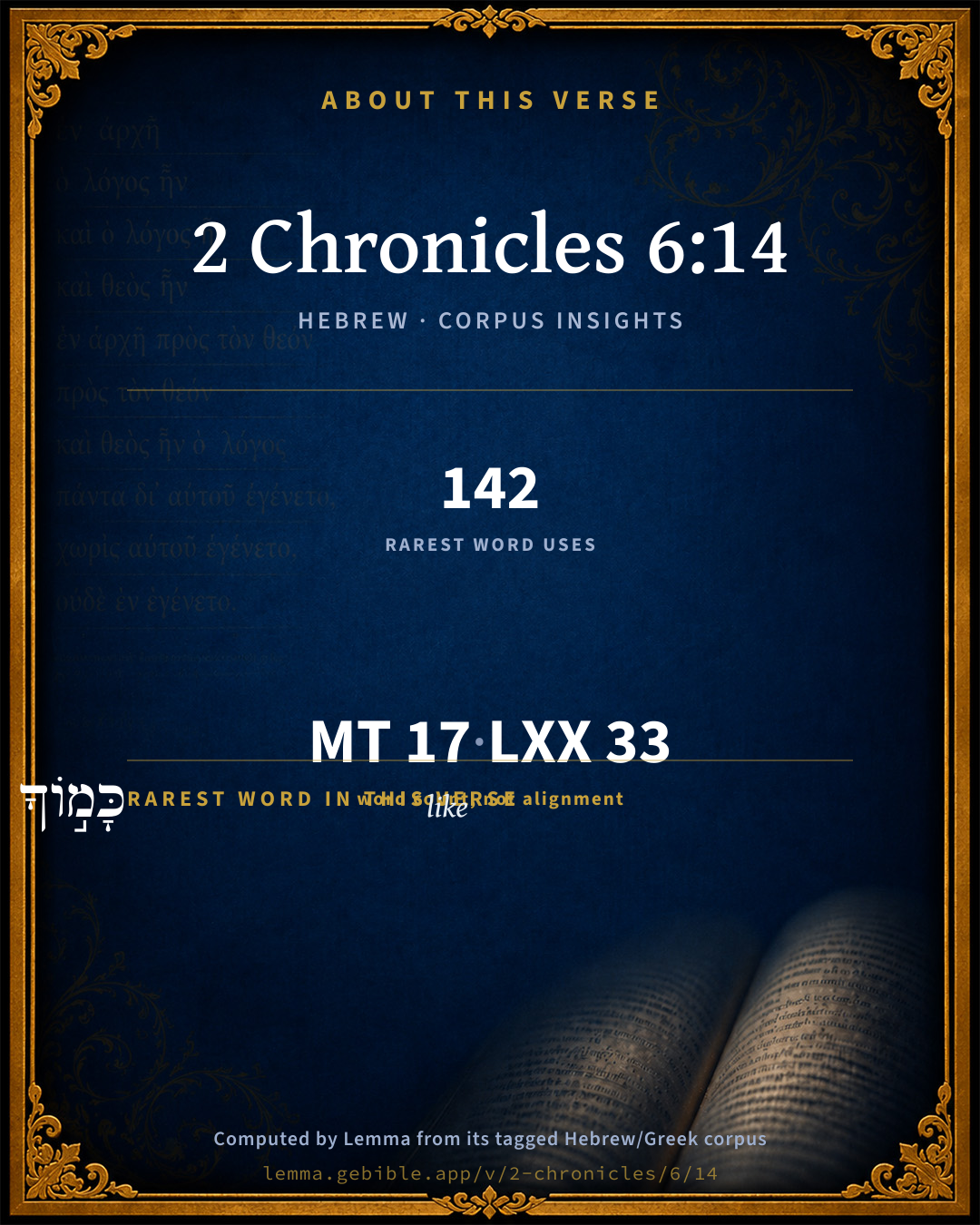
These counts appear in no published source. They are computed here, from the morphology-tagged text and Lemma’s own curated glosses. What Lemma adds →

17
words
16
distinct lemmas
Historical
section

Grammatical profile

  • 3 verbs
  • 12 nouns
  • 1 preposition
  • 1 particle

Verb forms

  • וַיֹּאמַ֗ר Qal · Sequential Imperfect
  • שֹׁמֵ֤ר Qal · Participle Active
  • הַהֹלְכִ֥ים Qal · Participle Active

Repetition

A word recurs within this verse — often emphatic in Hebrew:

  • אֱלֹהֵ֤י God H430 ×2

Hebrew & Septuagint length

In English translation the verse runs 36 words from the Hebrew and 33 from the Septuagint (LXX English) — closely comparable.

A rough comparison of the two English renderings, which tokenize alike — not a word-level alignment.

Word counts can differ between the Hebrew and the Greek without any difference in meaning — e.g. the Hebrew direct-object marker אֵת has no separate Greek word, and Greek often adds the article ὁ.

In the original languages it is 17 Hebrew tokens and 33 Greek tokens — but the two are counted differently (Hebrew bundles its prefixes and suffixes into one token; the Greek is in lemma form), so that isn’t a like-for-like length.

Cross-references

30

Topical passages linked to 2 Chronicles 6:14 in the Treasury of Scripture Knowledge — connected by theme and wording, ordered by reader-vote popularity; previews shown in the World English Bible.

  • Exodus 15:11 Who is like you, Yahweh, among the gods? Who is like you, glorious in holiness, Fearful in praises, doing wonders?
  • Deuteronomy 7:9 Know therefore that Yahweh your God, he is God, the faithful God, who keeps covenant and loving kindness with them who love him and keep his commandments to a thousand generations,
  • Nehemiah 1:5 and said, I beg you, Yahweh, the God of heaven, the great and awesome God, who keeps covenant and loving kindness with those who love him and keep his commandments:
  • Psalms 89:6 For who in the skies can be compared to Yahweh? Who among the sons of the heavenly beings is like Yahweh,
  • Psalms 89:8 Yahweh, God of hosts, who is a mighty one, like you? Yah, your faithfulness is around you.
  • Psalms 89:28 I will keep my loving kindness for him forevermore. My covenant will stand firm with him.
  • Luke 1:54–55 He has given help to Israel, his servant, that he might remember mercy,
  • 1 Thessalonians 2:12 to the end that you should walk worthily of God, who calls you into his own Kingdom and glory.
  • Genesis 5:24 Enoch walked with God, and he was not, for God took him.
  • Genesis 17:1 When Abram was ninety-nine years old, Yahweh appeared to Abram, and said to him, "I am God Almighty. Walk before me, and be blameless.
  • Genesis 33:20 He erected an altar there, and called it El Elohe Israel.
  • Deuteronomy 4:39 Know therefore this day, and lay it to your heart, that Yahweh he is God in heaven above and on the earth beneath; there is none else.
  • 1 Kings 3:6 Solomon said, You have shown to your servant David my father great loving kindness, according as he walked before you in truth, and in righteousness, and in uprightness of heart with you; and you have kept for him this great loving kindness, that you have given him a son to sit on his throne, as it is this day.
  • 1 Kings 6:12 Concerning this house which you are building, if you will walk in my statutes, and execute my ordinances, and keep all my commandments to walk in them; then will I establish my word with you, which I spoke to David your father.
  • 1 Kings 8:23 and he said, Yahweh, the God of Israel, there is no God like you, in heaven above, or on earth beneath; who keep covenant and loving kindness with your servants, who walk before you with all their heart;
  • 1 Kings 18:36 It happened at the time of the offering of the [evening] offering, that Elijah the prophet came near, and said, Yahweh, the God of Abraham, of Isaac, and of Israel, let it be known this day that you are God in Israel, and that I am your servant, and that I have done all these things at your word.
  • 1 Chronicles 29:20 David said to all the assembly, Now bless Yahweh your God. All the assembly blessed Yahweh, the God of their fathers, and bowed down their heads, and worshiped Yahweh, and the king.
  • Jeremiah 10:6 There is none like you, Yahweh; you are great, and your name is great in might.
  • Luke 1:6 They were both righteous before God, walking blamelessly in all the commandments and ordinances of the Lord.
  • Luke 1:50 His mercy is for generations of generations on those who fear him.
  • Micah 7:18–20 Who is a God like you, who pardons iniquity, And passes over the disobedience of the remnant of his heritage? He doesn't retain his anger forever, Because he delights in loving kindness.
  • Genesis 35:10 God said to him, "Your name is Jacob. Your name shall not be Jacob any more, but your name will be Israel." He named him Israel.
  • Exodus 3:15 God said moreover to Moses, "You shall tell the children of Israel this, 'Yahweh, the God of your fathers, the God of Abraham, the God of Isaac, and the God of Jacob, has sent me to you.' This is my name forever, and this is my memorial to all generations.
  • 2 Samuel 7:22 Therefore you are great, Yahweh God: for there is none like you, neither is there any God besides you, according to all that we have heard with our ears.
  • 1 Chronicles 29:10 Therefore David blessed Yahweh before all the assembly; and David said, You are blessed, Yahweh, the God of Israel our father, forever and ever.
  • Psalms 86:8 There is no one like you among the gods, Lord, Nor any deeds like your deeds.
  • Psalms 103:17–18 But Yahweh's loving kindness is from everlasting to everlasting with those who fear him, His righteousness to children's children;
  • Jeremiah 10:16 The portion of Jacob is not like these; for he is the former of all things; and Israel is the tribe of his inheritance: Yahweh of Hosts is his name.
  • Daniel 9:4 I prayed to Yahweh my God, and made confession, and said, Oh, Lord, the great and dreadful God, who keeps covenant and loving kindness with those who love him and keep his commandments,
  • Luke 1:72 To show mercy towards our fathers, To remember his holy covenant,

Cross-references courtesy of OpenBible.info (CC BY 4.0).

Hebrew and Greek witnesses Masoretic Hebrew ↔ Greek Septuagint

The same verse in the two great witnesses to the Old Testament, shown verse-for-verse.

These are two independent witnesses, not word-aligned to each other, and the Septuagint is shown in lemma (dictionary) form.

Hebrew 2 Chronicles 6:14 Masoretic · Westminster Leningrad Codex

וַיֹּאמַ֗ר יְהוָ֞ה אֱלֹהֵ֤י יִשְׂרָאֵל֙ אֵין כָּמ֣וֹךָ אֱלֹהִ֔ים בַּשָּׁמַ֖יִם וּבָאָ֑רֶץ שֹׁמֵ֤ר הַבְּרִית֙ וְֽהַחֶ֔סֶד לַעֲבָדֶ֕יךָ הַהֹלְכִ֥ים לְפָנֶ֖יךָ בְּכָל לִבָּֽם

and he said, Yahweh, the God of Israel, there is no God like you, in heaven, or on earth; who keep covenant and loving kindness with your servants, who walk before you with all their heart;

World English Bible · Public Domain

Greek LXX 2 Chronicles 6:14 Septuagint · lemma form

καί εἶπον κύριος ὁ θεός ἰσραήλ οὐ εἰμί ὅμοιος σύ θεός ἐν οὐρανός καί ἐπί ὁ γῆ φυλάσσω ὁ διαθήκη καί ὁ ἔλεος ὁ παῖς σύ ὁ πορεύομαι ἐναντίον σύ ἐν ὅλος καρδία

and said, Lord God of Israel, there is no God like you in heaven, or on the earth; keeping covenant and mercy with your servants that walk before you with their whole heart.

LXX2012 (modern English Septuagint) · Public Domain

Hebrew: Westminster Leningrad Codex (CC BY 4.0). Greek: Septuagint (public domain); English from LXX2012 (modern English Septuagint) (Public Domain). How the Septuagint differs from the Hebrew →

Commentary

Notes on 2 Chronicles 6:14 from classic Christian and Jewish commentators (each source and its license shown beneath its notes). The classic Christian expositions comment on the surrounding passage and are grouped to its opening verse, so a note may address several verses; the Jewish commentaries on the Tanakh (Rashi and others) are per-verse, so they appear only where the commentator wrote on this verse.

Lemma curates 59 commentaries, every one of them public domain or Creative Commons licensed, each selected and text-cleaned for this edition rather than reprinted as found. About our sources →

Joseph Benson's Commentary

2Ch 6:14. O Lord God of Israel, &c. — Solomon, in the foregoing verses, had signed and sealed, so to speak, the deed of dedication, by which the temple was appropriated to the honour and service of God. Now here in the prayer by which it was, as it were, consecrated, it is made a figure of Christ, the great Mediator, through whom we are to offer up all our prayers, and to expect all God’s favours, and to whom we are to have an eye in every thing wherein we have to do with God.

Joseph Benson's Commentary on the Old and New Testaments (1811–1818) — public domain. Text from a community e-Sword module.

Adam Clarke's Commentary

Verse 14. That walk before thee with all their hearts] "With all the will of their souls and with all the affection of their hearts."-Targum.

Adam Clarke's Commentary on the Bible (1810–1826) — public domain. Text from a community e-Sword/MySword module.

Ellicott's Commentary for English Readers

(14) In the heaven nor in the earth.—Abridged from “in the heaven above, and upon the earth beneath” (Kings). Syriac, “Thou art the Lord that sittest in heaven above, and Thy will (pl.) is done on earth beneath;” apparently a curious reminiscence of the Lord’s Prayer. The Assyrians also spoke of their gods as “without an equal” (sânina la isû, “a rival he has not”).

Which keepest covenant and shewest mercy.—Literally, keeping the covenant and the mercy; i.e., the covenanted mercy. (Comp. Isa_55:3.)

With thy servant.—Heb., for; so in 2Ch_6:16. (The verse is word for word as in Kings.)

And spakest with thy mouth. . . .—2Ch_6:4.

A Bible Commentary for English Readers, edited by Charles John Ellicott (1878–1897) — public domain. Text from a community e-Sword module.

The Cambridge Bible for Schools and Colleges

gen. ed. J. J. S. Perowne

14. which keepest covenant and shewest mercy] R.V. who keepest covenant and mercy (so 1 Kings).

The Cambridge Bible for Schools and Colleges (gen. ed. J. J. S. Perowne; Cambridge University Press, 1878–1918) — public domain. Text from a community e-Sword module.

Haydock's Catholic Bible Commentary

CHAPTER VI.

George Leo Haydock (1774–1849), Haydock's Catholic Family Bible and Commentary, 1859 edition — public domain. Excludes Psalms (Douay-Rheims chapter numbering differs from Protestant) and Deuterocanonical books (Catholic canon only).

The Pulpit Commentary

No God like thee, etc. The quoting of Scripture and the utilizing of language in which the religious feeling of those who have gone before has expressed itself had plainly set in Exo_15:11, Exo_15:12; Deu_7:9) The prayer which this verso opens occupies twenty-eight verses; it is the longest prayer recorded in Scripture. It consists of two verses (14, 15) of opening; then follow three petitions first, that God would perpetuate the line of David (ver. 16); next, that he would have regard to the place where his Name is put (vers. 17-20); and thirdly, that he would hear the prayers addressed to him toward this place (ver. 21). Of this last subject, seven different cases are propounded firstly, the case of the man wronged by his neighbour (vers. 22, 23); secondly, of the people worsted by their enemies (vers. 24, 25); thirdly, of the people suffering from drought (vers. 26, 27); fourthly, of the people visited by death or special calamity (vers. 28-31); fifthly, of the stranger who comes to offer to pray (vers 32, 33); sixthly, of the people going to war by God"s permission (vers. 34, 35); seventhly, of the people in captivity (vers. 36-39). Then the prayer closes in vers. 40-42.

The Pulpit Commentary (1880–1919), ed. H.D.M. Spence-Jones & Joseph S. Exell — public domain. Text from a community e-Sword module.

John Wesley's Explanatory Notes

O Lord, &c. - By this prayer the temple of Solomon is made a figure of Christ, the great Mediator thro' whom we are to offer up all our prayers, and to expect all God's favours, and to whom we are to have an eye in everything wherein we have to do with God.

John Wesley, Explanatory Notes Upon the Whole Bible (1754–1765) — public domain. Text via the GEBible commentary corpus.

unfoldingWord translationNotes

Door43 World Missions Community

on the earth, who keeps covenant and steadfast love with your servants

This can be stated as a new sentence. AT: "on the earth. You keep your promise to love your servants" or "on the earth. You faithfully love your servants"

walk before you with all their heart

The way a person lives is spoken of as if that person were walking on a path. AT: "live wholeheartedly the way that you want them to" (See: Metaphor)

you who have kept with your servant David my father, what you promised him

"you who have kept your promise to your servant David my father." To keep a promise is an idiom that means to do what one has promised. AT: "you who have done what you promised your servant David my father" (See: Idiom)

you spoke with your mouth

The phrase "with your mouth" may emphasize that God himself spoke. It was not someone else who made the promise. AT: "you yourself spoke"

and have fulfilled it with your hand

The hand is a metonym for the power of the hand. AT: "and, by your power, have fulfilled what you said" or "and by your power have done what you said" (See: Metonymy)

as it is today

This refers to the day when Solomon was saying this prayer.

translationWords

God

earth

covenant faithfulness

servant

walk

heart

unfoldingWord translationNotes — © Distant Shores Media and the Door43 World Missions Community, licensed CC BY-SA 4.0. Source: git.door43.org/Door43/en_tn.

Rashi

Rabbi Shlomo Yitzchaki (Rashi)

there is no God like You insofar as You keep the covenant and the kindness that You decree from heaven to give to those who love You. You hide and conceal the covenant and the kindness to fulfill Your promise on earth.

who walk before You as my father David walked, and this is [the meaning of] For You have kept for Your servant David with an expression referring to the realization of a promise.

Rashi on the Tanakh — English translations: “The Judaica Press complete Tanach with Rashi, translated by A. J. Rosenberg” (CC BY 4.0); “Pentateuch with Rashi's commentary by M. Rosenbaum and A.M. Silbermann, 1929-1934” (public domain); “The Metsudah Tanach series, Lakewood, N.J” (CC BY 4.0); and “The Book of Joshua, Metsudah Publications, 1997” (CC BY 4.0). Text via Sefaria.

Lesson kit

Teaching starters — assembled from the data on this page, not authored interpretation. Every prompt links to the verse data it draws on. Edit before teaching.

2 Chronicles, in the Historical, opens this verse with 17 words (16 distinct Hebrew lemmas). Its most distinctive word is kᵉmôw (“like”). A historical commentator’s framing appears above. Read the whole chapter for the surrounding context.

Discussion questions

  1. The word kᵉmôw carries the sense “like.” How does it shape the verse?
  2. How does Exodus 15:11, which shares this passage’s theme, read alongside this verse?
  3. What does the repetition of “God” (2× in this one verse) do in this verse?
  4. These translations render this verse differently; the difference is in the English rendering, not the original. What questions does that raise?
  5. «וַיֹּאמַ֗ר» is a Qal Sequential Imperfect verb. How does that grammatical form shape the action described?
  6. Compare how Joseph Benson's Commentary and Adam Clarke's Commentary read this verse. Where do they agree or differ?

Things to notice

Reading settings

Reading text

Shown beneath each verse's original-language words.

Old Testament
Old Testament edition

Read the OT as the Masoretic Hebrew (MT) or the Greek Septuagint (LXX).

English shown for the Greek Septuagint (in the Hebrew ↔ Greek comparison).

Comparing translations? Open the Compare panel on any verse page to stack up to four side by side.