
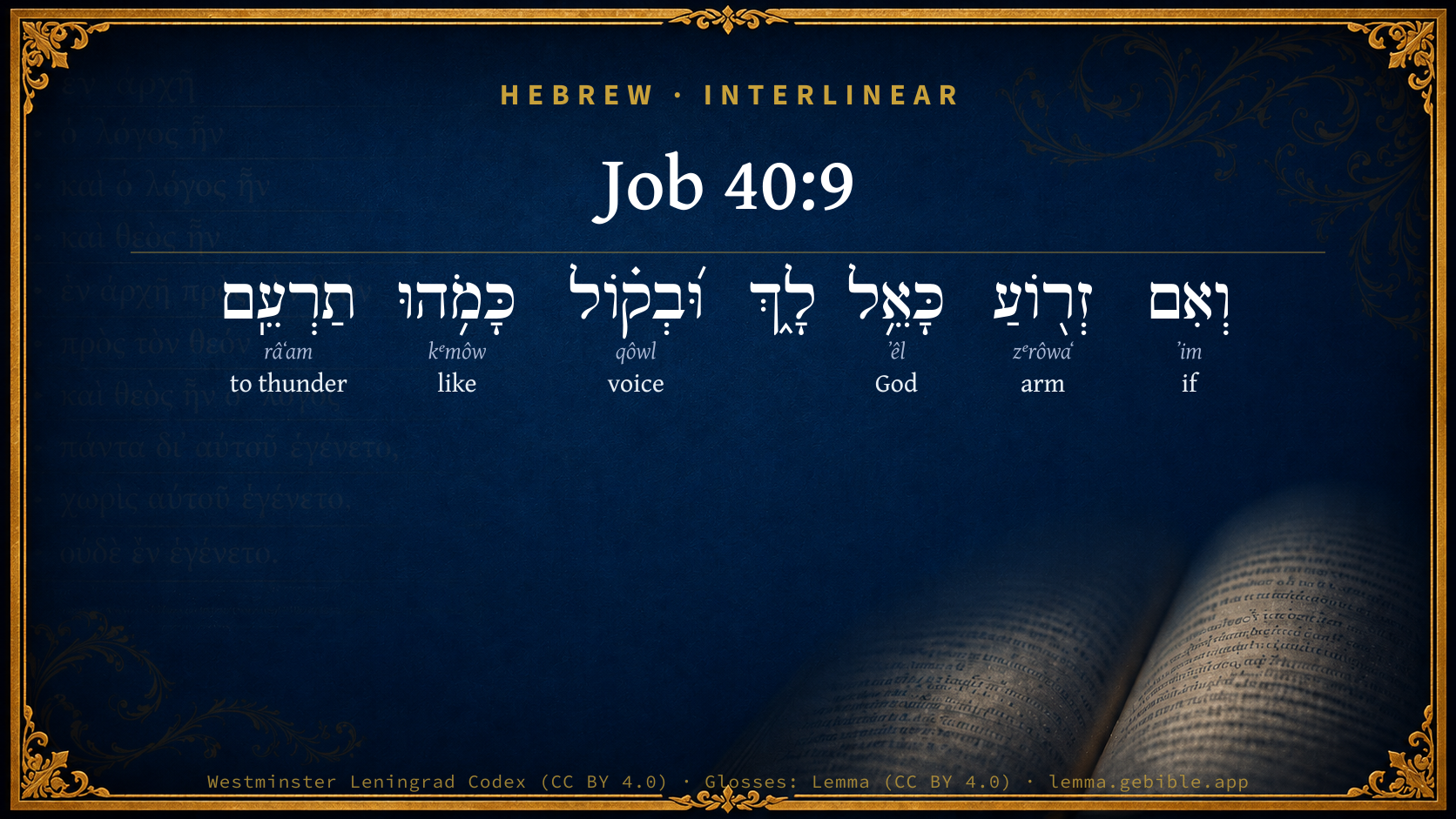
Job 40:9

Hebrew (Westminster Leningrad Codex) Job 40:9 appears in the Hebrew Old Testament. The text above is from the Westminster Leningrad Codex. Each word links to its Strong’s number, a concise gloss, and parsing drawn from the Open Scriptures Hebrew Bible morphology. Click any word for its full Brown-Driver-Briggs (BDB) entry.
Download image
Cite this verse

Job 40:9 (World English Bible). Public Domain. Lemma interlinear Bible study tool, https://lemma.gebible.app/v/job/40/9.

Show BibTeX & RIS
BibTeX
RIS
English Translation
Or have you an arm like God? Can you thunder with a voice like him?
World English Bible · Public Domain
Download a study sheet

One document with this verse’s original text, its word-by-word gloss line, the meaning frame, cross-references with their text, attributed commentary, and full source and license credits — printable, and it pastes into notes with its structure intact.

This verse Autodidact and up

Study sheet (.html) Plain text (.txt)

A passage Seminary Student

Up to 50 verses in one chapter. A passage sheet keeps up to 6 commentary sources and 12 cross-references per verse, in the order this page ranks them, and says so on the sheet whenever that leaves anything out. Ask for a single verse and you get the Autodidact verse sheet above.

Everything on this page stays free to read, with no account — the sheet is a download of what is already on screen, not access to it.

Want to remove ads? Support Godless Engineer
Compare translations 3

The same verse in 3 English versions, stacked beneath the original-language interlinear above. Click any original word for its lexicon entry.

Each is an independent rendering of the whole verse — the interlinear is not word-aligned to these translations.

Highlighted words mark where these versions differ — a whole-verse word diff, not a word-by-word alignment.

  • World English Bible Public Domain
    Or have you an arm like God? Can you thunder with a voice like him?
  • King James Version Public Domain
    Hast thou an arm like God? or canst thou thunder with a voice like him?
  • unfoldingWord Literal Text CC BY-SA 4.0
    Or if like God an arm to you? Or like him will you thunder with a voice?

unfoldingWord Literal Text — © unfoldingWord, licensed CC BY-SA 4.0. Word-aligned USFM3 via Door43 (git.door43.org/unfoldingWord/en_ult).

Versions to compare (up to 4)

3 of 4 selected

Show all 18 translations

Every available English version of this verse, each an independent rendering of the whole verse.

  • World English Bible Public Domain
    Or have you an arm like God? Can you thunder with a voice like him?
  • Berean Standard Bible Public Domain
    Do you have an arm like God’s? Can you thunder with a voice like His?
  • Majority Standard Bible Public Domain
    Do you have an arm like God’s? Can you thunder with a voice like His?
  • King James Version Public Domain
    Hast thou an arm like God? or canst thou thunder with a voice like him?
  • American Standard Version (1901) Public Domain
    Or hast thou an arm like God? And canst thou thunder with a voice like him?
  • Revised Version (1885) Public Domain
    Or hast thou an arm like God? and canst thou thunder with a voice like him?
  • Geneva Bible (1599) Public Domain
    Then will I confesse vnto thee also, that thy right hand can saue thee.
  • Douay-Rheims (1899) Public Domain
    Then I will confess that thy right hand is able to save thee.
  • Young's Literal Translation Public Domain
    And an arm like God hast thou? And with a voice like Him dost thou thunder?
  • Literal Standard Version CC BY-SA 4.0
    And do you have an arm like God? And do you thunder with a voice like His?
  • Unlocked Literal Bible CC BY-SA 4.0
    Do you have an arm like God's? Can you thunder with a voice like him?
  • unfoldingWord Literal Text CC BY-SA 4.0
    Or if like God an arm to you? Or like him will you thunder with a voice?
  • Darby Bible Public Domain
    Hast thou an arm like ùGod? or canst thou thunder with a voice like him?
  • World Messianic Bible Public Domain
    Or do you have an arm like God? Can you thunder with a voice like him?
  • Webster's Bible Public Domain
    \\40:14\\Then will I also confess to thee that thy own right hand can save thee.
  • Free Bible Version CC BY-SA 4.0
    Are you as powerful as I am? Does your voice thunder like mine?
  • Bible in Basic English Public Domain
    Then I will give praise to you, saying that your right hand is able to give you salvation.
  • JPS Tanakh (1917) Public Domain
    Or hast thou an arm like God? And canst thou thunder with a voice like Him?

Literal Standard Version (2020), Covenant Press — licensed CC BY-SA 4.0. Text via the HelloAO Bible API (eBible.org). Unlocked Literal Bible (unfoldingWord) — licensed CC BY-SA 4.0. Text via the HelloAO Bible API (eBible.org). unfoldingWord Literal Text — © unfoldingWord, licensed CC BY-SA 4.0. Word-aligned USFM3 via Door43 (git.door43.org/unfoldingWord/en_ult). Free Bible Version, Dr. Jonathan Gallagher — licensed CC BY-SA 4.0. Text via the HelloAO Bible API (eBible.org).

Word by word

More ways to search: Search by grammar → Find every occurrence → Compare this word →

Practice this passage: Drill this verse → Learn its vocabulary →

About this verse

These counts appear in no published source. They are computed here, from the morphology-tagged text and Lemma’s own curated glosses. What Lemma adds →

7
words
6
distinct lemmas
Wisdom
section

Notable vocabulary

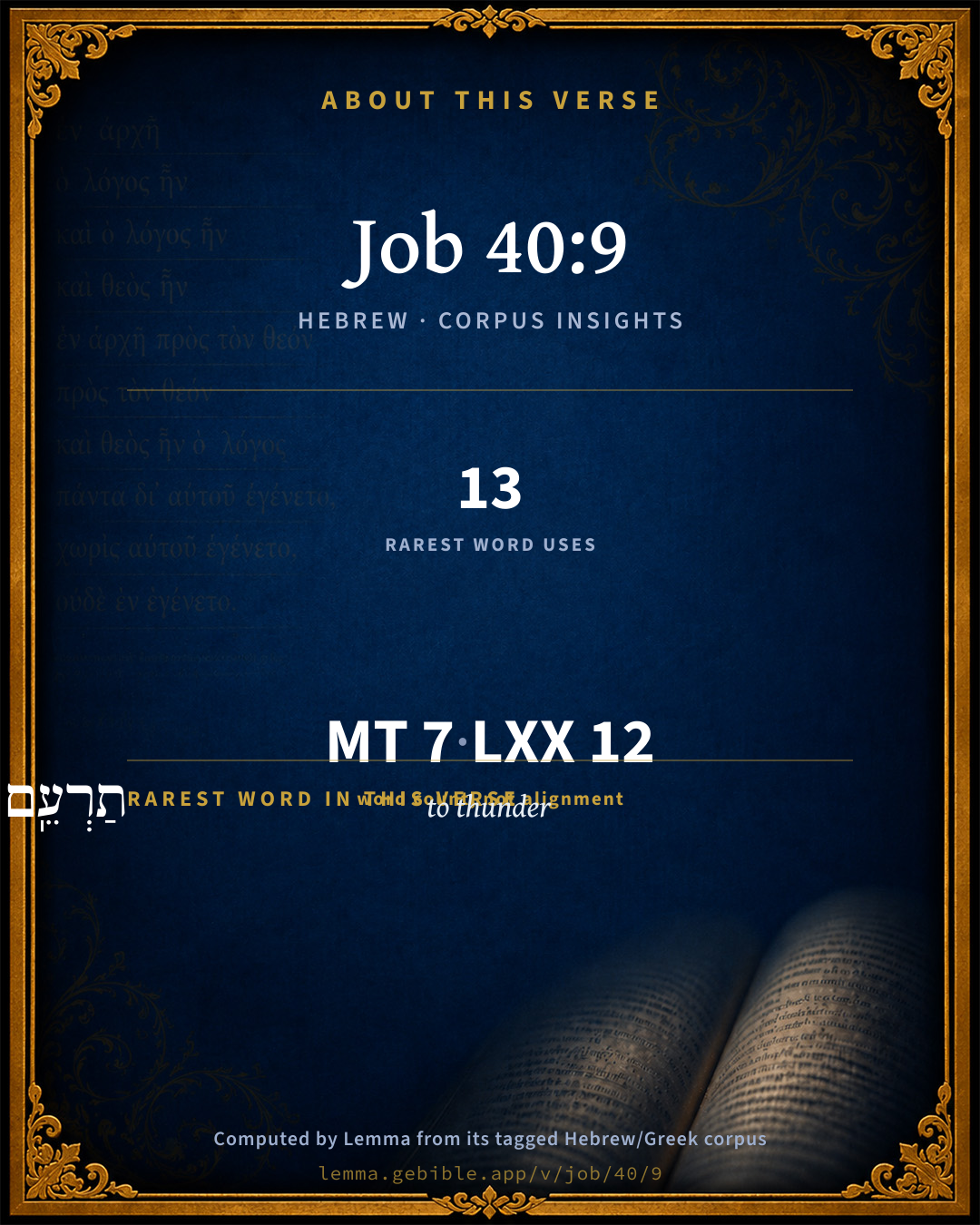
The rarest word here is תַרְעֵֽם to thunder H7481 — appearing just 13 times in the whole Hebrew Bible.

Shared distinctive vocabulary

תַרְעֵֽם to thunder H7481 occurs in 13 verses of the Hebrew Bible. Also found in:

Grammatical profile

  • 1 verb
  • 3 nouns
  • 2 prepositions
  • 1 conjunction

Verb forms

  • תַרְעֵֽם Hiphil · Imperfect

Hebrew & Septuagint length

In English translation the verse runs 15 words from the Hebrew and 11 from the Septuagint (LXX English) — closely comparable.

A rough comparison of the two English renderings, which tokenize alike — not a word-level alignment.

Word counts can differ between the Hebrew and the Greek without any difference in meaning — e.g. the Hebrew direct-object marker אֵת has no separate Greek word, and Greek often adds the article ὁ.

In the original languages it is 7 Hebrew tokens and 12 Greek tokens — but the two are counted differently (Hebrew bundles its prefixes and suffixes into one token; the Greek is in lemma form), so that isn’t a like-for-like length.

Cross-references

11

Topical passages linked to Job 40:9 in the Treasury of Scripture Knowledge — connected by theme and wording, ordered by reader-vote popularity; previews shown in the World English Bible.

  • Job 37:4–5 After it a voice roars. He thunders with the voice of his majesty; He doesn't hold back anything when his voice is heard.
  • Psalms 89:13 You have a mighty arm. Your hand is strong, and your right hand is exalted.
  • Exodus 15:6 Your right hand, Yahweh, is glorious in power, Your right hand, Yahweh, dashes the enemy in pieces.
  • Job 9:4 God who is wise in heart, and mighty in strength: Who has hardened himself against him, and prospered?
  • Job 23:6 Would he contend with me in the greatness of his power? No, but he would listen to me.
  • Job 33:12–13 "Behold, I will answer you. In this you are not just; For God is greater than man.
  • Psalms 29:3 Yahweh's voice is on the waters. The God of glory thunders, even Yahweh on many waters.
  • Psalms 39:3–9 My heart was hot within me. While I meditated, the fire burned: I spoke with my tongue:
  • Psalms 89:10 You have broken Rahab in pieces, like one of the slain. You have scattered your enemies with your mighty arm.
  • Isaiah 45:9 Woe to him who strives with his Maker--a potsherd among the potsherds of the earth! Shall the clay ask him who fashions it, "What are you making?" or your work, "He has no hands?"
  • 1 Corinthians 10:22 Or do we provoke the Lord to jealousy? Are we stronger than he?

Cross-references courtesy of OpenBible.info (CC BY 4.0).

Hebrew and Greek witnesses Masoretic Hebrew ↔ Greek Septuagint

The same verse in the two great witnesses to the Old Testament, shown verse-for-verse.

These are two independent witnesses, not word-aligned to each other, and the Septuagint is shown in lemma (dictionary) form.

Hebrew Job 40:9 Masoretic · Westminster Leningrad Codex

וְאִם זְר֖וֹעַ כָּאֵ֥ל לָ֑ךְ וּ֝בְק֗וֹל כָּמֹ֥הוּ תַרְעֵֽם

Or have you an arm like God? Can you thunder with a voice like him?

World English Bible · Public Domain

Greek LXX Job 40:9 Septuagint · lemma form

ἦ βραχίων σύ εἰμί κατά ὁ κύριος ἤ φωνή κατά αὐτός βροντάω

Then will I confess that your right hand can save you.

LXX2012 (modern English Septuagint) · Public Domain

Hebrew: Westminster Leningrad Codex (CC BY 4.0). Greek: Septuagint (public domain); English from LXX2012 (modern English Septuagint) (Public Domain). How the Septuagint differs from the Hebrew →

Commentary

Notes on Job 40:9 from classic Christian and Jewish commentators (each source and its license shown beneath its notes). The classic Christian expositions comment on the surrounding passage and are grouped to its opening verse, so a note may address several verses; the Jewish commentaries on the Tanakh (Rashi and others) are per-verse, so they appear only where the commentator wrote on this verse.

Lemma curates 59 commentaries, every one of them public domain or Creative Commons licensed, each selected and text-cleaned for this edition rather than reprinted as found. About our sources →

Trapp's Complete Commentary

John Trapp

Job 40:9 Hast thou an arm like God? or canst thou thunder with a voice like him?

Ver. 9. Hast thou an arm like God?] That thou shouldest wrestle a fall with him, and hope to overmatch him? "Thou hast a mighty arm," saith David: "strong is thy hand, and high is thy right hand," Psa 89:13. It spans the heavens, and holds the earth in the hollow of it. The weight of it broke the angels’ backs; and the terror of it may be seen in all those writs of execution recorded in the Scriptures. Oh, it is a fearful thing, saith the apostle, to fall into the (punishing) hands of the living God! Heb 10:31

Or canst thou thunder with a voice like him?] Of Pericles, the orator, it is said, that when he declaimed, Intonabat., fulgurabat, totam Graeciam commiscebat, &c., he thundered, he lightened, he mingled all Greece together (Cicero). And Livy, speaking of a certain Roman commander, saith, Haec cum intonuisset iracundus, &c., These things, when he had thundered out angrily, and with a courage, the people departed of their own accord. Alexander the Great, being once vexed at his soldiers for mutining and tumultuating, thunder-struck them with these words, Facessite hine ocyus, neminem teneo; liberate occulos meos ingratissimi milites, Get you quickly out of my presence, and be packing hence, ye ungrateful soldiers. And Severus, the emperor, in like sort dealt with his unruly army, Discedite Quirites, said he, et incertum an Quirites. These were terrible hard words, and very resolutely uttered: but what is any or all of this to the voice of God’s thunder, whereof see before? Knowest thou not, O Job, that thine arm is an arm of flesh? and thy voice so small and low that a fly would not be frighted at it?

John Trapp, A Commentary or Exposition upon All the Books of the Old and New Testament (1647–1656) — public domain. Text from a community e-Sword module.

Joseph Benson's Commentary

Job 40:9. Hast thou an arm like God? — Hast thou, a poor, weak worm of the earth, an arm comparable to his, who upholdeth all things? The power of creatures, even of angels themselves, is derived from God, limited by him, dependant on him; but the power of God is original, independent, and unlimited: he can do every thing without us; we can do nothing without him; and therefore we have not an arm like God. The meaning is, Thou art infinitely short of God in power, and therefore in justice: for all his perfections are equal and infinite. Injustice is much more likely to be in thee, an impotent creature, than in the Almighty God; see on Job 40:2. Canst thou thunder with a voice like him? — No: his voice will soon drown thine; and one of his mighty thunders will overpower and overrule thy weak speeches. Therefore do not presume to contend with him.

Joseph Benson's Commentary on the Old and New Testaments (1811–1818) — public domain. Text from a community e-Sword module.

Geneva Bible (1599)

Geneva Bible translators

Proving hereby that whosoever attributeth to himself power and ability to save himself, maketh himself God.

Geneva Bible (1599) marginal notes — public domain. Text via Bolls.life.

Jamieson, Fausset & Brown

Robert Jamieson, A. R. Fausset & David Brown

arm--God's omnipotence (Isa 53:1).

thunder--God's voice (Job 37:4).

Jamieson, Fausset & Brown — Commentary Critical and Explanatory on the Whole Bible (1871) — public domain (CC PDM 1.0). Text via the HelloAO Bible API.

Adam Clarke's Commentary

Verse 9. Hast thou an arm like God?] Every word, from this to the end of Job 40:14, has a wonderful tendency to humble the soul; and it is no wonder that at the conclusion of these sayings Job fell in the dust confounded, and ascribed righteousness to his Maker.

Adam Clarke's Commentary on the Bible (1810–1826) — public domain. Text from a community e-Sword/MySword module.

The Cambridge Bible for Schools and Colleges

gen. ed. J. J. S. Perowne

9–14. As Job questions the manner of the Almighty’s rule of the world, God invites him to deck himself with the thunder and majesty of the supreme ruler, and himself undertake the government of the world; and in the execution of this government to bring low all that is proud (comp. Isa_2:12 seq.), to subdue and keep down the forces of evil, and hide the faces of the wicked in darkness.

Under this ironical invitation to Job there lie two general thoughts, first, that omnipotence is necessary in the ruler of all; and second, that rule of the world consists in keeping in check the forces of evil. This is the idea under which rule of the world is conceived; in other words it is regarded as necessarily moral; and it is assumed that God’s rule is in fact a rule of this kind. In his present frame of mind Job probably would not now contest this. But if God’s rule be moral on the whole, it must be so in every particular; real exceptions are inconceivable, however like exceptions many things may appear.

The Cambridge Bible for Schools and Colleges (gen. ed. J. J. S. Perowne; Cambridge University Press, 1878–1918) — public domain. Text from a community e-Sword module.

John Gill's Exposition

Hast thou an arm like God?.... Such power as he has, which is infinite, almighty, and uncontrollable, and therefore there is no contending with him; as he has an arm on which good men may lean on and trust in, and by which they are supported, protected, and saved, so he has an arm to crush like a moth all that strive with him or against him;

or canst thou thunder with a voice like him? thunder is his voice; see Job 37:4, &c. and is expressive of his power, Job 26:14; and his powerful voice may be observed in calling all things out of nothing into being in creation; in commanding and ordering all things in providence according to his pleasure; and in quickening sinners through his Gospel, by his Spirit and grace in conversion, and will be in calling men out of their graves and summoning them to judgment at the last day. God can both overpower and out voice men, and therefore it is in vain to oppose him and contend with him.

John Gill's Exposition of the Whole Bible (1746–1763) — public domain (CC PDM 1.0). Text via the HelloAO Bible API.

Albert Barnes' Notes on the Bible

Hast thou an arm like God? - The arm is the symbol of strength. The question here is, whether Job would venture to compare his strength with the omnipotence of God?

Or canst thou thunder with a voice like him? - Thunder is a symbol of the majesty of the Most High, and is often spoken of as the voice of God; see Psa 29:1-11. The question here is, whether Job could presume to compare himself with the Almighty, whose voice was the thunder?

Albert Barnes' Notes on the Bible (1834–1885) — public domain. Text from a community e-Sword/MySword module.

Matthew Poole's English Annotations

Thou art infinitely short of God in power, and therefore in justice; for all his perfections are equal and infinite. Injustice is much more likely to be in thee, an impotent creature, than in the Almighty God; of which See Poole "Job 40:2".

Canst thou thunder with a voice like him? therefore do not presume to contend with him.

Matthew Poole's English Annotations on the Holy Bible (1683–1685) — public domain. Text from a community e-Sword/MySword module.

Whedon's Commentary on the Bible

Daniel D. Whedon

9. An arm like God — The arm of the Lord is the symbol of omnipotence, as in Isa_51:9, in which, in sublime strains, Jehovah is represented as personifying his own omnipotence.

Daniel D. Whedon (gen. ed.), Commentary on the Old and New Testaments (1874–1909) — public domain. Text from a community e-Sword module.

The Pulpit Commentary

Hast thou an arm like God? The might of God"s arm is often dwelt upon in Scripture. He brought Israel out of Egypt," with a mighty hand and stretched-out arm". (Deu_5:15 Deu_7:19, etc.) "Thou hast a mighty arm: strong is thy hand, and high is thy right hand," says one of the psalmists. (Psa_89:13) "Awake, awake, put on strength, O arm of the Lord!" says Isaiah. (Isa_51:9) No human strength, not the strength of all men put together, can compare with it. Or canst thou thunder with a voice like him? (comp. Job_38:34, Job_38:35; and for the idea of thunder being the actual "voice of God," see Job_37:4, 5 Psa_68:33 Psa_77:18, etc.)

The Pulpit Commentary (1880–1919), ed. H.D.M. Spence-Jones & Joseph S. Exell — public domain. Text from a community e-Sword module.

Lesson kit

Teaching starters — assembled from the data on this page, not authored interpretation. Every prompt links to the verse data it draws on. Edit before teaching.

Job, in the Wisdom, opens this verse with 7 words (6 distinct Hebrew lemmas). Its most distinctive word is râʻam (“to thunder”). A historical commentator’s framing appears above. Read the whole chapter for the surrounding context.

Discussion questions

  1. The word râʻam carries the sense “to thunder.” How does it shape the verse?
  2. 1 Samuel 1:6 shares the word «to thunder» with this verse. How do the two illuminate each other?
  3. These translations render this verse differently. What is at stake in choosing one wording over another?
  4. The verb «תַרְעֵֽם» is Hiphil Imperfect. How does its form color the action?
  5. Reading how Trapp's Complete Commentary and Joseph Benson's Commentary read this verse, where do the two commentators agree and where do they part?

Things to notice

Reading settings

Reading text

Shown beneath each verse's original-language words.

Old Testament
Old Testament edition

Read the OT as the Masoretic Hebrew (MT) or the Greek Septuagint (LXX).

English shown for the Greek Septuagint (in the Hebrew ↔ Greek comparison).

Comparing translations? Open the Compare panel on any verse page to stack up to four side by side.