

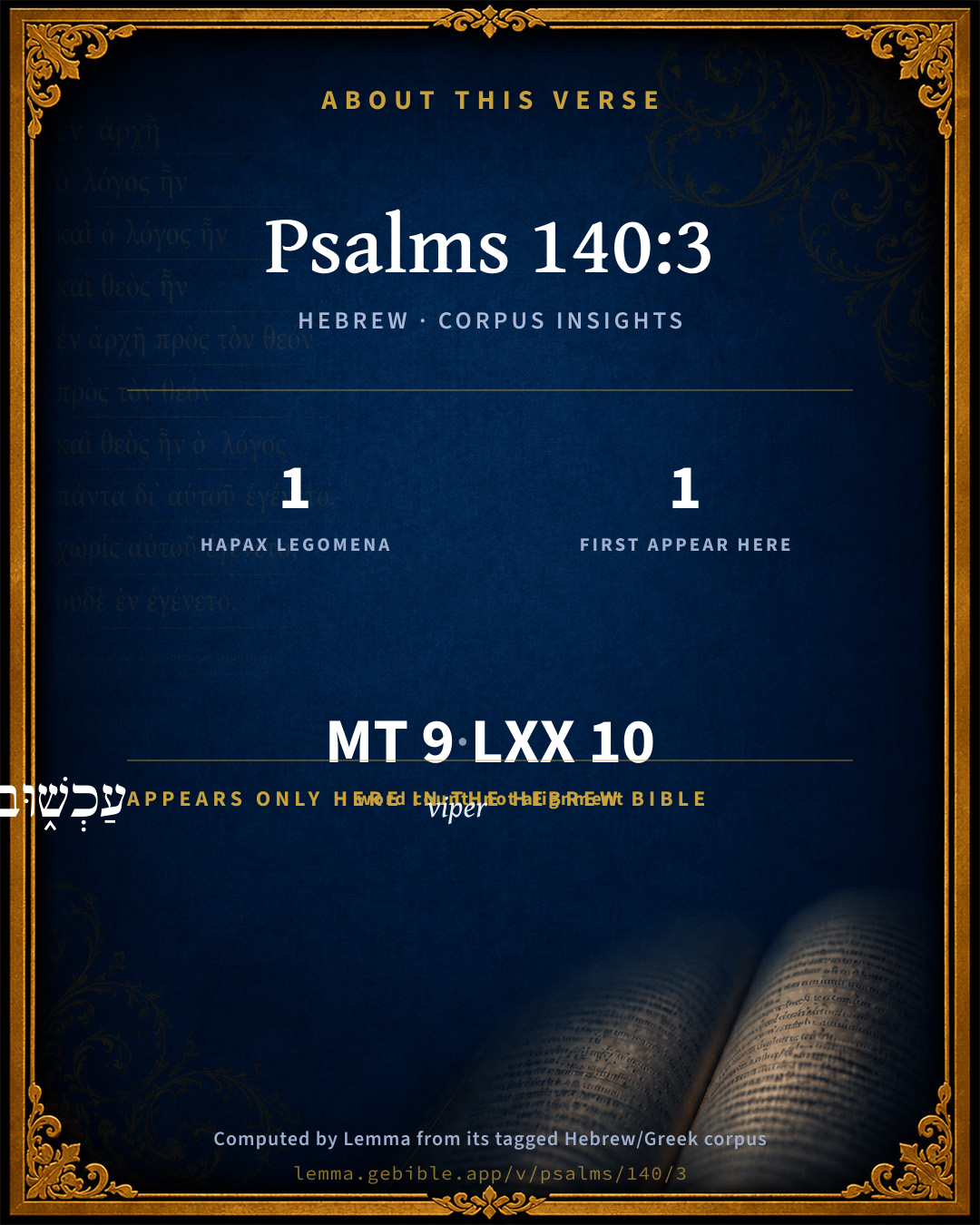
Psalms 140:3

Hebrew (Westminster Leningrad Codex) Psalms 140:3 appears in the Hebrew Old Testament. The text above is from the Westminster Leningrad Codex. Each word links to its Strong’s number, a concise gloss, and parsing drawn from the Open Scriptures Hebrew Bible morphology. Click any word for its full Brown-Driver-Briggs (BDB) entry.
Download image
Cite this verse

Psalms 140:3 (World English Bible). Public Domain. Lemma interlinear Bible study tool, https://lemma.gebible.app/v/psalms/140/3.

Show BibTeX & RIS
BibTeX
RIS
English Translation
They have sharpened their tongues like a serpent. Viper's poison is under their lips. Selah.
World English Bible · Public Domain
Highlights
  • 1 hapax legomenon — only here in the Hebrew Bible
  • 1 first appearance in the Hebrew Bible
Full analysis ↓
Download a study sheet

One document with this verse’s original text, its word-by-word gloss line, the meaning frame, cross-references with their text, attributed commentary, and full source and license credits — printable, and it pastes into notes with its structure intact.

This verse Autodidact and up

Study sheet (.html) Plain text (.txt)

A passage Seminary Student

Up to 50 verses in one chapter. A passage sheet keeps up to 6 commentary sources and 12 cross-references per verse, in the order this page ranks them, and says so on the sheet whenever that leaves anything out. Ask for a single verse and you get the Autodidact verse sheet above.

Everything on this page stays free to read, with no account — the sheet is a download of what is already on screen, not access to it.

Want to remove ads? Support Godless Engineer
Compare translations 3

The same verse in 3 English versions, stacked beneath the original-language interlinear above. Click any original word for its lexicon entry.

Each is an independent rendering of the whole verse — the interlinear is not word-aligned to these translations.

Highlighted words mark where these versions differ — a whole-verse word diff, not a word-by-word alignment.

  • World English Bible Public Domain
    They have sharpened their tongues like a serpent. Viper's poison is under their lips. Selah.
  • King James Version Public Domain
    They have sharpened their tongues like a serpent; adders' poison is under their lips. Selah.
  • unfoldingWord Literal Text CC BY-SA 4.0
    They have sharpened their tongue like a serpent; venom of a viper under their lips. Selah ts\*

unfoldingWord Literal Text — © unfoldingWord, licensed CC BY-SA 4.0. Word-aligned USFM3 via Door43 (git.door43.org/unfoldingWord/en_ult).

Versions to compare (up to 4)

3 of 4 selected

Show all 18 translations

Every available English version of this verse, each an independent rendering of the whole verse.

  • World English Bible Public Domain
    They have sharpened their tongues like a serpent. Viper's poison is under their lips. Selah.
  • Berean Standard Bible Public Domain
    They sharpen their tongues like snakes; the venom of vipers is on their lips. Selah
  • Majority Standard Bible Public Domain
    They sharpen their tongues like snakes; the venom of vipers is on their lips. Selah
  • King James Version Public Domain
    They have sharpened their tongues like a serpent; adders' poison is under their lips. Selah.
  • American Standard Version (1901) Public Domain
    They have sharpened their tongue like a serpent; Adders' poison is under their lips. Selah
  • Revised Version (1885) Public Domain
    They have sharpened their tongue like a serpent; adders’ poison is under their lips. Selah
  • Geneva Bible (1599) Public Domain
    They haue sharpened their tongues like a serpent: adders poyson is vnder their lips. Selah.
  • Douay-Rheims (1899) Public Domain
    Thou hast understood my thoughts afar off: my path and my line thou hast searched out.
  • Young's Literal Translation Public Domain
    They sharpened their tongue as a serpent, Poison of an adder `is' under their lips. Selah.
  • Literal Standard Version CC BY-SA 4.0
    They sharpened their tongue as a serpent, || Poison of a viper [is] under their lips. Selah.
  • Unlocked Literal Bible CC BY-SA 4.0
    Their tongues wound like serpents; vipers' poison is on their lips. Selah
  • unfoldingWord Literal Text CC BY-SA 4.0
    They have sharpened their tongue like a serpent; venom of a viper under their lips. Selah ts\*
  • Darby Bible Public Domain
    They sharpen their tongues like a serpent; adders' poison is under their lips. Selah.
  • World Messianic Bible Public Domain
    They have sharpened their tongues like a serpent. Viper’s poison is under their lips. Selah.
  • Webster's Bible Public Domain
    \\140:2\\Who imagine mischiefs in their heart; continually are they assembled for war.
  • Free Bible Version CC BY-SA 4.0
    Their tongues are as sharp as those of snakes; viper's venom is on their lips. Selah.
  • Bible in Basic English Public Domain
    Their tongues are sharp like the tongue of a snake; the poison of snakes is under their lips. (Selah.)
  • JPS Tanakh (1917) Public Domain
    (140-4) They have sharpened their tongue like a serpent; vipers' venom is under their lips. Selah

Literal Standard Version (2020), Covenant Press — licensed CC BY-SA 4.0. Text via the HelloAO Bible API (eBible.org). Unlocked Literal Bible (unfoldingWord) — licensed CC BY-SA 4.0. Text via the HelloAO Bible API (eBible.org). unfoldingWord Literal Text — © unfoldingWord, licensed CC BY-SA 4.0. Word-aligned USFM3 via Door43 (git.door43.org/unfoldingWord/en_ult). Free Bible Version, Dr. Jonathan Gallagher — licensed CC BY-SA 4.0. Text via the HelloAO Bible API (eBible.org).

Word by word

More ways to search: Search by grammar → Find every occurrence → Compare this word →

Practice this passage: Drill this verse → Learn its vocabulary →

About this verse

These counts appear in no published source. They are computed here, from the morphology-tagged text and Lemma’s own curated glosses. What Lemma adds →

9
words
9
distinct lemmas
Wisdom
section

Notable vocabulary

1 hapax legomenon — a word that appears only here in the entire Hebrew Bible:

  • עַכְשׁ֑וּב viper H5919

First appearance in Scripture

This word makes its first canonical appearance in the Hebrew Bible here:

  • עַכְשׁ֑וּב viper H5919

Shared distinctive vocabulary

שָֽׁנֲנ֣וּ to sharpen H8150 occurs in 9 verses of the Hebrew Bible. Also found in:

Grammatical profile

  • 1 verb
  • 5 nouns
  • 2 prepositions
  • 1 particle

Verb forms

  • שָֽׁנֲנ֣וּ Qal · Perfect

Hebrew & Septuagint length

In English translation the verse runs 15 words from the Hebrew and 20 from the Septuagint (LXX English) — closely comparable.

A rough comparison of the two English renderings, which tokenize alike — not a word-level alignment.

Word counts can differ between the Hebrew and the Greek without any difference in meaning — e.g. the Hebrew direct-object marker אֵת has no separate Greek word, and Greek often adds the article ὁ.

In the original languages it is 9 Hebrew tokens and 10 Greek tokens — but the two are counted differently (Hebrew bundles its prefixes and suffixes into one token; the Greek is in lemma form), so that isn’t a like-for-like length.

Cross-references

16

Topical passages linked to Psalms 140:3 in the Treasury of Scripture Knowledge — connected by theme and wording, ordered by reader-vote popularity; previews shown in the World English Bible.

  • Psalms 58:4 Their poison is like the poison of a snake; Like a deaf cobra that stops its ear,
  • Romans 3:13–14 "Their throat is an open tomb. With their tongues they have used deceit." "The poison of vipers is under their lips;"
  • 2 Corinthians 11:3 But I am afraid that somehow, as the serpent deceived Eve in his craftiness, so your minds might be corrupted from the simplicity that is in Christ.
  • Proverbs 23:32 In the end, it bites like a snake, And poisons like a viper.
  • Psalms 57:4 My soul is among lions. I lie among those who are set on fire, Even the sons of men, whose teeth are spears and arrows, And their tongue a sharp sword.
  • Isaiah 59:3–5 For your hands are defiled with blood, and your fingers with iniquity; your lips have spoken lies, your tongue mutters wickedness.
  • Jeremiah 9:3 They bend their tongue, [as it were] their bow, for falsehood; and they are grown strong in the land, but not for truth: for they proceed from evil to evil, and they don't know me, says Yahweh.
  • Jeremiah 9:5 They will deceive everyone his neighbor, and will not speak the truth: they have taught their tongue to speak lies; they weary themselves to commit iniquity.
  • Matthew 12:34 You offspring of vipers, how can you, being evil, speak good things? For out of the abundance of the heart, the mouth speaks.
  • James 3:6–8 And the tongue is a fire. The world of iniquity among our members is the tongue, which defiles the whole body, and sets on fire the course of nature, and is set on fire by Gehenna.
  • Genesis 3:13 Yahweh God said to the woman, "What is this you have done?" The woman said, "The serpent deceived me, and I ate."
  • Psalms 52:2–3 Your tongue plots destruction, Like a sharp razor, working deceitfully.
  • Psalms 64:3–4 Who sharpen their tongue like a sword, And aim their arrows, deadly words,
  • Proverbs 12:18 There is one who speaks rashly like the piercing of a sword, But the tongue of the wise heals.
  • Isaiah 59:13 transgressing and denying Yahweh, and turning away from following our God, speaking oppression and revolt, conceiving and uttering from the heart words of falsehood.
  • Psalms 59:7 Behold, they spew with their mouth. Swords are in their lips, "For," they say, "who hears us?"

Cross-references courtesy of OpenBible.info (CC BY 4.0).

Hebrew and Greek witnesses Masoretic Hebrew ↔ Greek Septuagint

The same verse in the two great witnesses to the Old Testament, shown verse-for-verse.

You’re reading Greek Psalm 139 (Hebrew Psalm 140). The Septuagint counts the superscription, so verse numbers can differ from the Hebrew — chapter-level alignment, not verse-by-verse. Numbering follows Rahlfs.

These are two independent witnesses, not word-aligned to each other, and the Septuagint is shown in lemma (dictionary) form.

Hebrew Psalms 140:3 Masoretic · Westminster Leningrad Codex

שָֽׁנֲנ֣וּ לְשׁוֹנָם֮ כְּֽמוֹ נָ֫חָ֥שׁ חֲמַ֥ת עַכְשׁ֑וּב תַּ֖חַת שְׂפָתֵ֣ימוֹ סֶֽלָה

They have sharpened their tongues like a serpent. Viper's poison is under their lips. Selah.

World English Bible · Public Domain

Greek LXX Greek Psalm 139:3 Septuagint · lemma form

ὅστις λογίζομαι ἀδικία ἐν καρδία ὅλος ὁ ἡμέρα παρατάσσω πόλεμος

They have sharpened their tongue as the tongue of a serpent; the poison of asps is under their lips. Pause.

LXX2012 (modern English Septuagint) · Public Domain

On this verse, Ellicott's Commentary for English Readers discusses the Septuagint’s reading. Read the note in Commentary ↓

Hebrew: Westminster Leningrad Codex (CC BY 4.0). Greek: Septuagint (public domain); English from LXX2012 (modern English Septuagint) (Public Domain). How the Septuagint differs from the Hebrew →

Commentary

Notes on Psalms 140:3 from classic Christian and Jewish commentators (each source and its license shown beneath its notes). The classic Christian expositions comment on the surrounding passage and are grouped to its opening verse, so a note may address several verses; the Jewish commentaries on the Tanakh (Rashi and others) are per-verse, so they appear only where the commentator wrote on this verse.

Lemma curates 59 commentaries, every one of them public domain or Creative Commons licensed, each selected and text-cleaned for this edition rather than reprinted as found. About our sources →

Trapp's Complete Commentary

John Trapp

Psa 140:3 They have sharpened their tongues like a serpent; adders’ poison [is] under their lips. Selah.

Ver. 3. They have sharpened their tongues like a serpent] Which, by reason of his sharp tongue, striketh more deeply.

Adders’poison] Venenum Ptyados. R. Solomen readeth spiders’ poison; others, asps!, vipers’; malice turneth men into serpents, saith Chrysostom.

John Trapp, A Commentary or Exposition upon All the Books of the Old and New Testament (1647–1656) — public domain. Text from a community e-Sword module.

J. A. Alexander on Psalms

Joseph Addison Alexander

4. (Psa 140:3) They sharpen their tongue as a serpent; the poison of an adder (is) under their lips, Selah. Not as a serpent (does), but (spiteful or venomous) as a serpent. See above, on Psa 64:3. With the last clause compare Psa 10:7; Psa 58:4. The word for asp or adder occurs only here. The only point of exegetical importance is, that it means a poisonous serpent, and is thus a specification of the general expression in the other clause.

Joseph Addison Alexander, The Psalms Translated and Explained (1850) — public domain. Text from a community e-Sword module.

Tyndale Open Study Notes

Tyndale Open Resources

140:3 sting like a snake . . . a viper: These creatures depict the wicked as very corrupt people (see Prov 23:32; Isa 14:29; Rom 3:13).

Tyndale Open Study Notes — © Tyndale Open Resources, licensed CC BY-SA 4.0. Text via the HelloAO Bible API.

Geneva Bible (1599)

Geneva Bible translators

He showeth what weapons the wicked use, when power and force fail them.

Geneva Bible (1599) marginal notes — public domain. Text via Bolls.life.

Adam Clarke's Commentary

Verse 3. They have sharpened their tongues] They employ their time in forging lies and calumnies against me; and those of the most virulent nature.

Adam Clarke's Commentary on the Bible (1810–1826) — public domain. Text from a community e-Sword/MySword module.

Ellicott's Commentary for English Readers

(3) Comp. Psa_64:3; Psa_58:4; Psa_52:2; Psa_10:7.

Adders.—The Hebrew word is peculiar to this place, and is explained by Gesenius to be a compound of two words, to represent “that which rolls itself up and lies in ambush.” “Besides the cobra and the cerastes, several other species of venomous snakes are common in Syria, and we may apply the name, either generically or specifically, to the vipers. Two species, Vipera ammodytes and Vipera euphratica, we found to be very common. The former of these was known to Linnæus as inhabiting Palestine. They are plainlycoloured serpents, with broad flat heads and suddenly-contracting tails” (Tristram, Nat. Hist. of the Bible, p. 275). The LXX. and Vulg. read “asp.” (Comp. Rom_3:13.)

A Bible Commentary for English Readers, edited by Charles John Ellicott (1878–1897) — public domain. Text from a community e-Sword module.

The Cambridge Bible for Schools and Colleges

gen. ed. J. J. S. Perowne

3. They have sharpened their tongues like a serpent] The lying tongue is elsewhere compared to the sword or arrow which wounds (Psa_52:2; Psa_55:21; Psa_57:4; Psa_59:7; Psa_64:3), or the serpent which inflicts a poisonous bite (Psa_58:3-4); and here the Psalmist combines the metaphors. They deliberately prepare to inflict a deadly wound by slander.

adder’s poison is under their lips] Hidden like the poison gland of the asp. The words are quoted in Rom_3:13, from the LXX.

The Cambridge Bible for Schools and Colleges (gen. ed. J. J. S. Perowne; Cambridge University Press, 1878–1918) — public domain. Text from a community e-Sword module.

John Gill's Exposition

They have sharpened their tongues like a serpent,.... Which Kimchi says it does before it bites. Aristotle (i) observes, that the tip or extreme point of a serpent's tongue is as small as a hair, and so exceeding sharp and piercing. Arama interprets this of the sharpness and cunning of the serpent; and particularly the serpent that deceived Eve, and spake cunningly to her. "For God knoweth", &c. and may design the calumnies and detractions, which were sharp as a razor; as swords, and spears, and arrows, and as the tongue of a serpent, Psa 57:4; and the subtlety of false teachers, and deceitful workers; and the sharp and cutting words of wicked men against Christ and his people, Jde 1:15;

adder's poison is under their lips; which may signify the malignity of sin in wicked men, which comes from the old serpent the devil; is latent in men; very infectious, like poison, and deadly and incurable, but by the grace of God, and blood of Christ: and may describe particularly the mischief of the tongue, which is a little member, as the asp is a little creature; but very mischievous, full of deadly poison, which lurks in it, lies under it, and which spitting out, it stupifies and kills insensibly; as do the calumnies of wicked men, and the doctrines of false teachers; see Rom 3:13. The Targum is,

"the poison of the spider;''

though it is said (k) the spider is not venomous.

Selah; on this word; see Gill on Psa 3:2.

(i) Hist. Animal. l. 2. c. 17. (k) Philosoph. Transact. abridged, vol. 2. p. 800. & vol. 5. par. 1. p. 24.

John Gill's Exposition of the Whole Bible (1746–1763) — public domain (CC PDM 1.0). Text via the HelloAO Bible API.

Albert Barnes' Notes on the Bible

They have sharpened their tongues like a serpent - Compare the notes at Psa 64:3. The idea here is, that since the tongue of the serpent “seems” to be sharp, pointed, adapted to penetrate (and probably the original reference in the image was derived from that idea), the wound inflicted is by the serpent’s tongue - “as if” with a hard, penetrating point. It is now known, however, that it is by a tooth - a single tooth, made flexible for the purpose - at the root of which a small bag containing the poison is located, which is injected through an orifice in the tooth into the wound. The meaning here is, that the words spoken by such persons - by their tongues - were like the poison produced by the bite of a serpent.

Adders’ poison is under their lips - The asp or adder is among the most poisonous of serpents. Thus, Cleopatra of Egypt is said to have destroyed her own life by an asp, which she had concealed for that purpose. This passage is quoted in Rom 3:13, as a proof of human depravity. See the notes at that verse.

Albert Barnes' Notes on the Bible (1834–1885) — public domain. Text from a community e-Sword/MySword module.

Matthew Poole's English Annotations

They have sharpened their tongues; their malicious hearts stirred up their tongues to utter vile slanders against me. Like a serpent; either whetting their tongues, as serpents are said to whet theirs when they are about to bite; or rather, using words as sharp and piercing as the sting of a serpent.

Matthew Poole's English Annotations on the Holy Bible (1683–1685) — public domain. Text from a community e-Sword/MySword module.

The Treasury of David

Charles H. Spurgeon

Ver. 3. They have sharpened their tongues like a serpent. The rapid motion of a viper's tongue gives you the idea of its sharpening it; even thus do the malicious move their tongues at such a rate that one might suppose them to be in the very act of wearing them to a point, or rubbing them to a keen edge. It was a common notion that serpents inserted their poison by their tongues, and the poets used the idea as a poetical expression, although it is certain that the serpent wounds by his fangs and not by his tongue. We are not to suppose that all authors who used such language were mistaken in their natural history any more than a writer can be charged with ignorance of astronomy because he speaks of the sun's travelling from east to west. How else can poets speak but according to the appearance of things to an imaginative eye. The world's great poet puts it in "King Lear":

"She struck me with her tongue,

Most serpent like, upon the very heart."

In the case of slanderers, they so literally sting with their tongues, which are so nimble in malice, and withal so piercing and cutting, that it is by no means unjust to speak of them as sharpened. "Adders' poison is under their lips." The deadliest of all venom is the slander of the unscrupulous. Some men care not what they say so long as they can vex and injure. Our text, however, must not be confined in its reference to some few individuals, for in the inspired epistle to the Romans it is quoted by the apostle as being true of us all. So depraved are we by nature that the most venomous creatures are our fit types. The old serpent has not only inoculated us with his venom, but he has caused us to be ourselves producers of the like poison: it lies under our lips, ready for use, and, alas, it is all too freely used when we grow angry, and desire to take vengeance upon any who have caused us vexation. It is sadly wonderful what hard things even good men will say when provoked; yea, even such as call themselves "perfect" in cool blood are not quite as gentle as doves when their claims to sinlessness are bluntly questioned. This poison of evil speaking would never fall from our lips, however much we might be provoked, if it were not there at other times; but by nature we have as great a store of venomous words as a cobra has of poison. O Lord, take the poison bags away, and cause our lips to drop nothing but honey. Selah. This is heavy work. Go up, go up, my heart! Sink not too low. Fall not into the lowest key. Lift up thyself to God.

Ver. 3. They have sharpened their tongues like a serpent. To sharpen or whet the tongue imports the keenest and most extreme kind of talkativeness, much more to sharpen the tongue "like a serpent." Naturalists tell us that no living creature stirs his tongue so swiftly as a serpent, and serpents are therefore said to have a treble tongue, because, moving their tongue so fast, they seem to have three tongues. The Psalmist meansthe wicked speak thick and threefold, they sting and poison me with their tongues. Joseph Caryl.

Ver. 3. They have sharpened their tongues like a serpent. This is an exact description of the way in which a serpent darts out his tongue before he inflicts the wound. See him: his head is erect, and his piercing eye is wildly and fiercely fixed on the object; the tongue rapidly appears and disappears, as if by that process it would be sharpened for the contest. Thus were the enemies of David making sharp their tongues for his destruction. Joseph Roberts, in "Oriental Illustrations of the Sacred Scriptures", 1835.

Ver. 3. They have sharpened their tongues like a serpent, etc. Is it not a fact, that there are many men, the very existence of whom is a baneful poison, as it were? They dart their livid tongue like the tongue of a serpent; and the venom of their disposition corrodes every object upon which it concentrates itself; ever vilifying and maligning, like the ill omened bird of night. Pliny.

Ver. 3. They have sharpened their tongues like a serpent. As the adder skilfully prepares herself for her work of death, so do the unhappy children of slander and falsehood prepare themselves, by every possible effort, for injuring their unoffending victims. John Morison.

Ver. 3. In St. James's day, as now, it would appear that there were idle men and idle women, who went about from house to house, dropping slander as they went, and yet you could not take up that slander and detect the falsehood there. You could not evaporate the truth in the slow process of the crucible, and then show the residuum of falsehood glittering and visible. You could not fasten upon any word or sentence, and say that it was calumny; for in order to constitute slander, it is not necessary that the word spoken should be falsehalf truths are often more calumnious than whole falsehoods. It is not even necessary that a word should be distinctly uttered; a dropped lip, an arched eyebrow, a shrugged shoulder, a significant look, an incredulous expression of countenance, nay, even an emphatic silence, may do the work; and when the light and trifling thing which has done the mischief has fluttered off, the venom is left behind, to work and rankle, to inflame hearts, to fever human existence, and to poison human society at the fountain springs of life. Very emphatically was it said by one whose whole being had smarted under such affliction, Adders' poison is under their lips. Frederick William Robertson.

Ver. 3. Slander and calumny must always precede and accompany persecution, because malice itself cannot excite people against a good man, as such; to do this, he must first be represented as a bad man. What can be said of those who are busied in this manner, but that they are a "generation of vipers", the brood of the old "Serpent", that grand accuser and calumniator of the brethren, having under their tongues a bag of "poison", conveying instant death to the reputation on which they fasten. Thus David was hunted as a rebel, Christ was crucified as a blasphemer, and the primitive Christians were tortured as guilty of incest and murder. George Horne.

Ver. 3. Man consists of soul and body; the body is but the shadow, or at best but the bearer of the soul: it's the soul that bears God's image; it's the soul especially for which Christ died. Now, by how much the soul is more precious than the body, by so much are the helps more excellent, and the enemies more dangerous than the body's. The body is fed with meat; but it is perishing meat (1Co 6:13); but the food of the soul is the heavenly manna (Joh 6:27). Answerably, the enemies are more hurtful, for that that hurts or kills the body toucheth not the soul; but what hurts or kills the soul kills the body with it, and destroys the whole man. The conclusion is, that therefore the bane or poison of the soul is much more hideous, horrible and hateful than that of the body; and of that poison speaks the present Scripture: adders' poison is under their lips.

A strange text, some may say, and 'tis true; but it is the fitter for these strange times, wherein the poison both of soul and body so far prevails. The words do describe in part the malignant and malicious nature of the unregenerate and sinful man; and to that purpose are they cited by the apostle to the Romans (Ro 3:13). The asp is but a little creature; but not a little poisonous. So little a creature hath been the bane and death of many a great person; let one suffice for all. That royal and renowned Cleopatra, queen of Egypt, chose rather to die by the biting of two asps than to be carried in triumph at Rome by Augustus. The manner of their poisoning is this, he that is bitten by the asp falls forthwith into a gentle sweat and a sweet sleep, and his strength and vital spirits decay and weaken by little till he die; thus the present pain is little, but the stroke is deadly. And even such stings are the tongues, and such swords the words of wicked men. And no marvel; for what can come but poisonous words and actions from them whose very inward nature is all poison within!

The poison of the soul is only sin, and this is like to poison in many respects. Poison, wherever it enters, stays not there, but diffuses itself all over the body, and never ceaseth till it has infected all. Such is the nature of sin; enter where it will it creeps from one member of the body to another, and from the body to the soul, till it has infected tim whole man; and then from man to man, till a whole family; and stays not there, but runs like a wildfire, from family to family, till it has poisoned a whole town, and so a whole country, and a whole kingdom. Woeful experience proves this true, both for Popish opinions, idle fashions, vain customs, and ill examples of all sorts, which once set on foot, spread themselves over the politic body of church and commonwealth, like a gangrene or a leprosy over the natural body, or like a poison through all the blood. Poison, having entered anywhere, as it seeks to creep presently over all, so desires it especially to seize upon the heart; such a malice and pride lies in the malignant nature of it, that it aspires to the heart; and such a craft and cunning lurks in it, that having once entered, it creeps closely and unfelt till it gets to the heart; but having possessed itself of that sovereign part of man, then like a tyrant it reigns and rages, and infecting first the vital blood and noble parts, it diffuses itself over all and every part. And such is the nature of sin, the spiritual poison of the soul; enter where it will, it is tim heart it aims at, and it will never stay till it comes there. The truth of this is so clear that proofs are needless; for who knows not that the senses are but the doors or windows, but the heart is the throne, and the soul itself the seat of sin: and hence it is that Solomon advises, "My son, keep thy heart with all diligence": Pr 4:23. William Crashaw, in "The Parable of Poyson", 1618.

Ver. 3. Adders' poison is under their lips. The word rendered "adder", bwvke, achsub, occurs here only; and it is perhaps impossible to determine what species is intended. As the word, in its proper signification, seems to express coiling, or bending backan act common to most serpentsthe name has perhaps no determinate reference; or it may be another name for the pethen, mentioned under Job 20.; which seems also to have been the opinion of the Seventy, as they render both words by, aspiv, and are followed by the Vulgate (aspis).

As to the poison, it will be observed, that in the venomous serpents there is a gland under the eye secreting the poisonous matter, which is conveyed, in a small tube or canal, to the end of a fang which lies concealed at the roof of the mouth. This fang is moveable at the pleasure of the serpent, and is protruded when it is about to strike at an antagonist. The situation of this poison, which is, in a manner, behind the upper lip, gives great propriety to the expression, "adders' poison is under their lips." The usage of the Hebrew language renders it by no means improbable that the fang itself is called Nwvl lashon, a tongue, in the present text; and a serpent might then be said to sharpen its tongue, when, in preparing to strike, it protruded its fangs. We do not see any explanation by which a more consistent meaning may be extracted from the expression here employed. John Kitto, in the "Pictorial Bible."

Ver. 3. Often the tongue of the serpent is spoken of as the seat of its venom. This is popular, not scientific language. William Swan Plumer.

Ver. 3. Adder. The word acshub (pronounced, ak-shoob), only occurs in this one passage. The precise species represented by this word is unknown. Buxtorf, however, explains the word as the Spitter, "illud genus quod venelmm proeul exspuit." Now, if we accept this derivation, we must take the word acshub as a synonym for pethen. We have already identified the Pethen with the Naja haje, a snake which has the power of expelling the poison to some distance, when it is out of reach of its enemy. Whether the snake really intends to eject the poison, or whether it is merely flung from the hollow fangs by the force of the suddenly checked stroke, is uncertain. That the Haje cobra can expel its poison is an acknowledged fact, and the Dutch colonists of the Cape have been so familiarly acquainted with this habit, that they have called this reptile by the name of Spuugh Slange, or Spitting Snake, a name which, if we accept Buxtorf's etymology, is precisely equivalent to the word acshub. J.G. Wood, in "Bible Animals."

Ver. 3,5,8. Selah. We meet with Selah here for the first time since Psalm 89. From Psalm 90 to Psalm 140 no Selah occurs. Why omitted in these fifty we cannot tell any more than why so often recurring in others. However, there are only about forty Psalms in all in which it is used. Andrew A. Bonar.

Ver. 3. The depraved state of the natural man as to his speech.

Psalms 140:4*

Charles H. Spurgeon's The Treasury of David (1869–1885) — public domain. Psalms only. Text from a community e-Sword/MySword module.

Whedon's Commentary on the Bible

Daniel D. Whedon

3. Sharpened their tongues like a serpent—The description is that of a serpent darting out his tongue before inflicting the wound. Roberts: “See him: his head is erect, and his piercing eye is wildly and fiercely fixed on the object; the tongue rapidly appears and disappears, as if by that process it would be sharpened for the contest.” The Hebrew word here rendered adder, would seem to be used in a general way to signify a serpent of some kind, but not determinate as to species. As a compound word the two parts together would signify, according to Gesenius, to coil up and to lie in wait, which might apply to various species, but specially to the cerastes, or horned adder, a dangerous wayside serpent, alluded to Gen_49:17. Others apply it to the toxicoa, so well known in northern Africa, also in Palestine and Syria.

Poison… under their lips—The secreted poison at the root of the serpent’s fang, which is injected, by a peculiar muscular apparatus, into the wound caused by the bite. A fit emblem of a malignant slanderer.

Daniel D. Whedon (gen. ed.), Commentary on the Old and New Testaments (1874–1909) — public domain. Text from a community e-Sword module.

The Pulpit Commentary

They have sharpened their tongues like a serpent. (comp. Psa_52:2 Psa_57:4 Psa_59:7 Psa_64:3) Adders" poison is under their lips. (comp. Psa_58:4 Rom_3:15) The meaning is that their tongues inflict wounds which are as painful as poisoned wounds. The pause-sign, "selah," marks off the first stanza.

The Pulpit Commentary (1880–1919), ed. H.D.M. Spence-Jones & Joseph S. Exell — public domain. Text from a community e-Sword module.

John Wesley's Explanatory Notes

Tongues - Using words as sharp and piercing as the sting of a serpent.

John Wesley, Explanatory Notes Upon the Whole Bible (1754–1765) — public domain. Text via the GEBible commentary corpus.

Rashi

Rabbi Shlomo Yitzchaki (Rashi)

every day they gather to wage war There will be wars in their dwellings and in their settlements.

Rashi on the Tanakh — English translations: “The Judaica Press complete Tanach with Rashi, translated by A. J. Rosenberg” (CC BY 4.0); “Pentateuch with Rashi's commentary by M. Rosenbaum and A.M. Silbermann, 1929-1934” (public domain); “The Metsudah Tanach series, Lakewood, N.J” (CC BY 4.0); and “The Book of Joshua, Metsudah Publications, 1997” (CC BY 4.0). Text via Sefaria.

Lesson kit

Teaching starters — assembled from the data on this page, not authored interpretation. Every prompt links to the verse data it draws on. Edit before teaching.

Psalms, in the Wisdom, opens this verse with 9 words (9 distinct Hebrew lemmas). Its most distinctive word is ʻakshûwb (“viper”). A historical commentator’s framing appears above. Read the whole chapter for the surrounding context.

Discussion questions

  1. What does “viper” (ʻakshûwb) contribute to the verse as a whole?
  2. This verse holds 1 word here found nowhere else in the Hebrew Bible. What might the rare word draw attention to?
  3. The word “viper” first appears here in Scripture. What is being introduced at this debut?
  4. Deuteronomy 6:7 shares the word «to sharpen» with this verse. How do the two illuminate each other?
  5. These translations render this verse differently; the difference is in the English rendering, not the original. What questions does that raise?
  6. The verb «שָֽׁנֲנ֣וּ» is Qal Perfect. How does its form color the action?
  7. Reading how Trapp's Complete Commentary and J. A. Alexander on Psalms read this verse, where do the two commentators agree and where do they part?

Things to notice

Reading settings

Reading text

Shown beneath each verse's original-language words.

Old Testament
Old Testament edition

Read the OT as the Masoretic Hebrew (MT) or the Greek Septuagint (LXX).

English shown for the Greek Septuagint (in the Hebrew ↔ Greek comparison).

Comparing translations? Open the Compare panel on any verse page to stack up to four side by side.