
Isaiah 30:22

Hebrew (Westminster Leningrad Codex) Isaiah 30:22 appears in the Hebrew Old Testament. The text above is from the Westminster Leningrad Codex. Each word links to its Strong’s number, a concise gloss, and parsing drawn from the Open Scriptures Hebrew Bible morphology. Click any word for its full Brown-Driver-Briggs (BDB) entry.
Download image
Cite this verse

Isaiah 30:22 (World English Bible). Public Domain. Lemma interlinear Bible study tool, https://lemma.gebible.app/v/isaiah/30/22.

Show BibTeX & RIS
BibTeX
RIS
English Translation
You shall defile the overlaying of your engraved images of silver, and the plating of your molten images of gold: you shall cast them away as an unclean thing; you shall tell it, Get you hence.
World English Bible · Public Domain
Download a study sheet

One document with this verse’s original text, its word-by-word gloss line, the meaning frame, cross-references with their text, attributed commentary, and full source and license credits — printable, and it pastes into notes with its structure intact.

This verse Autodidact and up

Study sheet (.html) Plain text (.txt)

A passage Seminary Student

Up to 50 verses in one chapter. A passage sheet keeps up to 6 commentary sources and 12 cross-references per verse, in the order this page ranks them, and says so on the sheet whenever that leaves anything out. Ask for a single verse and you get the Autodidact verse sheet above.

Everything on this page stays free to read, with no account — the sheet is a download of what is already on screen, not access to it.

Want to remove ads? Support Godless Engineer
Compare translations 3

The same verse in 3 English versions, stacked beneath the original-language interlinear above. Click any original word for its lexicon entry.

Each is an independent rendering of the whole verse — the interlinear is not word-aligned to these translations.

Highlighted words mark where these versions differ — a whole-verse word diff, not a word-by-word alignment.

  • World English Bible Public Domain
    You shall defile the overlaying of your engraved images of silver, and the plating of your molten images of gold: you shall cast them away as an unclean thing; you shall tell it, Get you hence.
  • King James Version Public Domain
    Ye shall defile also the covering of thy graven images of silver, and the ornament of thy molten images of gold: thou shalt cast them away as a menstruous cloth; thou shalt say unto it, Get thee hence.
  • unfoldingWord Literal Text CC BY-SA 4.0
    And you will defile the overlaying of the idols of your silver and the plating of the molded images of your gold. You will throw them away like a menstrual. “Get out!” you will say to it.

unfoldingWord Literal Text — © unfoldingWord, licensed CC BY-SA 4.0. Word-aligned USFM3 via Door43 (git.door43.org/unfoldingWord/en_ult).

Versions to compare (up to 4)

3 of 4 selected

Show all 18 translations

Every available English version of this verse, each an independent rendering of the whole verse.

  • World English Bible Public Domain
    You shall defile the overlaying of your engraved images of silver, and the plating of your molten images of gold: you shall cast them away as an unclean thing; you shall tell it, Get you hence.
  • Berean Standard Bible Public Domain
    So you will desecrate your silver-plated idols and your gold-plated images. You will throw them away like menstrual cloths, saying to them, “Be gone!”
  • Majority Standard Bible Public Domain
    So you will desecrate your silver-plated idols and your gold-plated images. You will throw them away like menstrual cloths, saying to them, “Be gone!”
  • King James Version Public Domain
    Ye shall defile also the covering of thy graven images of silver, and the ornament of thy molten images of gold: thou shalt cast them away as a menstruous cloth; thou shalt say unto it, Get thee hence.
  • American Standard Version (1901) Public Domain
    And ye shall defile the overlaying of thy graven images of silver, and the plating of thy molten images of gold: thou shalt cast them away as an unclean thing; thou shalt say unto it, Get thee hence.
  • Revised Version (1885) Public Domain
    And ye shall defile the overlaying of thy graven images of silver, and the plating of thy molten images of gold: thou shalt cast them away as an unclean thing; thou shalt say unto it, Get thee hence.
  • Geneva Bible (1599) Public Domain
    And ye shall pollute the couering of the images of siluer, and the riche ornament of thine images of golde, and cast them away as a menstruous cloth, and thou shalt say vnto it, Get thee hence.
  • Douay-Rheims (1899) Public Domain
    And thou shalt defile the plates of thy graven things of silver, and the garment of thy molten things of gold, and shalt cast them away as the uncleanness of a menstruous woman. Thou shalt say to it: Get thee hence.
  • Young's Literal Translation Public Domain
    And ye have defiled the covering of Thy graven images of silver, And the ephod of thy molten image of gold, Thou scatterest them as a sickening thing, `Go out,' thou sayest to it.
  • Literal Standard Version CC BY-SA 4.0
    And you have defiled the covering of Your carved images of silver, || And the ephod of your molten image of gold, || You scatter them as a sickening thing, “Go out,” you say to it.
  • Unlocked Literal Bible CC BY-SA 4.0
    You will desecrate your carved figures overlaid with silver and your gold cast figures. You will throw them away like a menstrual rag. You will say to them, “Get out of here.”
  • unfoldingWord Literal Text CC BY-SA 4.0
    And you will defile the overlaying of the idols of your silver and the plating of the molded images of your gold. You will throw them away like a menstrual. “Get out!” you will say to it.
  • Darby Bible Public Domain
    And ye shall defile the silver covering of your graven images, and the gold overlaying of your molten images; thou shalt cast them away as a menstruous cloth: Out! shalt thou say unto it.
  • World Messianic Bible Public Domain
    You shall defile the overlaying of your engraved images of silver, and the plating of your molten images of gold. You shall cast them away as an unclean thing. You shall tell it, “Go away!”
  • Webster's Bible Public Domain
    Ye shall defile also the covering of thy graven images of silver, and the ornament of thy molten images of gold: thou shalt cast them away as a polluted cloth; thou shalt say to it, Be gone from me.
  • Free Bible Version CC BY-SA 4.0
    You will defile your silver-coated idols coated with silver and your gold-covered images. You will throw them away like a dirty cloth used for periods, and say to them, “out of here!”
  • Bible in Basic English Public Domain
    And you will make unclean what is covering your pictured images of silver, and the plating of your images of gold: you will send them away as an unclean thing, saying, Be gone!
  • JPS Tanakh (1917) Public Domain
    And ye shall defile thy graven images overlaid with silver, and thy molten images covered with gold; thou shalt put them far away as one unclean; thou shalt say unto it: 'Get thee hence.'

Literal Standard Version (2020), Covenant Press — licensed CC BY-SA 4.0. Text via the HelloAO Bible API (eBible.org). Unlocked Literal Bible (unfoldingWord) — licensed CC BY-SA 4.0. Text via the HelloAO Bible API (eBible.org). unfoldingWord Literal Text — © unfoldingWord, licensed CC BY-SA 4.0. Word-aligned USFM3 via Door43 (git.door43.org/unfoldingWord/en_ult). Free Bible Version, Dr. Jonathan Gallagher — licensed CC BY-SA 4.0. Text via the HelloAO Bible API (eBible.org).

Word by word

More ways to search: Search by grammar → Find every occurrence → Compare this word →

Practice this passage: Drill this verse → Learn its vocabulary →

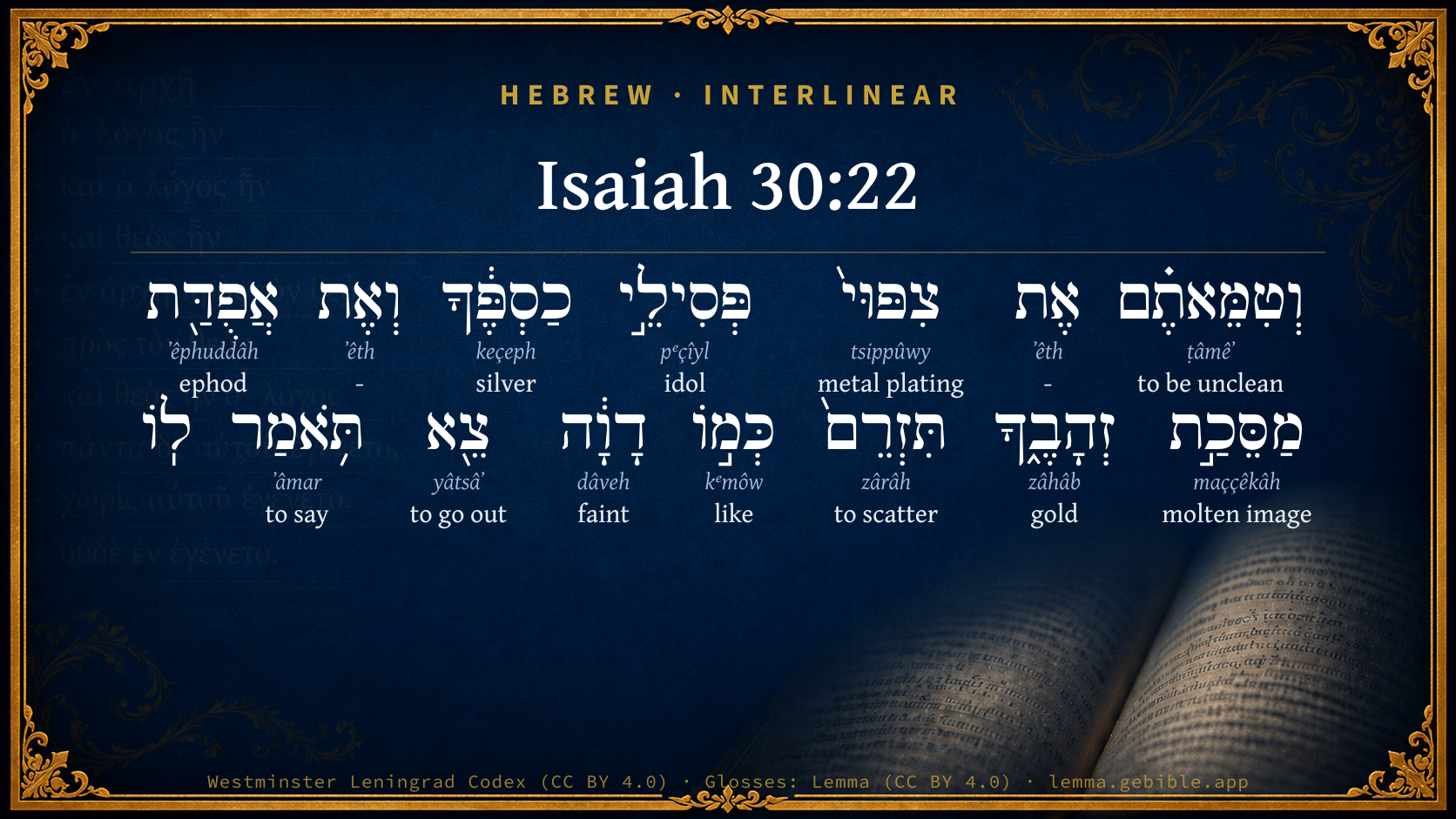
אֲפֻדַּ֖ת
ʼêphuddâh
H642
“ephod of”
Noun, Common, Feminine, Singular, Construct
Part of Speech
Noun
Type
Common
Gender
Feminine
Number
Singular
State
Construct
Full BDB Definition

Origin: from H646

TWOT: 142 . 1b ?

ephod - priestly garment, shoulder-cape or mantle, outer garment - worn by an ordinary priest and made of white stuff - worn by the high priest - more costly, woven of gold, blue, purple, scarlet, and linen threads provided with shoulder-pieces and a breast piece of like material, ornamented with gems and gold - a metallic covering for idols, a plating over
  1. וְטִמֵּאתֶ֗ם ṭâmêʼ H2930 “and · to be unclean” Conjunction + Verb, Piel, Sequential Perfect, 2nd Person, Masculine, Plural
  2. אֶת ʼêth H853 “-” Particle, Direct Object
  3. צִפּוּי֙ tsippûwy H6826 “metal plating of” Noun, Common, Masculine, Singular, Construct
  4. פְּסִילֵ֣י pᵉçîyl H6456 “idols of” Noun, Common, Masculine, Plural, Construct
  5. כַסְפֶּ֔ךָ keçeph H3701 “silver · your” Noun, Common, Masculine, Singular, Construct + Suffix, Personal, 2nd Person, Masculine, Singular
  6. וְאֶת ʼêth H853 “and · -” Conjunction + Particle, Direct Object
  7. מַסֵּכַ֣ת maççêkâh H4541 “molten image of” Noun, Common, Feminine, Singular, Construct
  8. זְהָבֶ֑ךָ zâhâb H2091 “gold · your” Noun, Common, Masculine, Singular, Construct + Suffix, Personal, 2nd Person, Masculine, Singular
  9. תִּזְרֵם֙ zârâh H2219 “to scatter · them” Verb, Qal, Imperfect, 2nd Person, Masculine, Singular + Suffix, Personal, 3rd Person, Masculine, Plural
  10. כְּמ֣וֹ kᵉmôw H3644 “like” Preposition
  11. דָוָ֔ה dâveh H1739 “faint” Adjective, Adjective, Feminine, Singular, Absolute
  12. צֵ֖א yâtsâʼ H3318 “go out” Verb, Qal, Imperative, 2nd Person, Masculine, Singular
  13. תֹּ֥אמַר ʼâmar H559 “to say” Verb, Qal, Imperfect, 2nd Person, Masculine, Singular

About this verse

These counts appear in no published source. They are computed here, from the morphology-tagged text and Lemma’s own curated glosses. What Lemma adds →

15
words
13
distinct lemmas
Prophets
section

Notable vocabulary

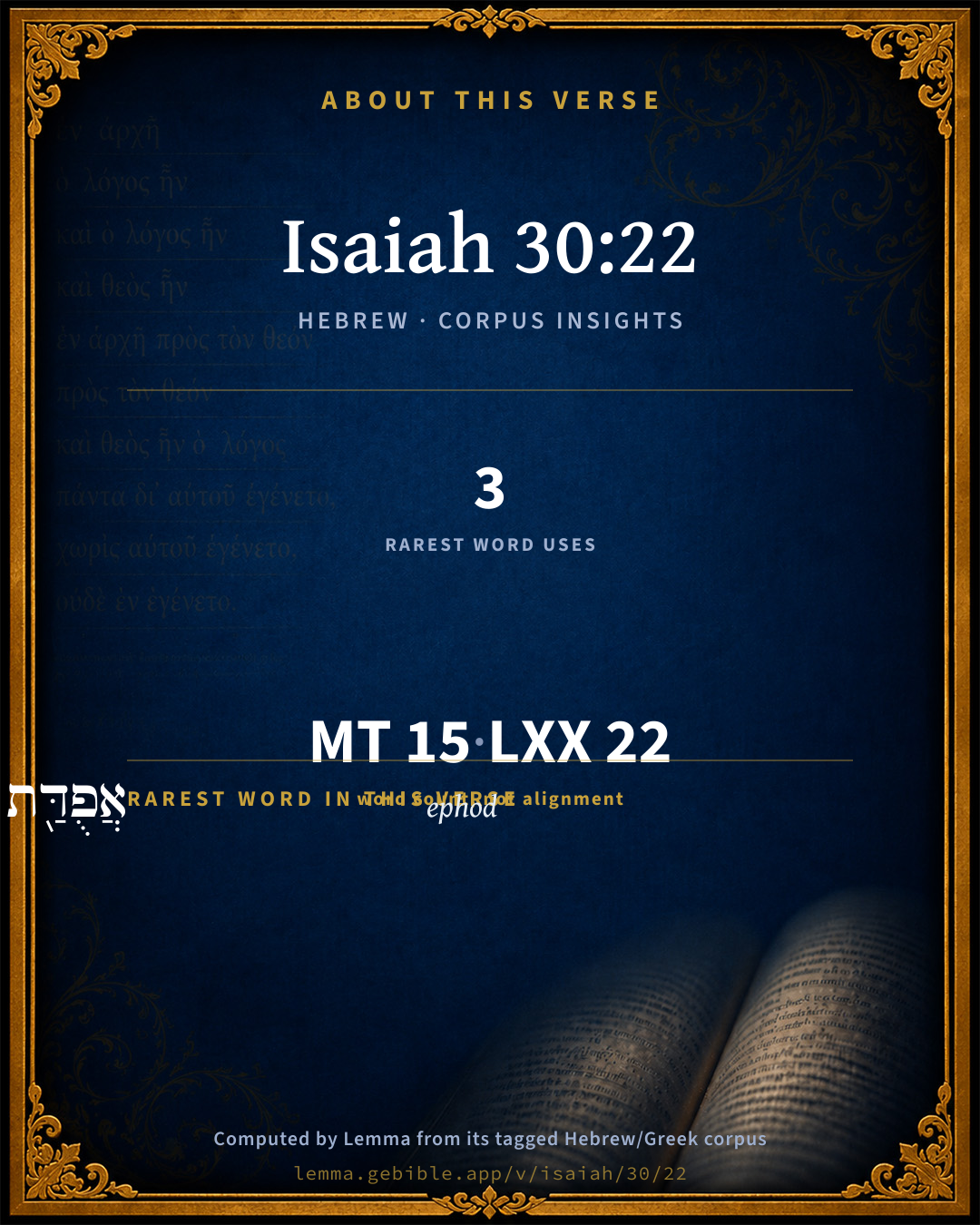
The rarest word here is אֲפֻדַּ֖ת ephod H642 — appearing just 3 times in the whole Hebrew Bible.

Shared distinctive vocabulary

אֲפֻדַּ֖ת ephod H642 occurs in 3 verses of the Hebrew Bible. Also found in:

Grammatical profile

  • 4 verbs
  • 6 nouns
  • 1 adjective
  • 2 prepositions
  • 2 particles

Verb forms

  • וְטִמֵּאתֶ֗ם Piel · Sequential Perfect
  • תִּזְרֵם֙ Qal · Imperfect
  • צֵ֖א Qal · Imperative
  • תֹּ֥אמַר Qal · Imperfect

Hebrew & Septuagint length

In English translation the verse runs 36 words from the Hebrew and 35 from the Septuagint (LXX English) — closely comparable.

A rough comparison of the two English renderings, which tokenize alike — not a word-level alignment.

Word counts can differ between the Hebrew and the Greek without any difference in meaning — e.g. the Hebrew direct-object marker אֵת has no separate Greek word, and Greek often adds the article ὁ.

In the original languages it is 15 Hebrew tokens and 22 Greek tokens — but the two are counted differently (Hebrew bundles its prefixes and suffixes into one token; the Greek is in lemma form), so that isn’t a like-for-like length.

Cross-references

17

Topical passages linked to Isaiah 30:22 in the Treasury of Scripture Knowledge — connected by theme and wording, ordered by reader-vote popularity; previews shown in the World English Bible.

  • Judges 17:3–4 He restored the eleven hundred [pieces] of silver to his mother; and his mother said, I most assuredly dedicate the silver to Yahweh from my hand for my son, to make an engraved image and a molten image: now therefore I will restore it to you.
  • Isaiah 31:7 For in that day they shall cast away every man his idols of silver, and his idols of gold, which your own hands have made to you for a sin.
  • Isaiah 46:6 Some pour out gold from the bag, and weigh silver in the balance. They hire a goldsmith, and he makes it a god. They fall down--yes, they worship.
  • Zechariah 13:2 It will come to pass in that day, says Yahweh of Hosts, that I will cut off the names of the idols out of the land, and they will no more be remembered; and also I will cause the prophets and the spirit of impurity to pass out of the land.
  • Exodus 32:2–4 Aaron said to them, "Take off the golden rings, which are in the ears of your wives, of your sons, and of your daughters, and bring them to me."
  • Isaiah 2:20–21 In that day, men shall cast away their idols of silver, And their idols of gold, Which have been made for themselves to worship, To the moles and to the bats;
  • Isaiah 17:7–8 In that day shall men look to their Maker, and their eyes shall have respect to the Holy One of Israel.
  • Ezekiel 36:31 Then shall you remember your evil ways, and your doings that were not good; and you shall loathe yourselves in your own sight for your iniquities and for your abominations.
  • Hosea 14:8 Ephraim, what have I to do any more with idols? I answer, and will take care of him. I am like a green fir tree; From me your fruit is found."
  • 2 Kings 23:4–20 The king commanded Hilkiah the high priest, and the priests of the second order, and the keepers of the threshold, to bring forth out of the temple of Yahweh all the vessels that were made for Baal, and for the Asherah, and for all the host of the sky, and he burned them outside of Jerusalem in the fields of the Kidron, and carried the ashes of them to Bethel.
  • 2 Chronicles 31:1 Now when all this was finished, all Israel who were present went out to the cities of Judah, and broke in pieces the pillars, and hewed down the Asherim, and broke down the high places and the altars out of all Judah and Benjamin, in Ephraim also and Manasseh, until they had destroyed them all. Then all the children of Israel returned, every man to his possession, into their own cities.
  • 2 Chronicles 34:3–7 For in the eighth year of his reign, while he was yet young, he began to seek after the God of David his father; and in the twelfth year he began to purge Judah and Jerusalem from the high places, and the Asherim, and the engraved images, and the molten images.
  • Lamentations 1:17 Zion spreads forth her hands; there is none to comfort her; Yahweh has commanded concerning Jacob, that those who are round about him should be his adversaries: Jerusalem is among them as an unclean thing.
  • Ezekiel 18:6 and has not eaten on the mountains, neither has lifted up his eyes to the idols of the house of Israel, neither has defiled his neighbor's wife, neither has come near to a woman in her impurity,
  • Micah 5:10–14 "It will happen in that day," says Yahweh, "That I will cut off your horses out of the midst of you, And will destroy your chariots.
  • Revelation 19:20 The beast was taken, and with him the false prophet who worked the signs in his sight, with which he deceived those who had received the mark of the beast and those who worshiped his image. These two were thrown alive into the lake of fire that burns with sulfur.
  • Isaiah 27:9 Therefore by this shall the iniquity of Jacob be forgiven, and this is all the fruit of taking away his sin: that he makes all the stones of the altar as chalk stones that are beaten in sunder, [so that] the Asherim and the sun-images shall rise no more.

Cross-references courtesy of OpenBible.info (CC BY 4.0).

Hebrew and Greek witnesses Masoretic Hebrew ↔ Greek Septuagint

The same verse in the two great witnesses to the Old Testament, shown verse-for-verse.

These are two independent witnesses, not word-aligned to each other, and the Septuagint is shown in lemma (dictionary) form.

Hebrew Isaiah 30:22 Masoretic · Westminster Leningrad Codex

וְטִמֵּאתֶ֗ם אֶת צִפּוּי֙ פְּסִילֵ֣י כַסְפֶּ֔ךָ וְאֶת אֲפֻדַּ֖ת מַסֵּכַ֣ת זְהָבֶ֑ךָ תִּזְרֵם֙ כְּמ֣וֹ דָוָ֔ה צֵ֖א תֹּ֥אמַר לֽוֹ

You shall defile the overlaying of your engraved images of silver, and the plating of your molten images of gold: you shall cast them away as an unclean thing; you shall tell it, Get you hence.

World English Bible · Public Domain

Greek LXX Isaiah 30:22 Septuagint · lemma form

καί ἐκαἴρω ὁ εἴδωλον ὁ περιἀργυρόω καί ὁ περιχρυσόω λεπτός ποιέω καί λικμάω ὡς ὕδωρ ἀπο καταἧμαι καί ὡς κόπρος ὠθέω αὐτός

And you shall pollute the plated idols, and you shall grind to powder the gilt ones, and shall scatter them as the water of a removed woman, and you shall thrust them forth as dung.

LXX2012 (modern English Septuagint) · Public Domain

Hebrew: Westminster Leningrad Codex (CC BY 4.0). Greek: Septuagint (public domain); English from LXX2012 (modern English Septuagint) (Public Domain). How the Septuagint differs from the Hebrew →

Targum (Aramaic paraphrase)

1

The Targum is the ancient Jewish Aramaic paraphrase of the Hebrew Scriptures — an interpretive translation, not the Hebrew text itself. Onkelos (literal) and Pseudo-Jonathan (expansive) render the Torah, and Jonathan the Prophets. Coverage is partial: where no permissively-licensed English translation exists for a verse, only the Aramaic is shown. This is verse-level text, not a word-by-word alignment to the Hebrew.

  1. Targum Jonathan Prophets (Joshua–Malachi)
    וּתְסַאֲבוּן יַת חִפּוּי צַלְמֵי כַּסְפֵּיכוֹן וְיַת תִּקוּן מַתְּכַת דַהַבְכוֹן תַּרְחִיקִינוּן כְּמָא דִמְרַחֲקִין יַת טוּמְאֲתָא כֵּן תַּרְחִיקִינוּן:

    And ye shall defile the covering of your idols of silver, and the ornament of thy molten images of gold; ye shall abominate it, as they abominate the impurity of a menstruous woman, thus ye shall abominate it.

    Targum Jonathan — Aramaic: “Mikraot Gedolot” (public domain). English: “Sefaria Community Translation” (CC0 1.0 (public-domain dedication)); “London "Chaldee Paraphrase," 1871” (public domain). Text via Sefaria.

Commentary

Notes on Isaiah 30:22 from classic Christian and Jewish commentators (each source and its license shown beneath its notes). The classic Christian expositions comment on the surrounding passage and are grouped to its opening verse, so a note may address several verses; the Jewish commentaries on the Tanakh (Rashi and others) are per-verse, so they appear only where the commentator wrote on this verse.

Lemma curates 59 commentaries, every one of them public domain or Creative Commons licensed, each selected and text-cleaned for this edition rather than reprinted as found. About our sources →

Trapp's Complete Commentary

John Trapp

Isa 30:22 Ye shall defile also the covering of thy graven images of silver, and the ornament of thy molten images of gold: thou shalt cast them away as a menstruous cloth; thou shalt say unto it, Get thee hence.

Ver. 22. Thou shalt defile also the covering.] Thou shalt pollute the idols which thou hadst perfumed. Such a change is wrought in people by the Word preached, as is to be seen in all the reformed churches; cavete ab idolis, beware of idols.

Thou shalt cast them away as a menstruous cloth.] Ut mulierem laborantem ex mensibus, as a labouring woman from her period. {a}

Thou shalt say unto them, Get thee hence.] Apage, Abi in malam crucem. Men should heartily hate sin by them committed: dealing by it as Amnon did by Tamar; and as heartily desiring to forego it, as to have it forgiven; to part with it, as to have it pardoned. See Hos 14:8. {See Trapp on "Hos 14:8"}

{a} Piscat. Comparat idola scorto perpetuo monstro abominabili. - Zeged.

John Trapp, A Commentary or Exposition upon All the Books of the Old and New Testament (1647–1656) — public domain. Text from a community e-Sword module.

Joseph Benson's Commentary

Isa 30:22. Ye shall also — To show your contempt of it; defile the covering of thy graven images — The leaves or plates, wherewith their wooden images were frequently covered: and the ornament of thy molten images — Or, the coat, or covering; Hebrew, אפדת, the ephod, as the word is rendered, Exo 28:8; and Exo 39:5; which was a costly and glorious robe. The images also were of gold: for the idolaters spared no cost in the making and adorning of their idols. Thou shalt cast them away, &c. — Thou shalt so deeply abhor idolatry that thou shalt cast away, with indignation, all the monuments and instruments thereof. This prophecy was fulfilled in some measure even before the Assyrian invasion, as we learn from 2Ch 31:1; Hezekiah inciting the people to destroy idolatry out of the land. Probably it was fulfilled still more upon the deliverance of Jerusalem from Sennacherib’s army, which, doubtless, would convince thousands of individuals of the almighty power of Jehovah, of the impotence of idols, and the sin and folly of worshipping them. But it was verified in the whole body of the Jewish nation, at their return from their captivity in Babylon, for they abhorred idols ever after. Add to this, it is accomplished daily in the conversion of souls, by the power of divine grace, from spiritual idolatry, to the fear and love of God. This deliverance from the love and practice of idolatry is the third blessing here represented as being conferred on the people, after the forementioned judgments. In the two following verses we have a fourth.

Joseph Benson's Commentary on the Old and New Testaments (1811–1818) — public domain. Text from a community e-Sword module.

Tyndale Open Study Notes

Tyndale Open Resources

30:22 One aspect of Hezekiah’s reforms was to remove silver idols and other idolatry of Ahaz’s era and to call the people back to the worship of the God of Israel (2 Kgs 18:4-5; 2 Chr 29).

Tyndale Open Study Notes — © Tyndale Open Resources, licensed CC BY-SA 4.0. Text via the HelloAO Bible API.

Geneva Bible (1599)

Geneva Bible translators

Showing, that there can be no true repentance, except both in heart and deed we show ourselves enemies to idolatry.

Ye shall cast away your idols, which you have made of gold, and silver, with all that belongeth unto them, as a most filthy thing, and polluted.

Geneva Bible (1599) marginal notes — public domain. Text via Bolls.life.

Jamieson, Fausset & Brown

Robert Jamieson, A. R. Fausset & David Brown

covering of . . . images--rather, "images" (formed of wood or potter's clay, and) "covered with silver." Hezekiah, and afterwards Josiah, defiled them (Kg2 23:8, Kg2 23:10, Kg2 23:14, Kg2 23:16; Ch2 31:1; compare Isa 2:20; Deu 7:25).

Jamieson, Fausset & Brown — Commentary Critical and Explanatory on the Whole Bible (1871) — public domain (CC PDM 1.0). Text via the HelloAO Bible API.

Adam Clarke's Commentary

Verse 22. Ye shall defile - "Ye shall treat as defiled"] The very prohibition of Moses, De 7:25, only thrown out of the prose into the poetical form: "The graven images of their gods ye shall burn with fire: thou shalt not desire the silver or the gold that is on them; nor take it unto thee, lest thou be snared therein; for it is an abomination to JEHOVAH thy God."

Adam Clarke's Commentary on the Bible (1810–1826) — public domain. Text from a community e-Sword/MySword module.

Ellicott's Commentary for English Readers

(22) Ye shall defile also . . .—The first effect of the turning of the people was to be the putting away of what had been their besetting sin. The “graven” image possibly refers to the “carved” wooden figure which was afterwards overlaid with silver and gold. (Comp. Isa_40:19.) These, which had been worshipped, were now to be cast aside, like that which was the very type of loathsomeness.

A Bible Commentary for English Readers, edited by Charles John Ellicott (1878–1897) — public domain. Text from a community e-Sword module.

The Cambridge Bible for Schools and Colleges

gen. ed. J. J. S. Perowne

22. The renunciation of idolatry.

Ye shall defile] i.e. “desecrate” (2Ki_23:8 ff.).

covering … ornament] Overlaying … plating, as R.V. An idol consisted of a core of wood or inferior metal, overlaid with a costly layer of silver or gold. The latter part was of course the most valuable, and perhaps also the most sacred (see Deu_7:25 f.).

cast them away, &c.] scatter them as an unclean thing; Exo_32:20.

The Cambridge Bible for Schools and Colleges (gen. ed. J. J. S. Perowne; Cambridge University Press, 1878–1918) — public domain. Text from a community e-Sword module.

John Gill's Exposition

Ye shall defile also the covering of thy graven images of silver,.... Images made of solid silver, covered with rich and costly garments; or images covered and decorated with plates of silver; see Jer 10:4 these they not only pulled down and defaced, but defiled, to show their contempt and abhorrence of them:

and the ornament of thy molten images of gold; images made of solid gold, covered with an ephod, as the word here used signifies; such an one as the high priest wore, and Micah made for his house of idolatry, Exo 28:6,

thou shall cast them away as a menstruous cloth; which is not only filthy and loathsome, but defiling; whoever touched it were unclean by the law for a while; or as a woman in her monthly courses, who, during that time, was to be separate from her husband, Lev 15:19, &c.; this is used to express the pollution and nauseousness of idols, and of the utter rejection of them:

thou shall say unto it, Get thee hence; Kimchi observes that some say the word signifies "dung; thou shall say to it, thou art dung", and only fit for the dunghill, and to it thou shall go; at the same time cast it out, declaring abhorrence of idols, repentance for worshipping them, and signifying that they would have nothing more to do with them. This shows the efficacy of the word of God when it comes not in word only, but with the power and Spirit of God; it was fulfilled in some measure in Hezekiah's time; see Kg2 18:4, and after the Babylonish captivity, when the Jews left off idolatry, and never more returned to it; and when the Gospel prevailed in the Roman Pagan empire, and at the time of the Reformation, and will be more largely accomplished when Popery shall be utterly destroyed through the powerful ministration of the Gospel.

John Gill's Exposition of the Whole Bible (1746–1763) — public domain (CC PDM 1.0). Text via the HelloAO Bible API.

Albert Barnes' Notes on the Bible

Ye shall defile also - That is, you shall regard them as polluted and abominable. This is language which is often used respecting their treatment of the images and altars of idolatry when they became objects of abomination, and when they were induced to abandon them (see 2Ki 23:8, 2Ki 23:10, 2Ki 23:16). It is not improbable that before destroying them they would express their abhorrence of them by some act of polluting or defiling them, as significant of their contempt for the objects of degraded idolatry (see the note at Isa 2:20). The sense of the whole passage is, that the effect of the judgments which God was about to bring upon the nation would be, to turn them from idolatry, to which as a nation they had been signally prone.

The covering - The images of idols were usually made of wood or clay, and overlaid with gold. That gold and silver were used “to plate” them is apparent from Deu 7:25; and the whole process of making them from wood, and then of overlaying them with plates of gold and silver is described with graphic power and severity of irony in Isa 40:19-20; Isa 41:6-7.

Thy graven images of silver - Margin, ‘The graven images of thy silver.’ Probably the construction in the text is correct, as meaning that the images were not made of entire silver, but of wood or clay, plated with silver.

And the ornament - The golden plates or the covering of the images.

Thy molten images - The word ‘molten’ refers to those which were made by “casting” (see the notes at Isa 40:19-20).

Thou shalt cast them away - (see the note at Isa 2:20). This would be in accordance with the express direction of Moses; Deu 7:25 : ‘The graven images of their gods shall ye burn with fire; thou shalt not desire the silver or gold that is on them, nor take it unto thee, lest thou be snared therein, for it is an abomination unto the Lord thy God.’

Albert Barnes' Notes on the Bible (1834–1885) — public domain. Text from a community e-Sword/MySword module.

Haydock's Catholic Bible Commentary

Garment. Hebrew, "ephod," belonging to the idol, or its priest. Ezechias had prohibited idolatry at first. After his deliverance he was still more zealous, and even those who had formerly retained an affection for idols, saw their vanity, and became sincere.

George Leo Haydock (1774–1849), Haydock's Catholic Family Bible and Commentary, 1859 edition — public domain. Excludes Psalms (Douay-Rheims chapter numbering differs from Protestant) and Deuterocanonical books (Catholic canon only).

Matthew Poole's English Annotations

Ye shall defile, to show your contempt of it, and to make it unfit for your own or any other’s use.

The covering; the leaves or plates wherewith their wooden images were frequently covered; of which see Exo 38:17,19; Num 16:38,39.

The ornament; or, the coat or covering. Heb. the ephod, as this very word is rendered, Exo 28:8; 39:5, which was a costly and glorious robe. The idolaters spared no cost in the making and adorning their idols; and, among others, the image of Jupiter in Sicily had a coat put upon it made all of massy gold.

Thou shalt cast them away as a menstruous cloth; thou shalt so deeply abhor idolatry, that thou shalt east away with indignation all the monuments and instruments thereof.

Matthew Poole's English Annotations on the Holy Bible (1683–1685) — public domain. Text from a community e-Sword/MySword module.

The Pulpit Commentary

Ye shall defile also the covering of thy graven images of silver. Idolatry, greatly encouraged by Ahaz, had been strictly forbidden by Hezekiah at the beginning of his reign; (2Ki_18:4) but the present passage, among others, shows how impossible it was for a king, with the best intentions, to effect the extirpation of idolatry, if his subjects were attached to it. Evidently the Jews had, in many cases, secretly maintained their idols and their idolatrous practices, despite the efforts of Hezekiah. But now, in their repentance, they would "defile" (i.e. destroy) both the outer "covering" of precious rectal, and the inner core of wood or stone, or base metallic substance. The ornament of thy molten images of gold; rather, the coating or overlaying. It was usual to overlay with gold or silver molten images of bronze or other inferior metal. Cast them away; literally, scatter; i.e. either grind them to powder, (2Ki_23:6) or at any rate break them to bits, dud then disperse the fragments far and wide.

The Pulpit Commentary (1880–1919), ed. H.D.M. Spence-Jones & Joseph S. Exell — public domain. Text from a community e-Sword module.

John Wesley's Explanatory Notes

Defile - To shew your contempt of it. Covering - The leaves or plates wherewith their images were frequently covered. Ornament - It was a costly and glorious robe.

John Wesley, Explanatory Notes Upon the Whole Bible (1754–1765) — public domain. Text via the GEBible commentary corpus.

J. A. Alexander on Isaiah

Joseph Addison Alexander

“And ye shall defile (i.e., treat as unclean) the covering of thy idols of silver and the case of thy image of gold; thou shalt scatter them (or abhor them) as an abominable thing. Away! shalt thou say to it.” The remarkable alternation of the singular and plural, both in the nouns and verbs of this sentence, is retained in the translation. The gold and silver, both in Hebrew and English, may qualify either the image or the covering. The latter is more probable, because the covering would scarcely have been mentioned, if it had not been commonly of greater value than the body of the idol. The words translated idol and image strictly denote graven and molten images respectively, but are constantly employed as poetical equivalents.

Joseph Addison Alexander, The Prophecies of Isaiah (1846–1847; New York: Scribner, 1870–1878) — public domain. Text from a community e-Sword module.

unfoldingWord translationNotes

Door43 World Missions Community

General Information:

Isaiah continues speaking to the people of Judah.

You will throw them away like a menstrual rag

This simile means they will throw away their idols like they were garbage. (See: Simile)

You will say to them, "Get out of here."

This speaks of the idols as if they could hear and get up and leave a place. Yahweh means that the people will no longer need or want the idols. (See: Personification)

translationWords

desecrate

image

silver

gold

unfoldingWord translationNotes — © Distant Shores Media and the Door43 World Missions Community, licensed CC BY-SA 4.0. Source: git.door43.org/Door43/en_tn.

Rashi

Rabbi Shlomo Yitzchaki (Rashi)

the adornment the beauty.

like a menstruant They shall be repugnant in your eyes like a menstruant.

Rashi on the Tanakh — English translations: “The Judaica Press complete Tanach with Rashi, translated by A. J. Rosenberg” (CC BY 4.0); “Pentateuch with Rashi's commentary by M. Rosenbaum and A.M. Silbermann, 1929-1934” (public domain); “The Metsudah Tanach series, Lakewood, N.J” (CC BY 4.0); and “The Book of Joshua, Metsudah Publications, 1997” (CC BY 4.0). Text via Sefaria.

Ibn Ezra

Rabbi Abraham ibn Ezra

צפוי The covering. A noun.

אפודת The ornament of. The ornamental covering over the image.—

Thou shalt cast them away, for they can be of no use.

דוה A menstruous woman, that is unclean, and whom no clean person may touch.

Ibn Ezra on the Tanakh — English translations: “Sefaria Community Translation” (CC0 1.0 (public-domain dedication)); “Yalkut, Sifsei Chachomim Chumash, Metsudah Publications, 2009” (CC BY 4.0); and “Commentary of Ibn Ezra on Isaiah - trans. by M. Friedlander, 1873” (public domain). Text via Sefaria.

Lesson kit

Teaching starters — assembled from the data on this page, not authored interpretation. Every prompt links to the verse data it draws on. Edit before teaching.

Isaiah, in the Prophets, opens this verse with 15 words (13 distinct Hebrew lemmas). Its most distinctive word is ʼêphuddâh (“ephod”). A historical commentator’s framing appears above. Read the whole chapter for the surrounding context.

Discussion questions

  1. What does “ephod” (ʼêphuddâh) contribute to the verse as a whole?
  2. Exodus 28:8 shares the word «ephod» with this verse. How do the two illuminate each other?
  3. These translations render this verse differently; the difference is in the English rendering, not the original. What questions does that raise?
  4. The verb «וְטִמֵּאתֶ֗ם» is Piel Sequential Perfect. How does its form color the action?
  5. Reading how Trapp's Complete Commentary and Joseph Benson's Commentary read this verse, where do the two commentators agree and where do they part?

Things to notice

Reading settings

Reading text

Shown beneath each verse's original-language words.

Old Testament
Old Testament edition

Read the OT as the Masoretic Hebrew (MT) or the Greek Septuagint (LXX).

English shown for the Greek Septuagint (in the Hebrew ↔ Greek comparison).

Comparing translations? Open the Compare panel on any verse page to stack up to four side by side.