
Isaiah 41:25

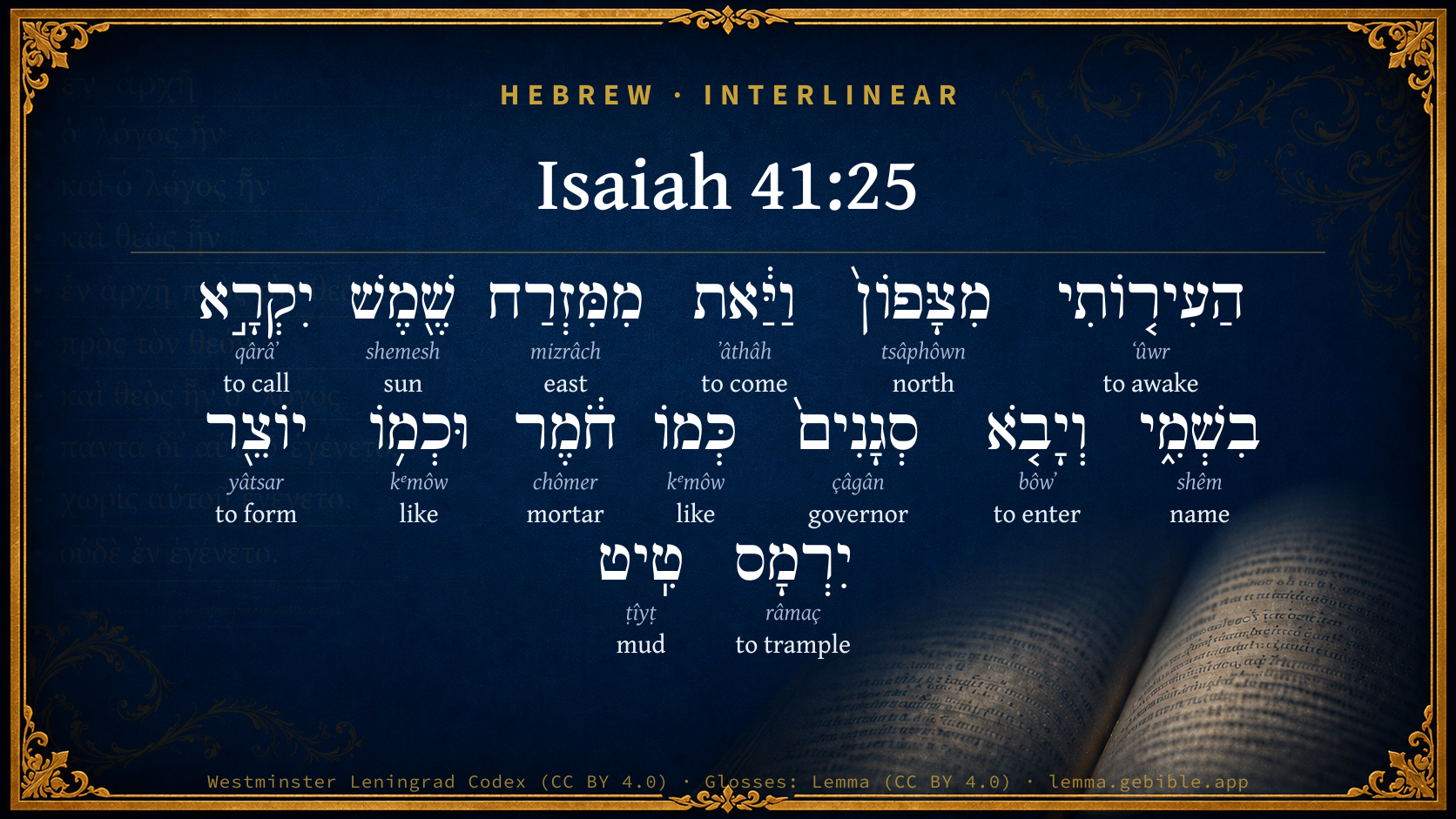
Hebrew (Westminster Leningrad Codex) Isaiah 41:25 appears in the Hebrew Old Testament. The text above is from the Westminster Leningrad Codex. Each word links to its Strong’s number, a concise gloss, and parsing drawn from the Open Scriptures Hebrew Bible morphology. Click any word for its full Brown-Driver-Briggs (BDB) entry.
Download image
Cite this verse

Isaiah 41:25 (World English Bible). Public Domain. Lemma interlinear Bible study tool, https://lemma.gebible.app/v/isaiah/41/25.

Show BibTeX & RIS
BibTeX
RIS
English Translation
I have raised up one from the north, and he has come; from the rising of the sun one who calls on my name: and he shall come on rulers as on mortar, and as the potter treads clay.
World English Bible · Public Domain
Download a study sheet

One document with this verse’s original text, its word-by-word gloss line, the meaning frame, cross-references with their text, attributed commentary, and full source and license credits — printable, and it pastes into notes with its structure intact.

This verse Autodidact and up

Study sheet (.html) Plain text (.txt)

A passage Seminary Student

Up to 50 verses in one chapter. A passage sheet keeps up to 6 commentary sources and 12 cross-references per verse, in the order this page ranks them, and says so on the sheet whenever that leaves anything out. Ask for a single verse and you get the Autodidact verse sheet above.

Everything on this page stays free to read, with no account — the sheet is a download of what is already on screen, not access to it.

Want to remove ads? Support Godless Engineer
Compare translations 3

The same verse in 3 English versions, stacked beneath the original-language interlinear above. Click any original word for its lexicon entry.

Each is an independent rendering of the whole verse — the interlinear is not word-aligned to these translations.

Highlighted words mark where these versions differ — a whole-verse word diff, not a word-by-word alignment.

  • World English Bible Public Domain
    I have raised up one from the north, and he has come; from the rising of the sun one who calls on my name: and he shall come on rulers as on mortar, and as the potter treads clay.
  • King James Version Public Domain
    I have raised up one from the north, and he shall come: from the rising of the sun shall he call upon my name: and he shall come upon princes as upon morter, and as the potter treadeth clay.
  • unfoldingWord Literal Text CC BY-SA 4.0
    I have awakened from the north, and he comes. From the rising of the sun, he calls upon my name, and he will come rulers like mud and as a potter treads clay.

unfoldingWord Literal Text — © unfoldingWord, licensed CC BY-SA 4.0. Word-aligned USFM3 via Door43 (git.door43.org/unfoldingWord/en_ult).

Versions to compare (up to 4)

3 of 4 selected

Show all 18 translations

Every available English version of this verse, each an independent rendering of the whole verse.

  • World English Bible Public Domain
    I have raised up one from the north, and he has come; from the rising of the sun one who calls on my name: and he shall come on rulers as on mortar, and as the potter treads clay.
  • Berean Standard Bible Public Domain
    I have raised up one from the north, and he has come—one from the east who calls on My name. He will march over rulers as if they were mortar, like a potter who treads the clay.
  • Majority Standard Bible Public Domain
    I have raised up one from the north, and he has come—one from the east who calls on My name. He will march over rulers as if they were mortar, like a potter who treads the clay.
  • King James Version Public Domain
    I have raised up one from the north, and he shall come: from the rising of the sun shall he call upon my name: and he shall come upon princes as upon morter, and as the potter treadeth clay.
  • American Standard Version (1901) Public Domain
    I have raised up one from the north, and he is come; from the rising of the sun one that calleth upon my name: and he shall come upon rulers as upon mortar, and as the potter treadeth clay.
  • Revised Version (1885) Public Domain
    I have raised up one from the north, and he is come; from the rising of the sun one that calleth upon my name: and he shall come upon rulers as upon mortar, and as the potter treadeth clay.
  • Geneva Bible (1599) Public Domain
    I haue raised vp from the North, and he shall come: from the East sunne shall he cal vpon my Name, and shall come vpon princes as vpon clay, and as the potter treadeth myre vnder the foote.
  • Douay-Rheims (1899) Public Domain
    I have raised up one from the north, and he shall come from the rising of the sun: he shall call upon my name, and he shall make princes to be as dirt, and as the potter treading clay.
  • Young's Literal Translation Public Domain
    I have stirred up `one' from the north, And he cometh, From the rising of the sun he calleth in My name, And he cometh in `on' prefects as `on' clay, And as a potter treadeth down mire.
  • Literal Standard Version CC BY-SA 4.0
    I have stirred up [one] from the north, || And he comes, || From the rising of the sun he calls in My Name, || And he comes in [on] prefects as [on] clay, || And as a potter treads down mire.
  • Unlocked Literal Bible CC BY-SA 4.0
    I have raised up one from the north, and he comes; from the sun's rising I summon him who calls on my name, and he will trample the rulers like mud, like a potter who is treading on the clay.
  • unfoldingWord Literal Text CC BY-SA 4.0
    I have awakened from the north, and he comes. From the rising of the sun, he calls upon my name, and he will come rulers like mud and as a potter treads clay.
  • Darby Bible Public Domain
    I have raised up one from the north, and he shall come, -- from the rising of the sun, he who will call upon my name; and he shall come upon princes as on mortar, and as the potter treadeth clay.
  • World Messianic Bible Public Domain
    “I have raised up one from the north, and he has come, from the rising of the sun, one who calls on my name, and he shall come on rulers as on mortar, and as the potter treads clay.
  • Webster's Bible Public Domain
    I have raised up one from the north, and he shall come: from the rising of the sun shall he call upon my name: and he shall come upon princes as upon mortar, and as the potter treadeth clay.
  • Free Bible Version CC BY-SA 4.0
    I have encouraged the one who comes from the north. He is from the east, and will respect me. He will tread on rulers as if they were mortar, like a potter treading on clay.
  • Bible in Basic English Public Domain
    I have sent for one from the north, and from the dawn he has come; in my name he will get rulers together and go against them; they will be like dust, even as the wet earth is stamped on by the feet of the potter.
  • JPS Tanakh (1917) Public Domain
    I have roused up one from the north, and he is come, from the rising of the sun one that calleth upon My name; and he shall come upon rulers as upon mortar, and as the potter treadeth clay.

Literal Standard Version (2020), Covenant Press — licensed CC BY-SA 4.0. Text via the HelloAO Bible API (eBible.org). Unlocked Literal Bible (unfoldingWord) — licensed CC BY-SA 4.0. Text via the HelloAO Bible API (eBible.org). unfoldingWord Literal Text — © unfoldingWord, licensed CC BY-SA 4.0. Word-aligned USFM3 via Door43 (git.door43.org/unfoldingWord/en_ult). Free Bible Version, Dr. Jonathan Gallagher — licensed CC BY-SA 4.0. Text via the HelloAO Bible API (eBible.org).

Word by word

More ways to search: Search by grammar → Find every occurrence → Compare this word →

Practice this passage: Drill this verse → Learn its vocabulary →

טִֽיט
ṭîyṭ
H2916
“mud”
Noun, Common, Masculine, Singular, Absolute
Part of Speech
Noun
Type
Common
Gender
Masculine
Number
Singular
State
Absolute
Full BDB Definition

Origin: from an unused root meaning apparently to be sticky [rath perb. a demon. From H2894 , through the idea of dirt to be swept away]

TWOT: 796a

mud, clay, mire, damp dirt - mud, mire - clay (poetical)
  1. הַעִיר֤וֹתִי ʻûwr H5782 “to awake” Verb, Hiphil, Perfect, 1st Person, Common, Singular
  2. מִצָּפוֹן֙ tsâphôwn H6828 “from · north” Preposition + Noun, Common, Feminine, Singular, Absolute
  3. וַיַּ֔את ʼâthâh H857 “and · to come” Conjunction + Verb, Qal, Sequential Imperfect, 3rd Person, Masculine, Singular
  4. מִמִּזְרַח mizrâch H4217 “from · east of” Preposition + Noun, Common, Masculine, Singular, Construct
  5. שֶׁ֖מֶשׁ shemesh H8121 “sun” Noun, Common, Both, Singular, Absolute
  6. יִקְרָ֣א qârâʼ H7121 “to call” Verb, Qal, Imperfect, 3rd Person, Masculine, Singular
  7. בִשְׁמִ֑י shêm H8034 “in/at · name · my” Preposition + Noun, Common, Masculine, Singular, Construct + Suffix, Personal, 1st Person, Common, Singular
  8. וְיָבֹ֤א bôwʼ H935 “and · to enter” Conjunction + Verb, Qal, Imperfect, 3rd Person, Masculine, Singular
  9. סְגָנִים֙ çâgân H5461 “governors” Noun, Common, Masculine, Plural, Absolute
  10. כְּמוֹ kᵉmôw H3644 “like” Preposition
  11. חֹ֔מֶר chômer H2563 “mortar” Noun, Common, Masculine, Singular, Absolute
  12. וּכְמ֥וֹ kᵉmôw H3644 “and · like” Conjunction + Preposition
  13. יוֹצֵ֖ר yâtsar H3335 “potter” Noun, Common, Masculine, Singular, Absolute
  14. יִרְמָס râmaç H7429 “to trample” Verb, Qal, Imperfect, 3rd Person, Masculine, Singular

About this verse

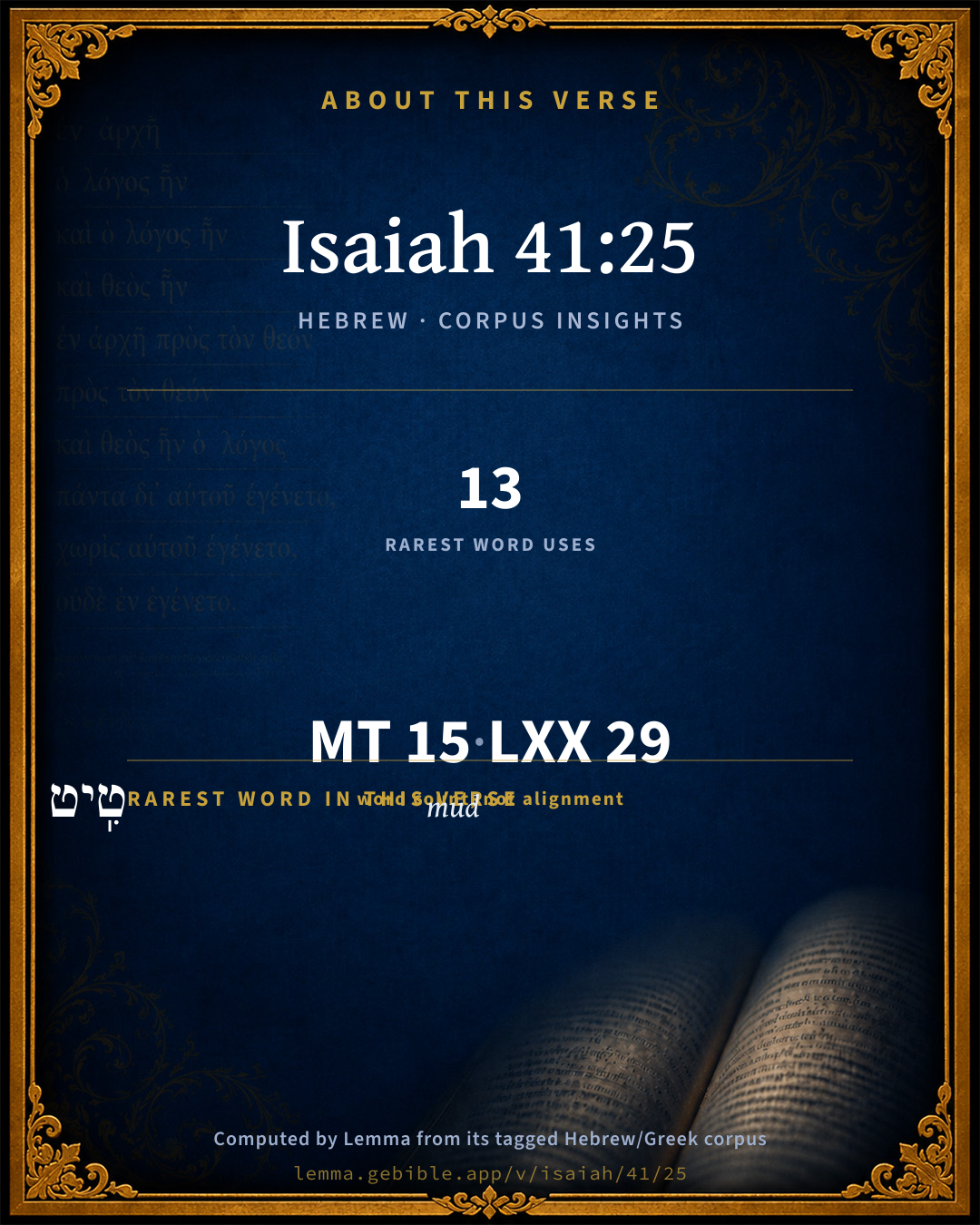
These counts appear in no published source. They are computed here, from the morphology-tagged text and Lemma’s own curated glosses. What Lemma adds →

15
words
14
distinct lemmas
Prophets
section

Notable vocabulary

The rarest word here is טִֽיט mud H2916 — appearing just 13 times in the whole Hebrew Bible.

Shared distinctive vocabulary

טִֽיט mud H2916 occurs in 12 verses of the Hebrew Bible. Also found in:

Grammatical profile

  • 5 verbs
  • 8 nouns
  • 2 prepositions

Verb forms

  • הַעִיר֤וֹתִי Hiphil · Perfect
  • וַיַּ֔את Qal · Sequential Imperfect
  • יִקְרָ֣א Qal · Imperfect
  • וְיָבֹ֤א Qal · Imperfect
  • יִרְמָס Qal · Imperfect

Repetition

A word recurs within this verse — often emphatic in Hebrew:

  • כְּמוֹ like H3644 ×2

Hebrew & Septuagint length

In English translation the verse runs 39 words from the Hebrew and 48 from the Septuagint (LXX English) — closely comparable.

A rough comparison of the two English renderings, which tokenize alike — not a word-level alignment.

Word counts can differ between the Hebrew and the Greek without any difference in meaning — e.g. the Hebrew direct-object marker אֵת has no separate Greek word, and Greek often adds the article ὁ.

In the original languages it is 15 Hebrew tokens and 29 Greek tokens — but the two are counted differently (Hebrew bundles its prefixes and suffixes into one token; the Greek is in lemma form), so that isn’t a like-for-like length.

Cross-references

12

Topical passages linked to Isaiah 41:25 in the Treasury of Scripture Knowledge — connected by theme and wording, ordered by reader-vote popularity; previews shown in the World English Bible.

  • Isaiah 41:2 Who has raised up one from the east, whom he calls in righteousness to his foot? he gives nations before him, and makes him rule over kings; he gives them as the dust to his sword, as the driven stubble to his bow.
  • 2 Samuel 22:43 Then did I beat them small as the dust of the earth, I did crush them as the mire of the streets, and did spread them abroad.
  • Isaiah 10:6 I will send him against a profane nation, and against the people of my wrath will I give him a charge, to take the spoil, and to take the prey, and to tread them down like the mire of the streets.
  • Isaiah 44:28–45:6 Who says of Cyrus, [He is] my shepherd, and shall perform all my pleasure, even saying of Jerusalem, She shall be built; and of the temple, Your foundation shall be laid.
  • Isaiah 46:10–11 declaring the end from the beginning, and from ancient times things that are not [yet] done; saying, My counsel shall stand, and I will do all my pleasure;
  • Micah 7:10 Then my enemy will see it, And shame will cover her who said to me, Where is Yahweh your God? Then my enemy will see me and will cover her shame. Now she will be trodden down like the mire of the streets.
  • Zechariah 10:5 They shall be as mighty men, Treading down muddy streets in the battle; And they shall fight, because Yahweh is with them; And the riders on horses will be confounded.
  • Ezra 1:2–3 Thus says Cyrus king of Persia, All the kingdoms of the earth has Yahweh, the God of heaven, given me; and he has charged me to build him a house in Jerusalem, which is in Judah.
  • Isaiah 21:2 A grievous vision is declared to me; the treacherous man deals treacherously, and the destroyer destroys. Go up, Elam; besiege, Media; all the sighing of it have I made to cease.
  • Isaiah 45:13 I have raised him up in righteousness, and I will make straight all his ways: he shall build my city, and he shall let my exiles go free, not for price nor reward, says Yahweh of Hosts.
  • Jeremiah 50:3 For out of the north there comes up a nation against her, which shall make her land desolate, and none shall dwell therein: they are fled, they are gone, both man and animal.
  • Jeremiah 51:27–29 Set up a standard in the land, blow the trumpet among the nations, prepare the nations against her, call together against her the kingdoms of Ararat, Minni, and Ashkenaz: appoint a marshal against her; cause the horses to come up as the rough canker-worm.

Cross-references courtesy of OpenBible.info (CC BY 4.0).

Hebrew and Greek witnesses Masoretic Hebrew ↔ Greek Septuagint

The same verse in the two great witnesses to the Old Testament, shown verse-for-verse.

These are two independent witnesses, not word-aligned to each other, and the Septuagint is shown in lemma (dictionary) form.

Hebrew Isaiah 41:25 Masoretic · Westminster Leningrad Codex

הַעִיר֤וֹתִי מִצָּפוֹן֙ וַיַּ֔את מִמִּזְרַח שֶׁ֖מֶשׁ יִקְרָ֣א בִשְׁמִ֑י וְיָבֹ֤א סְגָנִים֙ כְּמוֹ חֹ֔מֶר וּכְמ֥וֹ יוֹצֵ֖ר יִרְמָס טִֽיט

I have raised up one from the north, and he has come; from the rising of the sun one who calls on my name: and he shall come on rulers as on mortar, and as the potter treads clay.

World English Bible · Public Domain

Greek LXX Isaiah 41:25 Septuagint · lemma form

ἐγώ δέ ἀγείρω ὁ ἀπό βορέας καί ὁ ἀπό ἥλιος ἀνατολή καλέω ὁ ὄνομα ἐγώ ἔρχομαι ἄρχων καί ὡς πηλός κεραμεύς καί ὡς κεραμεύς καταπατέω ὁ πηλός οὕτως καταπατέω

But I have raised up him that comes from the north, and him that comes from the rising of the sun: they shall be called by my name: let the princes come, and as potter's clay, and as a potter treading clay, so shall you⌃ be trodden down.

LXX2012 (modern English Septuagint) · Public Domain

Hebrew: Westminster Leningrad Codex (CC BY 4.0). Greek: Septuagint (public domain); English from LXX2012 (modern English Septuagint) (Public Domain). How the Septuagint differs from the Hebrew →

Targum (Aramaic paraphrase)

1

The Targum is the ancient Jewish Aramaic paraphrase of the Hebrew Scriptures — an interpretive translation, not the Hebrew text itself. Onkelos (literal) and Pseudo-Jonathan (expansive) render the Torah, and Jonathan the Prophets. Coverage is partial: where no permissively-licensed English translation exists for a verse, only the Aramaic is shown. This is verse-level text, not a word-by-word alignment to the Hebrew.

  1. Targum Jonathan Prophets (Joshua–Malachi)
    אַיְתֵיתֵי בִּגְלַאִי מְלַךְ דְתַקִיף מֵרוּחַ צִפּוּנָא וְיֵיתֵי כְּמִפַּק שִׁמְשָׁא בִּגְבוּרְתֵּהּ מִמַדִנְחָא אַגְבְּרִינֵהּ בִּשְׁמִי וְיֵיתִי וְיֵדוּשׁ שִׁלְטוֹנֵי עַמְמַיָא כְּמָא דְדָיְשִׁין יַת עַפְרָא וּכְפַחְרָא דְעָרִיךְ יַת טִינָא:

    I will certainly bring a king who is mightier than the north wind, and he shall go forth as the going forth of the sun in might from the east: I will strengthen him by my name, and he shall come, and tread the rulers of the nations under foot, as those who tread the dust under foot, as the potter who prepares the clay.

    Targum Jonathan — Aramaic: “Mikraot Gedolot” (public domain). English: “Sefaria Community Translation” (CC0 1.0 (public-domain dedication)); “London "Chaldee Paraphrase," 1871” (public domain). Text via Sefaria.

Commentary

Notes on Isaiah 41:25 from classic Christian and Jewish commentators (each source and its license shown beneath its notes). The classic Christian expositions comment on the surrounding passage and are grouped to its opening verse, so a note may address several verses; the Jewish commentaries on the Tanakh (Rashi and others) are per-verse, so they appear only where the commentator wrote on this verse.

Lemma curates 59 commentaries, every one of them public domain or Creative Commons licensed, each selected and text-cleaned for this edition rather than reprinted as found. About our sources →

Trapp's Complete Commentary

John Trapp

Isa 41:25 I have raised up [one] from the north, and he shall come: from the rising of the sun shall he call upon my name: and he shall come upon princes as [upon] morter, and as the potter treadeth clay.

Ver. 25. I have raised up one from the north.] Here God beginneth to prove that he can do both those things, whereof the heathen vanities could do neither. This one in the text is Cyrus, say some; Christ, say others, by whom God here foretelleth that he will punish his enemies, but do good to his Church and chosen.

He shall call upon my name.] Or, Proclaim my name.

John Trapp, A Commentary or Exposition upon All the Books of the Old and New Testament (1647–1656) — public domain. Text from a community e-Sword module.

Joseph Benson's Commentary

Isa 41:25. I have raised up, &c. — You neither foreknow, nor can do any thing. But I do now fore-tel, and will certainly effect, a great revolution and change in the world, which you shall not be able to hinder; one from the north — Cyrus might be said to come from the north, because he was a Mede by his mother, as he was a Persian by his father; or because a great part of his army was gathered out of Media, which was northward in reference to Judea, and because Darius the Mede was joined with him in this expedition. From the rising, &c., shall he call upon my name — Or proclaim my name, as the words may be rendered, which Cyrus did in express and emphatical terms, Ezr 1:1-2. He shall come upon princes as upon mortar — Treading them down as easily as a man treadeth down mortar.

Joseph Benson's Commentary on the Old and New Testaments (1811–1818) — public domain. Text from a community e-Sword module.

Tyndale Open Study Notes

Tyndale Open Resources

41:25 I have stirred up a leader: The God who had planned the Exile through Babylon had already planned for Israel’s restoration from exile through Cyrus (see 41:2; see also 13:17). • Although Persia is located to the east, rough terrain required those traveling to Israel and Judah to enter from the north. • I will give him victory . . . He will trample them: As Babylon was sent to trample Assyria, so Persia would trample Babylon.

Tyndale Open Study Notes — © Tyndale Open Resources, licensed CC BY-SA 4.0. Text via the HelloAO Bible API.

Geneva Bible (1599)

Geneva Bible translators

Both of the Chaldeans and others.

Meaning, the Chaldeans.

That is, Cyrus, who shall do all things in my name and by my direction: whereby he meaneth that both their captivity and deliverance shall be ordered by God’s providence and appointment.

Geneva Bible (1599) marginal notes — public domain. Text via Bolls.life.

Jamieson, Fausset & Brown

Robert Jamieson, A. R. Fausset & David Brown

raised up--in purpose: not fulfilled till a hundred fifty years afterwards.

north--In Isa 41:2, "from the East"; both are true: see the note there.

call . . . my name--acknowledge Me as God, and attribute his success to Me; this he did in the proclamation (Ezr 1:2). This does not necessarily imply that Cyrus renounced idolatry, but hearing of Isaiah's prophecy given a hundred fifty years before, so fully realized in his own acts, he recognized God as the true God, but retained his idol (so Naaman, 2Ki. 5:1-27; compare Kg2 17:33, Kg2 17:41; Dan 3:28; Dan 4:1-3, Dan 4:34-37).

princes--the Babylonian satraps or governors of provinces.

mortar--"mire"; He shall tread them under foot as dirt (Isa 10:6).

Jamieson, Fausset & Brown — Commentary Critical and Explanatory on the Whole Bible (1871) — public domain (CC PDM 1.0). Text via the HelloAO Bible API.

Adam Clarke's Commentary

Verse 25. I have raised up one from the north] "That is," says Kimchi, "the Messiah. The king of Assyria placed the ten tribes in Chalach and Chabar by the river Gozan, and in the cities of the Medes, 2Kg 17:6, which lands lie northerly and easterly."

He shall come upon princes - "He shall trample on princes"] For יבא yabo, Le Clerc reads יבס yebes, from the Chaldee, who seems to read both words. "Forte legend. ויבס vaiyebes vel וירמס vaiyirmos: sequitur ס." "This should perhaps be read ויבס vaiyebes, or וירמס vaiyirmos: a ס samech follows." - Secker. See Na 3:14.

Adam Clarke's Commentary on the Bible (1810–1826) — public domain. Text from a community e-Sword/MySword module.

Ellicott's Commentary for English Readers

(25) I have raised up one from the north.—The north points to Media, the east to Persia, both of them under the rule of the great Deliverer.

Shall he call upon my name.—The word admits equally of the idea of “invoking” or “proclaiming.” It may almost be said, indeed, that the one implies the other. The words find a fulfilment in the proclamations of Cyrus cited in 2Ch_36:22-23; Ezr_1:2-4

He shall come upon princes.—The Hebrew noun Sagan is a transitional form of a Persian (Delitzch) or Assyrian (Cheyne) title for a viceroy or satrap.

As the potter treadeth clay.—Commonly the image describes the immediate action of Jehovah. (Jer_18:6; Jer_19:10). Here it is used for the supreme dominance of His instrument.

A Bible Commentary for English Readers, edited by Charles John Ellicott (1878–1897) — public domain. Text from a community e-Sword module.

The Cambridge Bible for Schools and Colleges

gen. ed. J. J. S. Perowne

25. raised up] Strictly: stirred up (as in Isa_41:2) i.e. “impelled into activity” (Driver).

from the north … from the rising of the sun (cf. Isa_41:2)] Scarcely: “from Media (in the north)” and “from Elam (in the east).” The terms are poetic; the north is the region of mystery, and the east the region of light (ch. Isa_24:15). In point of fact Cyrus came from the north-east.

shall he call upon my name] Render with R.V. one that calleth (or, shall call) on my name. The clause is a relative one, and forms the obj. to “stirred up.” The expression can hardly mean less than that Cyrus shall acknowledge Jehovah as God; the meaning “make known everywhere, by his deeds” (Dillmann) is not to be defended. It is true that in ch. Isa_45:4 f. it is said that Cyrus had not known Jehovah; but it is also said (Isa_41:3) that the effect of his remarkable successes will be “that thou mayest know that I am Jehovah that calleth thee by thy name, the God of Israel.” There is therefore no difficulty in the idea that Cyrus, who was at first the unconscious instrument of Jehovah’s purpose, shall at length recognise that Jehovah was the true author of his success. But the further explanation that Cyrus shall “become conscious of his original religious affinity to the Jews, and act upon that consciousness” (Cheyne) goes beyond the language of the prophet.

come upon princes] is a possible construction; but it is better, with many comm. since Clericus, to read “tread” (yâbûṣ for yâbô’). The word for “princes” (ṣâgân) is Assyrian (shaknu) and occurs first in Ezekiel.

25–29. The general argument is now brought to bear on the particular case of the raising up of Cyrus.

The Cambridge Bible for Schools and Colleges (gen. ed. J. J. S. Perowne; Cambridge University Press, 1878–1918) — public domain. Text from a community e-Sword module.

John Gill's Exposition

I have raised up one from the north,.... Either one people, or one person; a mighty king, as the Targum; meaning either Cyrus, who might be said to come from the north, and from the rising of the sun, or the east, as in the next clause; since he was by birth a Medo-Persian, hence called a mule; by his mother a Mede, and the country of Media lay rather to the north of Babylon; and by his father a Persian, and Persia lay to the east of it; and the forces he brought with him against it were partly Medes, and partly Persians; though some, as Jarchi observes, think two persons are meant in this and the next clause; in this Nebuchadnezzar, who came from Babylon, which lay north of Judea, to invade it; and in the other Cyrus, who came from the east, and proclaimed the name of the Lord, and liberty to the captive Jews. Kimchi and his father both interpret it of the King Messiah, as do also more ancient Jewish writers (c), of whom Cyrus was a type; but to me it seems best of all, as most agreeable to the scope and tenure of the prophecy, to understand it of Constantine, who, as reported, was born in Britain, in the northern part of the world; but, when called to the empire, was in the eastern parts of it; and so with great propriety it is expressed here, and in the following clause:

and from the rising of the sun he shall call upon my name; which those that apply the prophecy to Cyrus explain by Ezr 1:1, but is much more applicable to Constantine, who was a worshipper of the true God, which invocation of his name is expressive of; and who openly professed the name of Christ, and encouraged those that did, and spread his name and fame, his Gospel and his glory, throughout the empire, east and west:

and he shall come upon princes as upon morter, and as the potter treadeth clay; that is, he shall come upon them with his army, and conquer them, and tread them down, and trample upon them, as morter is trodden upon, or mire in the streets; or as the clay is trodden by the potter, who does with it as he pleases; which those who interpret it of Cyrus understand of Astyages, Croesus, Belshazzar, and others; see Isa 14:1, and is as true of Constantine, who subdued the emperors of Rome, trod them under his feet, as Maximius, Maxentius, Licinius, &c.; moreover, the word "saganin", here used, is a word used by Jewish writers for priests, for such who were the deputies of the high priest; and it may design here the Pagan priests, and the destruction of them, and of Paganism in the Roman empire by Constantine.

(c) Vajikra Rabba, sect. 9. fol. 153. 1. Bemidbar Rabba, sect. 13. fol. 208. 1. Shirhashirim Rabba, fol. 19. 2.

John Gill's Exposition of the Whole Bible (1746–1763) — public domain (CC PDM 1.0). Text via the HelloAO Bible API.

Albert Barnes' Notes on the Bible

I have raised up one - In the previous verses God had shown that the idols had no power of predicting future events. He stakes, so to speak, the question of his divinity on that point, and the whole controversy between him and them is to be decided by the inquiry whether they had the power of foretelling what would come to pass. He here urges his claims to divinity on this ground, that he had power to foretell future events. In illustration of this, he appeals to the fact that he had raised up, that is, in purpose, or would afterward raise up Cyrus, in accordance with his predictions, and in such a way that it would be distinctly seen that he had this power of foretelling future events. To see the force of this argument, it must be remembered that the Jews are contemplated as in Babylon, and near the close of their captivity; that God by the prophets, and especially by Isaiah, distinctly foretold the fact that he would raise up Cyrus to be their deliverer; that these predictions were uttered at least a hundred and fifty years before the time of their fulfillment; and that they would then have abundant evidence that they were accomplished. To these recorded predictions and to their fulfillment, God here appeals, and designs that in that future time when they should be in exile, his people should have evidence that He was worthy of their entire confidence, and that even the pagan should see that Yahweh was the true God, and that the idols were nothing. The personage referred to here is undoubtedly Cyrus (see the notes at Isa 41:2; compare Isa 45:1).

From the north - In Isa 41:2, he is said to have been raised up ‘from the east.’ Both were true. Cyrus was born in Persia, in the country called in the Scriptures ‘the east,’ but he early went to Media, and came from Media under the direction of his uncle, Cyaxares, when he attacked and subdued Babylon. Media was situated on the north and northeast of Babylon.

From the rising of the sun - The east - the land of the birth of Cyrus.

Shall he call upon my name - This expression means, probably, that he should acknowledge Yahweh to be the true God, and recognize him as the source of all his success. This he did in his proclamation respecting the restoration of the Jews to their own land: ‘Thus saith Cyrus, king of Persia, Yahweh, God of heaven, hath given me all the kingdoms of the earth’ Ezr 1:2. There is no decided evidence that Cyrus regarded himself as a worshipper of Yahweh, or that he was a pious man, but he was brought to make a public recognition of him as the true God, and to feel that he owed the success of his arms to him.

And he shall come upon princes - Upon the kings of the nations against whom he shall make war (see Isa 41:2-3). The word rendered here ‘princes’ (from סגן seggen or סגן ro n sâgân), denotes properly a deputy, a prefect, a governor, or one under another, and is usually applied to the governors of provinces, or the Babyionian princes, or magistrates Jer 51:23, Jer 51:28, Jer 51:57; Eze 23:6, Eze 23:12, Eze 23:33; Dan 3:2, Dan 3:27; Dan 6:8. It is sometimes applied, however, to the chiefs and rulers in Jerusalem in the times of Ezra and Nehemiah Ezr 9:2; Neh 2:16; Neh 4:8, Neh 4:13; Neh 5:7. Here it is used as a general term; and the sense is, that he would tread down and subdue the kings and princes of the nations that he invaded.

As upon mortar - (See the note at Isa 10:6).

Albert Barnes' Notes on the Bible (1834–1885) — public domain. Text from a community e-Sword/MySword module.

Haydock's Catholic Bible Commentary

Sun. Cyrus had a Persian for his father, and a Mede for his mother; thus uniting both nations, (Calmet) so that he was styled a mule by an ancient oracle. (Eusebius, præp. ix. 41.) --- These countries lay to the north-east of Judea. (Calmet)

George Leo Haydock (1774–1849), Haydock's Catholic Family Bible and Commentary, 1859 edition — public domain. Excludes Psalms (Douay-Rheims chapter numbering differs from Protestant) and Deuterocanonical books (Catholic canon only).

Matthew Poole's English Annotations

I have raised up; you neither foreknow nor can do any thing; but I do now foretell, and will certainly effect, great revolution and change in the world, which you shall not be able to hinder. One; which word, though not expressed in the Hebrew, must necessarily be understood, as being oft designed in the following words by the pronoun he. He understands one people; or rather one person, prince, or general, together with his people or forces, as appears from the latter part of the verse. Some conceive that the prophet in this place speaks of two several persons; in the first clause of Nebuchadnezzar, who in Scripture is commonly said to come

from the north, as Jer 1:13,15; 4:6; and the next clause of Cyrus, who came from the east, Isa 46:11. And then the words may be thus rendered, one

from the north, and he shall come; and one

from the rising of the sun, he shall call, &c. But it seems more natural and easy to understand the whole context of one and the same person, even of Cyrus, of whom he spake before, Isa 41:2, &c., who might well be said to come, both from the north and from the east: from the north rather, because he was a Mede by his mother, as he was a Persian by his father; or because a great part of his army was gathered out of Media, which was, and in Scripture is said to be, northward in reference to Judea, Jer 50:9,41; 51:48; and because Darius the Mede was joined with him in this expedition: and from the east, because Persia was directly eastward from Judea. And peradventure this work of

calling upon or proclaiming God’s name is here ascribed to him as he came from the east, rather than as he came from the north, because that work was not done by Darius the Mede, but by Cyrus the Persian.

Shall he call upon my name; or rather, as others render it, who shall call upon; or rather, proclaim my name, which Cyrus did in express and emphatical terms, Ezr 1:1-2.

He shall come upon princes as upon mortar; treading them down as easily as a man treadeth down mortar.

Matthew Poole's English Annotations on the Holy Bible (1683–1685) — public domain. Text from a community e-Sword/MySword module.

Whedon's Commentary on the Bible

Daniel D. Whedon

25. I have raised up one — Jehovah keeps the field as the moulder of history and foreteller of the future. In purpose he has “raised up one” from the north. In Isa_41:2 it is “from the east.” Both are true. The joint powers of Media and Persia lay in both directions from Babylon. See notes to Isa_41:2. This makes true God’s prediction of Cyrus, who is to come one hundred and fifty years after.

From the rising of the sun — That is, from Persia, or even farther east, and may refer, not only to Cyrus, but concretely to the improved heathenism, but still heathen religion, which was to come to Babylon through Cyrus, namely, Zoroastrianism, a monotheistic religion, though crudely mixed, yet designed perhaps to play a part in palpably moulding the Hebrew religion in some additional items. (See RAWLINSON’S Five Great Monarchies, vol. iv, chap. 6.)

Daniel D. Whedon (gen. ed.), Commentary on the Old and New Testaments (1874–1909) — public domain. Text from a community e-Sword module.

The Pulpit Commentary

It remains for Jehovah to plead his own cause, to vindicate his own Divinity. He adduces, as proof of his power in action, the fact of his raising up Cyrus; as proof of his ability to predict, the fact that he has announced his coming. One from the north... from the rising of the sun. Both as a Persian, and as King of Elam, Cyrus might be considered to come from the east. In fact, however, when he attacked Babylon, he fell upon it mainly from the north. After his conquest of Astyages (Istivegu), he made Ecbatana his capital (Herod., 1:153); and it was from this comparatively northern city that he directed his attack upon Nabonidus. His march lay by way of Arbela ("Transactions of the Society of Bibl. Archaeol.," vol. 7. p. 159) and Sippara (ibid., p. 165), through the district called Akkad to the Chaldean capital. Herodotus agrees with the monuments in bringing him to Babylon from the north. Shall he call upon my Name; or, shall he. proclaim my Name. (For the actual proclamation of Jehovah"s Name by Cyros, see Ezr_1:3; and note especially the phrase, "He i.e. Jehovah is the God.") Recent discoveries have raised the suspicion that Cyrus was an eyncretist, who was willing to accept the chief god of any nation as identical with his own Ormuzd. But it is to be borne in "mind that the document which has produced this impression is one issued by the priestly authorities of Babylon in their own language, and may have been quite unknown to the Persian court. Cyrus may have been a better Zoroastrian than he is represented by the priests of Merodach. The Zoroastrian religion was, as Delitzsch observes, "nearest to the Jewish religion of all the systems of heathenism" (see. Ancient Monarchies," vol. 3. pp. 93-117; and comp. Pusey, "Lectures on Daniel," pp. 530-550). He shall come upon princes as upon mortar; i.e. he shall tread them underfoot, mortar being commonly mixed with the feet, as was also clay for bricks and pottery (Herod., 2:36). The chief" princes" whom Cyrus is known to have conquered were Astyages of Media, Croesus of Lydia, and Nabenidus of Babylon. He was studiously mild in his treatment of royal captives, but naturally deprived them of all power.

The Pulpit Commentary (1880–1919), ed. H.D.M. Spence-Jones & Joseph S. Exell — public domain. Text from a community e-Sword module.

John Wesley's Explanatory Notes

Raised - Cyrus, might be said to come from the north, because he was a Mede by his mother, as he was a Persian by his father; or because a great part of his army was gathered out of Media, which was northward, in reference to Judea, and because Darius the Mede was joined with him in this expedition. Proclaim - This Cyrus did in express, emphatical terms, Ezra i, 1, 2. As on mortar - Treading them down, as easily as a man treads down mortar.

John Wesley, Explanatory Notes Upon the Whole Bible (1754–1765) — public domain. Text via the GEBible commentary corpus.

Keil & Delitzsch

C. F. Keil & F. Delitzsch

The more conclusively and incontrovertibly, therefore, does Jehovah keep the field as the moulder of history and foreteller of the future, and therefore as God above all gods. "I have raised up from the north, and he came: from the rising of the sun one who invokes my name; and he treads upon satraps as mud, and like a potter kneadeth clay." The object of the verb hâ‛ı̄rōthı̄ (I have wakened up) is he who came when wakened up by Jehovah from the north and east, i.e., from Media and Persia (ויּאת = ויּאתּ for ויּאת, with evasion of the auxiliary pathach, Ges. 76, 2, c), and, as the second clause affirms, who invokes or will invoke the name of Jehovah (at any rate, qui invocabit is the real meaning of qui invocat). For although the Zarathustrian religion, which Cyrus followed, was nearest to the Jehovah religion of all the systems of heathenism, it was a heathen religion after all. The doctrine of a great God (baga vazarka), the Creator of heaven and earth, and at the same time of a great number of Bagas and Yazatas, behind whose working and worship the great God was thrown into the shade, is (apart from the dualism condemned in Isa 45:7) the substance of the sacred writings of the Magi in our possession, as confirmed by the inscriptions of the Achemenides.

(Note: Windischmann, Zoroastrische Studien, pp. 134, 135.)

But the awakened of Jehovah would, as is here predicted, "call with the name, or by means of the name, of Jehovah," which may mean either call upon this name (Zep 3:9; Jer 10:25), or call out the name (compare Exo 33:19; Exo 34:5, with Exo 35:30) in the manner in which he does make use of it in the edict setting the exiles free (Ezr 1:2). The verb יבא which follows (cf., Isa 41:2) designated him still further as a conqueror of nations; the verb construed with an accusative is used here, as is very frequently the case, in the sense of hostile attack. The word Sâgân, which is met with first in Ezekiel - apart, that is to say, from the passage before us - may have owed its meaning in the Hebrew vocabulary to its similarity in sound to sōkhēn (Isa 22:15); at any rate, it is no doubt a Persian word, which became naturalized in the Hebrew (ζωγάνης in Athenaeus, and Neo-Pers. sichne, a governor: see Ges. Thes.), though this comparison is by no means so certain

(Note: Spiegel has the following remarks upon the subject: There is but very little probability in the etymologies which can be suggested for the word sâgân through the help of the old Persian. The new Persian shihne cannot be traced beyond Neo-Persian, and even there it is somewhat suspicious on account of the ḥ which it contains, and which is not Persian. The only real Persian word to which I could think of tracing it is shahr, a city (old Bactrian khshathra, or shoithra, a place of abode); or it might possibly have sprung from shoithraka, a supposititious word, in the sense of governor of a district, but with the r changed into n (a change which only occurs in Huzvaresh) and the h into ḥ. There are also difficulties in the comparison of the old Bactrian canh, to say or express solemnly. An adjective canhâna (expressing, commanding), formed from this verb, would be pronounced canhâna or even câna in old Persian; and from this Sâgân would have to be obtained, so that we should still want the n to take the place of the Gimel. At the same time, there is a still harsher form of the root canh in the Gatha dialect, namely cak (not the same as the Sanskrit cak, to be strong, as Haug supposes), though this comparison is by no means so certain, from which the Neo-Persian sachan, sachun, a word, is derived; so that it appears to have been also current in old Persian. Accordingly, the form cakâna may also have been used in the place of canhâna, and this might suit in some degree for sâgân.)

as that σατράπης is the same as the Ksatrapâv of the inscriptions, i.e., protector of the kingdom.

(Note: See H. Rawlinson, Asiatic Journal, xi. 1, p. 116 ss.; and Spiegel, Keilinschriften, p. 194.)

Without at all overlooking the fact that this word segânı̄m, so far as it can really be supposed to be a Persian word, favours the later composition of this portion of the book of Isaiah, we cannot admit that it has any decisive weight, inasmuch as the Persian word pardēs occurs even in the Song of Solomon. And the indications which might be found in the word segânı̄m unfavourable to Isaiah's authorship are abundantly counterbalanced by what immediately follows.

Keil & Delitzsch — Biblical Commentary on the Old Testament (1861–1891) — public domain (CC PDM 1.0). Text via the HelloAO Bible API. (Old Testament only.)

J. A. Alexander on Isaiah

Joseph Addison Alexander

“I have raised up (one) from the north, and he has come; from the rising of the sun shall he call upon my name; and he shall come upon princes as upon mortar, and as a potter treadeth clay.” This is a specific application of the general conclusion in v. 24. If the gods of the heathen could do absolutely nothing, it was impossible that they should be the authors of any one remarkable event, and especially of that on which the Prophet has his eye. The expressions are remarkably similar to those in v. 2, so that the Prophet may be here said to resume the train of thought which had been interrupted at the end of v. 4. Having taken occasion to describe the effect of the event foretold upon the worshipper of idols, and from that to show the impotence of the gods themselves, he returns to the event which he had been describing, and continues his description. As before, he takes his stand at an intermediate point between the beginning and the end of the whole process, as appears from the successive introduction of the preterit and future. With the single substitution of ‘he has come’ for ‘he shall come’, the common version is entirely correct. The mention of the north and east together has been variously explained. A satisfactory hypothesis, perhaps, is that the subject of this passage is not a determinate individual, but the conqueror indefinitely, who is not identified till afterwards. The act of calling on the name of Jehovah is commonly regarded as an allusion to the profession of the true religion, or at least the recognition of Jehovah as the true God, on the part of Cyrus (Ezr 1:2). Compare the figures of the last clause with Isa 10:6; Isa 25:10.

Joseph Addison Alexander, The Prophecies of Isaiah (1846–1847; New York: Scribner, 1870–1878) — public domain. Text from a community e-Sword module.

unfoldingWord translationNotes

Door43 World Missions Community

General Information:

Yahweh continues speaking.

I have raised up one

Yahweh speaks of appointing a person as if he raised that person up. AT: "I have appointed one" (See: Metaphor)

from the sun's rising

This refers to the east, the direction from which the sun rises. AT: "from the east" (See: Idiom)

him who calls on my name

Possible meanings are 1) that this person invokes Yahweh for his success or 2) that this person worships Yahweh.

he will trample the rulers

Conquering the rulers of other nations is spoken of as if it were trampling them under foot. AT: "he will conquer the rulers" (See: Metaphor)

like a potter who is treading on the clay

Yahweh compares the way in which this person will trample the other rulers with the way that a potter tramples on clay to mix it with water. (See: Simile)

Who announced this from the beginning, that we might know? Before this time, that we may say, "He is right"?

Yahweh uses these rhetorical questions to mock the idols that the people worship. The implied answers are 1) that the idols have not done these things and 2) that Yahweh is the one who has done these things. AT: "None of the idols announced this from the beginning, that we might know. And none of them announced this before time, that we may say, 'He is right.'" (See: Rhetorical Question andEllipsis)

Indeed none of them decreed it, yes, none heard you say anything

"Indeed, none of the idols decreed it. Indeed, no one heard you idols say anything"

translationWords

raise

call

name

rule

decree

unfoldingWord translationNotes — © Distant Shores Media and the Door43 World Missions Community, licensed CC BY-SA 4.0. Source: git.door43.org/Door43/en_tn.

Rashi

Rabbi Shlomo Yitzchaki (Rashi)

I have aroused from the north and he came I tell the future events. Behold I arouse Cyrus from the north to build the ruins of Jerusalem, and he came upon Babylon to destroy it.

from the rising of the sun he shall call in My name (Ezra 1:2) “All the kingdoms of the earth has the Lord God of the heavens given me.” And it appears that Persia is northeast of Eretz Israel. Another explanation is: I aroused Nebuchadnezzar from the north to destroy My city, and he came, and I aroused Cyrus from the east, that he call in My name to build My city, for the kingdom of Persia is east of Eretz Israel, as it is stated (Dan. 8:4): “I saw the ram butting etc.” [This verse in Daniel proves it. “I saw the ram butting to the west and to the north and to the south.” We deduce that he came from the east.] Jonathan paraphrases: I brought speedily a king, strong as the north wind, and he will come as the sun comes out with its might from the east; I will strengthen him with My name.

and he shall come [upon] princes And he shall come upon the king of Babylon and upon his princes as he would come to trample upon mire, and as a potter tramples clay for earthenware vessels, so will he trample the princes.

Rashi on the Tanakh — English translations: “The Judaica Press complete Tanach with Rashi, translated by A. J. Rosenberg” (CC BY 4.0); “Pentateuch with Rashi's commentary by M. Rosenbaum and A.M. Silbermann, 1929-1934” (public domain); “The Metsudah Tanach series, Lakewood, N.J” (CC BY 4.0); and “The Book of Joshua, Metsudah Publications, 1997” (CC BY 4.0). Text via Sefaria.

Ibn Ezra

Rabbi Abraham ibn Ezra

העירותי I have raised. The Pathah under ה is caused by the ע which follows.

From the north, Elam was north-east of Babylon. The word איש a man must be supplied: I have raised up a man from the north; Cyrus is meant.

ויאת And he came. It is an irregular form, because of the first and third radical (א and ה) being weak letters; it would have been of the form וַיׅפֶן, but the א being silent, the Hirek under י is changed into Pathah as is usually the case with gutturals; ויאת is Kal.

And he shall come upon princes, etc. He shall come into the land or the camp of princes, and tread upon them, as upon mortar.

Ibn Ezra on the Tanakh — English translations: “Sefaria Community Translation” (CC0 1.0 (public-domain dedication)); “Yalkut, Sifsei Chachomim Chumash, Metsudah Publications, 2009” (CC BY 4.0); and “Commentary of Ibn Ezra on Isaiah - trans. by M. Friedlander, 1873” (public domain). Text via Sefaria.

Lesson kit

Teaching starters — assembled from the data on this page, not authored interpretation. Every prompt links to the verse data it draws on. Edit before teaching.

Isaiah, in the Prophets, opens this verse with 15 words (14 distinct Hebrew lemmas). Its most distinctive word is ṭîyṭ (“mud”). A historical commentator’s framing appears above. Read the whole chapter for the surrounding context.

Discussion questions

  1. The word ṭîyṭ carries the sense “mud.” How does it shape the verse?
  2. How does 2 Samuel 22:43, which shares the word «mud», read alongside this verse?
  3. What does the repetition of “like” (2× in this one verse) do in this verse?
  4. These translations render this verse differently; the difference is in the English rendering, not the original. What questions does that raise?
  5. «הַעִיר֤וֹתִי» is a Hiphil Perfect verb. How does that grammatical form shape the action described?
  6. Compare how Trapp's Complete Commentary and Joseph Benson's Commentary read this verse. Where do they agree or differ?

Things to notice

Reading settings

Reading text

Shown beneath each verse's original-language words.

Old Testament
Old Testament edition

Read the OT as the Masoretic Hebrew (MT) or the Greek Septuagint (LXX).

English shown for the Greek Septuagint (in the Hebrew ↔ Greek comparison).

Comparing translations? Open the Compare panel on any verse page to stack up to four side by side.