Song of Solomon 6:10

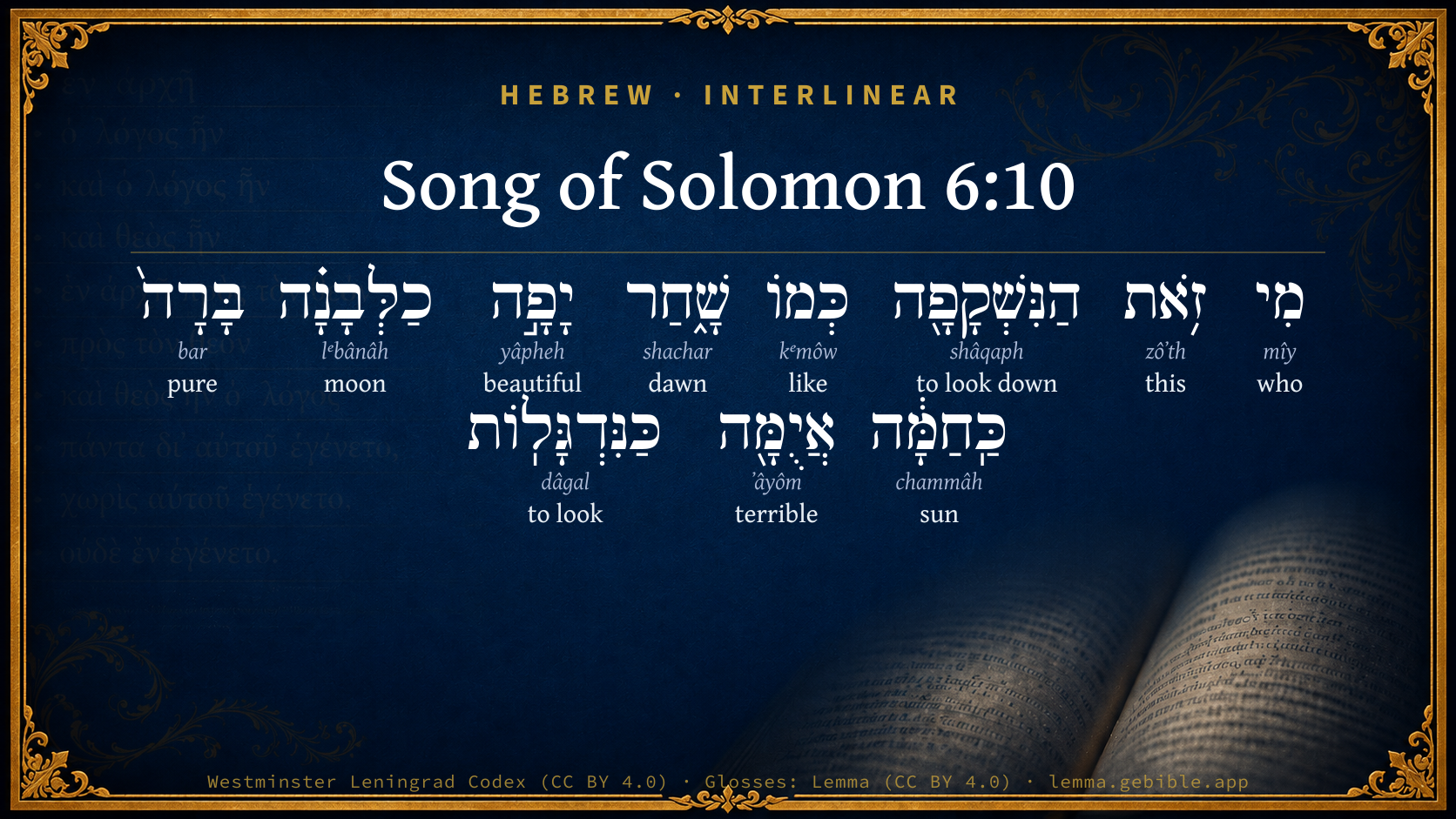
Hebrew (Westminster Leningrad Codex) Song of Solomon 6:10 appears in the Hebrew Old Testament. The text above is from the Westminster Leningrad Codex. Each word links to its Strong’s number, a concise gloss, and parsing drawn from the Open Scriptures Hebrew Bible morphology. Click any word for its full Brown-Driver-Briggs (BDB) entry.
Download image
Cite this verse

Song of Solomon 6:10 (World English Bible). Public Domain. Lemma interlinear Bible study tool, https://lemma.gebible.app/v/song-of-solomon/6/10.

Show BibTeX & RIS
BibTeX
RIS
English Translation
Who is she who looks forth as the morning, Beautiful as the moon, Clear as the sun, Awesome as an army with banners?
World English Bible · Public Domain
Highlights
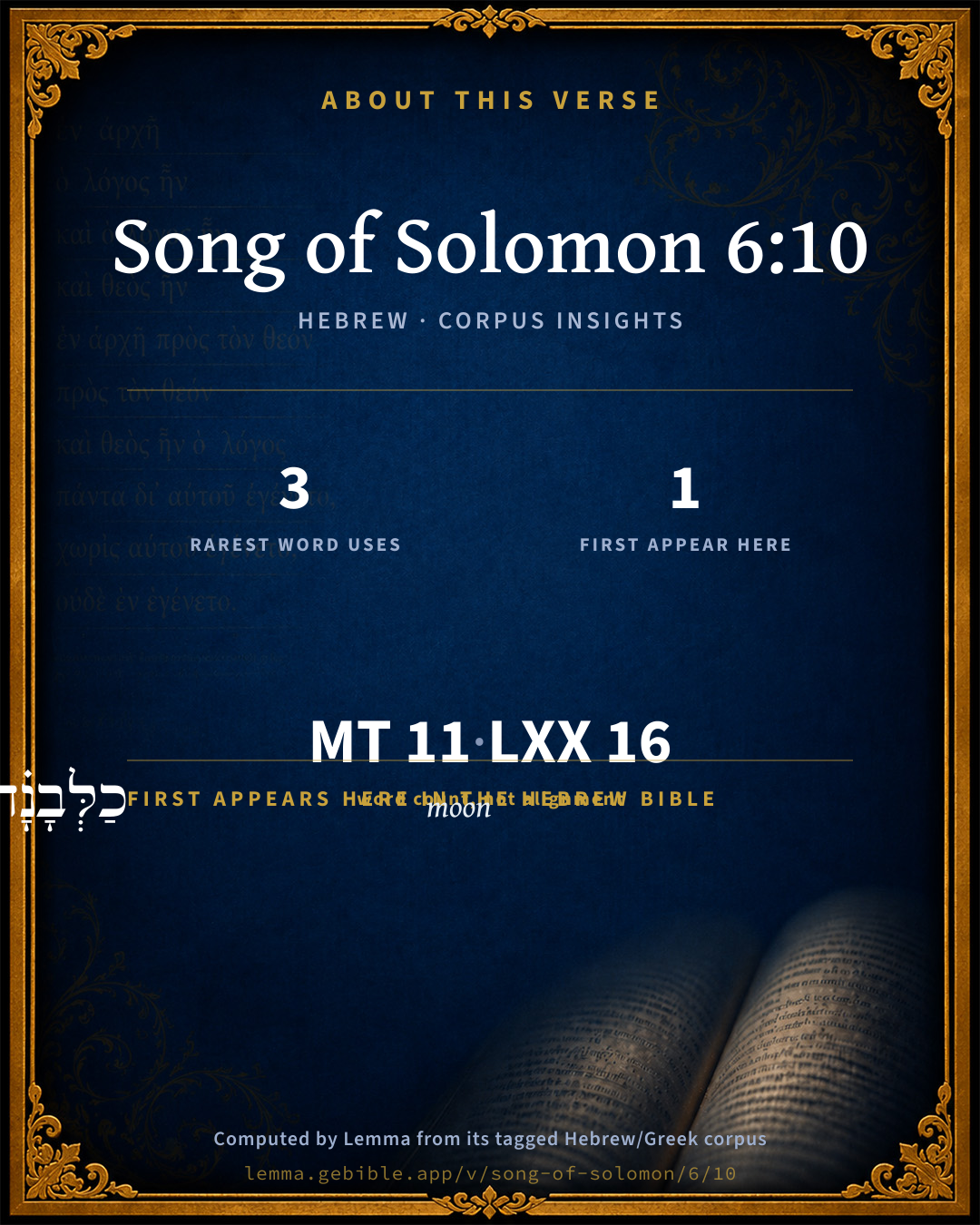
  • 1 first appearance in the Hebrew Bible
Full analysis ↓
Download a study sheet

One document with this verse’s original text, its word-by-word gloss line, the meaning frame, cross-references with their text, attributed commentary, and full source and license credits — printable, and it pastes into notes with its structure intact.

This verse Autodidact and up

Study sheet (.html) Plain text (.txt)

A passage Seminary Student

Up to 50 verses in one chapter. A passage sheet keeps up to 6 commentary sources and 12 cross-references per verse, in the order this page ranks them, and says so on the sheet whenever that leaves anything out. Ask for a single verse and you get the Autodidact verse sheet above.

Everything on this page stays free to read, with no account — the sheet is a download of what is already on screen, not access to it.

Want to remove ads? Support Godless Engineer
Compare translations 3

The same verse in 3 English versions, stacked beneath the original-language interlinear above. Click any original word for its lexicon entry.

Each is an independent rendering of the whole verse — the interlinear is not word-aligned to these translations.

Highlighted words mark where these versions differ — a whole-verse word diff, not a word-by-word alignment.

  • World English Bible Public Domain
    Who is she who looks forth as the morning, Beautiful as the moon, Clear as the sun, Awesome as an army with banners?
  • King James Version Public Domain
    Who is she that looketh forth as the morning, fair as the moon, clear as the sun, and terrible as an army with banners?
  • unfoldingWord Literal Text CC BY-SA 4.0
    “Who that, the woman who looks down like dawn, beautiful like the moon, pure like the sun, awe-inspiring like bannered armies?”

unfoldingWord Literal Text — © unfoldingWord, licensed CC BY-SA 4.0. Word-aligned USFM3 via Door43 (git.door43.org/unfoldingWord/en_ult).

Versions to compare (up to 4)

3 of 4 selected

Show all 18 translations

Every available English version of this verse, each an independent rendering of the whole verse.

  • World English Bible Public Domain
    Who is she who looks forth as the morning, Beautiful as the moon, Clear as the sun, Awesome as an army with banners?
  • Berean Standard Bible Public Domain
    Who is this who shines like the dawn, as fair as the moon, as bright as the sun, as majestic as the stars in procession?
  • Majority Standard Bible Public Domain
    Who is this who shines like the dawn, as fair as the moon, as bright as the sun, as majestic as the stars in procession?
  • King James Version Public Domain
    Who is she that looketh forth as the morning, fair as the moon, clear as the sun, and terrible as an army with banners?
  • American Standard Version (1901) Public Domain
    Who is she that looketh forth as the morning, Fair as the moon, Clear as the sun, Terrible as an army with banners?
  • Revised Version (1885) Public Domain
    Who is she that looketh forth as the morning, fair as the moon, clear as the sun, terrible as an army with banners?
  • Geneva Bible (1599) Public Domain
    I went downe to the garden of nuttes, to see the fruites of the valley, to see if the vine budded, and if the pomegranates flourished.
  • Douay-Rheims (1899) Public Domain
    I went down into the garden of nuts, to see the fruits of the valleys, and to look if the vineyard had flourished, and the pomegranates budded.
  • Young's Literal Translation Public Domain
    `Who `is' this that is looking forth as morning, Fair as the moon -- clear as the sun, Awe-inspiring as bannered hosts?'
  • Literal Standard Version CC BY-SA 4.0
    “Who [is] this that is looking forth as morning, || Beautiful as the moon—clear as the sun, || Awe-inspiring as bannered hosts?”
  • Unlocked Literal Bible CC BY-SA 4.0
    “Who is this who appears like the dawn, as beautiful as the moon, as bright as the sun, as awe-inspiring as an army with its banners?”
  • unfoldingWord Literal Text CC BY-SA 4.0
    “Who that, the woman who looks down like dawn, beautiful like the moon, pure like the sun, awe-inspiring like bannered armies?”
  • Darby Bible Public Domain
    Who is she that looketh forth as the dawn, Fair as the moon, clear as the sun, Terrible as troops with banners?
  • World Messianic Bible Public Domain
    Who is she who looks out as the morning, beautiful as the moon, clear as the sun, and awesome as an army with banners?
  • Webster's Bible Public Domain
    Who is she that looketh forth as the morning, fair as the moon, clear as the sun, and terrible as an army with banners?
  • Free Bible Version CC BY-SA 4.0
    Who is this who is like the dawn shining down from above, beautiful as the moon, bright as the shining sun? You look stunning!
  • Bible in Basic English Public Domain
    Who is she, looking down as the morning light, fair as the moon, clear as the sun, who is to be feared like an army with flags?
  • JPS Tanakh (1917) Public Domain
    Who is she that looketh forth as the dawn, fair as the moon, clear as the sun, terrible as an army with banners?

Literal Standard Version (2020), Covenant Press — licensed CC BY-SA 4.0. Text via the HelloAO Bible API (eBible.org). Unlocked Literal Bible (unfoldingWord) — licensed CC BY-SA 4.0. Text via the HelloAO Bible API (eBible.org). unfoldingWord Literal Text — © unfoldingWord, licensed CC BY-SA 4.0. Word-aligned USFM3 via Door43 (git.door43.org/unfoldingWord/en_ult). Free Bible Version, Dr. Jonathan Gallagher — licensed CC BY-SA 4.0. Text via the HelloAO Bible API (eBible.org).

Word by word

More ways to search: Search by grammar → Find every occurrence → Compare this word →

Practice this passage: Drill this verse → Learn its vocabulary →

כַלְּבָנָ֗ה
lᵉbânâh
H3842
“like/as the · moon”
Preposition, Determined + Noun, Common, Feminine, Singular, Absolute
Part of Speech
Preposition + Noun
Type
Common
Gender
Feminine
Number
Singular
State
Absolute
Full BDB Definition

Origin: from H3835

TWOT: 1074c

moon (as white)
  1. מִי mîy H4310 “who” Particle, Interrogative
  2. זֹ֥את zôʼth H2063 “this” Pronoun, Demonstrative, Feminine, Singular
  3. הַנִּשְׁקָפָ֖ה shâqaph H8259 “the · looking down” Particle, Definite Article + Verb, Niphal, Participle Active, Feminine, Singular, Absolute
  4. כְּמוֹ kᵉmôw H3644 “like” Preposition
  5. שָׁ֑חַר shachar H7837 “dawn” Noun, Common, Masculine, Singular, Absolute
  6. יָפָ֣ה yâpheh H3303 “beautiful” Adjective, Adjective, Feminine, Singular, Absolute
  7. בָּרָה֙ bar H1249 “pure” Adjective, Adjective, Feminine, Singular, Absolute
  8. כַּֽחַמָּ֔ה chammâh H2535 “like/as the · sun” Preposition, Determined + Noun, Common, Feminine, Singular, Absolute
  9. אֲיֻמָּ֖ה ʼâyôm H366 “terrible” Adjective, Adjective, Feminine, Singular, Absolute
  10. כַּנִּדְגָּלֽוֹת dâgal H1713 “like/as the · looking” Preposition, Determined + Verb, Niphal, Participle Active, Feminine, Plural, Absolute

About this verse

These counts appear in no published source. They are computed here, from the morphology-tagged text and Lemma’s own curated glosses. What Lemma adds →

11
words
11
distinct lemmas
Wisdom
section

Notable vocabulary

The rarest word here is כַלְּבָנָ֗ה moon H3842 — appearing just 3 times in the whole Hebrew Bible.

First appearance in Scripture

This word makes its first canonical appearance in the Hebrew Bible here:

  • כַלְּבָנָ֗ה moon H3842

Shared distinctive vocabulary

כַלְּבָנָ֗ה moon H3842 occurs in 3 verses of the Hebrew Bible. Also found in:

Grammatical profile

  • 2 verbs
  • 3 nouns
  • 3 adjectives
  • 1 pronoun
  • 1 preposition
  • 1 particle

Verb forms

  • הַנִּשְׁקָפָ֖ה Niphal · Participle Active
  • כַּנִּדְגָּלֽוֹת Niphal · Participle Active

Hebrew & Septuagint length

In English translation the verse runs 23 words from the Hebrew and 26 from the Septuagint (LXX English) — closely comparable.

A rough comparison of the two English renderings, which tokenize alike — not a word-level alignment.

Word counts can differ between the Hebrew and the Greek without any difference in meaning — e.g. the Hebrew direct-object marker אֵת has no separate Greek word, and Greek often adds the article ὁ.

In the original languages it is 11 Hebrew tokens and 16 Greek tokens — but the two are counted differently (Hebrew bundles its prefixes and suffixes into one token; the Greek is in lemma form), so that isn’t a like-for-like length.

Cross-references

22

Topical passages linked to Song of Solomon 6:10 in the Treasury of Scripture Knowledge — connected by theme and wording, ordered by reader-vote popularity; previews shown in the World English Bible.

  • Song of Solomon 6:4 You are beautiful, my love, as Tirzah, Lovely as Jerusalem, Awesome as an army with banners.
  • Job 31:26 If I have seen the sun when it shined, Or the moon moving in splendor,
  • Revelation 12:1 A great sign was seen in heaven: a woman clothed with the sun, and the moon under her feet, and on her head a crown of twelve stars.
  • 2 Samuel 23:4 [He shall be] as the light of the morning, when the sun rises, A morning without clouds, [When] the tender grass [springs] out of the earth, Through clear shining after rain.
  • Song of Solomon 3:6 Who is this who comes up from the wilderness like pillars of smoke, Perfumed with myrrh and frankincense, With all spices of the merchant?
  • Isaiah 58:8 Then shall your light break forth as the morning, and your healing shall spring forth speedily; and your righteousness shall go before you; the glory of Yahweh shall by your rearward.
  • Matthew 17:2 He was transfigured before them. His face shone like the sun, and his garments became as white as the light.
  • Ephesians 5:27 that he might present the assembly to himself gloriously, not having spot or wrinkle or any such thing; but that it should be holy and without blemish.
  • Revelation 10:1 I saw a mighty angel coming down out of the sky, clothed with a cloud. A rainbow was on his head. His face was like the sun, and his feet like pillars of fire.
  • Revelation 22:5 There will be no night, and they need no lamp light; for the Lord God will illuminate them. They will reign forever and ever.
  • Job 11:17 Life shall be clearer than the noonday; Though there is darkness, it shall be as the morning.
  • Psalms 14:5 There they were in great fear, For God is in the generation of the righteous.
  • Proverbs 4:18 But the path of the righteous is like the dawning light, That shines more and more until the perfect day.
  • Song of Solomon 8:5 Who is this who comes up from the wilderness, Leaning on her beloved? Under the apple tree I aroused you. There your mother conceived you. There she was in labor and bore you.
  • Isaiah 63:1 Who is this who comes from Edom, with dyed garments from Bozrah? this who is glorious in his clothing, marching in the greatness of his strength? I who speak in righteousness, mighty to save.
  • Hosea 6:5 Therefore I have cut them to pieces with the prophets; I killed them with the words of my mouth. Your judgments are like a flash of lightning.
  • Malachi 4:2 But to you who fear my name shall the sun of righteousness arise with healing in its wings. You will go out, and leap like calves of the stall.
  • Matthew 13:43 Then the righteous will shine forth like the sun in the Kingdom of their Father. He who has ears to hear, let him hear.
  • Romans 8:37 No, in all these things, we are more than conquerors through him who loved us.
  • Revelation 21:10–11 He carried me away in the Spirit to a great and high mountain, and showed me the holy city, Jerusalem, coming down out of heaven from God,
  • Revelation 21:23 The city has no need for the sun, neither of the moon, to shine, for the very glory of God illuminated it, and its lamp is the Lamb.
  • Revelation 22:16 I, Jesus, have sent my angel to testify these things to you for the assemblies. I am the root and the offspring of David; the Bright and Morning Star."

Cross-references courtesy of OpenBible.info (CC BY 4.0).

Hebrew and Greek witnesses Masoretic Hebrew ↔ Greek Septuagint

The same verse in the two great witnesses to the Old Testament, shown verse-for-verse.

These are two independent witnesses, not word-aligned to each other, and the Septuagint is shown in lemma (dictionary) form.

Hebrew Song of Solomon 6:10 Masoretic · Westminster Leningrad Codex

מִי זֹ֥את הַנִּשְׁקָפָ֖ה כְּמוֹ שָׁ֑חַר יָפָ֣ה כַלְּבָנָ֗ה בָּרָה֙ כַּֽחַמָּ֔ה אֲיֻמָּ֖ה כַּנִּדְגָּלֽוֹת

Who is she who looks forth as the morning, Beautiful as the moon, Clear as the sun, Awesome as an army with banners?

World English Bible · Public Domain

Greek LXX Song of Solomon 6:10 Septuagint · lemma form

τίς οὗτος ὁ ἐκκύπτω ὡσεί ὄρθρος καλός ὡς σελήνη ἐκλεκτός ὡς ὁ ἥλιος θάμβος ὡς τάσσω

I went down to the garden of nuts, to look at the fruits of the valley, to see if the vine flowered, if the pomegranates blossomed.

LXX2012 (modern English Septuagint) · Public Domain

On this verse, The Pulpit Commentary discusses the Septuagint’s reading. Read the note in Commentary ↓

Hebrew: Westminster Leningrad Codex (CC BY 4.0). Greek: Septuagint (public domain); English from LXX2012 (modern English Septuagint) (Public Domain). How the Septuagint differs from the Hebrew →

Commentary

Notes on Song of Solomon 6:10 from classic Christian and Jewish commentators (each source and its license shown beneath its notes). The classic Christian expositions comment on the surrounding passage and are grouped to its opening verse, so a note may address several verses; the Jewish commentaries on the Tanakh (Rashi and others) are per-verse, so they appear only where the commentator wrote on this verse.

Lemma curates 59 commentaries, every one of them public domain or Creative Commons licensed, each selected and text-cleaned for this edition rather than reprinted as found. About our sources →

The Cambridge Bible for Schools and Colleges

gen. ed. J. J. S. Perowne

10. These words evidently express the admiration of the ladies of the court for the Shulammite. Most commentators who regard the book as a connected whole take Son_6:10 to be the praises referred to in the previous verse. Son_6:9 would then end with a colon, and saying must be understood. The R.V. however marks a paragraph. Oettli emphasises the tense, and they praised her, and regards the words as those used by the court ladies when she was first met by the royal party. This is much the best hypothesis, for it gives a connecting point for the next verses as the words of the Shulammite. Delitzsch, on the other hand, makes this the beginning of a new act, and supposes that the Shulammite walks forth from some recess in the royal gardens and is greeted by the ladies with these words.

looketh forth as the morning] Better, as the dawn, i.e. as the dawn looks forth over the eastern hills, cp. Shakespeare, Hamlet, Acts 1. sc. 1,

“But, look, the morn, in russet mantle clad,

Walks o’er the dew of yon high eastern hill.”

clear] This is the word translated “choice one” in the previous verse, but it must mean clear here.

terrible as an army with banners] It is a marked peculiarity of the Song to repeat similes and epithets. They are introduced first for some special reason, then immediately they seem to crystallise into standing epithets. Cp. “feeding among the lilies.” The words used here for sun and moon are not the ordinary ones shemesh and yârçach, but chammâh, lit. ‘heat,’ and lìbhânâh, lit. ‘whiteness,’ exclusively poetic names, found together again in Isa_24:23; Isa_30:26.

The Cambridge Bible for Schools and Colleges (gen. ed. J. J. S. Perowne; Cambridge University Press, 1878–1918) — public domain. Text from a community e-Sword module.

Trapp's Complete Commentary

John Trapp

Son 6:10 Who [is] she [that] looketh forth as the morning, fair as the moon, clear as the sun, [and] terrible as [an army] with banners?

Ver. 10. Who is she that looketh forth as the morning.] This is the commendation that the queens and concubines give her, and it is expressed by way of question, not because they doubted, but for that they admired her excellence. See the like in Psa 77:13 Mic 7:17. First, The Church is compared to the "morning," which hath no full light, but mixed, so that light seems to strive with darkness. "Then shall thy light break forth as the morning." {Isa 58:8} The Hebrew word {a} here used hath its name from blackness or dimness. Next, she is said to be "fair as the moon," which is called here Lebanah, ab albedine, from her whiteness or bright shining. In her full, the moon is a very beautiful and fair creature, and even in her eclipse, though she appear dark toward the earth, yet is she bright and radiant in that part which looketh toward heaven; so is the Church. The Papists would have this moon always in the full, and if she show but little light to us, or be eclipsed, they will not yield she is the moon. And yet, except in the eclipse, astronomers demonstrate that the moon hath at all times as much light as in the full; but oftentimes a great part of the bright side is turned to heaven, and a lesser part to the earth, and so the Church is ever conspicuous to God’s eye, though it appear not always so to us. The Church waxeth and waneth as the moon, nonnunquam etiam in deliquio est et aspici non potest; adeo exiguus humerus fidelium aliquando apparet. Elijah complained of his aloneness. Christ, when he came, scarce found faith upon the earth. Papists themselves yield that there, was but Mary and some few others that "looked for the consolation of Israel." "Christ came to his own, and his own received him not," {Joh 1:11} he wondered at one good Nathanael, and sets him forth with an Ecce admirantis. "Behold an Israelite indeed." The mad multitude cried crucifige with one consent. The "whole world" went wondering after the beast. {Rev 13:3-4} Of Luther it is said, Iste vir totius orbis impetum sustinuit, that he had all the world against him, as once Athanasius had. Latimer saw so few good in his time, that he thought the last day had been come. Our Saviour foretold that toward that day "the love of many should wax cold, but he that endureth to the end shall be saved." {Mat 24:12-13} Lo, it is but a "he," a single man, a very few, that holdeth out, in comparison of the "many" apostates that fall from their own steadfastness. Here then falls to the ground that Popish and sottish mark of the true Church, universality and visibility. We deny not that the Church is a multitude of believers, and a catholic company, to the which we must join ourselves, but that she is always visible and aspectable, as a city on a hill, as the sun in heaven, can never be proven. As the moon, she hath her wanes and non-appearances, and when at the very brightest and broadest she may be muffled up and overcast with a cloud of persecution. Such was the paucity and obscurity of Christians in the Arian times, that Basil cries out, An ecclesias suas prorsus dereliquit Dominus? Hath the Lord utterly left his churches? &c. The ship of the Church was then almost overwhelmed saith Jerome. The Church was not then to be sought in tectis et exteriori pompa, in palaces and external pomp, but in dens, mines, and prisons, saith Hillary. God hath set the moon lowest in the heavens and nearest the earth, that it might daily put us in mind of the constance of the one and inconstance of the other, herself in some sort partaking of both.

Clear as the sun.] As having put on Christ that Sun of righteousness. {Gal 3:27 Mal 4:1-6 : 2Ki 12:1} The sun is so glorious a creature that the heathens, over admiring it, deified it, and from the Hebrew word, Chammah, here used, called it Jupiter Hammon. The Greeks called it ηλιος, from gnelion, the most high God. Eudoxes said that he was made for no other purpose but to behold it, and that he could be content to be presently burnt up by the heat of the sun, so he might be admitted to come so near it as to learn the nature of it. Chrysostom {b} cannot but wonder, that whereas all fire naturally tends upwards, the sun should shoot down his rays to the earth, and send his light abroad all below him. Christ, "the Father of lights," {Jas 1:17} doth the like for his spouses. And as the pearl, by the often beating of the sunbeams upon it, becomes radiant and orient as the sun itself, so doth the Church, and shall do much more when she shall "appear with him in glory." "Then shall the righteous shine forth as the sun in the kingdom of their father." {Mat 13:43} The sun in his strength, compared to them, shall be but as a clod of clay, or as those things that shine in the dark, but it is only from their rottenness. Three glimpses of this surpassing glory expected by the saints were seen: in Moses’s face when he came from the mount; in Christ’s transfiguration, when "his face did shine as the sun, his raiment was white and glistering, so as no fuller can white them"; {Mat 17:2 Mar 9:3 Luk 9:29} and in St Stephen’s countenance when he stood before the council. It should suffice for the present that the Church looketh forth, or is looked for, so some render this text, at first, "as the morning," somewhat dark and duskish: she shall be "fair as the moon," at least in regard of sanctification; and for justification she is "clear as the sun," so that God seeth no sin in her, or if he do, yet, as the sun, he "blots out the thick cloud as well as the cloud," the thickest mist as well as the thinnest vapour. {Isa 44:22} And therefore to the devil and his angels she must needs be "terrible as an army with banners"; because, as she marcheth under the banner of Christ’s mercy and love, {Son 2:4} so "the weapons of her warfare are not carnal but mighty through God, to the pulling down of strongholds," {2Co 10:4} and do strike as great a terror into her enemies as once Christ did into those ruffian soldiers that came to apprehend him, or as Basil did into Valens the emperor, that came to disturb him when he was in holy exercises. {c} {See Trapp on "Son 6:4"}

{a} שׁחר.

{b} Hom. 8, Ad. Pop. Anti.

{c} Greg. Orat. de Laude Basil.

John Trapp, A Commentary or Exposition upon All the Books of the Old and New Testament (1647–1656) — public domain. Text from a community e-Sword module.

The Biblical Illustrator

Joseph S. Exell

Son_6:10

Who is she that looketh forth as the morning, fair as the moon, clear as the sun, and terrible as an army with banners?

The dawn of a better day, celebrated in sacred song

There is a beautiful upward gradation indicated, a progression towards a glorious climax; there is the dawn of a better day seen by the wise mans prophetic eye, and we will prayerfully consider the prophetic inquiry as foreshadowing the mission of Christ, and the nature of His glorious kingdom. Who is she that looketh, etc. Apply these words:

I. To the history of Christ. Christ looked forth as the morning in the first promise made to our first parents in Eden. The Mosaic dispensation may be considered as daybreak, dim and hazy, the prophetic age may be regarded as fair as the moon, it was brighter than the former, and it shone, as the moon shines with light borrowed from the unseen Sun. When the fulness of time came, and Jesus was born in Bethlehem of Judea, then the Sun of Righteousness arose with healing in His wings, and throughout the whole of our Lords public ministry He marched forth clear as the sun. Christ went forth terrible as an army with banners. He vanquished Satan in the Temptation of the wilderness. He was a terror to evil-doers, and planted His standard in the centre of the kingdom of darkness. Especially was He terrible as an army with banners when He entered upon His Passion. And He shall be terrible as an army with banners when He shall come in His glory, and all His holy angels with Him, to gather all nations together, and separate the righteous from the wicked.

II. To the history of the Church. The Jewish Church was only the dawn of Gospel times, it looked forth as the morning--it was fair as the moon, but not clear as the sun. The day broke when the day of Pentecost came, and the Spirit rested upon the Apostles heads as tongues of flame. In that sunlight the Evangelists wrote their Gospels, and the Apostles their Epistles; and in the warmth and blessed life-giving influence of the rays of the Sun of Righteousness, the early preachers of the Cross went forth preaching Jesus and the Resurrection; they went forth terrible as an army with banners, and the world was won by them, for by the end of the third century the Gospel had been preached, and converts had been won in every part of the then known world. The Church is still going on from victory unto victory.

III. To the history of every Christian believer. The rise and progress of the soul in religion are gradual and progressive. Religious impression and conviction may be regarded as the looking forth as the morning. In the dawn of religious life there is much cloud, and the shadows of the night move but slowly away. We cannot tell just when the night ends and the morning breaks--and daybreak differs in different climes, so is it in the history of the regenerate: many rejoicing in the light of the Sun of Righteousness can only say, One thing I know, whereas I was in the dark, now I am in the light--the day has dawned, and the shadows have fled away. Light shines upon the soul fair as the moon, and, at first, often as cold. But soon the light shines brighter and warmer, the soul is filled with life and joy and glory, for, clear as the sun, Jesus sheds His love abroad there. (F. W. Brown.)

The glory of the Church

God, who has determined that everything shall be beautiful in its season, has not left the night without a charm. The moon rules the night. The stars are only set as gems in her tiara. Now, says my text, Who is she, fair as the moon? Our answer is, the Church. Like the moon, she is a borrowed light. She gathers up the glory of a Saviours sufferings, a Saviours death, a Saviours resurrection, a Saviours ascension, and pours that light on palace and dungeon, on squalid heathenism and elaborate scepticism, on widows tears and martyrs robe of flame, on weeping penitence and loud-mouthed scorn. She is the only institution to-day that gives any light to our world. After a season of storm or fog how you are thrilled when the sun comes out at noonday! The same sun which in the morning kindled conflagrations among the castles of cloud, stoops down to paint the lily white and the buttercup yellow and the forget-me-not blue. What can resist the sun? Light for voyager on the deep. Light for shepherds guarding the flocks afield. Light for the poor who have no lights to burn. Light for the downcast and ,the weary. Now, says my text, Who is she that looketh forth, clear as the sun? Our answer is, the Church. You have been going along a road before daybreak, and on one side you thought you saw a lion, on the other side you thought you saw a goblin of the darkness; but when the sun came out you found these were harmless apparitions. And it is the great mission of the Church of Jesus Christ to come forth clear as the sun, to illuminate all earthly darkness, to explain as far as possible all mystery, and to make the world radiant in its brightness. O Sun of the Church, shine on until there is no sorrow to soothe, no tears to wipe away, no shackles to break, no more souls to be redeemed! I take one more step in this subject and say that if you were placed for the defence of a feeble town, and a great army were seen coming over the hills with flying ensigns, then you would be able to get some idea of the terror that will strike the hearts of the enemies of God when the Church at last marches on like an army with banners. You know there is nothing that excites a soldiers enthusiasm so much as an old flag. Many a man almost dead, catching a glimpse of the national ensign, has sprung to his feet and started again into the battle. Now I dont want you to think of the Church of Christ as a defeated institution--as the victim of infidel sarcasm, something to be kicked and trampled on through all the ages of the world. It is an army with banners. It has an inscription and colours such as never stirred the hearts of any earthly soldiery. We have our banner of recruit, and on it is inscribed, Who is on the Lords side? our banner of defiance, and on it is inscribed, The gates of hell shall not prevail against it; our banner of triumph, and on it is inscribed, Victory through our Lord Jesus Christ! and we mean to plant that banner on every hill-top and wave it at the gate of heaven. Oh, what a shout of triumph when all the armies of earth and all the armies of heaven shall celebrate the victory of our King, all at once and all together: Hallelujah, for the Lord God Omnipotent reigneth I Hallelujah, for the kingdoms of this world have become the kingdom of our Lord Jesus Christ!(T. De Witt Talmage.)

The Biblical Illustrator, edited by Joseph S. Exell (c. 1880s–1900s) — public domain. Text from a community e-Sword module.

Joseph Benson's Commentary

Son 6:10. Who is she, &c. — These are the words of the queens and concubines. Who — What manner of person is this, how excellent and glorious! that looketh forth as the morning — As the morning light, which, coming after the darkness, is very pleasant and amiable. Fair as the moon — Namely, when it is full, and walketh in brightness, Job 31:26. Clear as the sun — Without any such spots or dark specks as are in the moon. Thus the church is said to be without spot, or wrinkle, or blemish, (Eph 5:27,) which she is by God’s gracious acceptance of her, as such, in Christ, and through his merits and Spirit; and terrible, &c. — See above, Son 6:4.

Joseph Benson's Commentary on the Old and New Testaments (1811–1818) — public domain. Text from a community e-Sword module.

The Pulpit Commentary

Who is she that looketh forth as the morning, fair as the moon, clear as the sun, terrible as an army with banners? This, of course, is the praise which comes from the lips of the queens and concubines, the ladies of the harem, the daughters of Jerusalem. The word rendered "looketh forth" is literally "bendeth forward," i.e. in order to look out or forth, (cf. Psa_14:2) LXX, ekkuptousa Venet., parakuptousa . (cf. Jam_1:25, "stooping down and looking into the Word as into well The idea seems to be that of a rising luminary, looking forth from the background, breaking through the shades of the garden, like the morning star appearing above the horizon (wv ewsforov , Venetian) Isa_14:12, where the morning star is called rjv h). The moon is generally jdey, "yellow," but here hnbl, "white," i.e. pale and sweet, as the lesser light, with true womanly delicacy and fairness; but the rest of the description, which plainly is added for the sake of the symbolical suggestiveness of the figures, removes all idea of mere weakness. Clear (or, bright) as the sun. And the word for "sun" is not, as usual, shemesh, but chammah, "heat," the warming light. (Psa_19:7; see Isa_49:2) The fierce rays of the Eastern sun are terrible to those who encounter them. The glory of the Church is a glory overwhelming as against all that opposes it. The description is pure hyperbole as applied to a fair bride, referring to the blazing beauty of her face and adornments, but symbolically it has always been felt a precious contribution to religious language. Perhaps no sentence in the Old Testament has been more frequently on the lips of devout men, especially when they have been speaking of the victories of the truth and the glowing prospects of the Saviour"s kingdom.

Vers. 10-13. Conversation between the chorus and the bride.

I ADDRESS OF THE CHORUS.

1. The question. "Who is she?" This question occurs three times in the song. In Son_3:6 it is asked apparently by a chorus of young men, the friends of the bridegroom; here and in Son_8:5 it seems to be put into the mouth of the chorus of maidens, the daughters of Jerusalem. It is an expression of admiration. The maidens meet the bride after an interval, and are startled by her surpassing beauty, at once graceful and majestic. Her happy love has shed a new grace around her; she is clothed in queenly attire; it is a vision of rare loveliness. It is the love of Christ which gives the Church whatever beauty she possesses. Christ"s love for her, drawing forth her responsive love for him, gives her whatever graces she may possess. She is his creation. He built his Church upon the rock; all that she is, and all that she has, comes only from his gift.

2. The description. She looks forth as the dawn. The bride"s sudden appearance is like the early dawn, coming forth in its beauty, tinging sky and clouds with rosy light. She is fair as the moon, clear and pure as the sun (poetical words are used here, as in Isa_24:23 Isa_30:26; the moon is the white, the sun the hot luminary); and the comparison of ver. 4 is repeated; in her queenly majesty she is terrible, awe-inspiring, as a bannered host. Christ is the Bright and Morning Star; (Rev_22:16) He is the Sun of Righteousness; (Mal_4:2) He is the true Light, the Light of the world. The true Light lighteth every man; (Joh_1:9) and they who believe in the Light, and walk as children of light, reflect something of its brightness; so that the Lord, in his condescending love, says of them, "Ye are the light of the world"; (Mat_5:14) and so St. Paul says of his Philippian converts that "ye shine as lights luminaries in the world". (Php_2:15) "God is light, and in him is no darkness at all." Christians must strive, by his grace and the illumination of his Spirit, to walk always in the light, as he is in the light, that so they may have fellowship with one another in the light of holy love, and that the blood of Jesus Christ may cleanse them continually from all sin, making their souls white and clear in the transparent truth of that purity in heart which must, by the Saviour"s compassionate mercy, belong to them who shall see God. (Mat_5:8)

II ANSWER OF THE BRIDE.

1. Her lowliness. The maidens praise her beauty and stateliness; she reminds them of her former low estate. She seems to be looking back to the hour of her first meeting with the bridegroom. She had no thought, country maiden as she was, of the elevation that awaited her. She was engaged in her ordinary occupations. She had gone down into the garden to tend it and to watch the budding of the fruit trees; there she first saw the king. Whatever graces the Church possesses come from the favour of the heavenly Bridegroom. "Through him we have access by one Spirit unto the Father. Now therefore ye are no more strangers and foreigners, but fellow citizens with the saints, and of the household of God". (Eph_2:18, Eph_2:19) The Gentiles were strangers and foreigners; they knew not the King; they were not looking for him. As the Lord God called Adam and Eve when they were hiding themselves among the trees of the garden, so the Lord called the Gentiles by the mission of his apostles. In the infancy of the human race it was the protevangel, the promise of the Seed of the woman who shall bruise the serpent"s head, that first shed light upon the gloom of sin and misery. And in the fulness of time it was the Lord"s gracious mission, "Go ye into all the world, and preach the gospel to every creature" that first called the Gentiles into the city of God. Till he calls us we are like the bride in the song, immersed in worldly pursuits and earthly cares; he brings us into the new Jerusalem and makes us fellow citizens with the saints. We must remember always that "By the grace of God I am what I am;" that whatever we may have done of good or right, it was "Not I, but the grace of God which was with me". (1Co_15:10) "By grace are ye saved through faith; and that not of yourselves: it is the gift of. (Eph_2:8) The bride was poor in this world"s goods; we Christians must be "poor in spirit." That holy poverty, that sense of our own helplessness and need of the Saviour, is very blessed; it has the first place in the Beatitudes.

2. Her exaltation. "I knew not," she says, "my soul made me the chariots of my people, a princely people." She uses a military figure, perhaps suggested by the words twice addressed to her in this chapter, "Terrible as an army with banners." In a sense she accepts the metaphor. Elijah and Elisha had been severally called "the chariot of Israel and the horsemen thereof". (2Ki_2:12 2Ki_13:14) So now the bride had been raised to a lofty position, and was awe-inspiring in her majesty, like a bannered host, or the chariots of a princely people. Her soul, she says, had made her this; she means her soups love for the bridegroom, whom she so often describes as "him whom my soul loveth". (Son_1:7 Son_3:1, Son_3:2, Son_3:3, Son_3:4) The king saw her and loved her. His love won her innocent heart; and that pure, artless love of hers, the love which filled her soul, the seat of the affections, had lifted her up into the very highest place in the affections of the king, so that now in her queenly majesty she was not only fair as the moon, but awe-inspiring as a bannered host, as the war chariots of a princely people. So it is love that makes one man better than another in the sight of God; not riches, or refinement, or learning, but love. There is, as it were, a hierarchy of love in the universe. Good men love, angels love more, but God is love the infinite, everlasting Love. "He prayeth best who loveth best." He is nearest to God who by his Spirit has learned the great grace of love. "God so loved the world, that he gave his only begotten Son, that whosoever believeth in him should not perish, but have everlasting life". (Joh_3:16) The love of Christ draws forth the love of his people. Their love, given in response to his most holy love, lifts them nearer the King; it makes them take up the cross and follow him as his faithful soldiers, quitting themselves like men in the good fight of faith; it makes them terrible to the powers of evil as a bannered host, as the war chariots of iron were in the days of the Judges. (Jud_1:19 4:3)

III SHORT DIALOGUE CONCLUDING THE CONVERSATION.

1. Request of the chorus. The bride retires; the maidens of the chorus eagerly call her back; they desire to look again upon her beauty. They call her for the first and only time, "O Shulamite!" What is the meaning of the word? Is it equivalent to Shunamite? Was the bride a native of Shuuem in the Plain of Esdraelon, where Elisha afterwards was wont to sojourn? (2Ki_4:8-12) And if so, can it be that the historical basis of the song is the love of Solomon for Abishag the fair Shunamite of 1Ki_1:3? Or, again, is it possible, as some scholars have suggested, that the Hebrew name Shula-mith may have been chosen as a near approach to the feminine form (Shelomith) of Solomon (Shelomoh), signifying the bride"s relationship to the great monarch? But the bride seems to belong to the Lebanon district; and wives were not then accustomed to take their husband"s name. Again, Shulamith may possibly have been the original name of the maiden, though it occurs nowhere else as a proper name. It is enough for our purpose that the word suggests the meaning "peaceful;" the Vulgate rendering is pacifica. The bride is modest and quiet, she is peaceful; such should Christians be.

2. Question of the bride. She repeats the name given to her by the chorus, and asks, "What will ye see in the Shulamite?" The question is asked in modesty. The last clause of the verse, whether taken as part of the question or as the answer of the chorus, is exceedingly difficult. The word translated "company" is the second part of Abel-meholah ("the meadow of the dance"), the home of Elisha. (1Ki_19:16) The Hebrew for "two armies" may be the name of the town in Gilead, "Mahanaim," so called by Jacob when "the angels of God met him" there. (Gen_32:2) Hence the translation of the Revised Version, "Why will ye look upon the Shulamite as upon the dance of Mahanaim?" as if the chorus was inviting the bride to dance some stately measure called from the Gileadite town. Some commentators who take this view understand the bride"s words as a modest refusal; others, that she complies with their request. But the second Hebrew word has the definite article, which would scarcely be used here if it were the name of the city. And if the first word must mean "dance," as it elsewhere does, may it not be taken in connection with the preceding titles of praise, "the bannered host" and "the chariots of a princely people," as a martial dance, or as the stately and well ordered evolutions of two bands of warriors? This interpretation, which is suggested with much doubt, may perhaps be regarded as yielding a more suitable explanation than that of the dance, though this last is the view of many accomplished scholars. The chorus looks upon the bride with the interest and delight with which they would watch the evolutions of two hosts with banners and chariots. Warlike images occur several times in the song. (Son_1:9 Son_6:4, Son_6:10, Son_6:12) To the Christian the words recall the onward march of the army of the soldiers of the cross with the attendant escort of angels, the two hosts (Mahanaim) of Gen_32:2. For the angels of God still, as in the times of old, encamp round about them that fear him to deliver them. (Psa_34:7) And still, if our eyes were opened, we should see, as the servant of Elisha once saw, "chariots and horses of fire round about" the faithful. "They that be with us are more than they that be with" the enemy. (2Ki_6:16, 2Ki_6:17)

Ver. 10-ch. Son_3:6, etc.) came into the neighbourhood of her town, Engedi. There the ladies of the court saw her, and were greatly struck with her beauty (ver. 10). Bewildered, she would have fled (vers. 12, 13), but thought the royal chariots were those of the nobles of her country (ver. 12). The ladies of the court beg her to return (ver. 13), and when she asks what they want of her (ver. 13), they request, and she consents, that she will dance before them, as the maidens of her country were wont to do. Thus Solomon sees her, and is enraptured with her, and begins to praise her in his gross way from her feet upwards (Son_7:2-9; Muller, in loc. ) as he had seen her in dancing. And he seems to have brought her to Jerusalem and to his palace there, where she relates all this. Such appears to be the history on which this song is founded. It is likely, natural, and enables us, whilst still regarding it allegorically, to avoid assigning to Christ language and conduct which far more befit such a one as Solomon was. From the narrative as above given we may learn that

I NO PLACES ARE FREE FROM SPIRITUAL PERIL. This maiden is represented as at home and occupied in her usual and proper employ, when suddenly all happened as is here told. And what places are there in which the world, and Satan, do not seek the soul"s harm? At home, in our lawful calling, in the Church, everywhere.

II THOSE WHOM THE WORLD HAS ENSNARED ARE USED TO ENSNARE OTHERS. The women of Solomon"s court are represented as actively engaged in trying to secure this maiden for him. It is a true picture of how worldly souls try to make others as themselves.

III MISTAKES HAVE OFTEN AS HURTFUL CONSEQUENCES AS SINS.

"Evil is wrought By want of thought As well as want of heart.

It was so here. There was mistake as to who the people were; as to the motive of the request made her; in not at once escaping; in yielding to their requests. It does seem very hard that when there is no intention of evil, evil should yet come, and often so terribly. (cf. 1Ki_13:11, etc.) But it is that we may learn by our mistakes. We learn by nothing so well, and they are never suffered to have irreparable consequences.

IV THE PERIL OF PARLEYING WITH SPIRITUAL FOES, Had she who is told of here fled away as she intended, none of her after trial would hate followed. To hold converse with a spiritual enemy is next to giving up the keys of the fortress. See how prompt our Lord was in repelling the suggestions of the tempter.

V THOUGH WE FALL WE SHALL NOT BE UTTERLY CAST DOWN. The tempter in this history was baffled after all. She whom he tried so much kept her faith and love. The soul that loves Christ may wander and fall, but shall assuredly be brought back. "He restoreth my soul." Faithful love will soon reassert its power. S.C.

The Pulpit Commentary (1880–1919), ed. H.D.M. Spence-Jones & Joseph S. Exell — public domain. Text from a community e-Sword module.

Tyndale Open Study Notes

Tyndale Open Resources

6:10 The poem ends as it began in 6:4: The woman’s majesty, like an army with billowing banners in full display, makes the knees knock and the heart flutter.

Tyndale Open Study Notes — © Tyndale Open Resources, licensed CC BY-SA 4.0. Text via the HelloAO Bible API.

Geneva Bible (1599)

Geneva Bible translators

He went down into the Synagogue to see what fruits came of the Law, and the Prophets.

Geneva Bible (1599) marginal notes — public domain. Text via Bolls.life.

Adam Clarke's Commentary

Verse 10. Looketh forth as the morning] The bride is as lovely as the dawn of day, the Aurora, or perhaps the morning star, VENUS. She is even more resplendent, she is as beautiful as the MOON. She even surpasses her, for she is as clear and bright as the SUN; and dangerous withal to look on, for she is as formidable as the vast collection of lights that burn by night at the head of every company in a numerous caravan. See Clarke on So 6:4. The comparison of a fine woman to the splendour of an unclouded full moon is continually recurring in the writings of the Asiatic poets.

Adam Clarke's Commentary on the Bible (1810–1826) — public domain. Text from a community e-Sword/MySword module.

Ellicott's Commentary for English Readers

(10) Who is she.—This verse is supposed to be spoken by the admiring ladies. The paragraph mark in the English Version should rather be at the beginning of the next verse. (Comp.—

“But soft, what light through yonder window breaks?

It is the East, and Juliet is the sun!

Arise, fair sun,” &c—Romeo and Juliet.)

But the poet heightens his figure by combining both the great lights of heaven with the dawn, and putting the praise in the mouth of “the meaner beauties of the night,” who feel their own inferiority “when the moon doth rise,” still more before the “all paling” sun.

A Bible Commentary for English Readers, edited by Charles John Ellicott (1878–1897) — public domain. Text from a community e-Sword module.

Albert Barnes' Notes on the Bible

The chorus address the bride here only as the Shulamite, and beg her to perform for their entertainment a sacred dance (see Son 6:13) of her own country. The bride, after complying with their request, while they sing some stanzas in her praise Son 7:1-5, and after receiving fresh commendations from the king Son 7:6-10, invites him to return with her to her mother’s house Cant. 7:11–8:4. Many Jewish allegorists interpret the whole as referring to the times of the second temple, and to the present dispersion of Israel, during which, God continuing to vouchsafe His mercy, Israel prays for final restoration, the coming of Messiah, and the glory of the latter day. Christian interpreters have made similar applications to the now militant Church looking for the Second Advent, or to the ancient synagogue praying for the Incarnation.

As the morning - The glorious beauty of the bride bursts upon them like a second dawn, as she comes forth to meet them at the commencement of another day. Special poetical words are used for “sun” (burning heat) and “moon” (white one). The same terms are applied to sun and moon in Isa 24:23; Isa 30:26.

Albert Barnes' Notes on the Bible (1834–1885) — public domain. Text from a community e-Sword/MySword module.

Matthew Poole's English Annotations

These are the words, either,

1. Of the Bridegroom; or,

2. of the queens and concubines last mentioned, as praising of her. And they are either words of inquiry, or rather of admiration and commendation:

Who, i.e. what manner of person, is this? how excellent and glorious! and so this pronoun who is understood Psa 24:8; Mar 4:41, compared with Mat 8:27.

As the morning; as the morning light, which coming after the darkness of the night is very pleasant and amiable, which also suddenly spreadeth itself from the east to the west.

Fair as the moon, to wit, when it is full and walking in brightness, as the phrase is, Job 31:26. But withal he seems to intimate that the church, like the moon, may have her eclipse, and be in darkness for a time.

Clear as the sun; without any such spots or dark specks as are in the moon; which is to be understood in the same sense that she is said to be without spot, or wrinkle, or blemish, Eph 5:27, which she is partly by God’s gracious acceptation of her as such in Christ, and through his righteousness; and partly because she shall be such in the future life.

Terrible as an army with banners: see Son 6:4.

Matthew Poole's English Annotations on the Holy Bible (1683–1685) — public domain. Text from a community e-Sword/MySword module.

Dummelow's Commentary on the Holy Bible

J. R. Dummelow

A Dialogue. Her Loveliness

10-13. A dialogue between these ladies and her. They compare her to the dawn, stooping down to look on the earth from the sky. It is still common in Arabic poems to address the beloved as 'Moon,' or 'Full moon'!

11, 12. She tells of her visit to the nut-garden, where, ere she was aware of it, her soul, i.e. her desire, set her in the chariots of Ammi-nadib. The precise meaning of this expression cannot be determined. The general sense appears to be that she was sunk in reverie, carried away in a lover's dream, a flight of fancy. Aroused from this, she would shyly hasten away.

13. But the chorus beg her to return and perform for them the 'Dance of Mahanaim' (RV), a sword-dance, no doubt, such as the bride executes, sword in hand, on the evening of the marriage, amidst a half-circle of men and women, whilst a poem (wasf= 'description') of the character of Son_7:1-6 is being sung. The title Shulamite is derived from the town-name Shulem (otherwise spelled 'Shunem'), from which Abishag, the fairest maiden of her day, came (1Ki_1:4): obviously it is another way of calling her 'fairest among women' (Son_1:8; Son_5:9; Son_6:1).

J. R. Dummelow, A Commentary on the Holy Bible (Macmillan, 1909) — public domain. Text from a community e-Sword module.

Whedon's Commentary on the Bible

Daniel D. Whedon

10. Who is she, etc. — The purport of this verse is, that if all the ladies of the palace are thus warm in admiration of this girl, she need have no apprehension of slights and annoyances to which jealousy might give rise.

That looketh forth — Better, looks forth.

As the morning — The Greek goddess Athena,

“The patroness of Athens, and to whom was built the Parthenon.

The brightest gem

Greece wore on all her zone,”

was the deified dawn. At the first streak of light in the east the priestess kindled her sacrificial fire and chanted a hymn of praise. The red morn beaming from the hills is always beautiful. So the meek moon, walking in brightness, and the effulgent sun that lights up the blushing day, all are vigorous metaphors.

Daniel D. Whedon (gen. ed.), Commentary on the Old and New Testaments (1874–1909) — public domain. Text from a community e-Sword module.

John Wesley's Explanatory Notes

Who - These are the words of the queens and concubines. Who, what manner of person is this, how excellent and glorious! Morning - As the morning light, which coming after the darkness, is very pleasant and amiable.

John Wesley, Explanatory Notes Upon the Whole Bible (1754–1765) — public domain. Text via the GEBible commentary corpus.

Kretzmann's Popular Commentary

Paul E. Kretzmann

Christ’s Love Toward the Church.

The King’s wonderful description of the bride’s beauty causes the "daughters of Jerusalem" to call out in admiration:

v. 10. Who is she that looketh forth, suddenly arising from the background, as the morning, like the rising dawn, fair as the moon, clear as the sun, and terrible as an army with banners, moving forward with victorious power? The answer of the bride is given with becoming humility:

v. 11. I went down into the garden of nuts, the beautiful park of the King, to see the fruits of the valley, or "to inspect the shrubs of the valley," and to see whether the vine flourished and the pomegranates budded.

v. 12. Or ever I was aware, my soul made me like the chariots of Amminadib, literally, "I knew it not that my soul had made me chariots of my noble people," that the King had displayed her pomp and power before the whole world. But the "daughters of Jerusalem" now clamor to see her beauty,

v. 13. Return, return, O Shula-mite, so they may observe her from all sides; return, return, that we may look upon thee, for they had never realized before what beauty was found in this bride of the King. Now the inspired author inserts a question, to test the interest which the "daughters of Jerusalem" may have in the bride. What will ye see in the Shulamite? And they promptly answer, As it were the company of two armies, that is, the angel hosts of Mahanaim, Gen 32:2. They regard the bride to be as magnificent and stately as the angel hosts whom Jacob saw near Peniel, between Jabbok and the Jordan.

Here we see the bride, filled with new courage and zeal for her work, ready to fulfill her ministry, imposing and impressive, even to outsiders, in her victorious progress, as the praise given her shows. She, however, disclaims any special merit, stating that it was reward enough for her to be permitted to see and admire the work of God’s hands. Yet the others insist that the work of the Church, if rightly viewed, reminds them of the blessed ministry of angels, with whose assistance the messengers of the Church carry out the duty entrusted to them. That is the glory connected with the work of the Church at all times.

Paul E. Kretzmann, Popular Commentary of the Bible (1921–1924) — public domain. Text from a community e-Sword module.

unfoldingWord translationNotes

Door43 World Missions Community

General Information:

The ULB understands this to be what the queens and the concubines said about the woman. However, some versions understand these to be the words of the man.

Who is this who appears like the dawn ... banners?

They are using this question to say that they think the young woman is amazing. AT: "This is an amazing woman! She comes into view like the dawn ... banners!" (See: Rhetorical Question)

who appears like the dawn

The dawn is beautiful. The woman is beautiful. AT: "who comes into view like the dawn" (See: Simile)

as awe-inspiring as an army with its banners

The beauty of the woman is so powerful that it makes the other women feel helpless, as if an army were approaching them. See how you translated this in Song of Songs 6:4. (See: Simile)

translationWords

like

unfoldingWord translationNotes — © Distant Shores Media and the Door43 World Missions Community, licensed CC BY-SA 4.0. Source: git.door43.org/Door43/en_tn.

Rashi

Rabbi Shlomo Yitzchaki (Rashi)

Who is this who looks forth upon us. [Looking] from a high place to a low place is called הַשְּׁקָפָה. So is the Temple higher than all lands.

like the dawn which progressively lights up little by little; so were the Israelites in the Second Temple. In the beginning, Zerubbabel was the governor of Judah, but not a king, and they were subjugated to Persia and to Greece, and afterwards, the house of the Hasmoneans defeated them and they became kings.

awesome as the bannered legions awesome among the mighty men as the bannered legions of kings. All this the Holy One, blessed be He, praises the congregation of Israel, “You are fair, my beloved, as Tirzah,” and the entire matter until here.

Rashi on the Tanakh — English translations: “The Judaica Press complete Tanach with Rashi, translated by A. J. Rosenberg” (CC BY 4.0); “Pentateuch with Rashi's commentary by M. Rosenbaum and A.M. Silbermann, 1929-1934” (public domain); “The Metsudah Tanach series, Lakewood, N.J” (CC BY 4.0); and “The Book of Joshua, Metsudah Publications, 1997” (CC BY 4.0). Text via Sefaria.

Lesson kit

Teaching starters — assembled from the data on this page, not authored interpretation. Every prompt links to the verse data it draws on. Edit before teaching.

Song of Solomon, in the Wisdom, opens this verse with 11 words (11 distinct Hebrew lemmas). Its most distinctive word is lᵉbânâh (“moon”). A historical commentator’s framing appears above. Read the whole chapter for the surrounding context.

Discussion questions

  1. The word lᵉbânâh carries the sense “moon.” How does it shape the verse?
  2. The word “moon” first appears here in Scripture. What is being introduced at this debut?
  3. Isaiah 24:23 shares the word «moon» with this verse. How do the two illuminate each other?
  4. These translations render this verse differently; the difference is in the English rendering, not the original. What questions does that raise?
  5. The verb «הַנִּשְׁקָפָ֖ה» is Niphal Participle Active. How does its form color the action?
  6. Reading how The Cambridge Bible for Schools and Colleges and Trapp's Complete Commentary read this verse, where do the two commentators agree and where do they part?

Things to notice

Reading settings

Reading text

Shown beneath each verse's original-language words.

Old Testament
Old Testament edition

Read the OT as the Masoretic Hebrew (MT) or the Greek Septuagint (LXX).

English shown for the Greek Septuagint (in the Hebrew ↔ Greek comparison).

Comparing translations? Open the Compare panel on any verse page to stack up to four side by side.