
1 Kings 22:4

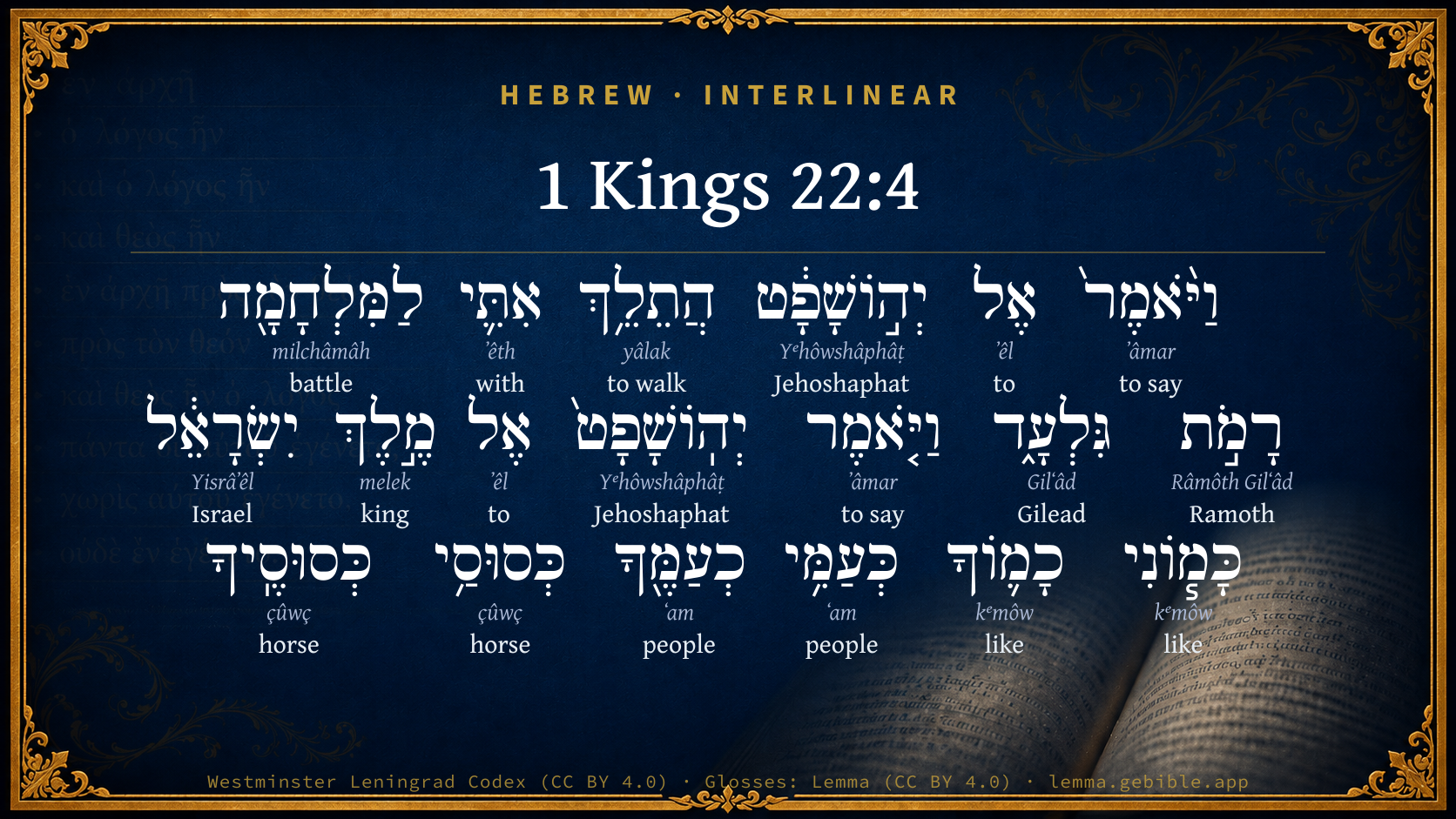
Hebrew (Westminster Leningrad Codex) 1 Kings 22:4 appears in the Hebrew Old Testament. The text above is from the Westminster Leningrad Codex. Each word links to its Strong’s number, a concise gloss, and parsing drawn from the Open Scriptures Hebrew Bible morphology. Click any word for its full Brown-Driver-Briggs (BDB) entry.
Download image
Cite this verse

1 Kings 22:4 (World English Bible). Public Domain. Lemma interlinear Bible study tool, https://lemma.gebible.app/v/1-kings/22/4.

Show BibTeX & RIS
BibTeX
RIS
English Translation
He said to Jehoshaphat, Will you go with me to battle to Ramoth-gilead? Jehoshaphat said to the king of Israel, I am as you are, my people as your people, my horses as your horses.
World English Bible · Public Domain
Download a study sheet

One document with this verse’s original text, its word-by-word gloss line, the meaning frame, cross-references with their text, attributed commentary, and full source and license credits — printable, and it pastes into notes with its structure intact.

This verse Autodidact and up

Study sheet (.html) Plain text (.txt)

A passage Seminary Student

Up to 50 verses in one chapter. A passage sheet keeps up to 6 commentary sources and 12 cross-references per verse, in the order this page ranks them, and says so on the sheet whenever that leaves anything out. Ask for a single verse and you get the Autodidact verse sheet above.

Everything on this page stays free to read, with no account — the sheet is a download of what is already on screen, not access to it.

Want to remove ads? Support Godless Engineer
Compare translations 3

The same verse in 3 English versions, stacked beneath the original-language interlinear above. Click any original word for its lexicon entry.

Each is an independent rendering of the whole verse — the interlinear is not word-aligned to these translations.

Highlighted words mark where these versions differ — a whole-verse word diff, not a word-by-word alignment.

  • World English Bible Public Domain
    He said to Jehoshaphat, Will you go with me to battle to Ramoth-gilead? Jehoshaphat said to the king of Israel, I am as you are, my people as your people, my horses as your horses.
  • King James Version Public Domain
    And he said unto Jehoshaphat, Wilt thou go with me to battle to Ramothgilead? And Jehoshaphat said to the king of Israel, I am as thou art, my people as thy people, my horses as thy horses.
  • unfoldingWord Literal Text CC BY-SA 4.0
    And he said to Jehoshaphat, “Will you go with me to battle Ramoth Gilead?” And Jehoshaphat said to the king of Israel, “Like me, like you. Like my people, like your people. Like my horses, like your horses.”

unfoldingWord Literal Text — © unfoldingWord, licensed CC BY-SA 4.0. Word-aligned USFM3 via Door43 (git.door43.org/unfoldingWord/en_ult).

Versions to compare (up to 4)

3 of 4 selected

Show all 18 translations

Every available English version of this verse, each an independent rendering of the whole verse.

  • World English Bible Public Domain
    He said to Jehoshaphat, Will you go with me to battle to Ramoth-gilead? Jehoshaphat said to the king of Israel, I am as you are, my people as your people, my horses as your horses.
  • Berean Standard Bible Public Domain
    So he asked Jehoshaphat, “Will you go with me to fight against Ramoth-gilead?” Jehoshaphat answered the king of Israel, “I am like you, my people are your people, and my horses are your horses.”
  • Majority Standard Bible Public Domain
    So he asked Jehoshaphat, “Will you go with me to fight against Ramoth-gilead?” Jehoshaphat answered the king of Israel, “I am as you are, my people are your people, and my horses are your horses.”
  • King James Version Public Domain
    And he said unto Jehoshaphat, Wilt thou go with me to battle to Ramothgilead? And Jehoshaphat said to the king of Israel, I am as thou art, my people as thy people, my horses as thy horses.
  • American Standard Version (1901) Public Domain
    And he said unto Jehoshaphat, Wilt thou go with me to battle to Ramoth-gilead? And Jehoshaphat said to the king of Israel, I am as thou art, my people as thy people, my horses as thy horses.
  • Revised Version (1885) Public Domain
    And he said unto Jehoshaphat, Wilt thou go with me to battle to Ramoth-gilead? And Jehoshaphat said to the king of Israel, I am as thou art, my people as thy people, my horses as thy horses.
  • Geneva Bible (1599) Public Domain
    And he sayde vnto Iehoshaphat, Wilt thou goe with mee to battel against Ramoth Gilead? And Iehoshaphat saide vnto the King of Israel, I am as thou art, my people as thy people, and mine horses as thine horses.
  • Douay-Rheims (1899) Public Domain
    And he said to Josaphat: Wilt thou come with me to battle to Ramoth Galaad?
  • Young's Literal Translation Public Domain
    And he saith unto Jehoshaphat, `Dost thou go with me to battle `to' Ramoth-Gilead?' and Jehoshaphat saith unto the king of Israel, `As I am, so thou; as my people, so thy people; as my horses, so thy horses.'
  • Literal Standard Version CC BY-SA 4.0
    And he says to Jehoshaphat, “Do you go with me to battle [against] Ramoth-Gilead?” And Jehoshaphat says to the king of Israel, “As I am, so [are] you; as my people, so your people; as my horses, so your horses.”
  • Unlocked Literal Bible CC BY-SA 4.0
    So he said to Jehoshaphat, “Will you go with me to war at Ramoth Gilead?” Jehoshaphat replied to the king of Israel, “I am like you, my people are like your people, and my horses are like your horses.”
  • unfoldingWord Literal Text CC BY-SA 4.0
    And he said to Jehoshaphat, “Will you go with me to battle Ramoth Gilead?” And Jehoshaphat said to the king of Israel, “Like me, like you. Like my people, like your people. Like my horses, like your horses.”
  • Darby Bible Public Domain
    And he said to Jehoshaphat, Wilt thou go with me to battle to Ramoth-Gilead? And Jehoshaphat said to the king of Israel, I am as thou, my people as thy people, my horses as thy horses.
  • World Messianic Bible Public Domain
    He said to Jehoshaphat, “Will you go with me to battle to Ramoth Gilead?” Jehoshaphat said to the king of Israel, “I am as you are, my people as your people, my horses as your horses.”
  • Webster's Bible Public Domain
    And he said to Jehoshaphat, Wilt thou go with me to battle to Ramoth-gilead? And Jehoshaphat said to the king of Israel, I am as thou art, my people as thy people, my horses as thy horses.
  • Free Bible Version CC BY-SA 4.0
    So he asked Jehoshaphat, “Will you join me in an attack to recapture Ramoth-gilead?” Jehoshaphat replied to the king of Israel, “You and I are as one, my men and your men are as one, and my horses and your horses are as one.”
  • Bible in Basic English Public Domain
    And he said to Jehoshaphat, Will you go with me to Ramoth-gilead to make war? And Jehoshaphat said to the king of Israel, I am as you are: my people as your people, my horses as your horses.
  • JPS Tanakh (1917) Public Domain
    And he said unto Jehoshaphat: 'Wilt thou go with me to battle to Ramoth-gilead?' And Jehoshaphat said to the king of Israel: 'I am as thou art, my people as thy people, my horses as thy horses.'

Literal Standard Version (2020), Covenant Press — licensed CC BY-SA 4.0. Text via the HelloAO Bible API (eBible.org). Unlocked Literal Bible (unfoldingWord) — licensed CC BY-SA 4.0. Text via the HelloAO Bible API (eBible.org). unfoldingWord Literal Text — © unfoldingWord, licensed CC BY-SA 4.0. Word-aligned USFM3 via Door43 (git.door43.org/unfoldingWord/en_ult). Free Bible Version, Dr. Jonathan Gallagher — licensed CC BY-SA 4.0. Text via the HelloAO Bible API (eBible.org).

Word by word

More ways to search: Search by grammar → Find every occurrence → Compare this word →

Practice this passage: Drill this verse → Learn its vocabulary →

רָמֹ֣ת
Râmôth Gilʻâd
H7433
“Ramoth”
Noun, Proper
Part of Speech
Noun
Type
Proper
Full BDB Definition

Origin: from the pl. of H7413 and H1568

TWOT: None

Ramoth = "heights" - an Israelite who had a foreign wife in the time of Ezra (noun proper masculine) - Ramoth-gilead - a place in Gilead (noun proper locative) - site dubious
  1. וַיֹּ֨אמֶר֙ ʼâmar H559 “and · to say” Conjunction + Verb, Qal, Sequential Imperfect, 3rd Person, Masculine, Singular
  2. אֶל ʼêl H413 “to” Preposition
  3. יְה֣וֹשָׁפָ֔ט Yᵉhôwshâphâṭ H3092 “Jehoshaphat” Noun, Proper
  4. הֲתֵלֵ֥ךְ yâlak H3212 “to walk” Particle, Interrogative + Verb, Qal, Imperfect, 2nd Person, Masculine, Singular
  5. אִתִּ֛י ʼêth H854 “with · me” Preposition + Suffix, Personal, 1st Person, Common, Singular
  6. לַמִּלְחָמָ֖ה milchâmâh H4421 “to/for the · battle” Preposition, Determined + Noun, Common, Feminine, Singular, Absolute
  7. גִּלְעָ֑ד Gilʻâd H1568 “Gilead” Noun, Proper
  8. וַיֹּ֤אמֶר ʼâmar H559 “and · to say” Conjunction + Verb, Qal, Sequential Imperfect, 3rd Person, Masculine, Singular
  9. יְהֽוֹשָׁפָט֙ Yᵉhôwshâphâṭ H3092 “Jehoshaphat” Noun, Proper
  10. אֶל ʼêl H413 “to” Preposition
  11. מֶ֣לֶךְ melek H4428 “king of” Noun, Common, Masculine, Singular, Construct
  12. יִשְׂרָאֵ֔ל Yisrâʼêl H3478 “Israel” Noun, Proper
  13. כָּמ֧וֹנִי kᵉmôw H3644 “like · me” Preposition + Suffix, Personal, 1st Person, Common, Singular
  14. כָמ֛וֹךָ kᵉmôw H3644 “like · you” Preposition + Suffix, Personal, 2nd Person, Masculine, Singular
  15. כְּעַמִּ֥י ʻam H5971 “like/as · people · my” Preposition + Noun, Common, Masculine, Singular, Construct + Suffix, Personal, 1st Person, Common, Singular
  16. כְעַמֶּ֖ךָ ʻam H5971 “like/as · people · your” Preposition + Noun, Common, Masculine, Singular, Construct + Suffix, Personal, 2nd Person, Masculine, Singular
  17. כְּסוּסַ֥י çûwç H5483 “like/as · horses · my” Preposition + Noun, Common, Masculine, Plural, Construct + Suffix, Personal, 1st Person, Common, Singular
  18. כְּסוּסֶֽיךָ çûwç H5483 “like/as · horses · your” Preposition + Noun, Common, Masculine, Plural, Construct + Suffix, Personal, 2nd Person, Masculine, Singular

About this verse

These counts appear in no published source. They are computed here, from the morphology-tagged text and Lemma’s own curated glosses. What Lemma adds →

19
words
13
distinct lemmas
Historical
section

Notable vocabulary

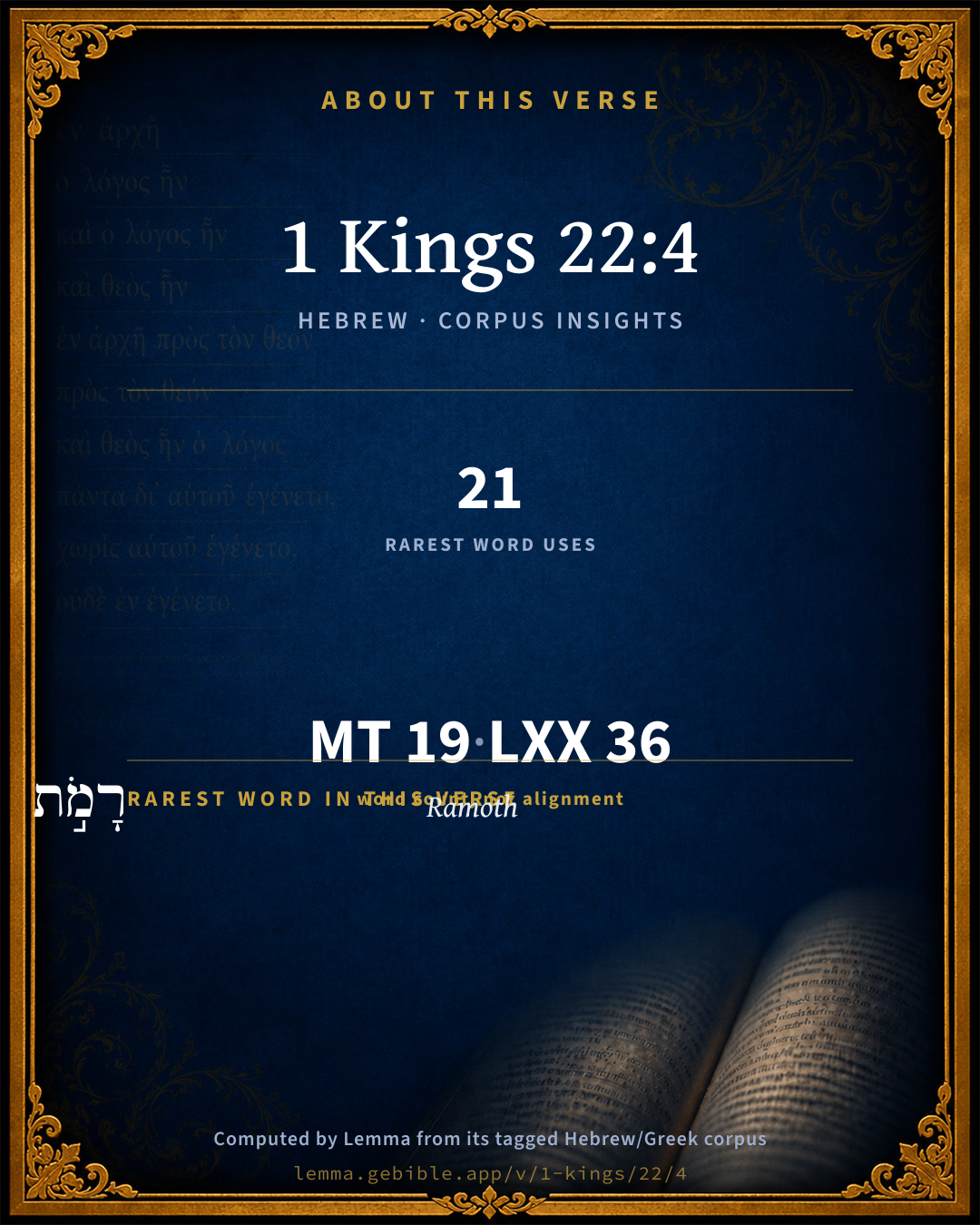
The rarest word here is רָמֹ֣ת Ramoth H7433 — appearing just 21 times in the whole Hebrew Bible.

Shared distinctive vocabulary

רָמֹ֣ת Ramoth H7433 occurs in 21 verses of the Hebrew Bible. Also found in:

Grammatical profile

  • 3 verbs
  • 11 nouns
  • 5 prepositions

Verb forms

  • וַיֹּ֨אמֶר֙ Qal · Sequential Imperfect
  • הֲתֵלֵ֥ךְ Qal · Imperfect
  • וַיֹּ֤אמֶר Qal · Sequential Imperfect

Repetition

Words recur within this verse — often emphatic in Hebrew:

  • וַיֹּ֨אמֶר֙ to say H559 ×2
  • יְה֣וֹשָׁפָ֔ט Jehoshaphat H3092 ×2
  • כָּמ֧וֹנִי like H3644 ×2
  • כְּעַמִּ֥י people H5971 ×2
  • כְּסוּסַ֥י horse H5483 ×2
  • אֶל to H413 ×2

Hebrew & Septuagint length

In English translation the verse runs 35 words from the Hebrew and 19 from the Septuagint (LXX English) — the Septuagint runs noticeably shorter here. See the side-by-side →

A rough comparison of the two English renderings, which tokenize alike — not a word-level alignment.

Word counts can differ between the Hebrew and the Greek without any difference in meaning — e.g. the Hebrew direct-object marker אֵת has no separate Greek word, and Greek often adds the article ὁ.

In the original languages it is 19 Hebrew tokens and 36 Greek tokens — but the two are counted differently (Hebrew bundles its prefixes and suffixes into one token; the Greek is in lemma form), so that isn’t a like-for-like length.

Cross-references

10

Topical passages linked to 1 Kings 22:4 in the Treasury of Scripture Knowledge — connected by theme and wording, ordered by reader-vote popularity; previews shown in the World English Bible.

  • 2 Kings 3:7 He went and sent to Jehoshaphat the king of Judah, saying, The king of Moab has rebelled against me: will you go with me against Moab to battle? He said, I will go up: I am as you are, my people as your people, my horses as your horses.
  • Ephesians 5:11 Have no fellowship with the unfruitful works of darkness, but rather even reprove them.
  • 2 Chronicles 18:3 Ahab king of Israel said to Jehoshaphat king of Judah, Will you go with me to Ramoth-gilead? He answered him, I am as you are, and my people as your people; and [we will be] with you in the war.
  • 2 Chronicles 19:2 Jehu the son of Hanani the seer went out to meet him, and said to king Jehoshaphat, Should you help the wicked, and love those who hate Yahweh? for this thing wrath is on you from before Yahweh.
  • Psalms 139:21–22 Yahweh, don't I hate those who hate you? Am I not grieved with those who rise up against you?
  • Proverbs 13:20 One who walks with wise men grows wise, But a companion of fools suffers harm.
  • 1 Corinthians 15:33 Don't be deceived! "Evil companionships corrupt good morals."
  • 2 John 1:11 for he who welcomes him participates in his evil works.
  • Revelation 2:26 He who overcomes, and he who keeps my works to the end, to him I will give authority over the nations.
  • 2 Corinthians 6:16–17 What agreement has a temple of God with idols? For you are a temple of the living God. Even as God said, "I will dwell in them, and walk in them; and I will be their God, and they will be my people."

Cross-references courtesy of OpenBible.info (CC BY 4.0).

Hebrew and Greek witnesses Masoretic Hebrew ↔ Greek Septuagint

The same verse in the two great witnesses to the Old Testament, shown verse-for-verse.

Here the Septuagint runs noticeably shorter than the Hebrew — LXX2012 (modern English Septuagint) 19 words vs World English Bible 35. A rough length comparison of the two English translations, not a word-level alignment — read both below.

These are two independent witnesses, not word-aligned to each other, and the Septuagint is shown in lemma (dictionary) form.

Hebrew 1 Kings 22:4 Masoretic · Westminster Leningrad Codex

וַיֹּ֨אמֶר֙ אֶל יְה֣וֹשָׁפָ֔ט הֲתֵלֵ֥ךְ אִתִּ֛י לַמִּלְחָמָ֖ה רָמֹ֣ת גִּלְעָ֑ד וַיֹּ֤אמֶר יְהֽוֹשָׁפָט֙ אֶל מֶ֣לֶךְ יִשְׂרָאֵ֔ל כָּמ֧וֹנִי כָמ֛וֹךָ כְּעַמִּ֥י כְעַמֶּ֖ךָ כְּסוּסַ֥י כְּסוּסֶֽיךָ

He said to Jehoshaphat, Will you go with me to battle to Ramoth-gilead? Jehoshaphat said to the king of Israel, I am as you are, my people as your people, my horses as your horses.

World English Bible · Public Domain

Greek LXX 1 Kings 22:4 Septuagint · lemma form

καί εἶπον βασιλεύς ἰσραήλ πρός ιωσαφατ ἀναβαίνω μετά ἐγώ εἰς ρεμμαθ γαλαάδ εἰς πόλεμος καί εἶπον ιωσαφατ καθώς ἐγώ οὕτως καί σύ καθώς ὁ λαός ἐγώ ὁ λαός σύ καθώς ὁ ἵππος ἐγώ ὁ ἵππος σύ

And the king of Israel said to Josaphat, Will you go up with us to Remmath Galaad to battle?

LXX2012 (modern English Septuagint) · Public Domain

Hebrew: Westminster Leningrad Codex (CC BY 4.0). Greek: Septuagint (public domain); English from LXX2012 (modern English Septuagint) (Public Domain). How the Septuagint differs from the Hebrew →

Targum (Aramaic paraphrase)

1

The Targum is the ancient Jewish Aramaic paraphrase of the Hebrew Scriptures — an interpretive translation, not the Hebrew text itself. Onkelos (literal) and Pseudo-Jonathan (expansive) render the Torah, and Jonathan the Prophets. Coverage is partial: where no permissively-licensed English translation exists for a verse, only the Aramaic is shown. This is verse-level text, not a word-by-word alignment to the Hebrew.

  1. Targum Jonathan Prophets (Joshua–Malachi)
    וַאֲמַר לִיהוֹשָׁפָט הֲתֵיזִל עִמִי לְאַגָחָא קְרָבָא לְרָמוֹת גִלְעָד וַאֲמַר יְהוֹשָׁפָט לְמַלְכָּא דְיִשְׂרָאֵל אֲנָא כְּוָתָךְ עַמִי כְעַמָךְ וְסוּסְוָתַי כְּסוּסְוָתָךְ:

    (no public-domain English translation for this verse)

    Targum Jonathan — Aramaic: “Mikraot Gedolot” (public domain). English: “Sefaria Community Translation” (CC0 1.0 (public-domain dedication)); “London "Chaldee Paraphrase," 1871” (public domain). Text via Sefaria.

Commentary

Notes on 1 Kings 22:4 from classic Christian and Jewish commentators (each source and its license shown beneath its notes). The classic Christian expositions comment on the surrounding passage and are grouped to its opening verse, so a note may address several verses; the Jewish commentaries on the Tanakh (Rashi and others) are per-verse, so they appear only where the commentator wrote on this verse.

Lemma curates 59 commentaries, every one of them public domain or Creative Commons licensed, each selected and text-cleaned for this edition rather than reprinted as found. About our sources →

Trapp's Complete Commentary

John Trapp

1Ki 22:4 And he said unto Jehoshaphat, Wilt thou go with me to battle to Ramothgilead? And Jehoshaphat said to the king of Israel, I [am] as thou [art], my people as thy people, my horses as thy horses.

Ver. 4. And he said unto Jehoshaphat.] After that he had royally entertained him, {2Ch 18:2} and concluded a match with him, betwixt his daughter Athaliah and Jehoshaphat’s son Joram.

I am as thou art, my people as thy people.] Here that of Solomon is exemplified, "A righteous man falling down before the wicked, is as a troubled fountain and a corrupt spring,." {Pro 25:26} Jehoshaphat was well chidden for this, as well he deserved. {2Ch 19:2}

John Trapp, A Commentary or Exposition upon All the Books of the Old and New Testament (1647–1656) — public domain. Text from a community e-Sword module.

Joseph Benson's Commentary

1Ki 22:4. He said to Jehoshaphat, Wilt thou go up with me, &c.? — It is not strange that Ahab should desire the assistance of so pious and prosperous a neighbour as Jehoshaphat, and should wish to draw him in to join him in this expedition for the recovery of Ramoth-Gilead. Even bad men have often coveted the friendship of the good; but it is strange that Jehoshaphat should go so entirely into Ahab’s interests as to say, I am as thou art, and my people as thy people — That is, I will heartily and effectually join with thee; and my forces shall be at thy service, as much as thine own.

Joseph Benson's Commentary on the Old and New Testaments (1811–1818) — public domain. Text from a community e-Sword module.

Geneva Bible (1599)

Geneva Bible translators

I am ready to join and go with thee, and all mine is at thy commandment.

Geneva Bible (1599) marginal notes — public domain. Text via Bolls.life.

Adam Clarke's Commentary

Verse 4. Wilt thou go with me] We find that there was a good understanding between Jehoshaphat and Ahab, which no doubt was the consequence of a matrimonial alliance between the son of the former, Jehoram, and the daughter of the latter, Athaliah; see 2Ch 18:1; 2Kg 8:18. This coalition did not please God, and Jehoshaphat is severely reproved for it by Jehu the seer, 2Ch 19:1-3.

Adam Clarke's Commentary on the Bible (1810–1826) — public domain. Text from a community e-Sword/MySword module.

Ellicott's Commentary for English Readers

(4) I am as thou art.—The answer is apparently one of deference, as well as friendship, to the stronger kingdom. It must be remembered that, as the whole chapter shows, Ahab had now returned to the worship of the Lord.

A Bible Commentary for English Readers, edited by Charles John Ellicott (1878–1897) — public domain. Text from a community e-Sword module.

The Cambridge Bible for Schools and Colleges

gen. ed. J. J. S. Perowne

4. I am as thou art] The marriage between the royal children would no doubt make Jehoshaphat more ready to comply with Ahab’s request. But it was not without danger to Judah also, that the Syrian king should hold a strong position in the land of Gilead.

my horses as thy horses] From this expression it appears that cavalry had now been largely introduced into both kingdoms.

The Cambridge Bible for Schools and Colleges (gen. ed. J. J. S. Perowne; Cambridge University Press, 1878–1918) — public domain. Text from a community e-Sword module.

John Gill's Exposition

And Jehoshaphat said unto the king of Israel, inquire, I pray thee, at the word of the Lord today. Being a pious and religious prince, he did not choose to go into a war at once, without consulting the Lord by his prophets, whether it was his will and pleasure they should engage in it, and should prosper; and he was desirous of having this done immediately, before they proceeded any further.

And Jehoshaphat said unto the king of Israel, inquire, I pray thee, at the word of the Lord today. Being a pious and religious prince, he did not choose to go into a war at once, without consulting the Lord by his prophets, whether it was his will and pleasure they should engage in it, and should prosper; and he was desirous of having this done immediately, before they proceeded any further.

1 Kings 22:6

kg1 22:6

kg1 22:6

kg1 22:6Then the king of Israel gathered the prophets together, about four hundred men,.... False prophets, as the Targum and Arabic version; and they are called Ahab's prophets, and not the Lord's, Kg1 22:23 perhaps these were the prophets of the groves, that ate at Jezebel's table, and were preserved when the prophets of Baal were destroyed, since the number agrees with them, see Kg1 18:19.

and said unto them, shall I go against Ramothgilead to battle, or shall I forbear? which would you advise to? signifying he should take their advice:

and they said, go up; for the Lord shall deliver it into the hand of the king: which words are very ambiguous, like the oracles of the Heathens; for they do not express who or what should be delivered up, for the word it is a supplement, nor to what king the delivery should be made; whether the Syrians, and the place they held should be given up to king Ahab, which they would have understood; or whether the Israelites should be delivered up to king Benhadad; so that, whichever had been the case, the credit of their prophecy would be secured. They used the word "Lord", and not Baal, in complaisance to Jehoshaphat, and perhaps as directed by Ahab.

John Gill's Exposition of the Whole Bible (1746–1763) — public domain (CC PDM 1.0). Text via the HelloAO Bible API.

Albert Barnes' Notes on the Bible

Ahab, well aware of the military strength of Syria, and feeling that he cannot now expect divine aid 1Ki 20:42; 1Ki 21:21, asks the aid of Jehoshaphat, whose military resources were very great 2Ch 17:12-19. Jehoshaphat’s answer is one of complete acquiescence, without reserve of any kind (compare 2Ch 18:3). Jehoshaphat was afterward rebuked for thus consenting to “help the ungodly” 2Ch 19:2. He probably acted not merely from complaisance, but from a belief that the interests of his own kingdom would be advanced by the step which he agreed to take. The power of Syria was at this time very menacing.

Albert Barnes' Notes on the Bible (1834–1885) — public domain. Text from a community e-Sword/MySword module.

Matthew Poole's English Annotations

I will heartily and effectually join with thee, and my forces shall be at thy service, as much as thy own.

Matthew Poole's English Annotations on the Holy Bible (1683–1685) — public domain. Text from a community e-Sword/MySword module.

Whedon's Commentary on the Bible

Daniel D. Whedon

4. I am as thou art, my people as thy people — I am in perfect sympathy and affinity with thee; my people and my property are to be treated and used as thine own.

Daniel D. Whedon (gen. ed.), Commentary on the Old and New Testaments (1874–1909) — public domain. Text from a community e-Sword module.

The Pulpit Commentary

And he said unto Jehoshaphat, Wilt thou go with me to battle to Ramoth-Gilead? It is probable this question was asked with some misgivings. Such an alliance was altogether new, and Ahab might well wonder how the idea would strike a pious prince like Jehoshaphat. That the latter ought to have refused his help, we know from 2Ch_19:2 And Jehoshaphat said to the king of Israel, I am as thou art Heb. as I as thou, my people as thy people, my horses as thy horses. From the ready and unreserved way in which he at once engages in this war, we may safely conclude that he, too, had reason to fear the power of Syria. Probably Ben-hadad, when he besieged Samaria, (1Ki_20:1) had formed the idea of reducing the whole of Palestine to subjection. And Jehoshaphat would remember that Ramoth-Gilead, where the Syrian king was still entrenched, was but forty miles distant from Jerusalem. Bahr holds that horses are specially mentioned "because they formed an essential part of the military power" (Psa_33:16, Psa_33:17; Pro_21:31) It is true that in a campaign against the Syrians they would be especially useful; (see on 1Ki_20:1) but they receive no mention at the hands of the chronicler, who reads instead of this last clause, "And we (or I) will be with thee in the war."

The Pulpit Commentary (1880–1919), ed. H.D.M. Spence-Jones & Joseph S. Exell — public domain. Text from a community e-Sword module.

Lesson kit

Teaching starters — assembled from the data on this page, not authored interpretation. Every prompt links to the verse data it draws on. Edit before teaching.

1 Kings, in the Historical, opens this verse with 19 words (13 distinct Hebrew lemmas). Its most distinctive word is Râmôth Gilʻâd (“Ramoth”). The Greek Septuagint runs shorter here. A historical commentator’s framing appears above. Read the whole chapter for the surrounding context.

Discussion questions

  1. How does “Ramoth” (Râmôth Gilʻâd) shape what this verse is saying?
  2. How does Joshua 21:38, which shares the word «Ramoth», read alongside this verse?
  3. What does the repetition of “to say” (2× in this one verse) do in this verse?
  4. The Septuagint runs shorter here than the Hebrew. What might account for the difference?
  5. These translations render this verse differently; the difference is in the English rendering, not the original. What questions does that raise?
  6. «וַיֹּ֨אמֶר֙» is a Qal Sequential Imperfect verb. How does that grammatical form shape the action described?
  7. Compare how Trapp's Complete Commentary and Joseph Benson's Commentary read this verse. Where do they agree or differ?

Things to notice

Reading settings

Reading text

Shown beneath each verse's original-language words.

Old Testament
Old Testament edition

Read the OT as the Masoretic Hebrew (MT) or the Greek Septuagint (LXX).

English shown for the Greek Septuagint (in the Hebrew ↔ Greek comparison).

Comparing translations? Open the Compare panel on any verse page to stack up to four side by side.