
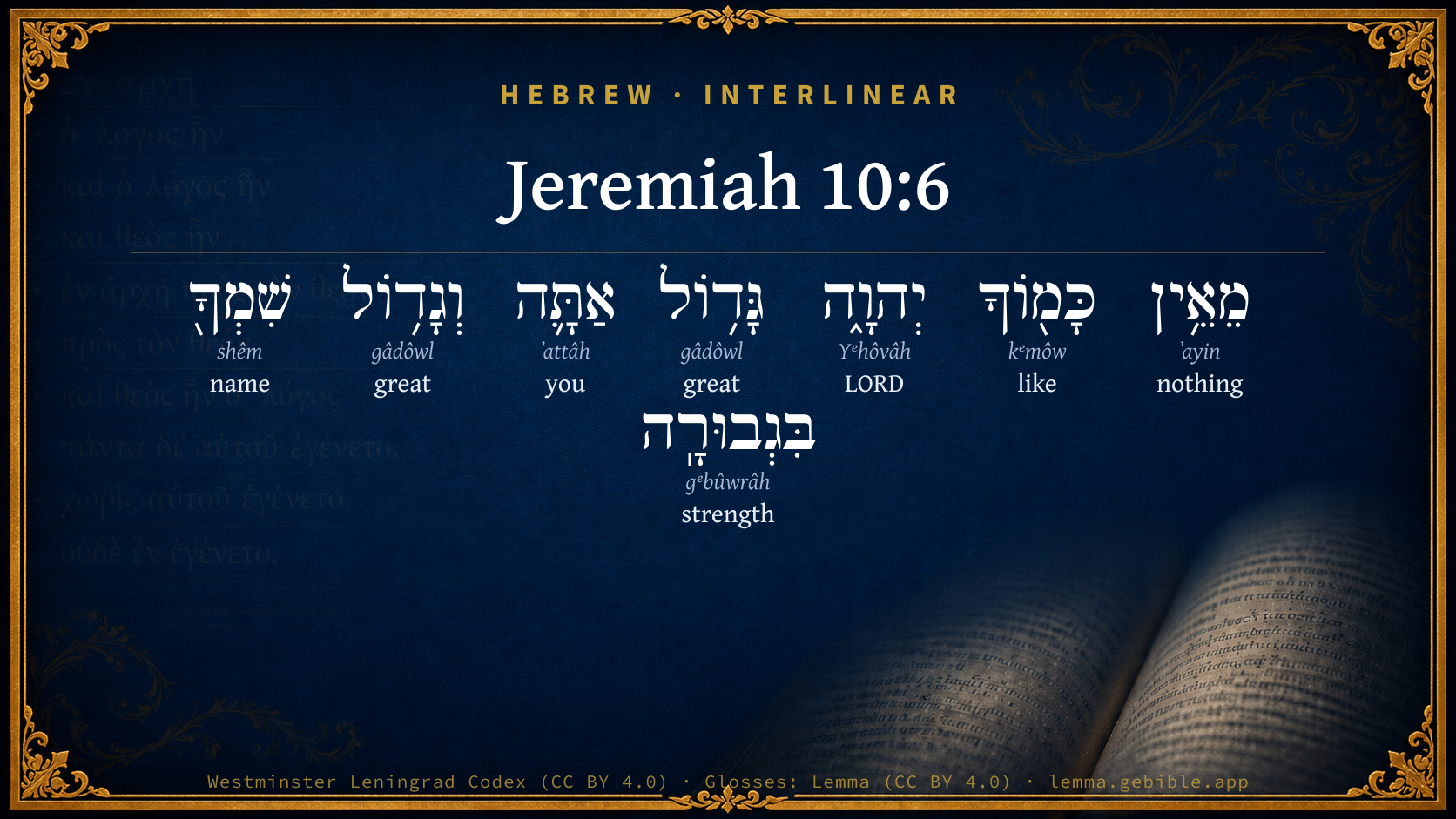
Jeremiah 10:6

Hebrew (Westminster Leningrad Codex) Jeremiah 10:6 appears in the Hebrew Old Testament. The text above is from the Westminster Leningrad Codex. Each word links to its Strong’s number, a concise gloss, and parsing drawn from the Open Scriptures Hebrew Bible morphology. Click any word for its full Brown-Driver-Briggs (BDB) entry.
Download image
Cite this verse

Jeremiah 10:6 (World English Bible). Public Domain. Lemma interlinear Bible study tool, https://lemma.gebible.app/v/jeremiah/10/6.

Show BibTeX & RIS
BibTeX
RIS
English Translation
There is none like you, Yahweh; you are great, and your name is great in might.
World English Bible · Public Domain
Download a study sheet

One document with this verse’s original text, its word-by-word gloss line, the meaning frame, cross-references with their text, attributed commentary, and full source and license credits — printable, and it pastes into notes with its structure intact.

This verse Autodidact and up

Study sheet (.html) Plain text (.txt)

A passage Seminary Student

Up to 50 verses in one chapter. A passage sheet keeps up to 6 commentary sources and 12 cross-references per verse, in the order this page ranks them, and says so on the sheet whenever that leaves anything out. Ask for a single verse and you get the Autodidact verse sheet above.

Everything on this page stays free to read, with no account — the sheet is a download of what is already on screen, not access to it.

Want to remove ads? Support Godless Engineer
Compare translations 3

The same verse in 3 English versions, stacked beneath the original-language interlinear above. Click any original word for its lexicon entry.

Each is an independent rendering of the whole verse — the interlinear is not word-aligned to these translations.

Highlighted words mark where these versions differ — a whole-verse word diff, not a word-by-word alignment.

  • World English Bible Public Domain
    There is none like you, Yahweh; you are great, and your name is great in might.
  • King James Version Public Domain
    Forasmuch as there is none like unto thee, O LORD; thou art great, and thy name is great in might.
  • unfoldingWord Literal Text CC BY-SA 4.0
    There is no one like you, Yahweh. You great, and your name great in power.

unfoldingWord Literal Text — © unfoldingWord, licensed CC BY-SA 4.0. Word-aligned USFM3 via Door43 (git.door43.org/unfoldingWord/en_ult).

Versions to compare (up to 4)

3 of 4 selected

Show all 18 translations

Every available English version of this verse, each an independent rendering of the whole verse.

  • World English Bible Public Domain
    There is none like you, Yahweh; you are great, and your name is great in might.
  • Berean Standard Bible Public Domain
    There is none like You, O LORD. You are great, and Your name is mighty in power.
  • Majority Standard Bible Public Domain
    There is none like You, O LORD. You are great, and Your name is mighty in power.
  • King James Version Public Domain
    Forasmuch as there is none like unto thee, O LORD; thou art great, and thy name is great in might.
  • American Standard Version (1901) Public Domain
    There is none like unto thee, O Jehovah; thou art great, and thy name is great in might.
  • Revised Version (1885) Public Domain
    There is none like unto thee, O LORD; thou art great, and thy name is great in might.
  • Geneva Bible (1599) Public Domain
    There is none like vnto thee, O Lord: thou art great, and thy name is great in power.
  • Douay-Rheims (1899) Public Domain
    There is none like to thee, O Lord: thou art great and great is thy name in might.
  • Young's Literal Translation Public Domain
    Because there is none like Thee, O Jehovah, Great `art' Thou, and great Thy name in might.
  • Literal Standard Version CC BY-SA 4.0
    Because there is none like You, O YHWH, || You [are] great, and Your Name [is] great in might.
  • Unlocked Literal Bible CC BY-SA 4.0
    There is no one like you, Yahweh. You are great, and your name is great in power.
  • unfoldingWord Literal Text CC BY-SA 4.0
    There is no one like you, Yahweh. You great, and your name great in power.
  • Darby Bible Public Domain
    There is none like unto thee, Jehovah; thou art great, and thy name is great in might.
  • World Messianic Bible Public Domain
    There is no one like you, LORD. You are great, and your name is great in might.
  • Webster's Bible Public Domain
    Forasmuch as there is none like to thee, O LORD; thou art great, and thy name is great in might.
  • Free Bible Version CC BY-SA 4.0
    There's no one like you, Lord! You are so great! You are incredibly powerful!
  • Bible in Basic English Public Domain
    There is no one like you, O Lord; you are great and your name is great in power.
  • JPS Tanakh (1917) Public Domain
    There is none like unto Thee, O LORD; Thou art great, and Thy name is great in might.

Literal Standard Version (2020), Covenant Press — licensed CC BY-SA 4.0. Text via the HelloAO Bible API (eBible.org). Unlocked Literal Bible (unfoldingWord) — licensed CC BY-SA 4.0. Text via the HelloAO Bible API (eBible.org). unfoldingWord Literal Text — © unfoldingWord, licensed CC BY-SA 4.0. Word-aligned USFM3 via Door43 (git.door43.org/unfoldingWord/en_ult). Free Bible Version, Dr. Jonathan Gallagher — licensed CC BY-SA 4.0. Text via the HelloAO Bible API (eBible.org).

Word by word

More ways to search: Search by grammar → Find every occurrence → Compare this word →

Practice this passage: Drill this verse → Learn its vocabulary →

About this verse

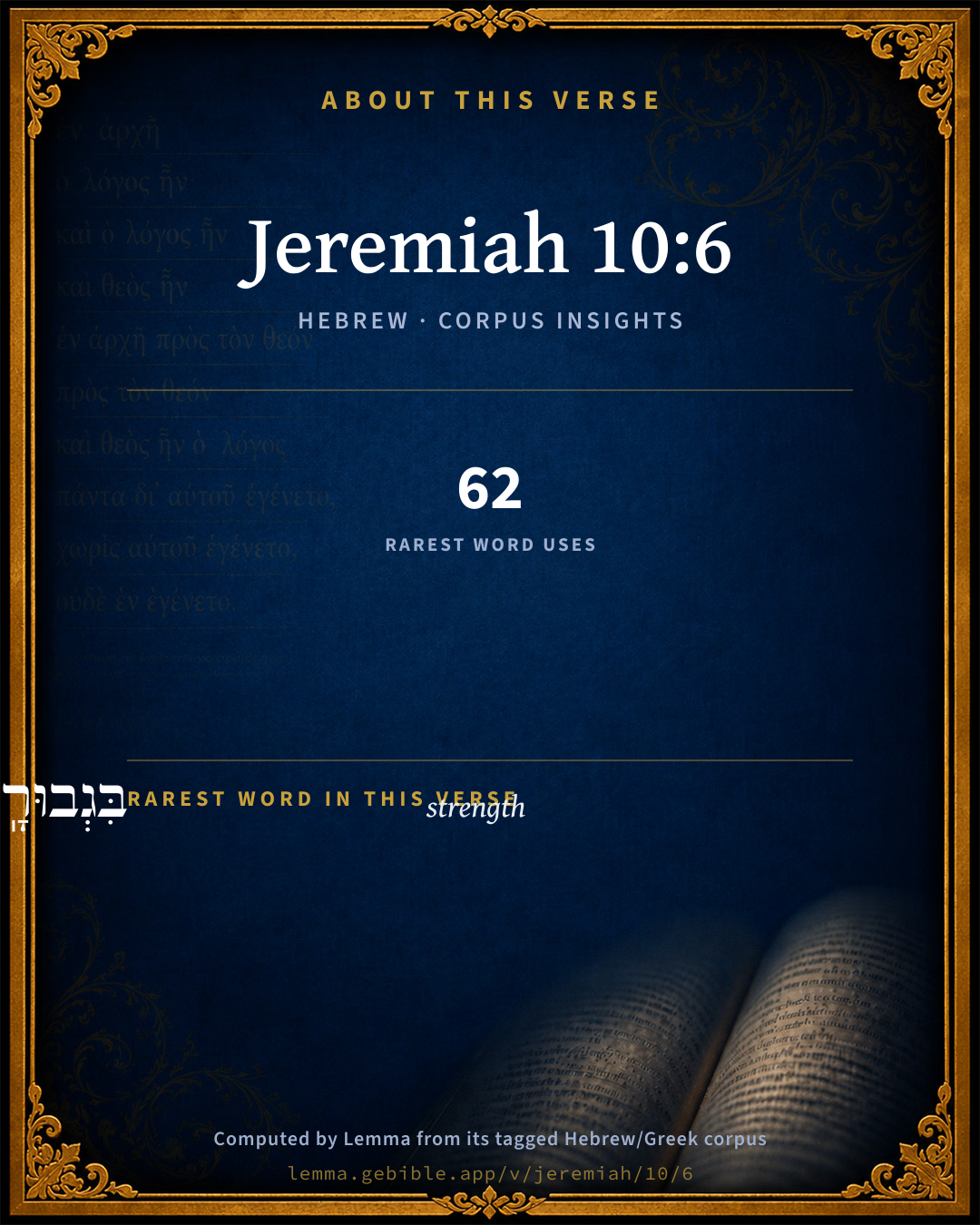
These counts appear in no published source. They are computed here, from the morphology-tagged text and Lemma’s own curated glosses. What Lemma adds →

8
words
7
distinct lemmas
Prophets
section

Grammatical profile

  • 3 nouns
  • 2 adjectives
  • 1 pronoun
  • 1 preposition
  • 1 particle

Repetition

A word recurs within this verse — often emphatic in Hebrew:

  • גָּד֥וֹל great H1419 ×2

Cross-references

24

Topical passages linked to Jeremiah 10:6 in the Treasury of Scripture Knowledge — connected by theme and wording, ordered by reader-vote popularity; previews shown in the World English Bible.

  • Exodus 15:11 Who is like you, Yahweh, among the gods? Who is like you, glorious in holiness, Fearful in praises, doing wonders?
  • Psalms 96:4 For great is Yahweh, and greatly to be praised! He is to be feared above all gods.
  • Psalms 48:1 Great is Yahweh, and greatly to be praised, In the city of our God, in his holy mountain.
  • Deuteronomy 33:26 There is none like God, Jeshurun, Who rides on the heavens for your help, In his excellency on the skies.
  • Psalms 145:3 Great is Yahweh, and greatly to be praised! His greatness is unsearchable.
  • Isaiah 12:6 Cry aloud and shout, you inhabitant of Zion; for great in the midst of you is the Holy One of Israel!"
  • 2 Samuel 7:22 Therefore you are great, Yahweh God: for there is none like you, neither is there any God besides you, according to all that we have heard with our ears.
  • Psalms 147:5 Great is our Lord, and mighty in power. His understanding is infinite.
  • Daniel 4:3 How great are his signs! and how mighty are his wonders! his kingdom is an everlasting kingdom, and his dominion is from generation to generation.
  • Exodus 8:10 He said, "Tomorrow." He said, "Be it according to your word, that you may know that there is none like Yahweh our God.
  • Isaiah 40:25 To whom then will you liken me, that I should be equal [to him]? says the Holy One.
  • Jeremiah 32:18 who show loving kindness to thousands, and recompense the iniquity of the fathers into the bosom of their children after them; the great, the mighty God, Yahweh of Hosts is his name;
  • Exodus 9:14 For this time I will send all my plagues against your heart, against your officials, and against your people; that you may know that there is none like me in all the earth.
  • Deuteronomy 32:31 For their rock is not as our Rock, Even our enemies themselves being judges.
  • Nehemiah 4:14 I looked, and rose up, and said to the nobles, and to the rulers, and to the rest of the people, Don't be you afraid of them: remember the Lord, who is great and awesome, and fight for your brothers, your sons, and your daughters, your wives, and your houses.
  • Nehemiah 9:32 Now therefore, our God, the great, the mighty, and the awesome God, who keep covenant and loving kindness, don't let all the travail seem little before you, that has come on us, on our kings, on our princes, and on our priests, and on our prophets, and on our fathers, and on all your people, since the time of the kings of Assyria to this day.
  • Psalms 35:10 All my bones shall say, "Yahweh, who is like you, Who delivers the poor from him who is too strong for him, Yes, the poor and the needy from him who robs him?"
  • Psalms 86:8–10 There is no one like you among the gods, Lord, Nor any deeds like your deeds.
  • Psalms 89:6–8 For who in the skies can be compared to Yahweh? Who among the sons of the heavenly beings is like Yahweh,
  • Isaiah 40:18 To whom then will you liken God? or what likeness will you compare to him?
  • Isaiah 46:9 Remember the former things of old: for I am God, and there is none else; [I am] God, and there is none like me;
  • Daniel 4:34 At the end of the days I, Nebuchadnezzar, lifted up my eyes to heaven, and my understanding returned to me, and I blessed the Most High, and I praised and honored him who lives forever; for his dominion is an everlasting dominion, and his kingdom from generation to generation.
  • Malachi 1:11 For from the rising of the sun even to the going down of the same, my name is great among the nations, and in every place incense will be offered to my name, and a pure offering: for my name is great among the nations," says Yahweh of Hosts.
  • Isaiah 46:5 To whom will you liken me, and make me equal, and compare me, that we may be like?

Cross-references courtesy of OpenBible.info (CC BY 4.0).

Hebrew and Greek witnesses Masoretic Hebrew ↔ Greek Septuagint

The same verse in the two great witnesses to the Old Testament, shown verse-for-verse.

These are two independent witnesses, not word-aligned to each other, and the Septuagint is shown in lemma (dictionary) form.

Hebrew Jeremiah 10:6 Masoretic · Westminster Leningrad Codex

מֵאֵ֥ין כָּמ֖וֹךָ יְהוָ֑ה גָּד֥וֹל אַתָּ֛ה וְגָד֥וֹל שִׁמְךָ֖ בִּגְבוּרָֽה

There is none like you, Yahweh; you are great, and your name is great in might.

World English Bible · Public Domain

Greek LXX Structure differs

In the Septuagint, Jeremiah is about an eighth shorter than the Hebrew and arranges its material differently — the Oracles Against the Nations (Hebrew chapters 46–51) appear in the middle of the Greek book, after 25:13. Because the chapter and verse boundaries do not line up, a verse-for-verse comparison with the Hebrew is not shown.

A verse-for-verse comparison isn’t shown here because the chapters and verses don’t line up. Switch to the LXX edition with the MT / LXX toggle above to read the Greek directly.

On this verse, The Cambridge Bible for Schools and Colleges discusses the Septuagint’s reading. Read the note in Commentary ↓

Hebrew: Westminster Leningrad Codex (CC BY 4.0). Greek: Septuagint (public domain); English from a public-domain English Septuagint. How the Septuagint differs from the Hebrew →

Targum (Aramaic paraphrase)

1

The Targum is the ancient Jewish Aramaic paraphrase of the Hebrew Scriptures — an interpretive translation, not the Hebrew text itself. Onkelos (literal) and Pseudo-Jonathan (expansive) render the Torah, and Jonathan the Prophets. Coverage is partial: where no permissively-licensed English translation exists for a verse, only the Aramaic is shown. This is verse-level text, not a word-by-word alignment to the Hebrew.

  1. Targum Jonathan Prophets (Joshua–Malachi)
    לֵית בַּר מִנָךְ יְיָ רַב אַתְּ וְרַב שְׁמָךְ בְּגִבָּרוּתָא:

    (no public-domain English translation for this verse)

    Targum Jonathan — Aramaic: “Mikraot Gedolot” (public domain). English: “Sefaria Community Translation” (CC0 1.0 (public-domain dedication)); “London "Chaldee Paraphrase," 1871” (public domain). Text via Sefaria.

Commentary

Notes on Jeremiah 10:6 from classic Christian and Jewish commentators (each source and its license shown beneath its notes). The classic Christian expositions comment on the surrounding passage and are grouped to its opening verse, so a note may address several verses; the Jewish commentaries on the Tanakh (Rashi and others) are per-verse, so they appear only where the commentator wrote on this verse.

Lemma curates 59 commentaries, every one of them public domain or Creative Commons licensed, each selected and text-cleaned for this edition rather than reprinted as found. About our sources →

Trapp's Complete Commentary

John Trapp

Jer 10:6 Forasmuch as [there is] none like unto thee, O LORD; thou [art] great, and thy name [is] great in might.

Ver. 6. Forasmuch as there is none like unto thee.] None of all these dii minutuli, these dunghill deities, are worthy to be named in the same day with thee.

Thou art great.] God is great; {Psa 77:13} greater; {Job 33:12} greatest; {Psa 95:3} greatness itself. {Psa 145:3} He is a degree above the superlative. Think the same of other his names and attributes, many of which we have here mentioned in this and the following verses; which are therefore highly to be prized, and oft to be perused. Leonard Lessius, a little before his death, finished his book concerning the fifty names of almighty God; often affirming, that in that little book he had found more light and spiritual support under those grievous fits of the stone which he suffered, than in all his voluminous commentaries upon Aquinas’s sums, which he had well nigh fitted for the press. {a}

{a} Ex Vita Lessii.

John Trapp, A Commentary or Exposition upon All the Books of the Old and New Testament (1647–1656) — public domain. Text from a community e-Sword module.

Albert Barnes' Notes on the Bible

For as much as - Or, “No one is like unto thee, O Jehovah.” In Jer 10:6-11, the prophet contrasts God’s greatness with the impotence of idols.

Albert Barnes' Notes on the Bible (1834–1885) — public domain. Text from a community e-Sword/MySword module.

Joseph Benson's Commentary

Jer 10:6-7. Forasmuch as there is none like unto thee — This verse would be better rendered, O Lord, thou art great, so that there is none like unto thee, and thy name is great, because of thy might. Who would not fear thee? — Rather, who would not reverence, or stand in awe of thee? For to thee doth it appertain — That is, as some interpret the phrase, To thee doth it appertain to be feared and reverenced; to thee fear and reverence are due. The Hebrew, however, may be rendered, Who would not fear thee when he shall come, or draw near to thee? accordingly Blaney translates the verse thus: Who will not fear thee, O king of nations, when he shall approach unto thee? Forasmuch as among all the wisest of the nations, and in all their kingdoms, there is none like unto thee — On the clause, among the wisest of the nations, he observes, “These words may signify, either all those nations which were most distinguished for the cultivation and improvement of their rational faculties; or else those sage individuals among them, from whose learning and philosophy some better notions of God and religion might have been expected than from the rude and illiterate vulgar. And yet the fact was, that all their boasted wisdom and knowledge had failed of leading them to an object of worship, in any degree corresponding with the infinite perfections and majesty of the divine nature.”

Joseph Benson's Commentary on the Old and New Testaments (1811–1818) — public domain. Text from a community e-Sword module.

Whedon's Commentary on the Bible

Daniel D. Whedon

THE INCOMPARABLE JEHOVAH, Jer_10:6-11.

6. Forasmuch — A complete misapprehension of the force of the original, which is a double negative, doubtless employed for purposes of emphasis — none like unto thee. It is a fitting introduction to this strophe, (Jer_10:6-11,) in which the almighty power of God is set forth in contrast with these dumb idols.

Daniel D. Whedon (gen. ed.), Commentary on the Old and New Testaments (1874–1909) — public domain. Text from a community e-Sword module.

Tyndale Open Study Notes

Tyndale Open Resources

10:6 there is no one like you! See Isa 40:21-31; 44:5-8.

Tyndale Open Study Notes — © Tyndale Open Resources, licensed CC BY-SA 4.0. Text via the HelloAO Bible API.

Geneva Bible (1599)

Geneva Bible translators

He teacheth the people to lift up their eyes to God, who hath all power and therefore ought only to be feared: and herein he showeth them not only the evil that they ought to eschew: but the good which they ought to follow, Rev. 15:4.

Geneva Bible (1599) marginal notes — public domain. Text via Bolls.life.

Jamieson, Fausset & Brown

Robert Jamieson, A. R. Fausset & David Brown

none--literally, "no particle of nothing": nothing whatever; the strongest possible denial (Exo 15:11; Psa 86:8, Psa 86:10).

Jamieson, Fausset & Brown — Commentary Critical and Explanatory on the Whole Bible (1871) — public domain (CC PDM 1.0). Text via the HelloAO Bible API.

John Calvin's Commentaries

As the truth respecting the gods of the heathens, that they are mere figments, would be useless and of no moment, were not the knowledge of the, true God added, the Prophet now introduces God himself. And there is another reason; for no one could know that these wooden and stony gods are of no account, were not the truth respecting the true God to shine forth. Whosoever does not understand that there is a God, and does not know who or what he is, can never be really influenced by this truth, that the gods of the heathens are demons, and that all their superstitions are sacrilegious.

We now then perceive why the Prophet turns to the true God: it was, that the brightness of God’s glory might dissipate the darkness in which the Gentiles were involved, and also, that true religion might really influence the hearts of men, so that by acknowledging the one true God, to whose power we ought to submit, they might not only despise and repudiate all idols, but also hate and abhor them. The rest to-morrow.

John Calvin's Commentaries (1540-1563) — public domain. Text from the Calvin Translation Society English edition (1840s-50s) via the Christian Classics Ethereal Library (ccel.org). Calvin's coverage is partial (roughly two-thirds of the Bible); uncommented books and verses are honest gaps, never fabricated. The 19th-century editor's footnotes and remarks are omitted so the notes are faithfully Calvin's own voice.

Ellicott's Commentary for English Readers

(6) Forasmuch as.—A somewhat flat addition to the Hebrew text, which opens with a vigorous abruptness, None is there like unto thee . . .

Great in might.—The latter is an almost technical word (as in Isa_33:13; Psa_21:13; Psa_145:11) for the Divine Omnipotence. (Compare “the Mighty God” of Isa_9:6.)

A Bible Commentary for English Readers, edited by Charles John Ellicott (1878–1897) — public domain. Text from a community e-Sword module.

The Cambridge Bible for Schools and Colleges

gen. ed. J. J. S. Perowne

6. There is none] This sense can only be got by omitting the first letter in MT. The omission can, however, be justified, as it may be an accidental repetition by a scribe of the last letter of Jer_10:5. Keeping the Hebrew consonants with a slight change of vowels, we get the sense “Whence is any like unto thee!” The same difficulty arises in Jer_10:7.

6–8. Omitted, most probably rightly, by LXX. See above.

6–16. See summary at commencement of the ch.

The Cambridge Bible for Schools and Colleges (gen. ed. J. J. S. Perowne; Cambridge University Press, 1878–1918) — public domain. Text from a community e-Sword module.

John Gill's Exposition

Forasmuch as there is none like unto thee, O Lord,.... None like him, for the perfections of his nature, for the works of his hands, and for the instances of his kindness and beneficence, both in a way of grace and providence; there is none like him for doing good, or doing evil; that is, for bestowing favours, or inflicting punishments; there is none like him for goodness or greatness, as follows:

thou art great; in his nature; of great power, wisdom, faithfulness, truth, and goodness; and in his works of creation and providence, and in everything in which he is concerned; and greatness is to be ascribed to him, and greatly is he to be praised; and all the glory due unto his name is to be given him:

and thy name is great in might; his name is himself, and his greatness much appears in the exertion of the attribute of his power and might; in making all things out of nothing, in upholding the whole creation, and in the government of the universe; or the fame of him is great through the effects of his power, which are to be seen throughout the earth.

John Gill's Exposition of the Whole Bible (1746–1763) — public domain (CC PDM 1.0). Text via the HelloAO Bible API.

Haydock's Catholic Bible Commentary

There. Septuagint omit the three following verses; and from ver. 9., all these, &c., to the end of ver. 10., which Grabe inserts in a different character. (Haydock)

George Leo Haydock (1774–1849), Haydock's Catholic Family Bible and Commentary, 1859 edition — public domain. Excludes Psalms (Douay-Rheims chapter numbering differs from Protestant) and Deuterocanonical books (Catholic canon only).

Matthew Poole's English Annotations

Forasmuch; this particle טן min, is to be taken here causally, and refers either to what goes before, showing there is no comparison between God and idols; or rather, to what follows, as the ground and reason of all due subjection to God, as in the next verse.

Thy name is great, or, thou art transcendently great,

in might, i.e. though idols may have something of a name in the world among the heathen, yet there was nothing of their real power or might seen; or if the devil might act something through them to delude the world, yet nothing to be compared with that might that hath manifested itself in God’s works, Psa 106:8; 111:6. All the works of idols are either none, or feeble and weak, Jer 10:8.

Matthew Poole's English Annotations on the Holy Bible (1683–1685) — public domain. Text from a community e-Sword/MySword module.

The Pulpit Commentary

Forasmuch as there is none; rather, so that, etc. But practically it is merely a strengthened negative. There is none like unto thee; none, that is, among those who claim to have Divine power. (comp. the phrase, "God of gods," Deu_10:17 Psa_136:2) It would appear from some passages, however, as if the heathen did not worship mere nonentities (though idols are sometimes called "things of naught," e.g. ten times by Isaiah) by comparison with Jehovah, but that there was a dark background of awful personal or quasi-personal reality. (Deu_4:7 2Ch_28:23)

Vers. 6, 7. The incomparable greatness of God.

I GOD IS GREAT. This simple item of the Mohammedan"s creed must be accepted with equal reverence by the Christian, though it forms but one part of his conception of the Divine nature. There is danger lest we should regard the goodness of God in such a way as to detract from his majesty. Truly considered, it enhances the supreme glory of God"s greatness. God is great in power, in wisdom, in resources, in essential being. God is also great in character, in purpose, in the just and good principles of his actions. The worship of a God of mere power is the cringing of a slave, and has no spiritual value, but rather degrades the devotee by destroying independence of conscience and moral courage. It would be our duty to resist a being of infinite power if that power were not used righteously, for such a being would not be God, but an infinite demon; and though resistance were hopeless, it would be better to be a martyr to conscience than the degraded minion of an unrighteous despotism. But God is worthy of all worship because his greatness of power reposes on greatness of character.

II THE GREATNESS OF GOD IS INCOMPARABLE. The Jews were led to see that their God was not one among many deities, not even the supreme God, the Zeus of a pantheon of lesser divinities, but the only God, and out of all comparison with all other beings. God is infinite. You cannot compare the infinite with anything finite. The greatest existence which has any limit is as far from the infinite as the smallest. This is as much larger than a world as it is larger than a grain of sand. The being of God is entirely distinct from all other orders of being vastly greater than the universe of them in its fullness incomparable to any. Yet:

1. God, being infinite, contains in himself all possibilities of being, and therefore all may see their ideal perfection in him though he transcends all. (Heb_2:10)

2. God has made man in his own image, and in his power of thought, freedom of will, and moral conscience, man has characteristics like the Divine in kind, though incomparable with that in degree. (Gen_1:26) Christ is the "express Image of his substance", (Heb_1:3) "but only so because in him dwelleth all the fullness of the Godhead bodily". (Col_2:9)

III THE INCOMPARABLE GREATNESS OF GOD SHOULD MOVE ALL MEN TO FEAR BEFORE HIM. All should fear because:

1. He is too great to be concerned with a few; all nations, all mankind, are equally under his sway.

2. He is infinitely above the greatest, so that kings and wise men, persons of the highest rank and of the most profound genius, are as much below him as if they were beggars and fools.

3. He is so vast in being, power, and character, that it is no mark of noble independence to resist him, but only a sign of foolish pride which will certainly be humiliated. The fear of God thus engendered is an awe, a reverence, not mere terror. The gospel tempers this with the confident love of children, but does not destroy it, since perfect love, while casting out terror, infuses feelings of reverence.

Vers. 6, 7. The uniqueness of Jehovah.

When other gods have been proved to be false, it is very important that this unlikeness of God to anything else should be established. His claim to attention and reverence is thereby held in judgment.

I IN WHAT RESPECTS JEHOVAH IN UNIQUE.

1. In idea. It is a wondrous conception a being so great, infinite, eternal, and unchangeable in his being, wisdom, power, holiness, justice, goodness, and truth. As a conception it stands alone, commands respect, and invites reverent investigation. Such goodness with such power and wisdom!

2. In pretensions.

a. He claims our sole worship;

b. our highest and holiest service is his by right, and is unworthy of him;

c. our welfare and destiny are in his hands.

3. In works. There is nothing he has claimed to be which he has not made good in his works creation, providence, grace.

II THIS CONCEPTION OF GOD AS UNIQUE HARMONIZES WITH THE INSTINCTS OF THE HUMAN SPIRIT, AND THE TEACHINGS OF HISTORY AND NATURE. It has cast its spell over the mightiest intellects, and commanded the homage of the purest and best of men. In the worship of him whom it represents the highest longings are satisfied, and the most characteristically human sympathies and principles encouraged. The unity of nature; the mental principle that traces everything to a great First Cause; the manner in which the system of religion of which he is center and dominating principle explains this, and harmonizes the life of man with his surroundings; are all indications that point to the same conclusion. M.

The Pulpit Commentary (1880–1919), ed. H.D.M. Spence-Jones & Joseph S. Exell — public domain. Text from a community e-Sword module.

unfoldingWord translationNotes

Door43 World Missions Community

General Information:

Jeremiah has just been talking about idol worship.

your name is great in power

Here Yahweh's "name" refers to himself and his reputation. AT: "you are very powerful" (See: Metonymy)

Who does not fear you, king of the nations?

Jeremiah asks this rhetorical question to emphasize that everyone should fear Yahweh. Here he refers to Yahweh as "king of the nations." This question can be written as a statement. AT: "Everyone should fear you, king of the nations." (See: Rhetorical Question)

what you deserve

"what you have earned"

translationWords

name

power

king

wise

royal

kingdom

unfoldingWord translationNotes — © Distant Shores Media and the Door43 World Missions Community, licensed CC BY-SA 4.0. Source: git.door43.org/Door43/en_tn.

Lesson kit

Teaching starters — assembled from the data on this page, not authored interpretation. Every prompt links to the verse data it draws on. Edit before teaching.

Jeremiah, in the Prophets, opens this verse with 8 words (7 distinct Hebrew lemmas). Its most distinctive word is gᵉbûwrâh (“strength”). A historical commentator’s framing appears above. Read the whole chapter for the surrounding context.

Discussion questions

  1. What does “strength” (gᵉbûwrâh) contribute to the verse as a whole?
  2. Exodus 15:11 shares this passage’s theme. How do the two illuminate each other?
  3. “great” occurs 2× in this one verse. What is the effect of the repetition?
  4. The translations on this page render this verse differently — a whole-verse word diff, not a word-by-word alignment. What might account for the different wordings?
  5. Reading how Trapp's Complete Commentary and Albert Barnes' Notes on the Bible read this verse, where do the two commentators agree and where do they part?

Things to notice

  • These translations choose different wording for 9 words in this verse.
  • “great” occurs 2× in this single verse.
  • 7 distinct Hebrew lemmas span 8 words in this verse.

Reading settings

Reading text

Shown beneath each verse's original-language words.

Old Testament
Old Testament edition

Read the OT as the Masoretic Hebrew (MT) or the Greek Septuagint (LXX).

English shown for the Greek Septuagint (in the Hebrew ↔ Greek comparison).

Comparing translations? Open the Compare panel on any verse page to stack up to four side by side.