
Job 9:32

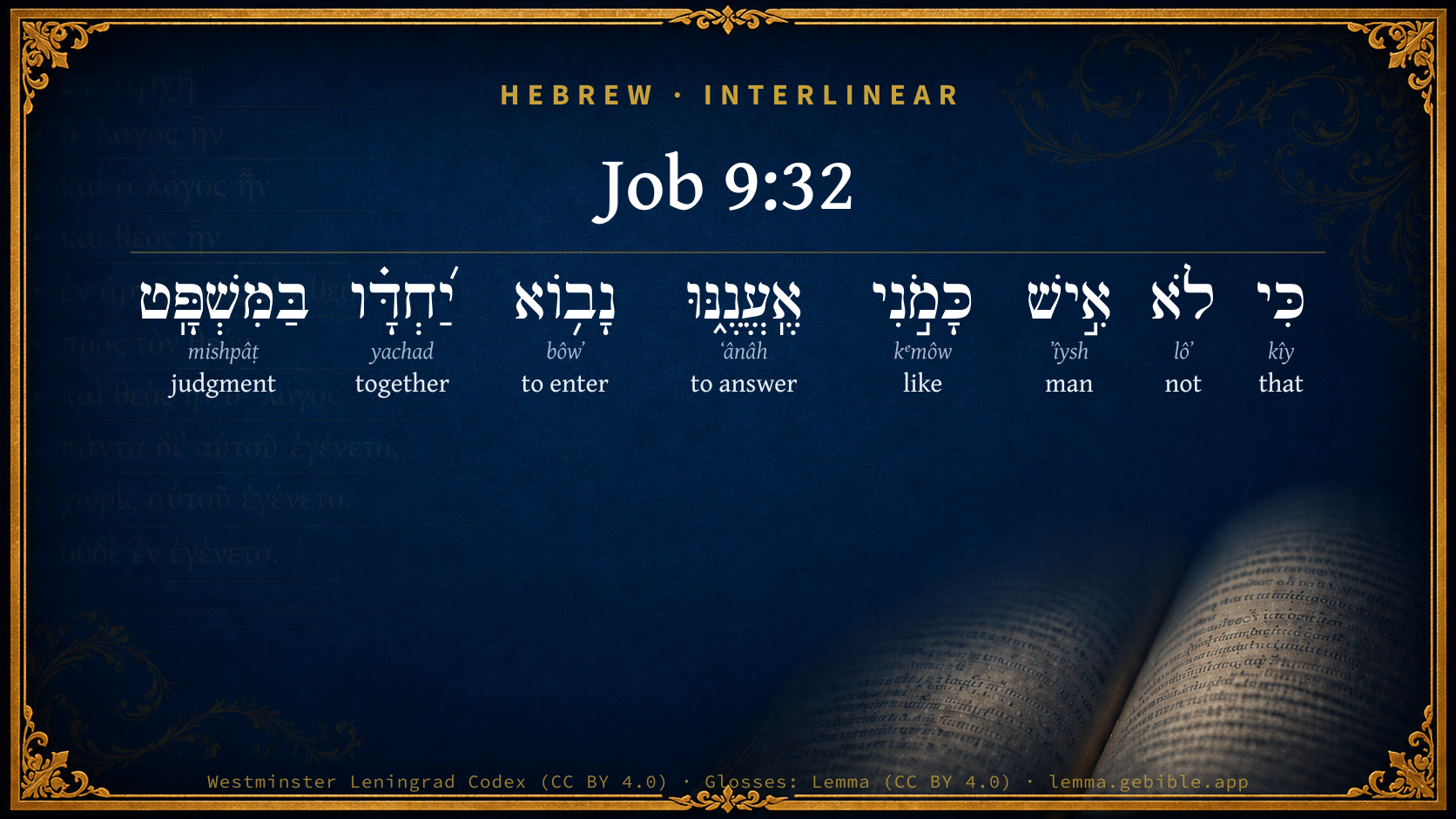
Hebrew (Westminster Leningrad Codex) Job 9:32 appears in the Hebrew Old Testament. The text above is from the Westminster Leningrad Codex. Each word links to its Strong’s number, a concise gloss, and parsing drawn from the Open Scriptures Hebrew Bible morphology. Click any word for its full Brown-Driver-Briggs (BDB) entry.
Download image
Cite this verse

Job 9:32 (World English Bible). Public Domain. Lemma interlinear Bible study tool, https://lemma.gebible.app/v/job/9/32.

Show BibTeX & RIS
BibTeX
RIS
English Translation
For he is not a man, as I am, that I should answer him, That we should come together in judgment.
World English Bible · Public Domain
Download a study sheet

One document with this verse’s original text, its word-by-word gloss line, the meaning frame, cross-references with their text, attributed commentary, and full source and license credits — printable, and it pastes into notes with its structure intact.

This verse Autodidact and up

Study sheet (.html) Plain text (.txt)

A passage Seminary Student

Up to 50 verses in one chapter. A passage sheet keeps up to 6 commentary sources and 12 cross-references per verse, in the order this page ranks them, and says so on the sheet whenever that leaves anything out. Ask for a single verse and you get the Autodidact verse sheet above.

Everything on this page stays free to read, with no account — the sheet is a download of what is already on screen, not access to it.

Want to remove ads? Support Godless Engineer
Compare translations 3

The same verse in 3 English versions, stacked beneath the original-language interlinear above. Click any original word for its lexicon entry.

Each is an independent rendering of the whole verse — the interlinear is not word-aligned to these translations.

Highlighted words mark where these versions differ — a whole-verse word diff, not a word-by-word alignment.

  • World English Bible Public Domain
    For he is not a man, as I am, that I should answer him, That we should come together in judgment.
  • King James Version Public Domain
    For he is not a man, as I am, that I should answer him, and we should come together in judgment.
  • unfoldingWord Literal Text CC BY-SA 4.0
    For I would not be answering a man like me, we would be coming together into judgment.

unfoldingWord Literal Text — © unfoldingWord, licensed CC BY-SA 4.0. Word-aligned USFM3 via Door43 (git.door43.org/unfoldingWord/en_ult).

Versions to compare (up to 4)

3 of 4 selected

Show all 18 translations

Every available English version of this verse, each an independent rendering of the whole verse.

  • World English Bible Public Domain
    For he is not a man, as I am, that I should answer him, That we should come together in judgment.
  • Berean Standard Bible Public Domain
    For He is not a man like me, that I can answer Him, that we can take each other to court.
  • Majority Standard Bible Public Domain
    For He is not a man like me, that I can answer Him, that we can take each other to court.
  • King James Version Public Domain
    For he is not a man, as I am, that I should answer him, and we should come together in judgment.
  • American Standard Version (1901) Public Domain
    For he is not a man, as I am, that I should answer him, That we should come together in judgment.
  • Revised Version (1885) Public Domain
    For he is not a man, as I am, that I should answer him, that we should come together in judgment.
  • Geneva Bible (1599) Public Domain
    For he is not a man as I am, that I shoulde answere him, if we come together to iudgement.
  • Douay-Rheims (1899) Public Domain
    For I shall not answer a man that is like myself: nor one that may be heard with me equally in judgment.
  • Young's Literal Translation Public Domain
    But if a man like myself -- I answer him, We come together into judgment.
  • Literal Standard Version CC BY-SA 4.0
    But if a man like myself—I answer Him, || We come together into judgment.
  • Unlocked Literal Bible CC BY-SA 4.0
    For God is not a man, as I am, that I could answer him, that we could come together in court.
  • unfoldingWord Literal Text CC BY-SA 4.0
    For I would not be answering a man like me, we would be coming together into judgment.
  • Darby Bible Public Domain
    For he is not a man, as I am, that I should answer him; that we should come together in judgment.
  • World Messianic Bible Public Domain
    For he is not a man, as I am, that I should answer him, that we should come together in judgment.
  • Webster's Bible Public Domain
    For he is not a man, as I am, that I should answer him, and we should come together in judgment.
  • Free Bible Version CC BY-SA 4.0
    For God is not a mortal being like me, I can't defend myself or take him to court.
  • Bible in Basic English Public Domain
    For he is not a man as I am, that I might give him an answer, that we might come together before a judge.
  • JPS Tanakh (1917) Public Domain
    For He is not a man, as I am, that I should answer Him, that we should come together in judgment.

Literal Standard Version (2020), Covenant Press — licensed CC BY-SA 4.0. Text via the HelloAO Bible API (eBible.org). Unlocked Literal Bible (unfoldingWord) — licensed CC BY-SA 4.0. Text via the HelloAO Bible API (eBible.org). unfoldingWord Literal Text — © unfoldingWord, licensed CC BY-SA 4.0. Word-aligned USFM3 via Door43 (git.door43.org/unfoldingWord/en_ult). Free Bible Version, Dr. Jonathan Gallagher — licensed CC BY-SA 4.0. Text via the HelloAO Bible API (eBible.org).

Word by word

More ways to search: Search by grammar → Find every occurrence → Compare this word →

Practice this passage: Drill this verse → Learn its vocabulary →

About this verse

These counts appear in no published source. They are computed here, from the morphology-tagged text and Lemma’s own curated glosses. What Lemma adds →

8
words
8
distinct lemmas
Wisdom
section

Grammatical profile

  • 2 verbs
  • 2 nouns
  • 1 preposition
  • 1 conjunction
  • 1 adverb
  • 1 particle

Verb forms

  • אֶֽעֱנֶ֑נּוּ Qal · Imperfect
  • נָב֥וֹא Qal · Imperfect

Hebrew & Septuagint length

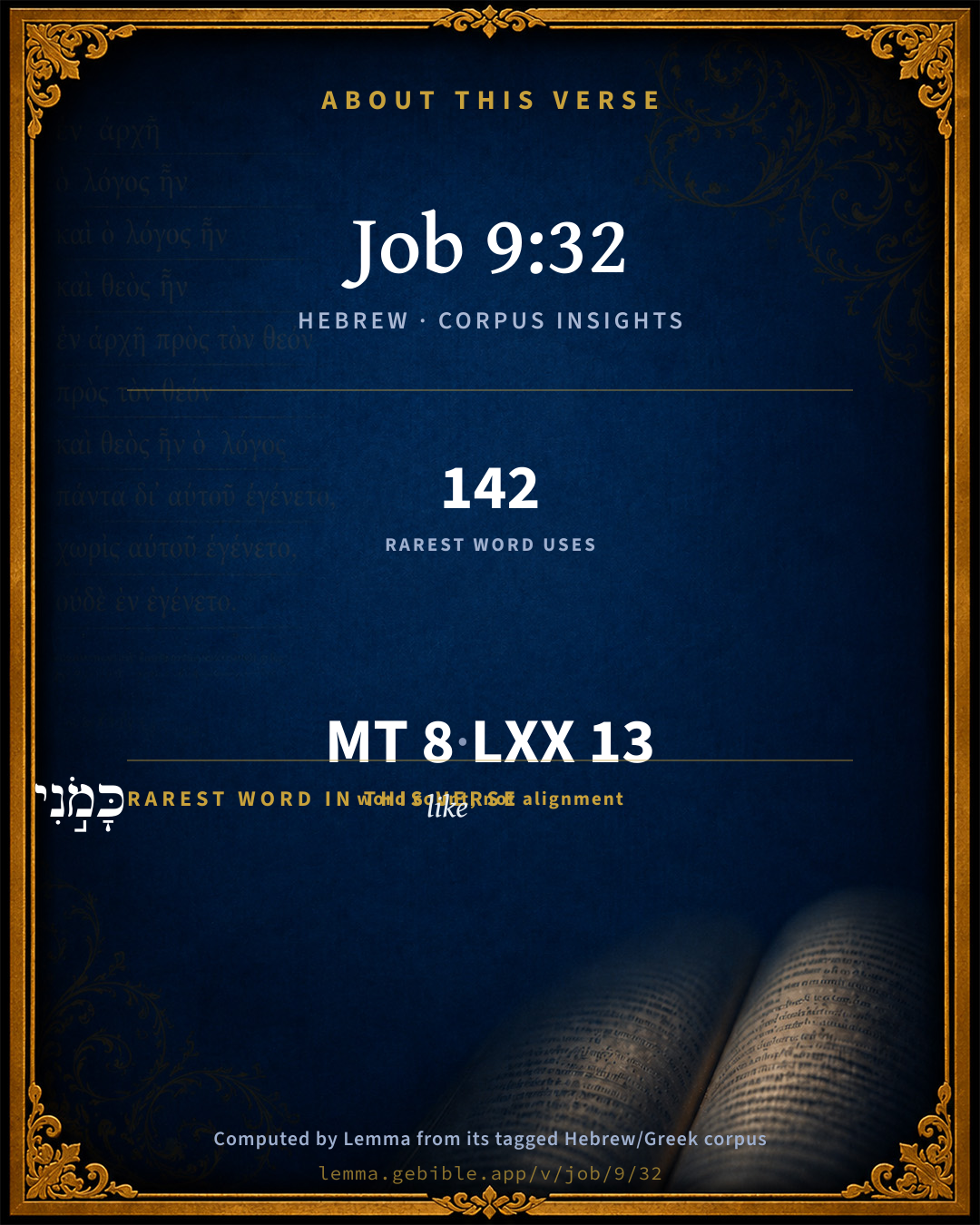
In English translation the verse runs 21 words from the Hebrew and 19 from the Septuagint (LXX English) — closely comparable.

A rough comparison of the two English renderings, which tokenize alike — not a word-level alignment.

Word counts can differ between the Hebrew and the Greek without any difference in meaning — e.g. the Hebrew direct-object marker אֵת has no separate Greek word, and Greek often adds the article ὁ.

In the original languages it is 8 Hebrew tokens and 13 Greek tokens — but the two are counted differently (Hebrew bundles its prefixes and suffixes into one token; the Greek is in lemma form), so that isn’t a like-for-like length.

Cross-references

12

Topical passages linked to Job 9:32 in the Treasury of Scripture Knowledge — connected by theme and wording, ordered by reader-vote popularity; previews shown in the World English Bible.

  • Romans 9:20 But indeed, O man, who are you to reply against God? Will the thing formed ask him who formed it, "Why did you make me like this?"
  • Ecclesiastes 6:10 Whatever has been, its name was given long ago; and it is known what man is; neither can he contend with him who is mightier than he.
  • Numbers 23:19 God is not a man, that he should lie, Neither the son of man, that he should repent: Has he said, and will he not do it? Or has he spoken, and will he not make it good?
  • Psalms 143:2 Don't enter into judgment with your servant, For in your sight no man living is righteous.
  • Isaiah 45:9 Woe to him who strives with his Maker--a potsherd among the potsherds of the earth! Shall the clay ask him who fashions it, "What are you making?" or your work, "He has no hands?"
  • 1 Samuel 16:7 But Yahweh said to Samuel, "Don't look on his face, or on the height of his stature; because I have rejected him: for [Yahweh sees] not as man sees; for man looks at the outward appearance, but Yahweh looks at the heart."
  • Job 13:18–23 See now, I have set my cause in order. I know that I am righteous.
  • Job 23:3–7 Oh that I knew where I might find him! That I might come even to his seat!
  • Job 33:12 "Behold, I will answer you. In this you are not just; For God is greater than man.
  • Job 35:5–7 Look to the heavens, and see. See the skies, which are higher than you.
  • Jeremiah 49:19 Behold, he shall come up like a lion from the pride of the Jordan against the strong habitation: for I will suddenly make them run away from it; and whoever is chosen, him will I appoint over it: for who is like me? and who will appoint me a time? and who is the shepherd who will stand before me?
  • 1 John 3:20 because if our heart condemns us, God is greater than our heart, and knows all things.

Cross-references courtesy of OpenBible.info (CC BY 4.0).

Hebrew and Greek witnesses Masoretic Hebrew ↔ Greek Septuagint

The same verse in the two great witnesses to the Old Testament, shown verse-for-verse.

These are two independent witnesses, not word-aligned to each other, and the Septuagint is shown in lemma (dictionary) form.

Hebrew Job 9:32 Masoretic · Westminster Leningrad Codex

כִּי לֹא אִ֣ישׁ כָּמֹ֣נִי אֶֽעֱנֶ֑נּוּ נָב֥וֹא יַ֝חְדָּ֗ו בַּמִּשְׁפָּֽט

For he is not a man, as I am, that I should answer him, That we should come together in judgment.

World English Bible · Public Domain

Greek LXX Job 9:32 Septuagint · lemma form

οὐ γάρ εἰμί ἄνθρωπος κατά ἐγώ ὅς ἀντικρίνω ἵνα ἔρχομαι ὁμοθυμαδόν εἰς κρίσις

For you are not man like me, with whom I could contend, that we might come together to judgment.

LXX2012 (modern English Septuagint) · Public Domain

On this verse, John Gill's Exposition discusses the Septuagint’s reading. Read the note in Commentary ↓

Hebrew: Westminster Leningrad Codex (CC BY 4.0). Greek: Septuagint (public domain); English from LXX2012 (modern English Septuagint) (Public Domain). How the Septuagint differs from the Hebrew →

Commentary

Notes on Job 9:32 from classic Christian and Jewish commentators (each source and its license shown beneath its notes). The classic Christian expositions comment on the surrounding passage and are grouped to its opening verse, so a note may address several verses; the Jewish commentaries on the Tanakh (Rashi and others) are per-verse, so they appear only where the commentator wrote on this verse.

Lemma curates 59 commentaries, every one of them public domain or Creative Commons licensed, each selected and text-cleaned for this edition rather than reprinted as found. About our sources →

Trapp's Complete Commentary

John Trapp

Job 9:32 For [he is] not a man, as I [am, that] I should answer him, [and] we should come together in judgment.

Ver. 32. For he is not a man as I am] He is not such a one, nor can be, as I am, and must be; he hath other eyes and thoughts and ways than creatures have. He who is just before men is unjust before God; therefore he is no fit match for me to contend in addition: have I an arm like God? or can I thunder with a voice like him? Job 40:9. Is it safe to contend with him that is mightier than I? Ecc 6:10. Surely if I should be so mad as to justify myself, yet I should soon be given to know that "that which is highly esteemed amongst men is an abomination in the sight of God," Luk 16:15.

And we should come together in judgment] How can that possibly be, when as God is the supreme judge, neither is there any appealing from or repealing of his sentence?

John Trapp, A Commentary or Exposition upon All the Books of the Old and New Testament (1647–1656) — public domain. Text from a community e-Sword module.

Joseph Benson's Commentary

Job 9:32-33. For he is not a man as I am — But one infinitely superior to me in majesty and power, wisdom and justice. That I should answer him — That I should presume to debate my cause with him, or answer his allegations against me. That we should come together in judgment — Face to face, to plead upon equal terms. Neither is there any days-man — Or, umpire; that might lay his hand upon us both — Order and govern us in pleading, and oblige us to stand to his decision. The laying the hand on both parties implies a coercive power to enforce the execution of his decrees. This no one could have over the Almighty: it was in vain, therefore, to contend with him. Our Lord Jesus Christ is now the blessed daysman, who has mediated between heaven and earth, has laid his hand upon us both: to him the Father hath committed all judgment. But this was not made so clear then as it is now by the gospel, which leaves no room for such a complaint as this.

Joseph Benson's Commentary on the Old and New Testaments (1811–1818) — public domain. Text from a community e-Sword module.

Tyndale Open Study Notes

Tyndale Open Resources

9:32-33 A mediator would not judge God and man but would work to bring them together (see 16:19-21).

Tyndale Open Study Notes — © Tyndale Open Resources, licensed CC BY-SA 4.0. Text via the HelloAO Bible API.

Jamieson, Fausset & Brown

Robert Jamieson, A. R. Fausset & David Brown

(Ecc 6:10; Isa 45:9).

Jamieson, Fausset & Brown — Commentary Critical and Explanatory on the Whole Bible (1871) — public domain (CC PDM 1.0). Text via the HelloAO Bible API.

Adam Clarke's Commentary

Verse 32. For he is not a man as I am] I cannot contend with him as with one of my fellows in a court of justice.

Adam Clarke's Commentary on the Bible (1810–1826) — public domain. Text from a community e-Sword/MySword module.

Ellicott's Commentary for English Readers

(32, 33) For he is not a man, as I am . . .—Is not that confession, if we believe that such a daysman as Job longed for has been given, itself a witness that it came from God, and was given by God? The light that has shined upon us was shining then in the heart of Job, and shines for ever in the pages of his book. Job felt, as he had been taught to feel, that in himself there not only was no hope, but no possibility of justification with God, unless there should be an umpire and impartial mediator, who could make the cause of both his own, and reconcile and unite the two in himself. It is useless to inquire what other particular form the aspiration of Job may have taken, or how far he understood and meant what he said; but here are his words, and this is what they must mean, and it is for us to adore the wisdom by which they were taught accurately to correspond with what we know has been given to us by God. We know that a daysman has laid his hand upon us both; and while we see that this is what Job wanted, we cannot but see more plainly that this is what we want. It is to be observed that this word daysman, or judge, is immediately connected with the Scripture phrase, “the day of the Lord,” and St. Paul’s words, “the day shall declare it” (1Co_3:13).

A Bible Commentary for English Readers, edited by Charles John Ellicott (1878–1897) — public domain. Text from a community e-Sword module.

The Cambridge Bible for Schools and Colleges

gen. ed. J. J. S. Perowne

32–34. The preceding verses described how unavailing all Job’s efforts were to make out his innocence in the face of the fixed resolution of God to hold him guilty. Now Job comes back to what is the real difficulty,—God is not a man like himself.

The Cambridge Bible for Schools and Colleges (gen. ed. J. J. S. Perowne; Cambridge University Press, 1878–1918) — public domain. Text from a community e-Sword module.

John Gill's Exposition

Neither is there any daysman betwixt us,.... Or "one that reproves" (q); who upon hearing a cause reproves him that is found guilty, or is blameworthy, or has done injury to another; but there is no such person to be found, among angels or men, capable of this, supposing, as if Job should say, I should appear to be the injured person; or there is no "umpire" or "arbitrator" (r), to whom the case between us can be referred; for, as Bar Tzemach observes, he that stands in such a character between two parties must be both more wise and more mighty than they; but there is none among all beings wiser and mightier than God:

that might lay his hand upon us both; and restrain them from using any violence to one another, as contending persons are apt to do; and compromise matters, settle and adjust things in difference between them, so as to do justice to both, and make both parties easy, and make peace between them. Herodotus (s) makes mention of a custom among the Arabians,"when they enter into covenants and agreements with each other, another man stands in the midst of them both, and with a sharp stone cuts the inside of the hands of the covenanters near the larger fingers; and then takes a piece out of each of their garments, and anoints with the blood seven stones that lie between them; and while he is doing this calls upon a deity, and when finished the covenant maker goes with his friends to an host or citizen, if the affair is transacted with a citizen; and the friends reckon it a righteous thing to keep the covenant.''To which, or some such custom, Job may be thought to allude. Now, whereas Christ is the daysman, umpire and mediator between God and men, who has interposed between them, and has undertaken to manage affairs relating to both; in things pertaining to God, the glory of his justice, and the honour of his law, and to made reconciliation for the sins of men, and to make peace for them with God by the blood of his cross; which he has completely done, being every way qualified for it, inasmuch as he partakes of both natures, and is God and man in one person, and so could put his hand on both, and make both one; or bring them who were at variance to an entire agreement with each other, upon such a bottom, as even the strict justice of God cannot object unto. Now, I say, Job must not be understood as if he was ignorant of this, for he had knowledge of Christ as a Redeemer and Saviour, and so as the Mediator and Peacemaker; the Septuagint version renders it as a wish, "O that there was a mediator between us!" and so it may be considered as a prayer for Christ's incarnation, and that he would appear and do the work of a mediator he was appointed to, which Job plainly saw there was great need of; or, as others (t), "there is no daysman yet"; there will be one, but as yet he is not come; in due time he will, which Job had faith in and full assurance of: but there is no need of such versions and glosses: Job is here not speaking of the affair of salvation, about which he had no doubt, he knew his state was safe, and he had an interest in the living Redeemer and blessed Mediator; but of the present dispensation of Providence, and of the clearing of that up to the satisfaction of his friends, so that he might appear to be an innocent person; and since God did not think fit to change the scene, there was none to interpose on his behalf, and it was in vain for him to contend with God.

(q) "arguens", Montanus, Bolducius, Drusius; "redarguens", Vatablus, Mercerus. (r) "Arbiter", Junius & Tremellius, Piscator, Cocceius, Schultens. (s) Thalia, sive, l. 3. c. 8. (t) So some in Caryll.

John Gill's Exposition of the Whole Bible (1746–1763) — public domain (CC PDM 1.0). Text via the HelloAO Bible API.

Albert Barnes' Notes on the Bible

For he is not a man as I am - He is infinitely superior to me in majesty and power. The idea is, that the contest would be unequal, and that he might as well surrender without bringing the matter to an issue. It is evident that the disposition of Job to yield, was rather because he saw that God was superior in power than because he saw that he was right, and that he felt that if he had ability to manage the cause as well as God could, the matter would not be so much against him as it was then. That there was no little impropriety of feeling in this, no one can doubt; but have we never had feelings like this when we have been afflicted? Have we never submitted to God because we felt that he was Almighty, and that it was vain to contend with him, rather than because he was seen to be right? True submission is always accompanied with the belief that God is RIGHT - whether we can see him to be right or not.

And we should come together in judgment - For trial, to have the case adjudicated. That is, that we should meet face to face, and have the cause tried before a superior judge. Noyes.

Albert Barnes' Notes on the Bible (1834–1885) — public domain. Text from a community e-Sword/MySword module.

Matthew Poole's English Annotations

He is not a man, as I am; but one infinitely superior to me in majesty, and power, and wisdom, and justice.

That I should answer him; that I should presume to debate my cause with him, or answer his allegations against me.

That we should come together, face to face, to plead upon equal terms before a superior and indifferent judge.

Matthew Poole's English Annotations on the Holy Bible (1683–1685) — public domain. Text from a community e-Sword/MySword module.

The Pulpit Commentary

For he is not a man, as I am, that I should answer him; and we should come together in judgment (comp. vers. 2-14). On one of two conditions only, Job thinks, could the contest be even between himself and God.

(1) If God, divesting himself of all his Divine attributes, became man;

(2) if some thirdsman could be found, some umpire or arbitrator, to preside over the contest, and decide it. Neither condition, however, was (he thought) possible; and therefore no satisfactory judgment could take place.

Recent commentators observe that the Christian scheme, which Job could not anticipate, provides almost a literal fulfilment of both conditions, since the God who is to judge us is "true Man," and is also a Mediator, or "Thirds-man," between us and the offended Father, with authority to make the final decision, "the Father having committed all judgment unto the Son, (Joh_5:22) and" given him authority to execute judgment also for the very reason that he is "the Son of man". (Joh_5:27)

The Pulpit Commentary (1880–1919), ed. H.D.M. Spence-Jones & Joseph S. Exell — public domain. Text from a community e-Sword module.

John Wesley's Explanatory Notes

A man - But one infinitely superior to me in majesty, and power, and wisdom, and justice. That - That I should presume to debate my cause with him. Come - Face to face, to plead upon equal terms.

John Wesley, Explanatory Notes Upon the Whole Bible (1754–1765) — public domain. Text via the GEBible commentary corpus.

unfoldingWord translationNotes

Door43 World Missions Community

answer him

Job implies that God has charged him of doing wrong, and he wants to respond to those charges. AT: "answer his charges against me" or "defend myself" or "argue my innocence with him" (See: Assumed Knowledge and Implicit Information)

come together in court

"come together to trial." Here "court" is a place where people can come and a judge will settle disputes. "Coming together in court" is a metonym for going against each other in a court of law. AT: "confront each other before a judge" (See: Metonymy)

There is no judge between us

This means there is no judge who is greater than God who could decide what is right between him and Job.

lay his hand upon us both

Here "lay his hand upon" means having power or authority over. AT: "take hold of both of us" or "have authority over both of us" (See: Idiom)

translationWords

God

judge, judges

unfoldingWord translationNotes — © Distant Shores Media and the Door43 World Missions Community, licensed CC BY-SA 4.0. Source: git.door43.org/Door43/en_tn.

Rashi

Rabbi Shlomo Yitzchaki (Rashi)

in debate Heb. במשפט, in words of debate. [The word] משפט is used in three expressions: 1) its beginning, viz. the clarification of the matters, 2) its middle, viz. the verdict, and 3) its end, viz. the meting out of the tortures and the collection of the debt. Sometimes Scripture writes it as referring to the beginning, sometimes to the middle, and sometimes to the end.

Rashi on the Tanakh — English translations: “The Judaica Press complete Tanach with Rashi, translated by A. J. Rosenberg” (CC BY 4.0); “Pentateuch with Rashi's commentary by M. Rosenbaum and A.M. Silbermann, 1929-1934” (public domain); “The Metsudah Tanach series, Lakewood, N.J” (CC BY 4.0); and “The Book of Joshua, Metsudah Publications, 1997” (CC BY 4.0). Text via Sefaria.

Lesson kit

Teaching starters — assembled from the data on this page, not authored interpretation. Every prompt links to the verse data it draws on. Edit before teaching.

Job, in the Wisdom, opens this verse with 8 words (8 distinct Hebrew lemmas). Its most distinctive word is kᵉmôw (“like”). A historical commentator’s framing appears above. Read the whole chapter for the surrounding context.

Discussion questions

  1. What does “like” (kᵉmôw) contribute to the verse as a whole?
  2. How does Romans 9:20, which shares this passage’s theme, read alongside this verse?
  3. These translations render this verse differently; the difference is in the English rendering, not the original. What questions does that raise?
  4. «אֶֽעֱנֶ֑נּוּ» is a Qal Imperfect verb. How does that grammatical form shape the action described?
  5. Compare how Trapp's Complete Commentary and Joseph Benson's Commentary read this verse. Where do they agree or differ?

Things to notice

Reading settings

Reading text

Shown beneath each verse's original-language words.

Old Testament
Old Testament edition

Read the OT as the Masoretic Hebrew (MT) or the Greek Septuagint (LXX).

English shown for the Greek Septuagint (in the Hebrew ↔ Greek comparison).

Comparing translations? Open the Compare panel on any verse page to stack up to four side by side.