Hosea 7:4

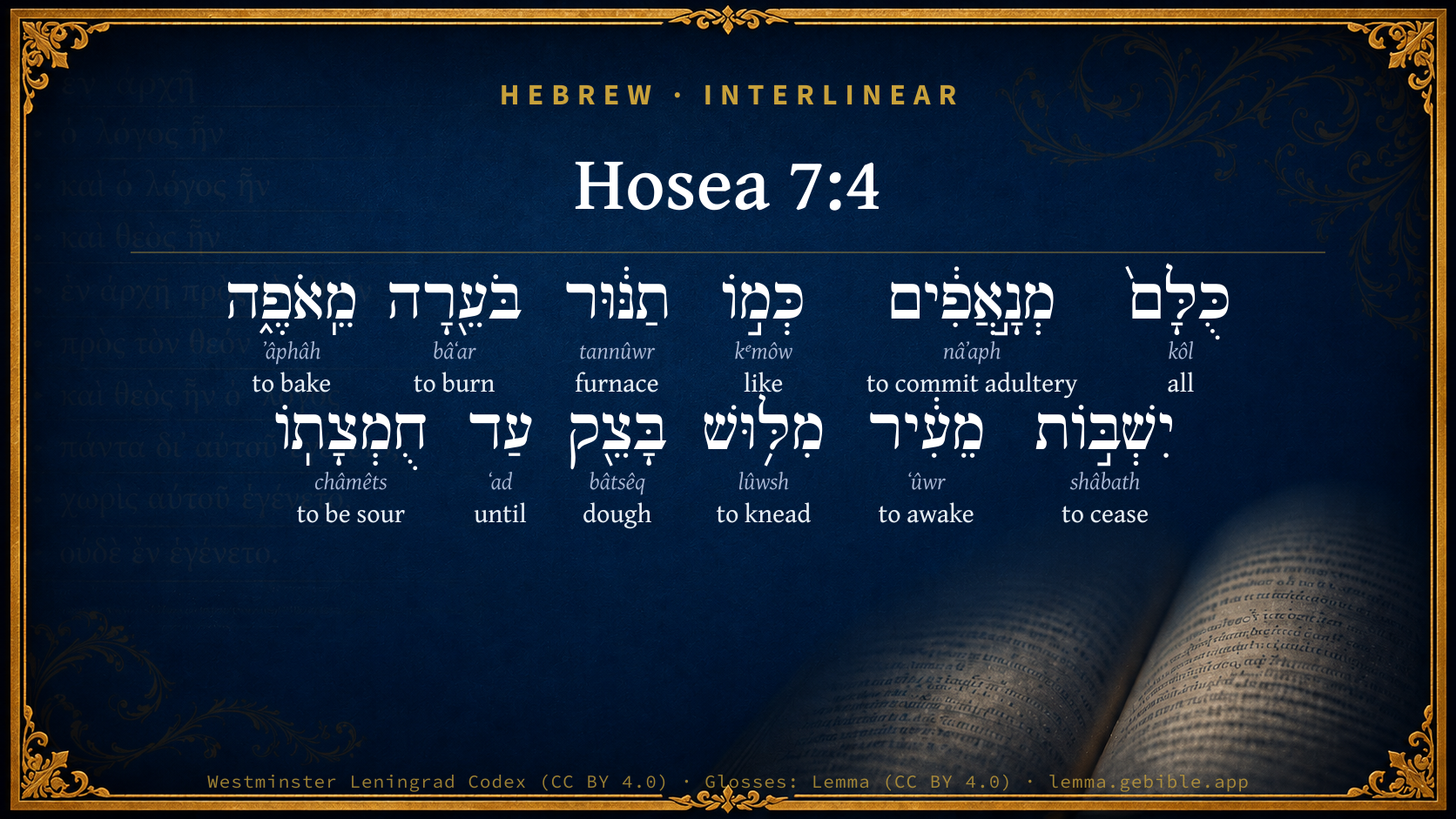
Hebrew (Westminster Leningrad Codex) Hosea 7:4 appears in the Hebrew Old Testament. The text above is from the Westminster Leningrad Codex. Each word links to its Strong’s number, a concise gloss, and parsing drawn from the Open Scriptures Hebrew Bible morphology. Click any word for its full Brown-Driver-Briggs (BDB) entry.
Download image
Cite this verse

Hosea 7:4 (World English Bible). Public Domain. Lemma interlinear Bible study tool, https://lemma.gebible.app/v/hosea/7/4.

Show BibTeX & RIS
BibTeX
RIS
English Translation
They are all adulterers. They are burning like an oven that the baker stops stirring, From the kneading of the dough, until it is leavened.
World English Bible · Public Domain
Download a study sheet

One document with this verse’s original text, its word-by-word gloss line, the meaning frame, cross-references with their text, attributed commentary, and full source and license credits — printable, and it pastes into notes with its structure intact.

This verse Autodidact and up

Study sheet (.html) Plain text (.txt)

A passage Seminary Student

Up to 50 verses in one chapter. A passage sheet keeps up to 6 commentary sources and 12 cross-references per verse, in the order this page ranks them, and says so on the sheet whenever that leaves anything out. Ask for a single verse and you get the Autodidact verse sheet above.

Everything on this page stays free to read, with no account — the sheet is a download of what is already on screen, not access to it.

Want to remove ads? Support Godless Engineer
Compare translations 3

The same verse in 3 English versions, stacked beneath the original-language interlinear above. Click any original word for its lexicon entry.

Each is an independent rendering of the whole verse — the interlinear is not word-aligned to these translations.

Highlighted words mark where these versions differ — a whole-verse word diff, not a word-by-word alignment.

  • World English Bible Public Domain
    They are all adulterers. They are burning like an oven that the baker stops stirring, From the kneading of the dough, until it is leavened.
  • King James Version Public Domain
    They are all adulterers, as an oven heated by the baker, who ceaseth from raising after he hath kneaded the dough, until it be leavened.
  • unfoldingWord Literal Text CC BY-SA 4.0
    All of them adulterers, like an oven burning from a baker; he ceases from awakening, from the kneading of the dough until leavening it.

unfoldingWord Literal Text — © unfoldingWord, licensed CC BY-SA 4.0. Word-aligned USFM3 via Door43 (git.door43.org/unfoldingWord/en_ult).

Versions to compare (up to 4)

3 of 4 selected

Show all 18 translations

Every available English version of this verse, each an independent rendering of the whole verse.

  • World English Bible Public Domain
    They are all adulterers. They are burning like an oven that the baker stops stirring, From the kneading of the dough, until it is leavened.
  • Berean Standard Bible Public Domain
    They are all adulterers, like an oven heated by a baker who needs not stoke the fire from the kneading to the rising of the dough.
  • Majority Standard Bible Public Domain
    They are all adulterers, like an oven heated by a baker who needs not stoke the fire from the kneading to the rising of the dough.
  • King James Version Public Domain
    They are all adulterers, as an oven heated by the baker, who ceaseth from raising after he hath kneaded the dough, until it be leavened.
  • American Standard Version (1901) Public Domain
    They are all adulterers; they are as an oven heated by the baker; he ceaseth to stir `the fire', from the kneading of the dough, until it be leavened.
  • Revised Version (1885) Public Domain
    They are all adulterers; they are as an oven heated by the baker; he ceaseth to stir the fire, from the kneading of the dough until it be leavened.
  • Geneva Bible (1599) Public Domain
    They are all adulterers, and as a very ouen heated by ye baker, which ceaseth from raysing vp, and from kneading ye dough vntill it be leauened.
  • Douay-Rheims (1899) Public Domain
    They are all adulterers, like an oven heated by the baker: the city rested a little from the mingling of the leaven, till the whole was leavened.
  • Young's Literal Translation Public Domain
    All of them `are' adulterers, Like a burning oven of a baker, He ceaseth from stirring up after kneading the dough, till its leavening.
  • Literal Standard Version CC BY-SA 4.0
    All of them [are] adulterers, || Like a burning oven of a baker, || He ceases from stirring up after kneading the dough, until its leavening.
  • Unlocked Literal Bible CC BY-SA 4.0
    They are all adulterers, like an oven heated by the baker, who ceases to stir the fire from the kneading of the dough until it is leavened.
  • unfoldingWord Literal Text CC BY-SA 4.0
    All of them adulterers, like an oven burning from a baker; he ceases from awakening, from the kneading of the dough until leavening it.
  • Darby Bible Public Domain
    They all practise adultery, as an oven heated by the baker: he ceaseth from stirring [the fire] after he hath kneaded the dough, until it be leavened.
  • World Messianic Bible Public Domain
    They are all adulterers. They are burning like an oven that the baker stops stirring, from the kneading of the dough, until it is leavened.
  • Webster's Bible Public Domain
    They are all adulterers, as an oven heated by the baker, who ceaseth from raising after he hath kneaded the dough, until it is leavened.
  • Free Bible Version CC BY-SA 4.0
    All of them are adulterers, burning with lust like an oven whose fire stays hot, even though it is not tended by the baker, having left the dough to rise after kneading.
  • Bible in Basic English Public Domain
    They are all untrue; they are like a burning oven; the bread-maker does not make up the fire from the time when the paste is mixed till it is leavened.
  • JPS Tanakh (1917) Public Domain
    They are all adulterers, as an oven heated by the baker, who ceaseth to stir from the kneading of the dough until it be leavened.

Literal Standard Version (2020), Covenant Press — licensed CC BY-SA 4.0. Text via the HelloAO Bible API (eBible.org). Unlocked Literal Bible (unfoldingWord) — licensed CC BY-SA 4.0. Text via the HelloAO Bible API (eBible.org). unfoldingWord Literal Text — © unfoldingWord, licensed CC BY-SA 4.0. Word-aligned USFM3 via Door43 (git.door43.org/unfoldingWord/en_ult). Free Bible Version, Dr. Jonathan Gallagher — licensed CC BY-SA 4.0. Text via the HelloAO Bible API (eBible.org).

Word by word

More ways to search: Search by grammar → Find every occurrence → Compare this word →

Practice this passage: Drill this verse → Learn its vocabulary →

בָּצֵ֖ק
bâtsêq
H1217
“dough”
Noun, Common, Masculine, Singular, Absolute
Part of Speech
Noun
Type
Common
Gender
Masculine
Number
Singular
State
Absolute
Full BDB Definition

Origin: from H1216

TWOT: 269a

dough (unleavened)
  1. כֻּלָּם֙ kôl H3605 “all · their” Noun, Common, Masculine, Singular, Construct + Suffix, Personal, 3rd Person, Masculine, Plural
  2. מְנָ֣אֲפִ֔ים nâʼaph H5003 “committing adultery” Verb, Piel, Participle Active, Masculine, Plural, Absolute
  3. כְּמ֣וֹ kᵉmôw H3644 “like” Preposition
  4. תַנּ֔וּר tannûwr H8574 “furnace” Noun, Common, Masculine, Singular, Absolute
  5. בֹּעֵ֖רָה bâʻar H1197 “burning” Verb, Qal, Participle Active, Feminine, Singular, Absolute
  6. מֵֽאֹפֶ֑ה ʼâphâh H644 “from · baking” Preposition + Verb, Qal, Participle Active, Masculine, Singular, Absolute
  7. יִשְׁבּ֣וֹת shâbath H7673 “to cease” Verb, Qal, Imperfect, 3rd Person, Masculine, Singular
  8. מֵעִ֔יר ʻûwr H5782 “awaking” Verb, Hiphil, Participle Active, Masculine, Singular, Absolute
  9. מִלּ֥וּשׁ lûwsh H3888 “from · to knead” Preposition + Verb, Qal, Infinitive Construct
  10. עַד ʻad H5704 “until” Preposition
  11. חֻמְצָתֽוֹ châmêts H2556 “to be sour · him” Verb, Qal, Infinitive Construct + Suffix, Personal, 3rd Person, Masculine, Singular

About this verse

These counts appear in no published source. They are computed here, from the morphology-tagged text and Lemma’s own curated glosses. What Lemma adds →

12
words
12
distinct lemmas
Prophets
section

Notable vocabulary

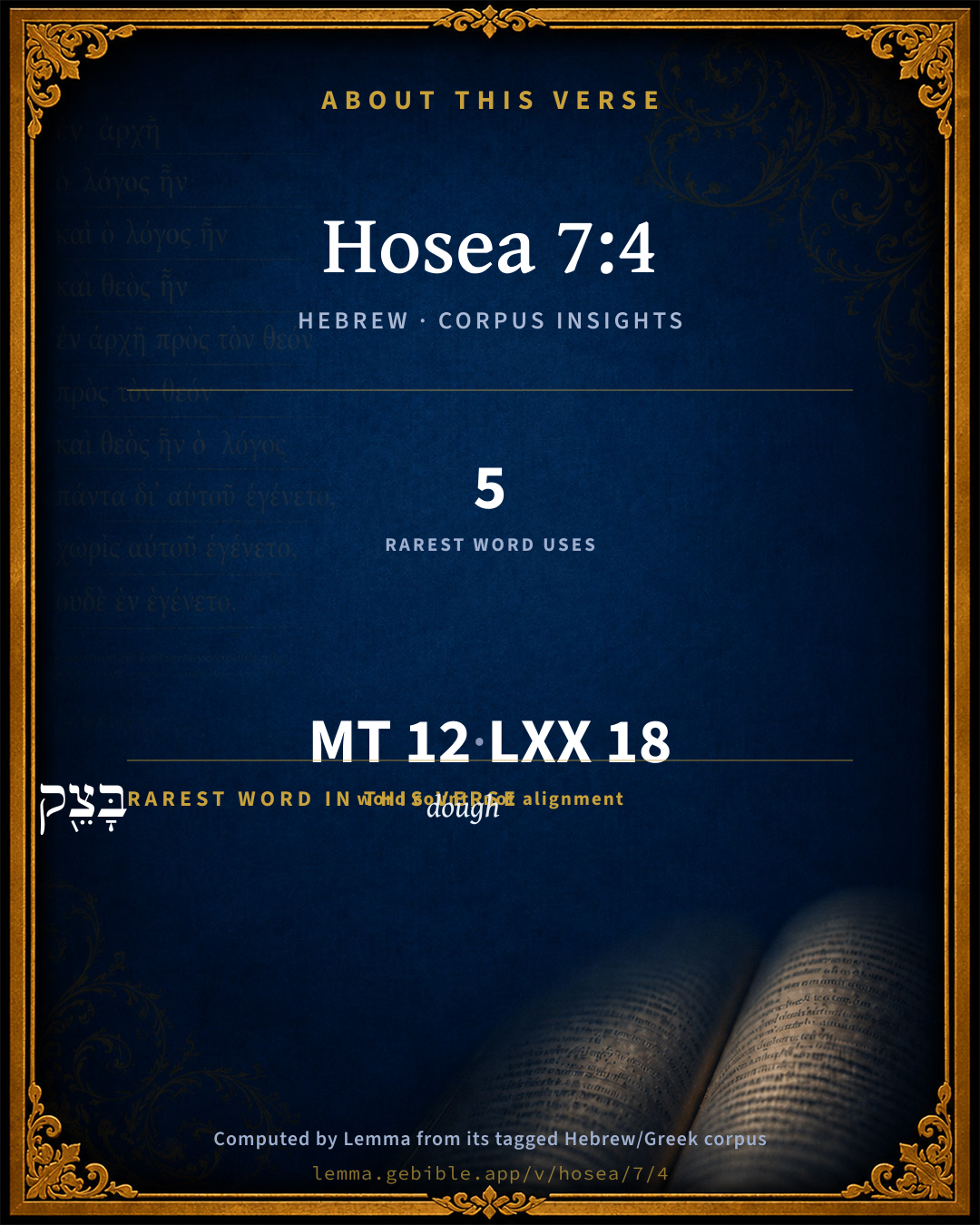
The rarest word here is בָּצֵ֖ק dough H1217 — appearing just 5 times in the whole Hebrew Bible.

Shared distinctive vocabulary

בָּצֵ֖ק dough H1217 occurs in 5 verses of the Hebrew Bible. Also found in:

Grammatical profile

  • 7 verbs
  • 3 nouns
  • 2 prepositions

Verb forms

  • מְנָ֣אֲפִ֔ים Piel · Participle Active
  • בֹּעֵ֖רָה Qal · Participle Active
  • מֵֽאֹפֶ֑ה Qal · Participle Active
  • יִשְׁבּ֣וֹת Qal · Imperfect
  • מֵעִ֔יר Hiphil · Participle Active
  • מִלּ֥וּשׁ Qal · Infinitive Construct
  • חֻמְצָתֽוֹ Qal · Infinitive Construct

Hebrew & Septuagint length

In English translation the verse runs 25 words from the Hebrew and 24 from the Septuagint (LXX English) — closely comparable.

A rough comparison of the two English renderings, which tokenize alike — not a word-level alignment.

Word counts can differ between the Hebrew and the Greek without any difference in meaning — e.g. the Hebrew direct-object marker אֵת has no separate Greek word, and Greek often adds the article ὁ.

In the original languages it is 12 Hebrew tokens and 18 Greek tokens — but the two are counted differently (Hebrew bundles its prefixes and suffixes into one token; the Greek is in lemma form), so that isn’t a like-for-like length.

Cross-references

6

Topical passages linked to Hosea 7:4 in the Treasury of Scripture Knowledge — connected by theme and wording, ordered by reader-vote popularity; previews shown in the World English Bible.

  • Jeremiah 9:2 Oh that I had in the wilderness a lodging-place of wayfaring men; that I might leave my people, and go from them! for they are all adulterers, an assembly of treacherous men.
  • Jeremiah 5:7–8 How can I pardon you? your children have forsaken me, and sworn by them that are no gods: when I had fed them to the full, they committed adultery, and assembled themselves in troops at the prostitutes' houses.
  • James 4:4 You adulterers and adulteresses, don't you know that friendship with the world is enmity with God? Whoever therefore wants to be a friend of the world makes himself an enemy of God.
  • Hosea 4:2 There is cursing, lying, murder, stealing, and committing adultery; They break boundaries, and bloodshed causes bloodshed.
  • Hosea 4:12 My people consult with their wooded idol, And answer to a stick of wood. Indeed the spirit of prostitution has led them astray, And they have been unfaithful to their God.
  • Hosea 7:6–7 For they have made ready their heart like an oven, While they lie in wait. Their baker sleeps all the night. In the morning it burns as a flaming fire.

Cross-references courtesy of OpenBible.info (CC BY 4.0).

Hebrew and Greek witnesses Masoretic Hebrew ↔ Greek Septuagint

The same verse in the two great witnesses to the Old Testament, shown verse-for-verse.

These are two independent witnesses, not word-aligned to each other, and the Septuagint is shown in lemma (dictionary) form.

Hebrew Hosea 7:4 Masoretic · Westminster Leningrad Codex

כֻּלָּם֙ מְנָ֣אֲפִ֔ים כְּמ֣וֹ תַנּ֔וּר בֹּעֵ֖רָה מֵֽאֹפֶ֑ה יִשְׁבּ֣וֹת מֵעִ֔יר מִלּ֥וּשׁ בָּצֵ֖ק עַד חֻמְצָתֽוֹ

They are all adulterers. They are burning like an oven that the baker stops stirring, From the kneading of the dough, until it is leavened.

World English Bible · Public Domain

Greek LXX Hosea 7:4 Septuagint · lemma form

πᾶς μοιχεύω ὡς κλίβανος καίω εἰς πέψις κατάκαυμα ἀπό ὁ φλόξ ἀπό φύρασις στέαρ ἕως ὁ ζυμοῦσθαι αὐτός

They are all adulterers, as an oven glowing with flame for hot-baking, on account of the kneading of the dough, until it is leavened.

LXX2012 (modern English Septuagint) · Public Domain

On this verse, The Pulpit Commentary discusses the Septuagint’s reading. Read the note in Commentary ↓

Hebrew: Westminster Leningrad Codex (CC BY 4.0). Greek: Septuagint (public domain); English from LXX2012 (modern English Septuagint) (Public Domain). How the Septuagint differs from the Hebrew →

Targum (Aramaic paraphrase)

1

The Targum is the ancient Jewish Aramaic paraphrase of the Hebrew Scriptures — an interpretive translation, not the Hebrew text itself. Onkelos (literal) and Pseudo-Jonathan (expansive) render the Torah, and Jonathan the Prophets. Coverage is partial: where no permissively-licensed English translation exists for a verse, only the Aramaic is shown. This is verse-level text, not a word-by-word alignment to the Hebrew.

  1. Targum Jonathan Prophets (Joshua–Malachi)
    כּוּלְהוֹן מַחְמַדִין לְמֵינַף נְשֵׁי חַבְרֵיהוֹן דָלְקִין כְּתַנוּרָא דַאֲזָלֵיהוֹן נַחְתּוֹמָא בְּכֵן יִגְלוּן בִּפְרִיעַ מִקִרְוֵיהוֹן כְּמָא דְמוֹחָן לְקַיָמָא מַחְשְׁבַת רִשְׁעָא וְעַל דְלָא אִדְכָּרוּ נִסִין וּגְבוּרָן דְאִתְעֲבִידוּ לְהוֹן בְּיוֹם מִסַקְהוֹן מִמִצְרַיִם מֵעִדַן מֵילַשׁ לִישָׁא עַד לָא חֲמָע:

    (no public-domain English translation for this verse)

    Targum Jonathan — Aramaic: “Mikraot Gedolot” (public domain). English: “Sefaria Community Translation” (CC0 1.0 (public-domain dedication)); “London "Chaldee Paraphrase," 1871” (public domain). Text via Sefaria.

Commentary

Notes on Hosea 7:4 from classic Christian and Jewish commentators (each source and its license shown beneath its notes). The classic Christian expositions comment on the surrounding passage and are grouped to its opening verse, so a note may address several verses; the Jewish commentaries on the Tanakh (Rashi and others) are per-verse, so they appear only where the commentator wrote on this verse.

Lemma curates 59 commentaries, every one of them public domain or Creative Commons licensed, each selected and text-cleaned for this edition rather than reprinted as found. About our sources →

Adam Clarke's Commentary

Verse 4. As an oven heated by the baker] Calmet's paraphrase on this and the following verses expresses pretty nearly the sense: Hosea makes a twofold comparison of the Israelites; to an oven, and to dough. Jeroboam set fire to his own oven-his kingdom-and put the leaven in his dough; and afterwards went to rest, that the fire might have time to heat his oven, and the leaven to raise his dough, that the false principles which he introduced might infect the whole population. This prince, purposing to make his subjects relinquish their ancient religion, put, in a certain sense, the fire to his own oven, and mixed his dough with leaven. At first he used no violence; but was satisfied with exhorting them, and proclaiming a feast. This fire spread very rapidly, and the dough was very soon impregnated by the leaven. All Israel was seen running to this feast, and partaking in these innovations. But what shall become of the oven-the kingdom; and the bread-the people? The oven shall be consumed by these flames; the king, the princes, and the people shall be enveloped in the burning, Ho 7:7. Israel was put under the ashes, as a loaf well kneaded and leavened; but not being carefully turned, it was burnt on one side before those who prepared it could eat of it; and enemies and strangers came and carried off the loaf. See Ho 7:8-9. Their lasting captivity was the consequence of their wickedness and their apostasy from the religion of their fathers. On this explication Ho 7:4-9, may be easily understood.

Adam Clarke's Commentary on the Bible (1810–1826) — public domain. Text from a community e-Sword/MySword module.

Trapp's Complete Commentary

John Trapp

Hos 7:4 They [are] all adulterers, as an oven heated by the baker, [who] ceaseth from raising after he hath kneaded the dough, until it be leavened.

Ver. 4. They are all adulterers] εξεκαυσθησαν, adulterio caleseunt, so Paguine, scalded in their base lusts, as those in Rom 1:27, all (for the most part) were such; but especially the courtiers and clawback informers, as Hos 7:3, God, in his just judgment, giving them up to those vile affections or passions of dishonour, and punishing their impieties with impurities, as he did also in those heathens, Rom 1:23.

As an oven heated by the baker] An apt similitude setting forth the intense heat of filthy lust (better marry than burn, 1Co 7:9), and of long continuance as the heat of an oven; yea, of Nebuchadnezzar’s oven, yea, of hell itself, whence it was enkindled, and where it shall be perpetually punished. The holy angels at the last day will be most active against such, to bring them to condign punishment: 2Pe 2:10, "But chiefly them that walk after the flesh in the lust of uncleanness." Note the word chiefly, and consider the example of the Sodomites, and God most severe against them, Heb 13:4. How much they have lived deliciously, and drenched themselves in fleshly delights, so much torments and sorrow shall they have proportionably, Rev 18:7. As their hearts have been as a hot oven or furnace, so they shall be bound up in bundles, and cast into a furnace of fire, where shall be wailing and gnashing of teeth, Mat 13:42.

John Trapp, A Commentary or Exposition upon All the Books of the Old and New Testament (1647–1656) — public domain. Text from a community e-Sword module.

Joseph Benson's Commentary

Hos 7:4. They are all adulterers — The expression may be here metaphorical, implying that they were apostates from God, to whose service they were engaged by the most solemn bond and covenant: compare Jer 9:2; Jas 4:4. If the words be understood literally, the prophet compares the heat of their lust to the flame of an oven heated; or, as Bishop Horsley renders it, “Over-heated by the baker.” Who ceaseth from raising after he has kneaded the dough, until it be leavened — Vulgate, Donec fermentaretur totum, until the fermentation of it be complete. When an oven is sufficiently heated, the baker does not increase the fire, but thinks what he has made sufficient to keep the oven hot till the dough be fit to be put into it. “An oven in which the heat is so intense as to be too strong for the baker’s purpose, insomuch that it must be suffered to abate before the bread can be set in, is certainly a most apt and striking image of the heart of the sensualist inflamed with appetite by repeated and excessive indulgence, so that it rages by the mere lust of the corrupted imagination, even in the absence of the external objects of desire that might naturally excite it; and works itself up to an excess which is even contrary to the purpose for which the animal appetites are implanted.” — Horsley.

Joseph Benson's Commentary on the Old and New Testaments (1811–1818) — public domain. Text from a community e-Sword module.

The Pulpit Commentary

Vers. 4-7. Vers. 4, 6, and 7 are linked together by the figure of an "oven," common to them; while 4 and 6 have also in common the figure of a "baker." Further, we are helped to the literal meaning of the metaphorical language of vers. 4 and 6 by vers. 5 and 7 respectively. They are all adulterers, as an oven heated by the baker. Whether the sin indicated was idolatry, which is often represented as spiritual adultery, or adultery in the literal sense, which was its frequent accompaniment; or in a larger sense faithlessness to solemn obligations such as treason, treachery, or perfidy in general; it was their habitual practice, as intimated by Piel participle in its iterative or intensive sense. The persons charged with this sin were kullam, all of them sovereign and subjects, princes and people alike. The traitors of the time referred to, or rather their heart heated with lawless lust and pernicious passion, is pictured by the prophet as an oven; and the oven is heated by tile baker, or more literally, burning from the baker. Who or what is represented by the baker? This may be a personification of the spirit of treason like the spirit of whoredoms, (Hos_5:4) or evil agency that impelled these men to their nefarious deeds; or we may understand by the "baker" those persons who were the prime movers in such matters, and who instigated others to become their tools and execute their plans. In either case the burning, once commenced, continued of itself; the primary instigators had no difficulty in securing agents ready and willing as themselves for such bad and bloody work, and who, once set ageing, needed no further impulse, but of their own motion delighted to carry it through. Who ceaseth from raising after he hath kneaded the dough, until it be leavened. An interval of time elapses between the inception and execution of the work. The baker ceaseth from raising, more literally, from stirring or stoking; after kindling the fire in the oven he lets it burn on and leaves off stirring it until the kneaded dough is fully fermented. This respite is allowed that the leaven of wickedness may do its work, and completely pervade the minds into which it has been introduced, and until matters are thoroughly matured for action. Meantime the fire burns steadily and sufficiently, until the oven requires to be more highly heated for the well-prepared and perfectly leavened dough. The use of the participle dyime is well explained by the principle stated by Ewald as follows: "Just as the idea of the verb "to be" is placed in immediate construction with the word which more exactly forms the predicate, so also may those verbs which describe a somewhat more specific kind of being, e.g. verbs which signify "commencing" to be, i.e. becoming... verbs of hastening, i.e. quickly becoming... and those of ceasing to be, Hos_7:4... The following verb, if such a word be required for the more specific predicate, most readily chooses the participial form.., verbs denoting continuance would be constructed in the same way." The particle d, equivalent to usque ad, implies the completeness of the leavening.

The difficulty of the section including vers. 4-7 has occasioned considerable difference of exposition; it may not, therefore, be amiss to supplement the foregoing observations.

1. Aben Ezra accounts for hrb being accented as milel

(1) on the ground that, though a feminine formation, it is really masculine (to agree with wynt), like hljn and hlyl, both of which, though feminine in form, are notwithstanding of the masculine gender. Abarbanel, who is followed by Wunsche,

(2) takes hrBo as a participle feminine for hrBo or jrBo, which is justified by the circumstance that the names of fire and of what is connected therewith are feminine in the Semitic, so that rwnj is feminine.

2. The word ryime, which Ewald and others take, properly we think,

(1) as participle of Hiph., is treated

(2) by Genenius and Maurer as infirmitive Qal with rain prefixed, which would occasion the awkward and unusual combination of two infinitives each prefixed with rain in immediate sequence; while

(3) Kimchi takes it as infinitive Hiph. contracted for ryiheme.

3. More important still is the interpretation of the verse. There is

(1) that already given, and which is in some measure supported by the following rabbinic comments: "Their evil passion," says Rashi, "which stirs them up, rests from kneading the dough until it is leavened, i.e. from the time that any one has thought on evil in his heart how he shall execute it, he rests and sleeps till the morning, when he shall be able to execute it, as the baker rests from kneading the dough until it is leavened, when he can bake it." Similar and yet somewhat peculiar is the concluding portion of Kimchi"s comment: "As soon as he lays the pieces of wood into the oven, in order to heat it, he commands the women to knead, and he ceases to stir them (the women) up until the dough is leavened, as he estimates it in his heart, and then he rouses them to come with the dough to bake it. And this is the time when the oven is heated.

(2) The LXX takes ry as a noun prefixed with the preposition rain (apo thv flogov ), and translates the whole as follows: "They are all adulterers, as an oven glowing from flame for hot-baking, from the kneading of the dough until it is leavened." The interpretation

(3) of Wunsche differs considerably from both the preceding; it is, "They are all adulterers, like an even, burning from a baker, who rests while stoking from the kneading of the dough till its fermentation;" and he cites in favor of this view Aben Ezra as follows: "This verse is inverted, and accordingly the sense is: As the oven of a baker burneth from the kneading of the dough till its fermentation, so that the baker can scarcely cease to stir it up, but must stir it up and heat it violently.

Vers. 3-7. The oven and the baker.

High and low united in the wickedness which has been described, and is to be described. The example of the king and court gave the key-note to the subjects, and they in turn pleased the king and his princes by a hearty imitation of their vices. "They made the king glad with their wickedness themselves living lives of debauchery and ungodliness; "and the princes with their lies offering them flattery, and siding with them in ridicule of the prophet"s teachings A new image is here employed to set forth the enormity of the wickedness which prevailed that, viz., of the heated oven and the baker. The elements of the figure may be thus analyzed. The oven is the heart; the fire, unholy lust, appetite, or passion; the dough, the evil intent or plan. This is prepared beforehand, while the fire smolders beneath; when it is matured for execution, the fire lust or passion is stirred up to a flame, and the act of wickedness is consummated. The general thought is the systematic character of the sin, its deliberateness in being previously conceived, planned, prepared for the soul, thereafter, being held as it were in readiness for its execution. Three illustrations, though the figure applies strictly only to the first and last.

I THE HEAT OF LUST. (Ver. 4) "They are all adulterers, as an oven heated by the baker," etc. Their debaucheries, i.e., were not the fruit of mere impulse. They were gone into as the result of forethought and preparation. Libidinous thoughts were encouraged. New gratifications were planned; the matter was reflected on and matured; the act of indulgence was anticipated in imagination. Time was thus given for the lustful desire to permeate the whole nature, when, like dough fully leavened, the evil intent was ready to be converted into deed. Lust, to use the figure of James, conceives, and brings forth sin. (Jam_1:15) Learn:

1. The importance of guarding against the inception of lust. It is in its beginnings that lust is most dangerous. The wrong thought, the lustful look, the dallying with desire, it is there the evil lurks. From this there is but a step to evil intent. The fire burns, the dough is prepared; it will be a wonder if actual sin is not some day the outcome.

2. The importance of regulating thought as a means to the control of the passions. Thought can be so directed as to feed and inflame passion; it can also be so ruled as to check and control it. The wicked use this power of thought for a bad purpose; nor less earnestly should we attempt to use it for a holy one. It is only through care of the thoughts, and through strict control exercised over them, that inward and outward purity can be preserved.

II THE HEAT OF WINE. (Ver. 5) "In the day of our king the princes have made him sick or, "are sick with heat of wine," etc. Royal feast days were days of recognized and premeditated debauch. Wine maddens and inflames the nature.

1. Drunkenness stands in close relation to lust, with which it is here brought into connection. It is lust"s most powerful auxiliary. "Whoredom and wine". (Hos_4:11) Sensuality, in turn, predisposes to excess in drinking. It loosens restraint. It destroys self-control. It inclines to animal indulgence generally.

2. Drunkenness is degrading in its own effects.

(1) Degrading to the body sick." It sickens and bestializes. It injures health. It bloats and disfigures the countenance. A more degrading spectacle can hardly be conceived than a helplessly intoxicated man.

(2) Degrading to the soul. It takes from it its self-respect. It begets a heartless, scoffing, irreverent disposition, and leads to association with those who are of this character. The King of Israel is here represented as striking up fellowship with "scorners mockers at Divine things.

3. Drunkenness prepares the way for strife and plotting. The drunkenness is the nexus between the adulteries and the conspiracies. Pot-companions are rarely stable friends. They do not really trust each other. Carousals lead to quarrelling. The strong and unscrupulous see with contempt the weaknesses of the rulers, and plot against them.

III THE HEAT OF ANGER, (Vers. 6, 7) "They have made ready their heart like an oven, while they lie in wait," etc. We have here the result of the carousals and the scorning in plots and conspiracies. These are:

1. Secretly prepared; like the oven got ready beforehand, the dough also being kneaded and leavened.

2. Silently waited upon. It takes time for a plot to mature, as it takes time for the leaven to permeate the dough. A good example is furnished in the case of Absalom, who first, by fair speeches and complaisances, stole the hearts of the people of Israel; then, after the leaven had had time to work, got leave of absence, and, with two hundred men accompanying, had himself proclaimed king. (2Sa_15:1-14)

3. Hotly executed. There is no mercy in the fierceness which at length breaks out in bloody deeds. The pent-up heat burns like an oven. The anger of the wicked is ruthless, cruel, unsparing. It had proved to be so in Israel"s history. Dynasty after dynasty had been swept away by assassination. Pekah, probably the then reigning king, was himself afterwards murdered by Hoshea. Yet Israel refused to take the lesson. "There is none of them that calleth upon me" (ver. 7). J.O.

The Pulpit Commentary (1880–1919), ed. H.D.M. Spence-Jones & Joseph S. Exell — public domain. Text from a community e-Sword module.

The Preacher's Complete Homiletical Commentary

Joseph S. Exell (gen. ed.)

CRITICAL NOTES.—

Hos_7:4. Oven] “In this passionate career the nation resembled a furnace which a baker heats in the evening and leaves burning all night while the dough is leavening, and then causes to burn with a still brighter flame in the morning when the dough is ready for baking” [Keil].

Hos_7:5. Day] Birth or coronation day, probably a feast day. Bottles] Lit. with heat through wine; bottles, not glasses, drunkenness, excess, and debauchery. Hand] In token of fellowship, health-drinking. Scorners] Ridicule of sacred things, derision of God, natural at intoxicating feasts (Dan_5:3-4).

Hos_7:6. Ready] Lit. applied (marg. brought near) their heart to sin. For] The reason for the open sin; their heart is ready, and only waiting for the spark to kindle it.

Hos_7:7. Devoured] Results of their conduct stated. Judges and kings, inflamed by the passion, here consumed and fell into the abyss, the six last kings in succession (2Ki_15:10; 2Ki_15:14; 2Ki_15:25), B. C. 772. None sought help from God in national calamity.

SIN A FURNACE OF FIRE—Hos_7:4-7

The passion of Israel for idolatry is likened to a furnace, heated by the baker, and left burning during the process of fermentation. There is little or no cessation to their indulgence. All are guilty, and fan the flames which consume them without reflection and return to God. Keeping up the figure, sin is like a furnace,

I. In the method by which it is kindled. Man is capable of warmth and enthusiasm. We are made for fervour. We feel the glow of friendship and the power of principles fondly cherished and firmly defended. We have properties not simply attributed to matter, but possessed by the Seraphim of heaven and attributed to God himself. “The zeal of the Lord of Hosts.” We are more influenced by evil than good. The heart, with its affections, is kindled into a passion; the temperament warmed, and men are “set on fire” with lust, and “set on fire of hell.” Like “an oven heated by the baker,” they burn with hatred, envy, and adultery; “burned in their lusts one toward another.” In whatever light we look at sin “it is a fire that consumeth to destruction, and would root out all mine increase” (Job_31:12).

II. In the fuel by which it is fed. The same material that kindles must keep alive the fire. It is heated and fed by lust; by constant and unnatural excitement. Respites only ferment; the flames slumber to break out into greater fury. Anger, ambition, and filthy lusts fill the soul, and the fire burns upon the altar and never goes out. Certain sins are mentioned in the text.

1. Prevalent adultery. They are all adulterers. “Given up to vile affections, and punished with impurities of heart and life.” “It is better to marry than burn” (1Co_7:9).

2. Excessive drink. The princes made the king “sick,” heated him “with bottles of wine.” Intemperance in any is degrading, but especially in men of place and power. Priest and prophet “err through strong drink” (Isa_28:7; Isa_56:11-12). The glory of Benhadad (1Ki_20:16), of Belshazzar, and of “the princes of Israel,” was covered with shame. Philip of Macedon, when drunk, unjustly condemned a woman. She boldly said, “I appeal to Philip; but it shall be when he is sober.” Roused by the appeal, the king examined the case, and reversed his judgment. “It is not for kings, O Lemuel, it is not for kings to drink wine; nor for princes strong drink: lest they drink, and forget the law, and pervert the judgment of any of the afflicted” (Pro_31:4-5).

3. Impious scorning. “He stretched out his hand” in friendship, and associated “with scorners.” The king jested with drunkards, praised idols, and scoffed at God. Atheists and scoffers, wine and mirth, are often found together. “Hypocritical mockers at feasts” give license to their tongue, and lose control over their conduct. “Wine is a mocker, strong drink is raging; and whosoever is deceived thereby is not wise.”

III. In the results which it produces. These are innumerable. The temptations to criminality are fearful. Every kind of “wickedness burneth as the fire” (Isa_9:18). “Can a man take fire in his bosom and his clothes not be burned? Can one go upon hot coals and his feet not be burned?”

1. It influences the heart. “For they have made ready their heart.” It hardens and encrusts it; disposes it to prepare, practise, and perfect evil. The heart is brought nigh, stirred up to sin, though the occasion for it be taken away. This oven, once heated, gives no breathing time, no real rest. Corrupt passions burn with intense heat, until extinguished and overcome by the grace of God.

2. It consumes its abettors. The fire “devoured their judges; all their kings are fallen.” Jeroboam and other kings corrupted the people to establish their own authority; were flattered and slain by those who flattered them. Their sins returned to their own bosom. The flames, like the furnace of Nebuchadnezzar, devoured those who were thrown into them and those who kindled them. It is ever thus with sin. The heathens taught that “the artificers of death perished by their own art.” “Kindle not the coals of a sinner, lest thou be burnt with the flame of his fire” (Sir_8:10).

HOMILETIC HINTS AND OUTLINES

Hos_7:5. The day of our king. Birthdays and coronation-days of rulers; national fasts and feasts spent in drunkenness and rioting—scenes of revelry, scenes of debauchery, scoffing, and murder. Drinking healths and taking lives! Kings falling in feasting and mirth! What a portrait history gives of human folly and God’s providence! “Their holy days, like those of so many English now, were days of excess. Their festival they turned into an irreligious and anti-religious carousal; making themselves like the brutes that perish, and tempting their king first to forget his royal dignity, and then to blaspheme the majesty of God” [Pusey].

Drink, debauchery, and scoffing a triple association in feasting without God. “Fools make a mock at sin.”

Hos_7:6. Their heart like an oven. Men who are wicked and vile may seem to be lying by and doing nothing, yet—

1. Their hearts are bent on their course; their oven is heating while they sleep.

2. Their designs are still going on; the heat is tending to burning as a flaming fire while the baker sleeps.

3. Iniquity that is hatched, through abundance of lust, is most violently executed, when opportunity offers; and the more violently that it hath been long delayed [Hutcheson].

Hos_7:7. Kings are fallen. Those who murdered others are murdered themselves. Plots of sin recoil on those who originate them.

None that calleth on me. God can correct the evils and subdue the sedition of a nation. But mark the stupidity and perversity of sin which make people insensible in danger and neglect God in trouble. Not even distress, in which generally men betake themselves to God, awakened any sense of sin in them. “Those are not only heated with sin, but hardened in sin, that continued to live without prayers, even when they are in trouble and distress.”

ILLUSTRATIONS TO CHAPTER 7

Hos_7:4-7. Fire. Some few years ago a noble steamer moored in one of the harbours of the United States was discovered to be on fire. The engines were instantly started, and the prow of the vessel directed to the shore. But the flames soon rendered the helm useless, and such of the crew as were on board were obliged to jump into the small boat, and leave the steamer to her fate. Soon the engines worked more fiercely; the wheels revolved with fearful speed and hurried the vessel through the water. The sight was terrible. At last came one tremendous shock, and all was darkness and ruin. Such is man, when seized and heated by an evil passion, whether the spirit of pride or of envy. He grows worse and worse, and is consumed in eternal ruin, unless God interpose.

Hos_7:5. Feasting. Times of festivity require a double guard. “Blasphemy is wit, and ribaldry eloquence, to a man that is turned into a brute” [Lawson].

The Preacher's Complete Homiletical Commentary (gen. ed. Joseph S. Exell; Funk & Wagnalls, c. 1892) — public domain (pre-1929). A full-Bible homiletical/sermon-outline anthology covering 65 of 66 books (2 John is absent from the source module). Text from a community e-Sword module.

Keil & Delitzsch

C. F. Keil & F. Delitzsch

To this there is added the passion with which the people make themselves slave to idolatry, and their rulers give themselves up to debauchery (Hos 7:4-7). Hos 7:4. "They are all adulterers, like an oven heated by the baker, who leaves off stirring from the kneading of the dough until its leavening. Hos 7:5. In the day of our king the princes are made sick with the heat of wine: he has stretched out his hand with the scorners. Hos 7:6. For they have brought their heart into their ambush, as into the oven; the whole night their baker sleeps; in the morning it burns like flaming fire. Hos 7:7. They are all red-hot like the oven, and consume their judges: all their kings have fallen; none among them calls to me." "All" (kullâm: Hos 7:4) does not refer to the king and princes, but to the whole nation. נאף is spiritual adultery, apostasy from the Lord; and literal adultery is only so far to be thought of, that the worship of Baal promoted licentiousness. In this passionate career the nation resembles a furnace which a baker heats in the evening, and leaves burning all night while the dough is leavening, and then causes to turn with a still brighter flame in the morning, when the dough is ready for baking. בּערה מאפה, burning from the baker, i.e., heated by the baker. בּערה is accentuated as milel, either because the Masoretes took offence at תּנּוּר being construed as a feminine (Ges. Lehrgeb. p. 546; Ewald, Gramm. p. 449, note 1), or because tiphchah could not occupy any other place in the short space between zakeph and athnach (Hitzig). העיר, excitare, here in the sense of stirring. On the use of the participle in the place of the infinitive, with verbs of beginning and ending, see Ewald, 298, b.

Hos 7:5-7

Both king and princes are addicted to debauchery (Hos 7:5). "The day of our king" is either the king's birthday, or the day when he ascended the throne, on either of which he probably gave a feast to his nobles. יום is taken most simply as an adverbial accus. loci. On this particular day the princes drink to such an extent, that they become ill with the heat of the wine. החלוּ, generally to make ill, here to make one's self ill. Hitzig follows the ancient versions, in deriving it from חלל, and taking it as equivalent to החלּוּ ot , "they begin," which gives a very insipid meaning. The difficult expression משׁך ידו את־ל, "he draws his hand with the scoffers," can hardly be understood in any other way than that suggested by Gesenius (Lex.), "the king goes about with scoffers," i.e., makes himself familiar with them, so that we may compare שׁוּת ידו עם (Exo 23:1). The scoffers are drunkards, just as in Pro 20:1 wine is directly called a scoffer. In Hos 7:6, Hos 7:7, the thought of the fourth verse is carried out still further. כּי introduces the explanation and ground of the simile of the furnace; for Hos 7:5 is subordinate to the main thought, and to be taken as a parenthetical remark. The words from כּי קרבוּ to בּארבּם ot כּי קרבוּ form one sentence. קרב is construed with ב loci, as in Jdg 19:13; Psa 91:10 : they have brought their heart near, brought them into their craftiness. "Like a furnace" (כּתנּוּר) contains an abridged simile. But it is not their heart itself which is here compared to a furnace (their heart = themselves), in the sense of "burning like a flaming furnace with base desires," as Gesenius supposes; for the idea of bringing a furnace into an 'ōrebh would be unsuitable and unintelligible. "The furnace is rather 'orbâm (their ambush), that which they have in common, that which keeps them together; whilst the fuel is libbâm, their own disposition" (Hitzig). Their baker is the machinator doli, who kindles the fire in them, i.e., in actual fact, not some person or other who instigates a conspiracy, but the passion of idolatry. This sleeps through the night, i.e., it only rests till the opportunity and time have arrived for carrying out the evil thoughts of their heart, or until the evil thoughts of the heart have become ripe for execution. This time is described in harmony with the figure, as the morning, in which the furnace burns up into bright flames (הוּא points to the more remote tannūr as the subject). In Hos 7:7 the figure is carried back to the literal fact. With the words, "they are all hot as a furnace," the expression in Hos 7:4, "adulterous like a furnace," is resumed; and now the fruit of this conduct is mentioned, viz., "they devour their judges, cast down their kings." By the judges we are not to understand the sârı̄m of Hos 7:5, who are mentioned along with the king as the supreme guardians of the law; but the kings themselves are intended, as the administrators of justice, as in Hos 13:10, where shōphetı̄m is also used as synonymous with מלך, and embraces both king and princes. The clause, "all their kings are fallen," adds no new feature to what precedes, and does not affirm that kings have also fallen in addition to or along with the judges; but it sums up what has been stated already, for the purpose of linking on the remark, that no one calls to the Lord concerning the fall of the kings. The suffix בּהם does not refer to the fallen kings, but to the nation in its entirety, i.e., to those who have devoured their judges. The thought is this: in the passion with which all are inflamed for idolatry, and with which the princes revel with the kings, they give no such heed to the inevitable consequences of their ungodly conduct, as that any one reflects upon the fall of the kings, or perceives that Israel has forsaken the way which leads to salvation, and is plunging headlong into the abyss of destruction, so as to return to the Lord, who alone can help and save. The prophet has here the times after Jeroboam II in his mind, when Zechariah was overthrown by Shallum, Shallum by Menahem, and Menahem the son of Pekahiah by Pekah, and that in the most rapid succession (Kg2 15:10, Kg2 15:14, Kg2 15:25), together with the eleven years' anarchy between Zechariah and Shallum (see at Kg2 15:8-12). At the same time, the expression, "all their kings have fallen," shows clearly, not only that the words are not to be limited to these events, but embrace all the earlier revolutions, but also and still more clearly, that there is no foundation whatever for the widespread historical interpretation of these verses, as relating to a conspiracy against the then reigning king Zechariah, or Shallum, or Pakahiah, according to which the baker is either Menahem (Hitzig) or Pekah (Schmidt).

Keil & Delitzsch — Biblical Commentary on the Old Testament (1861–1891) — public domain (CC PDM 1.0). Text via the HelloAO Bible API. (Old Testament only.)

Tyndale Open Study Notes

Tyndale Open Resources

7:4 adulterers: Hosea used this term earlier to describe spiritual apostasy (3:1); it refers here to those who were disloyal to the king.

Tyndale Open Study Notes — © Tyndale Open Resources, licensed CC BY-SA 4.0. Text via the HelloAO Bible API.

Geneva Bible (1599)

Geneva Bible translators

He compareth the rage of the people to a burning oven which the baker heateth, still till his dough be leavened and raised.

Geneva Bible (1599) marginal notes — public domain. Text via Bolls.life.

Jamieson, Fausset & Brown

Robert Jamieson, A. R. Fausset & David Brown

who ceaseth from raising--rather, "heating" it, from an Arabic root, "to be hot." So the Septuagint. Their adulterous and idolatrous lust is inflamed as the oven of a baker who has it at such a heat that he ceaseth from heating it only from the time that he hath kneaded the dough, until it be leavened; he only needs to omit feeding it during the short period of the fermentation of the bread. Compare Pe2 2:14, "that cannot cease from sin" [HENDERSON].

Jamieson, Fausset & Brown — Commentary Critical and Explanatory on the Whole Bible (1871) — public domain (CC PDM 1.0). Text via the HelloAO Bible API.

John Calvin's Commentaries

The Prophet pursues the same subject in this verse: he says that they were all adulterers. This similitude has already been often explained. He speaks not here of common fornication, but calls them adulterers, because they had violated their faith pledged to God, because they gave themselves up to filthy superstitions, and also, because they had wholly corrupted themselves, for faith and sincerity of heart constitute spiritual chastity before God. When men become corrupt in their whole life, and degenerate from the pure worship of God, they are justly deemed adulterers. In this sense does the Prophet now say, that they were all adulterers, and thus he confirms what I have said before, that as to the corruptions which then prevailed, it was not few men who had been drawn into them, but that the whole people were implicated in guilt; for they were all adulterers To say that they had been deceived by the king, that they had been forced by authority, that they had been compelled by the tyranny of their princes, would have been vain and frivolous, for all of them were adulterers.

He afterwards compares them to a furnace or an oven, They are, he says, as a furnace or an oven, heated by the baker, who ceases from stirring up until the meal kneaded is well fermented The Prophet by this similitude shows more clearly, that the people were not corrupted by some outward impulse, but by their own inclination and propensity of mind; yea, by a mad and furious desire of acting wickedly. He had previously said that they had willfully sinned, when they readily embraced the edict of the king; but now he goes still farther and says that they had been set on fire by an inward sinful instinct, and were like a hot oven. Then he adds that this had not been a sudden impulse, as it sometimes happens; but that it had so continued, that they were confirmed in their wickedness. When he says, that adulterers are like a burning oven, he means, that their defection had not only been voluntary, so that the blame was in themselves; but that they had also ardently seized on the occasion of sinning, and had been heated, as an hot oven. The ungodly often restrain their desires, and suppress them when no occasion is presented, but give vent to them when they have the opportunity of sinning with impunity. So God now declares that the people of Israel had not only been prone to defection, but had also greedily desired it, so that their madness was like a burning flame.

But a third thing follows, and that is, that this fire had not been suddenly lighted up, but had been for a long time gathering strength. Hence he says As an oven heated by the baker, who ceases, he says, from stirring up after the shaking or mixing of the meal, until it be fermented לום, lush, means “to besprinkle,” empaster is what they say here. Some foolishly hold that they were like those who sleep and afterwards awake early in the morning. But the Prophet had a different thing in view, and that was, that by length of time their wickedness had increased, and, as it were, by degrees. He means, in short, that they had not been under a sudden impulse, like men who often break out through want of thought, and immediately repent; and their lust, which had been in a moment set on fire, in a short time abates. The Prophet says, that the frenzy of the people of Israel had been different; for they had been like an oven, which the baker, after having lighted up, allows to grow quite hot even to the highest degree; for he waits while the dough is becoming well fermented. It was not then the intemperance and lust of a few days; but they made their hearts quite hot, as when a baker heats his oven, and puts in a great quantity of fuel, that after a time it may become heated, while the dough is fermenting.

The word מעיר, meoir, “from stirring up,” is to be taken for מהעיר, maeoir; for what some say, that the baker rested from the city, that is, to manage public affairs, is frigid. Others render it thus, “He rests from the city,” so as not to be a citizen, — to what purpose? There is then no doubt but that the Prophet here pursues his own similitudes which he will again shortly repeat. It follows —

John Calvin's Commentaries (1540-1563) — public domain. Text from the Calvin Translation Society English edition (1840s-50s) via the Christian Classics Ethereal Library (ccel.org). Calvin's coverage is partial (roughly two-thirds of the Bible); uncommented books and verses are honest gaps, never fabricated. The 19th-century editor's footnotes and remarks are omitted so the notes are faithfully Calvin's own voice.

Ellicott's Commentary for English Readers

(4) Render, ceaseth heating from the kneading of the dough till its leavening. The baker is unremitting in his exertions to keep up the heat of the oven, the smouldering fire being fed on camel’s dung and the like fuel, except when he is obliged to occupy himself with preparing the dough for baking—an apt image of the incessant burning rage of lust and violence.

A Bible Commentary for English Readers, edited by Charles John Ellicott (1878–1897) — public domain. Text from a community e-Sword module.

The Cambridge Bible for Schools and Colleges

gen. ed. J. J. S. Perowne

4. as an oven …] The fire corresponds to sensual lust, the oven is the heart. The baker ceaseth from kindling (so we should render), when the oven has reached a certain heat, and then he leaves the fire to smoulder, till the fermentation of the dough is complete, and a fresh heating is necessary. So after passion has once been gratified, it smoulders for a time, but is afterwards kindled to a greater heat than before, when some attractive object comes within its range.

The Cambridge Bible for Schools and Colleges (gen. ed. J. J. S. Perowne; Cambridge University Press, 1878–1918) — public domain. Text from a community e-Sword module.

John Gill's Exposition

They are all adulterers,.... King, princes, priests, and people, both in a spiritual and corporeal sense; they were all idolaters, given to idols try, eager of it, and constant in it, as the following metaphors show; and they were addicted to corporeal adultery; this was a prevailing vice among all ranks and degrees of men. So the Targum,

"they all desire to lie with their neighbours' wives;''

see Jer 5:7;

as an oven heated by the baker; which, if understood of spiritual adultery or idolatry, denotes their eagerness after it, and fervour in it, excited by their king, or by the devil and his instruments, the priests and false prophets; and if of bodily uncleanness, it is expressive of the heat of that lust, which is sometimes signified by burning; and is stirred up by the devil and the corrupt hearts of men to such a degree as to be raised to a flame, and be like a raging fire, or a heated oven; see Rom 1:27;

who ceaseth from raising; that is, the baker, having heated his oven, ceaseth from raising up the women to bring their bread to the bake house; or he ceaseth from waking, or from watching his oven; he lays himself down to sleep, and continues in it:

after he hath kneaded the dough, until it be leavened; having kneaded the dough, and put in the leaven, he lets it alone to work till the whole mass is leavened, taking his rest in the mean while: as the former clause expresses the vehement desire of the people after adultery, spiritual or corporeal, this may signify their continuance in it; or rather the wilful negligence of the king, priests, and prophets, who, instead of awaking them out of their sleep on a bed of adultery, let them alone in it, until they were all infected with it.

John Gill's Exposition of the Whole Bible (1746–1763) — public domain (CC PDM 1.0). Text via the HelloAO Bible API.

Albert Barnes' Notes on the Bible

They are all adulterers - The prophet continues to picture the corruption of all kinds and degrees of people. “All of them,” king, princes, people; all were given to adultery, both spiritual, in departing from God, and actual, (for both sorts of sins went together,) in defiling themselves and others. “All of them” were, (so the word means,) habitual “adulterers.” One only pause there was in their sin, the preparation to complete it. He likens their hearts, inflamed with lawless lusts, to the heat of “an oven” which “the baker” had already “heated.” The unusual construction “burning from the baker” instead of “heated “by” the baker” may have been chosen, in order to express, how the fire continued to burn of itself, as it were, (although at first kindled by the baker,) and was ever-ready to burn whatever was brought to it, and even now was all red-hot, burning on continually; and Satan, who had stirred it, gave it just this respite, “from the time when he had kneaded the dough” , until the leaven, which he had put into it, had fully worked, and the whole was ready for the operation of the fire.

The world is full of such people now, ever on fire, and pausing only from sin, until the flatteries, whereby they seduce the unstable, have worked and penetrated the whole mind, and victim after victim is gradually leavened and prepared for sin.

Albert Barnes' Notes on the Bible (1834–1885) — public domain. Text from a community e-Sword/MySword module.

Haydock's Catholic Bible Commentary

Leaven. Jeroboam invited the people simply to a feast, and used no violence to make them adopt his novelties. But they soon prevailed, and brought on ruin. The cake, or whole nation, was burnt, (ver. 8.) as well as the princes, ver. 7. (Calmet)

George Leo Haydock (1774–1849), Haydock's Catholic Family Bible and Commentary, 1859 edition — public domain. Excludes Psalms (Douay-Rheims chapter numbering differs from Protestant) and Deuterocanonical books (Catholic canon only).

Matthew Poole's English Annotations

They are all adulterers, both spiritually and carnally, and this latter adultery is that which here is charged on the courtiers and people of Israel.

As an oven heated by the baker: this vice is grown raging hot among them, as you see the fire in an oven, when the baker, having called up those that make the bread, to prepare all things ready, and the whole mass is leavened, he doth by continued supply of fuel heat the oven to the highest degree. So doth adultery among this people grow by degrees to raging flames. The whole mass of the people are leavened with this vice also, as well as the court, and every one inflamed with this unclean fire, as the oven heated by the baker.

Matthew Poole's English Annotations on the Holy Bible (1683–1685) — public domain. Text from a community e-Sword/MySword module.

John Wesley's Explanatory Notes

As an oven - This vice is grown raging hot among them, as the fire in an oven, when the baker having called up those that make the bread, to prepare all things ready, doth by continued supply of fuel, heat the oven, 'till the heat need be raised no higher.

John Wesley, Explanatory Notes Upon the Whole Bible (1754–1765) — public domain. Text via the GEBible commentary corpus.

Rashi

Rabbi Shlomo Yitzchaki (Rashi)

like an oven heated by the baker that was heated by the baker, so does their lust burn within them.

he rests from awakening Heb. יִשְׁבּוֹת מֵעִיר. Jonathan translated what he translated: I cannot reconcile it with the wording of the verse, and, according to its apparent meaning, their temptation, which arouses them, rests.

from the kneading the dough until it leavens From the time he thinks of the evil in his heart, how he will do it, he rests and sleeps until morning, when he can do it, just as the baker rests from the kneading of the dough until it leavens, when he can bake it. And so it is stated in Micah (2: 1): “Woe is to those who plan iniquity and work evil on their beds; when the morning lights up, they do it.”

Rashi on the Tanakh — English translations: “The Judaica Press complete Tanach with Rashi, translated by A. J. Rosenberg” (CC BY 4.0); “Pentateuch with Rashi's commentary by M. Rosenbaum and A.M. Silbermann, 1929-1934” (public domain); “The Metsudah Tanach series, Lakewood, N.J” (CC BY 4.0); and “The Book of Joshua, Metsudah Publications, 1997” (CC BY 4.0). Text via Sefaria.

Lesson kit

Teaching starters — assembled from the data on this page, not authored interpretation. Every prompt links to the verse data it draws on. Edit before teaching.

Hosea, in the Prophets, opens this verse with 12 words (12 distinct Hebrew lemmas). Its most distinctive word is bâtsêq (“dough”). A historical commentator’s framing appears above. Read the whole chapter for the surrounding context.

Discussion questions

  1. How does “dough” (bâtsêq) shape what this verse is saying?
  2. How does Exodus 12:34, which shares the word «dough», read alongside this verse?
  3. The translations on this page render this verse differently — a whole-verse word diff, not a word-by-word alignment. What might account for the different wordings?
  4. «מְנָ֣אֲפִ֔ים» is a Piel Participle Active verb. How does that grammatical form shape the action described?
  5. Compare how Adam Clarke's Commentary and Trapp's Complete Commentary read this verse. Where do they agree or differ?

Things to notice

Reading settings

Reading text

Shown beneath each verse's original-language words.

Old Testament
Old Testament edition

Read the OT as the Masoretic Hebrew (MT) or the Greek Septuagint (LXX).

English shown for the Greek Septuagint (in the Hebrew ↔ Greek comparison).

Comparing translations? Open the Compare panel on any verse page to stack up to four side by side.