Habakkuk 3:14

Hebrew (Westminster Leningrad Codex) Habakkuk 3:14 appears in the Hebrew Old Testament. The text above is from the Westminster Leningrad Codex. Each word links to its Strong’s number, a concise gloss, and parsing drawn from the Open Scriptures Hebrew Bible morphology. Click any word for its full Brown-Driver-Briggs (BDB) entry.
Download image
Cite this verse

Habakkuk 3:14 (World English Bible). Public Domain. Lemma interlinear Bible study tool, https://lemma.gebible.app/v/habakkuk/3/14.

Show BibTeX & RIS
BibTeX
RIS
English Translation
You pierced the heads of his warriors with their own spears. They came as a whirlwind to scatter me, Gloating as if to devour the wretched in secret.
World English Bible · Public Domain
Highlights
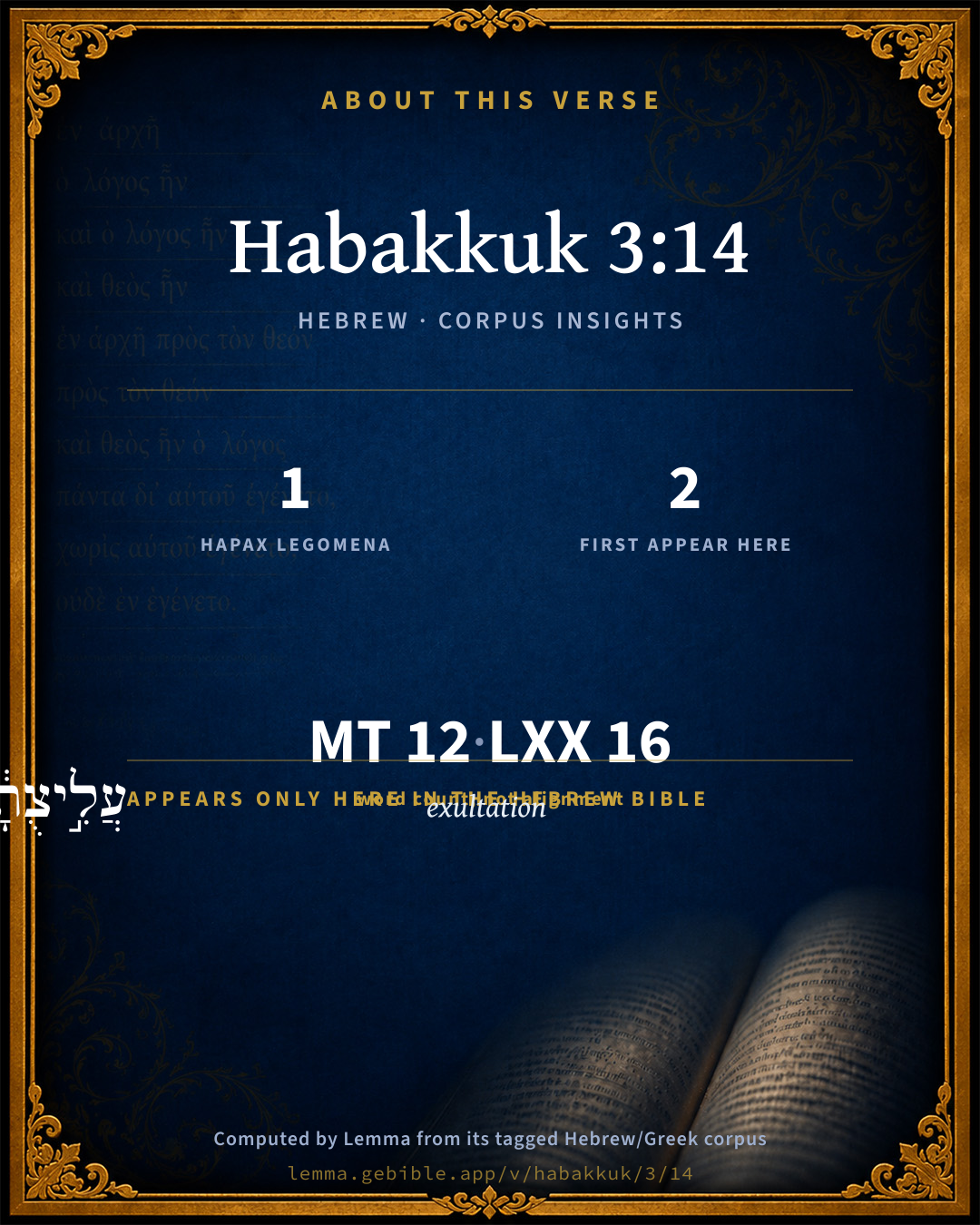
  • 1 hapax legomenon — only here in the Hebrew Bible
  • 2 first appearances in the Hebrew Bible
Full analysis ↓
Download a study sheet

One document with this verse’s original text, its word-by-word gloss line, the meaning frame, cross-references with their text, attributed commentary, and full source and license credits — printable, and it pastes into notes with its structure intact.

This verse Autodidact and up

Study sheet (.html) Plain text (.txt)

A passage Seminary Student

Up to 50 verses in one chapter. A passage sheet keeps up to 6 commentary sources and 12 cross-references per verse, in the order this page ranks them, and says so on the sheet whenever that leaves anything out. Ask for a single verse and you get the Autodidact verse sheet above.

Everything on this page stays free to read, with no account — the sheet is a download of what is already on screen, not access to it.

Want to remove ads? Support Godless Engineer
Compare translations 3

The same verse in 3 English versions, stacked beneath the original-language interlinear above. Click any original word for its lexicon entry.

Each is an independent rendering of the whole verse — the interlinear is not word-aligned to these translations.

Highlighted words mark where these versions differ — a whole-verse word diff, not a word-by-word alignment.

  • World English Bible Public Domain
    You pierced the heads of his warriors with their own spears. They came as a whirlwind to scatter me, Gloating as if to devour the wretched in secret.
  • King James Version Public Domain
    Thou didst strike through with his staves the head of his villages: they came out as a whirlwind to scatter me: their rejoicing was as to devour the poor secretly.
  • unfoldingWord Literal Text CC BY-SA 4.0
    You pierced with his own staffs the head of his warriors. They stormed to scatter me; their exultation as if to devour the afflicted in secret.

unfoldingWord Literal Text — © unfoldingWord, licensed CC BY-SA 4.0. Word-aligned USFM3 via Door43 (git.door43.org/unfoldingWord/en_ult).

Versions to compare (up to 4)

3 of 4 selected

Show all 18 translations

Every available English version of this verse, each an independent rendering of the whole verse.

  • World English Bible Public Domain
    You pierced the heads of his warriors with their own spears. They came as a whirlwind to scatter me, Gloating as if to devour the wretched in secret.
  • Berean Standard Bible Public Domain
    With his own spear You pierced his head, when his warriors stormed out to scatter us, gloating as though ready to secretly devour the weak.
  • Majority Standard Bible Public Domain
    With his own spear You pierced his head, when his warriors stormed out to scatter us, gloating as though ready to secretly devour the weak.
  • King James Version Public Domain
    Thou didst strike through with his staves the head of his villages: they came out as a whirlwind to scatter me: their rejoicing was as to devour the poor secretly.
  • American Standard Version (1901) Public Domain
    Thou didst pierce with his own staves the head of his warriors: They came as a whirlwind to scatter me; Their rejoicing was as to devour the poor secretly.
  • Revised Version (1885) Public Domain
    Thou didst pierce with his own staves the head of his warriors: they came as a whirlwind to scatter me: their rejoicing was as to devour the poor secretly.
  • Geneva Bible (1599) Public Domain
    Thou didest strike thorowe with his owne staues the heades of his villages: they came out as a whirle winde to scatter me: their reioycing was as to deuoure the poore secretly.
  • Douay-Rheims (1899) Public Domain
    Thou hast cursed his sceptres, the head of his warriors, them that came out as a whirlwind to scatter me. Their joy was like that of him that devoureth the poor man in secret.
  • Young's Literal Translation Public Domain
    Thou hast pierced with his staves the head of his leaders, They are tempestuous to scatter me, Their exultation `is' as to consume the poor in secret.
  • Literal Standard Version CC BY-SA 4.0
    You have pierced the head of his leaders with his own rods, || They are tempestuous to scatter me, || Their exultation [is] as to consume the poor in secret.
  • Unlocked Literal Bible CC BY-SA 4.0
    You have pierced the head of his warriors with his own arrows since they came like a storm to scatter us, their gloating was like one who devours the poor in a hiding place.
  • unfoldingWord Literal Text CC BY-SA 4.0
    You pierced with his own staffs the head of his warriors. They stormed to scatter me; their exultation as if to devour the afflicted in secret.
  • Darby Bible Public Domain
    Thou didst strike through with his own spears the head of his leaders: They came out as a whirlwind to scatter me, Whose exulting was as to devour the afflicted secretly.
  • World Messianic Bible Public Domain
    You pierced the heads of his warriors with their own spears. They came as a whirlwind to scatter me, gloating as if to devour the wretched in secret.
  • Webster's Bible Public Domain
    Thou didst strike through with his staffs the head of his villages: they came out as a whirlwind to scatter me: their rejoicing was as to devour the poor secretly.
  • Free Bible Version CC BY-SA 4.0
    With his own arrows you pierced the heads of his warriors, those who came like a whirlwind to scatter me, gloating like those who secretly abuse the poor.
  • Bible in Basic English Public Domain
    You have put your spears through his head, his horsemen were sent in flight like dry stems; they had joy in driving away the poor, in making a meal of them secretly.
  • JPS Tanakh (1917) Public Domain
    Thou hast stricken through with his own rods the head of his rulers, that come as a whirlwind to scatter me; whose rejoicing is as to devour the poor secretly.

Literal Standard Version (2020), Covenant Press — licensed CC BY-SA 4.0. Text via the HelloAO Bible API (eBible.org). Unlocked Literal Bible (unfoldingWord) — licensed CC BY-SA 4.0. Text via the HelloAO Bible API (eBible.org). unfoldingWord Literal Text — © unfoldingWord, licensed CC BY-SA 4.0. Word-aligned USFM3 via Door43 (git.door43.org/unfoldingWord/en_ult). Free Bible Version, Dr. Jonathan Gallagher — licensed CC BY-SA 4.0. Text via the HelloAO Bible API (eBible.org).

Word by word

More ways to search: Search by grammar → Find every occurrence → Compare this word →

Practice this passage: Drill this verse → Learn its vocabulary →

עֲלִ֣יצֻתָ֔ם
ʻălîytsûwth
H5951
“exultation · their”
Noun, Common, Feminine, Singular, Construct + Suffix, Personal, 3rd Person, Masculine, Plural
Part of Speech
Noun
Type
Common
Gender
Feminine
Number
Singular
State
Construct
Full BDB Definition

Origin: from H5970

TWOT: 1635a

exultation
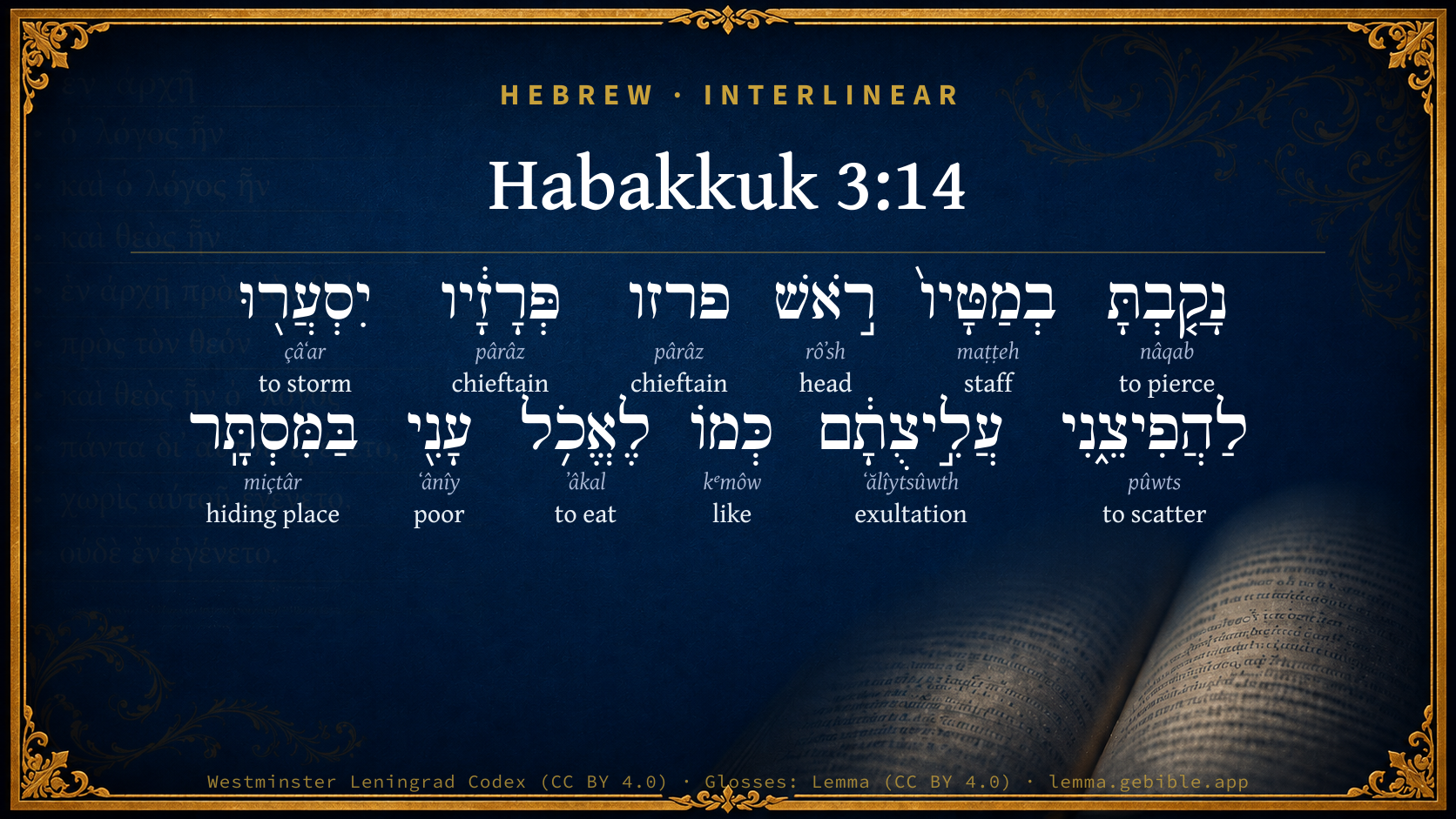
  1. נָקַ֤בְתָּ nâqab H5344 “to pierce” Verb, Qal, Perfect, 2nd Person, Masculine, Singular
  2. בְמַטָּיו֙ maṭṭeh H4294 “in/at · staffs · his” Preposition + Noun, Common, Masculine, Plural, Construct + Suffix, Personal, 3rd Person, Masculine, Singular
  3. רֹ֣אשׁ rôʼsh H7218 “head of” Noun, Common, Masculine, Singular, Construct
  4. פרזו pârâz H6518 “chieftain · his” Noun, Common, Masculine, Singular, Construct + Suffix, Personal, 3rd Person, Masculine, Singular
  5. פְּרָזָ֔יו pârâz H6518 “chieftains · his” Noun, Common, Masculine, Plural, Construct + Suffix, Personal, 3rd Person, Masculine, Singular
  6. יִסְעֲר֖וּ çâʻar H5590 “to storm” Verb, Qal, Imperfect, 3rd Person, Masculine, Plural
  7. לַהֲפִיצֵ֑נִי pûwts H6327 “to scatter · me” Preposition + Verb, Hiphil, Infinitive Construct + Suffix, Personal, 1st Person, Common, Singular
  8. כְּמוֹ kᵉmôw H3644 “like” Preposition
  9. לֶאֱכֹ֥ל ʼâkal H398 “to eat” Preposition + Verb, Qal, Infinitive Construct
  10. עָנִ֖י ʻânîy H6041 “poor” Adjective, Adjective, Masculine, Singular, Absolute
  11. בַּמִּסְתָּֽר miçtâr H4565 “in/at the · hiding place” Preposition, Determined + Noun, Common, Masculine, Singular, Absolute

About this verse

These counts appear in no published source. They are computed here, from the morphology-tagged text and Lemma’s own curated glosses. What Lemma adds →

12
words
11
distinct lemmas
Prophets
section

Notable vocabulary

1 hapax legomenon — a word that appears only here in the entire Hebrew Bible:

  • עֲלִ֣יצֻתָ֔ם exultation H5951

First appearance in Scripture

These words make their first canonical appearance in the Hebrew Bible here:

  • פרזו chieftain H6518
  • עֲלִ֣יצֻתָ֔ם exultation H5951

Grammatical profile

  • 4 verbs
  • 6 nouns
  • 1 adjective
  • 1 preposition

Verb forms

  • נָקַ֤בְתָּ Qal · Perfect
  • יִסְעֲר֖וּ Qal · Imperfect
  • לַהֲפִיצֵ֑נִי Hiphil · Infinitive Construct
  • לֶאֱכֹ֥ל Qal · Infinitive Construct

Repetition

A word recurs within this verse — often emphatic in Hebrew:

  • פרזו chieftain H6518 ×2

Hebrew & Septuagint length

In English translation the verse runs 28 words from the Hebrew and 30 from the Septuagint (LXX English) — closely comparable.

A rough comparison of the two English renderings, which tokenize alike — not a word-level alignment.

Word counts can differ between the Hebrew and the Greek without any difference in meaning — e.g. the Hebrew direct-object marker אֵת has no separate Greek word, and Greek often adds the article ὁ.

In the original languages it is 12 Hebrew tokens and 16 Greek tokens — but the two are counted differently (Hebrew bundles its prefixes and suffixes into one token; the Greek is in lemma form), so that isn’t a like-for-like length.

Cross-references

18

Topical passages linked to Habakkuk 3:14 in the Treasury of Scripture Knowledge — connected by theme and wording, ordered by reader-vote popularity; previews shown in the World English Bible.

  • Zechariah 9:14 Yahweh will be seen over them; And his arrow will go flash like lightning; And the Lord Yahweh will blow the trumpet, And will go with whirlwinds of the south.
  • Daniel 11:40 At the time of the end shall the king of the south contend with him; and the king of the north shall come against him like a whirlwind, with chariots, and with horsemen, and with many ships; and he shall enter into the countries, and shall overflow and pass through.
  • Psalms 118:10–12 All the nations surrounded me, But in the name of Yahweh, I cut them off.
  • Exodus 1:10–16 Come, let us deal wisely with them, lest they multiply, and it happen that when any war breaks out, they also join themselves to our enemies, and fight against us, and escape out of the land."
  • Exodus 1:22 Pharaoh charged all his people, saying, "You shall cast every son who is born into the river, and every daughter you shall save alive."
  • Exodus 11:4–7 Moses said, "This is what Yahweh says: 'About midnight I will go out into the midst of Egypt,
  • Exodus 12:12–13 For I will go through the land of Egypt in that night, and will strike all the firstborn in the land of Egypt, both man and animal. Against all the gods of Egypt I will execute judgments: I am Yahweh.
  • Exodus 12:29–30 It happened at midnight, that Yahweh struck all the firstborn in the land of Egypt, from the firstborn of Pharaoh who sat on his throne to the firstborn of the captive who was in the dungeon; and all the firstborn of cattle.
  • Exodus 14:5–9 It was told the king of Egypt that the people had fled; and the heart of Pharaoh and of his servants was changed towards the people, and they said, "What is this we have done, that we have let Israel go from serving us?"
  • Exodus 14:17–18 I, behold, I will harden the hearts of the Egyptians, and they shall go in after them: and I will get myself honor over Pharaoh, and over all his host, over his chariots, and over his horsemen.
  • Exodus 15:9–10 The enemy said, 'I will pursue, I will overtake, I will divide the spoil. My desire shall be satisfied on them. I will draw my sword, my hand shall destroy them.'
  • Judges 7:22 They blew the three hundred trumpets, and Yahweh set every man's sword against his fellow, and against all the host; and the host fled as far as Beth-shittah toward Zererah, as far as the border of Abel Meholah, by Tabbath.
  • Psalms 10:8 He lies in wait near the villages. From ambushes, he murders the innocent. His eyes are secretly set against the helpless.
  • Psalms 64:2–7 Hide me from the conspiracy of the wicked, From the noisy crowd of the ones doing evil;
  • Psalms 78:50–51 He made a path for his anger. He didn't spare their soul from death, But gave their life over to the pestilence,
  • Psalms 83:2 For, behold, your enemies are stirred up. Those who hate you have lifted up their heads.
  • Psalms 83:8–11 Assyria also is joined with them. They have helped the children of Lot. Selah.
  • Acts 4:27–28 For truly, in this city against your holy servant, Jesus, whom you anointed, both Herod and Pontius Pilate, with the Gentiles and the people of Israel, were gathered together

Cross-references courtesy of OpenBible.info (CC BY 4.0).

Hebrew and Greek witnesses Masoretic Hebrew ↔ Greek Septuagint

The same verse in the two great witnesses to the Old Testament, shown verse-for-verse.

These are two independent witnesses, not word-aligned to each other, and the Septuagint is shown in lemma (dictionary) form.

Hebrew Habakkuk 3:14 Masoretic · Westminster Leningrad Codex

נָקַ֤בְתָּ בְמַטָּיו֙ רֹ֣אשׁ פרזו פְּרָזָ֔יו יִסְעֲר֖וּ לַהֲפִיצֵ֑נִי עֲלִ֣יצֻתָ֔ם כְּמוֹ לֶאֱכֹ֥ל עָנִ֖י בַּמִּסְתָּֽר

You pierced the heads of his warriors with their own spears. They came as a whirlwind to scatter me, Gloating as if to devour the wretched in secret.

World English Bible · Public Domain

Greek LXX Habakkuk 3:14 Septuagint · lemma form

διακόπτω ἐν ἔκστασις κεφαλή δυνάστης σείω ἐν αὐτός δια ἀναοἴγω χαλινός αὐτός ὡς ἐσθίω πτωχός λάθρα

You did cut asunder the heads of princes with amazement, they shall tremble in it; they shall burst their bridles, they shall be as a poor man devouring in secret.

LXX2012 (modern English Septuagint) · Public Domain

On this verse, Whedon's Commentary on the Bible discusses the Septuagint’s reading. Read the note in Commentary ↓

Hebrew: Westminster Leningrad Codex (CC BY 4.0). Greek: Septuagint (public domain); English from LXX2012 (modern English Septuagint) (Public Domain). How the Septuagint differs from the Hebrew →

Targum (Aramaic paraphrase)

1

The Targum is the ancient Jewish Aramaic paraphrase of the Hebrew Scriptures — an interpretive translation, not the Hebrew text itself. Onkelos (literal) and Pseudo-Jonathan (expansive) render the Torah, and Jonathan the Prophets. Coverage is partial: where no permissively-licensed English translation exists for a verse, only the Aramaic is shown. This is verse-level text, not a word-by-word alignment to the Hebrew.

  1. Targum Jonathan Prophets (Joshua–Malachi)
    בְּזַעְתָּא יַמָא בְּחוּטְרֵיהּ דְמֹשֶׁה וְגִבָּרֵיהּ רֵישֵׁי מַשִׁרְיָת פַּרְעֹה דַחֲשִׁיבוּ מַחְשְׁבָן עַל עַמָךְ דַבַּרְתִּינוּן בְּרוּחַ עַלְעוֹלִין וּטְבַּעְתִּינוּן בְיַמָא דְסוּף עַל דִרְחִיקוּ וְשַׁעְבִּידוּ יַת עַמָךְ וִיהָבוּ עֵצָה בְּסִתְרָא לְאוֹבָדְהוֹן:

    (no public-domain English translation for this verse)

    Targum Jonathan — Aramaic: “Mikraot Gedolot” (public domain). English: “Sefaria Community Translation” (CC0 1.0 (public-domain dedication)); “London "Chaldee Paraphrase," 1871” (public domain). Text via Sefaria.

Commentary

Notes on Habakkuk 3:14 from classic Christian and Jewish commentators (each source and its license shown beneath its notes). The classic Christian expositions comment on the surrounding passage and are grouped to its opening verse, so a note may address several verses; the Jewish commentaries on the Tanakh (Rashi and others) are per-verse, so they appear only where the commentator wrote on this verse.

Lemma curates 59 commentaries, every one of them public domain or Creative Commons licensed, each selected and text-cleaned for this edition rather than reprinted as found. About our sources →

Trapp's Complete Commentary

John Trapp

Hab 3:14 Thou didst strike through with his staves the head of his villages: they came out as a whirlwind to scatter me: their rejoicing [was] as to devour the poor secretly.

Ver. 14. Thou didst strike through with his staves, the heads of his villages] Heb. Thou didst pierce, or bore through, as with an auger, with his staves (a metaphor from shepherds, according to that, Psa 23:4, "thy rod and thy staff"), or, with his tribes (the Dωδεκαφυλον, Act 26:7), that entered the land of promise; with these men, or with these weapons, though never so unlikely, thou didst, by the hand of David, wound the hairy scalp of thine enemies, those pagans and persecutors; and much more wilt, by the Son of David, subdue Satan and his complices.

They came out as a whirlwind to scatter me] Heb. They tempested, they raised a hurly-burly, being turbulent spirits, as the devil is, to disperse me, as the dust of the mountains is scattered before a whirlwind.

Their rejoicing was as to devour the poor] i.e. Poor me, they devoured in secret, as if God had been nothing aware of their doings; and this was their exultation, or rejoicing; they took pleasure in their cruelty, and promised themselves impunity.

John Trapp, A Commentary or Exposition upon All the Books of the Old and New Testament (1647–1656) — public domain. Text from a community e-Sword module.

Whedon's Commentary on the Bible

Daniel D. Whedon

14. The enemy was overwhelmed completely when his warriors were cut to pieces.

With his staves — Or, spears; R.V., “with his own staves”; that is, the staves of the enemy. His own weapons, now directed by Jehovah, will be used by the destroyers (compare Eze_38:21; Zec_14:13). It is not impossible, however, that for “his” we should read “thy,” that is, the staves or spears of Jehovah (compare Hab_3:11).

The head of his villages — R.V., “the head of his warriors.” The doubtful word is found only here; LXX. renders “princes.” The use of other words derived from the same root would favor the meaning “inhabitants of the plain,” in distinction from those living in walled towns; hence the translation of A.V., “villages.” From the meaning people scattered over the plain the more general “crowd” or “multitude” (compare margin, “hordes”) is derived, and since the poet deals with war, a “horde of warriors”; and this seems to be the meaning most suitable in this place, Jehovah pierced the heads of the hostile warriors.

They came out as a whirlwind — These words are better connected with the preceding as a relative clause, “who came out as a whirlwind,” that is, with the swiftness and violence of a storm.

To scatter me — In the vividness of the description the poet transposes himself into the midst of the events and includes himself among the people threatened by the enemy.

Their rejoicing was as to devour the poor secretly — Again better taken as a relative clause, “whose rejoicing.… “ The thought of the line seems to be that, while the enemies were advancing, they rejoiced at the thought of the helplessness of Israel, and they looked forward with exultation to the moment when they would have the poor, helpless people at their mercy, to devour them at their leisure (compare Exo_14:3; Exo_15:9). The figure is taken from the practice of a wild beast to seize the prey and carry it to its den, there to devour it (Psa_10:9; Isa_5:29). While this seems to be the general thought, it is difficult to get it from the present Hebrew text. Marti alters the text of Hab_3:14 so as to read, “thou didst pierce with thy weapons his head; his princes scattered like chaff; to scatter me came their army, to devour the poor in secret.”

Daniel D. Whedon (gen. ed.), Commentary on the Old and New Testaments (1874–1909) — public domain. Text from a community e-Sword module.

Geneva Bible (1599)

Geneva Bible translators

God destroyed his enemies both great and small with their own weapons, though they were never so fierce against his Church.

Geneva Bible (1599) marginal notes — public domain. Text via Bolls.life.

Jamieson, Fausset & Brown

Robert Jamieson, A. R. Fausset & David Brown

strike . . . with his staves--with the "wicked" (Hab 3:13) foe's own sword (MAURER translates, "spears") (Jdg 7:22).

head of his villages--Not only kings were overthrown by God's hand, but His vengeance passed through the foe's villages and dependencies. A just retribution, as the foe had made "the inhabitants of Israel's villages to cease" (Jdg 5:7). GROTIUS translates, "of his warriors"; GESENIUS, "the chief of his captains."

to scatter me--Israel, with whom Habakkuk identifies himself (compare Hab 1:12).

rejoicing . . . to devour the poor secretly--"The poor" means the Israelites, for whom in their helpless state the foe lurks in his lair, like a wild beast, to pounce on and devour (Psa 10:9; Psa 17:12).

Jamieson, Fausset & Brown — Commentary Critical and Explanatory on the Whole Bible (1871) — public domain (CC PDM 1.0). Text via the HelloAO Bible API.

Adam Clarke's Commentary

Verse 14. Thou didst strike through] The Hebrew will bear this sense: "Thou hast pierced amidst their tribes the head of their troops," referring to Pharaoh and his generals, who came like a whirlwind to fall upon the poor Israelites, when they appeared to be hemmed in by sea, and no place for their escape. If we follow the common reading, it seems to intimate that the troops of Pharaoh, in their confusion (for God shone out upon them from the cloud) fell foul of each other; and with their staves, or weapons, slew one another: but the head of the villages or towns, i.e., Pharaoh, was drowned with his army in the Red Sea.

Adam Clarke's Commentary on the Bible (1810–1826) — public domain. Text from a community e-Sword/MySword module.

John Calvin's Commentaries

At the beginning of this verse the Prophet pursues the same subject—that God had wounded all the enemies of his people; and he says that the head of villages or towns had been wounded, though some think that פרזים, perezim, mean rather the inhabitants of towns; for the Hebrews call fortified towns or villages פרזות, perezut, and the word is commonly found in the feminine gender; but as it is here a masculine noun, it is thought that it means the inhabitants. At the same time this does not much affect the subject; for the Prophet simply means, that not only things had been overthrown by God’s hand, but also all the provinces under their authority; as though he had said that God’s vengeance, when his purpose was to defend his people, advanced through all the villages and through every region, so that not a corner was safe. But we must also notice what follows—with his rods. The Prophet means that the wicked had been smitten by their own sword. Though the word rods is put here, it is yet to be taken for all kinds of instruments or weapons; it is the same as though it was said that they had been wounded by their own hands.

We now perceive the import of this clause—that God not only put forth his strength when he purposed to crush the enemies of his people, but that he had also smitten them with infatuation and madness, so that they destroyed themselves by their own hands. And this was done, as in the case of the Midianites, who, either by turning their swords against one another, fell by mutual wounds, or by slaying themselves, perished by their own hands. (Judges 7:2.) We indeed often read of the wicked that they ensnared themselves, fell into the pit which they had made, and, in short, perished through their own artifices; and the Prophet says here that the enemies of the Church had fallen, through God’s singular kindness, though no one rose up against them; for they had transfixed or wounded themselves by their own staff. Some read—“Thou hast cursed his sceptres and the head of his villages;” but the interpretation which I have given is much more appropriate.

He adds, that they came like a whirlwind. It is indeed a verb in the future tense; but the sentence must be thus rendered—“When they rushed as a whirlwind to cast me down, when their exultation was to devour the poor in their hiding-places.” It is indeed only a single verb, but it comes from סער, sor, which means a whirlwind, and we cannot render it otherwise than by a paraphrase. They rushed, he says, like a whirlwind. The Prophet here enlarges on the subject of God’s power, for he had checked the enemies of his people when they rushed on with so much impetuosity. Had their advance been slow God might have frustrated their attempts without a miracle, but as their own madness rendered them precipitate, and made them to be like a whirlwind, God’s power was more clearly known in restraining such violence. We now understand the import of what is here said; for the Prophet’s special object is not to complain of the violent and impetuous rage of enemies, but to exalt the power of God in checking the violent assaults of those enemies whom he saw raging against his people.

He subjoins, their exultation was to devour the poor. He intimates that there was nothing in the world capable of resisting the wicked, had not God brought miraculous help from heaven; for when they came to devour the poor, they came not to wage war, but to devour the prey like wild beasts. Then he says, to devour the poor in secret. He means, that the people of God had no strength to resist, except help beyond all hope came from heaven.

The import of the whole is—that when the miserable Israelites were without any protection, and exposed to the rage and cruelty of their enemies, they had been miraculously helped; for the Lord destroyed their enemies by their own swords; and that when they came, as it were to enjoy a victory, to take the prey, they were laid prostrate by the hand of God: hence his power shone forth more brightly. It follows—

John Calvin's Commentaries (1540-1563) — public domain. Text from the Calvin Translation Society English edition (1840s-50s) via the Christian Classics Ethereal Library (ccel.org). Calvin's coverage is partial (roughly two-thirds of the Bible); uncommented books and verses are honest gaps, never fabricated. The 19th-century editor's footnotes and remarks are omitted so the notes are faithfully Calvin's own voice.

Ellicott's Commentary for English Readers

(14) Thou dost strike through with his staves . . .—Better, Thou dost pierce with his (scil., thine anointed people’s) spears the head of his (the enemy’s) princes, when they sweep by to scatter me abroad, when they exult as if to devour the afflicted secretly. The first clause is very obscure. Matteh means not only “spear,” but also “rod,” “stem,” “tribe” (see on Hab_3:9); and the word which we translate “princes” may also, perhaps, mean “villages.” (See on Jdg_5:7.) It is also uncertain to whom the possessive pronouns attached to these substantives refer the last clause we are reminded of several passages in the Psalms, notably, Psa_10:9; Psa_14:4; Psa_17:12.

A Bible Commentary for English Readers, edited by Charles John Ellicott (1878–1897) — public domain. Text from a community e-Sword module.

The Cambridge Bible for Schools and Colleges

gen. ed. J. J. S. Perowne

14. Thou didst strike through] Thou hast pierced through with thy spears the head of his warriors. The Heb. text reads his spears or staves, which would mean that the weapons of the enemy were turned against himself. But though the idea is not uncommon (Eze_38:21; Zec_14:13; cf. 1Sa_14:20) that the enemies of God’s people shall be thrown into a panic and mutually destroy each other, there is nothing in the present passage to suggest that idea. The term rendered warriors with Vulgate (A.V. villages) does not occur again; Sept. princes.

They came out] which were come out as a whirlwind.

Their rejoicing was] exulting as about to devour the afflicted in secret places; lit. their exulting was as to devour. The figure is taken from the wild beast who devours his prey in his covert (Psa_10:7-9; Psa_17:12). The enemy exulted or raised a cry of exultation, feeling that their prey, the afflicted, that is the people Israel, was within their grasp. Comp. Exo_14:3; Exo_15:9, “The enemy said, I will pursue, I will overtake, I will divide the spoil; my desire shall be satisfied upon them; I will draw my sword, my hand shall destroy them.”

The Cambridge Bible for Schools and Colleges (gen. ed. J. J. S. Perowne; Cambridge University Press, 1878–1918) — public domain. Text from a community e-Sword module.

John Gill's Exposition

Thou didst strike through with his staves the head of his villages,.... Of his warriors, mighty men, princes; so the Vulgate Latin, Septuagint, Syriac, and Arabic versions; or of his armies, as Jarchi and Kimchi; which some interpret of Pharaoh and his host, who were destroyed by the steps and methods which they themselves took, going into the sea of themselves, and so were struck through with their own staves: others of the princes and armies of the Canaanites, who destroyed one another with their own weapons of war, as the Midianites did; though we have no instance of it on record: others of Goliath, as Burkius, called before "the head out of the house of the wicked", with respect to his rise from Gath; here, "the head of his Pagans", as he renders it, or Gentiles, with respect to his preeminence over the common soldiers, and all the Philistines: others of Sennacherib and his army, as Jarchi; but Kimchi's sense is much better, who interprets it of Gog and his army; and which, if understood of the Turk, the eastern antichrist, is not amiss; and so, as the western antichrist and his destruction are pointed at in the preceding verse Hab 3:13, the ruin of the other is intimated here; whose armies are expressed by a word which sometimes has the signification of villages; because he said, "I will go up to the land of unwalled villages", Eze 38:11 in the land of Judea about Jerusalem, where he will distribute and quarter his soldiers; and where he and they at the head of them in these villages will be cut to pieces with their own weapons; as it is said, "every man's sword shall be against his brother", Eze 38:21, Cocceius and Van Till render the words, "thou hast designed", marked out, or expressed by name, "in his tribes, the head of his villages"; and understand them, not of the enemy, but of Christ the anointed One, and his people; the Protestants, or reformed churches, who, being separated from antichrist, are represented as divided into tribes, and as dwelling in villages alone, and in separate states and kingdoms; and suppose that God has designed in his purposes and decrees some particular place, called the head or beginning of these villages, where his great and glorious work in the latter day will first appear; but what and where that place is is not said:

they came out as a whirlwind to scatter me; the prophet representing the true Israel, or the whole church of Christ: it is not unusual for mighty armies to be compared to a whirlwind coming forth with great force, suddenly and swiftly; see Jer 4:13 and particularly it is said of the army of Gog or the Turk, which shall invade Judea, in order to dispossess the Jews of their land, when converted and returned to it; "thou shall ascend and come like a storm, thou shall be like a cloud, to cover the land, thou and all thy bands, and many people with thee", Eze 38:9 who will think to scatter the people of the Jews again among the nations, as they have been:

their rejoicing was as to devour the poor secretly; the poor people of the Jews, to strip them of their substance, to carry off their gold and silver, their cattle and their goods; and which they thought they should as easily accomplish as a rich man gets the mastery over a poor man, and ruins him, that has none to help him; and that they should do this in a still, private, secret manner, so as that the Christian princes should have no knowledge of it, and come in to their assistance; and this they rejoiced at in themselves, and pleased themselves with it; see Eze 38:10. The above interpreters render this clause as a prayer, "let them tremble for fear": or be filled with horror, who come "to scatter me, whose rejoicing is as to devour the poor in secret"; which is interpreted of the Papists being terrified by some Christian princes, since the Reformation, from carrying some of their designs into execution; and of the clandestine arts and secret methods the Jesuits particularly use to do injury to the interest of Christ and true religion.

John Gill's Exposition of the Whole Bible (1746–1763) — public domain (CC PDM 1.0). Text via the HelloAO Bible API.

Albert Barnes' Notes on the Bible

Thou didst strike through with his staves the head of his villages - The destruction comes not upon himself only, but upon the whole multitude of his subjects; and this not by any mere act of divine might, but “with his own staves,” turning upon him the destruction which he prepared for others. So it often was of old. When the Midianites and Amalekites and the children of the east Jdg 6:3-4 wasted Israel in the days of Gideon “the Lord set every man’s sword against his fellow, even throughout all the host” Jdg 7:22; and when God delivered the Philistines into the hand of Jonathan 1Sa 14:12, 1Sa 14:16, 1Sa 14:20 so it was with “Ammon Moab and the inhabitants of Mount Seir,” at the prayer of Jehoshaphat and his army 2Ch 20:22-23. And so it shall be, God says, at the end, of the army of God; “every man’s sword shall be against his brother,” Eze 38:21. and Isaiah says, Isa 9:20, “every man shall eat the flesh of his own arm,” and Zechariah Zec 14:13, “a great tumult from the Lord shall be among them; and they shall lay every man hold on the hand of his neighbor, and his hand shall rise up against the hand of his neighbor.”

So Pharaoh drove Israel to the shore of the sea, in which he himself perished; Daniel’s accusers perished in the den of lions, from which Daniel was delivered unharmed; Dan 6:24. and so Haman was hanged on the gallows which he prepared for Mordecai Est 7:10. So it became a saying of Psalmists (Psa 7:5, add Psa 9:15; Psa 10:2; Psa 35:8; Psa 57:6; Psa 94:23; Psa 141:10; Pro 5:22; Pro 26:27; Ecc 10:8.) “He made a pit and digged it, and is fallen into the ditch which he made; his mischief shall return upon his own head, and his violent dealing shall come down upon his own pate:” and this from above, sent down by God. The pagan too observed that there was “no juster law than that artificers of death by their own art should perish.” This too befell him, when he seemed to have all but gained his end. “They came (out) as a whirlwind to scatter me,” with whirlwind force, to drive them asunder to all the quarters of the heavens, as the wind scatters the particles of Job 37:11. cloud, or (Jer 13:24, add Jer 18:17; Isa 41:16, Delitzsch) “as the stubble which passeth away by the wind of the wilderness.” Pharaoh at the Red Sea or Sennacherib, sweep all before them. Pharaoh said Exo 15:9. “I will pursue, I will overtake, I will divide the spoil; my lust shall be satisfied upon them; I will draw my sword, my hand shall destroy them.”

Their rejoicing - It is no longer one enemy. The malice of the members was concentrated in the head; the hatred concentrated in him was diffused in them. The readiness of instruments of evil to fulfill evil is an incentive to those who conceive it; those who seem to ride the wave are but carried on upon the crest of the surge which they first roused. They cannot check themselves or it. So the ambitious conceiver of mischief has his own guilt; the willing instruments of evil have theirs. Neither could be fully evil without the other. Sennacherib had been nothing without those fierce warriors who are pictured on the monuments, with individual fierceness fulfilling his will, nor the Huns without Attila, or Attila without his hordes whose tempers he embodied. Satan would be powerless but for the willing instruments whom he uses. So then Holy Scripture sometimes passes from the mention of the evil multitude to that of the one head, on earth or in hell, who impels them; or from the one evil head who has his own special responsibility in originating it, to the evil multitude, whose responsibility and guilt lies in fomenting the evil which they execute.

Their rejoicing - He does not say simply “they rejoice to,” but herein is their exceeding, exulting joy. The wise of this earth glories in his wisdom, the mighty man in his might, the rich in his riches: the truly wise, that he understandeth and knoweth God. But as for these, their exultation is concentrated in this, savagery; in this is their jubilation; this is their passion. Psalmists and pious people use the word to express their exulting joy in God: people must have an object for their empassioned souls; and these, in cruelty.

As it were to devour the poor secretly - From the general he descends again to the individual, but so as now to set forth the guilt of each individual in that stormy multitude which is, as it were, one in its evil unity, when each merges his responsibility, as it were, in that of the body, the horde or the mob, in which he acts. Their exultation, he says, is that of the individual robber trod murderer, who lies wait secretly in his ambush, to spring on the defenseless wanderer, to slay him and devour his substance. Premeditation, passion, lust of cruelty, cowardice, murderousness, habitual individual savagery and treachery, and that to the innocent and defenseless, are all concentrated in the words, “their exultation is, as it were, to devour the poor secretly,” i. e. “in their secret haunt.”

Pharaoh had triumphed over Israel. “They are entangled in the land, the wilderness hath shut them in” Exo 14:3. He rejoiceth in having them wholly in his power, as a lion has his prey in his lair, in secret, unknown to the Eyes of God whom he regarded not, with none to behold, none to deliver. Dion.: “They gloried in oppressing the people of Israel, even as the cruel man glories in secretly rending and afflicting the needy, when without fear they do this cruelty, nor heed God beholding all as Judge. The invisible enemies too rejoice very greatly in the ruin of our souls “Lest mine enemy say, I have prevailed against him: for if I be cast down, they that trouble me will rejoice at it Psa 13:4. “O Lord and governor of all my life, leave me not to their counsels and let me not fall by them” (Ecclesiasticus 23:1). Yet God left them not in his hands; but even “brake the head of Leviathan in pieces.”

Albert Barnes' Notes on the Bible (1834–1885) — public domain. Text from a community e-Sword/MySword module.

Haydock's Catholic Bible Commentary

Sceptres. The nobles were drowned (Haydock) with their king, (Calmet) when they expected an easy prey, Exodus xiii. 9. (Haydock) --- Hebrew, "thou hast pierced the chief of their troops in the midst of tribes," or sticks, as the Egyptians perhaps slew each other. (Calmet)

George Leo Haydock (1774–1849), Haydock's Catholic Family Bible and Commentary, 1859 edition — public domain. Excludes Psalms (Douay-Rheims chapter numbering differs from Protestant) and Deuterocanonical books (Catholic canon only).

Matthew Poole's English Annotations

Thou, O God,

didst strike through with his staves; either meant of the staves or arms of the Canaanitish kings which they lifted up against Israel, thereby provoking Israel to fight, in which being overcome, they perished by their own arms taken from them; or it may be meant of the weapons of Joshua and Israel, called staves, for that they were arrows and spears, which are armed staves: or it might be translated tribes; so with the tribes of Israel, the tribes of God’s anointed, or by them, were these Canaanites destroyed.

The head of his villages; all the cities, and all the unwalled towns; for so Israel destroyed the daughters with the mothers, i.e. the villages with the cities.

They; the inhabitants of Canaan, but particularly the five kings, Hab 3:11; of whose conspiracy you read Jos 10, which see.

Came out as a whirlwind; with violence invading every side; a tempest made up of contrary winds and exhalations, moving as violently as irregularly.

To scatter; to disperse and drive away from the earth.

Their rejoicing was as to devour; the joy they took was such as is the joy of men who take the spoil of enemies, and come to feast, not fight; they dreamed of nothing else but eating up God’s people as they would eat bread.

The poor; helpless and friendless as they seemed to be, poor Israel.

Secretly; either by secret conspiracy, or by secret execution of the plot they laid against Israel.

Matthew Poole's English Annotations on the Holy Bible (1683–1685) — public domain. Text from a community e-Sword/MySword module.

The Pulpit Commentary

Thou didst strike through with his staves; thou didst pierce with his own spears. Thou dost turn on the Chaldeans and all thine enemies the destruction which they intended for others. The people meet with the same fate as the royal house (ver. 13); Vulgate, maledixisti sceptris ejus, which seems to be a mistranslation. The head of his villages (

There is a difficulty in arriving at the meaning of this last word. The LXX renders it, "mighty men;" Jerome, "warriors;" Chaldee, "army;" Delitzsch and many modern critics, "hordes" or "inhabitants of the plain;" others again, "rulers" or "judges." The most probable version is either "warriors" or "hordes." The head, i.e. collectively the heads of his warlike troops. They came out (or, who rush) as a whirlwind to scatter me (see the description of the Chaldees,. (Hab_1:6, etc.) The prophet identifies himself with his people. (For the figure of the whirlwind, comp. Jer_13:24; Hos_13:3) Dr. Briggs renders, "Thou dost pierce with his rods the chief, when his rulers are rushing in to scatter me." Their rejoicing was as to devour the poor secretly; or, as in ambush, to devoter the helpless. They exult in acting the part of robbers and murderers, who lurk for the defenceless and afflict the poor. (Psa_10:8, etc.) As is equivalent to "as it were." Vulgate, Sicut ejus qui. "The poor" are primarily the Israelites, and then all meek worshippers of God.

The Pulpit Commentary (1880–1919), ed. H.D.M. Spence-Jones & Joseph S. Exell — public domain. Text from a community e-Sword module.

John Wesley's Explanatory Notes

Villages - All the cities and all the unwalled towns. They - The inhabitants of Canaan. As a whirlwind - With violence invading me on every side. To scatter - To disperse and drive away the Israelites. Their rejoicing - They rejoiced in full confidence of swallowing up Israel unawares.

John Wesley, Explanatory Notes Upon the Whole Bible (1754–1765) — public domain. Text via the GEBible commentary corpus.

unfoldingWord translationNotes

Door43 World Missions Community

General Information:

Habakkuk continues to describe his vision of Yahweh.

You have pierced the head of his warriors with his own arrows

The word "his" refers to the leader of the Chaldeans. Possible meanings are 1) this is a metaphor in which the warriors are spoken of as if they were a body and the leader were the head. AT: "You have killed with his own spear the one who leads the warriors" or 2) the word "head" refers to the heads of each of the warriors. AT: "With the leader's own spear, you have pierced the heads of each of his warriors" (See: Metaphor)

they came like a storm

The power and quickness of the Chaldeans as they attacked the people of Israel is compared to the coming of a sudden storm. AT: "they came quickly like a storm" (See: Simile)

their gloating was like one who devours the poor in a hiding place

The word "gloating" here means to rejoice for bad reasons and can be translated with a verb. The warriors treating people cruelly or killing them is spoken of as if the warriors were wild beasts who carry their prey to their hiding places in order to eat it. AT: "they gloated like a person who secretly abuses poor people" or "they rejoiced when they oppressed the poor, acting as if they would eat them like a beast eats its prey in its den" (See: Abstract Nouns and Metaphor)

heaped up the great waters

Yahweh causing the waters to surge is spoken of as if he heaped the water up into piles. AT: "caused the great waters to surge" (See: Metaphor)

translationWords

bow and arrow

devour

horse

unfoldingWord translationNotes — © Distant Shores Media and the Door43 World Missions Community, licensed CC BY-SA 4.0. Source: git.door43.org/Door43/en_tn.

Rashi

Rabbi Shlomo Yitzchaki (Rashi)

You pierced the heads... with war clubs Sennacherib and his company. they storm Who were storming with a tempest to scatter me. [Sennacherib] was the staff with which you chastised the nations. When he came and stormed to scatter me, You pierced the heads of his troops with his staffs, with which he had come to chastise me.

the heads of his villages The heads of his towns and his castles, as in (Deut. 3:5) “The open towns” and (Zech. 2:8) “Jerusalem shall be inhabited without walls.”

their joy was when they could... devour a poor one in secret Israel, known as a poor people.

Rashi on the Tanakh — English translations: “The Judaica Press complete Tanach with Rashi, translated by A. J. Rosenberg” (CC BY 4.0); “Pentateuch with Rashi's commentary by M. Rosenbaum and A.M. Silbermann, 1929-1934” (public domain); “The Metsudah Tanach series, Lakewood, N.J” (CC BY 4.0); and “The Book of Joshua, Metsudah Publications, 1997” (CC BY 4.0). Text via Sefaria.

Lesson kit

Teaching starters — assembled from the data on this page, not authored interpretation. Every prompt links to the verse data it draws on. Edit before teaching.

Habakkuk, in the Prophets, opens this verse with 12 words (11 distinct Hebrew lemmas). Its most distinctive word is ʻălîytsûwth (“exultation”). A historical commentator’s framing appears above. Read the whole chapter for the surrounding context.

Discussion questions

  1. The word ʻălîytsûwth carries the sense “exultation.” How does it shape the verse?
  2. This verse holds 1 word here found nowhere else in the Hebrew Bible. What might the rare word draw attention to?
  3. 2 words here appear for the first time in Scripture. What is being introduced at this debut?
  4. Zechariah 9:14 shares this passage’s theme. How do the two illuminate each other?
  5. “chieftain” occurs 2× in this one verse. What is the effect of the repetition?
  6. These translations render this verse differently. What is at stake in choosing one wording over another?
  7. The verb «נָקַ֤בְתָּ» is Qal Perfect. How does its form color the action?
  8. Reading how Trapp's Complete Commentary and Whedon's Commentary on the Bible read this verse, where do the two commentators agree and where do they part?

Things to notice

  • 1 word in this verse appears nowhere else in the Hebrew Bible.
  • 2 words make their first canonical appearance in Scripture here.
  • This verse counts 12 Hebrew ↔ 16 Greek words.
  • These translations choose different wording for 25 words in this verse.
  • “chieftain” occurs 2× in this single verse.

Reading settings

Reading text

Shown beneath each verse's original-language words.

Old Testament
Old Testament edition

Read the OT as the Masoretic Hebrew (MT) or the Greek Septuagint (LXX).

English shown for the Greek Septuagint (in the Hebrew ↔ Greek comparison).

Comparing translations? Open the Compare panel on any verse page to stack up to four side by side.