
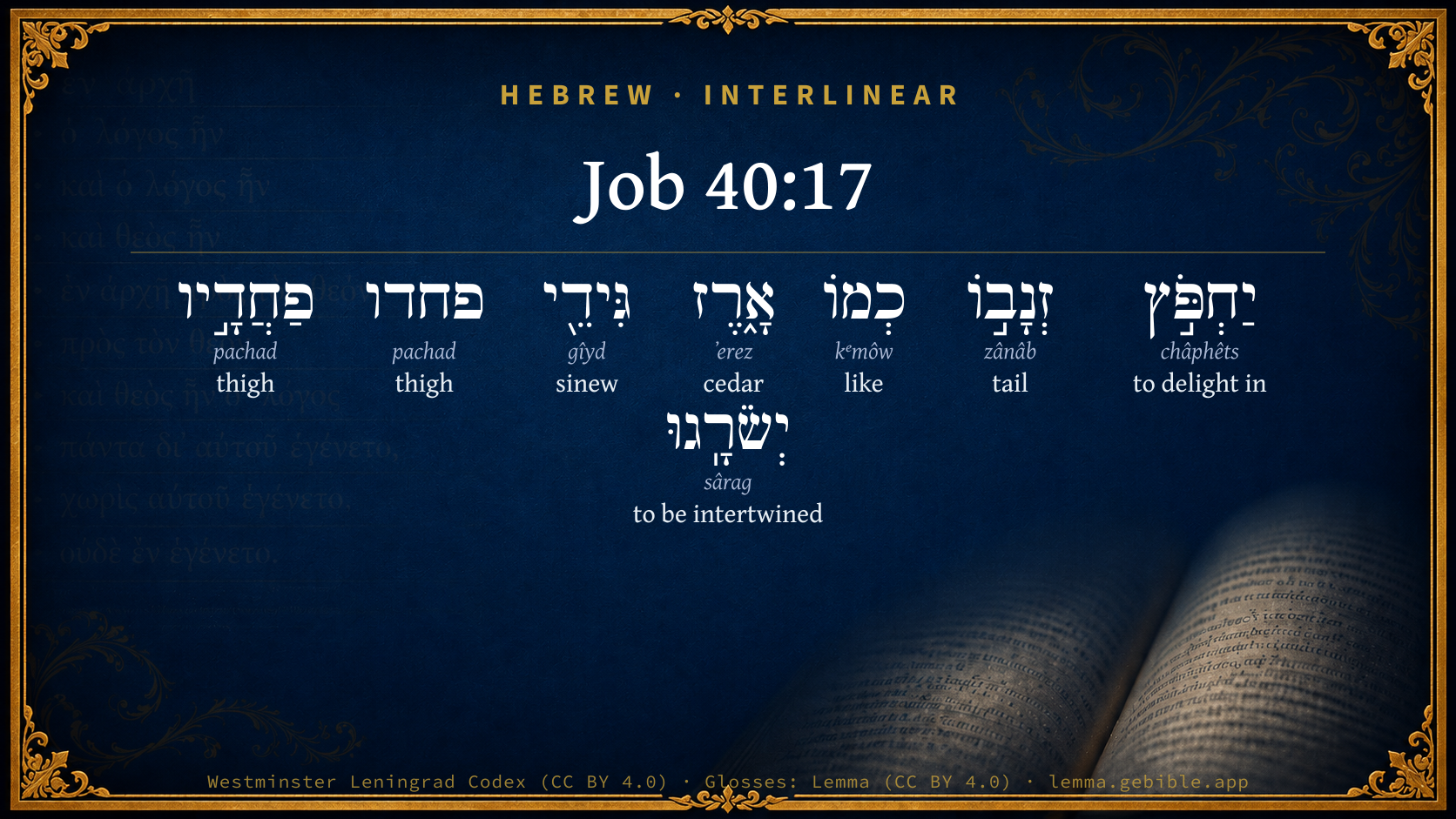
Job 40:17

Hebrew (Westminster Leningrad Codex) Job 40:17 appears in the Hebrew Old Testament. The text above is from the Westminster Leningrad Codex. Each word links to its Strong’s number, a concise gloss, and parsing drawn from the Open Scriptures Hebrew Bible morphology. Click any word for its full Brown-Driver-Briggs (BDB) entry.
Download image
Cite this verse

Job 40:17 (World English Bible). Public Domain. Lemma interlinear Bible study tool, https://lemma.gebible.app/v/job/40/17.

Show BibTeX & RIS
BibTeX
RIS
English Translation
He moves his tail like a cedar: The sinews of his thighs are knit together.
World English Bible · Public Domain
Highlights
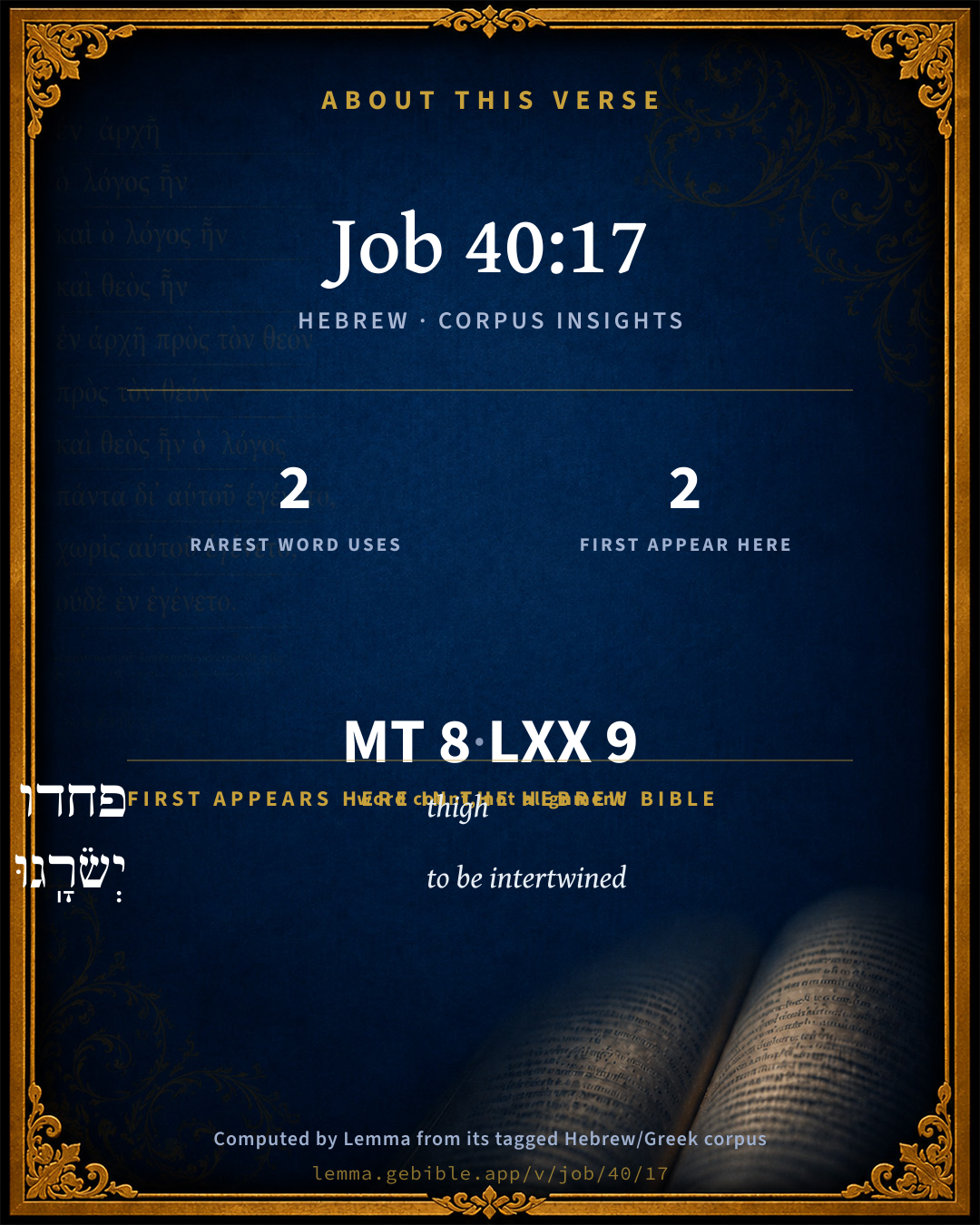
  • 2 first appearances in the Hebrew Bible
Full analysis ↓
Download a study sheet

One document with this verse’s original text, its word-by-word gloss line, the meaning frame, cross-references with their text, attributed commentary, and full source and license credits — printable, and it pastes into notes with its structure intact.

This verse Autodidact and up

Study sheet (.html) Plain text (.txt)

A passage Seminary Student

Up to 50 verses in one chapter. A passage sheet keeps up to 6 commentary sources and 12 cross-references per verse, in the order this page ranks them, and says so on the sheet whenever that leaves anything out. Ask for a single verse and you get the Autodidact verse sheet above.

Everything on this page stays free to read, with no account — the sheet is a download of what is already on screen, not access to it.

Want to remove ads? Support Godless Engineer
Compare translations 3

The same verse in 3 English versions, stacked beneath the original-language interlinear above. Click any original word for its lexicon entry.

Each is an independent rendering of the whole verse — the interlinear is not word-aligned to these translations.

Highlighted words mark where these versions differ — a whole-verse word diff, not a word-by-word alignment.

  • World English Bible Public Domain
    He moves his tail like a cedar: The sinews of his thighs are knit together.
  • King James Version Public Domain
    He moveth his tail like a cedar: the sinews of his stones are wrapped together.
  • unfoldingWord Literal Text CC BY-SA 4.0
    It bends its tail like a cedar; the sinews of its thighs are intertwined.

unfoldingWord Literal Text — © unfoldingWord, licensed CC BY-SA 4.0. Word-aligned USFM3 via Door43 (git.door43.org/unfoldingWord/en_ult).

Versions to compare (up to 4)

3 of 4 selected

Show all 18 translations

Every available English version of this verse, each an independent rendering of the whole verse.

  • World English Bible Public Domain
    He moves his tail like a cedar: The sinews of his thighs are knit together.
  • Berean Standard Bible Public Domain
    His tail sways like a cedar; the sinews of his thighs are tightly knit.
  • Majority Standard Bible Public Domain
    His tail sways like a cedar; the sinews of his thighs are tightly knit.
  • King James Version Public Domain
    He moveth his tail like a cedar: the sinews of his stones are wrapped together.
  • American Standard Version (1901) Public Domain
    He moveth his tail like a cedar: The sinews of his thighs are knit together.
  • Revised Version (1885) Public Domain
    He moveth his tail like a cedar: the sinews of his thighs are knit together.
  • Geneva Bible (1599) Public Domain
    Can the trees couer him with their shadow? or can the willowes of the riuer compasse him about?
  • Douay-Rheims (1899) Public Domain
    The shades cover his shadow, the willows of the brook shall compass him about.
  • Young's Literal Translation Public Domain
    He doth bend his tail as a cedar, The sinews of his thighs are wrapped together,
  • Literal Standard Version CC BY-SA 4.0
    He bends his tail as a cedar, || The sinews of his thighs are wrapped together,
  • Unlocked Literal Bible CC BY-SA 4.0
    He makes his tail like a cedar; the sinews of his thighs are joined together.
  • unfoldingWord Literal Text CC BY-SA 4.0
    It bends its tail like a cedar; the sinews of its thighs are intertwined.
  • Darby Bible Public Domain
    He bendeth his tail like a cedar; the sinews of his thighs are woven together.
  • World Messianic Bible Public Domain
    He moves his tail like a cedar. The sinews of his thighs are knit together.
  • Webster's Bible Public Domain
    \\40:22\\The shady trees cover him with their shadow; the willows of the brook encompass him.
  • Free Bible Version CC BY-SA 4.0
    It bends its tail like a cedar; its thigh sinews are strong.
  • Bible in Basic English Public Domain
    He is covered by the branches of the trees; the grasses of the stream are round him.
  • JPS Tanakh (1917) Public Domain
    He straineth his tail like a cedar; the sinews of his thighs are knit together.

Literal Standard Version (2020), Covenant Press — licensed CC BY-SA 4.0. Text via the HelloAO Bible API (eBible.org). Unlocked Literal Bible (unfoldingWord) — licensed CC BY-SA 4.0. Text via the HelloAO Bible API (eBible.org). unfoldingWord Literal Text — © unfoldingWord, licensed CC BY-SA 4.0. Word-aligned USFM3 via Door43 (git.door43.org/unfoldingWord/en_ult). Free Bible Version, Dr. Jonathan Gallagher — licensed CC BY-SA 4.0. Text via the HelloAO Bible API (eBible.org).

Word by word

More ways to search: Search by grammar → Find every occurrence → Compare this word →

Practice this passage: Drill this verse → Learn its vocabulary →

About this verse

These counts appear in no published source. They are computed here, from the morphology-tagged text and Lemma’s own curated glosses. What Lemma adds →

8
words
7
distinct lemmas
Wisdom
section

Notable vocabulary

The rarest word here is פחדו thigh H6344 — appearing just 2 times in the whole Hebrew Bible.

First appearance in Scripture

These words make their first canonical appearance in the Hebrew Bible here:

  • פחדו thigh H6344
  • יְשֹׂרָֽגוּ to be intertwined H8276

Grammatical profile

  • 2 verbs
  • 5 nouns
  • 1 preposition

Verb forms

  • יַחְפֹּ֣ץ Qal · Imperfect
  • יְשֹׂרָֽגוּ Pual · Imperfect

Repetition

A word recurs within this verse — often emphatic in Hebrew:

  • פחדו thigh H6344 ×2

Hebrew & Septuagint length

In English translation the verse runs 15 words from the Hebrew and 20 from the Septuagint (LXX English) — closely comparable.

A rough comparison of the two English renderings, which tokenize alike — not a word-level alignment.

Word counts can differ between the Hebrew and the Greek without any difference in meaning — e.g. the Hebrew direct-object marker אֵת has no separate Greek word, and Greek often adds the article ὁ.

In the original languages it is 8 Hebrew tokens and 9 Greek tokens — but the two are counted differently (Hebrew bundles its prefixes and suffixes into one token; the Greek is in lemma form), so that isn’t a like-for-like length.

Cross-references

1

Topical passages linked to Job 40:17 in the Treasury of Scripture Knowledge — connected by theme and wording, ordered by reader-vote popularity; previews shown in the World English Bible.

  • Job 41:23 The flakes of his flesh are joined together. They are firm on him. They can't be moved.

Cross-references courtesy of OpenBible.info (CC BY 4.0).

Hebrew and Greek witnesses Masoretic Hebrew ↔ Greek Septuagint

The same verse in the two great witnesses to the Old Testament, shown verse-for-verse.

These are two independent witnesses, not word-aligned to each other, and the Septuagint is shown in lemma (dictionary) form.

Hebrew Job 40:17 Masoretic · Westminster Leningrad Codex

יַחְפֹּ֣ץ זְנָב֣וֹ כְמוֹ אָ֑רֶז גִּידֵ֖י פחדו פַחֲדָ֣יו יְשֹׂרָֽגוּ

He moves his tail like a cedar: The sinews of his thighs are knit together.

World English Bible · Public Domain

Greek LXX Job 40:17 Septuagint · lemma form

ἵστημι οὐρά ὡς κυπάρισσος ὁ δέ νεῦρον αὐτός συνπλέκω

And the great trees make a shadow over him with their branches, and so do the bushes of the field.

LXX2012 (modern English Septuagint) · Public Domain

On this verse, Albert Barnes' Notes on the Bible discusses the Septuagint’s reading. Read the note in Commentary ↓

Hebrew: Westminster Leningrad Codex (CC BY 4.0). Greek: Septuagint (public domain); English from LXX2012 (modern English Septuagint) (Public Domain). How the Septuagint differs from the Hebrew →

Commentary

Notes on Job 40:17 from classic Christian and Jewish commentators (each source and its license shown beneath its notes). The classic Christian expositions comment on the surrounding passage and are grouped to its opening verse, so a note may address several verses; the Jewish commentaries on the Tanakh (Rashi and others) are per-verse, so they appear only where the commentator wrote on this verse.

Lemma curates 59 commentaries, every one of them public domain or Creative Commons licensed, each selected and text-cleaned for this edition rather than reprinted as found. About our sources →

Trapp's Complete Commentary

John Trapp

Job 40:17 He moveth his tail like a cedar: the sinews of his stones are wrapped together.

Ver. 17. He moveth his tail like a cedar] The elephant hath but a small and short tail for his bulk; Beza, therefore, rendereth it his prominent part, which is as the cedar, and interpreteth it to be his proboscis, or large snout, which truly, saith he, as being proper to the elephant, and of very great use, might not in any wise be pretermitted in this description. See Job 40:15.

The sinews of his stones are wrapped together] This is also another of the elephant’s properties, whose testicles are hidden and stick to his belly, fastened there by certain sinews and ligaments, and do not hang, as other beasts’ testicles do. As his genital members are but small, considering his size; so his lust to the female is not great, never coupling with her but in secret, and when she is once filled, forbearing her company.

John Trapp, A Commentary or Exposition upon All the Books of the Old and New Testament (1647–1656) — public domain. Text from a community e-Sword module.

Joseph Benson's Commentary

Job 40:17. He moveth his tail like a cedar — Though the tail be but short, both in the elephant, and in the hippopotamus; yet, when it is erected, it is exceeding stiff and strong. The sinews of his stones, &c. — Rather, of his thighs, as the Hebrew may be rendered. The thighs and feet of the river- horse are so sinewy and strong that one of them is able to break or overturn a large boat.

Joseph Benson's Commentary on the Old and New Testaments (1811–1818) — public domain. Text from a community e-Sword module.

Jamieson, Fausset & Brown

Robert Jamieson, A. R. Fausset & David Brown

like a cedar--As the tempest bends the cedar, so it can move its smooth thick tail [UMBREIT]. But the cedar implies straightness and length, such as do not apply to the river horse's short tail, but perhaps to an extinct species of animal (see on Job 40:15).

stones--rather, "thighs."

wrapped--firmly twisted together, like a thick rope.

Jamieson, Fausset & Brown — Commentary Critical and Explanatory on the Whole Bible (1871) — public domain (CC PDM 1.0). Text via the HelloAO Bible API.

Adam Clarke's Commentary

Verse 17. He moveth his tail like a cedar] Therefore it was neither the elephant, who has a tail like that of the hog, nor the hippopotamus, whose tail is only about a foot long.

The sinews of his stones] I translate with Mr. Good, and for the same reasons, the sinews of his haunches, which is still more characteristic; as the animal must have excelled in leaping.

Adam Clarke's Commentary on the Bible (1810–1826) — public domain. Text from a community e-Sword/MySword module.

Ellicott's Commentary for English Readers

(17) The sinews of his stones.—Rather, of his thighs.

A Bible Commentary for English Readers, edited by Charles John Ellicott (1878–1897) — public domain. Text from a community e-Sword module.

The Cambridge Bible for Schools and Colleges

gen. ed. J. J. S. Perowne

17. The “tail” of the hippopotamus is short, naked and muscular, resembling that of the hog. The great strength of the animal may be inferred from the muscular stiffness of the tail, which bends like the branch or young stem of a cedar.

The Cambridge Bible for Schools and Colleges (gen. ed. J. J. S. Perowne; Cambridge University Press, 1878–1918) — public domain. Text from a community e-Sword module.

John Gill's Exposition

His bones are as strong pieces of brass: his bones are as bars of iron. Than which nothing is stronger. The repetition is made for greater illustration and confirmation; but what is said is not applicable to the elephant, whose bones are porous and rimous, light and spongy for the most part, as appears from the osteology (k) of it; excepting its teeth, which are the ivory; though the teeth of the river horse are said to exceed them in hardness (l); and artificers say (m) they are wrought with greater difficulty than ivory. The ancients, according to Pausanias (n), used them instead of it; who relates, that the face of the image of the goddess Cybele was made of them: and Kircher (o) says, in India they make beads, crucifixes, and statues of saints of them; and that they are as hard or harder than a flint, and fire may be struck out of them. So the teeth of the morss, a creature of the like kind in the northern countries, are valued by the inhabitants as ivory (p), for hardness, whiteness, and weight, beyond it, and are dearer and much traded in; See Gill on Job 40:20; but no doubt not the teeth only, but the other bones of the creature in the text are meant.

(k) In Philosoph. Transact. vol. 5. p. 155, 156. (l) Odoardus Barbosa apud Bochart. ut supra. (Apud Hierozoic. par. 2. l. 5. c. 14. col. 758.) (m) Diepenses apud ib. (n) Arcadica, sive, l. 8. p. 530. (o) China cum Monument. p. 193. (p) Olaus Magnus, ut supra, (De Ritu. Septent. Gent.) l. 2. c. 19. Voyage to Spitzbergen, p. 115.

John Gill's Exposition of the Whole Bible (1746–1763) — public domain (CC PDM 1.0). Text via the HelloAO Bible API.

Albert Barnes' Notes on the Bible

He moveth his tail like a cedar - Margin, “setteth up.” The Hebrew word (חפץ châphêts) means “to bend, to curve;” and hence, it commonly denotes “to be inclined, favorably disposed to desire or please.” The obvious meaning here is, that this animal had some remarkable power of “bending” or “curving” its tail, and that there was some resemblance in this to the motion of the cedar-tree when moved by the wind. In “what” this resemblance consisted, or how this was a proof of its power, it is not quite easy to determine. Rosenmuller says that the meaning is, that the tail of the hippopotamus was “smooth, round, thick, and firm,” and in this respect resembled the cedar. The tail is short - being, according to Abdollatiph (see Ros.), about half a cubit in length. In the lower part, says he, it is thick, “equalling the extremities of the fingers;” and the idea here, according to this, is, that this short, thick, and apparently firm tail, was bent over by the will of the animal as the wind bends the branches of the cedar.

The point of comparison is not the “length,” but the fact of its being easily bent over or curved at the pleasure of the animal. Why this, however, should have been mentioned as remarkable, or how the power of the animal in this respect differs from others, is not very apparent. Some, who have supposed the elephant to be here referred to, have understood this of the proboscis. But though “this would be” a remarkable proof of the power of the animal, the language of the original will not admit of it. The Hebrew word (זנב zânâb) is used only to denote the tail. It is “possible” that there may be here an allusion to the unwieldy nature of every part of the animal, and especially to the thickness and inflexibility of the skin and what was remarkable was, that notwithstanding this, this member was entirely at its command. Still, the reason of the comparison is not very clear. The description of the movement of the “tail” here given, would agree much better with some of the extinct orders of animals whose remains have been recently discovered and arranged by Cuvier, than with that of the hippopotamus. Particularly, it would agree with the account of the ichthyosaurus (see Buckland’s “Geology, Bridgewater Treatise,” vol. i. 133ff), though the other parts of the animal here described would not accord well with this.

The sinews of his stones are wrapped together - Good renders this, “haunches;” Noyes, Prof. Lee, Rosenmuller, and Schultens, “thighs;” and the Septuagint simply has: “his sinews.” The Hebrew word used here (פחד pachad) means properly “fear, terror,” Exo 15:16; Job 13:11; and, according to Gesenius, it then means, since “fear” is transferred to cowardice and shame, anything which “causes” shame, and hence, the secret parts. So it is understood here by our translators; but there does not seem to be any good reason for this translation, but there is every reason why it should not be thus rendered. The “object” of the description is to inspire a sense of the “power” of the animal, or of his capacity to inspire terror or dread; and hence, the allusion here is to those parts which were fitted to convey this dread, or this sense of his power - to wit, his strength. The usual meaning of the word, therefore, should be retained, and the sense then would be, “the sinews of his terror,” that is, of his parts fitted to inspire terror, “are wrapped together;” are firm, compact, solid. The allusion then is to his thighs or haunches, as being formidable in their aspect, and the seat of strength. The sinews or muscles of these parts seemed to be like a hard-twisted rope; compact, firm, solid, and such as to defy all attempts to overcome them.

Albert Barnes' Notes on the Bible (1834–1885) — public domain. Text from a community e-Sword/MySword module.

Matthew Poole's English Annotations

He moveth his tail; which though it be but short, both in the elephant and in the hippopotamus, yet when it is erected is exceeding stiff and strong. But this may be understood, either,

1. Of his generative part, which is off called by that or the like name, which the following close of the verse may seem to favour. Or,

2. Of the elephant’s trunk, which being so eminent and remarkable a part, would not probably be omitted in this description, to which these words very fitly agree, because of its admirable motion and strength. Nor is it strange that this is called his tail, because that word is oft used improperly for any end of a thing, as Isa 7:4. See also Deu 25:18; 28:13,44.

The sinews of his stones: this may be noted, because the elephant’s testicles do not hang down below the belly, as they do in other beasts, but are contained within his belly, where they are fastened by ligaments of extraordinary strength. Or, the sinews of the terror thereof, to wit, of the trunk last mentioned, under the name of the

tail, i.e. its terrible sinews are strongly and strangely wrapped together, that he can move it as he listeth with wonderful dexterity and strength. Or,

the sinews of his thighs, as the latter word oft signifies in the Arabic tongue, which is very near akin to the Hebrew. The thighs and feet of the hippopotamus are noted to be so sinewy and strong, that one of them is able to break or overturn a large boat.

Matthew Poole's English Annotations on the Holy Bible (1683–1685) — public domain. Text from a community e-Sword/MySword module.

Whedon's Commentary on the Bible

Daniel D. Whedon

17. Like a cedar — Short and firm though the tail may be, it is swayed by the volition of the vast animal like a cedar bough by the wind. The interpretation turns on חפצ, moveth, the fundamental meaning of which is “to will,” “move at pleasure.” The name for cedar, ארז, “has been handed down on the spot [Lebanon] intact throughout all the changes of language, and the name arz is never applied by the natives to any tree but the true cedar.” — Tristram. See farther his Land of Israel, 40:628-632.

The sinews, etc. — Rather, The sinews of his thighs.

Are wrapped together — ישׂרגו. Better, knit together. According to Gesenius and Delitzsch the cognate noun שׂריגים, signifies “vine branches;” the speaker evidently choosing this word on account of its beautiful appropriateness for expressing complex and delicate intertwining of texture.

Daniel D. Whedon (gen. ed.), Commentary on the Old and New Testaments (1874–1909) — public domain. Text from a community e-Sword module.

The Pulpit Commentary

He moveth his tail like a cedar. The tail of the hippopotamus is remarkably short and thick. It only bends slightly, being stiff and unyielding, like the stem of a cedar. The sinews of his stones (rather, of his thighs) are wrapped together; or, interwoven one with another (so Professor Lee and Mr. Houghton).

The Pulpit Commentary (1880–1919), ed. H.D.M. Spence-Jones & Joseph S. Exell — public domain. Text from a community e-Sword module.

John Wesley's Explanatory Notes

Tail - Which though it be but short, yet when it is erected, is exceeding stiff and strong. Thighs - The sinews of his thighs. His thighs and feet are so sinewy and strong, that one of them is able to break or over-turn a large boat.

John Wesley, Explanatory Notes Upon the Whole Bible (1754–1765) — public domain. Text via the GEBible commentary corpus.

unfoldingWord translationNotes

Door43 World Missions Community

like a cedar

Cedar is a very hard wood, and his tail becomes very hard. (See: Simile)

like tubes of bronze

Here, his bones are compared to tubes made of bronze to show how tough this animal is. (See: Simile)

like bars of iron

This last comparison describes the strength of this great animal. (See: Simile)

translationWords

cedar

bronze

unfoldingWord translationNotes — © Distant Shores Media and the Door43 World Missions Community, licensed CC BY-SA 4.0. Source: git.door43.org/Door43/en_tn.

Rashi

Rabbi Shlomo Yitzchaki (Rashi)

hardens Heb. יחפץ like יַחְפּוֹז, hardens. Similarly, in the language of the Sages: דַחַפִּיזָא כִּי אוּפְתָּא (Hullin 47b), hard as wood.

his testicles Heb. פַחֲדָיו.

are knit together Heb. ישרגו, twisted cords, like (Lam. 1:14), “they are knit together (ישתרגו),” or the webbing (שריגי) of a bed in the language of the Mishnah, (Moed Katan 1:8), and it is an expression of twisted cords.

Rashi on the Tanakh — English translations: “The Judaica Press complete Tanach with Rashi, translated by A. J. Rosenberg” (CC BY 4.0); “Pentateuch with Rashi's commentary by M. Rosenbaum and A.M. Silbermann, 1929-1934” (public domain); “The Metsudah Tanach series, Lakewood, N.J” (CC BY 4.0); and “The Book of Joshua, Metsudah Publications, 1997” (CC BY 4.0). Text via Sefaria.

Lesson kit

Teaching starters — assembled from the data on this page, not authored interpretation. Every prompt links to the verse data it draws on. Edit before teaching.

Job, in the Wisdom, opens this verse with 8 words (7 distinct Hebrew lemmas). Its most distinctive word is pachad (“thigh”). A historical commentator’s framing appears above. Read the whole chapter for the surrounding context.

Discussion questions

  1. The word pachad carries the sense “thigh.” How does it shape the verse?
  2. 2 words make their first appearance in Scripture here. What does this debut establish?
  3. How does Job 41:23, which shares this passage’s theme, read alongside this verse?
  4. What does the repetition of “thigh” (2× in this one verse) do in this verse?
  5. These translations render this verse differently. What is at stake in choosing one wording over another?
  6. «יַחְפֹּ֣ץ» is a Qal Imperfect verb. How does that grammatical form shape the action described?
  7. Compare how Trapp's Complete Commentary and Joseph Benson's Commentary read this verse. Where do they agree or differ?

Things to notice

Reading settings

Reading text

Shown beneath each verse's original-language words.

Old Testament
Old Testament edition

Read the OT as the Masoretic Hebrew (MT) or the Greek Septuagint (LXX).

English shown for the Greek Septuagint (in the Hebrew ↔ Greek comparison).

Comparing translations? Open the Compare panel on any verse page to stack up to four side by side.