
Psalms 135:18

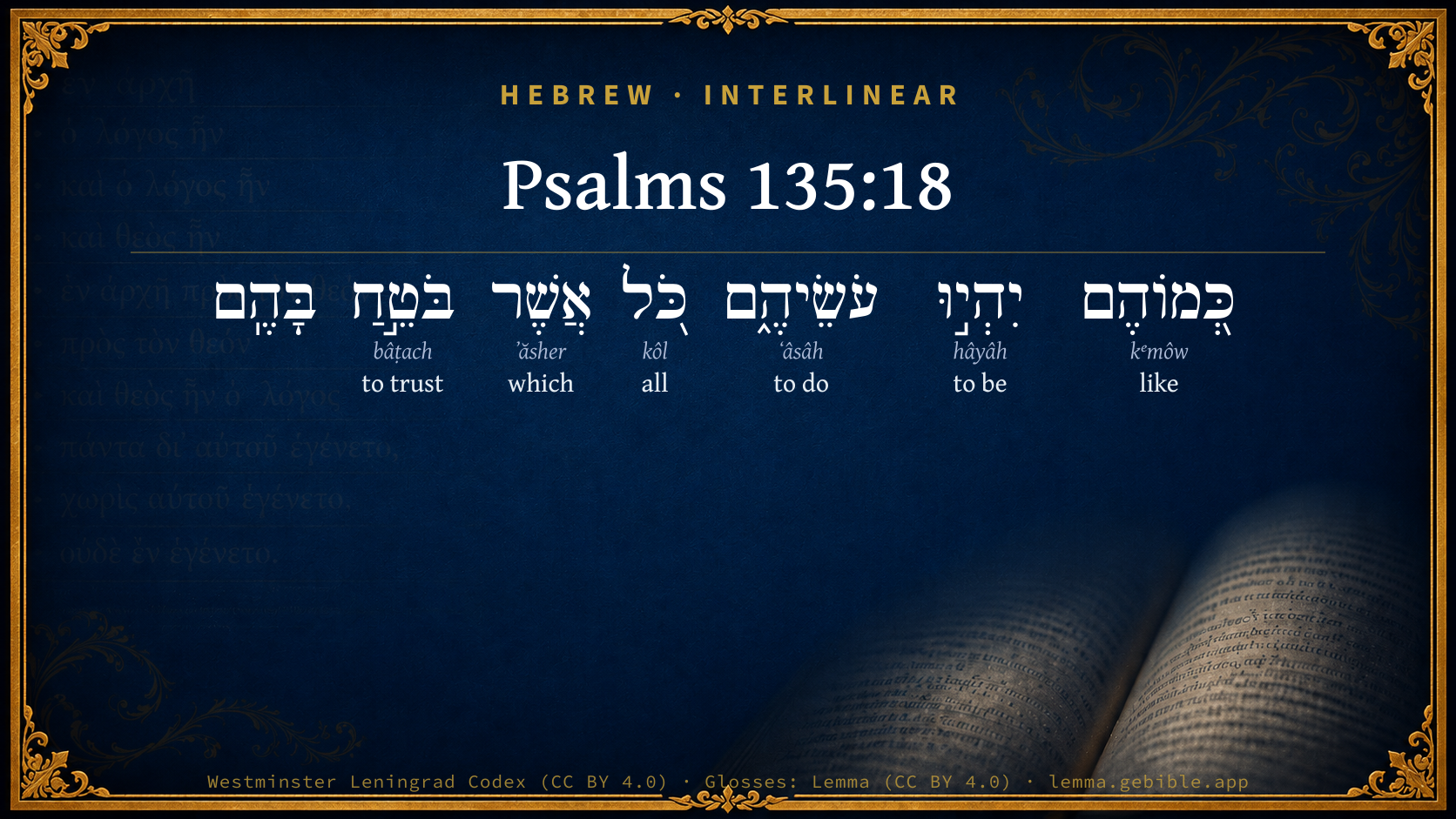
Hebrew (Westminster Leningrad Codex) Psalms 135:18 appears in the Hebrew Old Testament. The text above is from the Westminster Leningrad Codex. Each word links to its Strong’s number, a concise gloss, and parsing drawn from the Open Scriptures Hebrew Bible morphology. Click any word for its full Brown-Driver-Briggs (BDB) entry.
Download image
Cite this verse

Psalms 135:18 (World English Bible). Public Domain. Lemma interlinear Bible study tool, https://lemma.gebible.app/v/psalms/135/18.

Show BibTeX & RIS
BibTeX
RIS
English Translation
Those who make them will be like them; Yes, everyone who trusts in them.
World English Bible · Public Domain
Download a study sheet

One document with this verse’s original text, its word-by-word gloss line, the meaning frame, cross-references with their text, attributed commentary, and full source and license credits — printable, and it pastes into notes with its structure intact.

This verse Autodidact and up

Study sheet (.html) Plain text (.txt)

A passage Seminary Student

Up to 50 verses in one chapter. A passage sheet keeps up to 6 commentary sources and 12 cross-references per verse, in the order this page ranks them, and says so on the sheet whenever that leaves anything out. Ask for a single verse and you get the Autodidact verse sheet above.

Everything on this page stays free to read, with no account — the sheet is a download of what is already on screen, not access to it.

Want to remove ads? Support Godless Engineer
Compare translations 3

The same verse in 3 English versions, stacked beneath the original-language interlinear above. Click any original word for its lexicon entry.

Each is an independent rendering of the whole verse — the interlinear is not word-aligned to these translations.

Highlighted words mark where these versions differ — a whole-verse word diff, not a word-by-word alignment.

  • World English Bible Public Domain
    Those who make them will be like them; Yes, everyone who trusts in them.
  • King James Version Public Domain
    They that make them are like unto them: so is every one that trusteth in them.
  • unfoldingWord Literal Text CC BY-SA 4.0
    Their makers are like them— everyone who is trusting in them.

unfoldingWord Literal Text — © unfoldingWord, licensed CC BY-SA 4.0. Word-aligned USFM3 via Door43 (git.door43.org/unfoldingWord/en_ult).

Versions to compare (up to 4)

3 of 4 selected

Show all 17 translations

Every available English version of this verse, each an independent rendering of the whole verse.

  • World English Bible Public Domain
    Those who make them will be like them; Yes, everyone who trusts in them.
  • Berean Standard Bible Public Domain
    Those who make them become like them, as do all who trust in them.
  • Majority Standard Bible Public Domain
    Those who make them become like them, as do all who trust in them.
  • King James Version Public Domain
    They that make them are like unto them: so is every one that trusteth in them.
  • American Standard Version (1901) Public Domain
    They that make them shall be like unto them; Yea, every one that trusteth in them.
  • Revised Version (1885) Public Domain
    They that make them shall be like unto them; yea, every one that trusteth in them.
  • Geneva Bible (1599) Public Domain
    They that make them, are like vnto them: so are all that trust in them.
  • Young's Literal Translation Public Domain
    Like them are their makers, Every one who is trusting in them.
  • Literal Standard Version CC BY-SA 4.0
    Their makers are like them, || Everyone who is trusting in them.
  • Unlocked Literal Bible CC BY-SA 4.0
    Those who make them are like them, as is everyone who trusts in them.
  • unfoldingWord Literal Text CC BY-SA 4.0
    Their makers are like them— everyone who is trusting in them.
  • Darby Bible Public Domain
    They that make them are like unto them, -- every one that confideth in them.
  • World Messianic Bible Public Domain
    Those who make them will be like them, yes, everyone who trusts in them.
  • Webster's Bible Public Domain
    They that make them are like them: so is every one that trusteth in them.
  • Free Bible Version CC BY-SA 4.0
    Those who make idols will become just like them, and so will everyone who trusts in them.
  • Bible in Basic English Public Domain
    Those who make them are like them; and so is everyone who puts his hope in them.
  • JPS Tanakh (1917) Public Domain
    They that make them shall be like unto them; yea, every one that trusteth in them.

Literal Standard Version (2020), Covenant Press — licensed CC BY-SA 4.0. Text via the HelloAO Bible API (eBible.org). Unlocked Literal Bible (unfoldingWord) — licensed CC BY-SA 4.0. Text via the HelloAO Bible API (eBible.org). unfoldingWord Literal Text — © unfoldingWord, licensed CC BY-SA 4.0. Word-aligned USFM3 via Door43 (git.door43.org/unfoldingWord/en_ult). Free Bible Version, Dr. Jonathan Gallagher — licensed CC BY-SA 4.0. Text via the HelloAO Bible API (eBible.org).

Word by word

More ways to search: Search by grammar → Find every occurrence → Compare this word →

Practice this passage: Drill this verse → Learn its vocabulary →

About this verse

These counts appear in no published source. They are computed here, from the morphology-tagged text and Lemma’s own curated glosses. What Lemma adds →

7
words
6
distinct lemmas
Wisdom
section

Grammatical profile

  • 3 verbs
  • 1 noun
  • 2 prepositions
  • 1 particle

Verb forms

  • יִהְי֣וּ Qal · Imperfect
  • עֹשֵׂיהֶ֑ם Qal · Participle Active
  • בֹּטֵ֣חַ Qal · Participle Active

Hebrew & Septuagint length

In English translation the verse runs 14 words from the Hebrew and 17 from the Septuagint (LXX English) — closely comparable.

A rough comparison of the two English renderings, which tokenize alike — not a word-level alignment.

Word counts can differ between the Hebrew and the Greek without any difference in meaning — e.g. the Hebrew direct-object marker אֵת has no separate Greek word, and Greek often adds the article ὁ.

In the original languages it is 7 Hebrew tokens and 12 Greek tokens — but the two are counted differently (Hebrew bundles its prefixes and suffixes into one token; the Greek is in lemma form), so that isn’t a like-for-like length.

Cross-references

5

Topical passages linked to Psalms 135:18 in the Treasury of Scripture Knowledge — connected by theme and wording, ordered by reader-vote popularity; previews shown in the World English Bible.

  • Psalms 115:8 Those who make them will be like them; Yes, everyone who trusts in them.
  • Isaiah 44:18–20 They don't know, neither do they consider: for he has shut their eyes, that they can't see; and their hearts, that they can't understand.
  • Jeremiah 10:8 But they are together brutish and foolish: the instruction of idols! it is but a stock.
  • 2 Corinthians 4:4 in whom the god of this world has blinded the minds of the unbelieving, that the light of the Gospel of the glory of Christ, who is the image of God, should not dawn on them.
  • Psalms 97:7 Let all them be shamed who serve engraved images, Who boast in their idols. Worship him, all you gods!

Cross-references courtesy of OpenBible.info (CC BY 4.0).

Hebrew and Greek witnesses Masoretic Hebrew ↔ Greek Septuagint

The same verse in the two great witnesses to the Old Testament, shown verse-for-verse.

You’re reading Greek Psalm 134 (Hebrew Psalm 135). The Septuagint counts the superscription, so verse numbers can differ from the Hebrew — chapter-level alignment, not verse-by-verse. Numbering follows Rahlfs.

These are two independent witnesses, not word-aligned to each other, and the Septuagint is shown in lemma (dictionary) form.

Hebrew Psalms 135:18 Masoretic · Westminster Leningrad Codex

כְּ֭מוֹהֶם יִהְי֣וּ עֹשֵׂיהֶ֑ם כֹּ֭ל אֲשֶׁר בֹּטֵ֣חַ בָּהֶֽם

Those who make them will be like them; Yes, everyone who trusts in them.

World English Bible · Public Domain

Greek LXX Greek Psalm 134:18 Septuagint · lemma form

ὅμοιος αὐτός γίγνομαι ὁ ποιέω αὐτός καί πᾶς ὁ πείθω ἐπί αὐτός

Let those who make them be made like to them; and all those who trust in them.

LXX2012 (modern English Septuagint) · Public Domain

Hebrew: Westminster Leningrad Codex (CC BY 4.0). Greek: Septuagint (public domain); English from LXX2012 (modern English Septuagint) (Public Domain). How the Septuagint differs from the Hebrew →

Commentary

Notes on Psalms 135:18 from classic Christian and Jewish commentators (each source and its license shown beneath its notes). The classic Christian expositions comment on the surrounding passage and are grouped to its opening verse, so a note may address several verses; the Jewish commentaries on the Tanakh (Rashi and others) are per-verse, so they appear only where the commentator wrote on this verse.

Lemma curates 59 commentaries, every one of them public domain or Creative Commons licensed, each selected and text-cleaned for this edition rather than reprinted as found. About our sources →

Trapp's Complete Commentary

John Trapp

Psa 135:18 They that make them are like unto them: [so is] every one that trusteth in them.

Ver. 18. They that make them, &c.] See Psa 115:8.

John Trapp, A Commentary or Exposition upon All the Books of the Old and New Testament (1647–1656) — public domain. Text from a community e-Sword module.

J. A. Alexander on Psalms

Joseph Addison Alexander

18. (Psa 135:18) Like them shall be those making them, every one who (is) trusting in them. See above, on Psa 115:8, with which this verse agrees exactly. If the meaning had been simply, those who make them are like them, Hebrew usage would have required the verb to be suppressed. Its insertion, therefore, in the future form requires it to be rendered strictly shall be, i.e. in fate as well as character. Idolaters shall perish with their perishable idols. Compare Isa 1:31.

Joseph Addison Alexander, The Psalms Translated and Explained (1850) — public domain. Text from a community e-Sword module.

The Cambridge Bible for Schools and Colleges

gen. ed. J. J. S. Perowne

18. Like unto them shall their makers become,

Even everyone that trusteth in them.

The Cambridge Bible for Schools and Colleges (gen. ed. J. J. S. Perowne; Cambridge University Press, 1878–1918) — public domain. Text from a community e-Sword module.

John Gill's Exposition

Bless the Lord, O house of Israel,.... Who are chosen by the Lord to be a special people to him above all others; redeemed from Egyptian bondage; through a variety of surprising providences brought into and settled in the land of Canaan; distinguished by various blessings, favoured with the word, worship, and ordinances of God, and not left to worship idols of gold and silver, as other nations; and therefore had great reason to bless the Lord: as also the spiritual Israel, or the household of God and of faith, the family of Christ; and that because they are of his family, because of the love of God to them, his choice of them, his covenant with them, their redemption by Christ, their effectual calling; or for being made Israelites indeed, and the provisions made for them in the house of God for their spiritual welfare;

bless the Lord, O house of Aaron: who were separated from their brethren to minister in the priest's office; to offer gifts and sacrifices for the people, and to bless them, Exo 28:1; which was a very sacred and honourable employment, and they were under obligation to bless the Lord, who had called them to it, and put this honour on them; as are the ministers of the Gospel, who have received gifts from Christ; whom he has counted faithful, and put into the ministry; made stewards of the mysteries of his grace, and ambassadors in his stead; and especially if made useful for edification and conversion: and indeed all the Lord's people, who are all made priests unto God, and have nearness unto him, liberty and boldness to enter into the holiest of all, as Aaron once a year into the most holy place; and who have better sacrifices to offer than he, the living sacrifices of their own bodies and souls, and not slain beasts; spiritual sacrifices of prayer and praise; and, above all, the sweet smelling sacrifice of Christ they bring in the arms of faith, and so enter into the courts of God.

John Gill's Exposition of the Whole Bible (1746–1763) — public domain (CC PDM 1.0). Text via the HelloAO Bible API.

The Treasury of David

Charles H. Spurgeon

Ver. 18. They that make them are like unto them. they are as blockish, as senseless, as stupid as the gods they have made, and, like them they are the objects of divine abhorrence, and shall be broken in pieces in due time. So is every one that trusteth in them. The idol worshippers are as bad as the idol makers; for if there were none to worship, there would be no market for the degrading manufacture. Idolaters are spiritually dead, they are the mere images of men, their best being is gone, they are not what they seem. Their mouths do not really pray, their eyes see not the truth, their ears hear not the voice of the Lord, and the life of God is not in them. Those who believe in their own inventions in religion betray great folly, and an utter absence of the quickening Spirit. Gracious men can see the absurdity of forsaking the true God and setting up rivals in his place; but those who perpetrate this crime think not so: on the contrary, they pride themselves upon their great wisdom, and boast of "advanced thought" and "modern culture." Others there are who believe in a baptismal regeneration which does not renew the nature, and they make members of Christ and children of God who have none of the spirit of Christ, or the signs of adoption. May we be saved from such mimicry of divine work lest we also become like our idols.

Ver. 18. Like them shall be those making them, every one who (is) trusting in them. If the meaning had been simply, those who make them are like them, Hebrew usage would have required the verb to be suppressed. Its insertion, therefore, in the future form (wyhy) requires it to be rendered strictly shall be, i.e., in fate as well as character. Idolaters shall perish with their perishable idols. See Isa 1:31. Joseph Addison Alexander.

Ver. 18. People never rise above the level of their gods, which are to them their better nature. Andrew Robert Faussett.

Ver. 18. They that make them are like unto them. Idolatry is a benumbing sin, which bereaveth the idolater of the right use of his senses. David Dickson.

Ver. 18. They that make them, etc. Teacheth us, that the idol, the idol maker, and all such also as serve idols, are not only beastly and blockish before men, but shall before God, in good time, come to shame and confusion. Thomas Wilcocks, 1549-1608.

Ver. 18. Like unto them. A singular phenomenon, known as the Spectre of the Brocken, is seen on a certain mountain in Germany. The traveller who at dawn stands on the topmost ridge beholds a colossal shadowy spectre. But in fact it is only his own shadow projected upon the morning mists by the rising sun; and it imitates, of course, every movement of its creator. So heathen nations have mistaken their own image for Deity. Their gods display human frailties and passions and scanty virtues, projected and magnified upon the heavens, just as the small figures on the slide of a magic lantern are projected, magnified, and illuminated upon a white sheet. From Elan Foster's New Cyclopoedia of Illustrations, 1870.

Ver. 18. Like unto them. How many are like idol images, when they have eyes, ears, and mouths as though they had none: that is, when they do not use them when and how they should! Christoph Starke.

Ver. 18.

1. Men make idols like themselves.

2. The idols make their makers like themselves. Describe both processes.

Psalms 135:19*

Charles H. Spurgeon's The Treasury of David (1869–1885) — public domain. Psalms only. Text from a community e-Sword/MySword module.

Lesson kit

Teaching starters — assembled from the data on this page, not authored interpretation. Every prompt links to the verse data it draws on. Edit before teaching.

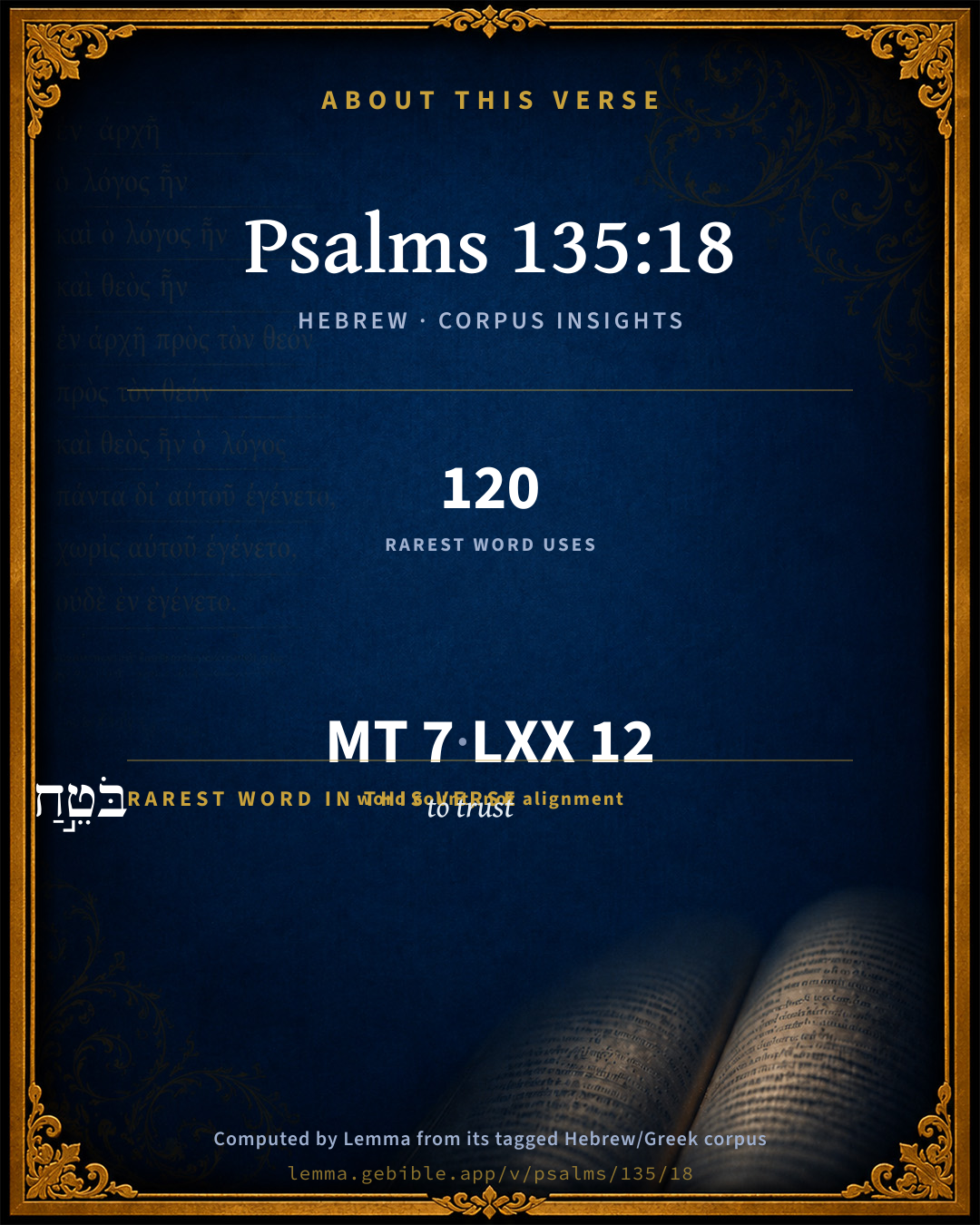
Psalms, in the Wisdom, opens this verse with 7 words (6 distinct Hebrew lemmas). Its most distinctive word is bâṭach (“to trust”). A historical commentator’s framing appears above. Read the whole chapter for the surrounding context.

Discussion questions

  1. What does “to trust” (bâṭach) contribute to the verse as a whole?
  2. Psalms 115:8 shares this passage’s theme. How do the two illuminate each other?
  3. The translations on this page render this verse differently — a whole-verse word diff, not a word-by-word alignment. What might account for the different wordings?
  4. The verb «יִהְי֣וּ» is Qal Imperfect. How does its form color the action?
  5. Reading how Trapp's Complete Commentary and J. A. Alexander on Psalms read this verse, where do the two commentators agree and where do they part?

Things to notice

Reading settings

Reading text

Shown beneath each verse's original-language words.

Old Testament
Old Testament edition

Read the OT as the Masoretic Hebrew (MT) or the Greek Septuagint (LXX).

English shown for the Greek Septuagint (in the Hebrew ↔ Greek comparison).

Comparing translations? Open the Compare panel on any verse page to stack up to four side by side.