
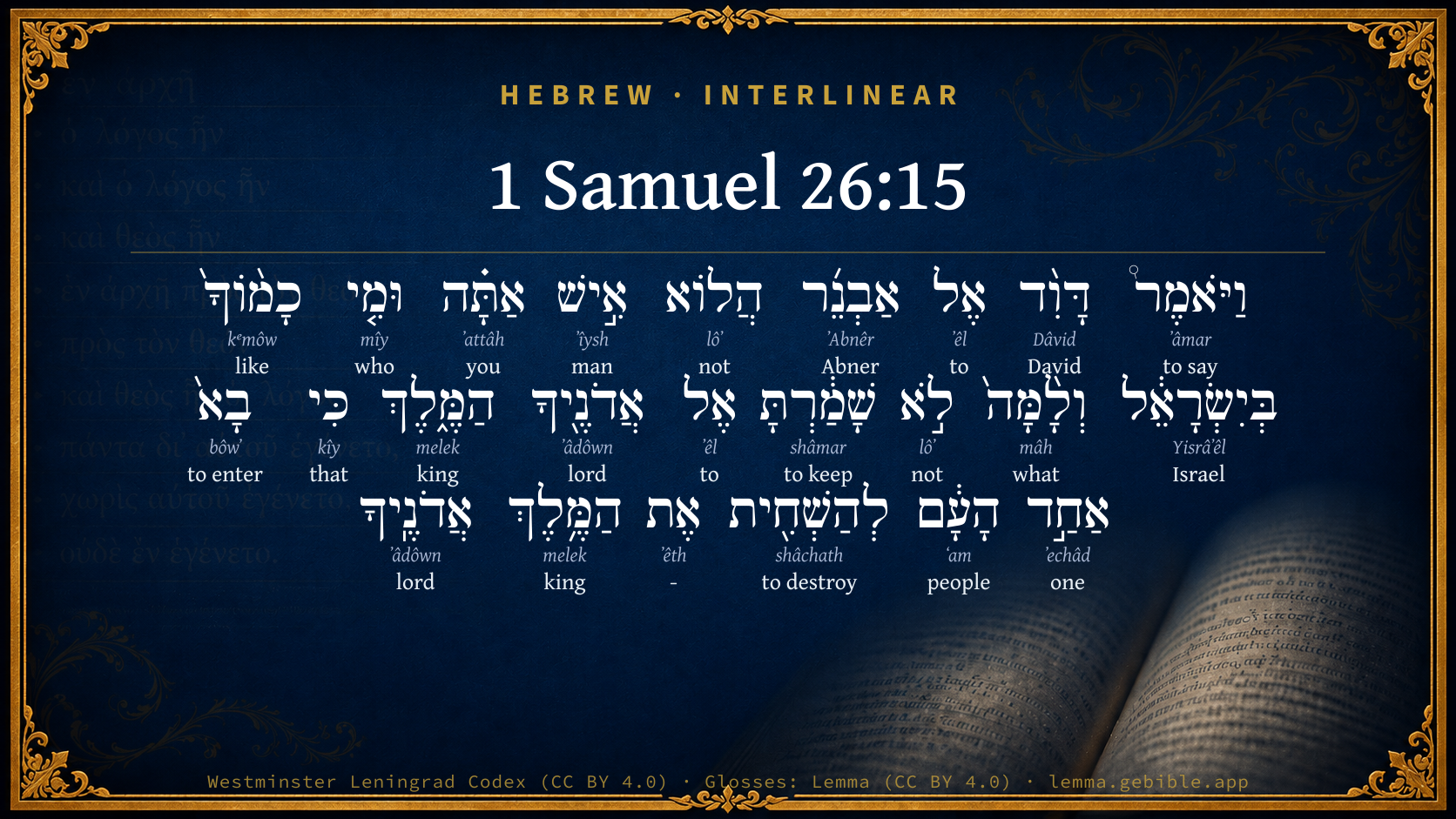
1 Samuel 26:15

Hebrew (Westminster Leningrad Codex) 1 Samuel 26:15 appears in the Hebrew Old Testament. The text above is from the Westminster Leningrad Codex. Each word links to its Strong’s number, a concise gloss, and parsing drawn from the Open Scriptures Hebrew Bible morphology. Click any word for its full Brown-Driver-Briggs (BDB) entry.
Download image
Cite this verse

1 Samuel 26:15 (World English Bible). Public Domain. Lemma interlinear Bible study tool, https://lemma.gebible.app/v/1-samuel/26/15.

Show BibTeX & RIS
BibTeX
RIS
English Translation
David said to Abner, Aren't you a [valiant] man? and who is like you in Israel? why then have you not kept watch over your lord, the king? for there came one of the people in to destroy the king your lord.
World English Bible · Public Domain
Download a study sheet

One document with this verse’s original text, its word-by-word gloss line, the meaning frame, cross-references with their text, attributed commentary, and full source and license credits — printable, and it pastes into notes with its structure intact.

This verse Autodidact and up

Study sheet (.html) Plain text (.txt)

A passage Seminary Student

Up to 50 verses in one chapter. A passage sheet keeps up to 6 commentary sources and 12 cross-references per verse, in the order this page ranks them, and says so on the sheet whenever that leaves anything out. Ask for a single verse and you get the Autodidact verse sheet above.

Everything on this page stays free to read, with no account — the sheet is a download of what is already on screen, not access to it.

Want to remove ads? Support Godless Engineer
Compare translations 3

The same verse in 3 English versions, stacked beneath the original-language interlinear above. Click any original word for its lexicon entry.

Each is an independent rendering of the whole verse — the interlinear is not word-aligned to these translations.

Highlighted words mark where these versions differ — a whole-verse word diff, not a word-by-word alignment.

  • World English Bible Public Domain
    David said to Abner, Aren't you a [valiant] man? and who is like you in Israel? why then have you not kept watch over your lord, the king? for there came one of the people in to destroy the king your lord.
  • King James Version Public Domain
    And David said to Abner, Art not thou a valiant man? and who is like to thee in Israel? wherefore then hast thou not kept thy lord the king? for there came one of the people in to destroy the king thy lord.
  • unfoldingWord Literal Text CC BY-SA 4.0
    And David said to Abner, “ you not a man? And who like you in Israel? So why did you not watch over your master the king? For one of the people came to destroy the king, your master.

unfoldingWord Literal Text — © unfoldingWord, licensed CC BY-SA 4.0. Word-aligned USFM3 via Door43 (git.door43.org/unfoldingWord/en_ult).

Versions to compare (up to 4)

3 of 4 selected

Show all 18 translations

Every available English version of this verse, each an independent rendering of the whole verse.

  • World English Bible Public Domain
    David said to Abner, Aren't you a [valiant] man? and who is like you in Israel? why then have you not kept watch over your lord, the king? for there came one of the people in to destroy the king your lord.
  • Berean Standard Bible Public Domain
    So David said to Abner, “You are a man, aren’t you? And who in Israel is your equal? Why then did you not protect your lord the king when one of the people came to destroy him?
  • Majority Standard Bible Public Domain
    So David said to Abner, “You are a man, aren’t you? And who in Israel is your equal? Why then did you not protect your lord the king when one of the people came to destroy him?
  • King James Version Public Domain
    And David said to Abner, Art not thou a valiant man? and who is like to thee in Israel? wherefore then hast thou not kept thy lord the king? for there came one of the people in to destroy the king thy lord.
  • American Standard Version (1901) Public Domain
    And David said to Abner, Art not thou a `valiant' man? and who is like to thee in Israel? wherefore then hast thou not kept watch over thy lord the king? for there came one of the people in to destroy the king thy lord.
  • Revised Version (1885) Public Domain
    And David said to Abner, Art not thou a valiant man? and who is like thee in Israel? wherefore then hast thou not kept watch over thy lord the king? for there came one of the people in to destroy the king thy lord.
  • Geneva Bible (1599) Public Domain
    And Dauid said to Abner, Art not thou a man? and who is like thee in Israel? wherefore then hast thou not kept thy lorde the King? for there came one of the folke in to destroy the King thy lord.
  • Douay-Rheims (1899) Public Domain
    And David said to Abner: Art not thou a man? and who is like thee in Israel? why then hast thou not kept thy lord the king? for there came one of the people in to kill the king thy lord.
  • Young's Literal Translation Public Domain
    And David saith unto Abner, `Art not thou a man? and who `is' like thee in Israel? but why hast thou not watched over thy lord the king? for one of the people had come in to destroy the king, thy lord.
  • Literal Standard Version CC BY-SA 4.0
    And David says to Abner, “Are you not a man? And who [is] like you in Israel? But why have you not watched over your lord the king? For one of the people had come in to destroy the king, your lord.
  • Unlocked Literal Bible CC BY-SA 4.0
    David said to Abner, “Are not you a courageous man? Who is like you in Israel? Why then have you not kept watch over your master the king? For someone came in to kill the king your master.
  • unfoldingWord Literal Text CC BY-SA 4.0
    And David said to Abner, “ you not a man? And who like you in Israel? So why did you not watch over your master the king? For one of the people came to destroy the king, your master.
  • Darby Bible Public Domain
    And David said to Abner, Art not thou a man? and who is like to thee in Israel? and why hast thou not guarded thy lord the king? for one of the people came in to destroy the king thy lord.
  • World Messianic Bible Public Domain
    David said to Abner, “Aren’t you a man? Who is like you in Israel? Why then have you not kept watch over your lord the king? For one of the people came in to destroy your lord the king.
  • Webster's Bible Public Domain
    And David said to Abner, Art not thou a valiant man? and who is like to thee in Israel? why then hast thou not kept thy lord the king? for there came in one of the people to destroy the king thy lord.
  • Free Bible Version CC BY-SA 4.0
    David called to Abner, “Aren't you meant to be this great man? Is there anyone in Israel who is better than you? So why didn't you protect your master the king when someone came to kill him?
  • Bible in Basic English Public Domain
    And David said to Abner, Are you not a man of war? is there any other like you in Israel? why then have you not kept watch over your lord the king? for one of the people came in to put the king your lord to death.
  • JPS Tanakh (1917) Public Domain
    And David said to Abner: 'Art not thou a valiant man? and who is like to thee in Israel? wherefore then hast thou not kept watch over thy lord the king? for there came one of the people in to destroy the king thy lord.

Literal Standard Version (2020), Covenant Press — licensed CC BY-SA 4.0. Text via the HelloAO Bible API (eBible.org). Unlocked Literal Bible (unfoldingWord) — licensed CC BY-SA 4.0. Text via the HelloAO Bible API (eBible.org). unfoldingWord Literal Text — © unfoldingWord, licensed CC BY-SA 4.0. Word-aligned USFM3 via Door43 (git.door43.org/unfoldingWord/en_ult). Free Bible Version, Dr. Jonathan Gallagher — licensed CC BY-SA 4.0. Text via the HelloAO Bible API (eBible.org).

Word by word

More ways to search: Search by grammar → Find every occurrence → Compare this word →

Practice this passage: Drill this verse → Learn its vocabulary →

אַבְנֵ֜ר
ʼAbnêr
H74
“Abner”
Noun, Proper
Part of Speech
Noun
Type
Proper
Full BDB Definition

Origin: from H1 and H5216

TWOT: None

Abner = "my father is a lamp" - Saul's cousin and army captain, treacherously slain by Joab
  1. וַיֹּאמֶר֩ ʼâmar H559 “and · to say” Conjunction + Verb, Qal, Sequential Imperfect, 3rd Person, Masculine, Singular
  2. דָּוִ֨ד Dâvid H1732 “David” Noun, Proper
  3. אֶל ʼêl H413 “to” Preposition
  4. הֲלוֹא lôʼ H3808 “not” Particle, Interrogative + Particle, Negative
  5. אִ֣ישׁ ʼîysh H376 “man” Noun, Common, Masculine, Singular, Absolute
  6. אַתָּ֗ה ʼattâh H859 “you” Pronoun, Personal, 2nd Person, Masculine, Singular
  7. וּמִ֤י mîy H4310 “and · who” Conjunction + Particle, Interrogative
  8. כָמ֨וֹךָ֙ kᵉmôw H3644 “like · you” Preposition + Suffix, Personal, 2nd Person, Masculine, Singular
  9. בְּיִשְׂרָאֵ֔ל Yisrâʼêl H3478 “in/at · Israel” Preposition + Noun, Proper
  10. וְלָ֨מָּה֙ mâh H4100 “and · to/for · what” Conjunction + Preposition + Particle, Interrogative
  11. לֹ֣א lôʼ H3808 “not” Particle, Negative
  12. שָׁמַ֔רְתָּ shâmar H8104 “to keep” Verb, Qal, Perfect, 2nd Person, Masculine, Singular
  13. אֶל ʼêl H413 “to” Preposition
  14. אֲדֹנֶ֖יךָ ʼâdôwn H113 “lords · your” Noun, Common, Masculine, Plural, Construct + Suffix, Personal, 2nd Person, Masculine, Singular
  15. הַמֶּ֑לֶךְ melek H4428 “the · king” Particle, Definite Article + Noun, Common, Masculine, Singular, Absolute
  16. כִּי kîy H3588 “that” Conjunction
  17. בָא֙ bôwʼ H935 “to enter” Verb, Qal, Perfect, 3rd Person, Masculine, Singular
  18. אַחַ֣ד ʼechâd H259 “one” Adjective, Cardinal number, Masculine, Singular, Absolute
  19. הָעָ֔ם ʻam H5971 “the · people” Particle, Definite Article + Noun, Common, Masculine, Singular, Absolute
  20. לְהַשְׁחִ֖ית shâchath H7843 “to destroy” Preposition + Verb, Hiphil, Infinitive Construct
  21. אֶת ʼêth H853 “-” Particle, Direct Object
  22. הַמֶּ֥לֶךְ melek H4428 “the · king” Particle, Definite Article + Noun, Common, Masculine, Singular, Absolute
  23. אֲדֹנֶֽיךָ ʼâdôwn H113 “lords · your” Noun, Common, Masculine, Plural, Construct + Suffix, Personal, 2nd Person, Masculine, Singular

About this verse

These counts appear in no published source. They are computed here, from the morphology-tagged text and Lemma’s own curated glosses. What Lemma adds →

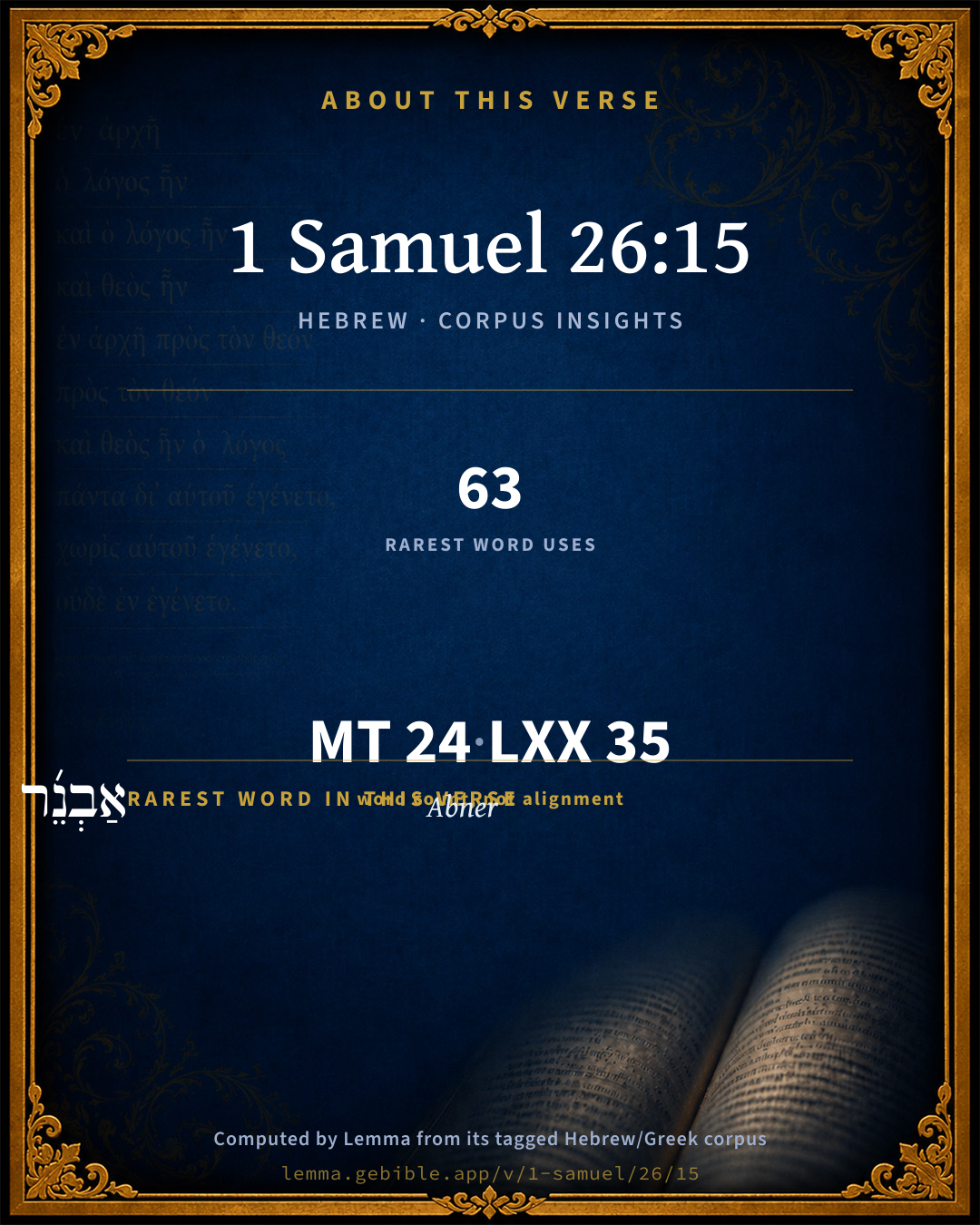
24
words
20
distinct lemmas
Historical
section

Grammatical profile

  • 4 verbs
  • 9 nouns
  • 1 adjective
  • 1 pronoun
  • 3 prepositions
  • 1 conjunction
  • 5 particles

Verb forms

  • וַיֹּאמֶר֩ Qal · Sequential Imperfect
  • שָׁמַ֔רְתָּ Qal · Perfect
  • בָא֙ Qal · Perfect
  • לְהַשְׁחִ֖ית Hiphil · Infinitive Construct

Repetition

Words recur within this verse — often emphatic in Hebrew:

  • אֲדֹנֶ֖יךָ lord H113 ×2
  • הַמֶּ֑לֶךְ king H4428 ×2
  • אֶל to H413 ×2
  • הֲלוֹא not H3808 ×2

Hebrew & Septuagint length

In English translation the verse runs 42 words from the Hebrew and 41 from the Septuagint (LXX English) — closely comparable.

A rough comparison of the two English renderings, which tokenize alike — not a word-level alignment.

Word counts can differ between the Hebrew and the Greek without any difference in meaning — e.g. the Hebrew direct-object marker אֵת has no separate Greek word, and Greek often adds the article ὁ.

In the original languages it is 24 Hebrew tokens and 35 Greek tokens — but the two are counted differently (Hebrew bundles its prefixes and suffixes into one token; the Greek is in lemma form), so that isn’t a like-for-like length.

Hebrew and Greek witnesses Masoretic Hebrew ↔ Greek Septuagint

The same verse in the two great witnesses to the Old Testament, shown verse-for-verse.

These are two independent witnesses, not word-aligned to each other, and the Septuagint is shown in lemma (dictionary) form.

Hebrew 1 Samuel 26:15 Masoretic · Westminster Leningrad Codex

וַיֹּאמֶר֩ דָּוִ֨ד אֶל אַבְנֵ֜ר הֲלוֹא אִ֣ישׁ אַתָּ֗ה וּמִ֤י כָמ֨וֹךָ֙ בְּיִשְׂרָאֵ֔ל וְלָ֨מָּה֙ לֹ֣א שָׁמַ֔רְתָּ אֶל אֲדֹנֶ֖יךָ הַמֶּ֑לֶךְ כִּי בָא֙ אַחַ֣ד הָעָ֔ם לְהַשְׁחִ֖ית אֶת הַמֶּ֥לֶךְ אֲדֹנֶֽיךָ

David said to Abner, Aren't you a [valiant] man? and who is like you in Israel? why then have you not kept watch over your lord, the king? for there came one of the people in to destroy the king your lord.

World English Bible · Public Domain

Greek LXX 1 Samuel 26:15 Septuagint · lemma form

καί εἶπον δαυίδ πρός αβεννηρ οὐ ἀνήρ σύ καί τίς ὡς σύ ἐν ἰσραήλ καί διά τίς οὐ φυλάσσω ὁ κύριος σύ ὁ βασιλεύς ὅτι εἰςἔρχομαι εἷς ἐκ ὁ λαός διαφθείρω ὁ βασιλεύς κύριος σύ

And David said to Abenner, Are not you a man? and who is like you in Israel? Why then do you not guard your lord the king? for one out of the people went in to destroy your lord the king.

LXX2012 (modern English Septuagint) · Public Domain

Hebrew: Westminster Leningrad Codex (CC BY 4.0). Greek: Septuagint (public domain); English from LXX2012 (modern English Septuagint) (Public Domain). How the Septuagint differs from the Hebrew →

Targum (Aramaic paraphrase)

1

The Targum is the ancient Jewish Aramaic paraphrase of the Hebrew Scriptures — an interpretive translation, not the Hebrew text itself. Onkelos (literal) and Pseudo-Jonathan (expansive) render the Torah, and Jonathan the Prophets. Coverage is partial: where no permissively-licensed English translation exists for a verse, only the Aramaic is shown. This is verse-level text, not a word-by-word alignment to the Hebrew.

  1. Targum Jonathan Prophets (Joshua–Malachi)
    וַאֲמַר דָוִד לְאַבְנֵר הֲלָא גְבַר גִבַּר אַתְּ וּמַן כְּוָתָךְ בְּיִשְׂרָאֵל וּלְמָא לָא נְטַרְתָּא עַל רִבּוֹנָךְ מַלְכָּא אֲרֵי אֲתָא חַד מִן עַמָא לְחַבָּלָא יַת מַלְכָּא רִבּוֹנָךְ:

    (no public-domain English translation for this verse)

    Targum Jonathan — Aramaic: “Mikraot Gedolot” (public domain). English: “Sefaria Community Translation” (CC0 1.0 (public-domain dedication)); “London "Chaldee Paraphrase," 1871” (public domain). Text via Sefaria.

Commentary

Notes on 1 Samuel 26:15 from classic Christian and Jewish commentators (each source and its license shown beneath its notes). The classic Christian expositions comment on the surrounding passage and are grouped to its opening verse, so a note may address several verses; the Jewish commentaries on the Tanakh (Rashi and others) are per-verse, so they appear only where the commentator wrote on this verse.

Lemma curates 59 commentaries, every one of them public domain or Creative Commons licensed, each selected and text-cleaned for this edition rather than reprinted as found. About our sources →

Trapp's Complete Commentary

John Trapp

1Sa 26:15 And David said to Abner, [Art] not thou a [valiant] man? and who [is] like to thee in Israel? wherefore then hast thou not kept thy lord the king? for there came one of the people in to destroy the king thy lord.

Ver. 15. Art not thou a valiant man?] Heb., A man, that is, a man every inch of thee? and hast thou not played the man in guarding thy sovereign so carefully? If Philip sleep, should not Antipater watch the while? Lilloe slept between the murderer and King Edwin his master, to intercept the deadly thrust intended and aimed at the heart of his sovereign. {a}

{a} Speed.

John Trapp, A Commentary or Exposition upon All the Books of the Old and New Testament (1647–1656) — public domain. Text from a community e-Sword module.

Joseph Benson's Commentary

1Sa 26:15-17. Wherefore hast thou not kept, &c. — Observed better military discipline for the preservation of the king’s person? There came one of the people — Into the king’s camp, and had a fair opportunity to destroy him. Because ye have not kept your master — Guarded him better from any danger. It is probable they despised David’s small forces, and, therefore, were so negligent. It is my voice, my lord, O king — He still acknowledges Saul’s authority, and the allegiance he owed him, though he had done him so many injuries.

Joseph Benson's Commentary on the Old and New Testaments (1811–1818) — public domain. Text from a community e-Sword module.

Geneva Bible (1599)

Geneva Bible translators

Esteemed most valiant and meet to save the King?

Geneva Bible (1599) marginal notes — public domain. Text via Bolls.life.

Jamieson, Fausset & Brown

Robert Jamieson, A. R. Fausset & David Brown

David said to Abner, Art not thou a valiant man: . . . wherefore then hast thou not kept thy lord the king?--The circumstance of David having penetrated to the center of the encampment, through the circular rows of the sleeping soldiers, constituted the point of this sarcastic taunt. This new evidence of David's moderation and magnanimous forbearance, together with his earnest and kindly expostulation, softened the obduracy of Saul's heart.

Jamieson, Fausset & Brown — Commentary Critical and Explanatory on the Whole Bible (1871) — public domain (CC PDM 1.0). Text via the HelloAO Bible API.

Adam Clarke's Commentary

Verse 15. Art not thou a valiant man?] This is a strong irony. Ye are worthy to die; ye are sons of death - ye deserve death for this neglect of your king. And had not Saul been so deeply affected with David's generosity in preserving his life, he had doubtless put Abner and his chief officers to death; though they were not to blame, as their apparent neglect was the effect of a supernatural sleep.

Adam Clarke's Commentary on the Bible (1810–1826) — public domain. Text from a community e-Sword/MySword module.

Ellicott's Commentary for English Readers

(15) A valiant man.—The English translators have rightly emphasised the Hebrew ish here by rendering a “valiant” man. Ish was used not unfrequently in this “nobler” sense; so in Psa_49:2, when the b’ne adam, as “the poor mean ones,” were contrasted with the b’ne ish, “the noble ones.” (See also Isa_2:9 : “mean men and great men.”)

Wherefore then hast thou not kept?—The whole of this bitter sarcastic address seems to imply that a deadly feud existed between David and Saul’s captain and kinsman, Abner. If this be the case, the royal generosity and nobility of David’s character was well shown in his subsequent friendship with this Abner, and in his deep sorrow for the great captain’s untimely death. (See 2 Samuel 3)

A Bible Commentary for English Readers, edited by Charles John Ellicott (1878–1897) — public domain. Text from a community e-Sword module.

The Cambridge Bible for Schools and Colleges

gen. ed. J. J. S. Perowne

15. a [valiant] man] Heb. simply, a man, i.e. one worthy of the name.

who is like to thee in Israel] Abner was evidently the most powerful man in Saul’s court. His course of action after Saul’s death shews plainly the influence he had gained.

kept] i.e. kept guard over.

The Cambridge Bible for Schools and Colleges (gen. ed. J. J. S. Perowne; Cambridge University Press, 1878–1918) — public domain. Text from a community e-Sword module.

John Gill's Exposition

And David said to Abner, art not thou a valiant man?.... Or a man (u), a man of great fame for courage and valour, a man of great authority, who had the next post in the army under Saul, but had not behaved like a man, worthy of his character and office:

and who is like to thee in Israel? none that bare so great a name, or was in so high an office, who therefore should have been careful to have acted according to both:

wherefore then hast thou not kept thy lord the king? took care to have set a guard about his person while he slept; which perhaps was neglected through a contempt of David and his men, as being in no fear of them:

for there came one of the people in to destroy the king thy lord; that is, there had been one in the camp that night, who had entered there with that view to have destroyed him, had he an opportunity, and which did offer; this was true of Abishai, who no doubt went down with David into the camp with that intent, though David did not, and therefore he says, "one of the people", not more; for though two went in, only one with that view: David observes to them the danger the king was in, his carefulness of him to preserve his life, to whom only it was owing, and the negligence of Abner, and those under his command.

(u) "vir", V. L. Pagninus, Montanus, Tigurine version, Piscator.

John Gill's Exposition of the Whole Bible (1746–1763) — public domain (CC PDM 1.0). Text via the HelloAO Bible API.

Albert Barnes' Notes on the Bible

This incidental testimony to Abner’s great eminence as a warrior is fully borne out by David’s dirge at Abner’s death 2Sa 3:31-34, 2Sa 3:38, as well as by his whole history. At the same time David’s bantering tone in regard to Abner, coupled with what he says in 1Sa 26:19, makes it proable that David attributed Saul’s persecution of him in some degree to Abner. Abner would be likely to dread a rival in the young conqueror of Judah (compare 2Sa 2:8).

Albert Barnes' Notes on the Bible (1834–1885) — public domain. Text from a community e-Sword/MySword module.

Haydock's Catholic Bible Commentary

Israel. This was a cutting irony. (Calmet) --- Salien attributes to it the enmity which Abner bore to David for above seven years. (Menochius)

George Leo Haydock (1774–1849), Haydock's Catholic Family Bible and Commentary, 1859 edition — public domain. Excludes Psalms (Douay-Rheims chapter numbering differs from Protestant) and Deuterocanonical books (Catholic canon only).

Matthew Poole's English Annotations

Who is like to thee, for courage and conduct? and therefore thy fault herein is the greater.

Matthew Poole's English Annotations on the Holy Bible (1683–1685) — public domain. Text from a community e-Sword/MySword module.

unfoldingWord translationNotes

Door43 World Missions Community

Are not you a courageous man?

David uses a question to rebuke Abner for not guarding Saul. AT: "You are a very brave man." (See: Rhetorical Question)

Who is like you in Israel?

David uses a question to rebuke Abner for not guarding Saul. AT: "You are the greatest soldier in Israel." (See: Rhetorical Question)

Why then have you not kept watch over your master the king?

Possible meanings are 1) this is a real question and David wants Abner to answer him or 2) this is a rhetorical question and David is rebuking Abner. AT: "Therefore you should have kept watch over your master the king!" (See: Rhetorical Question)

translationWords

David

Israel

lord

king

Yahweh

life

die

anoint

spear

unfoldingWord translationNotes — © Distant Shores Media and the Door43 World Missions Community, licensed CC BY-SA 4.0. Source: git.door43.org/Door43/en_tn.

Lesson kit

Teaching starters — assembled from the data on this page, not authored interpretation. Every prompt links to the verse data it draws on. Edit before teaching.

1 Samuel, in the Historical, opens this verse with 24 words (20 distinct Hebrew lemmas). Its most distinctive word is ʼAbnêr (“Abner”). A historical commentator’s framing appears above. Read the whole chapter for the surrounding context.

Discussion questions

  1. How does “Abner” (ʼAbnêr) shape what this verse is saying?
  2. “lord” occurs 2× in this one verse. What is the effect of the repetition?
  3. The translations on this page render this verse differently — a whole-verse word diff, not a word-by-word alignment. What might account for the different wordings?
  4. The verb «וַיֹּאמֶר֩» is Qal Sequential Imperfect. How does its form color the action?
  5. Reading how Trapp's Complete Commentary and Joseph Benson's Commentary read this verse, where do the two commentators agree and where do they part?

Things to notice

Reading settings

Reading text

Shown beneath each verse's original-language words.

Old Testament
Old Testament edition

Read the OT as the Masoretic Hebrew (MT) or the Greek Septuagint (LXX).

English shown for the Greek Septuagint (in the Hebrew ↔ Greek comparison).

Comparing translations? Open the Compare panel on any verse page to stack up to four side by side.