Isaiah 46:9

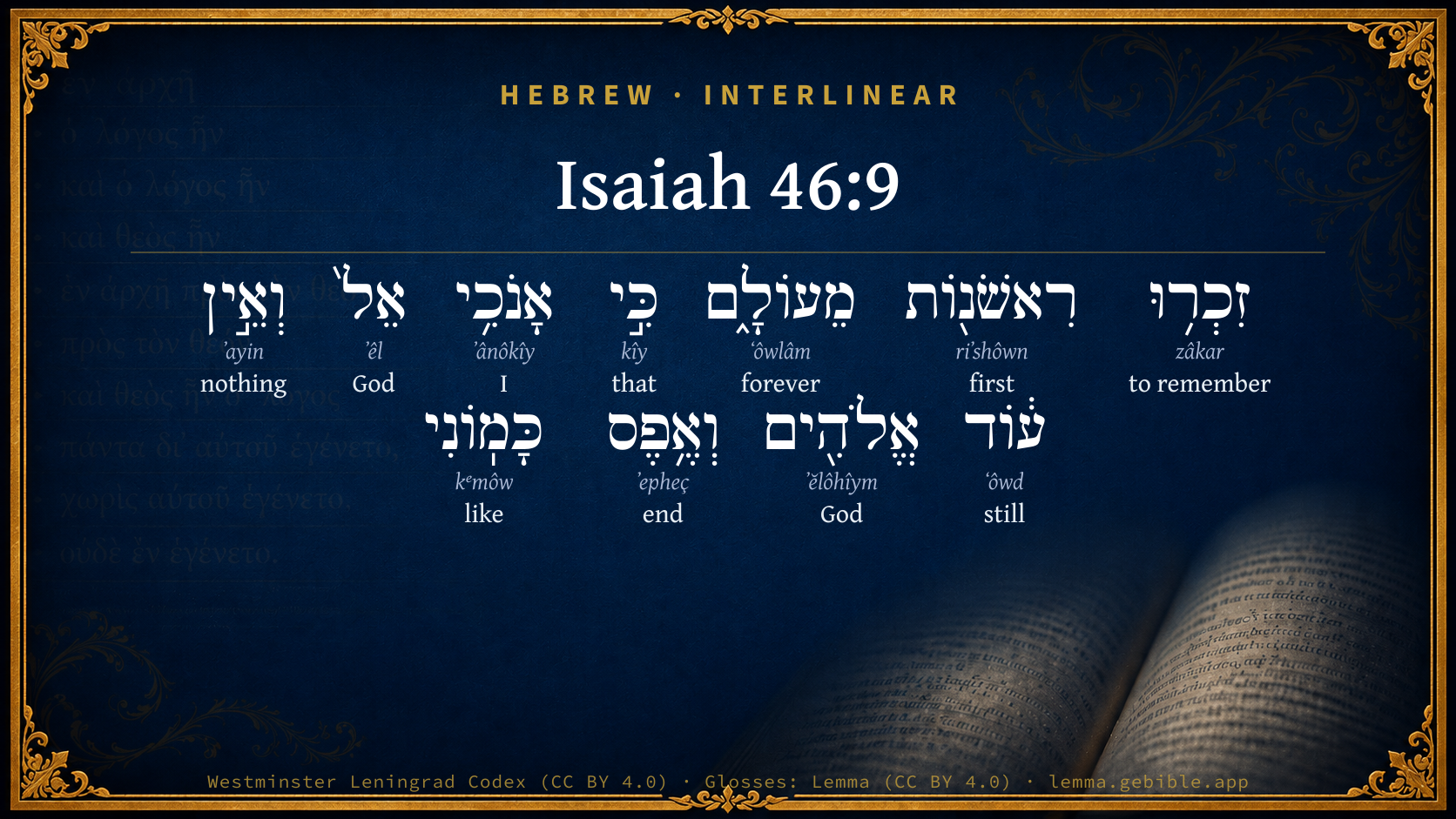
Hebrew (Westminster Leningrad Codex) Isaiah 46:9 appears in the Hebrew Old Testament. The text above is from the Westminster Leningrad Codex. Each word links to its Strong’s number, a concise gloss, and parsing drawn from the Open Scriptures Hebrew Bible morphology. Click any word for its full Brown-Driver-Briggs (BDB) entry.
Download image
Cite this verse

Isaiah 46:9 (World English Bible). Public Domain. Lemma interlinear Bible study tool, https://lemma.gebible.app/v/isaiah/46/9.

Show BibTeX & RIS
BibTeX
RIS
English Translation
Remember the former things of old: for I am God, and there is none else; [I am] God, and there is none like me;
World English Bible · Public Domain
Download a study sheet

One document with this verse’s original text, its word-by-word gloss line, the meaning frame, cross-references with their text, attributed commentary, and full source and license credits — printable, and it pastes into notes with its structure intact.

This verse Autodidact and up

Study sheet (.html) Plain text (.txt)

A passage Seminary Student

Up to 50 verses in one chapter. A passage sheet keeps up to 6 commentary sources and 12 cross-references per verse, in the order this page ranks them, and says so on the sheet whenever that leaves anything out. Ask for a single verse and you get the Autodidact verse sheet above.

Everything on this page stays free to read, with no account — the sheet is a download of what is already on screen, not access to it.

Want to remove ads? Support Godless Engineer
Compare translations 3

The same verse in 3 English versions, stacked beneath the original-language interlinear above. Click any original word for its lexicon entry.

Each is an independent rendering of the whole verse — the interlinear is not word-aligned to these translations.

Highlighted words mark where these versions differ — a whole-verse word diff, not a word-by-word alignment.

  • World English Bible Public Domain
    Remember the former things of old: for I am God, and there is none else; [I am] God, and there is none like me;
  • King James Version Public Domain
    Remember the former things of old: for I am God, and there is none else; I am God, and there is none like me,
  • unfoldingWord Literal Text CC BY-SA 4.0
    Remember the former from eternity, for I God, and there is no other; God, and none like me,

unfoldingWord Literal Text — © unfoldingWord, licensed CC BY-SA 4.0. Word-aligned USFM3 via Door43 (git.door43.org/unfoldingWord/en_ult).

Versions to compare (up to 4)

3 of 4 selected

Show all 18 translations

Every available English version of this verse, each an independent rendering of the whole verse.

  • World English Bible Public Domain
    Remember the former things of old: for I am God, and there is none else; [I am] God, and there is none like me;
  • Berean Standard Bible Public Domain
    Remember what happened long ago, for I am God, and there is no other; I am God, and there is none like Me.
  • Majority Standard Bible Public Domain
    Remember what happened long ago, for I am God, and there is no other; I am God, and there is none like Me.
  • King James Version Public Domain
    Remember the former things of old: for I am God, and there is none else; I am God, and there is none like me,
  • American Standard Version (1901) Public Domain
    Remember the former things of old: for I am God, and there is none else; `I am' God, and there is none like me;
  • Revised Version (1885) Public Domain
    Remember the former things of old: for I am God, and there is none else; I am God, and there is none like me;
  • Geneva Bible (1599) Public Domain
    Remember the former things of old: for I am God, and there is none other God, and there is nothing like me,
  • Douay-Rheims (1899) Public Domain
    Remember the former age, for I am God, and there is no God beside, neither is there the like to me:
  • Young's Literal Translation Public Domain
    Remember former things of old, For I `am' Mighty, and there is none else, God -- and there is none like Me.
  • Literal Standard Version CC BY-SA 4.0
    Remember former things of old, || For I [am] Mighty, and there is none else, || God—and there is none like Me.
  • Unlocked Literal Bible CC BY-SA 4.0
    Think about the earlier things, those of times past, for I am God, and there is no other, I am God, and there is no one like me.
  • unfoldingWord Literal Text CC BY-SA 4.0
    Remember the former from eternity, for I God, and there is no other; God, and none like me,
  • Darby Bible Public Domain
    Remember the former things of old; for I [am] ùGod, and there is none else; [I am] God, and there is none like me;
  • World Messianic Bible Public Domain
    Remember the former things of old; for I am God, and there is no other. I am God, and there is none like me.
  • Webster's Bible Public Domain
    Remember the former things of old: for I am God, and there is none else; I am God, and there is none like me,
  • Free Bible Version CC BY-SA 4.0
    Remember what I've done for you since the beginning, for I am God, and there is no God apart from me. I am God, and there is none like me.
  • Bible in Basic English Public Domain
    Let the things which are past come to your memory: for I am God, and there is no other; I am God, and there is no one like me;
  • JPS Tanakh (1917) Public Domain
    Remember the former things of old: that I am God, and there is none else; I am God, and there is none like Me;

Literal Standard Version (2020), Covenant Press — licensed CC BY-SA 4.0. Text via the HelloAO Bible API (eBible.org). Unlocked Literal Bible (unfoldingWord) — licensed CC BY-SA 4.0. Text via the HelloAO Bible API (eBible.org). unfoldingWord Literal Text — © unfoldingWord, licensed CC BY-SA 4.0. Word-aligned USFM3 via Door43 (git.door43.org/unfoldingWord/en_ult). Free Bible Version, Dr. Jonathan Gallagher — licensed CC BY-SA 4.0. Text via the HelloAO Bible API (eBible.org).

Word by word

More ways to search: Search by grammar → Find every occurrence → Compare this word →

Practice this passage: Drill this verse → Learn its vocabulary →

וְאֶ֥פֶס
ʼepheç
H657
“and · end”
Conjunction + Noun, Common, Masculine, Singular, Absolute
Part of Speech
Conjunction + Noun
Type
Common
Gender
Masculine
Number
Singular
State
Absolute
Full BDB Definition

Origin: from H656

TWOT: 147a

ceasing, end, finality
  1. זִכְר֥וּ zâkar H2142 “remember” Verb, Qal, Imperative, 2nd Person, Masculine, Plural
  2. רִאשֹׁנ֖וֹת riʼshôwn H7223 “first” Adjective, Adjective, Feminine, Plural, Absolute
  3. מֵעוֹלָ֑ם ʻôwlâm H5769 “from · forever” Preposition + Noun, Common, Masculine, Singular, Absolute
  4. כִּ֣י kîy H3588 “that” Conjunction
  5. אָנֹכִ֥י ʼânôkîy H595 “I” Pronoun, Personal, 1st Person, Common, Singular
  6. אֵל֙ ʼêl H410 “God” Noun, Common, Masculine, Singular, Absolute
  7. וְאֵ֣ין ʼayin H369 “and · nothing” Conjunction + Particle, Negative
  8. ע֔וֹד ʻôwd H5750 “still” Adverb
  9. אֱלֹהִ֖ים ʼĕlôhîym H430 “God(s)” Noun, Common, Masculine, Plural, Absolute
  10. כָּמֽוֹנִי kᵉmôw H3644 “like · me” Preposition + Suffix, Personal, 1st Person, Common, Singular

About this verse

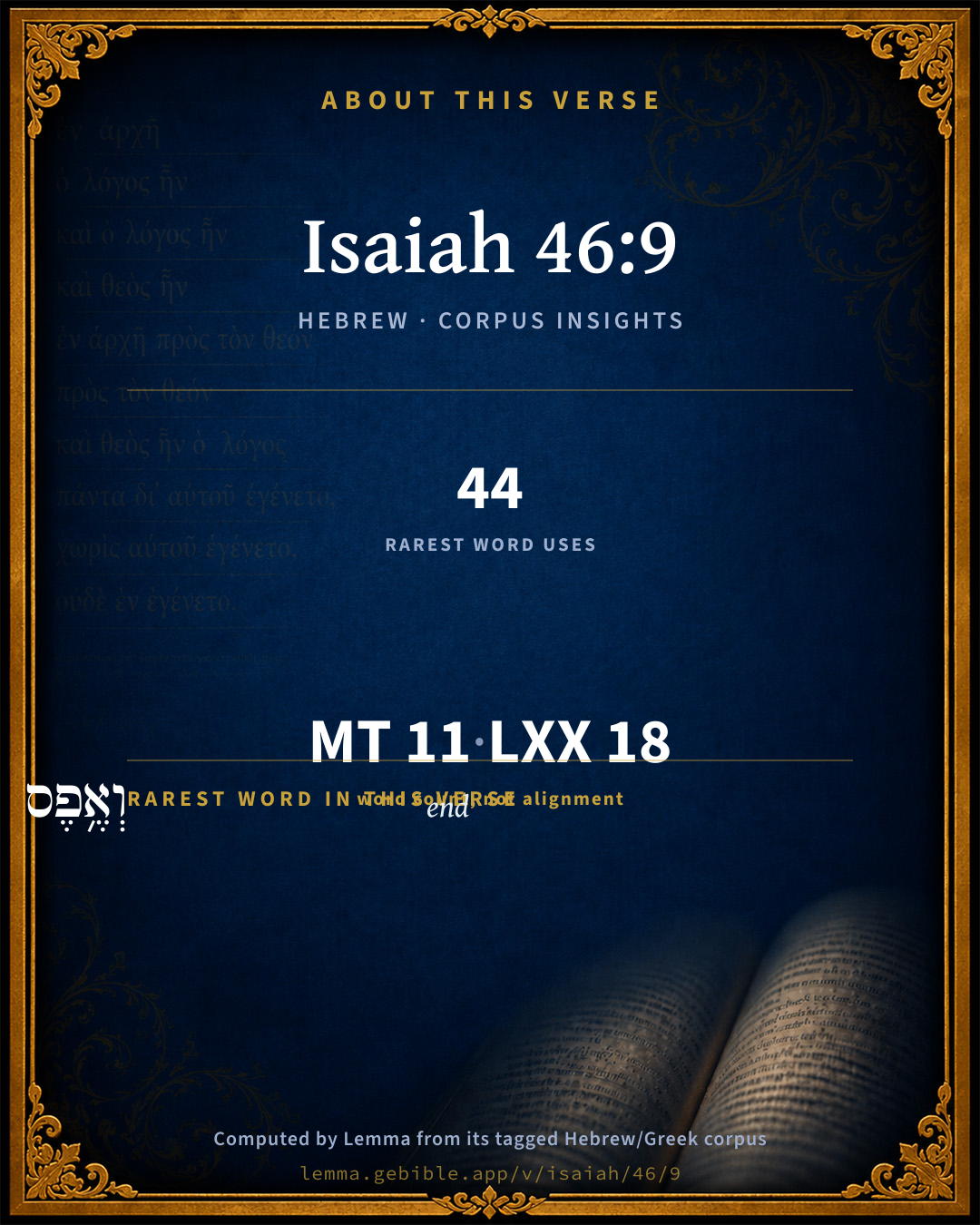
These counts appear in no published source. They are computed here, from the morphology-tagged text and Lemma’s own curated glosses. What Lemma adds →

11
words
11
distinct lemmas
Prophets
section

Shared distinctive vocabulary

וְאֶ֥פֶס end H657 occurs in 43 verses of the Hebrew Bible. Also found in:

Grammatical profile

  • 1 verb
  • 4 nouns
  • 1 adjective
  • 1 pronoun
  • 1 preposition
  • 1 conjunction
  • 1 adverb
  • 1 particle

Verb forms

  • זִכְר֥וּ Qal · Imperative

Hebrew & Septuagint length

In English translation the verse runs 24 words from the Hebrew and 20 from the Septuagint (LXX English) — closely comparable.

A rough comparison of the two English renderings, which tokenize alike — not a word-level alignment.

Word counts can differ between the Hebrew and the Greek without any difference in meaning — e.g. the Hebrew direct-object marker אֵת has no separate Greek word, and Greek often adds the article ὁ.

In the original languages it is 11 Hebrew tokens and 18 Greek tokens — but the two are counted differently (Hebrew bundles its prefixes and suffixes into one token; the Greek is in lemma form), so that isn’t a like-for-like length.

Cross-references

14

Topical passages linked to Isaiah 46:9 in the Treasury of Scripture Knowledge — connected by theme and wording, ordered by reader-vote popularity; previews shown in the World English Bible.

  • Isaiah 45:21–22 Declare you, and bring [it] forth; yes, let them take counsel together: who has shown this from ancient time? who has declared it of old? Haven't I, Yahweh? and there is no God else besides me, a just God and a Savior; there is no one besides me.
  • Isaiah 42:9 Behold, the former things have happened, and new things do I declare. Before they spring forth I tell you of them.
  • Psalms 111:4 He has caused his wonderful works to be remembered. Yahweh is gracious and merciful.
  • Isaiah 46:5 To whom will you liken me, and make me equal, and compare me, that we may be like?
  • Deuteronomy 33:26 There is none like God, Jeshurun, Who rides on the heavens for your help, In his excellency on the skies.
  • Deuteronomy 32:7 Remember the days of old, Consider the years of many generations: Ask your father, and he will show you; Your elders, and they will tell you.
  • Isaiah 45:18 For thus says Yahweh who created the heavens, the God who formed the earth and made it, who established it and didn't create it a waste, who formed it to be inhabited: I am Yahweh; and there is no one else.
  • Isaiah 65:17 For, behold, I create new heavens and a new earth; and the former things shall not be remembered, nor come into mind.
  • Nehemiah 9:7–37 You are Yahweh the God, who did choose Abram, and brought him forth out of Ur of the Chaldees, and gave him the name of Abraham,
  • Isaiah 45:5–6 I am Yahweh, and there is none else; besides me there is no God. I will gird you, though you have not known me;
  • Jeremiah 23:7–8 Therefore, behold, the days come, says Yahweh, that they shall no more say, As Yahweh lives, who brought up the children of Israel out of the land of Egypt;
  • Isaiah 45:14 Thus says Yahweh: "The labor of Egypt, and the merchandise of Ethiopia, and the Sabeans, men of stature, shall come over to you, and they shall be yours. They shall go after you. In chains they shall come over; and they shall fall down to you. They shall make supplication to you: 'Surely God is in you; and there is none else, there is no other god.
  • Daniel 9:6–15 neither have we listened to your servants the prophets, who spoke in your name to our kings, our princes, and our fathers, and to all the people of the land.
  • Psalms 105:1–45 Give thanks to Yahweh! Call on his name! Make his doings known among the peoples.

Cross-references courtesy of OpenBible.info (CC BY 4.0).

Hebrew and Greek witnesses Masoretic Hebrew ↔ Greek Septuagint

The same verse in the two great witnesses to the Old Testament, shown verse-for-verse.

These are two independent witnesses, not word-aligned to each other, and the Septuagint is shown in lemma (dictionary) form.

Hebrew Isaiah 46:9 Masoretic · Westminster Leningrad Codex

זִכְר֥וּ רִאשֹׁנ֖וֹת מֵעוֹלָ֑ם כִּ֣י אָנֹכִ֥י אֵל֙ וְאֵ֣ין ע֔וֹד אֱלֹהִ֖ים וְאֶ֥פֶס כָּמֽוֹנִי

Remember the former things of old: for I am God, and there is none else; [I am] God, and there is none like me;

World English Bible · Public Domain

Greek LXX Isaiah 46:9 Septuagint · lemma form

καί μιμνήσκω ὁ πρότερος ἀπό ὁ αἰών ὅτι ἐγώ εἰμί ὁ θεός καί οὐ εἰμί ἔτι πλήν ἐγώ

and remember the former things that were of old: for I am God, and there is none other beside me,

LXX2012 (modern English Septuagint) · Public Domain

Hebrew: Westminster Leningrad Codex (CC BY 4.0). Greek: Septuagint (public domain); English from LXX2012 (modern English Septuagint) (Public Domain). How the Septuagint differs from the Hebrew →

Targum (Aramaic paraphrase)

1

The Targum is the ancient Jewish Aramaic paraphrase of the Hebrew Scriptures — an interpretive translation, not the Hebrew text itself. Onkelos (literal) and Pseudo-Jonathan (expansive) render the Torah, and Jonathan the Prophets. Coverage is partial: where no permissively-licensed English translation exists for a verse, only the Aramaic is shown. This is verse-level text, not a word-by-word alignment to the Hebrew.

  1. Targum Jonathan Prophets (Joshua–Malachi)
    אִדְכַּרוּ קַדְמְיָתָא דְמִן עַלְמָא אֲרֵי אֲנָא אֱלָהּ וְלֵית עוֹד אֱלָהּ בַּר מִינִי:

    Remember the former things of old; for I am God, and there is no God whatever besides me,

    Targum Jonathan — Aramaic: “Mikraot Gedolot” (public domain). English: “Sefaria Community Translation” (CC0 1.0 (public-domain dedication)); “London "Chaldee Paraphrase," 1871” (public domain). Text via Sefaria.

Commentary

Notes on Isaiah 46:9 from classic Christian and Jewish commentators (each source and its license shown beneath its notes). The classic Christian expositions comment on the surrounding passage and are grouped to its opening verse, so a note may address several verses; the Jewish commentaries on the Tanakh (Rashi and others) are per-verse, so they appear only where the commentator wrote on this verse.

Lemma curates 59 commentaries, every one of them public domain or Creative Commons licensed, each selected and text-cleaned for this edition rather than reprinted as found. About our sources →

Trapp's Complete Commentary

John Trapp

Isa 46:9 Remember the former things of old: for I [am] God, and [there is] none else; [I am] God, and [there is] none like me,

Ver. 9. Remember the former things of old.] Again he calleth upon them to remember who had so foully forgot themselves in the days of Ahaz and Manasseh, and would do so again in Babylon, where they kept not themselves from idols. Papists unman themselves, or otherwise they could not be such gross idolaters.

John Trapp, A Commentary or Exposition upon All the Books of the Old and New Testament (1647–1656) — public domain. Text from a community e-Sword module.

The Biblical Illustrator

Joseph S. Exell

Isa_46:9-11

Remember the former things of old

The purposes of God

I.

When we come to look at THE PURPOSES OF GOD, we must not be misled by words. The word purpose, with us, supposes several things, which have nothing to do with the same term when applied to God. There is, with God, no ignorance previously to the formation of His purposes; no new light thrown on circumstances, out of which His purpose arises; no period in His past eternity, when His purposes were not formed; no consulting either with Himself or with others, with regard to their formation. Perhaps you may be ready to say, if we are to look at the purpose of God in this way, it is not a purpose at all, in the sense in which we use the term. And it certainly is not, as you will perceive. We accommodate human language to the infinite characteristics of the Divine nature; but we must do it with caution, and must be careful what measure of idea we associate with our common terms, when we are applying them to God. If not, we shall be deceived in the conclusions we draw and the doctrines we believe. If the purpose of God is to be viewed as it really is, we take it to be simply this: Gods foreknowledge of everything that is to come to pass, together with the operation of His influence upon that foreknowledge, in connection with those things. His foreknowledge had no beginning; His resolution, as to what He was to do, could have no beginning. From the moment He foresaw, He resolved or purposed. Such appears to be the meaning of the word purpose as applied to God. If it should be said, This is a view of purpose altogether foreign from the view we take of it, we grant it. But why? Because the nature of God is altogether foreign from ours. Ours is a finite and limited nature in itself; His is infinite and unlimited.

II. THE APPLICATION OF GODS PURPOSE IN REFERENCE TO MAN.

1. Are we to regard the purposes of God as involving in them the charge of originating immorality and sin? Did God purpose that man should be a sinner? If His purposes are to be taken and explained, as we take and explain our own, then this was the case. If He foresaw that man would fall before He made him, yet had not determined whether He should permit this or not, and then permitted it, we should say that the purpose of God implies in it a part at least of the moral guilt of His creature. But He had formed no such purpose as this. He foresaw that man would fall; He foresaw the provision that was to be made for his case; but there was no period in eternity when He had not foreseen this, and hence no purpose arose out of the mere incident of the liability of man to fall. He was left to the working of those powers which God gave him: and with the working of those powers the purposes of God never interfered.

2. But if we look not merely to the connection between the purpose of God and the origin of evil, but also to the connection between the purpose of God and the free agency of man, we have another field opened to us, in examining which we must very carefully recollect the views that we have taken of the Divine purpose. When God created man, He gave him powers and faculties which He intended to commit to his trust, and which He aid commit to his trust. He foresaw what use he would make of them, and how far he would abuse them; but He did not destroy them, in order that they might not be abused. There is an entire freedom in the operation of our faculties, so far as our own consciousness is concerned; are they not also exhibited to us as free, in the Word of God? Are we not addressed upon the subject of our shortcomings and our sins, as if we were held strictly free by the God that addresses us? Are we not hailed to return from our iniquity, as if we were free to return? Are we not invited to lay hold on the hope set before us in the Gospel, as if we were free to accept the invitation? Let us look next at the view that men take of our capacity; and we shall find, that except when they are induced to quarrel with the Word of God, except when they are induced to throw difficulties in the way of their own salvation, they too act upon the principle that man is free.

3. But let us look at the purpose of God in reference to mans responsibility. If man were not free, on what ground could he be held to be responsible? and does any one doubt of his responsibility to God? The responsibility of man arises out of the very nature of his faculties, just like the proof of his free agency in the use of them. And we find the Word of God harmonising with the view, which our own faculties would alone give us, in holding the responsibility of man. Then what has the purpose of God to do with our responsibility? It merely foresees the consequences of that responsibility, and purposes to leave the man to those consequences. Reject and neglect the great salvation, and you cannot be saved: such is the announced purpose of God. Accept that salvation, and he that believeth shall be saved: such is also the announced purpose of God. His purpose, therefore, in all these respects, is nothing more than His foreknowledge, connected with His determination respecting what He foresees; both the foreknowledge and the determination how He shall act in reference to what He foresees, being eternal.

4. Regarding the purpose of God in this light, we may take yet another view of its application, namely, its connection with the Gospel of Christ. With your belief, or your unbelief, the purpose of God has nothing to do, except so far as that purpose determines to reward the one, and to punish the other.

(1) Remembering these things, which of you would be disposed, in the face of the nature of God, in the face of his own consciousness, in the face of the settled opinions of all men and all ages, in the face of the Word of God itself, to say that he is not held responsible for the exercise of the powers which God has given him? In everything but religion, we act upon this consciousness of freedom and responsibility.

(2) Let us associate our own salvation with the determined purpose of God, that they who come to Him shall in no wise be cast out, and that he that believeth shall and must be saved. (J. Burner.)

A fourfold aspect of the Infinite

I. AS THE ONE AND ONLY GOD. I am God, and there is none else. The Bible establishes the doctrine of monotheism. This doctrine--

1. Agrees with our spiritual nature. The whole soul, both in its searches after truth and love, one for the intellect, the other for the heart, struggles after unity; it turns to the centre, as the needle to the pole, as the flower to the sun

2. Explains the harmony of the universe. How is it that all things in their constitution fit into each other, and in their operations are so harmonious and uniform? The whole machine shows in all its parts and revolutions that it had but one Architect.

3. Makes clear human obligation. If there be but one God, His will should be the supreme law of all our activities; His being should be the centre of our sympathies and love. Were there more gods than one we might be distracted on the question as to who should have our love and obedience.

II. AS ACQUAINTED WITH ALL THE FUTURITIES OF THE UNIVERSE. Declaring the end from the beginning, and from ancient times, the things that are not yet done. There is one mind in the universe, and only one, whose infinite glance comprehended all, swept over all space, and over all durations. Though such a fact baffles all our attempts at comprehension, its denial would undeify God. The whole history of the universe, from beginning to end, was in His mind before it took active shapes, or concrete embodiments. Hence--

(1) He can have no surprises.

(2) He can have no disappointments.

III. AS PURPOSING NOTING THAT CAN BY ANY POSSIBILITY FAIL. My counsel shall stand, &c.

1. God has a concern for His pleasure. The apostle calls His pleasure a good pleasure. What is it? The pleasure of disinterested benevolence.

2. All Gods purposes point to His pleasure. Whatever will make His creatures happy is His pleasure; and the whole universe is constructed on this principle.

3. None of Gods purposes shall fail. My purposes shall stand. The special purpose here referred to was terribly realised (Dan_5:30). Our purposes are constantly being broken; the vast shore of human history is crowded with the wrecks of broken purposes. Our purposes are broken sometimes--

(1) Through the lack of power to carry them out.

(2) Through the lack of time to carry them out. God has ample power and ample time to carry out His purposes.

IV. AS HAVING ABSOLUTE POWER TO SUBORDINATE EVEN UNGODLY MEN TO HIS SERVICE. Calling a ravenous bird, &c. In Gods great moral kingdom He has two classes of servants.

(1) Those who serve Him by their will--all holy angels and sainted men.

(2) Those who serve Him against their will--wicked men and devils.

Conclusion--What an ennobling view of our God! He is One: let us centre our souls on Him; He knows all futurities, let us trust His providence. He will fulfil all His purposes, let us acquiesce in His arrangements. He renders even His moral enemies subservient to His own will, therefore let us trust in Him who liveth for ever. (Homilist.)

Cyrus, a ravenous bird

Cyrus is compared to a ravenous bird on account of the celerity of his movements (Isa_41:3), just asNebuchadnezzar had been likened to an eagle (Jer_49:22;Eze_17:3). (Prof. J. Skinner, D. D.)

The Biblical Illustrator, edited by Joseph S. Exell (c. 1880s–1900s) — public domain. Text from a community e-Sword module.

Joseph Benson's Commentary

Isa 46:9-11. Remember the former things — What I have done for you and in the world, my evident predictions of future things, justified by the event; and those other miraculous works, whereby I have abundantly proved my divinity. Declaring the end from the beginning — Foretelling from the beginning of the world, or from the beginning of your nation, those future events which should happen in succeeding ages, even to the end of the world, or to the end of your commonwealth; for such predictions we find delivered by Moses, the first founder of their state. My counsel shall stand — As I will not, so no other power can, disappoint my purposes and predictions. This is another argument urged for the divinity of the God of Israel, namely, his foreknowledge and prediction of future events, of which the prophet subjoins a particular instance in the next words. Calling a ravenous bird, or eagle, from the east — From Persia, as Isa 41:2. “There can be no doubt that Cyrus is here meant. Kings and princes are often compared in Scripture to eagles, Jer 49:22; Eze 17:3. But it has been thought that there is a peculiar propriety in this application to Cyrus, as the eagle well denotes the magnanimity, the quickness of judgment, the celerity in all his expeditions and motions, for which Cyrus was so remarkable. We are also told by Plutarch, that Cyrus had an aquiline nose; and Xenophon expressly relates, that his standard was a golden eagle; which yet continues, says he, to be the standard of the Persian kings.” — Vitringa.

Joseph Benson's Commentary on the Old and New Testaments (1811–1818) — public domain. Text from a community e-Sword module.

Jamieson, Fausset & Brown

Robert Jamieson, A. R. Fausset & David Brown

former--namely, proofs of the sole Godship of Jehovah, from predictions fulfilled, and interpositions of God in behalf of Israel (Isa 45:5).

Jamieson, Fausset & Brown — Commentary Critical and Explanatory on the Whole Bible (1871) — public domain (CC PDM 1.0). Text via the HelloAO Bible API.

Ellicott's Commentary for English Readers

(9) I am God.—The first predicate is El, the mighty and strong one, the second Elohim, the one true object of worship. The verse that follows asserts what in modern language would be called the omniscience and the omnipotence of God.

A Bible Commentary for English Readers, edited by Charles John Ellicott (1878–1897) — public domain. Text from a community e-Sword module.

The Cambridge Bible for Schools and Colleges

gen. ed. J. J. S. Perowne

9. former things of old] See on Isa_41:22. The emphasis here lies less on the predictions than on the events themselves, which are of such a nature as to demonstrate that Jehovah alone is truly God.

The Cambridge Bible for Schools and Colleges (gen. ed. J. J. S. Perowne; Cambridge University Press, 1878–1918) — public domain. Text from a community e-Sword module.

John Gill's Exposition

Remember the former things of old,.... The things that were from the beginning, or the ancient things done by the Lord, whether as the effects of power, wisdom, and goodness, or in wrath, or in mercy; such as the creation of the heavens, and the earth, and all things in them; the destruction of the old world, and of Sodom and Gomorrah; the bringing of Israel out of Egypt through the Red sea and wilderness, to Canaan's land, and all the wondrous things then done for them; which are so many proofs of the true deity of the God of Israel, in opposition to the idols of the Gentiles:

for I am God, and there is none else; as he must needs be what did the above things:

I am God, and there is none like me; for greatness or goodness, or that has done the like things; not one of the gods of the Gentiles.

John Gill's Exposition of the Whole Bible (1746–1763) — public domain (CC PDM 1.0). Text via the HelloAO Bible API.

Albert Barnes' Notes on the Bible

Remember the former things ... - Bear in mind the repeated and constant proofs that have been given that Yahweh is the true God - the proofs derived from the prediction of future events, and from the frequent interpositions of his providence in your behalf as a nation.

For I am God - (See the notes at Isa 44:6).

Albert Barnes' Notes on the Bible (1834–1885) — public domain. Text from a community e-Sword/MySword module.

Matthew Poole's English Annotations

Remember the former things of old; what I have done for you, and in the world, my evident predictions of future things justified by the event, and those other miraculous works whereby I have abundantly proved my Divinity.

Matthew Poole's English Annotations on the Holy Bible (1683–1685) — public domain. Text from a community e-Sword/MySword module.

The Pulpit Commentary

Vers. 9-11. A FURTHER ADMONITION GROUNDED ON OTHER MOTIVES. Israel is exhorted to continue firm in the faith

(1) by the recollection of God"s mercies in the past (ver. 9);

(2) by the consideration of his prophetic power (ver. 10); and

(3) by a renewed promise of coming deliverance through Cyrus (ver. 11).

Manliness in relation to religion.

"Remember this, and show yourselves men." The prophet calls on the people of God to show themselves to be men, either by exercising their powers of recollection and reason in remembering the facts and arguments he has adduced, or by taking appropriate, manly action in the recollection and realization of these convincing and constraining reasons. Religion is a manly thing in both these aspects. So far from its being the childish or effeminate thing which its enemies have been pleased to call it, it is a sphere of thought and of action in which the very highest and noblest attributes of our humanity have fullest scope.

I AS A SPHERE OF HUMAN THOUGHT.

1. It is the most elevated. All objects of creation are worthy of regard, and the study of them is full of recompense. But they differ in the degree of their worthiness; there is an ascending scale, and they culminate in the Divine. The noblest study of mankind is God his nature, his character, his will, his kingdom.

2. It is the most obligatory. Men, as men, should consider that which most claims their attention, should dwell on those themes which most demand their thought and care. And these are found in Divine blessings, Divine dealings, Divine messages, Divine beauties and excellences. We are never doing anything more worthy of our manhood than when we are recalling and realizing what God is, what he has done, what he has been to our race and to ourselves, what sovereign and supreme claims he has on our reverence and love.

II As A SPHERE OF HUMAN ACTION. If there be anything which can be said to be manlier than patient and earnest thought on the highest themes, it is:

1. Deliberate choice of the wisest and best course the determination, at all costs and spite of all inducements, to take that course which commends itself to our judgment as the right and the wise one. This is exactly what men do when they surrender themselves to the will of God, to the service of Jesus Christ.

2. Resolute and persistent pursuit of it. Where does manliness find nobler illustrations than in the persistent worship of God under cruel persecution, the immovable adherence to sacred conviction under the wearying and worrying assaults of worldly and frivolous associates, the steadfast endeavour to extend the kingdom of righteousness and to raise the condition of the degraded, notwithstanding all the discouragements that await the Christian workman? C.

Ver. 9. Remember the former things of old; i.e. God"s wonderful dealings with Israel in times past the miracles in Egypt, the passage of the Red Sea, the deliverances from Midian, and Ammon, and the Philistines, and Zerah, and Sennacherib which proved him God in a sense in which the word could be applied to no other. I am God... I am God. In the original, "I am El... I am Elohim. El is "the Mighty One," "the Omnipotent;" Elohim, "the Godhead" in all its fulness.

The Pulpit Commentary (1880–1919), ed. H.D.M. Spence-Jones & Joseph S. Exell — public domain. Text from a community e-Sword module.

J. A. Alexander on Isaiah

Joseph Addison Alexander

“Remember former things of old (or from eternity), for I am the Mighty and there is no other, God, and there is none like me, declaring from the first the last, and from ancient time the things which are not (yet) done (or made), saying, My counsel shall stand and all my pleasure I will do.” He calls upon them to consider the proofs of His exclusive deity, afforded not only by the nullity of all conflicting claims, but by the fact of His infallible foreknowledge, as attested by the actual prediction of events long before their occurrence. Instead of ‘for’ some read ‘that’, on the ground that the thing to be believed was His divinity; the former things being cited merely as the proofs of it.

Joseph Addison Alexander, The Prophecies of Isaiah (1846–1847; New York: Scribner, 1870–1878) — public domain. Text from a community e-Sword module.

Rashi

Rabbi Shlomo Yitzchaki (Rashi)

Remember the first things of old that you have seen that I am God and there is no other; I am God and there is none like Me.

Rashi on the Tanakh — English translations: “The Judaica Press complete Tanach with Rashi, translated by A. J. Rosenberg” (CC BY 4.0); “Pentateuch with Rashi's commentary by M. Rosenbaum and A.M. Silbermann, 1929-1934” (public domain); “The Metsudah Tanach series, Lakewood, N.J” (CC BY 4.0); and “The Book of Joshua, Metsudah Publications, 1997” (CC BY 4.0). Text via Sefaria.

Ibn Ezra

Rabbi Abraham ibn Ezra

ראשנות The former things. The things that have passed; the word מעולם of old is therefore added. I am God. Thus you shall know that I alone am God.

Ibn Ezra on the Tanakh — English translations: “Sefaria Community Translation” (CC0 1.0 (public-domain dedication)); “Yalkut, Sifsei Chachomim Chumash, Metsudah Publications, 2009” (CC BY 4.0); and “Commentary of Ibn Ezra on Isaiah - trans. by M. Friedlander, 1873” (public domain). Text via Sefaria.

Lesson kit

Teaching starters — assembled from the data on this page, not authored interpretation. Every prompt links to the verse data it draws on. Edit before teaching.

Isaiah, in the Prophets, opens this verse with 11 words (11 distinct Hebrew lemmas). Its most distinctive word is ʼepheç (“end”). A historical commentator’s framing appears above. Read the whole chapter for the surrounding context.

Discussion questions

  1. What does “end” (ʼepheç) contribute to the verse as a whole?
  2. Numbers 13:28 shares the word «end» with this verse. How do the two illuminate each other?
  3. These translations render this verse differently. What is at stake in choosing one wording over another?
  4. The verb «זִכְר֥וּ» is Qal Imperative. How does its form color the action?
  5. Reading how Trapp's Complete Commentary and The Biblical Illustrator read this verse, where do the two commentators agree and where do they part?

Things to notice

Reading settings

Reading text

Shown beneath each verse's original-language words.

Old Testament
Old Testament edition

Read the OT as the Masoretic Hebrew (MT) or the Greek Septuagint (LXX).

English shown for the Greek Septuagint (in the Hebrew ↔ Greek comparison).

Comparing translations? Open the Compare panel on any verse page to stack up to four side by side.