
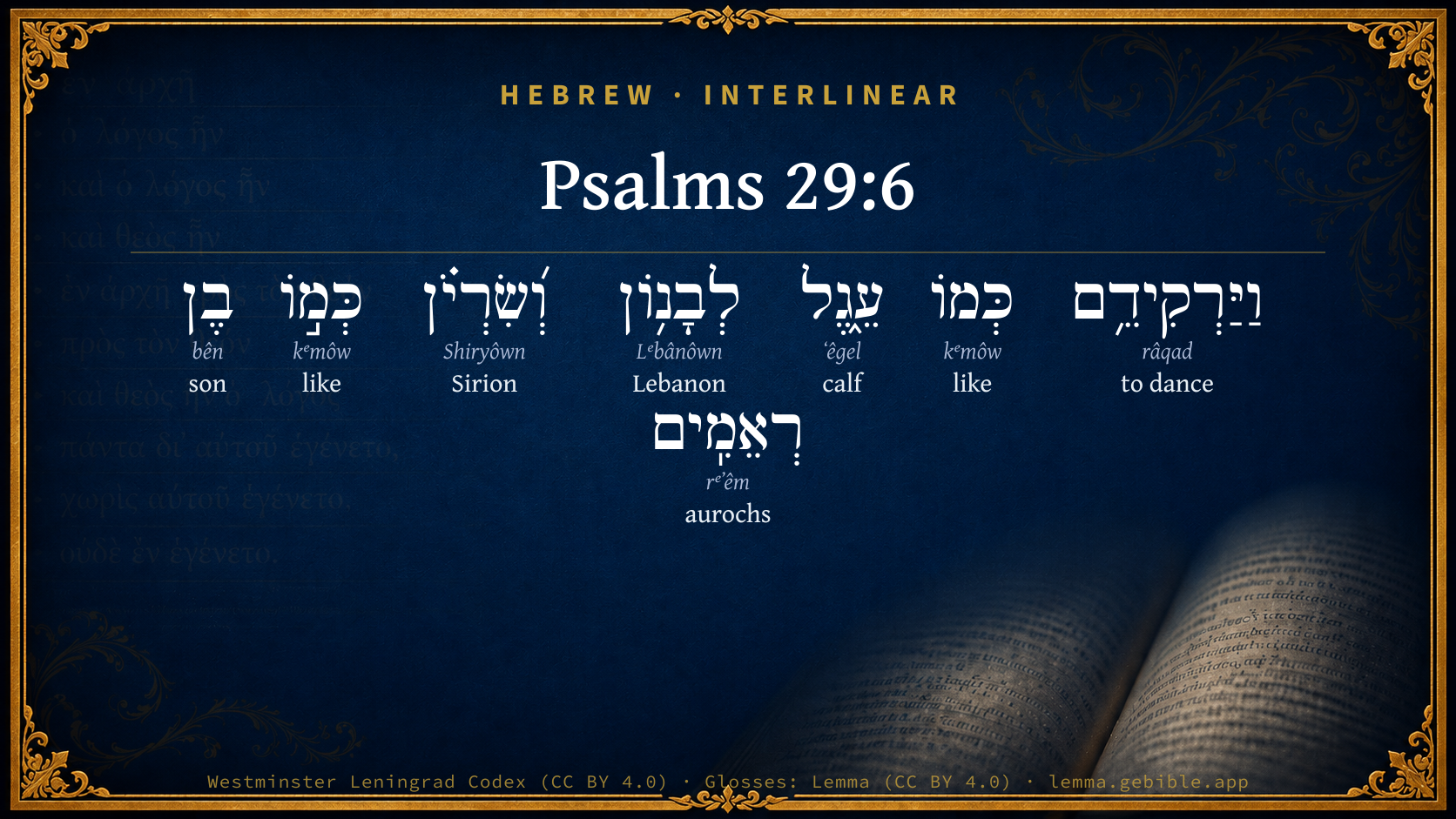
Psalms 29:6

Hebrew (Westminster Leningrad Codex) Psalms 29:6 appears in the Hebrew Old Testament. The text above is from the Westminster Leningrad Codex. Each word links to its Strong’s number, a concise gloss, and parsing drawn from the Open Scriptures Hebrew Bible morphology. Click any word for its full Brown-Driver-Briggs (BDB) entry.
Download image
Cite this verse

Psalms 29:6 (World English Bible). Public Domain. Lemma interlinear Bible study tool, https://lemma.gebible.app/v/psalms/29/6.

Show BibTeX & RIS
BibTeX
RIS
English Translation
He makes them also to skip like a calf; Lebanon and Sirion like a young, wild ox.
World English Bible · Public Domain
Download a study sheet

One document with this verse’s original text, its word-by-word gloss line, the meaning frame, cross-references with their text, attributed commentary, and full source and license credits — printable, and it pastes into notes with its structure intact.

This verse Autodidact and up

Study sheet (.html) Plain text (.txt)

A passage Seminary Student

Up to 50 verses in one chapter. A passage sheet keeps up to 6 commentary sources and 12 cross-references per verse, in the order this page ranks them, and says so on the sheet whenever that leaves anything out. Ask for a single verse and you get the Autodidact verse sheet above.

Everything on this page stays free to read, with no account — the sheet is a download of what is already on screen, not access to it.

Want to remove ads? Support Godless Engineer
Compare translations 3

The same verse in 3 English versions, stacked beneath the original-language interlinear above. Click any original word for its lexicon entry.

Each is an independent rendering of the whole verse — the interlinear is not word-aligned to these translations.

Highlighted words mark where these versions differ — a whole-verse word diff, not a word-by-word alignment.

  • World English Bible Public Domain
    He makes them also to skip like a calf; Lebanon and Sirion like a young, wild ox.
  • King James Version Public Domain
    He maketh them also to skip like a calf; Lebanon and Sirion like a young unicorn.
  • unfoldingWord Literal Text CC BY-SA 4.0
    And he makes Lebanon skip like a calf and Sirion like a son of wild oxen.

unfoldingWord Literal Text — © unfoldingWord, licensed CC BY-SA 4.0. Word-aligned USFM3 via Door43 (git.door43.org/unfoldingWord/en_ult).

Versions to compare (up to 4)

3 of 4 selected

Show all 18 translations

Every available English version of this verse, each an independent rendering of the whole verse.

  • World English Bible Public Domain
    He makes them also to skip like a calf; Lebanon and Sirion like a young, wild ox.
  • Berean Standard Bible Public Domain
    He makes Lebanon skip like a calf, and Sirion like a young wild ox.
  • Majority Standard Bible Public Domain
    He makes Lebanon skip like a calf, and Sirion like a young wild ox.
  • King James Version Public Domain
    He maketh them also to skip like a calf; Lebanon and Sirion like a young unicorn.
  • American Standard Version (1901) Public Domain
    He maketh them also to skip like a calf; Lebanon and Sirion like a young wild-ox.
  • Revised Version (1885) Public Domain
    He maketh them also to skip like a calf; Lebanon and Sirion like a young wild-ox.
  • Geneva Bible (1599) Public Domain
    He maketh them also to leape like a calfe: Lebanon also and Shirion like a yong vnicorne.
  • Douay-Rheims (1899) Public Domain
    And shall reduce them to pieces, as a calf of Libanus, and as the beloved son of unicorns.
  • Young's Literal Translation Public Domain
    And He causeth them to skip as a calf, Lebanon and Sirion as a son of Reems,
  • Literal Standard Version CC BY-SA 4.0
    And He causes them to skip as a calf, || Lebanon and Sirion as a son of Reems,
  • Unlocked Literal Bible CC BY-SA 4.0
    He makes Lebanon skip like a calf and Sirion like a young ox.
  • unfoldingWord Literal Text CC BY-SA 4.0
    And he makes Lebanon skip like a calf and Sirion like a son of wild oxen.
  • Darby Bible Public Domain
    And he maketh them to skip like a calf, Lebanon and Sirion like a young buffalo.
  • World Messianic Bible Public Domain
    He makes them also to skip like a calf; Lebanon and Sirion like a young, wild ox.
  • Webster's Bible Public Domain
    He maketh them also to skip like a calf; Lebanon and Sirion like a young unicorn.
  • Free Bible Version CC BY-SA 4.0
    He makes the mountains of Lebanon skip like a calf, and Mount Hermon like a young wild ox.
  • Bible in Basic English Public Domain
    He makes them go jumping about like a young ox; Lebanon and Sirion like a young mountain ox.
  • JPS Tanakh (1917) Public Domain
    He maketh them also to skip like a calf; Lebanon and Sirion like a young wild-ox.

Literal Standard Version (2020), Covenant Press — licensed CC BY-SA 4.0. Text via the HelloAO Bible API (eBible.org). Unlocked Literal Bible (unfoldingWord) — licensed CC BY-SA 4.0. Text via the HelloAO Bible API (eBible.org). unfoldingWord Literal Text — © unfoldingWord, licensed CC BY-SA 4.0. Word-aligned USFM3 via Door43 (git.door43.org/unfoldingWord/en_ult). Free Bible Version, Dr. Jonathan Gallagher — licensed CC BY-SA 4.0. Text via the HelloAO Bible API (eBible.org).

Word by word

More ways to search: Search by grammar → Find every occurrence → Compare this word →

Practice this passage: Drill this verse → Learn its vocabulary →

About this verse

These counts appear in no published source. They are computed here, from the morphology-tagged text and Lemma’s own curated glosses. What Lemma adds →

8
words
7
distinct lemmas
Wisdom
section

Notable vocabulary

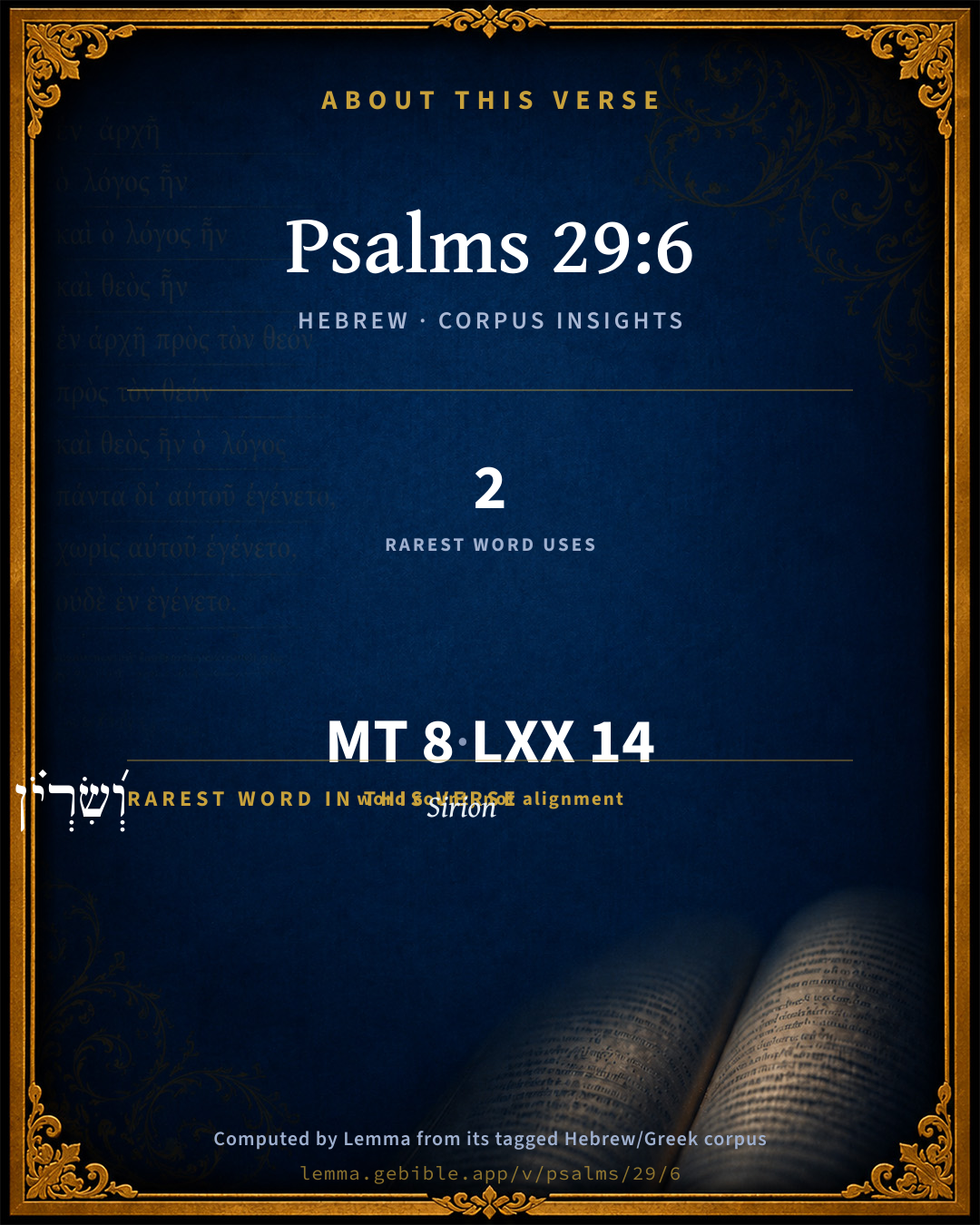
The rarest word here is וְ֝שִׂרְיֹ֗ן Sirion H8303 — appearing just 2 times in the whole Hebrew Bible.

Shared distinctive vocabulary

וְ֝שִׂרְיֹ֗ן Sirion H8303 occurs in 2 verses of the Hebrew Bible. Also found in:

Grammatical profile

  • 1 verb
  • 5 nouns
  • 2 prepositions

Verb forms

  • וַיַּרְקִידֵ֥ם Hiphil · Sequential Imperfect

Repetition

A word recurs within this verse — often emphatic in Hebrew:

  • כְּמוֹ like H3644 ×2

Hebrew & Septuagint length

In English translation the verse runs 17 words from the Hebrew and 21 from the Septuagint (LXX English) — closely comparable.

A rough comparison of the two English renderings, which tokenize alike — not a word-level alignment.

Word counts can differ between the Hebrew and the Greek without any difference in meaning — e.g. the Hebrew direct-object marker אֵת has no separate Greek word, and Greek often adds the article ὁ.

In the original languages it is 8 Hebrew tokens and 14 Greek tokens — but the two are counted differently (Hebrew bundles its prefixes and suffixes into one token; the Greek is in lemma form), so that isn’t a like-for-like length.

Cross-references

7

Topical passages linked to Psalms 29:6 in the Treasury of Scripture Knowledge — connected by theme and wording, ordered by reader-vote popularity; previews shown in the World English Bible.

  • Numbers 23:22 God brings them forth out of Egypt; He has as it were the strength of the wild-ox.
  • Deuteronomy 3:9 ([which] Hermon the Sidonians call Sirion, and the Amorites call it Senir;)
  • Psalms 114:4–7 The mountains skipped like rams, The little hills like lambs.
  • Psalms 92:10 But you have exalted my horn like that of the wild ox. I am anointed with fresh oil.
  • Jeremiah 4:23–25 I saw the earth, and, behold, it was waste and void; and the heavens, and they had no light.
  • Habakkuk 3:6–11 He stood, and shook the earth. He looked, and made the nations tremble. The ancient mountains were crumbled. The age-old hills collapsed. His ways are eternal.
  • Revelation 20:11 I saw a great white throne, and him who sat on it, from whose face the earth and the heaven fled away. There was found no place for them.

Cross-references courtesy of OpenBible.info (CC BY 4.0).

Hebrew and Greek witnesses Masoretic Hebrew ↔ Greek Septuagint

The same verse in the two great witnesses to the Old Testament, shown verse-for-verse.

You’re reading Greek Psalm 28 (Hebrew Psalm 29). The Septuagint counts the superscription, so verse numbers can differ from the Hebrew — chapter-level alignment, not verse-by-verse. Numbering follows Rahlfs.

These are two independent witnesses, not word-aligned to each other, and the Septuagint is shown in lemma (dictionary) form.

Hebrew Psalms 29:6 Masoretic · Westminster Leningrad Codex

וַיַּרְקִידֵ֥ם כְּמוֹ עֵ֑גֶל לְבָנ֥וֹן וְ֝שִׂרְיֹ֗ן כְּמ֣וֹ בֶן רְאֵמִֽים

He makes them also to skip like a calf; Lebanon and Sirion like a young, wild ox.

World English Bible · Public Domain

Greek LXX Greek Psalm 28:6 Septuagint · lemma form

καί λεπτύνω αὐτός ὡς ὁ μόσχος ὁ λίβανος καί ὁ ἀγαπάω ὡς υἱός μονόκερως

And he will beat them small, even Libanus itself, like a calf; and the beloved one is as a young unicorn.

LXX2012 (modern English Septuagint) · Public Domain

Hebrew: Westminster Leningrad Codex (CC BY 4.0). Greek: Septuagint (public domain); English from LXX2012 (modern English Septuagint) (Public Domain). How the Septuagint differs from the Hebrew →

Commentary

Notes on Psalms 29:6 from classic Christian and Jewish commentators (each source and its license shown beneath its notes). The classic Christian expositions comment on the surrounding passage and are grouped to its opening verse, so a note may address several verses; the Jewish commentaries on the Tanakh (Rashi and others) are per-verse, so they appear only where the commentator wrote on this verse.

Lemma curates 59 commentaries, every one of them public domain or Creative Commons licensed, each selected and text-cleaned for this edition rather than reprinted as found. About our sources →

Trapp's Complete Commentary

John Trapp

Psa 29:6 He maketh them also to skip like a calf; Lebanon and Sirion like a young unicorn.

Ver. 6. He maketh them also to skip like a calf] Young living creatures are full of motion. God by his thunder and earthquake thereupon (for so the Hebrews understand it) maketh not only those huge trees, the splinters of them, to fly up into the air, but also the mountains, whereupon they grow, to skip and jump out of their places and aloft from their centre.

Lebanon and Sirion, &c.] Or, Harmon, two known mountains, Deu 3:9.

John Trapp, A Commentary or Exposition upon All the Books of the Old and New Testament (1647–1656) — public domain. Text from a community e-Sword module.

J. A. Alexander on Psalms

Joseph Addison Alexander

6. (Psa 29:6) And made them skip like a calf, Lebanon and Sirion like the young of the unicorns (antelopes or wild bulls). The pronoun in the first clause may refer to cedars, or by anticipation to Lebanon and Sirion. This last is the Sidonian name of Hermon (Deu 3:9), the principal summit in the range of Antilibanus, here mentioned simply as a parallel to Lebanon, without any special local reference. By a similar rhetorical specification, the natural vivacity of young animals is specially ascribed to a particular species, well known to the writer and his readers as remarkable for wildness and agility. See above, on Psa 22:22 (21).

Joseph Addison Alexander, The Psalms Translated and Explained (1850) — public domain. Text from a community e-Sword module.

Tyndale Open Study Notes

Tyndale Open Resources

29:6 Lebanon’s mountains and Hermon are high mountains to the north of Israel. • The Lord can cause even immense mountains to shake at his command (see 114:4).

Tyndale Open Study Notes — © Tyndale Open Resources, licensed CC BY-SA 4.0. Text via the HelloAO Bible API.

Geneva Bible (1599)

Geneva Bible translators

Called also Hermon.

Geneva Bible (1599) marginal notes — public domain. Text via Bolls.life.

Ellicott's Commentary for English Readers

(6) Those trees that are not snapped off, bending to the storm, and swaying in the wind, seem to bound like wild buffaloes. (Comp. Psa_114:4.)

Sirion, according to Deu_3:9 (which see), was the Sidonian name of Hermon. Here the whole of the range of Anti-Libanus.

Unicorn.—See Psa_22:21, Note.

There is some ambiguity about the suffix, them. It may relate to the mountains instead of the cedars, and some commentators divide the clauses thus: “He maketh them skip; like a calf Lebanon, and Sirion like a young buffalo.” It is not, however, necessary to suppose, with some, that an earthquake accompanies the storm; the apparent movement of the hills beingintroduced to heighten the effect of the violence of the tempest.

A Bible Commentary for English Readers, edited by Charles John Ellicott (1878–1897) — public domain. Text from a community e-Sword module.

The Cambridge Bible for Schools and Colleges

gen. ed. J. J. S. Perowne

6. them] Not the cedars, but the mountains generally, to be understood from Lebanon and Sirion in the next line. Cp. Psa_114:4; Psa_114:6; Psa_18:7 ff.

Sirion] The old Sidonian name for Hermon (Deu_3:9), derived probably from the glistening of the snow on its summit. Lebanon and Sirion are specified as the noblest mountains of Palestine, and also as forming the northern boundary of the land.

unicorn] R.V. wild ox. See note on Psa_22:21.

The Cambridge Bible for Schools and Colleges (gen. ed. J. J. S. Perowne; Cambridge University Press, 1878–1918) — public domain. Text from a community e-Sword module.

John Gill's Exposition

He maketh them also to skip like a calf,.... That is, the cedars, the branches being broken off, or they torn up by the roots, and tossed about by the wind; which motion is compared to that of a calf that leaps and skips about;

Lebanon and Sirion, like a young unicorn; that is, these mountains move and skip about through the force of thunder, and the violence of an earthquake attending it; so historians report that mountains have moved from place to place, and they have met and dashed against one another (d). Sirion was a mountain in Judea near to Lebanon, and is the same with Hermon; which was called by the Sidonians Sirion, and by the Amorites Shenir, Deu 3:9. This may regard the inward motions of the mind, produced by the Gospel of Christ under a divine influence; see Isa 35:6.

(d) Plin. Nat. Hist. l. 2. c. 83. Joseph. Antiqu. l. 9. c. 11.

John Gill's Exposition of the Whole Bible (1746–1763) — public domain (CC PDM 1.0). Text via the HelloAO Bible API.

Albert Barnes' Notes on the Bible

He maketh them also to skip like a calf - That is, the cedars of Lebanon. Compare Psa 114:4, “The mountains skipped like rams, and the little hills like lambs.” Psa 68:16, “why leap ye, ye high hills?” The meaning is plain. The lightning tore off the large branches, and uprooted the loftiest trees, so that they seemed to play and dance like calves in their gambols. Nothing could be more strikingly descriptive of “power.”

Lebanon and Sirion - Sirion was the name by which Mount Hermon was known among the Sidonians: Deu 3:9, “Which Hermon the Sidonians call Sirion.” It is a part of the great range of Anti-libanus.

Like a young unicorn - On the meaning of the word used here, see the notes at Psa 22:21. The illustration would be the same if any young wild animal were referred to.

Albert Barnes' Notes on the Bible (1834–1885) — public domain. Text from a community e-Sword/MySword module.

Matthew Poole's English Annotations

He maketh them; the cedars last mentioned; which being broken by the thunder, the parts of them are suddenly and violently hurled about hither and thither.

Sirion; a high mountain beyond Jordan joining to Lebanon; of which see Deu 3:9; 4:48. Lebanon and Sirion are here understood, either,

1. Properly; and so they are said to skip or leap, both here and Psa 114:4, by a poetical hyperbole, very usual both in Scripture and other authors; which is so known, that it is needless to give any instances of it. Or,

2. Metonymically for the trees or people of them, as the wilderness, Psa 29:8, may seem to be taken; and as the earth, by the same figure, is frequently put for the people which dwell in it.

Unicorn, Heb. reem; of which see See Poole "Num 23:22; Psa 22:21".

Matthew Poole's English Annotations on the Holy Bible (1683–1685) — public domain. Text from a community e-Sword/MySword module.

The Treasury of David

Charles H. Spurgeon

Ver. 6. He maketh them also to skip like a calf; Lebanon and Sirion like a young unicorn. Not only the trees, but the mountains themselves move as though they frisked and leaped like young bulls or antelopes. As our own poets would mention hills and valleys known to them, so the Psalmist hears the crash and roar among the ranges of Libanus, and depicts the tumult in graphic terms. Thus sings one of our own countrymen:

"Amid Carnavon's mountains rages loud

The repercussive roar: with mighty crash

Into the flashing deep, from the rude rocks

Of Penmaen Mawr, heaped hideous to the sky,

Tumble the smitten cliffs; and Snowdon's peak,

Dissolving, instant yields his wintry load.

Far seen, the heights of heathy Cheviot blaze,

And Thule bellows through her utmost isles."

The glorious gospel of the blessed God has more than equal power over the rocky obduracy and mountainous pride of man. The voice of our dying Lord rent the rocks and opened the graves: his living voice still works the like wonders. Glory be to his name, the hills of our sins leap into his grave, and are buried in the red sea of his blood, when the voice of his intercession is heard.

Ver. 6. He maketh them also to skip like a calf; Lebanon and Sirion like a young unicorn; that is, the Lord by his thundering, powerful voice, first, will make them skip, as frightened with fear; and secondly, as revived with joy. Yet more Ps 29:7, "The voice of the Lord divideth the flames of fire; "that is, will send and divide to every one as they need 1Co 12:11, the Holy Spirit, who is compared to and called fire Mt 3:11, and who came as with a thunderstorm of a rushing mighty wind, and with the appearance of cloven tongues, like as of fire, and sat upon each one of the apostles. Ac 2:2-3. Nor did this voice of thunder, accompanied with divided flames of fire reach Jerusalem only; for, as it follows Ps 29:8, "The voice of the Lord shaketh the wilderness; the Lord shaketh the wilderness of Kadesh; "that is, the Lord by the voice of the gospel shall go forth with power to those Gentiles, who are like a wilderness, barren of goodness, and not fertilized in spirituals, though they dwell in well governed cities, and are well furnished with morals. It shall go forth also to those Gentiles who inhabit waste wildernesses, and are not so much as reduced to civility. These wildernesses, the thundering voice of the Lord hath shaken heretofore, and doth shake at this day, and will yet further shake, that the fulness of the Gentiles may come in. Many of these wildernesses hath the Lord turned into fruitful fields, and pleasant lands, by the voice of the gospel sounding among them. For in these wildernesses (as it followeth, Ps 29:9), "The voice of the Lord maketh the hinds to calve; "that is, they that were as wild, as untaught, and untamed as the hind, or any beast in the forest, he brings to the sorrows of their new birth, to repentance and gospel humiliation, and in doing this, "he (as the psalmist goes on), discovereth the forests; " that is, opens the hearts of men, which are as thick set and full grown with vanity, pride, hypocrisy, self love, and self sufficiency, as also with wantonness and sensuality, as any forest is overgrown with thickets of trees and bushes, which deny all passage through till cleared away with burning down or cutting up. Such an opening, such a discovery, doth the Lord make in the forests of men's hearts, by the sword and fire, that is, by the word and spirit of the gospel; and when this is done, the forest becomes a temple, and as that verse concludes, "In his temple doth every one speak of his glory." And if the floods of ungodliness rise up against the people, whom the thunder and lightning of the gospel have subdued to Christ, and framed into a holy temple, then the psalmist assures us Ps 29:10, "The Lord sitteth upon the flood, "that is, it is under his power, he rules and overrules it; "Yea, the Lord sitteth King for ever; "and Ps 29:11, "The Lord will give strength unto his people; the Lord will bless his people with peace." Thus the Lord "thundereth marvellously" Job 37:5, and these are glorious marvels which he thundereth; he converts sinners. Thus, though I like not their way who are given to allegorize the Scriptures, yet I doubt not but we may make a profitable use of this and many other Scriptures by way of allegory. This being an undeniable truth, which is the ground of itthat the Lord puts forth, as it were, the power of thunder and lightning in the preaching of his Word; these two things are to be marked. Joseph Caryl.

Ver. 6. He maketh them also to skip like a calf. That is to say, he hath made the splinters and broken pieces of trees that have been struck with lightning, to fly up into the air, or when they have been shaken by the wind, storms, or by earthquakes. John Diodati.

Ver. 6. The original is

"And makes them skip like a calf,

Lebanon and Sirion, like a young buffalo."

At first sight it might appear that the cedars were still meant, and that Lebanon and Sirion were used by metonymy for the cedars which grew upon them. But, 1. We never hear of cedars growing upon Sirion, or Shenir, or Hermon, for it has all these names; and, 2. There is a parallel passage where this interpretation will hardly answer in Psalm

114. Describing the exodus of Israel, it says

"The mountains skipped like rams,

And the little hills like lambs."

The same verb occurs here, the verb which means "to skip, to dance, " used in Na 3:2, to signify the jolting of chariots, and also in Joe 2:5. In both these instances, rough motion, accompanied with noise, seems intended. Now, though this may very well be understood as a highly figurative description, as it undoubtedly is, of the usual effect of a thunderstorm; yet it is interesting to compare it with the following passage of Volney, which described certain phenomena as frequent in Mount Lebanon, which may give a new meaning to the "skipping of the mountains:" "When the traveller, "say he, "penetrates the interior of these mountains, the ruggedness of the roads, the steepness of the declivities, the depth of the precipices, have at first a terrific effect; but the sagacity of the mules which bear him soon inspires him with confidence, and enables him to examine at his ease the picturesque scenes which succeed one another, so as almost to bewilder him." There, as in the Alps, he sometimes travels whole days to arrive at a spot which was in sight when he set out. He turns, he descends, he winds round, he climbs; and under the perpetual change of position, one is ready to think that a magical power is varying at every step the beauties of the landscapes. Sometimes villages are seen, ready as it were to slide down the deep declivities, and so disposed that the roofs of the one row of houses serve as a street to the row above. At another time, you see a convent seated on an isolated cone, like Marshaia in the valley of Tigre. Here a rock is pierced by a torrent, forming a natural cascade, as at Nahr el Leban; there another rock assumes the appearance of a natural wall! Often on the sides, ledges of stones, washed down and left by the waters, resemble ruins disposed by art. In some places, the waters meeting with inclined beds, have undermined the intermediate earth, and have formed caverns, as at Nahr el Kelb, near Antoura. In other places, they have worn for themselves subterranean channels, through which flow little rivulets during part of the year, as at Mar Hama. Sometimes these picturesque circumstances have become tragical ones. Rocks loosened or thrown off their equilibrium by thaw or earthquake, have been known to precipitate themselves on the adjacent dwellings, and crush the inhabitants. An accident of this kind, about twenty years ago, buried a whole village near Mar Djordos, so as to leave no trace of its existence. More recently, and near the same spot, the soil of a hill planted with mulberry trees and vines detached itself by a sudden thaw, and, sliding over the surface of the rock which it had covered, like a vessel launched from the stocks, established itself in the valley below. Robert Murray Macheyne.

Ver. 6. The unsettling power of the gospel.

Psalms 29:7*

Charles H. Spurgeon's The Treasury of David (1869–1885) — public domain. Psalms only. Text from a community e-Sword/MySword module.

Whedon's Commentary on the Bible

Daniel D. Whedon

6. Skip like a calf—A poetical hyperbole, as also “shaketh the wilderness” in Psa_29:8, as if it had been an earthquake. The same occurs Psa_68:8-9; Psa_18:7. The impression on the nerves is transferred to reality.

Lebanon and Sirion— “Sirion” is the old Sidonian name for Hermon. Deu_3:9. The storm originates in the north, in Lebanon and Hermon, and the psalmist traces its progress southward, as if it were its natural pathway, to Arabia. This theory of storms agrees with Pro_25:23, where, instead of “The north wind driveth away rain,” it should be translated, “The north wind bringeth forth rain,” in the sense of “giveth birth to rain.” See note on Psa_133:3.

Unicorn—The buffalo. See on Psa_22:21

Daniel D. Whedon (gen. ed.), Commentary on the Old and New Testaments (1874–1909) — public domain. Text from a community e-Sword module.

The Pulpit Commentary

He maketh them also to skip like a calf. (comp. Psa_18:7) As the thunder crashes and rolls and reverberates among the mountains, it seems as though the mountains themselves shook, and were moved from their places. This is expressed with extreme vividness, though no doubt with truly Oriental hyperbole, in the present passage. Lebanon and Sirion like a young unicorn; rather, like a young wild ox. Lebanon and Sirion, or Hermon, (Deu_3:9) are the two principal mountains of Palestine, Hermon being visible throughout almost the whole extent of the Holy Land, and Lebanon enjoying a commanding position beyond Galilee to the north. The storm which shook these lofty mountain-tracts would indeed be a manifestation of power.

The Pulpit Commentary (1880–1919), ed. H.D.M. Spence-Jones & Joseph S. Exell — public domain. Text from a community e-Sword module.

John Wesley's Explanatory Notes

Them - The cedars; which being broken by the thunder, the parts of them are suddenly and violently hurled hither and thither. Sirion - An high mountain beyond Jordan joining to Lebanon. Lebanon and Sirion are said to skip or leap, both here, and chap. cxiv, 4, by a poetical hyperbole.

John Wesley, Explanatory Notes Upon the Whole Bible (1754–1765) — public domain. Text via the GEBible commentary corpus.

unfoldingWord translationNotes

Door43 World Missions Community

Connecting Statement:

The writer continues describing the power of God's voice.

He makes Lebanon skip like a calf

The ground of Lebanon shaking is spoken of as if it were a young calf skipping. This emphasizes that when Yahweh speaks, the power of his voice shakes the ground. AT: "He makes the land of Lebanon shake like a calf skipping" (See: Simile)

skip

jump lightly back and forth

Sirion like a young ox

The words "he makes" and "skip" are understood from the first phrase. They can be repeated here. The ground of Sirion shaking is spoken of as if it were a young ox skipping. This emphasizes that when Yahweh speaks, the power of his voice shakes the ground. AT: "he makes Sirion skip like a young ox" (See: Ellipsis and Simile)

Sirion

This is a mountain in Lebanon. It is also called Mount Hermon. (See: How to Translate Names)

The voice of Yahweh sends out flames of fire

All occurrences of "voice" here represent Yahweh speaking. AT: "When Yahweh speaks he causes lightning to flash in the sky" (See: Metonymy)

flames of fire

This refers to lightning.

translationWords

Lebanon

cow

cow

fire

desert

Kadesh

unfoldingWord translationNotes — © Distant Shores Media and the Door43 World Missions Community, licensed CC BY-SA 4.0. Source: git.door43.org/Door43/en_tn.

Rashi

Rabbi Shlomo Yitzchaki (Rashi)

He causes them to dance like a calf The cedars and the mountains that came to hear the giving of the Torah.

Lebanon and Sirion The names of mountains.

Rashi on the Tanakh — English translations: “The Judaica Press complete Tanach with Rashi, translated by A. J. Rosenberg” (CC BY 4.0); “Pentateuch with Rashi's commentary by M. Rosenbaum and A.M. Silbermann, 1929-1934” (public domain); “The Metsudah Tanach series, Lakewood, N.J” (CC BY 4.0); and “The Book of Joshua, Metsudah Publications, 1997” (CC BY 4.0). Text via Sefaria.

Lesson kit

Teaching starters — assembled from the data on this page, not authored interpretation. Every prompt links to the verse data it draws on. Edit before teaching.

Psalms, in the Wisdom, opens this verse with 8 words (7 distinct Hebrew lemmas). Its most distinctive word is Shiryôwn (“Sirion”). A historical commentator’s framing appears above. Read the whole chapter for the surrounding context.

Discussion questions

  1. The word Shiryôwn carries the sense “Sirion.” How does it shape the verse?
  2. How does Deuteronomy 3:9, which shares the word «Sirion», read alongside this verse?
  3. What does the repetition of “like” (2× in this one verse) do in this verse?
  4. The translations on this page render this verse differently — a whole-verse word diff, not a word-by-word alignment. What might account for the different wordings?
  5. «וַיַּרְקִידֵ֥ם» is a Hiphil Sequential Imperfect verb. How does that grammatical form shape the action described?
  6. Compare how Trapp's Complete Commentary and J. A. Alexander on Psalms read this verse. Where do they agree or differ?

Things to notice

Reading settings

Reading text

Shown beneath each verse's original-language words.

Old Testament
Old Testament edition

Read the OT as the Masoretic Hebrew (MT) or the Greek Septuagint (LXX).

English shown for the Greek Septuagint (in the Hebrew ↔ Greek comparison).

Comparing translations? Open the Compare panel on any verse page to stack up to four side by side.