
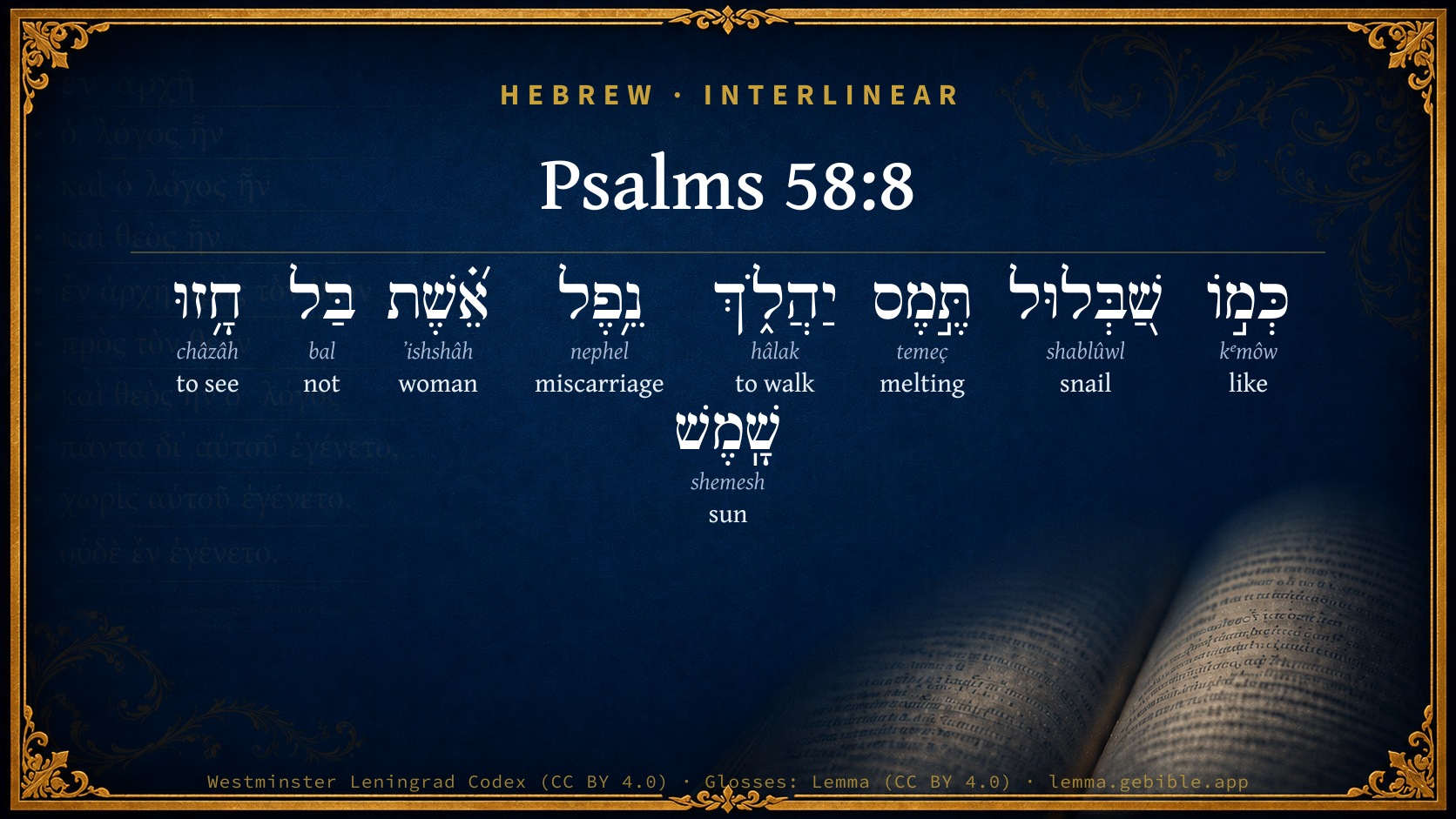
Psalms 58:8

Hebrew (Westminster Leningrad Codex) Psalms 58:8 appears in the Hebrew Old Testament. The text above is from the Westminster Leningrad Codex. Each word links to its Strong’s number, a concise gloss, and parsing drawn from the Open Scriptures Hebrew Bible morphology. Click any word for its full Brown-Driver-Briggs (BDB) entry.
Download image
Cite this verse

Psalms 58:8 (World English Bible). Public Domain. Lemma interlinear Bible study tool, https://lemma.gebible.app/v/psalms/58/8.

Show BibTeX & RIS
BibTeX
RIS
English Translation
Let them be like a snail which melts and passes away, Like the stillborn child, who has not seen the sun.
World English Bible · Public Domain
Highlights
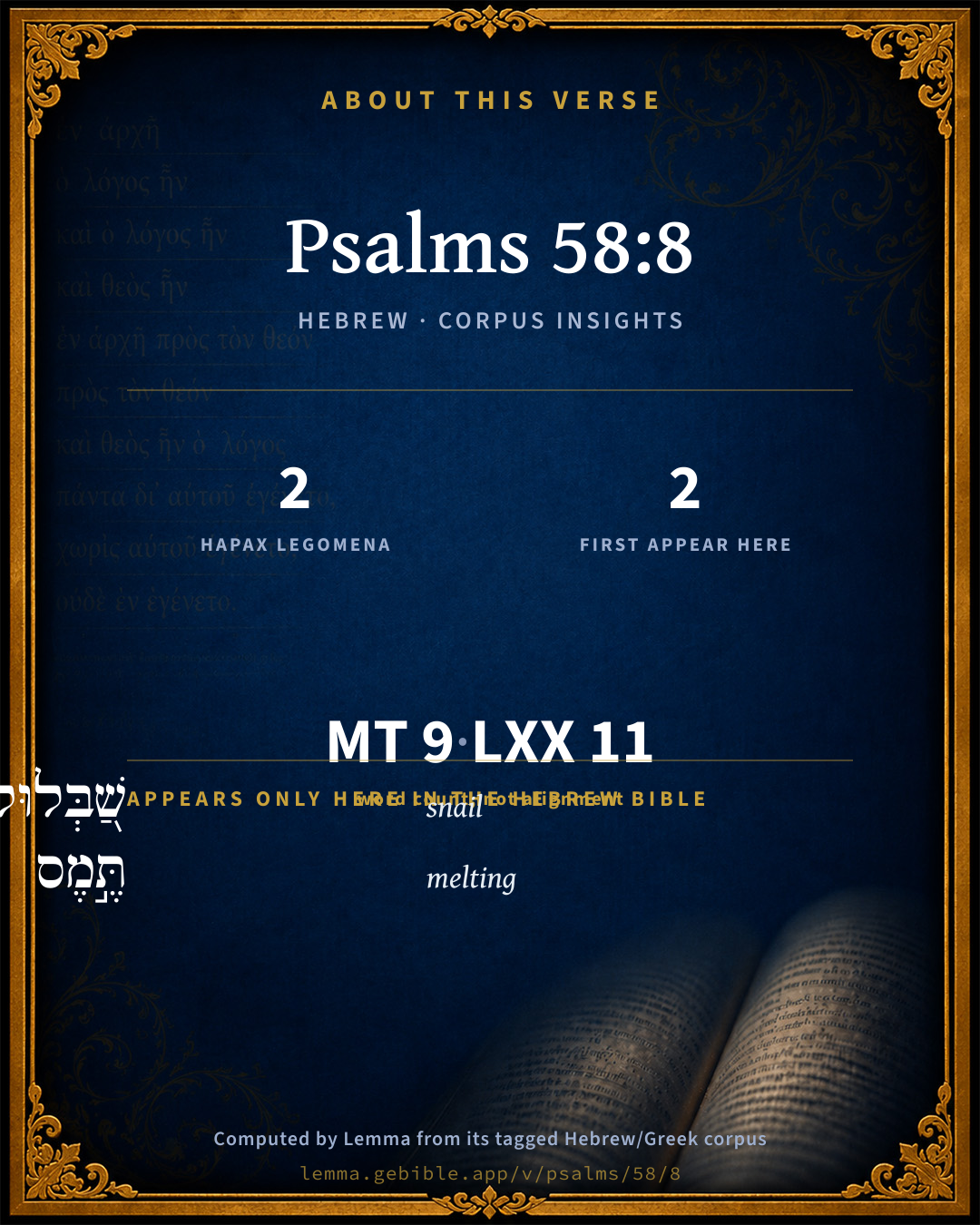
  • 2 hapax legomena — only here in the Hebrew Bible
  • 2 first appearances in the Hebrew Bible
Full analysis ↓
Download a study sheet

One document with this verse’s original text, its word-by-word gloss line, the meaning frame, cross-references with their text, attributed commentary, and full source and license credits — printable, and it pastes into notes with its structure intact.

This verse Autodidact and up

Study sheet (.html) Plain text (.txt)

A passage Seminary Student

Up to 50 verses in one chapter. A passage sheet keeps up to 6 commentary sources and 12 cross-references per verse, in the order this page ranks them, and says so on the sheet whenever that leaves anything out. Ask for a single verse and you get the Autodidact verse sheet above.

Everything on this page stays free to read, with no account — the sheet is a download of what is already on screen, not access to it.

Want to remove ads? Support Godless Engineer
Compare translations 3

The same verse in 3 English versions, stacked beneath the original-language interlinear above. Click any original word for its lexicon entry.

Each is an independent rendering of the whole verse — the interlinear is not word-aligned to these translations.

Highlighted words mark where these versions differ — a whole-verse word diff, not a word-by-word alignment.

  • World English Bible Public Domain
    Let them be like a snail which melts and passes away, Like the stillborn child, who has not seen the sun.
  • King James Version Public Domain
    As a snail which melteth, let every one of them pass away: like the untimely birth of a woman, that they may not see the sun.
  • unfoldingWord Literal Text CC BY-SA 4.0
    like a snail melts; it goes away. the miscarriage of a woman; they do not see the sun.

unfoldingWord Literal Text — © unfoldingWord, licensed CC BY-SA 4.0. Word-aligned USFM3 via Door43 (git.door43.org/unfoldingWord/en_ult).

Versions to compare (up to 4)

3 of 4 selected

Show all 18 translations

Every available English version of this verse, each an independent rendering of the whole verse.

  • World English Bible Public Domain
    Let them be like a snail which melts and passes away, Like the stillborn child, who has not seen the sun.
  • Berean Standard Bible Public Domain
    Like a slug that dissolves in its slime, like a woman’s stillborn child, may they never see the sun.
  • Majority Standard Bible Public Domain
    Like a slug that dissolves in its slime, like a woman’s stillborn child, may they never see the sun.
  • King James Version Public Domain
    As a snail which melteth, let every one of them pass away: like the untimely birth of a woman, that they may not see the sun.
  • American Standard Version (1901) Public Domain
    `Let them be' as a snail which melteth and passeth away, `Like' the untimely birth of a woman, that hath not seen the sun.
  • Revised Version (1885) Public Domain
    Let them be as a snail which melteth and passeth away: like the untimely birth of a woman, that hath not seen the sun.
  • Geneva Bible (1599) Public Domain
    Let them consume like a snayle that melteth, and like the vntimely fruite of a woman, that hath not seene the sunne.
  • Douay-Rheims (1899) Public Domain
    They shall come to nothing, like water running down; he hath bent his bow till they be weakened.
  • Young's Literal Translation Public Domain
    As a snail that melteth he goeth on, `As' an untimely birth of a woman, They have not seen the sun.
  • Literal Standard Version CC BY-SA 4.0
    He goes on as a snail that melts, || [As] an untimely birth of a woman, || They have not seen the sun.
  • Unlocked Literal Bible CC BY-SA 4.0
    Let them be like a snail that melts and passes away, like the untimely-born child of a woman that never sees the sunlight.
  • unfoldingWord Literal Text CC BY-SA 4.0
    like a snail melts; it goes away. the miscarriage of a woman; they do not see the sun.
  • Darby Bible Public Domain
    Let them be as a snail that melteth as it passeth away; [like] the untimely birth of a woman, let them not see the sun.
  • World Messianic Bible Public Domain
    Let them be like a snail which melts and passes away, like the stillborn child, who has not seen the sun.
  • Webster's Bible Public Domain
    \\58:7\\Let them melt away as waters which run continually: when he bendeth his bow to shoot his arrows, let them be as cut in pieces.
  • Free Bible Version CC BY-SA 4.0
    May they be like the slime of snails that dissolves away, like a stillborn child that never saw the light of day.
  • Bible in Basic English Public Domain
    Let them be like an after-birth which is turned to water and comes to an end; like the fruit of a woman who gives birth before her time, let them not see the sun.
  • JPS Tanakh (1917) Public Domain
    (58-9) Let them be as a snail which melteth and passeth away; like the untimely births of a woman, that have not seen the sun.

Literal Standard Version (2020), Covenant Press — licensed CC BY-SA 4.0. Text via the HelloAO Bible API (eBible.org). Unlocked Literal Bible (unfoldingWord) — licensed CC BY-SA 4.0. Text via the HelloAO Bible API (eBible.org). unfoldingWord Literal Text — © unfoldingWord, licensed CC BY-SA 4.0. Word-aligned USFM3 via Door43 (git.door43.org/unfoldingWord/en_ult). Free Bible Version, Dr. Jonathan Gallagher — licensed CC BY-SA 4.0. Text via the HelloAO Bible API (eBible.org).

Word by word

More ways to search: Search by grammar → Find every occurrence → Compare this word →

Practice this passage: Drill this verse → Learn its vocabulary →

About this verse

These counts appear in no published source. They are computed here, from the morphology-tagged text and Lemma’s own curated glosses. What Lemma adds →

9
words
9
distinct lemmas
Wisdom
section

Notable vocabulary

2 hapax legomena — words that appear only here in the entire Hebrew Bible:

  • שַׁ֭בְּלוּל snail H7642
  • תֶּ֣מֶס melting H8557

First appearance in Scripture

These words make their first canonical appearance in the Hebrew Bible here:

  • שַׁ֭בְּלוּל snail H7642
  • תֶּ֣מֶס melting H8557

Shared distinctive vocabulary

נֵ֥פֶל miscarriage H5309 occurs in 3 verses of the Hebrew Bible. Also found in:

Grammatical profile

  • 2 verbs
  • 5 nouns
  • 1 preposition
  • 1 particle

Verb forms

  • יַהֲלֹ֑ךְ Qal · Imperfect
  • חָ֥זוּ Qal · Perfect

Hebrew & Septuagint length

In English translation the verse runs 21 words from the Hebrew and 18 from the Septuagint (LXX English) — closely comparable.

A rough comparison of the two English renderings, which tokenize alike — not a word-level alignment.

Word counts can differ between the Hebrew and the Greek without any difference in meaning — e.g. the Hebrew direct-object marker אֵת has no separate Greek word, and Greek often adds the article ὁ.

In the original languages it is 9 Hebrew tokens and 11 Greek tokens — but the two are counted differently (Hebrew bundles its prefixes and suffixes into one token; the Greek is in lemma form), so that isn’t a like-for-like length.

Cross-references

5

Topical passages linked to Psalms 58:8 in the Treasury of Scripture Knowledge — connected by theme and wording, ordered by reader-vote popularity; previews shown in the World English Bible.

  • Job 3:16 Or as a hidden untimely birth I had not been, As infants who never saw light.
  • Ecclesiastes 6:3 If a man fathers a hundred children, and lives many years, so that the days of his years are many, but his soul is not filled with good, and moreover he has no burial; I say, that an untimely birth is better than he:
  • Psalms 37:35–36 I have seen the wicked in great power, Spreading himself like a green tree in its native soil.
  • James 1:10 and the rich, in that he is made humble, because like the flower in the grass, he will pass away.
  • Matthew 24:35 Heaven and earth will pass away, but my words will not pass away.

Cross-references courtesy of OpenBible.info (CC BY 4.0).

Hebrew and Greek witnesses Masoretic Hebrew ↔ Greek Septuagint

The same verse in the two great witnesses to the Old Testament, shown verse-for-verse.

You’re reading Greek Psalm 57 (Hebrew Psalm 58). The Septuagint counts the superscription, so verse numbers can differ from the Hebrew — chapter-level alignment, not verse-by-verse. Numbering follows Rahlfs.

These are two independent witnesses, not word-aligned to each other, and the Septuagint is shown in lemma (dictionary) form.

Hebrew Psalms 58:8 Masoretic · Westminster Leningrad Codex

כְּמ֣וֹ שַׁ֭בְּלוּל תֶּ֣מֶס יַהֲלֹ֑ךְ נֵ֥פֶל אֵ֝֗שֶׁת בַּל חָ֥זוּ שָֽׁמֶשׁ

Let them be like a snail which melts and passes away, Like the stillborn child, who has not seen the sun.

World English Bible · Public Domain

Greek LXX Greek Psalm 57:8 Septuagint · lemma form

ἐκοὐδενόω ὡς ὕδωρ διαπορεύομαι ἐντείνω ὁ τόξον αὐτός ἕως ὅς ἀσθενέω

They shall be destroyed as melted wax: the fire has fallen and they have not seen the sun.

LXX2012 (modern English Septuagint) · Public Domain

On this verse, The Cambridge Bible for Schools and Colleges discusses the Septuagint’s reading. Read the note in Commentary ↓

Hebrew: Westminster Leningrad Codex (CC BY 4.0). Greek: Septuagint (public domain); English from LXX2012 (modern English Septuagint) (Public Domain). How the Septuagint differs from the Hebrew →

Commentary

Notes on Psalms 58:8 from classic Christian and Jewish commentators (each source and its license shown beneath its notes). The classic Christian expositions comment on the surrounding passage and are grouped to its opening verse, so a note may address several verses; the Jewish commentaries on the Tanakh (Rashi and others) are per-verse, so they appear only where the commentator wrote on this verse.

Lemma curates 59 commentaries, every one of them public domain or Creative Commons licensed, each selected and text-cleaned for this edition rather than reprinted as found. About our sources →

Trapp's Complete Commentary

John Trapp

Psa 58:8 As a snail [which] melteth, let [every one of them] pass away: [like] the untimely birth of a woman, [that] they may not see the sun.

Ver. 8. As a snail which melteth] The psalmist heapeth up many very fit similitudes agreeable to these men’s avarice and ambition, which was to raise themselves and their posterity to great estates; but all should come to nothing suddenly.

John Trapp, A Commentary or Exposition upon All the Books of the Old and New Testament (1647–1656) — public domain. Text from a community e-Sword module.

Joseph Benson's Commentary

Psa 58:8. As a snail melteth — Which thrusts forth itself, and seems to threaten with its horns, but is quickly dissolved. For it wastes by its own motions, in every stretch it makes, leaving some of its moisture behind, which, by degrees, must needs consume it, though it makes a path to shine after it. Like the untimely birth of a woman — Which dies as soon as it begins to live, and never sees the sun.

Joseph Benson's Commentary on the Old and New Testaments (1811–1818) — public domain. Text from a community e-Sword module.

J. A. Alexander on Psalms

Joseph Addison Alexander

9. (Psa 58:8). As a snail melts, let him go; (like) the untimely birth of a woman, they have not beheld the sun. The idea of speedy and entire disappearance is still more strongly expressed here. The meaning of the word translated snail rests upon rabbinical tradition and a doubtful etymology. The point of comparison may relate to some popular belief or to some apparent idiosyncrasy in this class of animals, perhaps to the idea of its losing a portion of its body by locomotion. The. next noun primarily signifies what falls from the tree, unripe fruit, and is then transferred to animal abortions. The past tense in the last clause seems to mark it as a kind of reflection introduced into the midst of the prayer. "So far from living too long, as I feared, they seem scarcely to have lived at all."

Joseph Addison Alexander, The Psalms Translated and Explained (1850) — public domain. Text from a community e-Sword module.

Tyndale Open Study Notes

Tyndale Open Resources

58:8 When moving over dry ground, snails dry up.

Tyndale Open Study Notes — © Tyndale Open Resources, licensed CC BY-SA 4.0. Text via the HelloAO Bible API.

Jamieson, Fausset & Brown

Robert Jamieson, A. R. Fausset & David Brown

Other figures of this utter ruin; the last denoting rapidity. In a shorter time than pots feel the heat of thorns on fire--

Jamieson, Fausset & Brown — Commentary Critical and Explanatory on the Whole Bible (1871) — public domain (CC PDM 1.0). Text via the HelloAO Bible API.

Adam Clarke's Commentary

Verse 8. As a snail which melteth] The Chaldee reads the verse thus: "They shall melt away in their sins as water flows off; as the creeping snail that smears its track; as the untimely birth and the blind mole, which do not see the sun."

The original word שבלול shablul, a snail, is either from שביל shebil, a path, because it leaves a shining path after it by emitting a portion of slime, and thus glaring the ground; and therefore might be emphatically called the pathmaker; or from ישב yashab to dwell, ב be, in, לול lul, a winding or spiral shell, which is well known to be its house, and which it always inhabits; for when it is not coiled up within this shell, it carries it with it wheresoever it goes. See Bochart. These figures need no farther explanation.

Adam Clarke's Commentary on the Bible (1810–1826) — public domain. Text from a community e-Sword/MySword module.

John Calvin's Commentaries

8. Let him vanish like a snail, which melts away The two comparisons in this verse are introduced with the same design as the first, expressing his desire that his enemies might pass away quietly, and prove as things in their own nature the most evanescent. He likens them to snails, and it might appear ridiculous in David to use such contemptible figures when speaking of men who were formidable for their strength and influence, did we not reflect that he considered God as able in a moment, without the slightest effort, to crush and annihilate the mightiest opposition. Their power might be such as encouraged them, in their vain-confidence, to extend their schemes into a far distant futurity, but he looked upon it with the eye of faith, and saw it doomed in the judgment of God to be of short continuance. He perhaps alluded to the suddenness with which the wicked rise into power, and designed to dash the pride which they are apt to feel from such an easy advance to prosperity, by reminding them that their destruction would be equally rapid and sudden. There is the same force in the figure employed in the end of the verse where they are compared to an abortion. If we consider the length of time to which they contemplate in their vain-confidence that their life shall extend, they may be said to pass out of this world before they have well begun to live, and to be dragged back, as it were, from the very goal of existence.

John Calvin's Commentaries (1540-1563) — public domain. Text from the Calvin Translation Society English edition (1840s-50s) via the Christian Classics Ethereal Library (ccel.org). Calvin's coverage is partial (roughly two-thirds of the Bible); uncommented books and verses are honest gaps, never fabricated. The 19th-century editor's footnotes and remarks are omitted so the notes are faithfully Calvin's own voice.

The Cambridge Bible for Schools and Colleges

gen. ed. J. J. S. Perowne

8. Let them be like a snail which melts away and is gone:

Like the untimely births of women, that have not seen the sun.

Two more figures for the destruction of the wicked:—let them melt away; nay, vanish as though they had never existed.

The word shablûl puzzled the ancient translators. The LXX render it ‘wax’ (doubtless to suit the verb ‘melt’), Jerome ‘worm’; but later Hebrew attests the meaning snail. But what is the point of comparison? Is it that the snail seems to melt away as it goes along, leaving a slimy track behind it, or perhaps was popularly supposed to do so? or is it not rather an allusion to the way in which snails dry up and perish in drought? There are to be found in all parts of Palestine “myriads of snail shells in fissures, still adhering by the calcareous exudation round their orifice to the surface of the rock, but the animal of which is utterly shrivelled and wasted—‘melted away,’ according to the expression of the Psalmist.” Tristram, Nat. Hist, of Bible, p. 296.

For the second figure cp. Job_3:16; Ecc_6:3-5. That they may not see the sun (A.V.) is an ungrammatical rendering.

The Cambridge Bible for Schools and Colleges (gen. ed. J. J. S. Perowne; Cambridge University Press, 1878–1918) — public domain. Text from a community e-Sword module.

John Gill's Exposition

As a snail which melteth, let everyone of them pass away,.... As a snail when it comes out of its shell liquefies, drops its moisture, and with it makes a "path", from whence it has its name in the Hebrew language; and so the Targum here,

"as the snail moistens its way;''

which moistness it gradually exhausts, and melts away, and dies: so the psalmist prays that everyone of his enemies might die in like manner. Some think reference is had to the snail's putting out its horns to no purpose when in danger, and apply it to the vain threatenings of the wicked; a strange difference this, between a roaring young lion, Psa 58:6, and a melting snail. The Septuagint, Vulgate Latin, and all the Oriental versions, render it, "as wax which melteth": see Psa 68:2;

like the untimely birth of a woman, that they may not see the sun; see Job 3:16. The Targum is,

"as an abortive and a mole, which are blind and see not the sun.''

So Jarchi renders it a "mole", agreeably to the Talmud (g). Or, "let them not see the sun" (h); let them die, and never see the sun in the firmament any more; Christ, the sun of righteousness; nor enjoy the favour of God, and the light of his countenance; nor have the light of life, or eternal glory and happiness; see Psa 49:19.

(g) T. Bab. Moed Katon, fol. 6. 2. (h) "ne videant solem", Pagninus, Montanus.

John Gill's Exposition of the Whole Bible (1746–1763) — public domain (CC PDM 1.0). Text via the HelloAO Bible API.

Albert Barnes' Notes on the Bible

As a snail which melteth, let every one of them pass away - Or rather, As the snail which melteth as it goes; that is, which leaves a slimy trail as it moves along, and thus melts away the more as it advances, until at length it dies. Gesenius, Lexicon. The allusion is to what seems to occur to the snail; it seems to melt or to be dissolved as it moves along; or seems to leave a part of itself in the slime which flows from it.

Like the untimely birth of a woman - The Hebrew word means literally “that which falls from a woman;” and hence, the word is used to denote an abortion. The prayer is, that they might utterly pass away; that they might become like those who never had real life; that their power might wholly disappear.

That they may not see the sun - May not be among the living. Compare the notes at Job 3:16.

Albert Barnes' Notes on the Bible (1834–1885) — public domain. Text from a community e-Sword/MySword module.

Matthew Poole's English Annotations

Which melteth; Which thrusts forth, and seems to threaten with its horns, but is quickly dissolved; for when it goes out of its shell, it spends its vital moisture, until by degrees it waste away and perish.

The untimely birth of a woman; which endeavouring violently and unseasonably to break forth from the womb, is choked in the attempt, and doth not live to see the light of the sun.

Matthew Poole's English Annotations on the Holy Bible (1683–1685) — public domain. Text from a community e-Sword/MySword module.

The Treasury of David

Charles H. Spurgeon

Ver. 8. As a snail which melteth, let every one of them pass away. As the snail makes its own way by its slime, and so dissolves as it goes, or as its shell is often found empty, as though the inhabitant had melted away, so shall the malicious eat out their own strength while they proceed upon their malevolent designs, and shall themselves disappear. To destroy himself by envy and chagrin is the portion of the ill disposed.

Like the untimely birth of a woman, that they may not see the sun. Solemn is this curse, but how surely does it fall on many graceless wretches! They are as if they had never been. Their character is shapeless, hideous, revolting. They are fitter to be hidden away in an unknown grave than to be reckoned among men. Their life comes never to ripeness, their aims are abortive, their only achievement is to have brought misery to others, and horror to themselves. Such men as Herod, Judas, Alva, Bonner, had it not been better for them if they had never been born? Better for the mothers who bore them? Better for the lands they cursed? Better for the earth in which their putrid carcasses are hidden from the sun? Every unregenerate man is an abortion. He misses the true form of God made manhood; he corrupts in the darkness of sin; he never sees or shall see the light of God in purity, in heaven.

Ver 6-9. See Psalms on "Ps 58:6" for further information.

Ver. 8. As a snail which melteth away as it goeth, literally, which goeth in melting (or slime), the noun being in the accusative as describing the nature of the action, and the allusion being to the slimy trail which the snail leaves behind it, so that it seems to waste away. Evidently this is nothing more than a poetical hyperbole, and need not be explained, therefore, as a popular error or a mistake in natural history.

J. J. Stewart Perowne, B.D., in "The Book of Psalms; a New Translation, with Introduction and Notes, "1864.

Ver. 8. As a snail which melteth, etc. This is a very remarkable and not very intelligible passage. The Jewish Bible renders the passage in a way which explains the idea which evidently prevailed at the time the Psalms were composed: "As a snail let him melt as he passeth on." The ancients had an idea that the slimy track made by a snail as it crawled along was subtracted from the substance of its body, and that in consequence the farther it crept the smaller it became until at last it wasted entirely away. The commentators on the Talmud took this view of the case. The Hebrew word, lwlbv shablul, which undoubtedly does signify a snail of some kind, is thus explained: --"The Shablul is a creeping thing; when it comes out of its shell, saliva pours from itself until it becomes liquid, and so dies." Other explanations of this passage have been offered, but there is no doubt that the view taken by these commentators is the correct one, and that the psalmist, when he wrote the terrible series of denunciations in which the passage occurs, had in his mind the popular belief regarding the gradual wasting away of the snail as it "passeth on." It is needless to say that no particular species of snail is mentioned, and almost as needless to state that in Palestine there are many species of snails, to any or all of which these words are equally applicable. J. G. Wood, in "Bible Animals." 1869.

Ver. 8. The untimely birth of a woman. The wicked are all, so speak, human abortions; they are and for ever remain defective beings, who have not accomplished the great purpose of their existence. Heaven is the one end for which man is created, and he who falls short of it does not attain the purpose of his being; he is an eternal abortion. O. Prescott Hiller.

Ver. 8. (second clause). David when he curseth the plots of wicked men, that though they have conceived mischief, and though they have gone with it a long time, and are ready to bring it forth, yet saith he, Let them be (that is, let their counsels and designs be) like the untimely birth of a woman, that they may not see the sun: that is, let them be dashed and blasted, let them never bring forth their poisonous brood to the hurt and trouble of the world. Joseph Caryl.

Ver. 8. The snail like course of ungodly men. Their sin destroys their property, health, time, influence, life.

Psalms 58:9*

Charles H. Spurgeon's The Treasury of David (1869–1885) — public domain. Psalms only. Text from a community e-Sword/MySword module.

Whedon's Commentary on the Bible

Daniel D. Whedon

8. As a snail which melteth— “Referring to the well-known habits of the snail, which boldly comes forth from its shell, blind to all danger, and runs out its feelers to the utmost length, but quickly withdraws them at the slightest touch, and rapidly and timidly retreats within its fortress. The snail, moreover, is so frail that it may be crushed by its most insignificant enemy, and aptly illustrates the utter impotency of the proudest and mightiest of the wicked.”—VAN LENNEP, Bible Lands, p. 322

Daniel D. Whedon (gen. ed.), Commentary on the Old and New Testaments (1874–1909) — public domain. Text from a community e-Sword module.

The Pulpit Commentary

As a snail which molteth, lot every one of them pass away; or, "let them be as a snail, which melteth and passeth away" (Revised Version). Snails in Palestine, during dry seasons, often shrink, shrivel up, and disappear from their shells (Tristram, "Natural History of the Bible," p. 296). Like the untimely birth of a woman, that they may not see the sun; rather, that hath not seen the sun (Professor Cheyne, Revised Version); i.e. "let them be as an abortion". (comp. Job_3:16)

The Pulpit Commentary (1880–1919), ed. H.D.M. Spence-Jones & Joseph S. Exell — public domain. Text from a community e-Sword module.

John Wesley's Explanatory Notes

Melteth - Which is quickly dissolved.

John Wesley, Explanatory Notes Upon the Whole Bible (1754–1765) — public domain. Text via the GEBible commentary corpus.

Rashi

Rabbi Shlomo Yitzchaki (Rashi)

Let them be rejected by themselves, that they will be rejected in their own eyes from worry, and as [if] in water let them walk. Similar to this is (Ezek. 7:17): “and all knees will go [as in] water,” from tears.

He will aim His arrows i.e., the Holy One, blessed be He, so that they will be cut off. יתמֹללוּ is soyent preciz, let them be cut off.

Rashi on the Tanakh — English translations: “The Judaica Press complete Tanach with Rashi, translated by A. J. Rosenberg” (CC BY 4.0); “Pentateuch with Rashi's commentary by M. Rosenbaum and A.M. Silbermann, 1929-1934” (public domain); “The Metsudah Tanach series, Lakewood, N.J” (CC BY 4.0); and “The Book of Joshua, Metsudah Publications, 1997” (CC BY 4.0). Text via Sefaria.

Lesson kit

Teaching starters — assembled from the data on this page, not authored interpretation. Every prompt links to the verse data it draws on. Edit before teaching.

Psalms, in the Wisdom, opens this verse with 9 words (9 distinct Hebrew lemmas). Its most distinctive word is shablûwl (“snail”). A historical commentator’s framing appears above. Read the whole chapter for the surrounding context.

Discussion questions

  1. What does “snail” (shablûwl) contribute to the verse as a whole?
  2. 2 words here appear nowhere else in the Hebrew Bible. Why might the author reach for such rare wording?
  3. 2 words make their first appearance in Scripture here. What does this debut establish?
  4. How does Job 3:16, which shares the word «miscarriage», read alongside this verse?
  5. These translations render this verse differently; the difference is in the English rendering, not the original. What questions does that raise?
  6. «יַהֲלֹ֑ךְ» is a Qal Imperfect verb. How does that grammatical form shape the action described?
  7. Compare how Trapp's Complete Commentary and Joseph Benson's Commentary read this verse. Where do they agree or differ?

Things to notice

Reading settings

Reading text

Shown beneath each verse's original-language words.

Old Testament
Old Testament edition

Read the OT as the Masoretic Hebrew (MT) or the Greek Septuagint (LXX).

English shown for the Greek Septuagint (in the Hebrew ↔ Greek comparison).

Comparing translations? Open the Compare panel on any verse page to stack up to four side by side.