Isaiah 26:17

Hebrew (Westminster Leningrad Codex) Isaiah 26:17 appears in the Hebrew Old Testament. The text above is from the Westminster Leningrad Codex. Each word links to its Strong’s number, a concise gloss, and parsing drawn from the Open Scriptures Hebrew Bible morphology. Click any word for its full Brown-Driver-Briggs (BDB) entry.
Download image
Cite this verse

Isaiah 26:17 (World English Bible). Public Domain. Lemma interlinear Bible study tool, https://lemma.gebible.app/v/isaiah/26/17.

Show BibTeX & RIS
BibTeX
RIS
English Translation
Like as a woman with child, who draws near the time of her delivery, is in pain and cries out in her pangs; so we have been before you, Yahweh.
World English Bible · Public Domain
Download a study sheet

One document with this verse’s original text, its word-by-word gloss line, the meaning frame, cross-references with their text, attributed commentary, and full source and license credits — printable, and it pastes into notes with its structure intact.

This verse Autodidact and up

Study sheet (.html) Plain text (.txt)

A passage Seminary Student

Up to 50 verses in one chapter. A passage sheet keeps up to 6 commentary sources and 12 cross-references per verse, in the order this page ranks them, and says so on the sheet whenever that leaves anything out. Ask for a single verse and you get the Autodidact verse sheet above.

Everything on this page stays free to read, with no account — the sheet is a download of what is already on screen, not access to it.

Want to remove ads? Support Godless Engineer
Compare translations 3

The same verse in 3 English versions, stacked beneath the original-language interlinear above. Click any original word for its lexicon entry.

Each is an independent rendering of the whole verse — the interlinear is not word-aligned to these translations.

Highlighted words mark where these versions differ — a whole-verse word diff, not a word-by-word alignment.

  • World English Bible Public Domain
    Like as a woman with child, who draws near the time of her delivery, is in pain and cries out in her pangs; so we have been before you, Yahweh.
  • King James Version Public Domain
    Like as a woman with child, that draweth near the time of her delivery, is in pain, and crieth out in her pangs; so have we been in thy sight, O LORD.
  • unfoldingWord Literal Text CC BY-SA 4.0
    As a pregnant draws near to delivering writhes, she cries out in her pangs, thus we have been from your face, Yahweh.

unfoldingWord Literal Text — © unfoldingWord, licensed CC BY-SA 4.0. Word-aligned USFM3 via Door43 (git.door43.org/unfoldingWord/en_ult).

Versions to compare (up to 4)

3 of 4 selected

Show all 18 translations

Every available English version of this verse, each an independent rendering of the whole verse.

  • World English Bible Public Domain
    Like as a woman with child, who draws near the time of her delivery, is in pain and cries out in her pangs; so we have been before you, Yahweh.
  • Berean Standard Bible Public Domain
    As a woman with child about to give birth writhes and cries out in pain, so were we in Your presence, O LORD.
  • Majority Standard Bible Public Domain
    As a woman with child about to give birth writhes and cries out in pain, so were we in Your presence, O LORD.
  • King James Version Public Domain
    Like as a woman with child, that draweth near the time of her delivery, is in pain, and crieth out in her pangs; so have we been in thy sight, O LORD.
  • American Standard Version (1901) Public Domain
    Like as a woman with child, that draweth near the time of her delivery, is in pain and crieth out in her pangs; so we have been before thee, O Jehovah.
  • Revised Version (1885) Public Domain
    Like as a woman with child, that draweth near the time of her delivery, is in pain and crieth out in her pangs; so have we been before thee, O LORD.
  • Geneva Bible (1599) Public Domain
    Like as a woman with childe, that draweth neere to the trauaile, is in sorow, and cryeth in her paines, so haue we bene in thy sight, O Lord.
  • Douay-Rheims (1899) Public Domain
    As a woman with child, when she draweth near the time of her delivery, is in pain, and crieth out in her pangs: so are we become in thy presence, O Lord.
  • Young's Literal Translation Public Domain
    When a pregnant woman cometh near to the birth, She is pained -- she crieth in her pangs, So we have been from Thy face, O Jehovah.
  • Literal Standard Version CC BY-SA 4.0
    When a pregnant woman comes near to the birth, || She is pained—she cries in her pangs, || So we have been from Your face, O YHWH.
  • Unlocked Literal Bible CC BY-SA 4.0
    As a pregnant woman nears the time for her to give birth, when she is in pain and cries out in her labor pains, so we have been before you, Lord.
  • unfoldingWord Literal Text CC BY-SA 4.0
    As a pregnant draws near to delivering writhes, she cries out in her pangs, thus we have been from your face, Yahweh.
  • Darby Bible Public Domain
    As a woman with child, that draweth near her delivery, is in travail, [and] crieth out in her pangs; so have we been before thee, Jehovah.
  • World Messianic Bible Public Domain
    Just as a woman with child, who draws near the time of her delivery, is in pain and cries out in her pangs, so we have been before you, LORD.
  • Webster's Bible Public Domain
    As a woman with child, that draweth near the time of her delivery, is in pain, and crieth out in her pangs; so have we been in thy sight, O LORD.
  • Free Bible Version CC BY-SA 4.0
    Just as a pregnant woman giving birth tosses about and cries out in pain, that's what we were like in your presence, Lord.
  • Bible in Basic English Public Domain
    As a woman with child, whose time is near, is troubled, crying out in her pain; so have we been before you, O Lord.
  • JPS Tanakh (1917) Public Domain
    Like as a woman with child, that draweth near the time of her delivery, is in pain and crieth out in her pangs; so have we been at Thy presence, O LORD.

Literal Standard Version (2020), Covenant Press — licensed CC BY-SA 4.0. Text via the HelloAO Bible API (eBible.org). Unlocked Literal Bible (unfoldingWord) — licensed CC BY-SA 4.0. Text via the HelloAO Bible API (eBible.org). unfoldingWord Literal Text — © unfoldingWord, licensed CC BY-SA 4.0. Word-aligned USFM3 via Door43 (git.door43.org/unfoldingWord/en_ult). Free Bible Version, Dr. Jonathan Gallagher — licensed CC BY-SA 4.0. Text via the HelloAO Bible API (eBible.org).

Word by word

More ways to search: Search by grammar → Find every occurrence → Compare this word →

Practice this passage: Drill this verse → Learn its vocabulary →

הָרָה֙
hâreh
H2030
“pregnant”
Adjective, Adjective, Feminine, Singular, Absolute
Part of Speech
Adjective
Type
Adjective
Gender
Feminine
Number
Singular
State
Absolute
Full BDB Definition

Origin: from H2029

TWOT: 515a

pregnant
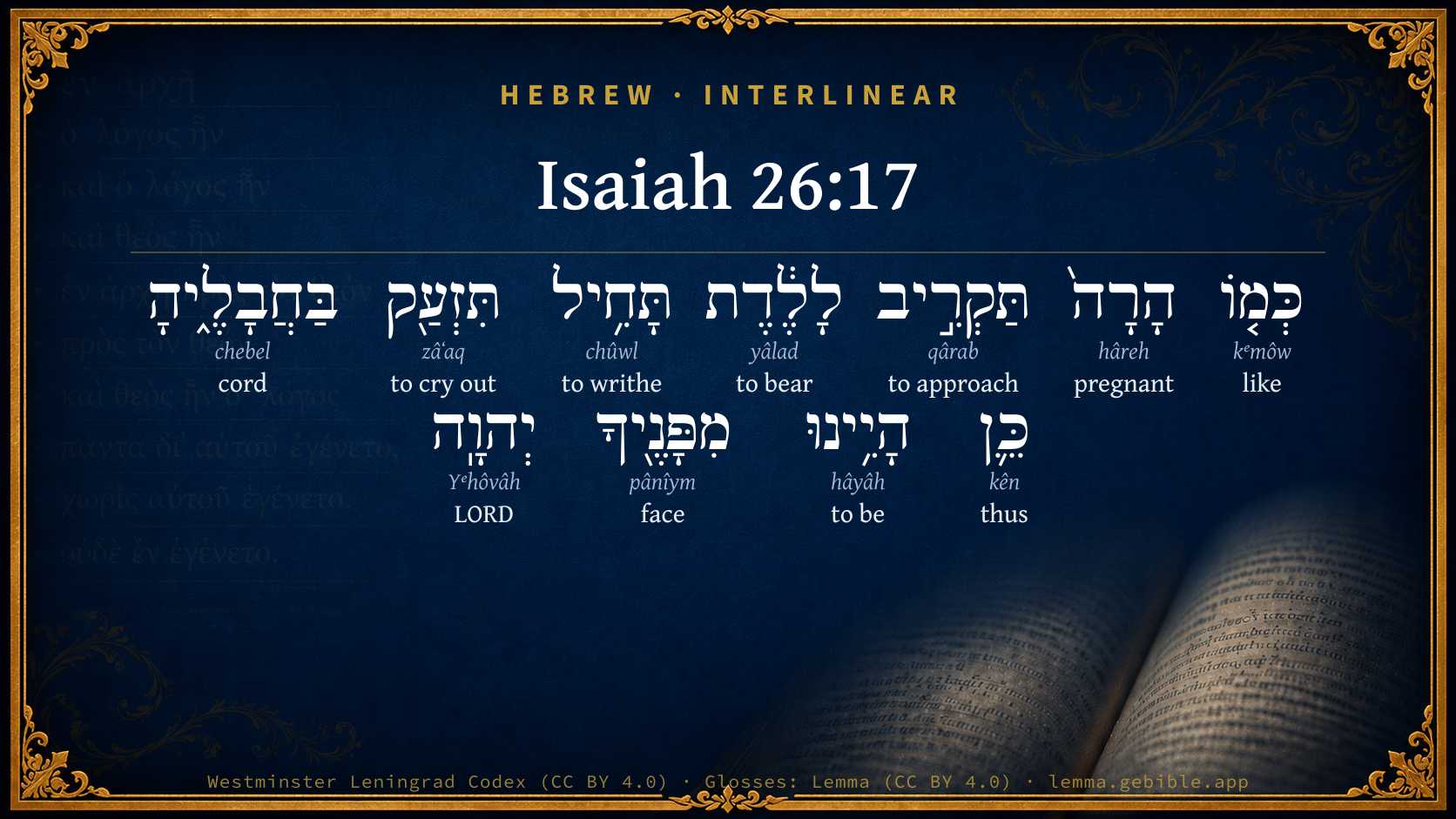
  1. כְּמ֤וֹ kᵉmôw H3644 “like” Preposition
  2. תַּקְרִ֣יב qârab H7126 “to approach” Verb, Hiphil, Imperfect, 3rd Person, Feminine, Singular
  3. לָלֶ֔דֶת yâlad H3205 “to bear” Preposition + Verb, Qal, Infinitive Construct
  4. תָּחִ֥יל chûwl H2342 “to writhe” Verb, Qal, Imperfect, 3rd Person, Feminine, Singular
  5. תִּזְעַ֖ק zâʻaq H2199 “to cry out” Verb, Qal, Imperfect, 3rd Person, Feminine, Singular
  6. בַּחֲבָלֶ֑יהָ chebel H2256 “in/at · cords · her” Preposition + Noun, Common, Masculine, Plural, Construct + Suffix, Personal, 3rd Person, Feminine, Singular
  7. כֵּ֛ן kên H3651 “thus” Particle, Demonstrative
  8. הָיִ֥ינוּ hâyâh H1961 “to be” Verb, Qal, Perfect, 1st Person, Common, Plural
  9. מִפָּנֶ֖יךָ pânîym H6440 “from · face(s) · your” Preposition + Noun, Common, Both, Plural, Construct + Suffix, Personal, 2nd Person, Masculine, Singular
  10. יְהוָֽה Yᵉhôvâh H3068 “LORD” Noun, Proper

About this verse

These counts appear in no published source. They are computed here, from the morphology-tagged text and Lemma’s own curated glosses. What Lemma adds →

11
words
11
distinct lemmas
Prophets
section

Notable vocabulary

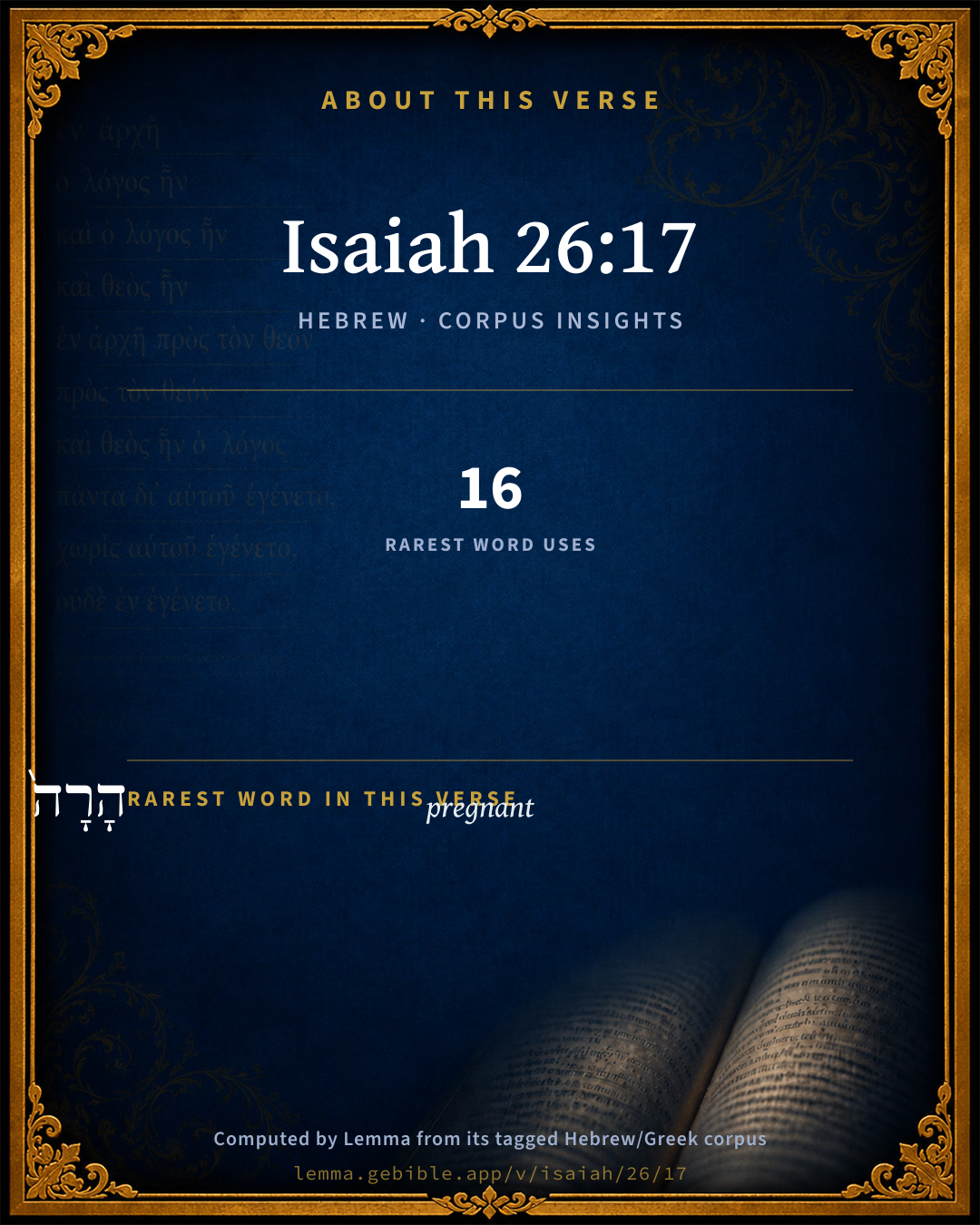
The rarest word here is הָרָה֙ pregnant H2030 — appearing just 16 times in the whole Hebrew Bible.

Shared distinctive vocabulary

הָרָה֙ pregnant H2030 occurs in 16 verses of the Hebrew Bible. Also found in:

Grammatical profile

  • 5 verbs
  • 3 nouns
  • 1 adjective
  • 1 preposition
  • 1 particle

Verb forms

  • תַּקְרִ֣יב Hiphil · Imperfect
  • לָלֶ֔דֶת Qal · Infinitive Construct
  • תָּחִ֥יל Qal · Imperfect
  • תִּזְעַ֖ק Qal · Imperfect
  • הָיִ֥ינוּ Qal · Perfect

Hebrew & Septuagint length

In English translation the verse runs 30 words from the Hebrew and 24 from the Septuagint (LXX English) — closely comparable.

A rough comparison of the two English renderings, which tokenize alike — not a word-level alignment.

Word counts can differ between the Hebrew and the Greek without any difference in meaning — e.g. the Hebrew direct-object marker אֵת has no separate Greek word, and Greek often adds the article ὁ.

Cross-references

8

Topical passages linked to Isaiah 26:17 in the Treasury of Scripture Knowledge — connected by theme and wording, ordered by reader-vote popularity; previews shown in the World English Bible.

  • Isaiah 13:8 and they shall be dismayed; pangs and sorrows shall take hold [of them]; they shall be in pain as a woman in travail: they shall look in amazement one at another; their faces [shall be] faces of flame.
  • Isaiah 21:3 Therefore are my loins filled with anguish; pangs have taken hold on me, as the pangs of a woman in travail: I am pained so that I can't hear; I am dismayed so that I can't see.
  • John 16:21 A woman, when she gives birth, has sorrow, because her time has come. But when she has delivered the child, she doesn't remember the anguish any more, for the joy that a human being is born into the world.
  • Jeremiah 4:31 For I have heard a voice as of a woman in travail, the anguish as of her who brings forth her first child, the voice of the daughter of Zion, who gasps for breath, who spreads her hands, [saying], Woe is me now! for my soul faints before the murderers.
  • 1 Thessalonians 5:3 For when they are saying, "Peace and safety," then sudden destruction will come on them, like birth pains on a pregnant woman; and they will in no way escape.
  • Psalms 48:6 Trembling took hold of them there, Pain, as of a woman in travail.
  • Jeremiah 6:24 We have heard the report of it; our hands wax feeble: anguish has taken hold of us, [and] pangs as of a woman in travail.
  • Jeremiah 30:6 Ask now, and see whether a man does travail with child: why do I see every man with his hands on his loins, as a woman in travail, and all faces are turned into paleness?

Cross-references courtesy of OpenBible.info (CC BY 4.0).

Hebrew and Greek witnesses Masoretic Hebrew ↔ Greek Septuagint

The same verse in the two great witnesses to the Old Testament, shown verse-for-verse.

These are two independent witnesses, not word-aligned to each other, and the Septuagint is shown in lemma (dictionary) form.

Hebrew Isaiah 26:17 Masoretic · Westminster Leningrad Codex

כְּמ֤וֹ הָרָה֙ תַּקְרִ֣יב לָלֶ֔דֶת תָּחִ֥יל תִּזְעַ֖ק בַּחֲבָלֶ֑יהָ כֵּ֛ן הָיִ֥ינוּ מִפָּנֶ֖יךָ יְהוָֽה

Like as a woman with child, who draws near the time of her delivery, is in pain and cries out in her pangs; so we have been before you, Yahweh.

World English Bible · Public Domain

Greek LXX Isaiah 26:17 Septuagint · lemma form

καί ὡς ὁ ὠδίνω ἐγγίζω ὁ τίκτω καί ἐπί ὁ ὠδίν αὐτός κράζω οὕτως γίγνομαι ὁ ἀγαπητός σύ διά ὁ φόβος σύ κύριος

And as a woman in travail draws near to be delivered, and cries out in her pain; so have we been to your beloved.

LXX2012 (modern English Septuagint) · Public Domain

Hebrew: Westminster Leningrad Codex (CC BY 4.0). Greek: Septuagint (public domain); English from LXX2012 (modern English Septuagint) (Public Domain). How the Septuagint differs from the Hebrew →

Targum (Aramaic paraphrase)

1

The Targum is the ancient Jewish Aramaic paraphrase of the Hebrew Scriptures — an interpretive translation, not the Hebrew text itself. Onkelos (literal) and Pseudo-Jonathan (expansive) render the Torah, and Jonathan the Prophets. Coverage is partial: where no permissively-licensed English translation exists for a verse, only the Aramaic is shown. This is verse-level text, not a word-by-word alignment to the Hebrew.

  1. Targum Jonathan Prophets (Joshua–Malachi)
    כִּמְעַדְיָא דִמְטָא דִבְעִדָן מֵילְדָה זָיְעָא וּמְצַוְחָא בְּחֶבְלָהָא כֵּן הֲוֵינָא מִן קֳדָם דְחַבְנָא קֳדָמָךְ יְיָ:

    Like as a woman with child, who draweth near the time of her delivery, trembleth, and crieth out in her pangs, so have we been, because we have sinned before thee.

    Targum Jonathan — Aramaic: “Mikraot Gedolot” (public domain). English: “Sefaria Community Translation” (CC0 1.0 (public-domain dedication)); “London "Chaldee Paraphrase," 1871” (public domain). Text via Sefaria.

Commentary

Notes on Isaiah 26:17 from classic Christian and Jewish commentators (each source and its license shown beneath its notes). The classic Christian expositions comment on the surrounding passage and are grouped to its opening verse, so a note may address several verses; the Jewish commentaries on the Tanakh (Rashi and others) are per-verse, so they appear only where the commentator wrote on this verse.

Lemma curates 59 commentaries, every one of them public domain or Creative Commons licensed, each selected and text-cleaned for this edition rather than reprinted as found. About our sources →

Trapp's Complete Commentary

John Trapp

Isa 26:17 Like as a woman with child, [that] draweth near the time of her delivery, is in pain, [and] crieth out in her pangs; so have we been in thy sight, O LORD.

Ver. 17. So have we been in thy sight.] Heb, From thy face - i.e., by reason of thy wrath. So 2Th 1:9, "Who shall be punished from the presence of God," that is, of God himself present to their terror.

John Trapp, A Commentary or Exposition upon All the Books of the Old and New Testament (1647–1656) — public domain. Text from a community e-Sword module.

Tyndale Open Study Notes

Tyndale Open Resources

26:17 The imagery of a pregnant woman in childbirth describes the nation’s pain when Assyrian king Sennacherib attacked it in 701 BC (see 37:3).

Tyndale Open Study Notes — © Tyndale Open Resources, licensed CC BY-SA 4.0. Text via the HelloAO Bible API.

Geneva Bible (1599)

Geneva Bible translators

To wit, in extreme sorrow.

Geneva Bible (1599) marginal notes — public domain. Text via Bolls.life.

Jamieson, Fausset & Brown

Robert Jamieson, A. R. Fausset & David Brown

An image of anguish accompanied with expectation, to be followed by joy that will cause the anguish utterly to be forgotten. Zion, looking for deliverance, seemingly in vain, but really about to be gloriously saved (Mic 4:9-13; Mic 5:1-3; Joh 16:21-22).

Jamieson, Fausset & Brown — Commentary Critical and Explanatory on the Whole Bible (1871) — public domain (CC PDM 1.0). Text via the HelloAO Bible API.

Ellicott's Commentary for English Readers

(17) Like as a woman with child.—This, as in Mat_24:8, Joh_16:21, comes as the most natural image of longing, painful expectation, followed by great joy.

A Bible Commentary for English Readers, edited by Charles John Ellicott (1878–1897) — public domain. Text from a community e-Sword module.

The Cambridge Bible for Schools and Colleges

gen. ed. J. J. S. Perowne

17. The agony of the crisis is compared to the pangs of a woman in travail,—a common figure, Hos_13:13; Mic_4:10, &c.

in thy sight] Or, because of thee—Thy chastening hand.

The Cambridge Bible for Schools and Colleges (gen. ed. J. J. S. Perowne; Cambridge University Press, 1878–1918) — public domain. Text from a community e-Sword module.

John Gill's Exposition

Like as a woman with child,.... By this simile are set forth the great distresses and afflictions the church of Christ will be in, before redemption and deliverance from the antichristian yoke comes:

that draweth near the time of her delivery; when her burden is great and very troublesome:

is in pain, and crieth out in her pangs; for her friends to come about her, and give her all the help and assistance they can:

so have we been in thy sight, O Lord; in great distress and trouble, and crying to him for salvation and deliverance, all which were well known unto him.

John Gill's Exposition of the Whole Bible (1746–1763) — public domain (CC PDM 1.0). Text via the HelloAO Bible API.

Albert Barnes' Notes on the Bible

Like as a woman with child ... - This verse is designed to state their griefs and sorrows during the time of their oppression in Babylon. The comparison used here is one that is very frequent in the sacred writings to represent any great suffering (see Psa 48:6; Jer 6:24; Jer 13:21; Jer 22:23; Jer 49:24; Jer 50:43; Mic 4:9-10).

Albert Barnes' Notes on the Bible (1834–1885) — public domain. Text from a community e-Sword/MySword module.

Matthew Poole's English Annotations

So have we been, such was our anguish and danger, in thy sight; whilst thou didst only look upon us like a mere spectator, without affording us the least degree of pity or help. Or this phrase notes only the reality of the thing; God was witness of this our misery, and knoweth the truth of what I say.

Matthew Poole's English Annotations on the Holy Bible (1683–1685) — public domain. Text from a community e-Sword/MySword module.

The Pulpit Commentary

Like as a woman with child. (comp. Isa_13:8 Isa_21:3) Isaiah uses the metaphor to express any severe pain combined with anxiety. So have we been in thy sight; rather, so have we been at thy presence. When thou wert visiting us in anger, and laying thy chastisements upon us.

The Pulpit Commentary (1880–1919), ed. H.D.M. Spence-Jones & Joseph S. Exell — public domain. Text from a community e-Sword module.

John Wesley's Explanatory Notes

Like - Such was our anguish and danger.

John Wesley, Explanatory Notes Upon the Whole Bible (1754–1765) — public domain. Text via the GEBible commentary corpus.

J. A. Alexander on Isaiah

Joseph Addison Alexander

“As when a pregnant (woman) draws near to the birth, she writhes, she cries out in her pangs; so have we been, from Thy presence, oh Jehovah!” Before we thus cast ourselves upon Thy mercy in submissive prayer, we tried to deliver ourselves, but only to the aggravation of our sufferings. The comparison here used is not intended simply to denote extreme pain, as it is in many other cases, but as the next verse clearly shows, the pain arising from ineffectual efforts to relieve themselves. The great majority of writers apply this verse to the condition of the exiles. The translation ‘from Thy presence’ is to be preferred; but whether with the accessory idea of removal, alienation, or with that of infliction, is a question not determined by the phrase itself, but either left uncertain or to be decided by the context.

Joseph Addison Alexander, The Prophecies of Isaiah (1846–1847; New York: Scribner, 1870–1878) — public domain. Text from a community e-Sword module.

Rashi

Rabbi Shlomo Yitzchaki (Rashi)

As a pregnant woman comes near to give birth, etc. So were we because of You; we see troubles being renewed, and we think that they are sorts of indications of salvation and redemption, for we are promised to be redeemed out of straits, as a woman giving birth.

because of You Because of Your decrees.

Rashi on the Tanakh — English translations: “The Judaica Press complete Tanach with Rashi, translated by A. J. Rosenberg” (CC BY 4.0); “Pentateuch with Rashi's commentary by M. Rosenbaum and A.M. Silbermann, 1929-1934” (public domain); “The Metsudah Tanach series, Lakewood, N.J” (CC BY 4.0); and “The Book of Joshua, Metsudah Publications, 1997” (CC BY 4.0). Text via Sefaria.

Ibn Ezra

Rabbi Abraham ibn Ezra

Like as a woman, etc. This verse describes the chastening mentioned in the preceding verse.

תקריב That draweth near Lit. that bringeth near, namely, herself.

Ibn Ezra on the Tanakh — English translations: “Sefaria Community Translation” (CC0 1.0 (public-domain dedication)); “Yalkut, Sifsei Chachomim Chumash, Metsudah Publications, 2009” (CC BY 4.0); and “Commentary of Ibn Ezra on Isaiah - trans. by M. Friedlander, 1873” (public domain). Text via Sefaria.

Lesson kit

Teaching starters — assembled from the data on this page, not authored interpretation. Every prompt links to the verse data it draws on. Edit before teaching.

Isaiah, in the Prophets, opens this verse with 11 words (11 distinct Hebrew lemmas). Its most distinctive word is hâreh (“pregnant”). A historical commentator’s framing appears above. Read the whole chapter for the surrounding context.

Discussion questions

  1. What does “pregnant” (hâreh) contribute to the verse as a whole?
  2. How does Genesis 16:11, which shares the word «pregnant», read alongside this verse?
  3. The translations on this page render this verse differently — a whole-verse word diff, not a word-by-word alignment. What might account for the different wordings?
  4. «תַּקְרִ֣יב» is a Hiphil Imperfect verb. How does that grammatical form shape the action described?
  5. Compare how Trapp's Complete Commentary and Tyndale Open Study Notes read this verse. Where do they agree or differ?

Things to notice

Reading settings

Reading text

Shown beneath each verse's original-language words.

Old Testament
Old Testament edition

Read the OT as the Masoretic Hebrew (MT) or the Greek Septuagint (LXX).

English shown for the Greek Septuagint (in the Hebrew ↔ Greek comparison).

Comparing translations? Open the Compare panel on any verse page to stack up to four side by side.