
Psalms 71:19

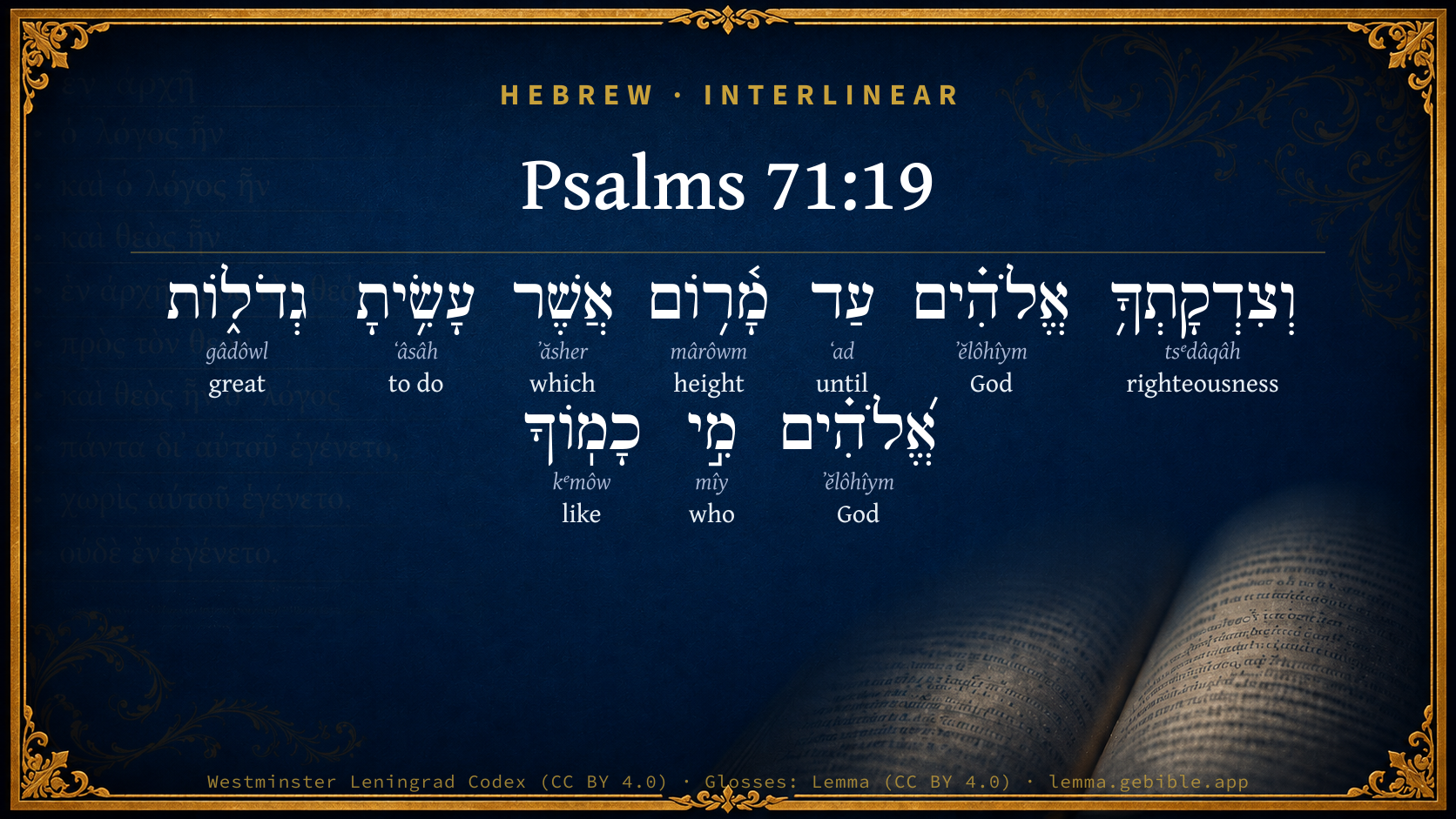
Hebrew (Westminster Leningrad Codex) Psalms 71:19 appears in the Hebrew Old Testament. The text above is from the Westminster Leningrad Codex. Each word links to its Strong’s number, a concise gloss, and parsing drawn from the Open Scriptures Hebrew Bible morphology. Click any word for its full Brown-Driver-Briggs (BDB) entry.
Download image
Cite this verse

Psalms 71:19 (World English Bible). Public Domain. Lemma interlinear Bible study tool, https://lemma.gebible.app/v/psalms/71/19.

Show BibTeX & RIS
BibTeX
RIS
English Translation
Your righteousness also, God, reaches to the heavens; You have done great things. God, who is like you?
World English Bible · Public Domain
Download a study sheet

One document with this verse’s original text, its word-by-word gloss line, the meaning frame, cross-references with their text, attributed commentary, and full source and license credits — printable, and it pastes into notes with its structure intact.

This verse Autodidact and up

Study sheet (.html) Plain text (.txt)

A passage Seminary Student

Up to 50 verses in one chapter. A passage sheet keeps up to 6 commentary sources and 12 cross-references per verse, in the order this page ranks them, and says so on the sheet whenever that leaves anything out. Ask for a single verse and you get the Autodidact verse sheet above.

Everything on this page stays free to read, with no account — the sheet is a download of what is already on screen, not access to it.

Want to remove ads? Support Godless Engineer
Compare translations 3

The same verse in 3 English versions, stacked beneath the original-language interlinear above. Click any original word for its lexicon entry.

Each is an independent rendering of the whole verse — the interlinear is not word-aligned to these translations.

Highlighted words mark where these versions differ — a whole-verse word diff, not a word-by-word alignment.

  • World English Bible Public Domain
    Your righteousness also, God, reaches to the heavens; You have done great things. God, who is like you?
  • King James Version Public Domain
    Thy righteousness also, O God, is very high, who hast done great things: O God, who is like unto thee!
  • unfoldingWord Literal Text CC BY-SA 4.0
    For your righteousness, God, to height, who do great; God, who like you?

unfoldingWord Literal Text — © unfoldingWord, licensed CC BY-SA 4.0. Word-aligned USFM3 via Door43 (git.door43.org/unfoldingWord/en_ult).

Versions to compare (up to 4)

3 of 4 selected

Show all 18 translations

Every available English version of this verse, each an independent rendering of the whole verse.

  • World English Bible Public Domain
    Your righteousness also, God, reaches to the heavens; You have done great things. God, who is like you?
  • Berean Standard Bible Public Domain
    Your righteousness reaches to the heavens, O God, You who have done great things. Who, O God, is like You?
  • Majority Standard Bible Public Domain
    Your righteousness reaches to the heavens, O God, You who have done great things. Who, O God, is like You?
  • King James Version Public Domain
    Thy righteousness also, O God, is very high, who hast done great things: O God, who is like unto thee!
  • American Standard Version (1901) Public Domain
    Thy righteousness also, O God, is very high; Thou who hast done great things, O God, who is like unto thee?
  • Revised Version (1885) Public Domain
    Thy righteousness also, O God, is very high; thou who hast done great things, O God, who is like unto thee?
  • Geneva Bible (1599) Public Domain
    And thy righteousnes, O God, I wil exalt on high: for thou hast done great thinges: O God, who is like vnto thee!
  • Douay-Rheims (1899) Public Domain
    and thy justice, O God, even to the highest great things thou hast done: O God, who is like to thee?
  • Young's Literal Translation Public Domain
    And Thy righteousness, O God, `is' unto the heights, Because Thou hast done great things, O God, who `is' like Thee?
  • Literal Standard Version CC BY-SA 4.0
    And Your righteousness, O God, [is] to the heights, || Because You have done great things, || O God, who [is] like You?
  • Unlocked Literal Bible CC BY-SA 4.0
    Your righteousness also, God, is very high; you who have done great things, God, who is like you?
  • unfoldingWord Literal Text CC BY-SA 4.0
    For your righteousness, God, to height, who do great; God, who like you?
  • Darby Bible Public Domain
    And thy righteousness, O God, reacheth on high, thou who hast done great things: O God, who is like unto thee?
  • World Messianic Bible Public Domain
    God, your righteousness also reaches to the heavens. You have done great things. God, who is like you?
  • Webster's Bible Public Domain
    Thy righteousness also, O God, is very high, who hast done great things: O God, who is like to thee!
  • Free Bible Version CC BY-SA 4.0
    God, your trustworthy and true nature is higher than the highest heaven! You have done incredible things! God, who is like you?
  • Bible in Basic English Public Domain
    Your righteousness, O God, is very high; you have done great things; O God, who is like you?
  • JPS Tanakh (1917) Public Domain
    Thy righteousness also, O God, which reacheth unto high heaven; Thou who hast done great things, O God, who is like unto Thee?

Literal Standard Version (2020), Covenant Press — licensed CC BY-SA 4.0. Text via the HelloAO Bible API (eBible.org). Unlocked Literal Bible (unfoldingWord) — licensed CC BY-SA 4.0. Text via the HelloAO Bible API (eBible.org). unfoldingWord Literal Text — © unfoldingWord, licensed CC BY-SA 4.0. Word-aligned USFM3 via Door43 (git.door43.org/unfoldingWord/en_ult). Free Bible Version, Dr. Jonathan Gallagher — licensed CC BY-SA 4.0. Text via the HelloAO Bible API (eBible.org).

Word by word

More ways to search: Search by grammar → Find every occurrence → Compare this word →

Practice this passage: Drill this verse → Learn its vocabulary →

About this verse

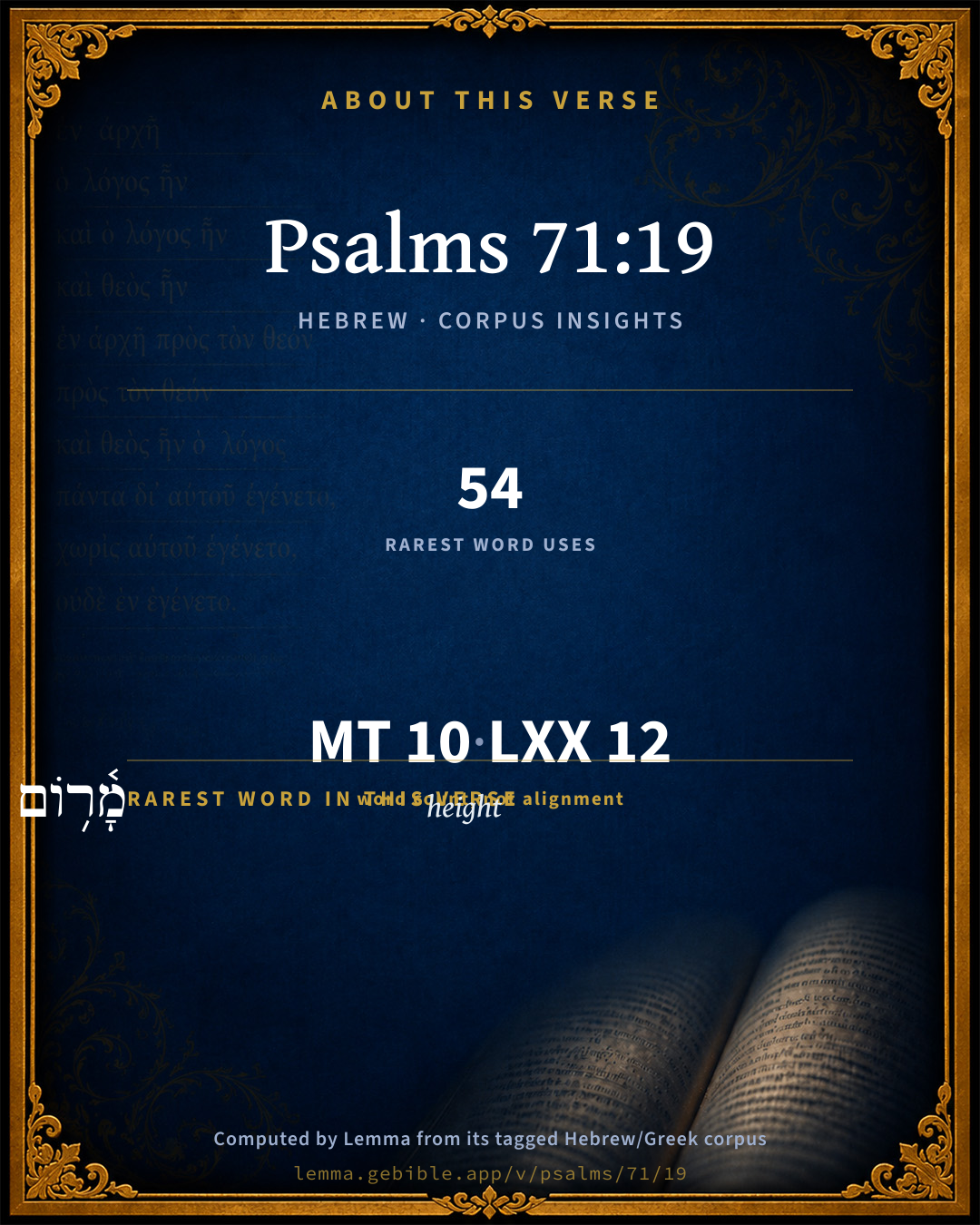
These counts appear in no published source. They are computed here, from the morphology-tagged text and Lemma’s own curated glosses. What Lemma adds →

10
words
9
distinct lemmas
Wisdom
section

Shared distinctive vocabulary

מָ֫ר֥וֹם height H4791 occurs in 52 verses of the Hebrew Bible. Also found in:

Grammatical profile

  • 1 verb
  • 4 nouns
  • 1 adjective
  • 2 prepositions
  • 2 particles

Verb forms

  • עָשִׂ֥יתָ Qal · Perfect

Repetition

A word recurs within this verse — often emphatic in Hebrew:

  • אֱלֹהִ֗ים God H430 ×2

Hebrew & Septuagint length

In English translation the verse runs 18 words from the Hebrew and 28 from the Septuagint (LXX English) — closely comparable.

A rough comparison of the two English renderings, which tokenize alike — not a word-level alignment.

Word counts can differ between the Hebrew and the Greek without any difference in meaning — e.g. the Hebrew direct-object marker אֵת has no separate Greek word, and Greek often adds the article ὁ.

In the original languages it is 10 Hebrew tokens and 12 Greek tokens — but the two are counted differently (Hebrew bundles its prefixes and suffixes into one token; the Greek is in lemma form), so that isn’t a like-for-like length.

Cross-references

18

Topical passages linked to Psalms 71:19 in the Treasury of Scripture Knowledge — connected by theme and wording, ordered by reader-vote popularity; previews shown in the World English Bible.

  • Psalms 35:10 All my bones shall say, "Yahweh, who is like you, Who delivers the poor from him who is too strong for him, Yes, the poor and the needy from him who robs him?"
  • Psalms 36:5–6 Your loving kindness, Yahweh, is in the heavens. Your faithfulness reaches to the skies.
  • Psalms 57:10 For your great loving kindness reaches to the heavens, And your truth to the skies.
  • Isaiah 55:9 For as the heavens are higher than the earth, so are my ways higher than your ways, and my thoughts than your thoughts.
  • Exodus 15:11 Who is like you, Yahweh, among the gods? Who is like you, glorious in holiness, Fearful in praises, doing wonders?
  • Psalms 86:8 There is no one like you among the gods, Lord, Nor any deeds like your deeds.
  • Psalms 89:6–8 For who in the skies can be compared to Yahweh? Who among the sons of the heavenly beings is like Yahweh,
  • Psalms 126:2–3 Then our mouth was filled with laughter, And our tongue with singing. Then they said among the nations, "Yahweh has done great things for them."
  • Isaiah 40:18 To whom then will you liken God? or what likeness will you compare to him?
  • Jeremiah 10:7 Who should not fear you, King of the nations? for to you does it appertain; because among all the wise men of the nations, and in all their royal estate, there is none like you.
  • Job 5:9 Who does great things that can't be fathomed, Marvelous things without number;
  • Psalms 72:18 Praise be to Yahweh God, the God of Israel, Who alone does marvelous deeds.
  • Isaiah 5:16 But Yahweh of Hosts is exalted in justice, And God the Holy One is sanctified in righteousness.
  • Isaiah 40:25 To whom then will you liken me, that I should be equal [to him]? says the Holy One.
  • Luke 1:49 For he who is mighty has done great things for me. Holy is his name.
  • Psalms 139:6 This knowledge is beyond me. It's lofty. I can't attain it.
  • Proverbs 15:24 The path of life leads upward for the wise, To keep him from going downward to Sheol.
  • Proverbs 24:7 Wisdom is too high for a fool: He doesn't open his mouth in the gate.

Cross-references courtesy of OpenBible.info (CC BY 4.0).

Hebrew and Greek witnesses Masoretic Hebrew ↔ Greek Septuagint

The same verse in the two great witnesses to the Old Testament, shown verse-for-verse.

You’re reading Greek Psalm 70 (Hebrew Psalm 71). The Septuagint counts the superscription, so verse numbers can differ from the Hebrew — chapter-level alignment, not verse-by-verse. Numbering follows Rahlfs.

These are two independent witnesses, not word-aligned to each other, and the Septuagint is shown in lemma (dictionary) form.

Hebrew Psalms 71:19 Masoretic · Westminster Leningrad Codex

וְצִדְקָתְךָ֥ אֱלֹהִ֗ים עַד מָ֫ר֥וֹם אֲשֶׁר עָשִׂ֥יתָ גְדֹל֑וֹת אֱ֝לֹהִ֗ים מִ֣י כָמֽוֹךָ

Your righteousness also, God, reaches to the heavens; You have done great things. God, who is like you?

World English Bible · Public Domain

Greek LXX Greek Psalm 70:19 Septuagint · lemma form

ὁ θεός ἕως ὕψιστος ὅς ποιέω μεγαλεῖος ὁ θεός τίς ὅμοιος σύ

even your power and your righteousness, O God, up to the highest heavens, even the mighty works which you have done: O God, who is like to you?

LXX2012 (modern English Septuagint) · Public Domain

On this verse, Keil & Delitzsch discusses the Septuagint’s reading. Read the note in Commentary ↓

Hebrew: Westminster Leningrad Codex (CC BY 4.0). Greek: Septuagint (public domain); English from LXX2012 (modern English Septuagint) (Public Domain). How the Septuagint differs from the Hebrew →

Commentary

Notes on Psalms 71:19 from classic Christian and Jewish commentators (each source and its license shown beneath its notes). The classic Christian expositions comment on the surrounding passage and are grouped to its opening verse, so a note may address several verses; the Jewish commentaries on the Tanakh (Rashi and others) are per-verse, so they appear only where the commentator wrote on this verse.

Lemma curates 59 commentaries, every one of them public domain or Creative Commons licensed, each selected and text-cleaned for this edition rather than reprinted as found. About our sources →

Trapp's Complete Commentary

John Trapp

Psa 71:19 Thy righteousness also, O God, [is] very high, who hast done great things: O God, who [is] like unto thee!

Ver. 19. Thy righteousness also, O God, is very high] Far above the reach of human reason; yet for the strengthening of my hope, I will look up after it, though mine eye should be tired in the way.

John Trapp, A Commentary or Exposition upon All the Books of the Old and New Testament (1647–1656) — public domain. Text from a community e-Sword module.

Joseph Benson's Commentary

Psa 71:19. Thy righteousness also is very high — Most eminent and evident, as high things are; and that which thou hast in righteousness done for thy people is very great. God’s righteousness, here intended, includes the rectitude of his nature; the equity of his providential dispensations; the righteous laws which he hath given us to be ruled by; the righteous promises he hath given us to depend upon; and the everlasting righteousness which his Son hath brought in, by his obedience unto death, for our justification.

Joseph Benson's Commentary on the Old and New Testaments (1811–1818) — public domain. Text from a community e-Sword module.

Whedon's Commentary on the Bible

Daniel D. Whedon

19. Thy righteousness—Five times in this psalm is the “righteousness” of God mentioned as the source of salvation and the theme of praise. Psa_71:2; Psa_71:15-16; Psa_71:19; Psa_71:24. It is a technical term for the rectoral justice of God. The Hebrews had no conception of any divine method of salvation, temporal or spiritual, which did not include justice as well as mercy; a vindication of regal rectitude as well as of fatherly pity. Psa_85:10-11; Psa_85:13; Rom_3:26. Hence, no acceptable praise can be given him which does not exalt his righteousness, and no salvation can be expected which bears not the seal of his justice. See on Rom_3:25-26. His acts are in harmony with all his attributes.

Daniel D. Whedon (gen. ed.), Commentary on the Old and New Testaments (1874–1909) — public domain. Text from a community e-Sword module.

Keil & Delitzsch

C. F. Keil & F. Delitzsch

The thought of this proclamation so thoroughly absorbs the poet that he even now enters upon the tone of it; and since to his faith the deliverance is already a thing of the past, the tender song with its uncomplaining prayer dies away into a loud song of praise, in which he pictures it all to himself. Without Psa 71:19-21 being subordinate to עד־אגיד in Psa 71:18, וצדקתך is coupled by close connection with בגורתך. Psa 71:19 is an independent clause; and עד־מרום takes the place of the predicate: the righteousness of God exceeds all bounds, is infinite (Psa 36:6., Psa 57:11). The cry כמוך מי, as in Psa 35:10; Psa 69:9, Jer 10:6, refers back to Exo 15:11. According to the Chethb, the range of the poet's vision widens in Psa 71:20 from the proofs of the strength and righteousness of God which he has experienced in his own case to those which he has experienced in common with others in the history of his own nation. The Ker (cf. on the other hand Psa 60:5; Psa 85:7; Deu 31:17) rests upon a failing to discern how the experiences of the writer are interwoven with those of the nation. תּשׁוּב in both instances supplies the corresponding adverbial notion to the principal verb, as in Psa 85:7 (cf. Psa 51:4). תּהום, prop. a rumbling, commonly used of a deep heaving of waters, here signifies an abyss. "The abysses of the earth" (lxx ἐκ τῶν ἀβύσσων τῆς γῆς, just as the old Syriac version renders the New Testament ἄβυσσος, e.g., in Luk 8:31, by Syr. tehūmā') are, like the gates of death (Psa 9:14), a figure of extreme perils and dangers, in the midst of which one is as it were half hidden in the abyss of Hades. The past and future are clearly distinguished in the sequence of the tenses. When God shall again raise His people out of the depth of the present catastrophe, then will He also magnify the גּדלּה of the poet, i.e., in the dignity of his office, by most brilliantly vindicating him in the face of his foes, and will once more (תּסּוב, fut. Niph. like תּשׁוּב ekil .h above) comfort him. He on his part will also (cf. Job 40:14) be grateful for this national restoration and this personal vindication: he will praise God, will praise His truth, i.e., His fidelity to His promises. בּכלי נבל instead of בּנבל sounds more circumstantial than in the old poetry. The divine name "The Holy One of Israel" occurs here for the third time in the Psalter; the other passages are Psa 78:41; Psa 89:19, which are older in time, and older also than Isaiah, who uses it thirty times, and Habakkuk, who uses it once. Jeremiah has it twice (Jer 50:29; Jer 51:5), and that after the example of Isaiah. In Psa 71:23, Psa 71:24 the poet means to say that lips and tongue, song and speech, shall act in concert in the praise of God. תּרנּנּה with Dagesh also in the second Nun, after the form תּקוננּה, תּשׁכּנּה, side by side with which we also find the reading תּרנּנּה, and the reading תּרנּנה, which is in itself admissible, after the form תּאמנה, תּעגנה, but is here unattested.

(Note: Heidenheim reads תּרנּנּה with Segol, following the statement of Ibn-Bil'am in his טעמי המקרא and of Mose ha-Nakdan in his דרכי הנקוד, that Segol always precedes the ending נּה, with the exception only of הנּה and האזנּה. Baer, on the other hand, reads תונּנּה, following Aben-Ezra and Kimchi (Michlol 66b).)

The cohortative after כּי (lxx ὅταν) is intended to convey this meaning: when I feel myself impelled to harp unto Thee. In the perfects in the closing line that which is hoped for stands before his soul as though it had already taken place. כי is repeated with triumphant emphasis.

Keil & Delitzsch — Biblical Commentary on the Old Testament (1861–1891) — public domain (CC PDM 1.0). Text via the HelloAO Bible API. (Old Testament only.)

J. A. Alexander on Psalms

Joseph Addison Alexander

Psa 71:19. And thy righteousness, 0 God, (reaches) even to the height (or high place), i.e. heaven, (thou) who hast done great things, 0 God, who is like thee? With the first clause compare Psa 36:5; Psa 57:10); with the last, Exo 15:11, Deu 3:24, 2Sa 7:22.

Joseph Addison Alexander, The Psalms Translated and Explained (1850) — public domain. Text from a community e-Sword module.

Tyndale Open Study Notes

Tyndale Open Resources

71:19-21 God’s righteous character provides encouragement and strength in the midst of suffering. The wounded psalmist confesses faith in God’s ability to transform his misery and weakness into abundant life.

Tyndale Open Study Notes — © Tyndale Open Resources, licensed CC BY-SA 4.0. Text via the HelloAO Bible API.

Geneva Bible (1599)

Geneva Bible translators

His faith breaketh through all tentations, and by this exclamation he praiseth the power of God.

Thy just performance of thy promise.

Geneva Bible (1599) marginal notes — public domain. Text via Bolls.life.

Adam Clarke's Commentary

Verse 19. Thy righteousness - is very high] עד מרום ad marom - is up to the exalted place, reaches up to heaven. The mercy of God fills all space and place. It crowns in the heavens what it governed upon earth.

Who hast done great things] גדלות gedoloth. Thou hast worked miracles, and displayed the greatest acts of power.

Who is like unto thee!] מי כמוך mi camocha. God is alone, - who can resemble him? He is eternal. He can have none before, and there can be none after; for in the infinite unity of his trinity he is that eternal, unlimited, impartible, incomprehensible, and uncompounded ineffable Being, whose essence is hidden from all created intelligences, and whose counsels cannot be fathomed by any creature that even his own hand can form. WHO IS LIKE UNTO THEE! will excite the wonder, amazement, praise, and adoration of angels and men to all eternity.

Adam Clarke's Commentary on the Bible (1810–1826) — public domain. Text from a community e-Sword/MySword module.

John Calvin's Commentaries

19. And thy righteousness, O God! is very high. Some connect this verse with the preceding, and repeating the verb I will declare, as common to both verses, translate, And I will declare thy righteousness, O God! But this being a matter of small importance, I will not dwell upon it. David prosecutes at greater length the subject of which he had previously spoken. In the first place, he declares that the righteousness of God is very high; secondly, that it wrought mightily; and, finally, he exclaims in admiration, Who is like thee? It is worthy of notice, that the righteousness of God, the effects of which are near to us and conspicuous, is yet placed on high, inasmuch as it cannot be comprehended by our finite understanding. Whilst we measure it according to our own limited standard, we are overwhelmed and swallowed up by the smallest temptation. In order, therefore, to give it free course to save us, it behoves us to take a large and a comprehensive view — to look above and beneath, far and wide, that we may form some due conceptions of its amplitude. The same remarks apply to the second clause, which makes mention of the works of God: For thou hast done great things. If we attribute to his known power the praise which is due to it, we will never want ground for entertaining good hope. Finally, our sense of the goodness of God should extend so far as to ravish us with admiration; for thus it will come to pass that our minds, which are often distracted by an unholy disquietude, will repose upon God alone. If any temptation thrusts itself upon us, we immediately magnify a fly into an elephant; or rather, we rear very high mountains, which keep the hand of God from reaching us; and at the same time we basely limit the power of God. The exclamation of David, then, Who is like thee? tends to teach us the lesson, that we should force our way through every impediment by faith, and regard the power of God, which is well entitled to be so regarded, as superior to all obstacles. All men, indeed, confess with the mouth, that none is like God; but there is scarce one out of a hundred who is truly and fully persuaded that He alone is sufficient to save us.

John Calvin's Commentaries (1540-1563) — public domain. Text from the Calvin Translation Society English edition (1840s-50s) via the Christian Classics Ethereal Library (ccel.org). Calvin's coverage is partial (roughly two-thirds of the Bible); uncommented books and verses are honest gaps, never fabricated. The 19th-century editor's footnotes and remarks are omitted so the notes are faithfully Calvin's own voice.

Ellicott's Commentary for English Readers

(19) Very high.—Literally, to the height, i.e., to the heavens, as in Psa_36:5; Psa_57:10. The clauses should be arranged, Thy righteousness also, O God, to the height—Thou who doest great things—God, who is like unto thee? (Comp. Exo_15:11.)

A Bible Commentary for English Readers, edited by Charles John Ellicott (1878–1897) — public domain. Text from a community e-Sword module.

The Cambridge Bible for Schools and Colleges

gen. ed. J. J. S. Perowne

19. is very high] Lit., (reacheth) unto the height, of heaven. Cp. Psa_36:5; Psa_57:10; Job_11:8.

who hast done &c.] It is better with R.V. to connect this clause with what follows: Thou who hast done great things, O God, who is like unto thee? Jehovah is incomparable for power and goodness. The fundamental passage is Exo_15:11; cp. Psa_35:10; Psa_86:8; Psa_89:6; Psa_89:8; Mic_7:18.

The Cambridge Bible for Schools and Colleges (gen. ed. J. J. S. Perowne; Cambridge University Press, 1878–1918) — public domain. Text from a community e-Sword module.

John Gill's Exposition

Thy righteousness also, O God, is very high,.... Or, "unto the place on high" (f); it reaches unto heaven, as the mercy, truth, and faithfulness of God, are said to do, Psa 36:5. The righteousness of Christ is accepted of with God the Father in heaven; it is in Christ, who is there at the right hand of God; and it is higher and infinitely above any righteousness of a creature, angel's or man's;

who hast done great things; in nature, in forming the world out of nothing, and in upholding all creatures in their beings; in providence, in governing the world, and ordering all things in it for the best, and to answer the wisest purposes; in grace, in the salvation of lost sinners by Christ; in the justification of them by his righteousness; and in the atonement and pardon of their sins, through his blood and sacrifice; in the regeneration of them by his grace; in making and performing exceeding great and precious promises, and in giving them eternal life;

O God, who is like unto thee? either for greatness or goodness; for power or for mercy; for justice, truth, and faithfulness; for the perfections of his nature, or the works of his hands; and to be praised, reverenced and adored, as he is; see Psa 89:6.

(f) "usque in excelsum", Pagninus, Montanus, Gejerus; "in altum usque", Junius & Tremellius, Piscator.

John Gill's Exposition of the Whole Bible (1746–1763) — public domain (CC PDM 1.0). Text via the HelloAO Bible API.

Albert Barnes' Notes on the Bible

Thy righteousness also, O God, is very high - See the notes at Psa 36:5. The purpose of the psalmist is to exalt that righteousness as much as possible, and he, therefore, compares it with that which is high - the heavens - the highest thing of all. The literal rendering would be, “even to the high,” or the height; that is, to the highest place. The passage is designed to express his confidence in God, in the infirmities and troubles which he must expect to come upon him with advancing years.

Who hast done great things - In his work of creation; in his providence; in his manifested mercy toward his people. He had done things so great as to show that he could protect those who put their trust in him.

O God, who is like unto thee! - Who can be compared to thee! See the notes at Psa 35:10. Compare the notes at Isa 40:18. See also Psa 89:8; Exo 15:11; 2Sa 7:22.

Albert Barnes' Notes on the Bible (1834–1885) — public domain. Text from a community e-Sword/MySword module.

Matthew Poole's English Annotations

Very high, i.e. most eminent and evident, as high things are.

Matthew Poole's English Annotations on the Holy Bible (1683–1685) — public domain. Text from a community e-Sword/MySword module.

The Treasury of David

Charles H. Spurgeon

Ver. 19. Thy righteousness also, O God, is very high. Very sublime, unsearchable, exalted, and glorious is the holy character of God, and his way of making men righteous. His plan of righteousness uplifts men from the gates of hell to the mansions of heaven. It is a high doctrine gospel, gives a high experience, leads to high practice, and ends in high felicity.

Who hast done great things. The exploits of others are mere child's play compared with thine, and are not worthy to be mentioned in the same age. Creation, providence, redemption, are all unique, and nothing can compare with them.

O God, who is like unto thee. As thy works are so transcendent, so art thou. Thou art without compeer, or even second, and such are thy works, and such, especially, thy plan of justifying sinners by the righteousness which thou hast provided. Adoration is a fit frame of mind for the believer. When he draws near to God, he enters into a region where everything is surpassingly sublime; miracles of love abound on every hand, and marvels of mingled justice and grace. A traveller among the high Alps often feels overwhelmed with awe, amid their amazing sublimities; much more is this the case when we survey the heights and depths of the mercy and holiness of the Lord.

O God, who is like unto thee.

Ver. 19. O God, who is like unto thee? Either for greatness or goodness, for power or for mercy, for justice, truth, and faithfulness; for the perfections of his nature, or the works of his hands; and to be praised, reverenced, and adored, as he is. John Gill.

Ver. 19. Who is like unto thee! Krmk ym, Mi camocha. God is alone: who can resemble him? He is eternal; he can have none before, and there can be none after; for, in the infinite unity of trinity, he is that eternal, unlimited, impartible, incomprehensible, and uncompounded, ineffable Being, whose essence is hidden from all created intelligences, and whose counsels cannot be fathomed by any creature that even his own hand can form. "WHO IS LIKE UNTO THEE!" will excite the wonder, amazement, praise, and adoration of angels and men to all eternity. Adam Clarke.

Ver. 19. A sermon might be instructively worked out upon "the high things of God."

Psalms 71:20*

Charles H. Spurgeon's The Treasury of David (1869–1885) — public domain. Psalms only. Text from a community e-Sword/MySword module.

The Pulpit Commentary

Thy righteousness also, O God, is very high; or, reaches to the height. (comp. Psa_7:7 Psa_10:5 Psa_18:16, etc.) Who hast done great things: O God, who is like unto thee!. (comp. Psa_35:10 Psa_89:6, Psa_89:8)

The Pulpit Commentary (1880–1919), ed. H.D.M. Spence-Jones & Joseph S. Exell — public domain. Text from a community e-Sword module.

John Wesley's Explanatory Notes

Very high - Most eminent.

John Wesley, Explanatory Notes Upon the Whole Bible (1754–1765) — public domain. Text via the GEBible commentary corpus.

unfoldingWord translationNotes

Door43 World Missions Community

Your righteousness also, God, is very high

The psalmist speaks of the good things God has done as though they were put together as a high building or a mountain. (See: Metaphor)

who is like you?

This rhetorical question can be translated as a statement. AT: "there is no one like you!" (See: Rhetorical Question)

revive

strengthen or make lively again

from the depths of the earth

"The depths of the earth" here is a metaphor for where people go when they die. The psalmist had not already died, but in this exaggeration he speaks as if he had. AT: "when we are near death" (See: Metaphor and Hyperbole and Generalization)

translationWords

trouble

unfoldingWord translationNotes — © Distant Shores Media and the Door43 World Missions Community, licensed CC BY-SA 4.0. Source: git.door43.org/Door43/en_tn.

Rashi

Rabbi Shlomo Yitzchaki (Rashi)

And Your charity, O God which is up to the heights. The two verses are connected by “I shall tell [of] Your strength to the generation.”

Rashi on the Tanakh — English translations: “The Judaica Press complete Tanach with Rashi, translated by A. J. Rosenberg” (CC BY 4.0); “Pentateuch with Rashi's commentary by M. Rosenbaum and A.M. Silbermann, 1929-1934” (public domain); “The Metsudah Tanach series, Lakewood, N.J” (CC BY 4.0); and “The Book of Joshua, Metsudah Publications, 1997” (CC BY 4.0). Text via Sefaria.

Lesson kit

Teaching starters — assembled from the data on this page, not authored interpretation. Every prompt links to the verse data it draws on. Edit before teaching.

Psalms, in the Wisdom, opens this verse with 10 words (9 distinct Hebrew lemmas). Its most distinctive word is mârôwm (“height”). A historical commentator’s framing appears above. Read the whole chapter for the surrounding context.

Discussion questions

  1. What does “height” (mârôwm) contribute to the verse as a whole?
  2. Judges 5:18 shares the word «height» with this verse. How do the two illuminate each other?
  3. “God” occurs 2× in this one verse. What is the effect of the repetition?
  4. These translations render this verse differently. What is at stake in choosing one wording over another?
  5. The verb «עָשִׂ֥יתָ» is Qal Perfect. How does its form color the action?
  6. Reading how Trapp's Complete Commentary and Joseph Benson's Commentary read this verse, where do the two commentators agree and where do they part?

Things to notice

Reading settings

Reading text

Shown beneath each verse's original-language words.

Old Testament
Old Testament edition

Read the OT as the Masoretic Hebrew (MT) or the Greek Septuagint (LXX).

English shown for the Greek Septuagint (in the Hebrew ↔ Greek comparison).

Comparing translations? Open the Compare panel on any verse page to stack up to four side by side.