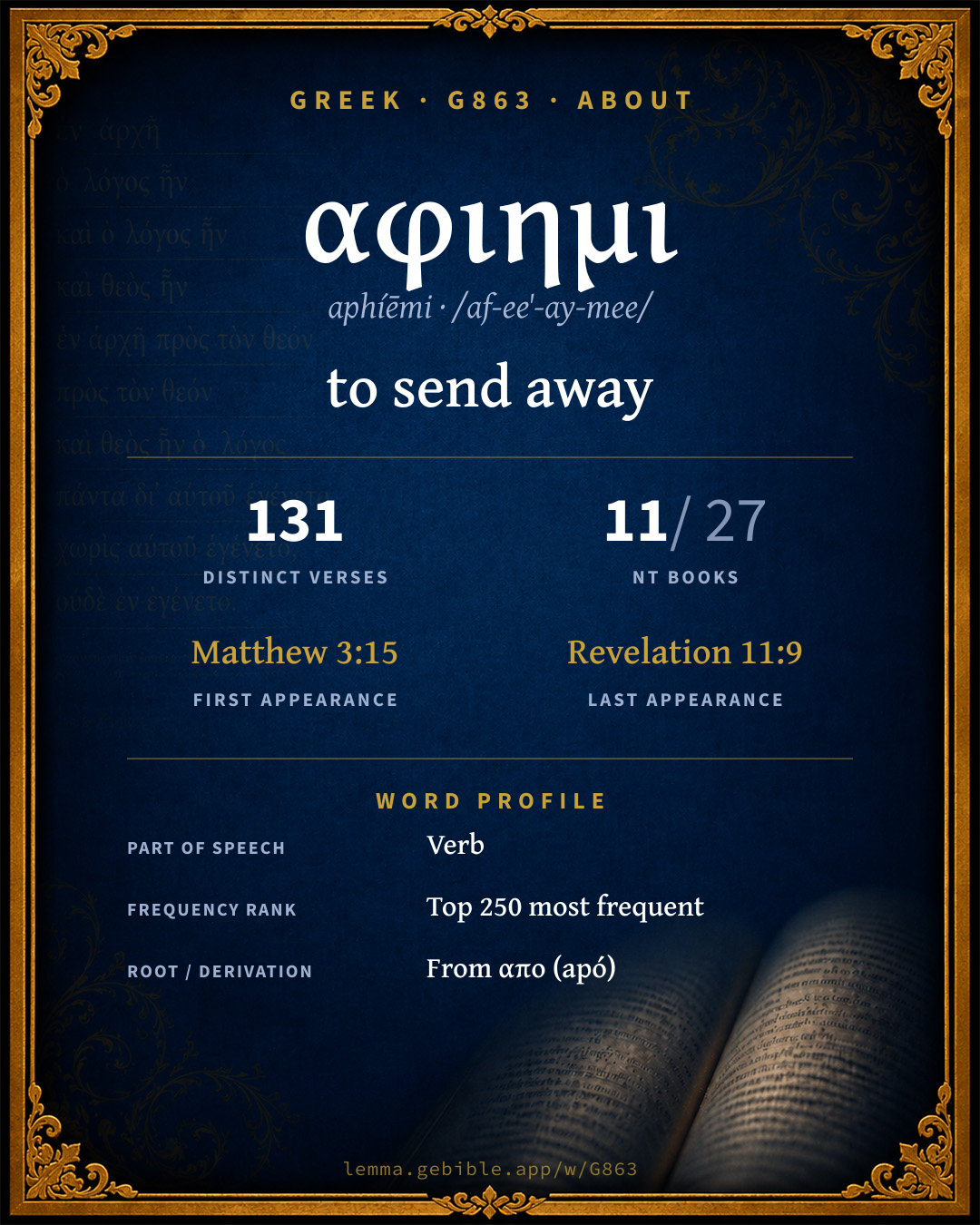
ἀφίημι
to send away
‘to send away’ is one of 6 main senses fuller range ↓
Full lexicon entry — Thayer's Greek Lexicon
From Thayer's Greek Lexicon
Where this word appears
See every Aorist-tense verb in the Greek New Testament →
Grammar key — what these labels mean
Part of speech
- Verb
- An action or state-of-being word.
Tense
- Aorist
- Action viewed as a simple whole, without regard to duration — often past (perfective aspect).
- Future
- Action expected in future time.
- Perfect
- A completed past action with continuing present results.
- Present
- Ongoing or general action in present time (imperfective aspect).
- Imperfect
- Continuous or repeated action in past time (“was writing”).
Voice
- Active
- The subject performs the action.
- Passive
- The subject receives the action.
Mood
- Indicative
- States a fact or asks a factual question (the mood of reality).
- Imperative
- Expresses a command or request.
- Participle
- A verbal adjective (“writing,” “having written”).
- Subjunctive
- Expresses probability, purpose, or possibility (the mood of contingency).
- Infinitive
- A verbal noun (“to write”), unmarked for person or number.
Case
- Nominative
- The case of the subject (and the predicate nominative).
Person
- 3rd person
- The one spoken about (“he / she / it / they”).
- 2nd person
- The one addressed (“you”).
- 1st person
- The speaker (“I / we”).
Gender
- Masculine
- Grammatically masculine.
Number
- Singular
- One.
- Plural
- More than one.
Grammatical forms 34 distinct
- Verb, Aorist, Active, Indicative, 3rd person, Singular 20 times (14%)
- Verb, Aorist, Active, Imperative, 2nd person, Singular 15 times (10%)
- Verb, Aorist, Active, Participle, Nominative, Plural, Masculine 15 times (10%)
- Verb, Future, Passive, Indicative, 3rd person, Singular 12 times (8%)
- Verb, Aorist, Active, Imperative, 2nd person, Plural 10 times (7%)
- Verb, Aorist, Active, Participle, Nominative, Singular, Masculine 6 times (4%)
- Verb, Perfect, Passive, Indicative, 3rd person, Plural 6 times (4%)
- Verb, Aorist, Active, Subjunctive, 2nd person, Plural 5 times (3%)
+26 more forms (54 occurrences)
Parsed forms decoded from the imported morphology (Robinson–Tischendorf, public domain), counted across 143 parsed occurrences — not distinct verses.
Every verse where G863 appears — 131 distinct verses across 11 books. Click any verse to open its interlinear word-by-word view. Verse text shown in the World English Bible for context — . Each verse’s Greek form is shown with its reference; the English is not keyword-highlighted, since the data carries no word-level English alignment. Use “Compare translations” on any verse to read it across multiple English versions. This concordance covers the Greek New Testament; Septuagint (Greek Old Testament) occurrences of this word are not indexed here.
Matthew 40 verses
- Matthew 3:15 ἄφες ἀφίησιν aor act impv 2sg pres act ind 3sg But Jesus, answering, said to him, "Allow it now, for this is the fitting way for us to fulfill all righteousness." Then he allowed him.
- Matthew 4:11 ἀφίησιν pres act ind 3sg Then the devil left him, and behold, angels came and ministered to him.
- Matthew 4:20 ἀφέντες aor act ptcp nom pl masc They immediately left their nets and followed him.
- Matthew 4:22 ἀφέντες aor act ptcp nom pl masc They immediately left the boat and their father, and followed him.
- Matthew 5:24 ἄφες aor act impv 2sg leave your gift there before the altar, and go your way. First be reconciled to your brother, and then come and offer your gift.
- Matthew 5:40 ἄφες aor act impv 2sg If anyone sues you to take away your coat, let him have your cloak also.
- Matthew 6:12 ἄφες ἀφήκαμεν aor act impv 2sg aor act ind 1pl Forgive us our debts, as we also forgive our debtors.
- Matthew 6:14 ἀφῆτε ἀφήσει aor act subj 2pl fut act ind 3sg "For if you forgive men their trespasses, your heavenly Father will also forgive you.
- Matthew 6:15 ἀφῆτε ἀφήσει aor act subj 2pl fut act ind 3sg But if you don't forgive men their trespasses, neither will your Father forgive your trespasses.
- Matthew 7:4 ἄφες aor act impv 2sg Or how will you tell your brother, 'Let me remove the speck from your eye;' and behold, the beam is in your own eye?
- Matthew 8:15 ἀφῆκεν aor act ind 3sg He touched her hand, and the fever left her. She got up and served him.
- Matthew 8:22 ἄφες aor act impv 2sg But Jesus said to him, "Follow me, and leave the dead to bury their own dead."
- Matthew 9:2 ἀφίενταί pres pass ind 3pl Behold, they brought to him a man who was paralyzed, lying on a bed. Jesus, seeing their faith, said to the paralytic, "Son, cheer up! Your sins are forgiven you."
- Matthew 9:5 ἀφίενταί pres pass ind 3pl For which is easier, to say, 'Your sins are forgiven;' or to say, 'Get up, and walk?'
- Matthew 9:6 ἀφιέναι pres act inf But that you may know that the Son of Man has authority on earth to forgive sins..." (then he said to the paralytic), "Get up, and take up your mat, and go up to your house."
- Matthew 12:31 ἀφεθήσεται ἀφεθήσεται fut pass ind 3sg fut pass ind 3sg Therefore I tell you, every sin and blasphemy will be forgiven men, but the blasphemy against the Spirit will not be forgiven men.
- Matthew 12:32 ἀφεθήσεται ἀφεθήσεται fut pass ind 3sg fut pass ind 3sg Whoever speaks a word against the Son of Man, it will be forgiven him; but whoever speaks against the Holy Spirit, it will not be forgiven him, neither in this age, nor in that which is to come.
- Matthew 13:30 ἄφετε aor act impv 2pl Let both grow together until the harvest, and in the harvest time I will tell the reapers, "First, gather up the darnel, and bind them in bundles to burn them; but gather the wheat into my barn."'"
- Matthew 13:36 ἀφεὶς aor act ptcp nom sg masc Then Jesus sent the multitudes away, and went into the house. His disciples came to him, saying, "Explain to us the parable of the darnel of the field."
- Matthew 15:14 ἄφετε aor act impv 2pl Leave them alone. They are blind guides of the blind. If the blind guide the blind, both will fall into a pit."
- Matthew 18:12 ἀφεὶς aor act ptcp nom sg masc "What do you think? If a man has one hundred sheep, and one of them goes astray, doesn't he leave the ninety-nine, go to the mountains, and seek that which has gone astray?
- Matthew 18:21 ἀφήσω fut act ind 1sg Then Peter came and said to him, "Lord, how often shall my brother sin against me, and I forgive him? Until seven times?"
- Matthew 18:27 ἀφῆκεν aor act ind 3sg The lord of that servant, being moved with compassion, released him, and forgave him the debt.
- Matthew 18:32 ἀφῆκά aor act ind 1sg Then his lord called him in, and said to him, 'You wicked servant! I forgave you all that debt, because you begged me.
- Matthew 18:35 ἀφῆτε aor act subj 2pl So my heavenly Father will also do to you, if you don't each forgive your brother from your hearts for his misdeeds."
- Matthew 19:14 ἄφετε aor act impv 2pl But Jesus said, "Allow the little children, and don't forbid them to come to me; for to such belongs the Kingdom of Heaven."
- Matthew 19:27 ἀφήκαμεν aor act ind 1pl Then Peter answered, "Behold, we have left everything, and followed you. What then will we have?"
- Matthew 19:29 ἀφῆκεν aor act ind 3sg Everyone who has left houses, or brothers, or sisters, or father, or mother, or wife, or children, or lands, for my name's sake, will receive one hundred times, and will inherit eternal life.
- Matthew 22:22 ἀφέντες aor act ptcp nom pl masc When they heard it, they marveled, and left him, and went away.
- Matthew 22:25 ἀφῆκεν aor act ind 3sg Now there were with us seven brothers. The first married and died, and having no seed left his wife to his brother.
- Matthew 23:13 ἀφίετε pres act ind 2pl "Woe to you, scribes and Pharisees, hypocrites! For you devour widows' houses, and as a pretense you make long prayers. Therefore you will receive greater condemnation.
- Matthew 23:23 ἀφήκατε ἀφεῖναι aor act ind 2pl aor act inf "Woe to you, scribes and Pharisees, hypocrites! For you tithe mint, dill, and cumin, and have left undone the weightier matters of the law: justice, mercy, and faith. But you ought to have done these, and not to have left the other undone.
- Matthew 23:38 ἀφίεται pres pass ind 3sg Behold, your house is left to you desolate.
- Matthew 24:2 ἀφεθῇ aor pass subj 3sg But he answered them, "Don't you see all of these things? Most assuredly I tell you, there will not be left here one stone on another, that will not be thrown down."
- Matthew 24:40 ἀφίεται pres pass ind 3sg Then two men will be in the field: one will be taken and one will be left;
- Matthew 24:41 ἀφίεται pres pass ind 3sg two women grinding at the mill, one will be taken and one will be left.
- Matthew 26:44 ἀφεὶς aor act ptcp nom sg masc He left them again, went away, and prayed a third time, saying the same words.
- Matthew 26:56 ἀφέντες aor act ptcp nom pl masc But all this has happened, that the Scriptures of the prophets might be fulfilled." Then all the disciples left him, and fled.
- Matthew 27:49 ἄφες aor act impv 2sg The rest said, "Let him be. Let's see whether Elijah comes to save him."
- Matthew 27:50 ἀφῆκεν aor act ind 3sg Jesus cried again with a loud voice, and yielded up his spirit.
Mark 33 verses
- Mark 1:18 ἀφέντες aor act ptcp nom pl masc Immediately they left their nets, and followed him.
- Mark 1:20 ἀφέντες aor act ptcp nom pl masc Immediately he called them, and they left their father, Zebedee, in the boat with the hired servants, and went after him.
- Mark 1:31 ἀφῆκεν aor act ind 3sg He came and took her by the hand, and raised her up. The fever left her, and she served them.
- Mark 1:34 ἤφιεν impf act ind 3sg He healed many who were sick with various diseases, and cast out many demons. He didn't allow the demons to speak, because they knew him.
- Mark 2:5 ἀφίενταί pres pass ind 3pl Jesus, seeing their faith, said to the paralytic, "Son, your sins are forgiven you."
- Mark 2:7 ἀφιέναι pres act inf "Why does this man speak blasphemies like that? Who can forgive sins but God alone?"
- Mark 2:9 ἀφίενταί pres pass ind 3pl Which is easier, to tell the paralytic, 'Your sins are forgiven;' or to say, 'Arise, and take up your bed, and walk?'
- Mark 2:10 ἀφιέναι pres act inf But that you may know that the Son of Man has authority on earth to forgive sins"--he said to the paralytic--
- Mark 3:28 ἀφεθήσεται fut pass ind 3sg Most assuredly I tell you, all of the children of men's sins will be forgiven them, including their blasphemies with which they may blaspheme;
- Mark 4:12 ἀφεθῇ aor pass subj 3sg that 'seeing they may see, and not perceive; and hearing they may hear, and not understand; lest perhaps they should turn again, and their sins should be forgiven them.'"
- Mark 4:36 ἀφέντες aor act ptcp nom pl masc Leaving the multitude, they took him with them, even as he was, in the boat. Other small boats were also with him.
- Mark 5:19 ἀφῆκεν aor act ind 3sg He didn't allow him, but said to him, "Go to your house, to your friends, and tell them what great things the Lord has done for you, and how he had mercy on you."
- Mark 5:37 ἀφῆκεν aor act ind 3sg He allowed no one to follow him, except Peter, James, and John the brother of James.
- Mark 7:8 ἀφέντες aor act ptcp nom pl masc "For you set aside the commandment of God, and hold tightly to the tradition of men--the washing of pitchers and cups, and you do many other such things."
- Mark 7:12 ἀφίετε pres act ind 2pl then you no longer allow him to do anything for his father or his mother,
- Mark 7:27 ἄφες aor act impv 2sg But Jesus said to her, "Let the children be filled first, for it is not appropriate to take the children's bread and throw it to the dogs."
- Mark 8:13 ἀφεὶς aor act ptcp nom sg masc He left them, and again entering into the boat, departed to the other side.
- Mark 10:14 ἄφετε aor act impv 2pl But when Jesus saw it, he was moved with indignation, and said to them, "Allow the little children to come to me! Don't forbid them, for the Kingdom of God belongs to such as these.
- Mark 10:28 ἀφήκαμεν aor act ind 1pl Peter began to tell him, "Behold, we have left all, and have followed you."
- Mark 10:29 ἀφῆκεν aor act ind 3sg Jesus said, "Most assuredly I tell you, there is no one who has left house, or brothers, or sisters, or father, or mother, or wife, or children, or land, for my sake, and for the Gospel's sake,
- Mark 11:6 ἀφῆκαν aor act ind 3pl They said to them just as Jesus had said, and they let them go.
- Mark 11:16 ἤφιεν impf act ind 3sg He would not allow anyone to carry a container through the temple.
- Mark 11:25 ἀφίετε ἀφῇ pres act impv 2pl aor act subj 3sg Whenever you stand praying, forgive, if you have anything against anyone; so that your Father, who is in heaven, may also forgive you your transgressions.
- Mark 12:12 ἀφέντες aor act ptcp nom pl masc They tried to seize him, but they feared the multitude; for they perceived that he spoke the parable against them. They left him, and went away.
- Mark 12:19 ἀφῇ aor act subj 3sg "Teacher, Moses wrote to us, 'If a man's brother dies, and leaves a wife behind him, and leaves no children, that his brother should take his wife, and raise up offspring for his brother.'
- Mark 12:20 ἀφῆκεν aor act ind 3sg There were seven brothers. The first took a wife, and dying left no offspring.
- Mark 12:22 ἀφῆκαν aor act ind 3pl and the seven took her and left no children. Last of all the woman also died.
- Mark 13:2 ἀφεθῇ aor pass subj 3sg Jesus said to him, "Do you see these great buildings? There will not be left here one stone on another, which will not be thrown down."
- Mark 13:34 ἀφεὶς aor act ptcp nom sg masc "It is like a man, traveling to another country, having left his house, and given authority to his servants, and to each one his work, and also commanded the doorkeeper to keep watch.
- Mark 14:6 ἄφετε aor act impv 2pl But Jesus said, "Leave her alone. Why do you trouble her? She has done a good work for me.
- Mark 14:50 ἀφέντες aor act ptcp nom pl masc They all left him, and fled.
- Mark 15:36 ἄφετε aor act impv 2pl One ran, and filling a sponge full of vinegar, put it on a reed, and gave it to him to drink, saying, "Let him be. Let's see whether Elijah comes to take him down."
- Mark 15:37 ἀφεὶς aor act ptcp nom sg masc Jesus cried out with a loud voice, and gave up the spirit.
Luke 28 verses
- Luke 4:39 ἀφῆκεν aor act ind 3sg He stood over her, and rebuked the fever; and it left her. Immediately she rose up and served them.
- Luke 5:11 ἀφέντες aor act ptcp nom pl masc When they had brought their boats to land, they left everything, and followed him.
- Luke 5:20 ἀφέωνταί perf pass ind 3pl Seeing their faith, he said to him, "Man, your sins are forgiven you."
- Luke 5:21 ἀφεῖναι aor act inf The scribes and the Pharisees began to reason, saying, "Who is this that speaks blasphemies? Who can forgive sins, but God alone?"
- Luke 5:23 ἀφέωνταί perf pass ind 3pl Which is easier to say, 'Your sins are forgiven you;' or to say, 'Arise and walk?'
- Luke 5:24 ἀφιέναι pres act inf But that you may know that the Son of Man has authority on earth to forgive sins" (he said to the paralyzed man), "I tell you, arise, and take up your cot, and go to your house."
- Luke 6:42 ἄφες aor act impv 2sg Or how can you tell your brother, 'Brother, let me remove the speck of chaff that is in your eye,' when you yourself don't see the beam that is in your own eye? You hypocrite! First remove the beam from your own eye, and then you can see clearly to remove the speck of chaff that is in your brother's eye.
- Luke 7:47 ἀφέωνται ἀφίεται perf pass ind 3pl pres pass ind 3sg Therefore I tell you, her sins, which are many, are forgiven, for she loved much. But to whom little is forgiven, the same loves little."
- Luke 7:48 ἀφέωνταί perf pass ind 3pl He said to her, "Your sins are forgiven."
- Luke 7:49 ἀφίησιν pres act ind 3sg Those who sat at the table with him began to say to themselves, "Who is this who even forgives sins?"
- Luke 8:51 ἀφῆκεν aor act ind 3sg When he came to the house, he didn't allow anyone to enter in, except Peter, John, James, the father of the child, and her mother.
- Luke 9:60 ἄφες aor act impv 2sg But Jesus said to him, "Leave the dead to bury their own dead, but you go and announce the Kingdom of God."
- Luke 10:30 ἀφέντες aor act ptcp nom pl masc Jesus answered, "A certain man was going down from Jerusalem to Jericho, and he fell among robbers, who both stripped him and beat him, and departed, leaving him half dead.
- Luke 11:4 ἄφες ἀφίομεν aor act impv 2sg pres act ind 1pl Forgive us our sins, For we ourselves also forgive everyone who is indebted to us. Bring us not into temptation, But deliver us from the evil one.'"
- Luke 12:10 ἀφεθήσεται ἀφεθήσεται fut pass ind 3sg fut pass ind 3sg Everyone who speaks a word against the Son of Man will be forgiven, but those who blaspheme against the Holy Spirit will not be forgiven.
- Luke 12:39 ἀφῆκεν aor act ind 3sg But know this, that if the master of the house had known in what hour the thief was coming, he would have watched, and not allowed his house to be broken into.
- Luke 13:8 ἄφες aor act impv 2sg He answered, 'Lord, leave it alone this year also, until I dig around it, and fertilize it.
- Luke 13:35 ἀφίεται pres pass ind 3sg Behold, your house is left to you desolate. I tell you, you will not see me, until you say, 'Blessed is he who comes in the name of the Lord!'"
- Luke 17:3 ἄφες aor act impv 2sg Be careful. If your brother sins against you, rebuke him. If he repents, forgive him.
- Luke 17:4 ἀφήσεις fut act ind 2sg If he sins against you seven times in the day, and seven times returns, saying, 'I repent,' you shall forgive him."
- Luke 17:34 ἀφεθήσεται fut pass ind 3sg I tell you, in that night there will be two people in one bed. The one will be taken, and the other will be left.
- Luke 17:35 ἀφεθήσεται fut pass ind 3sg There will be two grinding grain together. One will be taken, and the other will be left."
- Luke 18:16 ἄφετε aor act impv 2pl Jesus summoned them, saying, "Allow the little children to come to me, and don't hinder them, for the Kingdom of God belongs to such as these.
- Luke 18:28 ἀφέντες aor act ptcp nom pl masc Peter said, "Look, we have left everything, and followed you."
- Luke 18:29 ἀφῆκεν aor act ind 3sg He said to them, "Most assuredly I tell you, there is no one who has left house, or wife, or brothers, or parents, or children, for the Kingdom of God's sake,
- Luke 19:44 ἀφήσουσιν fut act ind 3pl and will dash you and your children within you to the ground. They will not leave in you one stone on another, because you didn't know the time of your visitation."
- Luke 21:6 ἀφεθήσεται fut pass ind 3sg "As for these things which you see, the days will come, in which there will not be left here one stone on another that will not be thrown down."
- Luke 23:34 ἄφες aor act impv 2sg Jesus said, "Father, forgive them, for they don't know what they are doing." Dividing his garments among them, they cast lots.
John 14 verses
- John 4:3 ἀφῆκεν aor act ind 3sg he left Judea, and departed into Galilee.
- John 4:28 ἀφῆκεν aor act ind 3sg So the woman left her water pot, and went away into the city, and said to the people,
- John 4:52 ἀφῆκεν aor act ind 3sg So he inquired of them the hour when he began to get better. They said therefore to him, "Yesterday at the seventh hour, the fever left him."
- John 8:29 ἀφῆκέν aor act ind 3sg He who sent me is with me. The Father hasn't left me alone, for I always do the things that are pleasing to him."
- John 10:12 ἀφίησιν pres act ind 3sg He who is a hired hand, and not a shepherd, who doesn't own the sheep, sees the wolf coming, leaves the sheep, and flees. The wolf snatches the sheep, and scatters them.
- John 11:44 ἄφετε aor act impv 2pl He who was dead came out, bound hand and foot with wrappings, and his face was wrapped around with a cloth. Jesus said to them, "Free him, and let him go."
- John 11:48 ἀφῶμεν aor act subj 1pl If we leave him alone like this, everyone will believe in him, and the Romans will come and take away both our place and our nation."
- John 12:7 ἄφες aor act impv 2sg But Jesus said, "Leave her alone. She has kept this for the day of my burial.
- John 14:18 ἀφήσω fut act ind 1sg I will not leave you orphans. I will come to you.
- John 14:27 ἀφίημι pres act ind 1sg Peace I leave with you. My peace I give to you; not as the world gives, give I to you. Don't let your heart be troubled, neither let it be fearful.
- John 16:28 ἀφίημι pres act ind 1sg I came out from the Father, and have come into the world. Again, I leave the world, and go to the Father."
- John 16:32 ἀφῆτε aor act subj 2pl Behold, the time is coming, yes, and has now come, that you will be scattered, everyone to his own place, and you will leave me alone. Yet I am not alone, because the Father is with me.
- John 18:8 ἄφετε aor act impv 2pl Jesus answered, "I told you that I AM. If therefore you seek me, let these go their way,"
- John 20:23 ἀφῆτε ἀφέωνται aor act subj 2pl perf pass ind 3pl Whoever's sins you forgive, they are forgiven them. Whoever's sins you retain, they have been retained."
Acts 3 verses
- Acts 5:38 ἄφετε aor act impv 2pl Now I tell you, withdraw from these men, and leave them alone. For if this counsel or this work is of men, it will be overthrown.
- Acts 8:22 ἀφεθήσεταί fut pass ind 3sg Repent therefore of this, your wickedness, and ask God if perhaps the thought of your heart may be forgiven you.
- Acts 14:17 ἀφῆκεν aor act ind 3sg Yet he didn't leave himself without witness, in that he did good and gave you rains from the sky and fruitful seasons, filling our hearts with food and gladness."
Romans 2 verses
- Romans 1:27 ἀφέντες aor act ptcp nom pl masc Likewise also the men, leaving the natural function of the woman, burned in their lust toward one another, men doing what is inappropriate with men, and receiving in themselves the due penalty of their error.
- Romans 4:7 ἀφέθησαν aor pass ind 3pl "Blessed are they whose iniquities are forgiven, Whose sins are covered.
1 Corinthians 3 verses
- 1 Corinthians 7:11 ἀφιέναι pres act inf (but if she departs, let her remain unmarried, or else be reconciled to her husband), and that the husband not leave his wife.
- 1 Corinthians 7:12 ἀφιέτω pres act impv 3sg But to the rest I--not the Lord--say, if any brother has an unbelieving wife, and she is content to live with him, let him not leave her.
- 1 Corinthians 7:13 ἀφιέτω pres act impv 3sg The woman who has an unbelieving husband, and he is content to live with her, let her not leave her husband.
Hebrews 2 verses
- Hebrews 2:8 ἀφῆκεν aor act ind 3sg You have put all things in subjection under his feet." For in that he subjected all things to him, he left nothing that is not subject to him. But now we don't see all things subjected to him, yet.
- Hebrews 6:1 ἀφέντες aor act ptcp nom pl masc Therefore leaving the doctrine of the first principles of Christ, let us press on to perfection--not laying again a foundation of repentance from dead works, of faith toward God,
James 1 verse
1 John 2 verses
Revelation 3 verses
- Revelation 2:4 ἀφῆκες aor act ind 2sg But I have this against you, that you left your first love.
- Revelation 2:20 ἀφεῖς pres act ind 2sg But I have this against you, that you tolerate your woman, Jezebel, who calls herself a prophetess. She teaches and seduces my servants to commit sexual immorality, and to eat things sacrificed to idols.
- Revelation 11:9 ἀφίουσιν pres act ind 3pl From among the peoples, tribes, languages, and nations people will look at their dead bodies for three and a half days, and will not allow their dead bodies to be laid in a tomb.
About this entry
At a glance — auto-summarized from this page’s data, not written by a person. Every figure links to its source below. This summary describes the numbers; it doesn’t interpret them.
At its core, αφιημι (aphíēmi) means “to send away.” Ranging over 6 senses, it is not a single-sense word. Spanning 131 verses in 11 books, it ranks among the common words of the Greek New Testament. Its uses concentrate in Matthew (31% of all occurrences). It first appears in Matthew 3:15. Each statement above links to its evidence; the full detail follows below.
Gloss history
Strong's 1890 vs modern scholarship

About this word
Strong's G863 catalogs a Greek word from the Greek New Testament.
These counts are not copied from any lexicon or concordance. They are computed here, from the morphology-tagged Greek New Testament. What Lemma adds →
- 131
- distinct verses
- The word appears in 131 distinct verses.
- 11 / 27
- NT books
- The word appears in 11 of 27 New Testament books.
- #115
- by frequency
- Top 250 most frequent Greek words (rank 115 of 5,347 Greek words by occurrence).
View all 131 occurrences in the concordance →
By section of the New Testament
By traditional corpus
Conventional, traditional groupings — biblical authorship is debated, so this is a traditional corpus grouping, not an authorship claim. Some books belong to more than one corpus (Luke is in both the Gospels and the Lukan corpus, and so on), so these shares overlap and need not total 100%. Each figure is a share of the word’s 131 distinct verses.
- Gospels 115 verses · 88%
- Lukan (Luke–Acts) 31 verses · 24%
- Johannine 19 verses · 15%
- Pauline corpus 5 verses · 4%
- General (Catholic) Epistles 3 verses · 2%
- Revelation 3 verses · 2%
- Hebrews 2 verses · 2%
How translations render this word
Counts come from each version’s own published word-to-Strong’s tagging or interlinear alignment — an approximate guide to how each version renders this word, not a word-level alignment the data otherwise carries. Because each total is that version’s own tagged count, the per-version totals vary from one another and need not match the appearance or distinct-verse counts above. These counts may also differ from a printed concordance because Lemma counts each distinctly tagged rendering and does not collapse phrase taggings into a single head-word total. This is a fixed set of word-tagged versions (KJV, ASV, BSB, ULT) and does not change with the reading translation you choose elsewhere. Each version’s license is shown beside its name below (and on Sources).
- King James Version: Forgive 18×, Left 18×, Let 12×
- American Standard Version: Left 18×, Forgive 15×, Leave 12×
- Berean Standard Bible: Forgive 13×, Left 12×, Let 11×
- unfoldingWord Literal Text: Forgive 17×, Having left 17×, Leave 13×
King James Version Public Domain
Renders G863 across 174 tagged occurrences — most commonly:
Plus other, less common renderings. Plus 43 renderings that appear only once — usually multi-word phrases or single function words the recovered tagging swept in, not distinct renderings.
American Standard Version Public Domain
Renders G863 across 169 tagged occurrences — most commonly:
Plus other, less common renderings. Plus 38 renderings that appear only once — usually multi-word phrases or single function words the recovered tagging swept in, not distinct renderings.
Berean Standard Bible Public Domain
Renders G863 across 142 tagged occurrences — most commonly:
Plus other, less common renderings. Plus 46 renderings that appear only once — usually multi-word phrases or single function words the recovered tagging swept in, not distinct renderings. Not rendered by a distinct English word in 1 further occurrence.
unfoldingWord Literal Text CC BY-SA 4.0
Renders G863 across 184 tagged occurrences — most commonly:
Plus other, less common renderings. Plus 42 renderings that appear only once — usually multi-word phrases or single function words the recovered tagging swept in, not distinct renderings.
Senses in Thayer's
The 6 senses Thayer's distinguishes for this word, in lexicon order (not ranked by frequency or importance). The full entry — with sub-senses — is in the Lexicon Entry tab.
- to bid going away or depart
- to send forth, yield up, to expire
- to let go, let alone, let be
- of teachers, writers and speakers
- to permit, allow, not to hinder, to give up a thing to a person
- to leave, go way from one
Word origin
Derived from απο (apó) (G575) — from.
From G575 and ἵημι hiē mi (to send ; an intensive form of εἶμι eimi (to go )); to send forth in various applications : - cry forgive forsake lay aside leave let (alone be go have) omit put (send) away remit suffer yield up.
— Strong’s Exhaustive Concordance (1890), public domain.
Forms in the corpus
The 36 distinct written forms G863 takes in the Greek New Testament, most frequent first — each parse links to that tense’s occurrences in the concordance.
Same root — word family
Other Thayer's entries built from the same root as G863, grouped by Strong’s listed origin. These share a root / origin per the lexicon — not necessarily a shared meaning. Each links to that word’s own entry.
Derives from
Shares the same root
- απαγγελλω apangéllō G518 to report
- απαγχομαι apánchomai G519 to strangle
- απαγω apágō G520 to lead away
- απαιρω apaírō G522 to take away
- απαιτεω apaitéō G523 to demand back
- απαλγεω apalgéō G524 to cease grieving
- απαλλασσω apallássō G525 to depart
- απαλλοτριοω apallotrióō G526 to estrange
- απανταω apantáō G528 to meet
- απαρνεομαι aparnéomai G533 to deny
- απαρτι apárti G534 henceforth
- απαρχη aparchḗ G536 to offer firstfruits
- απαυγασμα apaúgasma G541 brightness
- απειδω apeídō G542 to look away
- απειμι ápeimi G548 to depart
- απειμι ápeimi G549 to depart
- απειπομην apeipómēn G550 to declare
- απεκδεχομαι apekdéchomai G553 waiting for
- απεκδυομαι apekdýomai G554 to despoil
- απελαυνω apelaúnō G556 to drive away
- απελεγμος apelegmós G557 censure
- απελευθερος apeleútheros G558 freedman
- απελπιζω apelpízō G560 not despairing
- απεναντι apénanti G561 opposite
+85 more words share this root (not shown).
Derived from this word
Compare all same-root words → Showing 4 of 112 — not the complete family. They share a root, not necessarily a meaning.
Septuagint usage
The same Greek word αφιημι appears 81 times in the Greek Old Testament (Septuagint), across 80 verses in 23 books.
- 81
- LXX occurrences
- Tagged occurrences of this Greek word in the Septuagint.
- 80
- verses
- Distinct Septuagint verses containing this word.
- 23 / 39
- OT books
- The word appears in 23 of the 39 Old Testament books.
Sample Septuagint occurrences
- Genesis 4:13 ἀποἵημι
- Exodus 9:21 ἀποἵημι
- Leviticus 4:20 ἀποἵημι
- Numbers 14:19 ἀποἵημι
- Deuteronomy 15:2 ἀποἵημι
- Joshua 10:19 ἀποἵημι
- Judges 1:34 ἀποἵημι
- Ruth 2:16 ἀποἵημι
- 2 Samuel 15:16 ἀποἵημι
- 1 Kings 19:3 ἀποἵημι
- 2 Kings 4:27 ἀποἵημι
- 1 Chronicles 16:21 ἀποἵημι
Septuagint occurrences (same lexeme)
Every verse where the same Strong’s number (G863) appears in the Greek Septuagint — showing the first 50 of 80. Verse text shown in the World English Bible for context; the Greek form is the matched word — the English is not keyword-highlighted.
- Genesis 4:13 ἀποἵημι Cain said to Yahweh, "My punishment is greater than I can bear.
- Genesis 18:26 ἀποἵημι Yahweh said, "If I find in Sodom fifty righteous within the city, then I will spare all the place for their sake."
- Genesis 20:6 ἀποἵημι God said to him in the dream, "Yes, I know that in the integrity of your heart you have done this, and I also withheld you from sinning against me. Therefore I didn't allow you to touch her.
- Genesis 35:18 ἀποἵημι It happened, as her soul was departing (for she died), that she named him Ben-oni, but his father named him Benjamin.
- Genesis 42:33 ἀποἵημι The man, the lord of the land, said to us, 'Hereby will I know that you are honest men. Leave one of your brothers with me, and take grain for the famine of your houses, and go your way.
- Genesis 45:2 ἀποἵημι He wept aloud. The Egyptians heard, and the house of Pharaoh heard.
- Genesis 50:17 ἀποἵημι "So you shall tell Joseph, 'Now please forgive the disobedience of your brothers, and their sin, because they did evil to you.' Now, please forgive the disobedience of the servants of the God of your father." Joseph wept when they spoke to him.
- Exodus 9:21 ἀποἵημι Whoever didn't regard the word of Yahweh left his servants and his cattle in the field.
- Exodus 12:23 ἀποἵημι For Yahweh will pass through to strike the Egyptians; and when he sees the blood on the lintel, and on the two side-posts, Yahweh will pass over the door, and will not allow the destroyer to come in to your houses to strike you.
- Exodus 22:4 ἀποἵημι If the stolen property is found in his hand alive, whether it is ox, donkey, or sheep, he shall pay double.
- Exodus 32:32 ἀποἵημι Yet now, if you will, forgive their sin-- and if not, please blot me out of your book which you have written."
- Leviticus 4:20 ἀποἵημι Thus shall he do with the bull; as he did with the bull of the sin offering, so shall he do with this; and the priest shall make atonement for them, and they shall be forgiven.
- Leviticus 4:26 ἀποἵημι All its fat he shall burn on the altar, like the fat of the sacrifice of peace offerings; and the priest shall make atonement for him concerning his sin, and he will be forgiven.
- Leviticus 4:31 ἀποἵημι All its fat he shall take away, like the fat is taken away from off of the sacrifice of peace offerings; and the priest shall burn it on the altar for a sweet savor to Yahweh; and the priest shall make atonement for him, and he will be forgiven.
- Leviticus 4:35 ἀποἵημι All its fat he shall take away, like the fat of the lamb is taken away from the sacrifice of peace offerings; and the priest shall burn them on the altar, on the offerings of Yahweh made by fire; and the priest shall make atonement for him concerning his sin that he has sinned, and he will be forgiven.
- Leviticus 5:6 ἀποἵημι and he shall bring his trespass offering to Yahweh for his sin which he has sinned, a female from the flock, a lamb or a goat, for a sin offering; and the priest shall make atonement for him concerning his sin.
- Leviticus 5:10 ἀποἵημι He shall offer the second for a burnt offering, according to the ordinance; and the priest shall make atonement for him concerning his sin which he has sinned, and he shall be forgiven.
- Leviticus 5:13 ἀποἵημι The priest shall make atonement for him concerning his sin that he has sinned in any of these things, and he will be forgiven; and the rest shall be the priest's, as the meal offering.'"
- Leviticus 5:16 ἀποἵημι He shall make restitution for that which he has done wrong in the holy thing, and shall add a fifth part to it, and give it to the priest; and the priest shall make atonement for him with the ram of the trespass offering, and he will be forgiven.
- Leviticus 5:18 ἀποἵημι He shall bring a ram without blemish from of the flock, according to your estimation, for a trespass offering, to the priest; and the priest shall make atonement for him concerning the thing in which he sinned and didn't know it, and he will be forgiven.
- Leviticus 5:26 ἀποἵημι
- Leviticus 16:10 ἀποἵημι But the goat, on which the lot fell for the scapegoat, shall be presented alive before Yahweh, to make atonement for him, to send him away for the scapegoat into the wilderness.
- Leviticus 19:22 ἀποἵημι The priest shall make atonement for him with the ram of the trespass offering before Yahweh for his sin which he has committed: and the sin which he has committed shall be forgiven him.
- Numbers 14:19 ἀποἵημι Pardon, Please, the iniquity of this people according to the greatness of your loving kindness, and according as you have forgiven this people, from Egypt even until now.
- Numbers 15:25 ἀποἵημι The priest shall make atonement for all the congregation of the children of Israel, and they shall be forgiven; for it was an error, and they have brought their offering, an offering made by fire to Yahweh, and their sin-offering before Yahweh, for their error:
- Numbers 15:26 ἀποἵημι and all the congregation of the children of Israel shall be forgiven, and the stranger who lives as a foreigner among them; for in respect of all the people it was done unwittingly.
- Numbers 22:13 ἀποἵημι Balaam rose up in the morning, and said to the princes of Balak, Get you into your land; for Yahweh refuses to give me leave to go with you.
- Deuteronomy 15:2 ἀποἵημι This is the manner of the release: every creditor shall release that which he has lent to his neighbor; he shall not exact it of his neighbor and his brother; because Yahweh's release has been proclaimed.
- Deuteronomy 26:10 ἀποἵημι Now, behold, I have brought the first of the fruit of the ground, which you, Yahweh, have given me. You shall set it down before Yahweh your God, and worship before Yahweh your God:
- Joshua 10:19 ἀποἵημι but don't stay; pursue after your enemies, and strike the hindmost of them; don't allow them to enter into their cities: for Yahweh your God has delivered them into your hand.
- Judges 1:34 ἀποἵημι The Amorites forced the children of Dan into the hill-country; for they would not allow them to come down to the valley;
- Judges 2:21 ἀποἵημι I also will not henceforth drive out any from before them of the nations that Joshua left when he died;
- Judges 2:23 ἀποἵημι So Yahweh left those nations, without driving them out hastily; neither delivered he them into the hand of Joshua.
- Judges 3:1 ἀποἵημι Now these are the nations which Yahweh left, to prove Israel by them, even as many [of Israel] as had not known all the wars of Canaan;
- Judges 3:28 ἀποἵημι He said to them, Follow after me; for Yahweh has delivered your enemies the Moabites into your hand. They went down after him, and took the fords of the Jordan against the Moabites, and didn't allow a man to pass over.
- Judges 16:26 ἀποἵημι and Samson said to the boy who held him by the hand, Allow me that I may feel the pillars whereupon the house rests, that I may lean on them.
- Ruth 2:16 ἀποἵημι Also pull out some for her from the bundles, and leave it, and let her glean, and don't rebuke her.
- 2 Samuel 15:16 ἀποἵημι The king went forth, and all his household after him. The king left ten women, who were concubines, to keep the house.
- 2 Samuel 16:10 ἀποἵημι The king said, What have I to do with you, you sons of Zeruiah? Because he curses, and because Yahweh has said to him, Curse David; who then shall say, Why have you done so?
- 2 Samuel 16:11 ἀποἵημι David said to Abishai, and to all his servants, Behold, my son, who came forth from my bowels, seeks my life: how much more [may] this Benjamite now [do it]? let him alone, and let him curse; for Yahweh has invited him.
- 2 Samuel 20:3 ἀποἵημι David came to his house at Jerusalem; and the king took the ten women his concubines, whom he had left to keep the house, and put them in custody, and provided them with sustenance, but didn't go in to them. So they were shut up to the day of their death, living in widowhood.
- 1 Kings 19:3 ἀποἵημι When he saw that, he arose, and went for his life, and came to Beersheba, which belongs to Judah, and left his servant there.
- 2 Kings 4:27 ἀποἵημι When she came to the man of God to the hill, she caught hold of his feet. Gehazi came near to thrust her away; but the man of God said, Let her alone: for her soul is vexed within her; and Yahweh has hid it from me, and has not told me.
- 2 Kings 23:18 ἀποἵημι He said, Let him be; let no man move his bones. So they let his bones alone, with the bones of the prophet who came out of Samaria.
- 1 Chronicles 16:21 ἀποἵημι He allowed no man to do them wrong; Yes, he reproved kings for their sakes,
- 2 Chronicles 10:4 ἀποἵημι Your father made our yoke grievous: now therefore make you the grievous service of your father, and his heavy yoke which he put on us, lighter, and we will serve you.
- 2 Chronicles 10:10 ἀποἵημι The young men who had grown up with him spoke to him, saying, Thus shall you tell the people who spoke to you, saying, Your father made our yoke heavy, but make you it lighter to us; thus shall you say to them, My little finger is thicker than my father's loins.
- 2 Chronicles 28:14 ἀποἵημι So the armed men left the captives and the spoil before the princes and all the assembly.
- Ezra 6:7 ἀποἵημι let the work of this house of God alone; let the governor of the Jews and the elders of the Jews build this house of God in its place.
- Job 10:1 ἀποἵημι "My soul is weary of my life; I will give free course to my complaint. I will speak in the bitterness of my soul.
These are occurrences of the same Greek lexeme (G863) in the Septuagint — not a translation of any one Hebrew word. The store carries no word-level Hebrew↔Greek alignment, so no Hebrew original is asserted here. Counts come from the recovered LXX Strong's tagging — high-frequency vocabulary is well covered, while rare or late forms may be untagged — so they reflect tagged occurrences and may slightly undercount.