
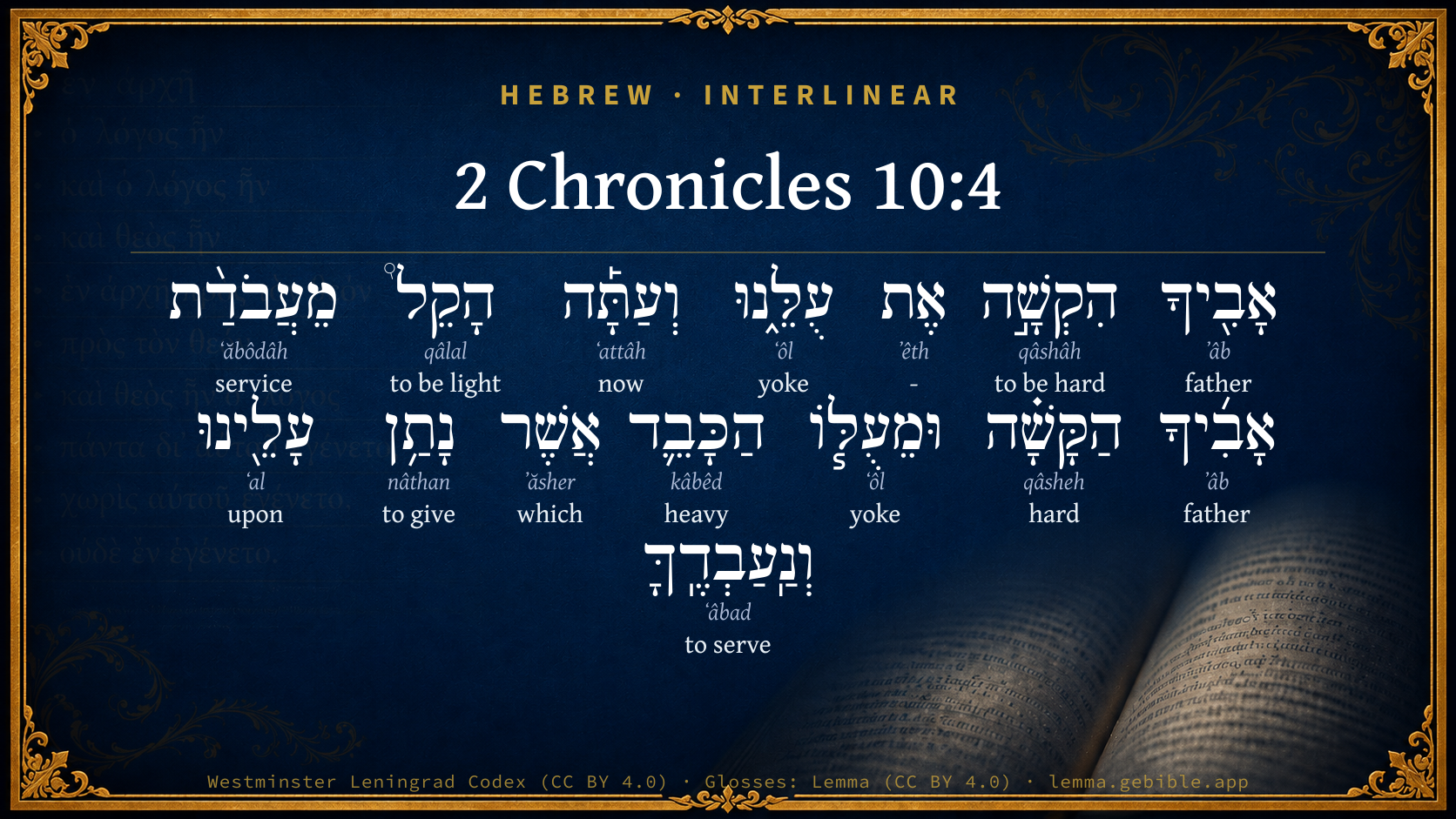
2 Chronicles 10:4

Hebrew (Westminster Leningrad Codex) 2 Chronicles 10:4 appears in the Hebrew Old Testament. The text above is from the Westminster Leningrad Codex. Each word links to its Strong’s number, a concise gloss, and parsing drawn from the Open Scriptures Hebrew Bible morphology. Click any word for its full Brown-Driver-Briggs (BDB) entry.
Download image
Cite this verse

2 Chronicles 10:4 (World English Bible). Public Domain. Lemma interlinear Bible study tool, https://lemma.gebible.app/v/2-chronicles/10/4.

Show BibTeX & RIS
BibTeX
RIS
English Translation
Your father made our yoke grievous: now therefore make you the grievous service of your father, and his heavy yoke which he put on us, lighter, and we will serve you.
World English Bible · Public Domain
Download a study sheet

One document with this verse’s original text, its word-by-word gloss line, the meaning frame, cross-references with their text, attributed commentary, and full source and license credits — printable, and it pastes into notes with its structure intact.

This verse Autodidact and up

Study sheet (.html) Plain text (.txt)

A passage Seminary Student

Up to 50 verses in one chapter. A passage sheet keeps up to 6 commentary sources and 12 cross-references per verse, in the order this page ranks them, and says so on the sheet whenever that leaves anything out. Ask for a single verse and you get the Autodidact verse sheet above.

Everything on this page stays free to read, with no account — the sheet is a download of what is already on screen, not access to it.

Want to remove ads? Support Godless Engineer
Compare translations 3

The same verse in 3 English versions, stacked beneath the original-language interlinear above. Click any original word for its lexicon entry.

Each is an independent rendering of the whole verse — the interlinear is not word-aligned to these translations.

Highlighted words mark where these versions differ — a whole-verse word diff, not a word-by-word alignment.

  • World English Bible Public Domain
    Your father made our yoke grievous: now therefore make you the grievous service of your father, and his heavy yoke which he put on us, lighter, and we will serve you.
  • King James Version Public Domain
    Thy father made our yoke grievous: now therefore ease thou somewhat the grievous servitude of thy father, and his heavy yoke that he put upon us, and we will serve thee.
  • unfoldingWord Literal Text CC BY-SA 4.0
    “Your father hardened our yoke. But now, lighten the hard service of your father and his heavy yoke which he gave to us, and we will serve you.”

unfoldingWord Literal Text — © unfoldingWord, licensed CC BY-SA 4.0. Word-aligned USFM3 via Door43 (git.door43.org/unfoldingWord/en_ult).

Versions to compare (up to 4)

3 of 4 selected

Show all 18 translations

Every available English version of this verse, each an independent rendering of the whole verse.

  • World English Bible Public Domain
    Your father made our yoke grievous: now therefore make you the grievous service of your father, and his heavy yoke which he put on us, lighter, and we will serve you.
  • Berean Standard Bible Public Domain
    “Your father put a heavy yoke on us. But now you should lighten the burden of your father’s service and the heavy yoke he put on us, and we will serve you.”
  • Majority Standard Bible Public Domain
    “Your father put a heavy yoke on us. But now you must lighten the burden of your father’s service and the heavy yoke he put on us, and we will serve you.”
  • King James Version Public Domain
    Thy father made our yoke grievous: now therefore ease thou somewhat the grievous servitude of thy father, and his heavy yoke that he put upon us, and we will serve thee.
  • American Standard Version (1901) Public Domain
    Thy father made our yoke grievous: now therefore make thou the grievous service of thy father, and his heavy yoke which he put upon us, lighter, and we will serve thee.
  • Revised Version (1885) Public Domain
    Thy father made our yoke grievous: now therefore make thou the grievous service of thy father, and his heavy yoke which he put upon us, lighter, and we will serve thee.
  • Geneva Bible (1599) Public Domain
    Thy father made our yoke grieuous: nowe therefore make thou the grieuous seruitude of thy father, and his sore yoke, that he put vpon vs, lighter, and we will serue thee.
  • Douay-Rheims (1899) Public Domain
    Thy father oppressed us with a most grievous yoke, do thou govern us with a lighter hand than thy father, who laid upon us a heavy servitude, and ease some thing of the burden, that we may serve thee.
  • Young's Literal Translation Public Domain
    `Thy father made our yoke sharp, and now, make light `somewhat' of the sharp service of thy father, and of his heavy yoke that he put upon us, and we serve thee.'
  • Literal Standard Version CC BY-SA 4.0
    “Your father made our yoke sharp, and now, make light [some] of the sharp service of your father, and [some] of his heavy yoke that he put on us, and we serve you.”
  • Unlocked Literal Bible CC BY-SA 4.0
    “Your father made our yoke difficult. Now therefore, make your father's hard work easier, and lighten the heavy yoke that he put on us, and we will serve you.”
  • unfoldingWord Literal Text CC BY-SA 4.0
    “Your father hardened our yoke. But now, lighten the hard service of your father and his heavy yoke which he gave to us, and we will serve you.”
  • Darby Bible Public Domain
    Thy father made our yoke grievous; and now lighten the grievous servitude of thy father, and his heavy yoke that he put upon us, and we will serve thee.
  • World Messianic Bible Public Domain
    “Your father made our yoke grievous. Now therefore make the grievous service of your father and his heavy yoke which he put on us, lighter, and we will serve you.”
  • Webster's Bible Public Domain
    Thy father made our yoke grievous: now therefore ease thou somewhat the grievous servitude of thy father, and his heavy yoke that he put upon us, and we will serve thee.
  • Free Bible Version CC BY-SA 4.0
    “Your father placed a heavy burden on us,” they told him. “But now if you lighten the load your father imposed and the heavy demands he laid on us, we will serve you.”
  • Bible in Basic English Public Domain
    Your father put a hard yoke on us: if you will make the conditions under which your father kept us down less cruel, and the weight of the yoke he put on us less hard, then we will be your servants.
  • JPS Tanakh (1917) Public Domain
    'Thy father made our yoke grievous; now therefore make thou the grievous service of thy father, and his heavy yoke which he put upon us, lighter, and we will serve thee.'

Literal Standard Version (2020), Covenant Press — licensed CC BY-SA 4.0. Text via the HelloAO Bible API (eBible.org). Unlocked Literal Bible (unfoldingWord) — licensed CC BY-SA 4.0. Text via the HelloAO Bible API (eBible.org). unfoldingWord Literal Text — © unfoldingWord, licensed CC BY-SA 4.0. Word-aligned USFM3 via Door43 (git.door43.org/unfoldingWord/en_ult). Free Bible Version, Dr. Jonathan Gallagher — licensed CC BY-SA 4.0. Text via the HelloAO Bible API (eBible.org).

Word by word

More ways to search: Search by grammar → Find every occurrence → Compare this word →

Practice this passage: Drill this verse → Learn its vocabulary →

הִקְשָׁ֣ה
qâshâh
H7185
“to be hard”
Verb, Hiphil, Perfect, 3rd Person, Masculine, Singular
Part of Speech
Verb
Stem
Hiphil
Form
Perfect
Person
3rd Person
Gender
Masculine
Number
Singular
Full BDB Definition

Origin: a primitive root

TWOT: 2085

to be hard, be severe, be fierce, be harsh - (Qal) - to be hard, be difficult - to be hard, be severe - (Niphal) - to be ill-treated - to be hard pressed - (Piel) to have severe labour (of women) - (Hiphil) - to make difficult, make difficulty - to make severe, make burdensome - to make hard, make stiff, make stubborn - of obstinacy (figuratively) - to show stubbornness
  1. אָבִ֖יךָ ʼâb H1 “father · your” Noun, Common, Masculine, Singular, Construct + Suffix, Personal, 2nd Person, Masculine, Singular
  2. אֶת ʼêth H853 “-” Particle, Direct Object
  3. עֻלֵּ֑נוּ ʻôl H5923 “yoke · our” Noun, Common, Masculine, Singular, Construct + Suffix, Personal, 1st Person, Common, Plural
  4. וְעַתָּ֡ה ʻattâh H6258 “and · now” Conjunction + Adverb
  5. הָקֵל֩ qâlal H7043 “be light” Verb, Hiphil, Imperative, 2nd Person, Masculine, Singular
  6. מֵעֲבֹדַ֨ת ʻăbôdâh H5656 “from · service of” Preposition + Noun, Common, Feminine, Singular, Construct
  7. אָבִ֜יךָ ʼâb H1 “father · your” Noun, Common, Masculine, Singular, Construct + Suffix, Personal, 2nd Person, Masculine, Singular
  8. הַקָּשָׁ֗ה qâsheh H7186 “the · hard” Particle, Definite Article + Adjective, Adjective, Feminine, Singular, Absolute
  9. וּמֵעֻלּ֧וֹ ʻôl H5923 “and · from · yoke · his” Conjunction + Preposition + Noun, Common, Masculine, Singular, Construct + Suffix, Personal, 3rd Person, Masculine, Singular
  10. הַכָּבֵ֛ד kâbêd H3515 “the · heavy” Particle, Definite Article + Adjective, Adjective, Masculine, Singular, Absolute
  11. אֲשֶׁר ʼăsher H834 “which” Particle, Relative
  12. נָתַ֥ן nâthan H5414 “to give” Verb, Qal, Perfect, 3rd Person, Masculine, Singular
  13. עָלֵ֖ינוּ ʻal H5921 “upon · us” Preposition + Suffix, Personal, 1st Person, Common, Plural
  14. וְנַֽעַבְדֶֽךָּ ʻâbad H5647 “and · to serve · you” Conjunction + Verb, Qal, Imperfect, 1st Person, Common, Plural + Suffix, Personal, 2nd Person, Masculine, Singular

About this verse

These counts appear in no published source. They are computed here, from the morphology-tagged text and Lemma’s own curated glosses. What Lemma adds →

15
words
13
distinct lemmas
Historical
section

Shared distinctive vocabulary

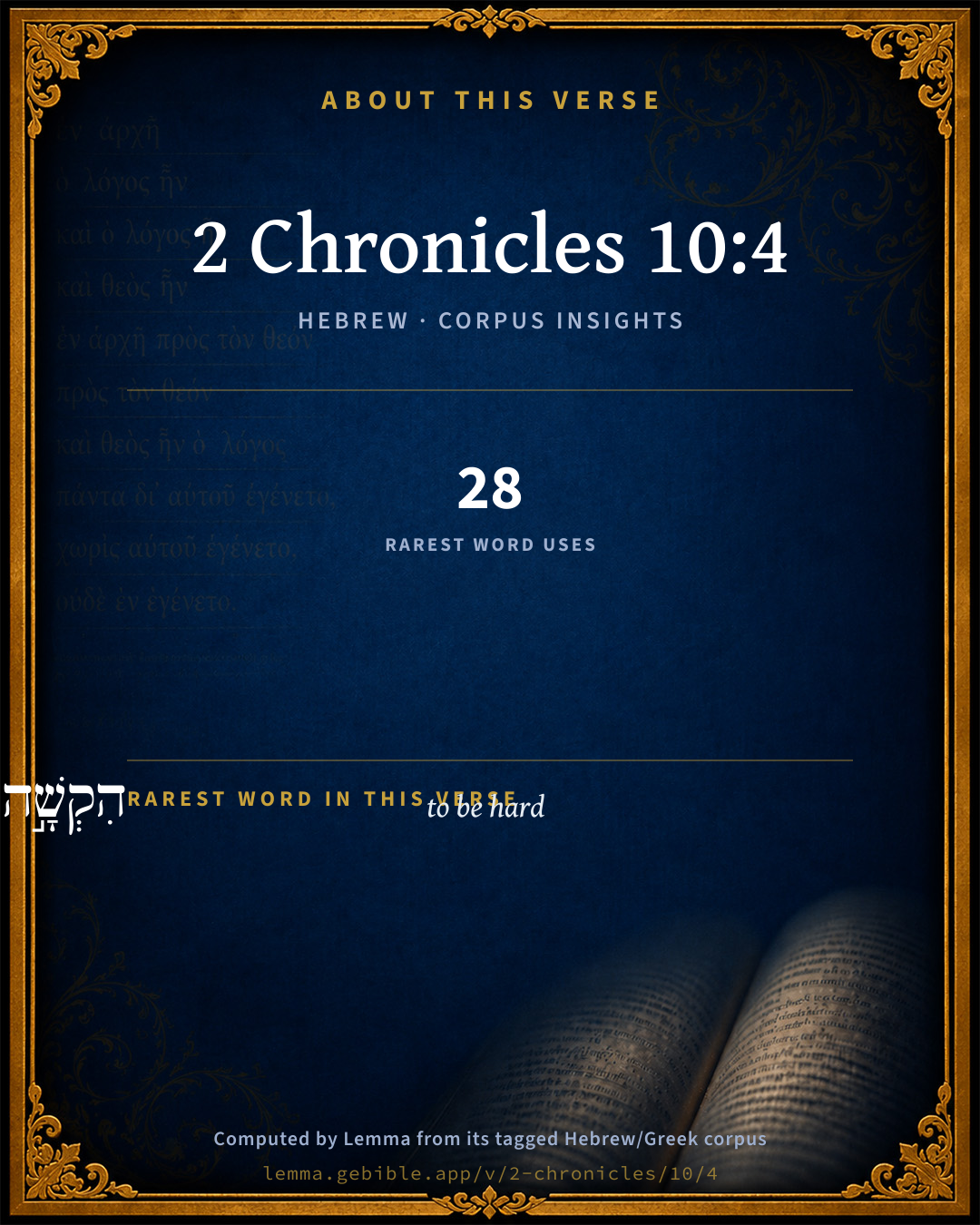
הִקְשָׁ֣ה to be hard H7185 occurs in 28 verses of the Hebrew Bible. Also found in:

Grammatical profile

  • 4 verbs
  • 5 nouns
  • 2 adjectives
  • 1 preposition
  • 1 adverb
  • 2 particles

Verb forms

  • הִקְשָׁ֣ה Hiphil · Perfect
  • הָקֵל֩ Hiphil · Imperative
  • נָתַ֥ן Qal · Perfect
  • וְנַֽעַבְדֶֽךָּ Qal · Imperfect

Repetition

Words recur within this verse — often emphatic in Hebrew:

  • אָבִ֖יךָ father H1 ×2
  • עֻלֵּ֑נוּ yoke H5923 ×2

Hebrew & Septuagint length

In English translation the verse runs 31 words from the Hebrew and 30 from the Septuagint (LXX English) — closely comparable.

A rough comparison of the two English renderings, which tokenize alike — not a word-level alignment.

Word counts can differ between the Hebrew and the Greek without any difference in meaning — e.g. the Hebrew direct-object marker אֵת has no separate Greek word, and Greek often adds the article ὁ.

Cross-references

12

Topical passages linked to 2 Chronicles 10:4 in the Treasury of Scripture Knowledge — connected by theme and wording, ordered by reader-vote popularity; previews shown in the World English Bible.

  • 1 Kings 12:4 Your father made our yoke grievous: now therefore make you the grievous service of your father, and his heavy yoke which he put on us, lighter, and we will serve you.
  • Exodus 1:13–14 The Egyptians ruthlessly made the children of Israel serve,
  • Exodus 2:23 It happened in the course of those many days, that the king of Egypt died, and the children of Israel sighed because of the bondage, and they cried, and their cry came up to God because of the bondage.
  • 1 Samuel 8:11–18 He said, This will be the manner of the king who shall reign over you: he will take your sons, and appoint them to him, for his chariots, and to be his horsemen; and they shall run before his chariots;
  • 1 Kings 4:20 Judah and Israel were many as the sand which is by the sea in multitude, eating and drinking and making merry.
  • 1 Kings 4:25 Judah and Israel lived safely, every man under his vine and under his fig tree, from Dan even to Beersheba, all the days of Solomon.
  • 1 Kings 5:15 Solomon had seventy thousand who bore burdens, and eighty thousand who were stone cutters in the mountains;
  • 1 Kings 9:22 But of the children of Israel did Solomon make no bondservants; but they were the men of war, and his servants, and his princes, and his captains, and rulers of his chariots and of his horsemen.
  • Isaiah 47:6 I was angry with my people, I profaned my inheritance, and gave them into your hand: you did show them no mercy; on the aged have you very heavily laid your yoke.
  • Matthew 11:29–30 Take my yoke upon you, and learn from me, for I am gentle and lowly in heart; and you will find rest for your souls.
  • Matthew 23:4 For they bind heavy burdens that are grievous to be borne, and lay them on men's shoulders; but they themselves will not lift a finger to help them.
  • 1 John 5:3 For this is the love of God, that we keep his commandments. His commandments are not grievous.

Cross-references courtesy of OpenBible.info (CC BY 4.0).

Hebrew and Greek witnesses Masoretic Hebrew ↔ Greek Septuagint

The same verse in the two great witnesses to the Old Testament, shown verse-for-verse.

These are two independent witnesses, not word-aligned to each other, and the Septuagint is shown in lemma (dictionary) form.

Hebrew 2 Chronicles 10:4 Masoretic · Westminster Leningrad Codex

אָבִ֖יךָ הִקְשָׁ֣ה אֶת עֻלֵּ֑נוּ וְעַתָּ֡ה הָקֵל֩ מֵעֲבֹדַ֨ת אָבִ֜יךָ הַקָּשָׁ֗ה וּמֵעֻלּ֧וֹ הַכָּבֵ֛ד אֲשֶׁר נָתַ֥ן עָלֵ֖ינוּ וְנַֽעַבְדֶֽךָּ

Your father made our yoke grievous: now therefore make you the grievous service of your father, and his heavy yoke which he put on us, lighter, and we will serve you.

World English Bible · Public Domain

Greek LXX 2 Chronicles 10:4 Septuagint · lemma form

ὁ πατήρ σύ σκληρύνω ὁ ζυγός ἐγώ καί νῦν ἀποἵημι ἀπό ὁ δουλεία ὁ πατήρ σύ ὁ σκληρός καί ἀπό ὁ ζυγός αὐτός ὁ βαρύς ὅς δίδωμι ἐπί ἐγώ καί δουλεύω σύ

Your father made our yoke grievous: now then abate somewhat of your father's grievous rule, and of his heavy yoke which he put upon us, and we will serve you.

LXX2012 (modern English Septuagint) · Public Domain

Hebrew: Westminster Leningrad Codex (CC BY 4.0). Greek: Septuagint (public domain); English from LXX2012 (modern English Septuagint) (Public Domain). How the Septuagint differs from the Hebrew →

Commentary

Notes on 2 Chronicles 10:4 from classic Christian and Jewish commentators (each source and its license shown beneath its notes). The classic Christian expositions comment on the surrounding passage and are grouped to its opening verse, so a note may address several verses; the Jewish commentaries on the Tanakh (Rashi and others) are per-verse, so they appear only where the commentator wrote on this verse.

Lemma curates 59 commentaries, every one of them public domain or Creative Commons licensed, each selected and text-cleaned for this edition rather than reprinted as found. About our sources →

Tyndale Open Study Notes

Tyndale Open Resources

10:4 Rehoboam was not powerful enough to enforce taxation over the northern tribes, so they demanded concessions to remain under his rule.

Tyndale Open Study Notes — © Tyndale Open Resources, licensed CC BY-SA 4.0. Text via the HelloAO Bible API.

Geneva Bible (1599)

Geneva Bible translators

That is, handled us rudely, it seemeth that God hardened their hearts, so that they thus murmured without cause: which declareth also the inconstancy of the people.

Geneva Bible (1599) marginal notes — public domain. Text via Bolls.life.

Ellicott's Commentary for English Readers

(4) Made . . . grievous . . . ease thou.—Made hard . . . lighten.

Now therefore.—And now. Kings and the Syriac here, “and thou now”—w’attah ‘attah: an assonance which the chronicler has avoided, at the expense of the proper emphasis, which lies on thou. (Some Hebrew MSS. and the Vulgate and Arabic read, and thou.) (Comp. 2Ch_10:10, and thou . . . lighten it.)

A Bible Commentary for English Readers, edited by Charles John Ellicott (1878–1897) — public domain. Text from a community e-Sword module.

The Cambridge Bible for Schools and Colleges

gen. ed. J. J. S. Perowne

4. ease thou somewhat … put upon us] R.V. make thou the grievous service of thy father, and his heavy yoke which he put upon us, lighter (as in 1 Kin.). The “service” complained of is described (in part) in 1Ki_5:13-14 (no parallel in Chron.). Cp. 2Ch_8:9 (= 1Ki_9:22), note.

and we will serve thee] The people claim their ancient right to a voice in the appointment of a king; cp. 1Sa_11:14-15 (Saul) and 2Sa_5:1-3 (David).

The Cambridge Bible for Schools and Colleges (gen. ed. J. J. S. Perowne; Cambridge University Press, 1878–1918) — public domain. Text from a community e-Sword module.

The Pulpit Commentary

The grievous servitude heavy yoke. These may, for conciseness" sake, be supposed to correspond with the naturally enough hated "forced labour" (1Ki_4:6, 7 5:13-16 11:27, 28) and the burdensome "taxes" (1Ki_4:19-28) which had not failed to become more odious to the people as familiarity with them grew. The refreshing New Testament contrast to all this (Mat_11:28-30) will occur to every memory.

Vers. 4-14.

The legacy of brilliance, etc.

We have here

I THE LEGACY OF BRILLIANCE. "Thy father made our yoke grievous" (ver. 4). No man ever had a nobler opportunity than Solomon had. His father handed to him a united nation, a country whose enemies were subdued, the kindly and helpful shadow of a great name and a beloved disposition and an illustrious career. He was endowed by God with great talent and surpassing wealth. He had before him an object of honourable ambition, which would be acceptable to Heaven and gratifying to his subjects. But, instead of pursuing the path of usefulness and the prize of a people"s gratitude, he aimed at overwhelming splendour. And what did he gain by his pursuit? Forty years of selfish gratification, not undimmed (we may be sure) by many cares, disappointments, difficulties, in his home (or harem) and in his court; and when he died he left a kingdom less compact, a dynasty less secure than he found when he took the reins of government from his father David. All his brilliance ended in a popular sense of injury, in a general consciousness that the people had been weighted with needlessly heavy burdens, with a store of suppressed popular discontent ready to burst out and blaze forth at the first opportunity. Brilliance is a very fascinating thing, whether it be on the throne or in parliamentary government, or in the courts of law, or in business, or in the school. But what is its end? To what issues does it lead? Usually it conducts to poverty, to serious error, to discomfiture, often to a catastrophe. But, where brilliance breaks down and is ruined, steady and conscientious faithfulness, under the guidance of heavenly wisdom, will succeed will lead on to a real enrichment, to a lasting safety, to an honour that may be accepted and enjoyed.

II THE WISDOM OF CONTEMPLATION AND CONSULTATION. "He said Come again unto me after three days And he took counsel" (vers. 5, 6). It is, indeed, true that no good ultimately came of this delay and this consultation. But that was because Rehoboam consulted the wrong men. He did well in asking for time and in appealing to others at this critical juncture. Supposing that this demand took him by surprise, nothing would have been more foolish than to have given a reply offhand. A remonstrance is very likely to excite anger in the first instance, and no wise man will come to an important decision when he is out of temper. It is in the hour of complete self-control that we should settle grave matters affecting our destiny. Moreover, we do well to take the judgment of others. It was due to the nation that his father"s wise statesmen should be asked for their advice in a great national crisis. It was due to himself that his inexperience should secure the inestimable advantage of their ripe sagacity. It is always due to ourselves that we get the additional light which can be gained from an impartial judgment. No man can possibly look at his own affairs in a perfectly pure atmosphere; no man can take an entirely unbiassed view of his own temporal interests. Men who look from outside see what we cannot possibly see, and their counsel is sure to be worth our consideration. "The physician who prescribes for himself, or the lawyer who advises himself, has a fool for his patient or for his client." This saying will hold good in every department of human action. Take time for thought, and invite the frank and full counsel of your true friends.

III OUR TRUE COUNSELLORS. These are:

1. They who have had an opportunity of knowing. The young men whomRehoboam consulted could have given him very good advice on some subjects, on those that belonged to their period of life athletics, fashions, etc.; but of statesmanship what could they tell? We should take care to consult those who know, who have learned in the best schools.

2. They who give us frank rather than palatable counsel; who will tell uswhat they believe to be for the best, rather than that which will humour our own fancies.

3. They whose counsel makes for peace rather than for strife. There aretimes when the wisest will be for war, but in nine cases out of ten the true Christian advocate will urge conciliation and concord. C.

The Pulpit Commentary (1880–1919), ed. H.D.M. Spence-Jones & Joseph S. Exell — public domain. Text from a community e-Sword module.

John Wesley's Explanatory Notes

Grievous - It is probable, when Solomon had declined from God, that God left him to himself to act thus impolitically.

John Wesley, Explanatory Notes Upon the Whole Bible (1754–1765) — public domain. Text via the GEBible commentary corpus.

Rashi

Rabbi Shlomo Yitzchaki (Rashi)

Your father made our yoke hard because he was a man who toiled at work, and he made it incumbent upon us to sustain his laborers with the tax, as it is written in I Kings (5:27): “And King Solomon raised a levy, etc.”

Rashi on the Tanakh — English translations: “The Judaica Press complete Tanach with Rashi, translated by A. J. Rosenberg” (CC BY 4.0); “Pentateuch with Rashi's commentary by M. Rosenbaum and A.M. Silbermann, 1929-1934” (public domain); “The Metsudah Tanach series, Lakewood, N.J” (CC BY 4.0); and “The Book of Joshua, Metsudah Publications, 1997” (CC BY 4.0). Text via Sefaria.

Lesson kit

Teaching starters — assembled from the data on this page, not authored interpretation. Every prompt links to the verse data it draws on. Edit before teaching.

2 Chronicles, in the Historical, opens this verse with 15 words (13 distinct Hebrew lemmas). Its most distinctive word is qâshâh (“to be hard”). A historical commentator’s framing appears above. Read the whole chapter for the surrounding context.

Discussion questions

  1. What does “to be hard” (qâshâh) contribute to the verse as a whole?
  2. How does Genesis 35:16, which shares the word «to be hard», read alongside this verse?
  3. What does the repetition of “father” (2× in this one verse) do in this verse?
  4. These translations render this verse differently; the difference is in the English rendering, not the original. What questions does that raise?
  5. «הִקְשָׁ֣ה» is a Hiphil Perfect verb. How does that grammatical form shape the action described?
  6. Compare how Tyndale Open Study Notes and Geneva Bible (1599) read this verse. Where do they agree or differ?

Things to notice

Reading settings

Reading text

Shown beneath each verse's original-language words.

Old Testament
Old Testament edition

Read the OT as the Masoretic Hebrew (MT) or the Greek Septuagint (LXX).

English shown for the Greek Septuagint (in the Hebrew ↔ Greek comparison).

Comparing translations? Open the Compare panel on any verse page to stack up to four side by side.