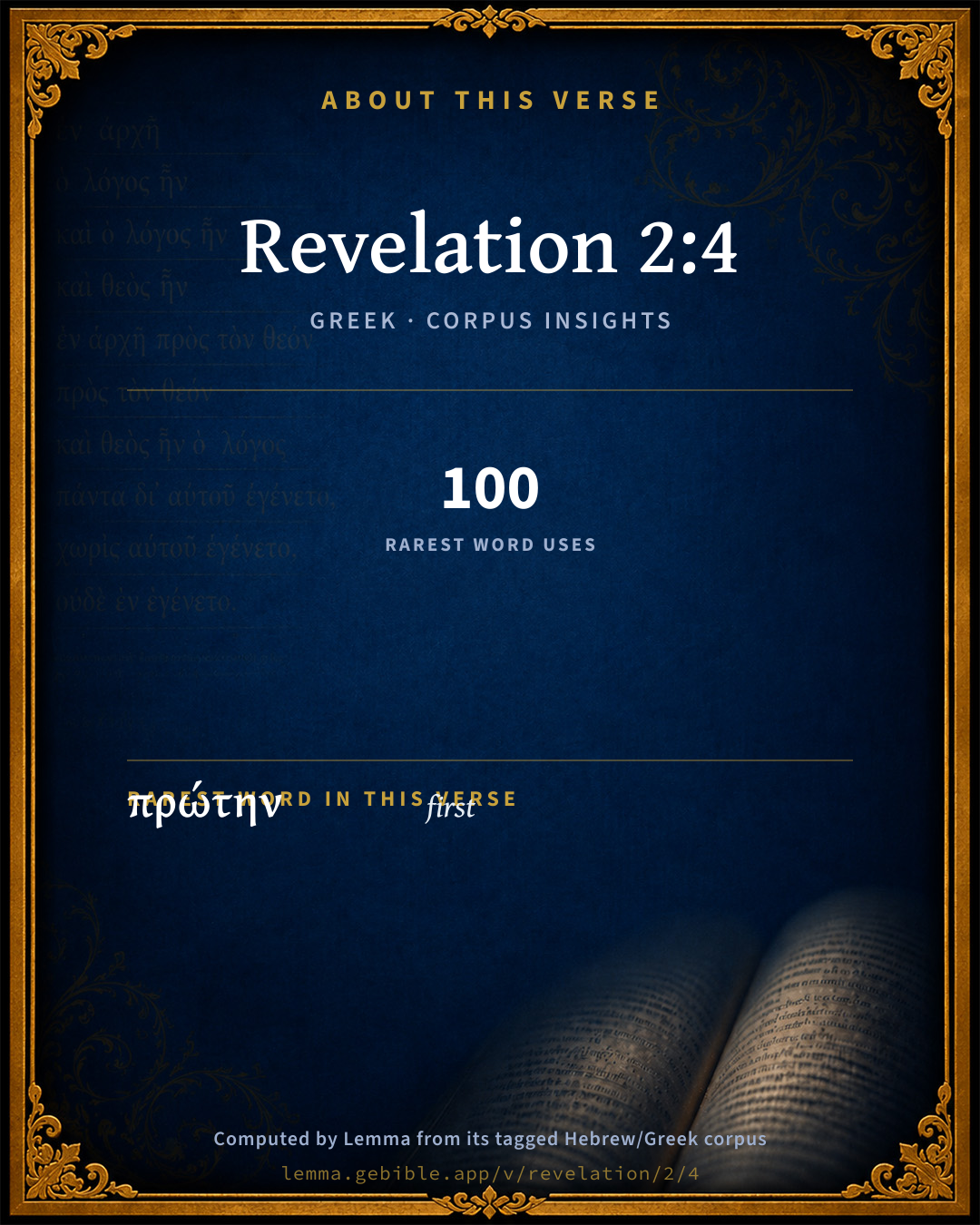
Revelation 2:4

Greek (Tischendorf 8th ed.) Revelation 2:4 appears in the Greek New Testament. The text above is from the Tischendorf 8th edition. Each word links to its Strong’s number and a concise gloss. Click any word for its full Thayer’s Greek Lexicon entry.

Download image
Cite this verse

Revelation 2:4 (World English Bible). Public Domain. Lemma interlinear Bible study tool, https://lemma.gebible.app/v/revelation/2/4.

Show BibTeX & RIS
BibTeX
RIS
English Translation
But I have this against you, that you left your first love.
World English Bible · Public Domain
Download a study sheet

One document with this verse’s original text, its word-by-word gloss line, the meaning frame, cross-references with their text, attributed commentary, and full source and license credits — printable, and it pastes into notes with its structure intact.

This verse Autodidact and up

Study sheet (.html) Plain text (.txt)

A passage Seminary Student

Up to 50 verses in one chapter. A passage sheet keeps up to 6 commentary sources and 12 cross-references per verse, in the order this page ranks them, and says so on the sheet whenever that leaves anything out. Ask for a single verse and you get the Autodidact verse sheet above.

Everything on this page stays free to read, with no account — the sheet is a download of what is already on screen, not access to it.

Want to remove ads? Support Godless Engineer
Compare translations 3

The same verse in 3 English versions, stacked beneath the original-language interlinear above. Click any original word for its lexicon entry.

Each is an independent rendering of the whole verse — the interlinear is not word-aligned to these translations.

Highlighted words mark where these versions differ — a whole-verse word diff, not a word-by-word alignment.

  • World English Bible Public Domain
    But I have this against you, that you left your first love.
  • King James Version Public Domain
    Nevertheless I have somewhat against thee, because thou hast left thy first love.
  • unfoldingWord Literal Text CC BY-SA 4.0
    But I have against you that you have abandoned your first love.

unfoldingWord Literal Text — © unfoldingWord, licensed CC BY-SA 4.0. Word-aligned USFM3 via Door43 (git.door43.org/unfoldingWord/en_ult).

Versions to compare (up to 4)

3 of 4 selected

Show all 19 translations

Every available English version of this verse, each an independent rendering of the whole verse.

  • World English Bible Public Domain
    But I have this against you, that you left your first love.
  • Berean Standard Bible Public Domain
    But I have this against you: You have abandoned your first love.
  • Majority Standard Bible Public Domain
    But I have this against you: You have abandoned your first love.
  • King James Version Public Domain
    Nevertheless I have somewhat against thee, because thou hast left thy first love.
  • American Standard Version (1901) Public Domain
    But I have `this' against thee, that thou didst leave thy first love.
  • Revised Version (1885) Public Domain
    But I have this against thee, that thou didst leave thy first love.
  • Geneva Bible (1599) Public Domain
    Neuertheles, I haue somewhat against thee, because thou hast left thy first loue.
  • Douay-Rheims (1899) Public Domain
    But I have somewhat against thee, because thou hast left thy first charity.
  • Young's Literal Translation Public Domain
    `But I have against thee: That thy first love thou didst leave!
  • Literal Standard Version CC BY-SA 4.0
    But I have against you that you left your first love!
  • Unlocked Literal Bible CC BY-SA 4.0
    But I have against you the fact that you have left behind your first love.
  • unfoldingWord Literal Text CC BY-SA 4.0
    But I have against you that you have abandoned your first love.
  • Darby Bible Public Domain
    but I have against thee, that thou hast left thy first love.
  • World Messianic Bible Public Domain
    But I have this against you, that you left your first love.
  • Webster's Bible Public Domain
    Nevertheless, I have somewhat against thee, because thou hast left thy first love.
  • Free Bible Version CC BY-SA 4.0
    But I have something against you: you have neglected your first love.
  • Bible in Basic English Public Domain
    But I have this against you, that you are turned away from your first love.
  • Text-Critical English NT CC BY 4.0
    But I have this against yoʋ: Yoʋ have left yoʋr first love.
  • Tyndale New Testament (1534) Public Domain
    Neverthelesse I have sumwhat agaynst the for thou haste lefte thy fyrst love.

Literal Standard Version (2020), Covenant Press — licensed CC BY-SA 4.0. Text via the HelloAO Bible API (eBible.org). Unlocked Literal Bible (unfoldingWord) — licensed CC BY-SA 4.0. Text via the HelloAO Bible API (eBible.org). unfoldingWord Literal Text — © unfoldingWord, licensed CC BY-SA 4.0. Word-aligned USFM3 via Door43 (git.door43.org/unfoldingWord/en_ult). Free Bible Version, Dr. Jonathan Gallagher — licensed CC BY-SA 4.0. Text via the HelloAO Bible API (eBible.org).

Word by word

More ways to search: Search by grammar → Find every occurrence → Compare this word →

Practice this passage: Drill this verse → Learn its vocabulary →

About this verse

These counts appear in no published source. They are computed here, from the morphology-tagged text and Lemma’s own curated glosses. What Lemma adds →

11
words
9
distinct lemmas
Revelation
section

Repetition

Words recur within this verse:

Cross-references

10

Topical passages linked to Revelation 2:4 in the Treasury of Scripture Knowledge — connected by theme and wording, ordered by reader-vote popularity; previews shown in the World English Bible.

  • Matthew 24:12–13 Because iniquity will be multiplied, the love of many will grow cold.
  • Jeremiah 2:2–5 Go, and cry in the ears of Jerusalem, saying, Thus says Yahweh, I remember for you the kindness of your youth, the love of your weddings; how you went after me in the wilderness, in a land that was not sown.
  • Hebrews 6:10–11 For God is not unrighteous, so as to forget your work and the labor of love which you showed toward his name, in that you served the saints, and still do serve them.
  • Philippians 1:9 This I pray, that your love may abound yet more and more in knowledge and all discernment;
  • 2 Thessalonians 1:3 We are bound to always give thanks to God for you, brothers, even as it is appropriate, because your faith grows exceedingly, and the love of each and every one of you towards one another abounds;
  • 1 Thessalonians 4:9–10 But concerning brotherly love, you have no need that one write to you. For you yourselves are taught by God to love one another,
  • Revelation 3:14–17 "To the angel of the assembly in Laodicea write: "The Amen, the Faithful and True Witness, the Head of God's creation, says these things:
  • Philippians 3:13–16 Brothers, I don't regard myself as yet having taken hold, but one thing I do. Forgetting the things which are behind, and stretching forward to the things which are before,
  • Revelation 2:14 But I have a few things against you, because you have there some who hold the teaching of Balaam, who taught Balak to throw a stumbling block before the children of Israel, to eat things sacrificed to idols, and to commit sexual immorality.
  • Revelation 2:20 But I have this against you, that you tolerate your woman, Jezebel, who calls herself a prophetess. She teaches and seduces my servants to commit sexual immorality, and to eat things sacrificed to idols.

Cross-references courtesy of OpenBible.info (CC BY 4.0).

Commentary

Notes on Revelation 2:4 from classic Christian and Jewish commentators (each source and its license shown beneath its notes). The classic Christian expositions comment on the surrounding passage and are grouped to its opening verse, so a note may address several verses; the Jewish commentaries on the Tanakh (Rashi and others) are per-verse, so they appear only where the commentator wrote on this verse.

Lemma curates 59 commentaries, every one of them public domain or Creative Commons licensed, each selected and text-cleaned for this edition rather than reprinted as found. About our sources →

Joseph Benson's Commentary

Rev 2:4. Nevertheless, I have somewhat to allege against thee — Exemplary as thou art in many respects; or, as somewhat is not in the original, the verse may be properly read, I have against thee that thou hast left thy first love — Namely, the zeal and fervour of it, which thou didst manifest to me and my cause; that love for which the church at Ephesus was so eminent when St. Paul wrote his epistle to them. Neither they nor their pastors need to have left this; they might have retained it entire to the end. And they did retain it in part, otherwise there could not have remained so much of what is commendable in them. But they had not kept, as they might have done, the first tender, affectionate love in its vigour and warmth. Reader, has the love of God, of Christ, and of his people, been shed abroad in thy heart? And hast thou retained it in all its fervour and efficacy? If not, the following exhortation is addressed to thee. “It is very plain,” says Doddridge, “that these epistles, though inscribed to the angels or pastors of the churches, are directed to the churches themselves, as represented by them. Just as the Jewish Church was represented by Joshua their high-priest, Zec 3:1. But it is not improbable that where some of the churches are blamed, there might be in their ministers some faults correspondent to those charged on the society; and particularly that the zeal of this minister of Ephesus might be declining. There is, I think, no reason to be anxious with regard to Timothy’s character on this account; for it can never be proved that he was a stated pastor of the church of Ephesus, though such confident things have been said concerning it on very slender foundations.”

Joseph Benson's Commentary on the Old and New Testaments (1811–1818) — public domain. Text from a community e-Sword module.

Tyndale Open Study Notes

Tyndale Open Resources

2:4 You don’t love me or each other as you did at first: When the church was first established, their love for Christ and for each other had been strong. Struggles with false teachers and persecution had caused that original love to grow cold. Correct theology, action, and even suffering (2:2-3) are just an empty shell of Christian life if dynamic love is absent (1 Cor 13).

Tyndale Open Study Notes — © Tyndale Open Resources, licensed CC BY-SA 4.0. Text via the HelloAO Bible API.

Meyer's Critical & Exegetical Commentary

Heinrich August Wilhelm Meyer

Rev_2:4-5. In sharp antithesis to the praise,[945] follows (ἀλλὰ) the declaration of what the Lord has against the church;[946] viz., that it has left, i.e., given up, its first love.[947] The ΠΡΏΤΗΝ is not to be taken as comparative, nor is it to be inferred in the sense in itself correct, that the Greek superlative has a comparative force;[948] rather, the love is regarded as actually the first, i.e., that which was actually present at the beginning of the life of faith.[949] This ἈΓΆΠΗ certainly is not the sedulous care and vigilance with fervor and zeal for the purity of the divine word against false prophets,[950] which is impossible already, because of Rev_2:2 (ΔΎΝῌ pres.). Opposed to this, but just as inappropriate, is the explanation of Eichhorn: You are restraining the wicked teachers too captiously and severely. The reference appears specially to apply to the care of the poor;[951] it is altogether difficult to regard it alone of brotherly love,[952] but of that only so far as it is the manifestation of love to God and Christ, which the indefinite expression may suggest. Züllig and Hengstenb. have properly recalled Jer_2:2. The lovely description of the fellowship of believers with God as that of a bridal or marriage relation[953] is particularly applicable to the foundation of the grace of God appearing in Christ,[954] and still to be hoped for from him.[955] Against this exposition an appeal cannot therefore be made[956] to Rev_2:2-3; since even where the first love has vanished, and works springing only from the purest glow of this first love are no longer found (Rev_2:5), the power of faith and love to the Lord is still sufficient for the works praised in Rev_2:2-3.

To there proof (Rev_2:4) is added the call to repentance, and, in case this do not occur,[957] the threatening of judgment. The remembrance[958] of the first better condition, whence as from a moral elevation the church had fallen,[959] should cause a penitential return and the doing of the first works, as they formerly gave testimony to that first love (Rev_2:4). In this line of thought, the πόθεν πέπτωκας cannot mean the loss of salvation you have experienced.[960] The threat (ΚΙΝ. Τ. ΛΥΧΝ., Κ.Τ.Λ.) is expressed, not only in accordance with the designation of the speaking Lord, Rev_2:1, but also (ἘΡΧ. ΣΟΙ) in connection with the prophetic fundamental thoughts of the entire book, as both are inwardly combined with one another, as Christ is the one who is to come, according to his relation described in Rev_2:1[961] to his church (and the world). But since John states the particular judgment upon an individual congregation as a coming of the Lord, which yet is not identical with his final coming, the peculiar goal of all prophecy, the prophet himself shows how he associates the individual preliminary revelations of judgment with the full conclusion in the final judgment, as well as distinguishes them from one another.[962] But the distinction dare not be urged in such a way that the eschatological reference of the ἜΡΧΟΜΑΙ vanishes.[963]

Concerning the dat. incomm. ΣΟΊ,[964] cf. Winer, p. 147.

κ. κινήσω τ. λυχνίαν σου, κ.τ.λ., designates, according to the rule underlying the whole representation,[965] nothing else than: I will cause thee to cease to be the church.[966] Ewald, unsatisfactorily: I will withdraw my grace and kindness from thee. Grotius, incorrectly: I will cause thy people to flee another way; viz., to those places where there will be greater care for the poor.[967] Zeger, and many others who regard the angel as the bishop of the church, incorrectly: I will take the church from thee, that thou no longer preside over it.

[945] Rev_2:2-3.

[946] Cf. Mat_5:23.

[947] De Wette. Cf. Rom_1:27; Mar_7:8; Pro_4:13, where is the contrary φυλάσσειν

[948] Ew., Winer, p. 229.

[949] Cf. N. de Lyra, Areth., De Wette, Hengstenb., Ebrard, Ew. ii., etc.

[950] Calov. Cf. also Vitr.

[951] Grot., Ewald. Cf. also Heinr. on Rev_2:5.

[952] Heinr., De Wette, Ebrard.

[953] Cf. Hos_2:15 sqq.

[954] Eph_5:25; Eph_5:32.

[955] Rev_19:9; Rev_22:17.

[956] Ebrard.

[957] εί δὲ μὴ. Cf. Winer, p. 508: ἐὰν μὴ μετανοήσης, as once more made expressly prominent at the close. Cf. Winer, p. 568.

[958] μνημον., Rev_3:3.

[959] Cf. also Rom_11:11; Rom_11:22; Rom_14:4; 1Co_10:12; Heb_4:11. N. de Lyra, Pric., Eichh., Stern, De Wette, Hengstenb., etc.

[960] Kypke, Bretschneider, Lex. on this word, by presupposing the false reading ἐκπέπτ., which, according to linguistic usage, more readily offers the conception of something lost.

[961] Cf. Rev_1:12 sqq.

[962] Cf. also De Wette, etc.

[963] Against Klief.

[964] Rev_2:16. Cf. Rev_3:3, ἐπὶ σὲ.

[965] Rev_1:12 sqq., 20. Cf. to κιν., Rev_6:14.

[966] Aretius. Cf. Heinr., De Wette, Stern, Hengstenb., etc.

[967] Cf. on Rev_2:4.

Meyer — Critical and Exegetical Commentary on the New Testament — English translation by Peter Christie, edited by Frederick Crombie (T&T Clark, 1880) — public domain. Text from a community e-Sword module.

Expositor's Greek Testament

ed. W. Robertson Nicoll

Rev 2:4 . Brotherly love, an early and authentic proof of the faith; as in Rev 2:19 , 2Jn 1:5-6 , 3Jn 1:6 , and the striking parallel of Mat 24:12 (see 10) where, as at Corinth (see also Did. xvi. 3) party-spirit and immorality threatened its existence. Jealous regard for moral or doctrinal purity, and unwavering loyalty in trial, so far from necessarily sustaining the spirit of charity, may exist side by side, as here, with censoriousness, suspicion, and quarrelling. Hence the neglect of brotherly love, which formed a cardinal fault in contemporary gnosticism ( i.e. , 1Jn 2:9 ; 1Ti 1:5 f.), may penetrate the very opposition to such error. During any prolonged strain put upon human nature, especially in a small society driven jealously to maintain its purity, temper is prone to make inroads on affection and forbearance; it was inevitable also that opportunities for this should be given in early Christianity, where party-leaders tended to exaggerate either the liberal or the puritan element in the gospel. When Apollonius of Tyana visited Ephesus, one of the first topics he raised was the duty of unselfish charity ( Vit. Apoll. iv. 3). The historical reference here is probably to the temporary decline of the Ephesian çhurch after Paul’s departure (see Act 20:29 f., etc.) Its revival took place under the ministry of the Johannine circle, who carrying on the spirit of Paulinism with independent vigour made it the most prominent centre of Christianity in the East. With Rev 2:2-4 , compare Pliny, H. N. ii. 18: “deus est mortali iuuare mortalem, et haec ad aeter-nam gloriam uia”; also Pirke Aboth, ii. 15, where R. Jehoshua, a contemporary Jewish sage, says: “an evil eye [ i.e. , envy, niggardliness], and the evil nature, and hatred of mankind put a man out of the world” ( cf. 1Jn 3:15 ). This emphasis upon brotherly love as the dominant characteristic of the church and the supreme test of genuine faith, is early Christian, however, rather than specifically Johannine (see the account ol the young aristocratic martyr Vettius Epagathus, Ep. Lugd. ). The purity which is not peaceable cannot be adequate to the demands of Jesus, and nowhere did this need reinforcement more than in the townships of Asia Minor, where factiousness and division constantly spoiled their guilds and mutual relations.

The Expositor's Greek Testament, edited by W. Robertson Nicoll (1897–1910) — public domain. Text from a community e-Sword module.

Geneva Bible (1599)

Geneva Bible translators

To deal with thee for.

Geneva Bible (1599) marginal notes — public domain. Text via Bolls.life.

Jamieson, Fausset & Brown

Robert Jamieson, A. R. Fausset & David Brown

somewhat . . . because--Translate, "I have against thee (this) that," &c. It is not a mere somewhat"; it is everything. How characteristic of our gracious Lord, that He puts foremost all He can find to approve, and only after this notes the shortcomings!

left thy first love--to Christ. Compare Ti1 5:12, "cast off their first faith." See the Ephesians' first love, Eph 1:15. This epistle was written under Domitian, when thirty years had elapsed since Paul had written his Epistle to them. Their warmth of love had given place to a lifeless orthodoxy. Compare Paul's view of faith so called without love, Co1 13:2.

Jamieson, Fausset & Brown — Commentary Critical and Explanatory on the Whole Bible (1871) — public domain (CC PDM 1.0). Text via the HelloAO Bible API.

Adam Clarke's Commentary

Verse 4. Nevertheless I have somewhat against thee] The clause should be read, according to the Greek, thus: But I have against thee that thou hast left thy first love. They did not retain that strong and ardent affection for God and sacred things which they had when first brought to the knowledge of the truth, and justified by faith in Christ.

Adam Clarke's Commentary on the Bible (1810–1826) — public domain. Text from a community e-Sword/MySword module.

Ellicott's Commentary for English Readers

(4) Nevertheless I have somewhat against thee.—Better, I have against thee that thou didst let go. This is the fault, and it is no trifle which is blamed, as the word “somewhat” (which is not to be found in the original) might be taken to imply; for the decay of love is the decay of that without which all other graces are as nothing (1Co_13:1-3), since “all religion is summed up in one word, Love. God asks this; we cannot give more; He cannot take less” (Norman Macleod, Life, i., p. 324). Great as the fault is, it is the fault which Love alone would have detected. “Can any one more touchingly rebuke than by commencing, ‘Thou no longer lovest me enough?’” It is the regretful cry of the heavenly Bridegroom, recalling the early days of His Bride’s love, the kindness of her youth, the love of her espousals (Jer_2:2. Comp. Hos_2:15). It is impossible not to see some reference in this to the language of St. Paul (which must have been familiar to the Ephesian Christians) in Eph_5:23-33, where human love is made a type of the divine.

A Bible Commentary for English Readers, edited by Charles John Ellicott (1878–1897) — public domain. Text from a community e-Sword module.

The Cambridge Bible for Schools and Colleges

gen. ed. J. J. S. Perowne

4. thy first love] It is to be remembered that these words have not in ecclesiastical (or indeed in any) Greek the same sentimental associations as in English; nevertheless it is not unlikely that conjugal love is meant: cf. Jer_2:2. Some understand the word of love to the brethren, because we have “the first works” in the next verse: but the argument is a bad one. Of course those good words (whether of “charity” in the narrower sense or not) proceeded from love to Christ.

The Cambridge Bible for Schools and Colleges (gen. ed. J. J. S. Perowne; Cambridge University Press, 1878–1918) — public domain. Text from a community e-Sword module.

John Gill's Exposition

Nevertheless I have somewhat against thee,.... So the Jews represent God saying, concerning their fathers, "Abraham", &c. "I have something against them" (a). Christ has nothing against his people, his faithful ministers, and true churches, in a judicial way, or to their condemnation, for there is none to them that are in him; but he has often many things to complain of in them, and to rebuke and chastise them for, in a way of providence: and what he had against the church at Ephesus, and against the churches in the period which that represents, follows,

because thou hast left thy first love: by which is meant, not hospitality to strangers, or an affectionate care of the poor of the church, or a zealous concern to feed the flock, and maintain church discipline; but the love of the saints to God, and Christ, and one another, which appeared at the beginning of this church state, when they were all of one heart and one soul, as generally at first conversion love is the warmest; and so it was at the first planting of Gospel churches, and therefore here called first love. Now this, though it was not lost, for the true grace of love can never be lost, yet it was left; it abated in its heat and fervour; there was a remissness in the exercise of it; what our Lord had foretold should be before the destruction of Jerusalem was fulfilled in this period of time, the love of many waxed cold, Mat 24:12; through the prevalence of corruption in some; and through an over love to the world, as in Demas, and others; and through a desire of ease and freedom from reproach and persecution; and through the introduction of errors, which damp the heat of love, and spirit of religion; and through the contentions and divisions among themselves, as at Corinth, Galatia, and elsewhere, which greatly weakened their love to one another, and to divine things; and which was very displeasing to Christ, who, for the restoring of them, gives the following advice. Compare with this Ti2 1:15.

(a) Pesikta Rabbati apud Yalkut Simeoni, par. 2. fol. 60. 4.

John Gill's Exposition of the Whole Bible (1746–1763) — public domain (CC PDM 1.0). Text via the HelloAO Bible API.

Trapp's Complete Commentary

John Trapp

4 Nevertheless I have somewhat against thee, because thou hast left thy first love.

Ver. 4. Thou hast left thy first love] Those first ripe fruits that Christ’s soul desireth, Mic 7:1, that kindness of youth, that spousal love, that God so well remembereth, Jer 2:2. This Ephesus had left, and so became Aphesis, remiss and reckless, possessed with a spirit of sloth and indevotion. And surely he is a rare and happy man that can say in a spiritual sense (as it was said of Moses), that after long profession of zeal, his sight is not waxed dim, his holy heat not abated, that runs not retrograde, as did Solomon, Asa, others, with whom the end was worse than the beginning.

John Trapp, A Commentary or Exposition upon All the Books of the Old and New Testament (1647–1656) — public domain. Text from a community e-Sword module.

Albert Barnes' Notes on the Bible

Nevertheless I have somewhat against thee - Notwithstanding this general commendation, there are things which I cannot approve.

Because thou hast left thy first love - Thou hast “remitted” (ἀφῆκας aphēkas) or let down thy early love; that is, it is less glowing and ardent than it was at first. The love here referred to is evidently love to the Saviour; and the idea is, that, as a church, they had less of this than formerly characterized them. In this respect they were in a state of declension; and, though they still maintained the doctrines of his religion, and opposed the advocates of error, they showed less ardor of affection toward him directly than they had formerly done. In regard to this we may remark:

(1) That what is here stated of the church at Ephesus is not uncommon:

(a) Individual Christians often lose much of their first love. It is true, indeed, that there is often an appearance of this which does not exist in reality. Not a little of the ardor of young converts is often nothing more than the excitement of animal feeling, which will soon die away of course, though their real love may not be diminished, or may be constantly growing stronger. When a son returns home after a long absence, and meets his parents and brothers and sisters, there is a glow, a warmth of feeling, a joyousness of emotion, which cannot be expected to continue always, and which he may never be able to recall again, though he may be ever growing in real attachment to his friends and to his home.

(b) Churches remit the ardor of their first love. They are often formed under the reviving influences of the Holy Spirit when many are converted, and are warm-hearted and zealous young converts. Or they are formed from other churches that have become cold and dead, from which the new organization, embodying the life of the church, was constrained to separate. Or they are formed under the influence of some strong and mighty truth that has taken possession of the mind, and that gives a special character to the church at first. Or they are formed with a distinct reference to promoting some one great object in the cause of the Redeemer. So the early Christian churches were formed. So the church in Germany, France, Switzerland, and England came out from the Roman communion under the influence of the doctrine of justification by faith. So the Nestorians in former ages, and the Moravians in modern times, were characterized by warm zeal in the cause of missions.

So the Puritans came out from the established church of England at one time, and the Methodists at another, warmed with a holier love to the cause of evangelical religion than existed in the body from which they separated. So many a church is formed now amidst the exciting scenes of a revival of religion, and in the early days of its history puts to shame the older and the slumbering churches around them. But it need scarcely be said that this early zeal may die away, and that the church, once so full of life and love, may become as cold as those that went before it, or as those from which it separated, and that there may be a necessity for the formation of new organizations that shall be fired with ardor and zeal. One has only to look at Germany, at Switzerland, at various portions of the reformed churches elsewhere; at the Nestorians, whose zeal for missions long since departed; or even at the Moravians, among whom it has so much declined; at various portions of the Puritan churches, and at many an individual church formed under the warm and exciting feelings of a revival of religion, to see that what occurred at Ephesus may occur elsewhere.

(2) The same thing that occurred there may be expected to follow in all similar cases. The Saviour governs the church always on essentially the same principles; and it is no uncommon thing that, when a church has lost the ardor of its first love, it is suffered more and more to decline, until “the candlestick is removed” - until either the church becomes wholly extinct, or until vital piety is wholly gone, and all that remains is the religion of forms.

Albert Barnes' Notes on the Bible (1834–1885) — public domain. Text from a community e-Sword/MySword module.

Matthew Poole's English Annotations

Nevertheless I have somewhat against thee; something to accuse thee of, and blame thee for.

Because thou hast left thy first love; of late thou hast not been so warm in the propagation of my gospel, and maintaining my truth. The love of many in this church, both toward God and their brethren, probably was cooled, though not wholly extinguished.

Matthew Poole's English Annotations on the Holy Bible (1683–1685) — public domain. Text from a community e-Sword/MySword module.

Whedon's Commentary on the Bible

Daniel D. Whedon

4. Nevertheless—The turning point from commendation to reproof.

Somewhat—Not in the Greek, which would read, I have against thee that thou hast left, etc.

First love—The glow of holy life at their first conversion (Acts 19,) and so beautifully recognised in Paul’s Epistle to the Ephesians. Hengstenberg remarks, “That first love we see still flourishing so long as Paul’s connexion with the Ephesians lasts.”

Daniel D. Whedon (gen. ed.), Commentary on the Old and New Testaments (1874–1909) — public domain. Text from a community e-Sword module.

The Pulpit Commentary

But I have (this) against thee, that thou didst leave thy first love. The Authorized Version unwarrantably softens the censure by inserting "somewhat;" the Greek means rather, "I have (this grave thing) against thee." In "hath aught against thee" (Mat_5:23) and "have aught against any", (Mar_11:25) the "aught" (ti) is expressed in the Greek; here nothing is expressed. "Thy first love" is expressed very emphatically with the article repeated; "thy love, thy first one." The meaning of it is much disputed. It cannot mean "thy former gentleness towards evil men and false apostles." It may mean "thy love of the brethren," so much insisted upon in St. John"s First Epistle. More probably it means "thy first love for me." Christ is here speaking as the Bridegroom, and addresses the Church of Ephesus as his bride. (comp. Jer_2:2-13) This thought would be familiar to the Ephesians from St. Paul"s teaching. (Eph_5:23-33) It shows strange ignorance of human frailty and of history to argue that "a generation at least must have passed away, and the thirty years from Nero to Domitian must have elapsed, ere the change here noted could come to pass." Does this writer forget the Epistle to the Galatians? In a very few years the Churches of Galatia had left their first love. The frequent and rapid lapses of Israel into idolatry show the same thing from the time when Aaron made the calf down to the Captivity. This verse is certainly no obstacle to the theory that the Apocalypse was written about A.D. 68.

Going back in the ways of God.

"Nevertheless I have... first love." There is no stage of our heavenward journey that is so hard as that which we go over for the third time. When in the ardour of our first love we first traversed that part of the road, we went along vigorously, with a strong elastic step. And when we went back, though we went slowly enough at first, like as when the boy"s ball, which he has flung high into the air, when ceasing its upward ascent, begins to descend, that beginning is slow, but quickens every second. And so on the backward road we quicken speed in a mournful way. But when we have finished this retrogression, and with a startled shock discover what we have lost, but, by God"s exceeding grace, resolve to recover ithic labor hoc opus est this is toil indeed. Our text brings before us the case of those who have thus gone back, and whom the Lord is lovingly rousing to the resolve that they will regain what they have lost. Note

I WHAT THEY LEFT AND LOST. It was that blessed early condition of peace and joy Godward which the beginning of the religious life so often witnesses. "All things were new Christ was new, the Word a new light, worship a new gift, the world a new realm of beauty, shining in the brightness of its Author; even the man himself was new to himself. Sin was gone, and fear also was gone with it. To love was his all, and he loved everything. The day dawned in joy, and the thoughts of the night were songs in his heart. Then how tender, how teachable! in his conscience how true! in his works how dutiful! It was the Divine childhood, as it were, of his faith, and the beauty of childhood was in it. This was his first love; and if all do not remember any precise experience of the kind, they do at least remember what so far resembled this as to leave no important distinction." There was fervour of feeling: a great outgoing of the soul towards Christ; much prayer, and that very real; hearty service; delight in worship the sabbath, the sanctuary, the sacred service; the avoiding, not sin only, but its occasions, the "hating of the garment spotted by the flesh;" in short, there was a close walk with God. Blessed, blessed time, the primeval Paradise of the soul, the golden age, the leaving of which one might mourn, even as our first parents mourned when they were driven forth from Eden to the thorns and briars of the wilderness!

II How IT CAME TO BE LEFT. Many are the explanations that might be given. In some, absorption overmuch in business; in others, the influence of unspiritual and worldly companions; in others, intellectual doubts, insinuated into the mind by unbelieving or sceptical books; in others, the chill moral atmosphere of the Church itself; in others, some lingering, lurking lust reasserting itself; and so on in ever increasing variety; but each one knows for himself how the going back was brought about. But that we may not make sorry those whom God has not made sorry, we would add the caution not to regard every fluctuation of feeling as proof of this going back. Some are forever tormenting themselves in this way, and so kill the very love they are looking for, and in looking for it. "The complications of the heart are infinite, and we may become confused in our attempts to untwist them." Men dig at the roots of their motives to see that they are the right ones, and the roots of tender plants cannot stand such rough handling. But whilst there are some who distress themselves when they have no need, there are more who have great need, and yet are not distressed as they should be. Let such consider

III WHAT COMES OF LEAVING OUR FIRST LOVE.

1. The Spirit of God is grieved. Can a father see his child turn cold and sullen towards him, and not be grieved? And in view of such turnings back from him, must not our Lord be in a very real sense "the Man of sorrows" still?

2. Sinful men are hardened in their sin. Their boast is that there is no reality in religion; that it is all a spasmodic passing thing; that the fervour of it in the beginning will soon cool down, and here is another proof that there is nothing in it.

3. The Church of God is distressed. Its members had relied upon those who have gone back, had hoped for much good from them, had looked to see them carrying on and extending the work of God around them; and now they are disappointed and made ashamed. The enemies of God blaspheme, and those who have gone back are the cause.

4. And they themselves suffer most of all.

(1) They are miserable; they have enough of religion left to give them disrelish for the ways of the world, but not near enough to give them the joy which belongs only to those who are whole hearted in the service of God.

(2) And they are on the verge of great and awful judgment. If they still go back, it will be "unto perdition;" and if, in God"s mercy, they be made to stop ere they have gone to that last length, it will most likely have to be by some sharp scourging process, with many tears, and amid terrible trouble both without and within. What a pitiful journey that must have been when the wretched prodigal resolved at length that he would "arise, and go to his Father"! In what humiliation, fear, shame, distress, he had to urge his weary way along the return road! Only one thing could have been worse that be should not have come back. Oh, you who are forsaking Christ, if you be really his, you will have to come back; but no joyous journey will that be for you. No, indeed! It never has been, and never can be. Still blessed be the Lord, who forces you to make it, difficult and hard though it be. It is the hand which was nailed to the cross, and the heart which there was pierced for you, that now wields the scourge which compels you, in sorrow and in shame, to come back to him whom you left. But

IV WHAT FOLLY IT IS TO LEAVE HIM AT ALL. Ministers of Christ are so fond, as well they may be, of proclaiming God"s pardoning love, that they too much pass over his preserving love. We take it too much for granted that men will go off into "the far country," as that foolish younger son did; and we forget that much-maligned elder son who stayed at home with his father, and who was therefore far more blessed than the other could ever be. He could not understand his father"s gentleness to that ne"er-do-well brother of his as many still, and ever since the gospel has been preached, have failed to understand God"s gentleness to returning sinners; and so he complained. But how did his father answer him? It is too little noted. "Son, thou art ever with me, and all that I have is thine;" the meaning of all which was, "What, my son! you complain at my forgiving and welcoming your poor wretched brother! you who are so much better off, you complain!" Yes, he was better off; his lot, as is the lot of all those who never leave their first love, is far the preferable one, and there is no need that we should choose the other. Never let it be forgotten that he who brought you to himself will keep you near to and in himself, as willingly as, surely more willingly than, he will receive you after you have gone astray. To be pardoned, ah! well may we thank God for that; but to have been preserved, to have been "kept from the evil so that it should not hurt us," to have been "kept in the love of God, for that more thanksgiving still is due; and may God grant that we may be able forever and ever in his blessed presence to render it unto him. S.C.

The Pulpit Commentary (1880–1919), ed. H.D.M. Spence-Jones & Joseph S. Exell — public domain. Text from a community e-Sword module.

John Wesley's Explanatory Notes

But I have against thee, that thou hast left thy first love - That love for which all that church was so eminent when St. Paul wrote his epistle to them. He need not have left this. He might have retained it entire to the end. And he did retain it in part, or there could not have remained so much of what was commendable in him. But he had not kept, as he might have done, the first tender love in its vigour and warmth. Reader, hast thou?

John Wesley, Explanatory Notes Upon the Whole Bible (1754–1765) — public domain. Text via the GEBible commentary corpus.

Godbey's Commentary on the New Testament

William B. Godbey

4. Here the Spirit reveals that these people, with all their sterling orthodoxy, were in a back-slidden state, having lost their first love, instead of exchanging it for perfect love, as the Lord willeth.

William B. Godbey, Commentary on the New Testament (1896–1900) — public domain. Text from a community e-Sword module.

The People's New Testament

B. W. Johnson

4–7. Nevertheless. After these words of promise a stain on the garments of the church is pointed out. Thou hast left thy first love. They have not maintained the ardor and devotion of the love of their earlier history. Nothing but the fervent love of the Bride can satisfy the Bridegroom. This change shows that many years must have passed since the last communication of Paul to the Ephesian church.

B. W. Johnson's The People's New Testament with Notes (1889–1891) — public domain. Electronic text from the Christian Classics Ethereal Library (CCEL) ThML edition.

Cambridge Greek Testament for Schools and Colleges

4. τὴν ἀγάπην σου τὴν πρώτην. It is to be remembered that these words have not in ecclesiastical (or indeed in any) Greek the same sentimental associations as in English; nevertheless it is not unlikely that conjugal love is meant: cf. Jer 2:2, LXX. ἐμνήσθην ἐλέους νεότητός σου καὶ ἀγάπης τελειώσεώς σου. Christ is certainly its object; it might be inferred from τὰ πρῶτα ἔργα that it showed itself in love to the brethren.

Cambridge Greek Testament for Schools and Colleges (Cambridge University Press, 1896; 21 vols, various authors incl. Carr, Maclear, Plummer, Farrar, Lumby, Moule, M. R. James, Simcox) — public domain. Text from a community e-Sword module.

Vincent's Word Studies in the New Testament

Marvin R. Vincent

Somewhat. Not in the text, and unnecessary. The following clause is the object of I have. "I have against thee that thou hast left," etc. "It is indeed a somewhat which the Lord has against the Ephesian Church; it threatens to grow to be an everything; for see the verse following" (Trench). For the phrase have against, see Mt 5:23; Mr 11:25; Col. iii. : 13.

Hast left [αφηκας] Rev., more correctly, rendering the aorist, didst leave. The verb originally means to send, away or dismiss. See on Joh 4:3. First love. Compare Jer 2:2. The first enthusiastic devotion of the Church to her Lord, under the figure of conjugal love.

Marvin R. Vincent, Word Studies in the New Testament (1887–1900) — public domain. Text from a community e-Sword/MySword module.

Lesson kit

Teaching starters — assembled from the data on this page, not authored interpretation. Every prompt links to the verse data it draws on. Edit before teaching.

Revelation, in the Revelation, opens this verse with 11 words (9 distinct Greek lemmas). Its most distinctive word is prōtos (“first”). A historical commentator’s framing appears above. Read the whole chapter for the surrounding context.

Discussion questions

  1. How does “first” (prōtos) shape what this verse is saying?
  2. How does Matthew 24:12–13, which shares this passage’s theme, read alongside this verse?
  3. What does the repetition of “you” (2× in this one verse) do in this verse?
  4. These translations render this verse differently; the difference is in the English rendering, not the original. What questions does that raise?
  5. Compare how Joseph Benson's Commentary and Tyndale Open Study Notes read this verse. Where do they agree or differ?

Things to notice

  • These translations choose different wording for 6 words in this verse.
  • “you” occurs 2× in this single verse.
  • 9 distinct Greek lemmas span 11 words in this verse.

Reading settings

Reading text

Shown beneath each verse's original-language words.

Old Testament
Old Testament edition

Read the OT as the Masoretic Hebrew (MT) or the Greek Septuagint (LXX).

English shown for the Greek Septuagint (in the Hebrew ↔ Greek comparison).

Comparing translations? Open the Compare panel on any verse page to stack up to four side by side.