Ezra 6:7

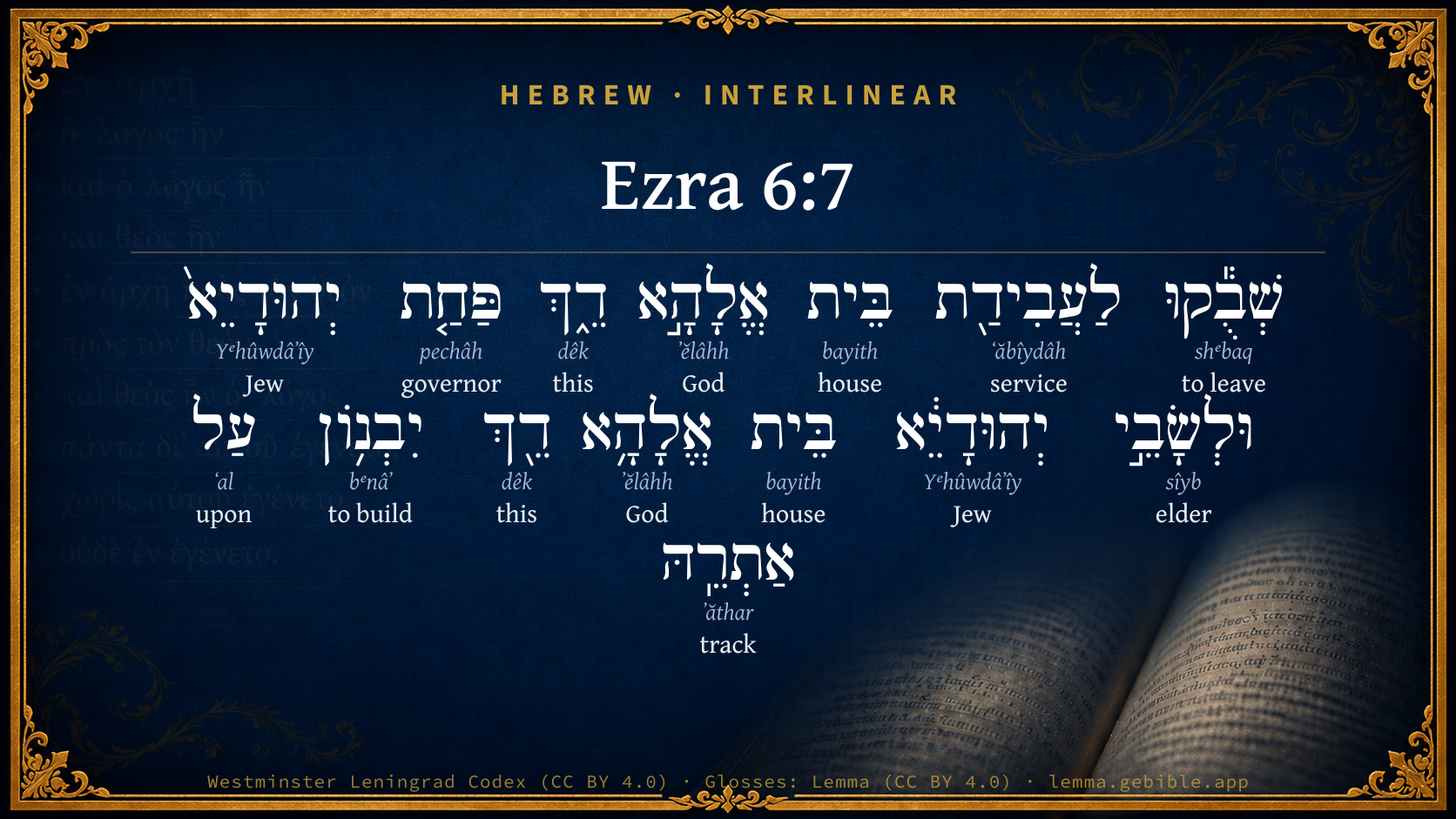
Hebrew (Westminster Leningrad Codex) Ezra 6:7 appears in the Hebrew Old Testament. The text above is from the Westminster Leningrad Codex. Each word links to its Strong’s number, a concise gloss, and parsing drawn from the Open Scriptures Hebrew Bible morphology. Click any word for its full Brown-Driver-Briggs (BDB) entry.
Download image
Cite this verse

Ezra 6:7 (World English Bible). Public Domain. Lemma interlinear Bible study tool, https://lemma.gebible.app/v/ezra/6/7.

Show BibTeX & RIS
BibTeX
RIS
English Translation
let the work of this house of God alone; let the governor of the Jews and the elders of the Jews build this house of God in its place.
World English Bible · Public Domain
Highlights
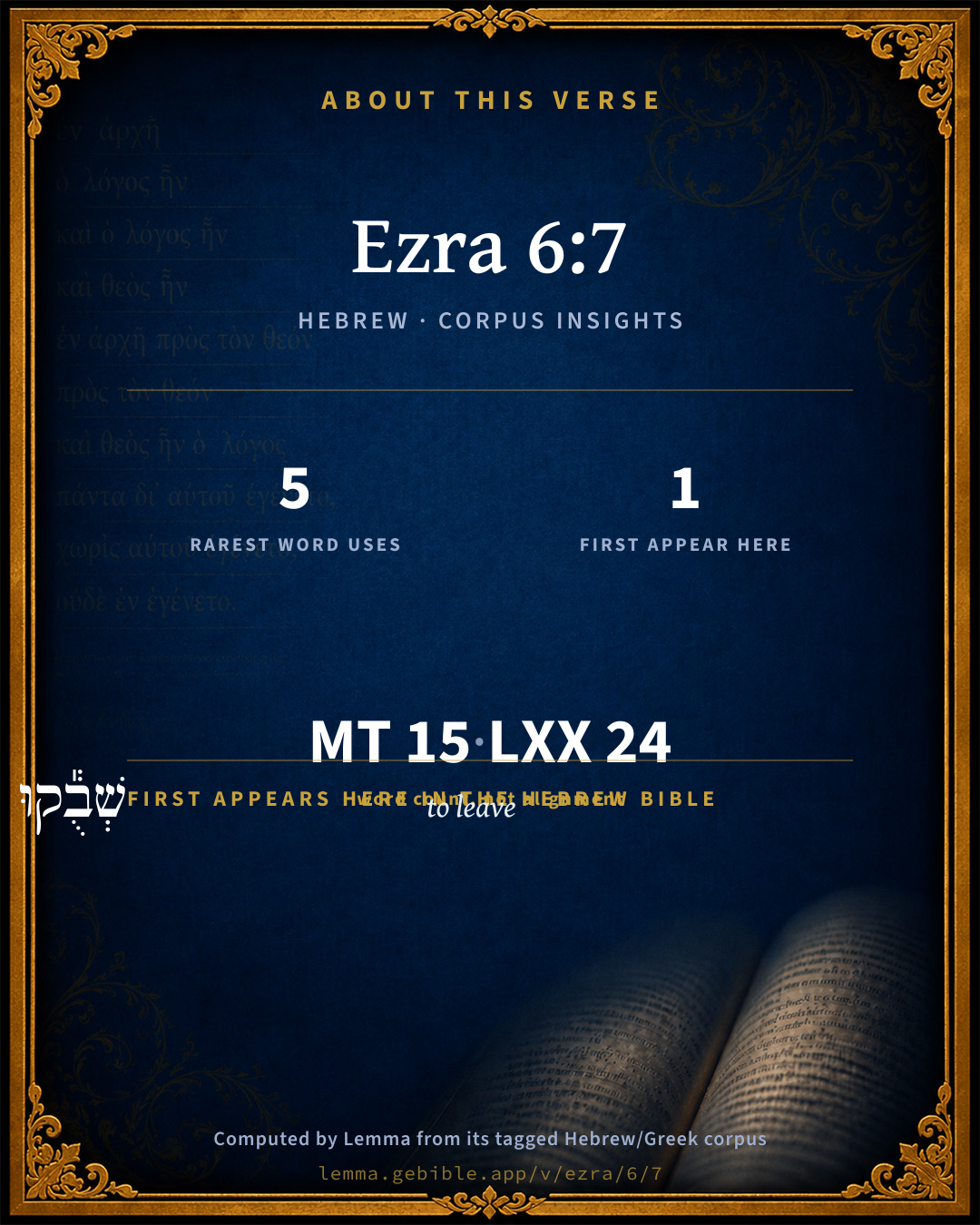
  • 1 first appearance in the Hebrew Bible
Full analysis ↓
Download a study sheet

One document with this verse’s original text, its word-by-word gloss line, the meaning frame, cross-references with their text, attributed commentary, and full source and license credits — printable, and it pastes into notes with its structure intact.

This verse Autodidact and up

Study sheet (.html) Plain text (.txt)

A passage Seminary Student

Up to 50 verses in one chapter. A passage sheet keeps up to 6 commentary sources and 12 cross-references per verse, in the order this page ranks them, and says so on the sheet whenever that leaves anything out. Ask for a single verse and you get the Autodidact verse sheet above.

Everything on this page stays free to read, with no account — the sheet is a download of what is already on screen, not access to it.

Want to remove ads? Support Godless Engineer
Compare translations 3

The same verse in 3 English versions, stacked beneath the original-language interlinear above. Click any original word for its lexicon entry.

Each is an independent rendering of the whole verse — the interlinear is not word-aligned to these translations.

Highlighted words mark where these versions differ — a whole-verse word diff, not a word-by-word alignment.

  • World English Bible Public Domain
    let the work of this house of God alone; let the governor of the Jews and the elders of the Jews build this house of God in its place.
  • King James Version Public Domain
    Let the work of this house of God alone; let the governor of the Jews and the elders of the Jews build this house of God in his place.
  • unfoldingWord Literal Text CC BY-SA 4.0
    Leave alone the work of that house of God. Let the governor of the Jews and the elders of the Jews build that house of God on its place.

unfoldingWord Literal Text — © unfoldingWord, licensed CC BY-SA 4.0. Word-aligned USFM3 via Door43 (git.door43.org/unfoldingWord/en_ult).

Versions to compare (up to 4)

3 of 4 selected

Show all 18 translations

Every available English version of this verse, each an independent rendering of the whole verse.

  • World English Bible Public Domain
    let the work of this house of God alone; let the governor of the Jews and the elders of the Jews build this house of God in its place.
  • Berean Standard Bible Public Domain
    Leave this work on the house of God alone. Let the governor and elders of the Jews rebuild this house of God on its original site.
  • Majority Standard Bible Public Domain
    Leave this work on the house of God alone. Let the governor and elders of the Jews rebuild this house of God on its original site.
  • King James Version Public Domain
    Let the work of this house of God alone; let the governor of the Jews and the elders of the Jews build this house of God in his place.
  • American Standard Version (1901) Public Domain
    let the work of this house of God alone; let the governor of the Jews and the elders of the Jews build this house of God in its place.
  • Revised Version (1885) Public Domain
    let the work of this house of God alone; let the governor of the Jews and the elders of the Jews build this house of God in its place.
  • Geneva Bible (1599) Public Domain
    Suffer ye the worke of this house of God, that the captaine of the Iewes and the Elders of the Iewes may buylde this house of God in his place.
  • Douay-Rheims (1899) Public Domain
    And let that temple of God be built by the governor of the Jews, and by their ancients, that they may build that house of God in its place.
  • Young's Literal Translation Public Domain
    let alone the work of this house of God, let the governor of the Jews, and the elders of the Jews, build this house of God on its place.
  • Literal Standard Version CC BY-SA 4.0
    let alone the work of this house of God, let the governor of the Jews, and [the] elders of the Jews, build this house of God on its place.
  • Unlocked Literal Bible CC BY-SA 4.0
    Leave the work of this house of God alone. The governor and Jewish elders will build this house of God at that place.
  • unfoldingWord Literal Text CC BY-SA 4.0
    Leave alone the work of that house of God. Let the governor of the Jews and the elders of the Jews build that house of God on its place.
  • Darby Bible Public Domain
    let the work of this house of God alone; let the governor of the Jews and the elders of the Jews build this house of God in its place.
  • World Messianic Bible Public Domain
    Leave the work of this house of God alone; let the governor of the Jews and the Jewish elders build this house of God in its place.
  • Webster's Bible Public Domain
    Let the work of this house of God alone; let the governor of the Jews, and the elders of the Jews, build this house of God in its place.
  • Free Bible Version CC BY-SA 4.0
    This work on God's Temple—leave it alone! Let the governor and leaders of the Jews continue with rebuilding this Temple of God on its original site.
  • Bible in Basic English Public Domain
    Let the work of this house of God go on; let the ruler of the Jews and their responsible men put up this house of God in its place.
  • JPS Tanakh (1917) Public Domain
    let the work of this house of God alone; let the governor of the Jews and the elders of the Jews build this house of God in its place.

Literal Standard Version (2020), Covenant Press — licensed CC BY-SA 4.0. Text via the HelloAO Bible API (eBible.org). Unlocked Literal Bible (unfoldingWord) — licensed CC BY-SA 4.0. Text via the HelloAO Bible API (eBible.org). unfoldingWord Literal Text — © unfoldingWord, licensed CC BY-SA 4.0. Word-aligned USFM3 via Door43 (git.door43.org/unfoldingWord/en_ult). Free Bible Version, Dr. Jonathan Gallagher — licensed CC BY-SA 4.0. Text via the HelloAO Bible API (eBible.org).

Word by word

More ways to search: Search by grammar → Find every occurrence → Compare this word →

Practice this passage: Drill this verse → Learn its vocabulary →

שְׁבֻ֕קוּ
shᵉbaq
H7662
“leave”
Adjective, V
Part of Speech
Adjective
Full BDB Definition

Origin: corresponding to the root of H7733

TWOT: 3018

to leave, let alone - (Peal) to leave, let alone - (Ithpael) to be left
  1. לַעֲבִידַ֖ת ʻăbîydâh H5673 “to/for · service of” Adjective, T + Noun, Common, Feminine, Singular, Construct
  2. בֵּית bayith H1005 “house of” Adjective, N, Common
  3. אֱלָהָ֣א ʼĕlâhh H426 “God · the” Adjective, N, Common + Particle, Definite Article
  4. דֵ֑ךְ dêk H1791 “this” Adjective, P
  5. פַּחַ֤ת pechâh H6347 “governor of” Adjective, N, Common
  6. יְהוּדָיֵא֙ Yᵉhûwdâʼîy H3062 “Jews · the” Adjective, N + Particle, Definite Article
  7. וּלְשָׂבֵ֣י sîyb H7868 “and · to/for · elders of” Adjective, C + Preposition + Noun, Common, Masculine, Plural, Construct
  8. יְהוּדָיֵ֔א Yᵉhûwdâʼîy H3062 “Jews · the” Adjective, N + Particle, Definite Article
  9. בֵּית bayith H1005 “house of” Adjective, N, Common
  10. אֱלָהָ֥א ʼĕlâhh H426 “God · the” Adjective, N, Common + Particle, Definite Article
  11. דֵ֖ךְ dêk H1791 “this” Adjective, P
  12. יִבְנ֥וֹן bᵉnâʼ H1124 “to build” Adjective, V
  13. עַל ʻal H5922 “upon” Adjective, R
  14. אַתְרֵֽהּ ʼăthar H870 “track · his” Adjective, N, Common + Suffix, Personal, 3rd Person, Masculine, Singular

About this verse

These counts appear in no published source. They are computed here, from the morphology-tagged text and Lemma’s own curated glosses. What Lemma adds →

15
words
11
distinct lemmas
Historical
section

Notable vocabulary

The rarest word here is שְׁבֻ֕קוּ to leave H7662 — appearing just 5 times in the whole Hebrew Bible.

First appearance in Scripture

This word makes its first canonical appearance in the Hebrew Bible here:

  • שְׁבֻ֕קוּ to leave H7662

Shared distinctive vocabulary

שְׁבֻ֕קוּ to leave H7662 occurs in 5 verses of the Hebrew Bible. Also found in:

Grammatical profile

  • 2 nouns
  • 9 adjectives
  • 4 particles

Repetition

Words recur within this verse — often emphatic in Hebrew:

  • בֵּית house H1005 ×2
  • אֱלָהָ֣א God H426 ×2
  • יְהוּדָיֵא֙ Jew H3062 ×2
  • דֵ֑ךְ this H1791 ×2

Hebrew & Septuagint length

In English translation the verse runs 29 words from the Hebrew and 30 from the Septuagint (LXX English) — closely comparable.

A rough comparison of the two English renderings, which tokenize alike — not a word-level alignment.

Word counts can differ between the Hebrew and the Greek without any difference in meaning — e.g. the Hebrew direct-object marker אֵת has no separate Greek word, and Greek often adds the article ὁ.

In the original languages it is 15 Hebrew tokens and 24 Greek tokens — but the two are counted differently (Hebrew bundles its prefixes and suffixes into one token; the Greek is in lemma form), so that isn’t a like-for-like length.

Cross-references

1

Topical passages linked to Ezra 6:7 in the Treasury of Scripture Knowledge — connected by theme and wording, ordered by reader-vote popularity; previews shown in the World English Bible.

  • Acts 5:38–39 Now I tell you, withdraw from these men, and leave them alone. For if this counsel or this work is of men, it will be overthrown.

Cross-references courtesy of OpenBible.info (CC BY 4.0).

Hebrew and Greek witnesses Masoretic Hebrew ↔ Greek Septuagint

The same verse in the two great witnesses to the Old Testament, shown verse-for-verse.

These are two independent witnesses, not word-aligned to each other, and the Septuagint is shown in lemma (dictionary) form.

Hebrew Ezra 6:7 Masoretic · Westminster Leningrad Codex

שְׁבֻ֕קוּ לַעֲבִידַ֖ת בֵּית אֱלָהָ֣א דֵ֑ךְ פַּחַ֤ת יְהוּדָיֵא֙ וּלְשָׂבֵ֣י יְהוּדָיֵ֔א בֵּית אֱלָהָ֥א דֵ֖ךְ יִבְנ֥וֹן עַל אַתְרֵֽהּ

let the work of this house of God alone; let the governor of the Jews and the elders of the Jews build this house of God in its place.

World English Bible · Public Domain

Greek LXX Ezra 6:7 Septuagint · lemma form

ἀποἵημι ὁ ἔργον οἶκος ὁ θεός ὁ ἀποἡγέομαι ὁ ἰουδαῖος καί ὁ πρεσβύτερος ὁ ἰουδαῖος οἶκος ὁ θεός ἐκεῖνος οἰκοδομέω ἐπί ὁ τόπος αὐτός

Now let alone the work of the house of God: let the rulers of the Jews and the elders of the Jews build that house of God on its place.

LXX2012 (modern English Septuagint) · Public Domain

In the Septuagint this is one book — Esdras B (2 Esdras): Ezra is chapters 1–10, Nehemiah 11–23.

Hebrew: Westminster Leningrad Codex (CC BY 4.0). Greek: Septuagint (public domain); English from LXX2012 (modern English Septuagint) (Public Domain). How the Septuagint differs from the Hebrew →

Commentary

Notes on Ezra 6:7 from classic Christian and Jewish commentators (each source and its license shown beneath its notes). The classic Christian expositions comment on the surrounding passage and are grouped to its opening verse, so a note may address several verses; the Jewish commentaries on the Tanakh (Rashi and others) are per-verse, so they appear only where the commentator wrote on this verse.

Lemma curates 59 commentaries, every one of them public domain or Creative Commons licensed, each selected and text-cleaned for this edition rather than reprinted as found. About our sources →

Trapp's Complete Commentary

John Trapp

Ezr 6:7 Let the work of this house of God alone; let the governor of the Jews and the elders of the Jews build this house of God in his place.

Ver. 7. Let the work of this house of God alone] Meddle not, make no disturbance; this was doubtless a hard task to them, for their spirits were irked, as Moab, Num 22:3, and their fingers even itched at these builders. They sleep not, except they may do mischief, Pro 4:16.

John Trapp, A Commentary or Exposition upon All the Books of the Old and New Testament (1647–1656) — public domain. Text from a community e-Sword module.

John Gill's Exposition

Moreover, I make a decree, what ye shall do to the elders of these Jews, for the building of this house of God,.... This must be considered as an additional decree of Darius, which was peculiarly made by him, in which more was granted in favour of the Jews, and as an encouragement to them to go on with the building of the temple; though Josephus (a) says this is no other than a confirmation of the decree of Cyrus; for, according to him, all that is here granted to them, or threatened to others, from hence to the end of Ezr 6:10, was contained in the decree:

that of the king's goods, even of the tribute beyond the river; what was collected out of his dominions on that side the river Euphrates, towards the land of Israel: according to Herodotus (b), this Darius was the first of the kings of Persia that exacted tribute; under Cyrus and Cambyses only presents were brought; but he imposed a tribute, and was therefore called an huckster, as Cambyses had the name of lord, and Cyrus that of father: the same writer gives an account of the several nations he received it from, and the particular sums, which in all amounted to 14,560 Euboic talents of gold; among whom are mentioned all Phoenicia and Syria, called Palestine, the tribute of which parts is the tribute beyond the river he referred to: and this king was well disposed to the Jewish nation, temple, and worship, before he was king, if what Josephus (c) says is true, that, while a private man, he vowed to God that, if he should be king, he would send all the sacred vessels that were in Babylon to the temple at Jerusalem: and out of the above tribute it is ordered:

that forthwith expenses be given unto these men, that they be not hindered; from going on with the building, for want of money to buy materials, and pay the workmen.

(a) Antiqu. l. 11. c. 4. sect. 6. (b) Thalia, sive, l. 3. c. 89-95. (c) Antiqu. l. 11. c. 3. sect. 1.

John Gill's Exposition of the Whole Bible (1746–1763) — public domain (CC PDM 1.0). Text via the HelloAO Bible API.

Rashi

Rabbi Shlomo Yitzchaki (Rashi)

this [as translated,] this.

the governors of the Jews The rulers of the Jews shall do this thing.

and to the elders of the Jews And to the elders of the Jews I command.

this House of God [as translated,] this House of God.

Rashi on the Tanakh — English translations: “The Judaica Press complete Tanach with Rashi, translated by A. J. Rosenberg” (CC BY 4.0); “Pentateuch with Rashi's commentary by M. Rosenbaum and A.M. Silbermann, 1929-1934” (public domain); “The Metsudah Tanach series, Lakewood, N.J” (CC BY 4.0); and “The Book of Joshua, Metsudah Publications, 1997” (CC BY 4.0). Text via Sefaria.

Lesson kit

Teaching starters — assembled from the data on this page, not authored interpretation. Every prompt links to the verse data it draws on. Edit before teaching.

Ezra, in the Historical, opens this verse with 15 words (11 distinct Hebrew lemmas). Its most distinctive word is shᵉbaq (“to leave”). A historical commentator’s framing appears above. Read the whole chapter for the surrounding context.

Discussion questions

  1. How does “to leave” (shᵉbaq) shape what this verse is saying?
  2. This is the first place “to leave” appears in Scripture (first appears here). What does its debut here establish?
  3. How does Daniel 2:44, which shares the word «to leave», read alongside this verse?
  4. What does the repetition of “house” (2× in this one verse) do in this verse?
  5. These translations render this verse differently. What is at stake in choosing one wording over another?
  6. Compare how Trapp's Complete Commentary and John Gill's Exposition read this verse. Where do they agree or differ?

Things to notice

Reading settings

Reading text

Shown beneath each verse's original-language words.

Old Testament
Old Testament edition

Read the OT as the Masoretic Hebrew (MT) or the Greek Septuagint (LXX).

English shown for the Greek Septuagint (in the Hebrew ↔ Greek comparison).

Comparing translations? Open the Compare panel on any verse page to stack up to four side by side.