Judges 1:34

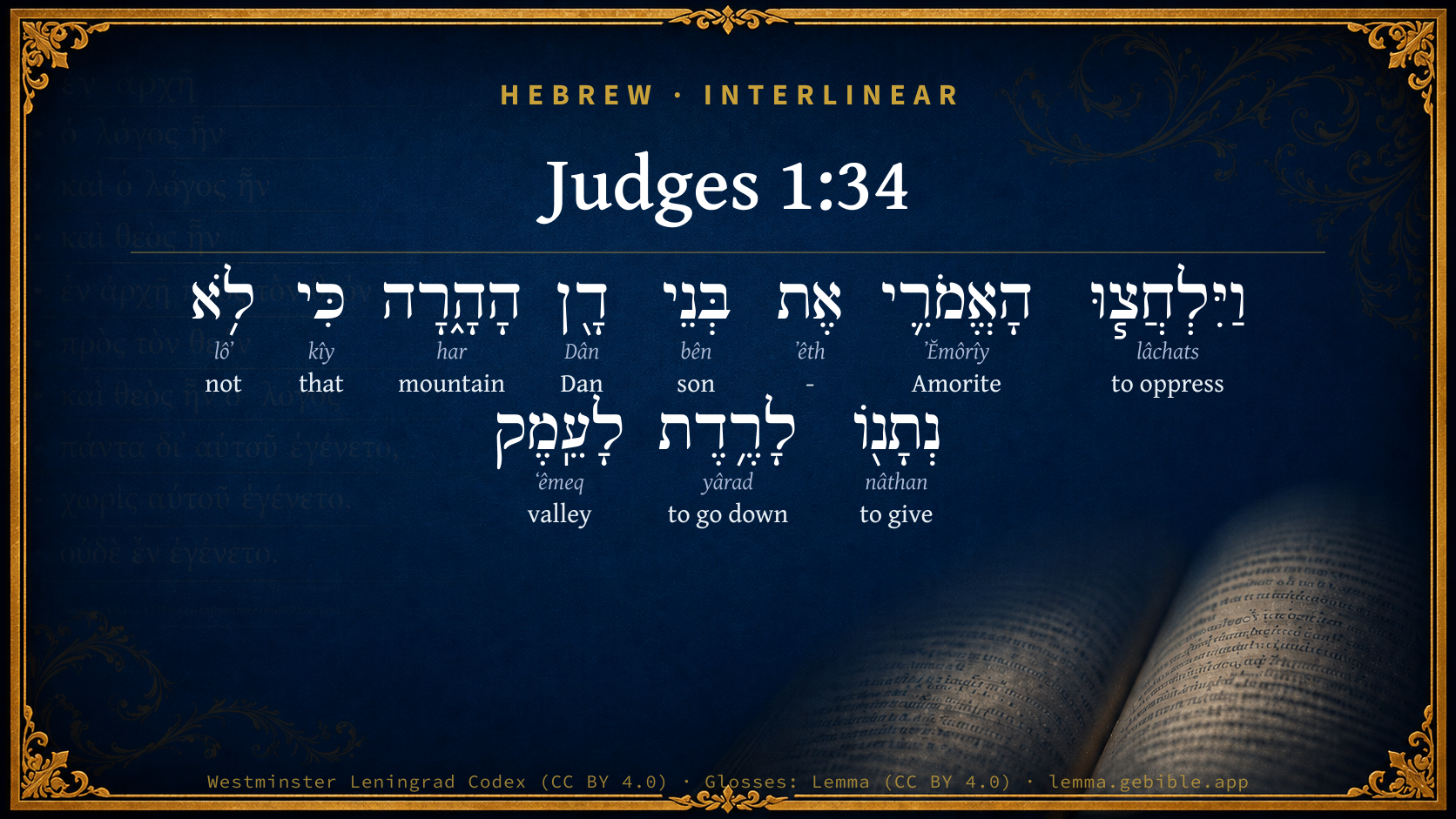
Hebrew (Westminster Leningrad Codex) Judges 1:34 appears in the Hebrew Old Testament. The text above is from the Westminster Leningrad Codex. Each word links to its Strong’s number, a concise gloss, and parsing drawn from the Open Scriptures Hebrew Bible morphology. Click any word for its full Brown-Driver-Briggs (BDB) entry.
Download image
Cite this verse

Judges 1:34 (World English Bible). Public Domain. Lemma interlinear Bible study tool, https://lemma.gebible.app/v/judges/1/34.

Show BibTeX & RIS
BibTeX
RIS
English Translation
The Amorites forced the children of Dan into the hill-country; for they would not allow them to come down to the valley;
World English Bible · Public Domain
Download a study sheet

One document with this verse’s original text, its word-by-word gloss line, the meaning frame, cross-references with their text, attributed commentary, and full source and license credits — printable, and it pastes into notes with its structure intact.

This verse Autodidact and up

Study sheet (.html) Plain text (.txt)

A passage Seminary Student

Up to 50 verses in one chapter. A passage sheet keeps up to 6 commentary sources and 12 cross-references per verse, in the order this page ranks them, and says so on the sheet whenever that leaves anything out. Ask for a single verse and you get the Autodidact verse sheet above.

Everything on this page stays free to read, with no account — the sheet is a download of what is already on screen, not access to it.

Want to remove ads? Support Godless Engineer
Compare translations 3

The same verse in 3 English versions, stacked beneath the original-language interlinear above. Click any original word for its lexicon entry.

Each is an independent rendering of the whole verse — the interlinear is not word-aligned to these translations.

Highlighted words mark where these versions differ — a whole-verse word diff, not a word-by-word alignment.

  • World English Bible Public Domain
    The Amorites forced the children of Dan into the hill-country; for they would not allow them to come down to the valley;
  • King James Version Public Domain
    And the Amorites forced the children of Dan into the mountain: for they would not suffer them to come down to the valley:
  • unfoldingWord Literal Text CC BY-SA 4.0
    And the Amorite, they pressed the sons of Dan the hill country, for he did not allow him to go down into the valley.

unfoldingWord Literal Text — © unfoldingWord, licensed CC BY-SA 4.0. Word-aligned USFM3 via Door43 (git.door43.org/unfoldingWord/en_ult).

Versions to compare (up to 4)

3 of 4 selected

Show all 18 translations

Every available English version of this verse, each an independent rendering of the whole verse.

  • World English Bible Public Domain
    The Amorites forced the children of Dan into the hill-country; for they would not allow them to come down to the valley;
  • Berean Standard Bible Public Domain
    The Amorites forced the Danites into the hill country and did not allow them to come down into the plain.
  • Majority Standard Bible Public Domain
    The Amorites forced the Danites into the hill country and did not allow them to come down into the plain.
  • King James Version Public Domain
    And the Amorites forced the children of Dan into the mountain: for they would not suffer them to come down to the valley:
  • American Standard Version (1901) Public Domain
    And the Amorites forced the children of Dan into the hill-country; for they would not suffer them to come down to the valley;
  • Revised Version (1885) Public Domain
    And the Amorites forced the children of Dan into the hill country: for they would not suffer them to come down to the valley:
  • Geneva Bible (1599) Public Domain
    And the Amorites droue the children of Dan into the mountaine: so that they suffered them not to come downe to the valley.
  • Douay-Rheims (1899) Public Domain
    And the Amorrhite straitened the children of Dan in the mountain, and gave them not place to go down to the plain:
  • Young's Literal Translation Public Domain
    And the Amorites press the sons of Dan to the mountain, for they have not suffered them to go down to the valley;
  • Literal Standard Version CC BY-SA 4.0
    And the Amorites press the sons of Dan to the mountain, for they have not permitted them to go down to the valley;
  • Unlocked Literal Bible CC BY-SA 4.0
    The Amorites forced the tribe of Dan to live in the hill country, not allowing them to come down to the plain.
  • unfoldingWord Literal Text CC BY-SA 4.0
    And the Amorite, they pressed the sons of Dan the hill country, for he did not allow him to go down into the valley.
  • Darby Bible Public Domain
    The Amorites pressed the Danites back into the hill country, for they did not allow them to come down to the plain;
  • World Messianic Bible Public Domain
    The Amorites forced the children of Dan into the hill country, for they would not allow them to come down to the valley;
  • Webster's Bible Public Domain
    And the Amorites forced the children of Dan to the mountain: for they would not suffer them to come down to the valley:
  • Free Bible Version CC BY-SA 4.0
    The Amorites pushed the people of Dan back into the hill country—they did not let them come down into the lowlands.
  • Bible in Basic English Public Domain
    And the children of Dan were forced into the hill-country by the Amorites, who would not let them come down into the valley;
  • JPS Tanakh (1917) Public Domain
    And the Amorites forced the children of Dan into the hill-country; for they would not suffer them to come down to the valley.

Literal Standard Version (2020), Covenant Press — licensed CC BY-SA 4.0. Text via the HelloAO Bible API (eBible.org). Unlocked Literal Bible (unfoldingWord) — licensed CC BY-SA 4.0. Text via the HelloAO Bible API (eBible.org). unfoldingWord Literal Text — © unfoldingWord, licensed CC BY-SA 4.0. Word-aligned USFM3 via Door43 (git.door43.org/unfoldingWord/en_ult). Free Bible Version, Dr. Jonathan Gallagher — licensed CC BY-SA 4.0. Text via the HelloAO Bible API (eBible.org).

Word by word

More ways to search: Search by grammar → Find every occurrence → Compare this word →

Practice this passage: Drill this verse → Learn its vocabulary →

וַיִּלְחֲצ֧וּ
lâchats
H3905
“and · to oppress”
Conjunction + Verb, Qal, Sequential Imperfect, 3rd Person, Masculine, Plural
Part of Speech
Conjunction + Verb
Stem
Qal
Form
Sequential Imperfect
Person
3rd Person
Gender
Masculine
Number
Plural
Full BDB Definition

Origin: a primitive root

TWOT: 1106

to squeeze, press, oppress - (Qal) - to squeeze, press - to oppress - (Niphal) to squeeze oneself
  1. הָאֱמֹרִ֛י ʼĔmôrîy H567 “the · Amorite” Particle, Definite Article + Noun, Gentilic, Masculine, Singular, Absolute
  2. אֶת ʼêth H853 “-” Particle, Direct Object
  3. בְּנֵי bên H1121 “sons of” Noun, Common, Masculine, Plural, Construct
  4. דָ֖ן Dân H1835 “Dan” Noun, Proper
  5. הָהָ֑רָה har H2022 “the · mountain · toward” Particle, Definite Article + Noun, Common, Masculine, Singular, Absolute + Suffix, Demonstrative
  6. כִּי kîy H3588 “that” Conjunction
  7. לֹ֥א lôʼ H3808 “not” Particle, Negative
  8. נְתָנ֖וֹ nâthan H5414 “to give · him” Verb, Qal, Perfect, 3rd Person, Masculine, Singular + Suffix, Personal, 3rd Person, Masculine, Singular
  9. לָרֶ֥דֶת yârad H3381 “to go down” Preposition + Verb, Qal, Infinitive Construct
  10. לָעֵֽמֶק ʻêmeq H6010 “to/for the · valley” Preposition, Determined + Noun, Common, Masculine, Singular, Absolute

About this verse

These counts appear in no published source. They are computed here, from the morphology-tagged text and Lemma’s own curated glosses. What Lemma adds →

11
words
11
distinct lemmas
Historical
section

Notable vocabulary

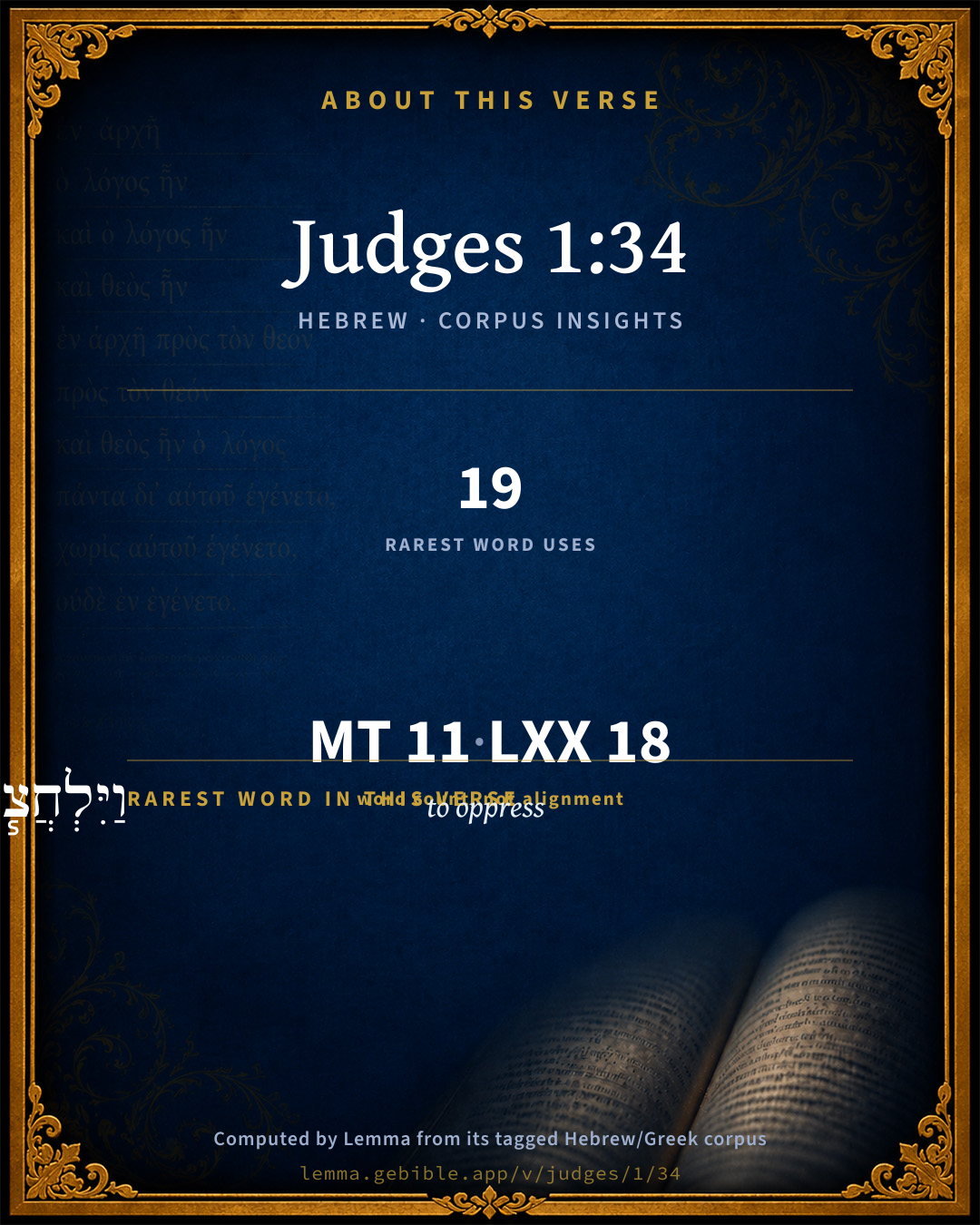
The rarest word here is וַיִּלְחֲצ֧וּ to oppress H3905 — appearing just 19 times in the whole Hebrew Bible.

Shared distinctive vocabulary

וַיִּלְחֲצ֧וּ to oppress H3905 occurs in 18 verses of the Hebrew Bible. Also found in:

Grammatical profile

  • 3 verbs
  • 5 nouns
  • 1 conjunction
  • 2 particles

Verb forms

  • וַיִּלְחֲצ֧וּ Qal · Sequential Imperfect
  • נְתָנ֖וֹ Qal · Perfect
  • לָרֶ֥דֶת Qal · Infinitive Construct

Hebrew & Septuagint length

In English translation the verse runs 22 words from the Hebrew and 24 from the Septuagint (LXX English) — closely comparable.

A rough comparison of the two English renderings, which tokenize alike — not a word-level alignment.

Word counts can differ between the Hebrew and the Greek without any difference in meaning — e.g. the Hebrew direct-object marker אֵת has no separate Greek word, and Greek often adds the article ὁ.

In the original languages it is 11 Hebrew tokens and 18 Greek tokens — but the two are counted differently (Hebrew bundles its prefixes and suffixes into one token; the Greek is in lemma form), so that isn’t a like-for-like length.

Cross-references

2

Topical passages linked to Judges 1:34 in the Treasury of Scripture Knowledge — connected by theme and wording, ordered by reader-vote popularity; previews shown in the World English Bible.

  • Joshua 19:47 The border of the children of Dan went out beyond them; for the children of Dan went up and fought against Leshem, and took it, and struck it with the edge of the sword, and possessed it, and lived therein, and called Leshem, Dan, after the name of Dan their father.
  • Judges 18:1 In those days there was no king in Israel: and in those days the tribe of the Danites sought them an inheritance to dwell in; for to that day [their] inheritance had not fallen to them among the tribes of Israel.

Cross-references courtesy of OpenBible.info (CC BY 4.0).

Hebrew and Greek witnesses Masoretic Hebrew ↔ Greek Septuagint

The same verse in the two great witnesses to the Old Testament, shown verse-for-verse.

These are two independent witnesses, not word-aligned to each other, and the Septuagint is shown in lemma (dictionary) form.

Hebrew Judges 1:34 Masoretic · Westminster Leningrad Codex

וַיִּלְחֲצ֧וּ הָאֱמֹרִ֛י אֶת בְּנֵי דָ֖ן הָהָ֑רָה כִּי לֹ֥א נְתָנ֖וֹ לָרֶ֥דֶת לָעֵֽמֶק

The Amorites forced the children of Dan into the hill-country; for they would not allow them to come down to the valley;

World English Bible · Public Domain

Greek LXX Judges 1:34 Septuagint · lemma form

καί ἐκθλίβω ὁ ἀμορραῖος ὁ υἱός δαν εἰς ὁ ὄρος ὅτι οὐ ἀποἵημι αὐτός καταβαίνω εἰς ὁ κοιλάς

And the Amorite drove out the children of Dan into the mountains, for they did not suffer them to come down into the valley.

LXX2012 (modern English Septuagint) · Public Domain

On this verse, The Cambridge Bible for Schools and Colleges discusses the Septuagint’s reading. Read the note in Commentary ↓

Hebrew: Westminster Leningrad Codex (CC BY 4.0). Greek: Septuagint (public domain); English from LXX2012 (modern English Septuagint) (Public Domain). How the Septuagint differs from the Hebrew →

Targum (Aramaic paraphrase)

1

The Targum is the ancient Jewish Aramaic paraphrase of the Hebrew Scriptures — an interpretive translation, not the Hebrew text itself. Onkelos (literal) and Pseudo-Jonathan (expansive) render the Torah, and Jonathan the Prophets. Coverage is partial: where no permissively-licensed English translation exists for a verse, only the Aramaic is shown. This is verse-level text, not a word-by-word alignment to the Hebrew.

  1. Targum Jonathan Prophets (Joshua–Malachi)
    וּדְחַקוּ אֱמוֹרָאֵי יַת בְּנֵי דָן לְטוּרָא אֲרֵי לָא שַׁבְקוּנוּן לְמֵחַת לְמֵישְׁרָא:

    (no public-domain English translation for this verse)

    Targum Jonathan — Aramaic: “Mikraot Gedolot” (public domain). English: “Sefaria Community Translation” (CC0 1.0 (public-domain dedication)); “London "Chaldee Paraphrase," 1871” (public domain). Text via Sefaria.

Commentary

Notes on Judges 1:34 from classic Christian and Jewish commentators (each source and its license shown beneath its notes). The classic Christian expositions comment on the surrounding passage and are grouped to its opening verse, so a note may address several verses; the Jewish commentaries on the Tanakh (Rashi and others) are per-verse, so they appear only where the commentator wrote on this verse.

Lemma curates 59 commentaries, every one of them public domain or Creative Commons licensed, each selected and text-cleaned for this edition rather than reprinted as found. About our sources →

The Cambridge Bible for Schools and Colleges

gen. ed. J. J. S. Perowne

34, 35. The fortunes of Dan

34. Dan, we may infer, attempted to settle in the N.W. corner of Judah, on the rich land (‘the valley’) between the hills and the coast. But the native population forced them back into the hills; in chs. 13, 16, 18 we find Danite settlements at Zorah and Eshtaol in the Valley of Sorek (Wadi eṣ-Ṣarâr), in Jdg_1:34 the places which Dan tried to occupy are in the next valley to the N., that of Ayyâlôn (W. Selmân—Merj ibn ‘Umar); these quarters, however, proved too strait for them, and, probably not long after the present period, a part of the tribe was driven to seek a home in the north (18), where they are settled in the time of Deborah (Jdg_5:17). It is possible that the migration was due to pressure from the Philistines.

the Amorites] Elsewhere in this chap., as always in J, the pre-Israelite inhabitants are called Canaanites, while Amorites is the name used by E and D; the text of Jdg_1:34-36 no doubt originally had ‘Canaanites.’ There is no sufficient reason to suppose that these verses come from a different document (cf. 34 with 19 ‘hill country … valley,’ 35 with 27b, 23, 30, 33).

forced] The same Hebr. word as in Jdg_4:3, Jdg_10:12 ‘oppress’; Amo_6:14 ‘afflict.’

After this verse it is probable that Jos_19:47 (corrected), a verse which is clearly an insertion in its present context, followed in the original narrative of J: ‘and the border of their inheritance was too strait for them (cf. 2Ki_6:1 in Hebr.), and the children of Dan went up and fought with Lesham (= Laish, Jdg_18:29) and took it, and smote it with the edge of the sword, and possessed it and dwelt in it; and they called Lesham, Dan, after the name of Dan their father.’ Perhaps this verse was struck out here, because the episode is narrated at length in the Appendix, ch. 18. At the beginning of Jos_19:47 the LXX seem to have translated a text which commenced with ‘And the sons of Dan did not dispossess the Amorites …’ If this sentence stood originally in the present document, it would conform Jdg_1:34, which begins abruptly, with Jdg_1:21; Jdg_1:29 ff.

The Cambridge Bible for Schools and Colleges (gen. ed. J. J. S. Perowne; Cambridge University Press, 1878–1918) — public domain. Text from a community e-Sword module.

The Biblical Illustrator

Joseph S. Exell

Jdg_1:34-36

The Amorites forced the children of Dan into the mountain.

A neglect of duty injurious to others

So that we see that the negligence of the other tribes in suffering the forbidden nations to remain and wax strong caused these their brethren to be wronged, and to go without their due which God had allotted them. For if they had kept their enemies out they might have been able now to help this tribe of Dan: who, if the house of Joseph had not done more than the rest, they had been left almost without habitation. And by this way we may see that mens sins do not only redound to their own hurt, but also to the hurt of others. Whereas none are hurt, neither themselves, by those that fear to offend God, and be careful to do their duties, but they may receive great benefit thereby. But the other hurt many as well as themselves. As we see bad parents, what woe they hoard up for their unhappy children, as Ahab and the like. As also, how many souls doth an ignorant, idle, or scandalous minister destroy and cause to perish. (R. Rogers.)

.

The Biblical Illustrator, edited by Joseph S. Exell (c. 1880s–1900s) — public domain. Text from a community e-Sword module.

Joseph Benson's Commentary

Jdg 1:34-35. They would not suffer them to come down into the valley —

That is, into the plain country; which was the occasion of that expedition for the obtaining of territory elsewhere, of which we read Jos 19:47, and Jdg 18:2. The hand of the house of Joseph prevailed — That is, of the Ephraimites, who helped their brethren the Danites against the Amorites.

Joseph Benson's Commentary on the Old and New Testaments (1811–1818) — public domain. Text from a community e-Sword module.

Geneva Bible (1599)

Geneva Bible translators

Or, afflicted them.

Geneva Bible (1599) marginal notes — public domain. Text via Bolls.life.

Adam Clarke's Commentary

Verse 34. The Amorites forced the children of Dan, c.] Just as the ancient Britons were driven into the mountains of Wales by the Romans and the native Indians driven back into the woods by the British settlers in America.

Adam Clarke's Commentary on the Bible (1810–1826) — public domain. Text from a community e-Sword/MySword module.

Ellicott's Commentary for English Readers

(34) The Amorites.—They were the Highlanders of Palestine (Jos_10:6; Num_13:29; Deu_1:44).

Forced.—Literally “squeezed” or “pressed.”

Forced the children of Dan into the mountain.—The condition of this tribe was, therefore, the worst of all. So far from reducing under tribute the Canaanites of its assigned possession, as the central tribes did, the Danites did not even succeed in establishing a tolerated neutrality among them, like the northern tribes, but were driven into a few mountain-strongholds. It was probably this failure, and the consequent pressure of space under which the tribe laboured, which induced them to undertake the successful northern expedition alluded to in Jos_19:47 and described in Judges 18

A Bible Commentary for English Readers, edited by Charles John Ellicott (1878–1897) — public domain. Text from a community e-Sword module.

John Gill's Exposition

And the Amorites forced the children of Dan into the mountain,.... Into the mountainous part of the tribe of Dan; the most noted mountains in it were Sear and Baalah, which lay on the border of Judah, Jos 15:10; Joppa in this tribe was built on an high rock, and so Gibbethon, as its name seems to import, perhaps was built on a hill or mountain, as were the cities after mentioned:

for they would not suffer them to come down to the valley; which lay between Joppa and Caesarea, the plain of Sharon, in which were Lydda, Jamnia, &c. which belonged to their tribe, and they afterwards enjoyed; See Gill on Jos 19:48.

John Gill's Exposition of the Whole Bible (1746–1763) — public domain (CC PDM 1.0). Text via the HelloAO Bible API.

Albert Barnes' Notes on the Bible

The Amorites are usually found in the mountain Num 13:29; Jos 10:6. Here they dwell in the valley, of which the monuments of Rameses III show them to have been in possession when that monarch invaded Syria. It was their great strength in this district, and their forcible detention of the territory of Dan, which led to the expedition of the Danites Judg. 18. The house of Joseph lent their powerful aid in subduing them, probably in the times of the Judges.

Albert Barnes' Notes on the Bible (1834–1885) — public domain. Text from a community e-Sword/MySword module.

Matthew Poole's English Annotations

Into the plain country; which was the occasion of that expedition for the getting of new quarters; of which we read Jos 19; Jdg 18.

Matthew Poole's English Annotations on the Holy Bible (1683–1685) — public domain. Text from a community e-Sword/MySword module.

Whedon's Commentary on the Bible

Daniel D. Whedon

34. Amorites — Jos_2:10, note.

Forced the children of Dan into the mountain — Dan’s portion was chiefly that part of the Shephelah, or maritime plain, which lay to the west of Benjamin and northwest of Judah. Hence he was forced out of the main part of his inheritance. The tribe made up for this by conquests in the north, near Mount Hermon. Chap. 18, and Jos_19:47.

Daniel D. Whedon (gen. ed.), Commentary on the Old and New Testaments (1874–1909) — public domain. Text from a community e-Sword module.

The Pulpit Commentary

Vers. 34, 35. The failure of duty of one an occasion of inconvenience to another.

Joseph, strong enough to have destroyed the Amorites, made them tributaries. The same people a little further away were thereby enabled to afflict and annoy a companion tribe. "The Amorites forced the children of Dan into the mountain," etc. The cause of Dan ought to have been the cause of Joseph. The latter was therefore guilty of intense selfishness.

I IT IS A SIN FOR CHRISTIANS TO REAP ADVANTAGE AT THE EXPENSE OF LOSS OR INCONVENIENCE TO THEIR BRETHREN.

II GOD OFTEN MAKES THE UNWORTHINESS OR FAULT OF ONE OF HIS CHILDREN A DISCIPLINE TO ANOTHER.

III BUT THIS DOES NOT FREE THE LATTER FROM THE RESPONSIBILITY OF DOING HIS BEST. Dan might be annoyed, and justly, at the indirect help given to his oppressors, but all the same he ought to have invoked the aid of Jehovah and gone forth to do battle against them. He might have delivered himself from the inconvenience to which he was subject. And so with all the indirectly produced ills of life; a heroic faith is certain to overcome them, or render them comparatively innoxious. M.

The Pulpit Commentary (1880–1919), ed. H.D.M. Spence-Jones & Joseph S. Exell — public domain. Text from a community e-Sword module.

John Wesley's Explanatory Notes

The valley - That is, into the plain country; which was the occasion of that expedition for the getting new quarters, of which we read ver. 47, 48 and chap. xviii, 1-31.

John Wesley, Explanatory Notes Upon the Whole Bible (1754–1765) — public domain. Text via the GEBible commentary corpus.

unfoldingWord translationNotes

Door43 World Missions Community

not allowing them to come down

"stopping them from coming down"

plain

a very large area of flat land without trees

Mount Heres

This is the name of a large hill on which the city of Aijalon was built. (See: How to Translate Names)

Aijalon ... Shaalbim

These are names of cities. (See: How to Translate Names)

the military might of the house of Joseph conquered them

"the tribes of people who descended from Joseph were able to conquer them because of their powerful army"

house of Joseph

Here "house" represents descendants. Manasseh and Ephraim were sons of Joseph, and the "house of Joseph" can refer to the descendants of Manasseh and Ephraim. AT: "the descendants of Manasseh and Ephraim" or "the men of the tribes of Manasseh and Ephraim" (See: Metonymy)

the hill of Akrabbim

This was a pass southwest of the Dead Sea. It is also called the "Scorpion Pass." (See: How to Translate Names)

Sela

This is the name of a city. (See: How to Translate Names)

translationWords

Amorite

tribe

Dan

life

might

house

Joseph (OT)

servant

labor

unfoldingWord translationNotes — © Distant Shores Media and the Door43 World Missions Community, licensed CC BY-SA 4.0. Source: git.door43.org/Door43/en_tn.

Lesson kit

Teaching starters — assembled from the data on this page, not authored interpretation. Every prompt links to the verse data it draws on. Edit before teaching.

Judges, in the Historical, opens this verse with 11 words (11 distinct Hebrew lemmas). Its most distinctive word is lâchats (“to oppress”). A historical commentator’s framing appears above. Read the whole chapter for the surrounding context.

Discussion questions

  1. What does “to oppress” (lâchats) contribute to the verse as a whole?
  2. Exodus 3:9 shares the word «to oppress» with this verse. How do the two illuminate each other?
  3. The translations on this page render this verse differently — a whole-verse word diff, not a word-by-word alignment. What might account for the different wordings?
  4. The verb «וַיִּלְחֲצ֧וּ» is Qal Sequential Imperfect. How does its form color the action?
  5. Reading how The Cambridge Bible for Schools and Colleges and The Biblical Illustrator read this verse, where do the two commentators agree and where do they part?

Things to notice

Reading settings

Reading text

Shown beneath each verse's original-language words.

Old Testament
Old Testament edition

Read the OT as the Masoretic Hebrew (MT) or the Greek Septuagint (LXX).

English shown for the Greek Septuagint (in the Hebrew ↔ Greek comparison).

Comparing translations? Open the Compare panel on any verse page to stack up to four side by side.