
Mark 14:50

Greek (Tischendorf 8th ed.) Mark 14:50 appears in the Greek New Testament. The text above is from the Tischendorf 8th edition. Each word links to its Strong’s number and a concise gloss. Click any word for its full Thayer’s Greek Lexicon entry.
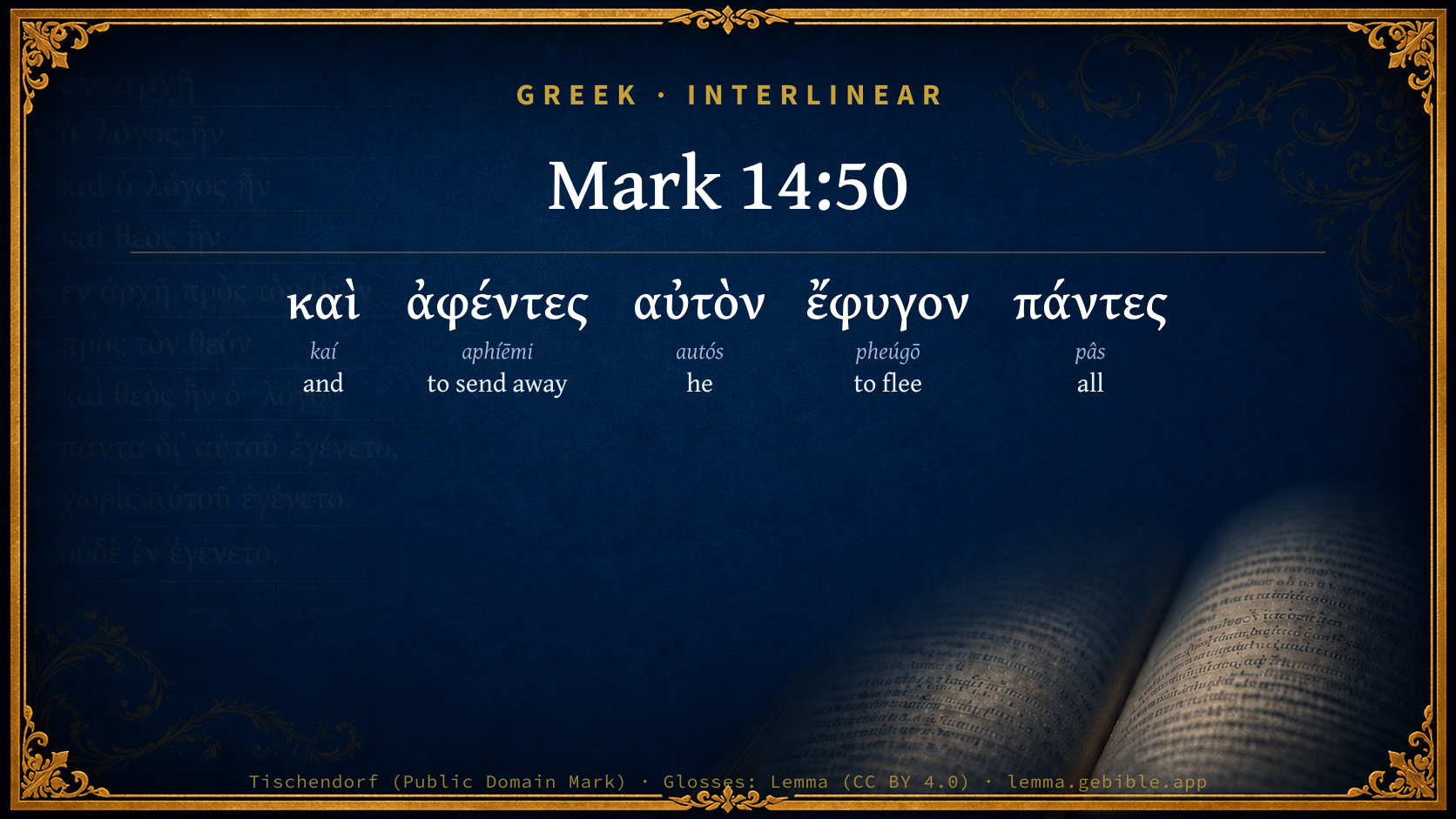
Download image
Cite this verse

Mark 14:50 (World English Bible). Public Domain. Lemma interlinear Bible study tool, https://lemma.gebible.app/v/mark/14/50.

Show BibTeX & RIS
BibTeX
RIS
English Translation
They all left him, and fled.
World English Bible · Public Domain
Download a study sheet

One document with this verse’s original text, its word-by-word gloss line, the meaning frame, cross-references with their text, attributed commentary, and full source and license credits — printable, and it pastes into notes with its structure intact.

This verse Autodidact and up

Study sheet (.html) Plain text (.txt)

A passage Seminary Student

Up to 50 verses in one chapter. A passage sheet keeps up to 6 commentary sources and 12 cross-references per verse, in the order this page ranks them, and says so on the sheet whenever that leaves anything out. Ask for a single verse and you get the Autodidact verse sheet above.

Everything on this page stays free to read, with no account — the sheet is a download of what is already on screen, not access to it.

Want to remove ads? Support Godless Engineer
Compare translations 3

The same verse in 3 English versions, stacked beneath the original-language interlinear above. Click any original word for its lexicon entry.

Each is an independent rendering of the whole verse — the interlinear is not word-aligned to these translations.

Highlighted words mark where these versions differ — a whole-verse word diff, not a word-by-word alignment.

  • World English Bible Public Domain
    They all left him, and fled.
  • King James Version Public Domain
    And they all forsook him, and fled.
  • unfoldingWord Literal Text CC BY-SA 4.0
    And having left him, they all fled.

unfoldingWord Literal Text — © unfoldingWord, licensed CC BY-SA 4.0. Word-aligned USFM3 via Door43 (git.door43.org/unfoldingWord/en_ult).

Versions to compare (up to 4)

3 of 4 selected

Show all 19 translations

Every available English version of this verse, each an independent rendering of the whole verse.

  • World English Bible Public Domain
    They all left him, and fled.
  • Berean Standard Bible Public Domain
    Then everyone deserted Him and fled.
  • Majority Standard Bible Public Domain
    Then everyone deserted Him and fled.
  • King James Version Public Domain
    And they all forsook him, and fled.
  • American Standard Version (1901) Public Domain
    And they all left him, and fled.
  • Revised Version (1885) Public Domain
    And they all left him, and fled.
  • Geneva Bible (1599) Public Domain
    Then they all forsooke him, and fled.
  • Douay-Rheims (1899) Public Domain
    Then his disciples leaving him, all fled away.
  • Young's Literal Translation Public Domain
    And having left him they all fled;
  • Literal Standard Version CC BY-SA 4.0
    And having left Him they all fled;
  • Unlocked Literal Bible CC BY-SA 4.0
    All those with Jesus left him and ran away.
  • unfoldingWord Literal Text CC BY-SA 4.0
    And having left him, they all fled.
  • Darby Bible Public Domain
    And all left him and fled.
  • World Messianic Bible Public Domain
    They all left him, and fled.
  • Webster's Bible Public Domain
    And they all forsook him, and fled.
  • Free Bible Version CC BY-SA 4.0
    Then all Jesus' disciples deserted him and ran away.
  • Bible in Basic English Public Domain
    And they all went away from him in fear.
  • Text-Critical English NT CC BY 4.0
    Then they all the disciples left him and fled.
  • Tyndale New Testament (1534) Public Domain
    And they all forsoke him and ranne awaye.

Literal Standard Version (2020), Covenant Press — licensed CC BY-SA 4.0. Text via the HelloAO Bible API (eBible.org). Unlocked Literal Bible (unfoldingWord) — licensed CC BY-SA 4.0. Text via the HelloAO Bible API (eBible.org). unfoldingWord Literal Text — © unfoldingWord, licensed CC BY-SA 4.0. Word-aligned USFM3 via Door43 (git.door43.org/unfoldingWord/en_ult). Free Bible Version, Dr. Jonathan Gallagher — licensed CC BY-SA 4.0. Text via the HelloAO Bible API (eBible.org).

Word by word

More ways to search: Search by grammar → Find every occurrence → Compare this word →

Practice this passage: Drill this verse → Learn its vocabulary →

ἔφυγον
pheúgō
G5343
“to flee”
Verb, Aorist, Active, Indicative, 3rd person, Plural
Part of Speech
Verb
Tense
Aorist
Voice
Active
Mood
Indicative
Person
3rd person
Number
Plural
Full Thayer's Definition

Origin: apparently a primary verb

TDNT: None

1. to flee away, seek safety by flight 2. metaph. to flee (to shun or avoid by flight) something abhorrent, esp. vices 3. to be saved by flight, to escape safely out of danger 4. poetically, to flee away, vanish
  1. καὶ kaí G2532 “and” Conjunction
  2. ἀφέντες aphíēmi G863 “to send away” Verb, Aorist, Active, Participle, Nominative, Plural, Masculine
  3. αὐτὸν autós G846 “he” Personal pronoun, Accusative, Singular, Masculine
  4. πάντες pâs G3956 “all” Adjective, Nominative, Plural, Masculine

About this verse

These counts appear in no published source. They are computed here, from the morphology-tagged text and Lemma’s own curated glosses. What Lemma adds →

5
words
5
distinct lemmas
Gospels
section

Shared distinctive vocabulary

ἔφυγον to flee G5343 occurs in 30 verses of the Greek New Testament. Also found in:
Cross-references

9

Topical passages linked to Mark 14:50 in the Treasury of Scripture Knowledge — connected by theme and wording, ordered by reader-vote popularity; previews shown in the World English Bible.

  • Mark 14:27 Jesus said to them, "All of you will be made to stumble because of me tonight, for it is written, 'I will strike the shepherd, and the sheep will be scattered.'
  • John 16:32 Behold, the time is coming, yes, and has now come, that you will be scattered, everyone to his own place, and you will leave me alone. Yet I am not alone, because the Father is with me.
  • Psalms 88:18 You have put lover and friend far from me, And my friends into darkness.
  • 2 Timothy 4:16 At my first defense, no one came to help me, but all left me. May it not be held against them.
  • Psalms 38:11 My lovers and my friends stand aloof from my plague. My kinsmen stand far away.
  • Psalms 88:7–8 Your wrath lies heavily on me. You have afflicted me with all your waves. Selah.
  • Job 19:13–14 "He has put my brothers far from me. My acquaintances are wholly estranged from me.
  • Isaiah 63:3 I have trodden the winepress alone; and of the peoples there was no man with me: yes, I trod them in my anger, and trampled them in my wrath; and their lifeblood is sprinkled on my garments, and I have stained all my clothing.
  • John 18:8 Jesus answered, "I told you that I AM. If therefore you seek me, let these go their way,"

Cross-references courtesy of OpenBible.info (CC BY 4.0).

Commentary

Notes on Mark 14:50 from classic Christian and Jewish commentators (each source and its license shown beneath its notes). The classic Christian expositions comment on the surrounding passage and are grouped to its opening verse, so a note may address several verses; the Jewish commentaries on the Tanakh (Rashi and others) are per-verse, so they appear only where the commentator wrote on this verse.

Lemma curates 59 commentaries, every one of them public domain or Creative Commons licensed, each selected and text-cleaned for this edition rather than reprinted as found. About our sources →

The Biblical Illustrator

Joseph S. Exell

Mar_14:50

And they all forsook Him and fled.

The deserters

We may take three views of the desertion of our Lord on this occasion; that event may be considered with reference to the deserters, to the deserted, and to ourselves.

I. The desertion of our Lord may be considered with reference to the apostles. In this view it affords an affecting instance of the inconstancy of man. The desertion of our Lord by the apostles affords also a proof of the melancholy consequences of the adoption of false notions. Men are sometimes found, it is true, both better and worse than their respective creeds; but it is undeniable that, whatever sentiment we really embrace, whatever we truly believe, is sure to influence our spirit and conduct. The apostles, in common with the Jews generally, had fully adopted the notion of a personal reign of the Messiah, of a temporal and worldly kingdom. Hence, ambition, of a kind (in their circumstances) the most absurd and unnatural, took full possession of their minds. They expected to be the chief ministers and counsellors of state of the largest, and, in every respect, the greatest empire in the world, an empire which was destined to absorb all others, and to become universal. Think of such a notion as this, for a few illiterate fishermen of one of the obscurest provinces of the civilized world! I do not say that it would have been otherwise-that they would steadfastly have adhered to their Lord, and have gone with Him to prison and to death, if they had been entirely quit of their false notions, and had had right views of the spiritual nature of His kingdom; for temptation, danger, fear, may overcome the strongest convictions; but it is easy to perceive that their false notions contributed to render them an easy prey to the enemy, while more correct views would have tended to prepare their minds for the trial, and to fortify them against it. We may learn from this how important it is that we should take heed what we believe. Let us prove all things, and hold fast that which is good.

II. The desertion of Christ by the apostles may be considered with reference to our Lord Himself; and here it may be viewed in two aspects: as an aggravation of His sufferings, and as a proof of His love.

1. As an aggravation of His sufferings. It should not be forgotten that our Lord was made in all points like unto His brethren. He had all the affections, passions, feelings, of human nature just as we have; the great difference being that, in us they are constantly liable to perversion and abuse, while in Him their exercise was always healthful and legitimate. In the language of prophecy, also, He complains of the desertion of His friends: I looked for some to take pity, but there was none, and for comforters, but I found none. Of the people there was none with Me. As bone of our bone, as subject to all the sympathies of our common humanity, He felt it deeply, and on many accounts, when Judas came, heading a band of ruffians, and betrayed Him with the very token of affection. He felt it deeply when Peter denied Him in His very presence with oaths and curses. He felt it deeply when they all forsook Him and fled.

2. This melancholy event may be considered further as a proof of the greatness of the Saviours love. He met with everything calculated not only to test His love, to prove its sincerity and its strength; but also to chill, and to extinguish it. But as it was self-moved, it was self-sustained. Many waters could net quench it. All the ingratitude of man could not destroy it; all the powers of darkness could not damp its ardour. Having loved His own who were in the world, He loved them to the end. Perhaps the unfaithfulness of the apostles was permitted, that Jesus might taste of every ingredient of bitterness which is mingled in mans cup of woe; that, being tempted in all points like unto His brethren, He might be able to sympathize with, and to succour them in their temptations. It may have been permitted also, in order to show that there was nothing to deserve His favour in the objects of His love. Say not that your sins are too great to be forgiven, or your heart too depraved to be renewed. Only trust Him: His grace is sufficient for you. And let this encourage the unhappy backslider, notwithstanding his frequent desertion of his Lord, to return to Him. Jesus did not disown the apostles, though they deserted Him in His distress; but after His resurrection He sent to them, by the faithful women, messages of tenderness and love: Go, said He to Mary Magdalene, go to My brethren, and say unto them, I ascend unto My Father and your Father; to My God, and your God. And to the other women, Go, tell My brethren that I go into Galilee, and there shall they see Me.

III. We proceed to consider this melancholy event with reference to ourselves. We may learn not a little from it. We may use it as a mirror in which to see ourselves. Some may see in it, perhaps, the likeness of their own conduct to their fellow men. When you thought they did well for themselves, then you blessed them. When you knew they did not need you, you followed them, and were at their service. When all praised them, you also joined in the laudation. But circumstances changed with them; and you changed too. The time came when you might really have served them, but then you withdrew yourself. Others may see in the desertion of the apostles, the likeness of their own conduct to the Saviour. Oh! how many desert Him in His poor, calumniated, persecuted brethren? How many desert Him in His injured, oppressed interest! Many will befriend and applaud a mission, a religious institution, a Christian church, a ministry, while it receives general commendation and support; but let the great frown upon it, let the foul breath of calumny pass over it and dim its lustre, let the bleak winds of adversity blow upon it, and blast it; and where are they then? They are scattered, and gone everyone to his own. We may learn from this event to solace ourselves under some of the severest trials which can befall us in the present world. Surely there are few things more bitter than this-to be deserted, when we most need their assistance, by those on whose friendly offices we are entitled to rely. But we may learn from this event not to wonder at it; it is no strange thing. We must not wonder, then, if when we are most deeply interested in any great undertaking, if when our labours and sacrifices for the good of our fellow creatures are most abundant, or when our afflictions and sufferings are most severe, that is to say, if when we most need the sympathy and support of our friends, we should be left most entirely to ourselves. Let us solace ourselves in God. Yet I am not alone, for the Father is with me. Let us live more in communion with Him. Let us look less to creatures, and more to the Creator. Let us depend less on outward things, and more on God. Finally, let us learn to anticipate the hour in which our most faithful friends must leave us. Oh! to have the great and good Shepherd with us then! Though I walk through the valley of the shadow of death, I will fear no evil; Thou art with me; Thy rod and Thy staff they comfort me. (J. J. Davies.)

The Biblical Illustrator, edited by Joseph S. Exell (c. 1880s–1900s) — public domain. Text from a community e-Sword module.

Tyndale Open Study Notes

Tyndale Open Resources

14:50 As Jesus had predicted just hours before (14:27-31), all his disciples deserted him.

Tyndale Open Study Notes — © Tyndale Open Resources, licensed CC BY-SA 4.0. Text via the HelloAO Bible API.

Expositor's Greek Testament

ed. W. Robertson Nicoll

Mar 14:50 . καὶ ἀφέντες , etc., and deserting Him fled all ( πάντες last, vide above): the nine with the three, the three not less than the nine all alike panic-stricken.

The Expositor's Greek Testament, edited by W. Robertson Nicoll (1897–1910) — public domain. Text from a community e-Sword module.

Geneva Bible (1599)

Geneva Bible translators

All his disciples.

Geneva Bible (1599) marginal notes — public domain. Text via Bolls.life.

The Cambridge Bible for Schools and Colleges

gen. ed. J. J. S. Perowne

50. they all forsook him, and fled] Even the impetuous Peter who had made so many promises; even the disciple whom He loved.

The Cambridge Bible for Schools and Colleges (gen. ed. J. J. S. Perowne; Cambridge University Press, 1878–1918) — public domain. Text from a community e-Sword module.

John Gill's Exposition

And they led Jesus away to the high priest,.... Caiaphas, as is added in the Syriac, Arabic, and Persic versions. This was done, after they had took Jesus and bound, him, and after they had had him to Annas, who sent him bound to Caiaphas; see Joh 18:12;

and with him, the high priest Caiaphas,

were assembled all the chief priests, and the elders, and the Scribes; even the whole sanhedrim, who met at Caiaphas's house, and were waiting there for Jesus; whom Judas with his band of soldiers and others, were gone to secure, and brng before them; See Gill on Mat 26:57.

John Gill's Exposition of the Whole Bible (1746–1763) — public domain (CC PDM 1.0). Text via the HelloAO Bible API.

The Pulpit Commentary

And they all left him, and fled. But soon afterwards two of them, Peter and John, took courage, and followed him to the house of the high priest.

The Pulpit Commentary (1880–1919), ed. H.D.M. Spence-Jones & Joseph S. Exell — public domain. Text from a community e-Sword module.

Cambridge Greek Testament for Schools and Colleges

50. ἔφυγον πάντες ([3224][3225][3226][3227][3228][3229]) rather than πάν. ἔφ. ([3230][3231][3232][3233][3234]).

[3224] Codex Sinaiticus. 4th cent. Discovered by Tischendorf in 1859 at the Monastery of St Katharine on Mount Sinai. Now at St Petersburg. The whole Gospel, ending at Mar 16:8. Photographic facsimile, 1911.

[3225] Codex Vaticanus. 4th cent., but perhaps a little later than א. In the Vatican Library almost since its foundation by Pope Nicolas V., and one of its greatest treasures. The whole Gospel, ending at Mar 16:8. Photographic facsimile, 1889.

[3226] Codex Ephraemi. 5th cent. A palimpsest: the original writing has been partially rubbed out, and the works of Ephraem the Syrian have been written over it; but a great deal of the original writing has been recovered; of Mark we have Mar 1:17 to Mar 6:31, Mar 8:5 to Mar 12:29, Mar 13:19 to Mar 16:20. In the National Library at Paris.

[3227] Codex Regius. 8th cent. An important witness. At Paris. Contains Mar 1:1 to Mar 10:15; Mar 10:30 to Mar 15:1; Mar 15:20 to Mar 16:20, but the shorter ending is inserted between Mar 16:8 and Mar 16:9, showing that the scribe preferred it to the longer one.

[3228] Codex Sangallensis. 9th or 10th cent. Contains the Gospels nearly complete, with an interlinear Latin translation. The text of Mark is specially good, agreeing often with CL. At St Gall.

[3229] Codex Athous Laurae. 8th cent. Like N and Σ, it is written in silver letters on purple vellum. Contains Mar 9:5 to Mar 16:20, and, as in L, the shorter ending is inserted between Mar 16:8 and Mar 16:9. As in Δ, the text of Mark is specially good.

[3230] Codex Alexandrinus. 5th cent. Brought by Cyril Lucar, Patriarch of Constantinople, from Alexandria, and afterwards presented by him to King Charles I. in 1628. In the British Museum. The whole Gospel. Photographic facsimile, 1879.

[3231] Codex Bezae. 6th cent. Has a Latin translation (d) side by side with the Greek text, and the two do not quite always agree. Presented by Beza to the University Library of Cambridge in 1581. Remarkable for its frequent divergences from other texts. Contains Mark, except Mar 16:15-20, which has been added by a later hand. Photographic facsimile, 1899.

[3232] Codex Monacensis. 10th cent. Contains Mar 6:47 to Mar 16:20. Many verses in 14, 15, 16 are defective.

[3233] Codex Oxoniensis. 9th cent. Contains Mark, except Mar 3:35 to Mar 6:20.

[3234] Codex Petropolitanus. 9th cent. Gospels almost complete. Mar 16:18-20 is in a later hand.

50. ἔφυγον πάντες. See crit. note. The πάντες comes at the end with emphasis; and they forsook Him and fled—all of them. Peter, after striking one useless blow, flees with the rest; cf. Mar 14:27; Mar 14:29. It was evident that He was not going to use His miraculous power to prove His Messiahship, and they left Him to the fate which He had often foretold.

Cambridge Greek Testament for Schools and Colleges (Cambridge University Press, 1896; 21 vols, various authors incl. Carr, Maclear, Plummer, Farrar, Lumby, Moule, M. R. James, Simcox) — public domain. Text from a community e-Sword module.

International Critical Commentary

50. καὶ ἀφέντες αὐτὸν ἔφυγον πάντες—They had stood by him until his words and acts made it evident that Jesus was committed to a policy of non-resistance. After that, to stay was simply to involve themselves in his fate, and for that, not courage, but faith was lacking. This is the explanation of their conduct during this crisis; their faith had suffered an eclipse. To the rest of the Jews, his non-resistance and the failure of heaven to interfere in his behalf were conclusive proof of the falseness of his Messianic claim. To the disciples, whose simpler and less sophisticated mind was deeply impressed with the varied proof of greatness afforded in their intimate association with him, but who had the same Jewish ideas of the Messiah, these untoward events were an occasion of profound doubt and perplexity, but not of actual unbelief. But doubt removes courage; the disciples fled because their faith wavered.

International Critical Commentary — older volumes (1896–1929), various authors — public domain. Text from a community e-Sword module.

Lesson kit

Teaching starters — assembled from the data on this page, not authored interpretation. Every prompt links to the verse data it draws on. Edit before teaching.

Mark, in the Gospels, opens this verse with 5 words (5 distinct Greek lemmas). Its most distinctive word is pheúgō (“to flee”). A historical commentator’s framing appears above. Read the whole chapter for the surrounding context.

Discussion questions

  1. The word pheúgō carries the sense “to flee.” How does it shape the verse?
  2. How does Matthew 2:13, which shares the word «to flee», read alongside this verse?
  3. These translations render this verse differently. What is at stake in choosing one wording over another?
  4. Compare how The Biblical Illustrator and Tyndale Open Study Notes read this verse. Where do they agree or differ?

Things to notice

Reading settings

Reading text

Shown beneath each verse's original-language words.

Old Testament
Old Testament edition

Read the OT as the Masoretic Hebrew (MT) or the Greek Septuagint (LXX).

English shown for the Greek Septuagint (in the Hebrew ↔ Greek comparison).

Comparing translations? Open the Compare panel on any verse page to stack up to four side by side.