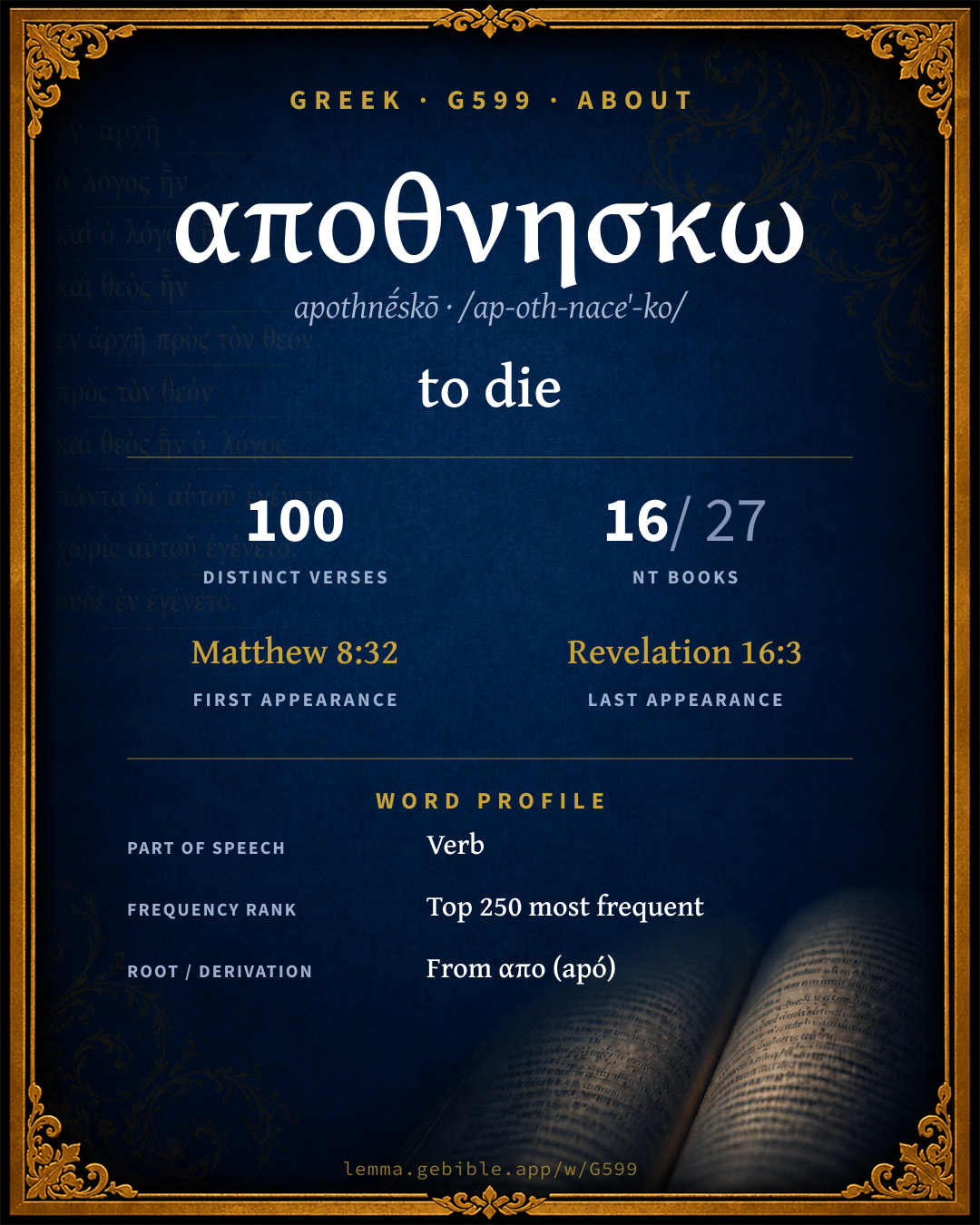
ἀποθνήσκω
to die
‘to die’ is one of 5 main senses fuller range ↓
Full lexicon entry — Thayer's Greek Lexicon
From Thayer's Greek Lexicon
Where this word appears
See every Aorist-tense verb in the Greek New Testament →
Grammar key — what these labels mean
Part of speech
- Verb
- An action or state-of-being word.
Tense
- Aorist
- Action viewed as a simple whole, without regard to duration — often past (perfective aspect).
- Present
- Ongoing or general action in present time (imperfective aspect).
- Future
- Action expected in future time.
- Imperfect
- Continuous or repeated action in past time (“was writing”).
Voice
- Active
- The subject performs the action.
- Middle deponent
- Middle in form but active in meaning.
Mood
- Indicative
- States a fact or asks a factual question (the mood of reality).
- Infinitive
- A verbal noun (“to write”), unmarked for person or number.
- Subjunctive
- Expresses probability, purpose, or possibility (the mood of contingency).
- Participle
- A verbal adjective (“writing,” “having written”).
Case
- Nominative
- The case of the subject (and the predicate nominative).
- Dative
- The case of the indirect object, means, or location — “to / for / with / in.”
- Genitive
- The case of source, possession, or “of” — answers “whose / from what.”
Person
- 3rd person
- The one spoken about (“he / she / it / they”).
- 2nd person
- The one addressed (“you”).
- 1st person
- The speaker (“I / we”).
Gender
- Masculine
- Grammatically masculine.
- Neuter
- Grammatically neuter.
Number
- Singular
- One.
- Plural
- More than one.
Grammatical forms 24 distinct
- Verb, Aorist, Active, Indicative, 3rd person, Singular 33 times (29%)
- Verb, Aorist, Active, Infinitive 16 times (14%)
- Verb, Aorist, Active, Subjunctive, 3rd person, Singular 13 times (12%)
- Verb, Aorist, Active, Indicative, 3rd person, Plural 10 times (9%)
- Verb, Present, Active, Indicative, 3rd person, Singular 5 times (4%)
- Verb, Present, Active, Infinitive 5 times (4%)
- Verb, Aorist, Active, Participle, Nominative, Singular, Masculine 3 times (3%)
- Verb, Future, Middle deponent, Indicative, 2nd person, Plural 3 times (3%)
+16 more forms (24 occurrences)
Parsed forms decoded from the imported morphology (Robinson–Tischendorf, public domain), counted across 112 parsed occurrences — not distinct verses.
Every verse where G599 appears — 100 distinct verses across 16 books. Click any verse to open its interlinear word-by-word view. Verse text shown in the World English Bible for context — . Each verse’s Greek form is shown with its reference; the English is not keyword-highlighted, since the data carries no word-level English alignment. Use “Compare translations” on any verse to read it across multiple English versions. This concordance covers the Greek New Testament; Septuagint (Greek Old Testament) occurrences of this word are not indexed here.
Matthew 5 verses
- Matthew 8:32 ἀπέθανον aor act ind 3pl He said to them, "Go!" They came out, and went into the herd of pigs: and behold, the whole herd of pigs rushed down the cliff into the sea, and died in the water.
- Matthew 9:24 ἀπέθανεν aor act ind 3sg he said to them, "Make room, because the girl isn't dead, but sleeping." They were ridiculing him.
- Matthew 22:24 ἀποθάνῃ aor act subj 3sg saying, "Teacher, Moses said, 'If a man dies, having no children, his brother shall marry his wife, and raise up seed for his brother.'
- Matthew 22:27 ἀπέθανεν aor act ind 3sg After them all, the woman died.
- Matthew 26:35 ἀποθανεῖν aor act inf Peter said to him, "Even if I must die with you, I will not deny you." All of the disciples also said likewise.
Mark 8 verses
- Mark 5:35 ἀπέθανεν aor act ind 3sg While he was still speaking, they came from the synagogue ruler's house saying, "Your daughter is dead. Why bother the Teacher any more?"
- Mark 5:39 ἀπέθανεν aor act ind 3sg When he had entered in, he said to them, "Why do you make an uproar and weep? The child is not dead, but is asleep."
- Mark 9:26 ἀπέθανεν aor act ind 3sg Having cried out, and convulsed greatly, it came out of him. The boy became like one dead; so much that most of them said, "He is dead."
- Mark 12:19 ἀποθάνῃ aor act subj 3sg "Teacher, Moses wrote to us, 'If a man's brother dies, and leaves a wife behind him, and leaves no children, that his brother should take his wife, and raise up offspring for his brother.'
- Mark 12:20 ἀποθνῄσκων pres act ptcp nom sg masc There were seven brothers. The first took a wife, and dying left no offspring.
- Mark 12:21 ἀπέθανεν aor act ind 3sg The second took her, and died, leaving no children behind him. The third likewise;
- Mark 12:22 ἀπέθανεν aor act ind 3sg and the seven took her and left no children. Last of all the woman also died.
- Mark 15:44 ἀπέθανεν aor act ind 3sg Pilate marveled if he were already dead; and summoning the centurion, he asked him whether he had been dead long.
Luke 9 verses
- Luke 8:42 ἀπέθνῃσκεν impf act ind 3sg for he had an only daughter, about twelve years of age, and she was dying. But as he went, the multitudes pressed against him.
- Luke 8:52 ἀπέθανεν aor act ind 3sg All were weeping and mourning her, but he said, "Don't weep. She isn't dead, but sleeping."
- Luke 8:53 ἀπέθανεν aor act ind 3sg They were ridiculing him, knowing that she was dead.
- Luke 16:22 ἀποθανεῖν ἀπέθανεν aor act inf aor act ind 3sg It happened that the beggar died, and that he was carried away by the angels to Abraham's bosom. The rich man also died, and was buried.
- Luke 20:28 ἀποθάνῃ aor act subj 3sg They asked him, "Teacher, Moses wrote to us that if a man's brother dies having a wife, and he is childless, his brother should take the wife, and raise up children for his brother.
- Luke 20:29 ἀπέθανεν aor act ind 3sg There were therefore seven brothers. The first took a wife, and died childless.
- Luke 20:31 ἀπέθανον aor act ind 3pl The third took her, and likewise the seven all left no children, and died.
- Luke 20:32 ἀπέθανεν aor act ind 3sg Afterward the woman also died.
- Luke 20:36 ἀποθανεῖν aor act inf For they can't die any more, for they are like the angels, and are children of God, being children of the resurrection.
John 24 verses
- John 4:47 ἀποθνῄσκειν pres act inf When he heard that Jesus had come out of Judea into Galilee, he went to him, and begged him that he would come down and heal his son, for he was at the point of death.
- John 4:49 ἀποθανεῖν aor act inf The nobleman said to him, "Sir, come down before my child dies."
- John 6:49 ἀπέθανον aor act ind 3pl Your fathers ate the manna in the wilderness, and they died.
- John 6:50 ἀποθάνῃ aor act subj 3sg This is the bread which comes down out of heaven, that anyone may eat of it and not die.
- John 6:58 ἀπέθανον aor act ind 3pl This is the bread which came down out of heaven-- not as our fathers ate the manna, and died. He who eats this bread will live forever."
- John 8:21 ἀποθανεῖσθε fut mid.dep ind 2pl Jesus said therefore again to them, "I am going away, and you will seek me, and you will die in your sins. Where I go, you can't come."
- John 8:24 ἀποθανεῖσθε ἀποθανεῖσθε fut mid.dep ind 2pl fut mid.dep ind 2pl I said therefore to you that you will die in your sins; for unless you believe that I am he, you will die in your sins."
- John 8:52 ἀπέθανεν aor act ind 3sg Then the Jews said to him, "Now we know that you have a demon. Abraham died, and the prophets; and you say, 'If a man keeps my word, he will never taste of death.'
- John 8:53 ἀπέθανεν ἀπέθανον aor act ind 3sg aor act ind 3pl Are you greater than our father, Abraham, who died? The prophets died. Who do you make yourself out to be?"
- John 11:14 ἀπέθανεν aor act ind 3sg So Jesus said to them plainly then, "Lazarus is dead.
- John 11:16 ἀποθάνωμεν aor act subj 1pl Thomas therefore, who is called Didymus, said to his fellow disciples, "Let's go also, that we may die with him."
- John 11:21 ἀπέθανεν aor act ind 3sg Therefore Martha said to Jesus, "Lord, if you would have been here, my brother wouldn't have died.
- John 11:25 ἀποθάνῃ aor act subj 3sg Jesus said to her, "I am the resurrection and the life. He who believes in me, though he die, yet will he live.
- John 11:26 ἀποθάνῃ aor act subj 3sg Whoever lives and believes in me will never die. Do you believe this?"
- John 11:32 ἀπέθανεν aor act ind 3sg Therefore when Mary came to where Jesus was, and saw him, she fell down at his feet, saying to him, "Lord, if you would have been here, my brother wouldn't have died."
- John 11:37 ἀποθάνῃ aor act subj 3sg Some of them said, "Couldn't this man, who opened the eyes of him who was blind, have also kept this man from dying?"
- John 11:50 ἀποθάνῃ aor act subj 3sg nor do you consider that it is advantageous for us that one man should die for the people, and that the whole nation not perish."
- John 11:51 ἀποθνῄσκειν pres act inf Now he didn't say this of himself, but being high priest that year, he prophesied that Jesus would die for the nation,
- John 12:24 ἀποθάνῃ ἀποθάνῃ aor act subj 3sg aor act subj 3sg Most assuredly I tell you, unless a grain of wheat falls into the earth and dies, it remains by itself alone. But if it dies, it bears much fruit.
- John 12:33 ἀποθνῄσκειν pres act inf But he said this, signifying by what kind of death he should die.
- John 18:14 ἀποθανεῖν aor act inf Now it was Caiaphas who advised the Jews that it was expedient that one man should perish for the people.
- John 18:32 ἀποθνῄσκειν pres act inf that the word of Jesus might be fulfilled, which he spoke, signifying by what kind of death he should die.
- John 19:7 ἀποθανεῖν aor act inf The Jews answered him, "We have a law, and by our law he ought to die, because he made himself the Son of God."
- John 21:23 ἀποθνήσκει ἀποθνήσκει pres act ind 3sg pres act ind 3sg This saying therefore went out among the brothers, that this disciple wouldn't die. Yet Jesus didn't say to him that he wouldn't die, but, "If I desire that he stay until I come, what is that to you?"
Acts 4 verses
- Acts 7:4 ἀποθανεῖν aor act inf Then he came out of the land of the Chaldaeans, and lived in Haran. From there, when his father was dead, God moved him into this land, where you are now living.
- Acts 9:37 ἀποθανεῖν aor act inf It happened in those days that she fell sick, and died. When they had washed her, they laid her in an upper chamber.
- Acts 21:13 ἀποθανεῖν aor act inf Then Paul answered, "What are you doing, weeping and breaking my heart? For I am ready not only to be bound, but also to die at Jerusalem for the name of the Lord Jesus."
- Acts 25:11 ἀποθανεῖν aor act inf For if I have done wrong, and have committed anything worthy of death, I don't refuse to die; but if none of those things is true that they accuse me of, no one can give me up to them. I appeal to Caesar!"
Romans 19 verses
- Romans 5:6 ἀπέθανεν aor act ind 3sg For while we were yet weak, at the right time Christ died for the ungodly.
- Romans 5:7 ἀποθανεῖται ἀποθανεῖν fut mid.dep ind 3sg aor act inf For one will hardly die for a righteous man. Yet perhaps for a righteous person someone would even dare to die.
- Romans 5:8 ἀπέθανεν aor act ind 3sg But God commends his own love toward us, in that while we were yet sinners, Christ died for us.
- Romans 5:15 ἀπέθανον aor act ind 3pl But the free gift isn't like the trespass. For if by the trespass of the one the many died, much more did the grace of God, and the gift by the grace of the one man, Jesus Christ, abound to the many.
- Romans 6:2 ἀπεθάνομεν aor act ind 1pl May it never be! We who died to sin, how could we live in it any longer?
- Romans 6:7 ἀποθανὼν aor act ptcp nom sg masc For he who has died has been freed from sin.
- Romans 6:8 ἀπεθάνομεν aor act ind 1pl But if we died with Christ, we believe that we will also live with him;
- Romans 6:9 ἀποθνῄσκει pres act ind 3sg knowing that Christ, being raised from the dead, dies no more. Death no more has dominion over him!
- Romans 6:10 ἀπέθανεν ἀπέθανεν aor act ind 3sg aor act ind 3sg For the death that he died, he died to sin one time; but the life that he lives, he lives to God.
- Romans 7:2 ἀποθάνῃ aor act subj 3sg For the woman that has a husband is bound by law to the husband while he lives, but if the husband dies, she is discharged from the law of the husband.
- Romans 7:3 ἀποθάνῃ aor act subj 3sg So then if, while the husband lives, she is joined to another man, she would be called an adulteress. But if the husband dies, she is free from the law, so that she is no adulteress, though she is joined to another man.
- Romans 7:6 ἀποθανόντες aor act ptcp nom pl masc But now we have been discharged from the law, having died to that in which we were held; so that we serve in newness of the spirit, and not in oldness of the letter.
- Romans 7:10 ἀπέθανον aor act ind 1sg The commandment, which was for life, this I found to be for death;
- Romans 8:13 ἀποθνῄσκειν pres act inf For if you live after the flesh, you must die; but if by the Spirit you put to death the deeds of the body, you will live.
- Romans 8:34 ἀποθανών aor act ptcp nom sg masc Who is he who condemns? It is Christ who died, yes rather, who was raised from the dead, who is at the right hand of God, who also makes intercession for us.
- Romans 14:7 ἀποθνῄσκει pres act ind 3sg For none of us lives to himself, and none dies to himself.
- Romans 14:8 ἀποθνῄσκωμεν ἀποθνῄσκομεν ἀποθνῄσκωμεν pres act subj 1pl pres act ind 1pl pres act subj 1pl For if we live, we live to the Lord. Or if we die, we die to the Lord. If therefore we live or die, we are the Lord's.
- Romans 14:9 ἀπέθανεν aor act ind 3sg For to this end Christ died, rose, and lived again, that he might be Lord of both the dead and the living.
- Romans 14:15 ἀπέθανεν aor act ind 3sg Yet if because of food your brother is grieved, you walk no longer in love. Don't destroy with your food him for whom Christ died.
1 Corinthians 7 verses
- 1 Corinthians 8:11 ἀπέθανεν aor act ind 3sg And through your knowledge, he who is weak perishes, the brother for whose sake Christ died.
- 1 Corinthians 9:15 ἀποθανεῖν aor act inf But I have used none of these things, and I don't write these things that it may be done so in my case; for I would rather die, than that anyone should make my boasting void.
- 1 Corinthians 15:3 ἀπέθανεν aor act ind 3sg For I delivered to you first of all that which I also received: that Christ died for our sins according to the Scriptures,
- 1 Corinthians 15:22 ἀποθνῄσκουσιν pres act ind 3pl For as in Adam all die, so also in Christ all will be made alive.
- 1 Corinthians 15:31 ἀποθνῄσκω pres act ind 1sg I affirm, by the boasting in you which I have in Christ Jesus our Lord, I die daily.
- 1 Corinthians 15:32 ἀποθνῄσκομεν pres act ind 1pl If I fought with animals at Ephesus for human purposes, what does it profit me? If the dead are not raised, then "let us eat and drink, for tomorrow we die."
- 1 Corinthians 15:36 ἀποθάνῃ aor act subj 3sg You foolish one, that which you yourself sow is not made alive unless it dies.
2 Corinthians 2 verses
- 2 Corinthians 5:15 ἀπέθανεν ἀπέθανον ἀπέθανεν ἀποθανόντι aor act ind 3sg aor act ind 3pl aor act ind 3sg aor act ptcp dat sg masc He died for all, that those who live should no longer live to themselves, but to him who for their sakes died and rose again.
- 2 Corinthians 6:9 ἀποθνῄσκοντες pres act ptcp nom pl masc as unknown, and yet well known; as dying, and behold, we live; as punished, and not killed;
Galatians 2 verses
Philippians 1 verse
Colossians 2 verses
1 Thessalonians 2 verses
- 1 Thessalonians 4:14 ἀπέθανεν aor act ind 3sg For if we believe that Jesus died and rose again, even so those who have fallen asleep in Jesus will God bring with him.
- 1 Thessalonians 5:10 ἀποθανόντος aor act ptcp gen sg masc who died for us, that, whether we wake or sleep, we should live together with him.
Hebrews 7 verses
- Hebrews 7:8 ἀποθνῄσκοντες pres act ptcp nom pl masc Here people who die receive tithes, but there one receives tithes of whom it is testified that he lives.
- Hebrews 9:27 ἀποθανεῖν aor act inf Inasmuch as it is appointed for men to die once, and after this, judgment,
- Hebrews 10:28 ἀποθνῄσκει pres act ind 3sg A man who disregards Moses' law dies without compassion on the word of two or three witnesses.
- Hebrews 11:4 ἀποθανὼν aor act ptcp nom sg masc By faith, Abel offered to God a more excellent sacrifice than Cain, through which he had testimony given to him that he was righteous, God bearing witness with respect to his gifts; and through it he, being dead, still speaks.
- Hebrews 11:13 ἀπέθανον aor act ind 3pl These all died in faith, not having received the promises, but having seen them and embraced them from afar, and having confessed that they were strangers and pilgrims on the earth.
- Hebrews 11:21 ἀποθνῄσκων pres act ptcp nom sg masc By faith, Jacob, when he was dying, blessed each of the sons of Joseph, and worshiped, leaning on the top of his staff.
- Hebrews 11:37 ἀπέθανον aor act ind 3pl They were stoned. They were sawn apart. They were tempted. They were slain with the sword. They went around in sheep skins and in goat skins; being destitute, afflicted, ill-treated
1 Peter 1 verse
Jude 1 verse
Revelation 6 verses
- Revelation 3:2 ἀποθανεῖν aor act inf Wake up, and keep the things that remain, which you were about to throw away, for I have found no works of yours perfected before my God.
- Revelation 8:9 ἀπέθανεν aor act ind 3sg and one third of the living creatures which were in the sea died. One third of the ships were destroyed.
- Revelation 8:11 ἀπέθανον aor act ind 3pl The name of the star is called "Wormwood." One third of the waters became wormwood. Many people died from the waters, because they were made bitter.
- Revelation 9:6 ἀποθανεῖν aor act inf In those days people will seek death, and will in no way find it. They will desire to die, and death will flee from them.
- Revelation 14:13 ἀποθνῄσκοντες pres act ptcp nom pl masc I heard the voice from heaven saying, "Write, 'Blessed are the dead who die in the Lord from now on.'" "Yes," says the Spirit, "that they may rest from their labors; for their works follow with them."
- Revelation 16:3 ἀπέθανεν aor act ind 3sg The second angel poured out his bowl into the sea, and it became blood as of a dead man. Every living thing in the sea died.
About this entry
At a glance — auto-summarized from this page’s data, not written by a person. Every figure links to its source below. This summary describes the numbers; it doesn’t interpret them.
αποθνησκω — transliterated apothnḗskō — is a Greek verb carrying the sense “to die.” Its lexical range runs to 5 senses. Spanning 100 verses in 16 books, it ranks among the moderately common words of the Greek New Testament. Debuting at Matthew 8:32, it then recurs through the corpus. From the same root come απο, απαγγελλω and απαγχομαι. Each statement above links to its evidence; the full detail follows below.
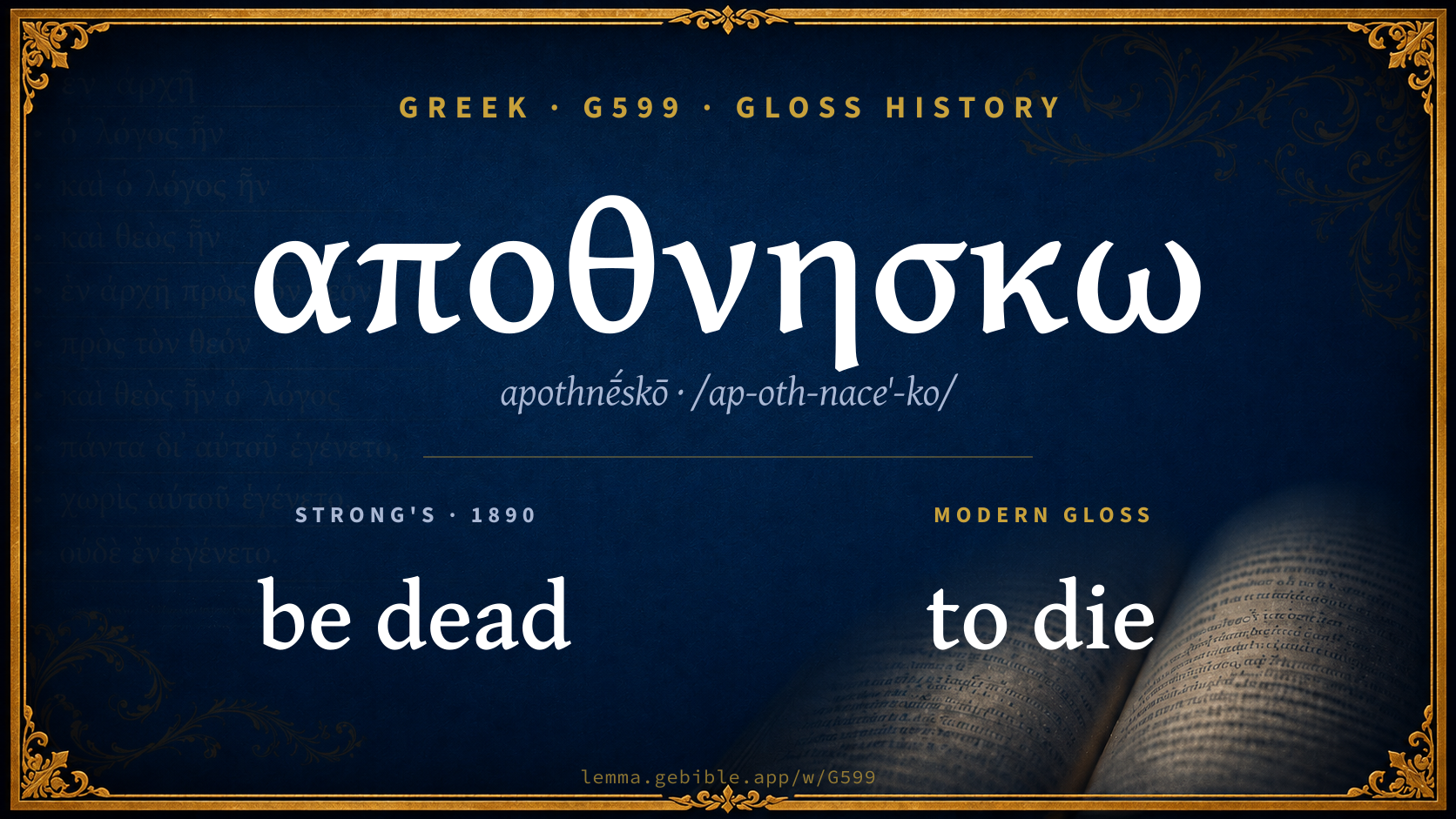
Gloss history
Strong's 1890 vs modern scholarship
About this word
Strong's G599 catalogs a Greek word from the Greek New Testament.
These counts are not copied from any lexicon or concordance. They are computed here, from the morphology-tagged Greek New Testament. What Lemma adds →
- 100
- distinct verses
- The word appears in 100 distinct verses.
- 16 / 27
- NT books
- The word appears in 16 of 27 New Testament books.
- #149
- by frequency
- Top 250 most frequent Greek words (rank 149 of 5,347 Greek words by occurrence).
View all 100 occurrences in the concordance →
By section of the New Testament
By traditional corpus
Conventional, traditional groupings — biblical authorship is debated, so this is a traditional corpus grouping, not an authorship claim. Some books belong to more than one corpus (Luke is in both the Gospels and the Lukan corpus, and so on), so these shares overlap and need not total 100%. Each figure is a share of the word’s 100 distinct verses.
- Gospels 46 verses · 46%
- Pauline corpus 35 verses · 35%
- Johannine 30 verses · 30%
- Lukan (Luke–Acts) 13 verses · 13%
- Hebrews 7 verses · 7%
- Revelation 6 verses · 6%
- General (Catholic) Epistles 2 verses · 2%
How translations render this word
Counts come from each version’s own published word-to-Strong’s tagging or interlinear alignment — an approximate guide to how each version renders this word, not a word-level alignment the data otherwise carries. Because each total is that version’s own tagged count, the per-version totals vary from one another and need not match the appearance or distinct-verse counts above. These counts may also differ from a printed concordance because Lemma counts each distinctly tagged rendering and does not collapse phrase taggings into a single head-word total. This is a fixed set of word-tagged versions (KJV, ASV, BSB, ULT) and does not change with the reading translation you choose elsewhere. Each version’s license is shown beside its name below (and on Sources).
- King James Version: Die 30×, Died 28×, Dead 6×
- American Standard Version: Died 30×, Die 28×, Dead 5×
- Berean Standard Bible: Died 37×, Die 23×, Dies 10×
- unfoldingWord Literal Text: Died 36×, Die 25×, Dies 11×
King James Version Public Domain
Renders G599 across 121 tagged occurrences — most commonly:
Plus 31 renderings that appear only once — usually multi-word phrases or single function words the recovered tagging swept in, not distinct renderings. Not rendered by a distinct English word in 1 further occurrence.
American Standard Version Public Domain
Renders G599 across 113 tagged occurrences — most commonly:
Plus 35 renderings that appear only once — usually multi-word phrases or single function words the recovered tagging swept in, not distinct renderings.
Berean Standard Bible Public Domain
Renders G599 across 107 tagged occurrences — most commonly:
Plus 23 renderings that appear only once — usually multi-word phrases or single function words the recovered tagging swept in, not distinct renderings. Not rendered by a distinct English word in 4 further occurrences.
unfoldingWord Literal Text CC BY-SA 4.0
Renders G599 across 125 tagged occurrences — most commonly:
Plus other, less common renderings. Plus 21 renderings that appear only once — usually multi-word phrases or single function words the recovered tagging swept in, not distinct renderings.
Senses in Thayer's
The 5 senses Thayer's distinguishes for this word, in lexicon order (not ranked by frequency or importance). The full entry — with sub-senses — is in the Lexicon Entry tab.
- of the natural death of man
- of the violent death of man or animals
- to perish by means of something
- of trees which dry up, of seeds which rot when planted
- of eternal death, to be subject to eternal misery in hell
Word origin
Derived from απο (apó) (G575) — from.
Forms in the corpus
The 25 distinct written forms G599 takes in the Greek New Testament, most frequent first — each parse links to that tense’s occurrences in the concordance.
Same root — word family
Other Thayer's entries built from the same root as G599, grouped by Strong’s listed origin. These share a root / origin per the lexicon — not necessarily a shared meaning. Each links to that word’s own entry.
Derives from
Shares the same root
- απαγγελλω apangéllō G518 to report
- απαγχομαι apánchomai G519 to strangle
- απαγω apágō G520 to lead away
- απαιρω apaírō G522 to take away
- απαιτεω apaitéō G523 to demand back
- απαλγεω apalgéō G524 to cease grieving
- απαλλασσω apallássō G525 to depart
- απαλλοτριοω apallotrióō G526 to estrange
- απανταω apantáō G528 to meet
- απαρνεομαι aparnéomai G533 to deny
- απαρτι apárti G534 henceforth
- απαρχη aparchḗ G536 to offer firstfruits
- απαυγασμα apaúgasma G541 brightness
- απειδω apeídō G542 to look away
- απειμι ápeimi G548 to depart
- απειμι ápeimi G549 to depart
- απειπομην apeipómēn G550 to declare
- απεκδεχομαι apekdéchomai G553 waiting for
- απεκδυομαι apekdýomai G554 to despoil
- απελαυνω apelaúnō G556 to drive away
- απελεγμος apelegmós G557 censure
- απελευθερος apeleútheros G558 freedman
- απελπιζω apelpízō G560 not despairing
- απεναντι apénanti G561 opposite
+85 more words share this root (not shown).
Compare all same-root words → Showing 4 of 111 — not the complete family. They share a root, not necessarily a meaning.
Septuagint usage
The same Greek word αποθνησκω appears 463 times in the Greek Old Testament (Septuagint), across 429 verses in 27 books.
- 463
- LXX occurrences
- Tagged occurrences of this Greek word in the Septuagint.
- 429
- verses
- Distinct Septuagint verses containing this word.
- 27 / 39
- OT books
- The word appears in 27 of the 39 Old Testament books.
Sample Septuagint occurrences
- Genesis 2:17 ἀποθνήσκω
- Exodus 10:28 ἀποθνήσκω
- Leviticus 8:35 ἀποθνήσκω
- Numbers 1:51 ἀποθνήσκω
- Deuteronomy 2:14 ἀποθνήσκω
- Joshua 1:18 ἀποθνήσκω
- Judges 1:7 ἀποθνήσκω
- Ruth 1:3 ἀποθνήσκω
- 1 Samuel 2:34 ἀποθνήσκω
- 2 Samuel 1:1 ἀποθνήσκω
- 1 Kings 2:1 ἀποθνήσκω
- 2 Kings 1:1 ἀποθνήσκω
Septuagint occurrences (same lexeme)
Every verse where the same Strong’s number (G599) appears in the Greek Septuagint — showing the first 50 of 429. Verse text shown in the World English Bible for context; the Greek form is the matched word — the English is not keyword-highlighted.
- Genesis 2:17 ἀποθνήσκω but of the tree of the knowledge of good and evil, you shall not eat of it: for in the day that you eat of it you will surely die."
- Genesis 3:3 ἀποθνήσκω but of the fruit of the tree which is in the midst of the garden, God has said, 'You shall not eat of it, neither shall you touch it, lest you die.'"
- Genesis 3:4 ἀποθνήσκω The serpent said to the woman, "You won't surely die,
- Genesis 5:5 ἀποθνήσκω All the days that Adam lived were nine hundred thirty years, then he died.
- Genesis 5:8 ἀποθνήσκω All the days of Seth were nine hundred twelve years, then he died.
- Genesis 5:11 ἀποθνήσκω All the days of Enosh were nine hundred five years, then he died.
- Genesis 5:14 ἀποθνήσκω and all the days of Kenan were nine hundred ten years, then he died.
- Genesis 5:17 ἀποθνήσκω All the days of Mahalalel were eight hundred ninety-five years, then he died.
- Genesis 5:20 ἀποθνήσκω All the days of Jared were nine hundred sixty-two years, then he died.
- Genesis 5:27 ἀποθνήσκω All the days of Methuselah were nine hundred sixty-nine years, then he died.
- Genesis 5:31 ἀποθνήσκω All the days of Lamech were seven hundred seventy-seven years, then he died.
- Genesis 7:21 ἀποθνήσκω All flesh died that moved on the earth, including birds, cattle, animals, every creeping thing that creeps on the earth, and every man.
- Genesis 7:22 ἀποθνήσκω All in whose nostrils was the breath of the spirit of life, of all that was on the dry land, died.
- Genesis 9:11 ἀποθνήσκω I will establish my covenant with you; neither will all flesh be cut off any more by the waters of the flood; neither will there any more be a flood to destroy the earth."
- Genesis 9:29 ἀποθνήσκω All the days of Noah were nine hundred fifty years, then he died.
- Genesis 11:11 ἀποθνήσκω Shem lived after he became the father of Arpachshad five hundred years, and became the father of sons and daughters.
- Genesis 11:13 ἀποθνήσκω Arpachshad lived after he became the father of Shelah four hundred three years, and became the father of sons and daughters.
- Genesis 11:15 ἀποθνήσκω and Shelah lived after he became the father of Eber four hundred three years, and became the father of sons and daughters.
- Genesis 11:17 ἀποθνήσκω Eber lived after he became the father of Peleg four hundred thirty years, and became the father of sons and daughters.
- Genesis 11:19 ἀποθνήσκω Peleg lived after he became the father of Reu two hundred nine years, and became the father of sons and daughters.
- Genesis 11:21 ἀποθνήσκω Reu lived after he became the father of Serug two hundred seven years, and became the father of sons and daughters.
- Genesis 11:23 ἀποθνήσκω Serug lived after he became the father of Nahor two hundred years, and became the father of sons and daughters.
- Genesis 11:25 ἀποθνήσκω Nahor lived after he became the father of Terah one hundred nineteen years, and became the father of sons and daughters.
- Genesis 11:28 ἀποθνήσκω Haran died before his father Terah in the land of his birth, in Ur of the Chaldees.
- Genesis 11:32 ἀποθνήσκω The days of Terah were two hundred five years. Terah died in Haran.
- Genesis 19:19 ἀποθνήσκω See now, your servant has found favor in your sight, and you have magnified your loving kindness, which you have shown to me in saving my life. I can't escape to the mountain, lest evil overtake me, and I die.
- Genesis 20:3 ἀποθνήσκω But God came to Abimelech in a dream of the night, and said to him, "Behold, you are a dead man, because of the woman whom you have taken. For she is a man's wife."
- Genesis 20:7 ἀποθνήσκω Now therefore, restore the man's wife. For he is a prophet, and he will pray for you, and you will live. If you don't restore her, know for sure that you will die, you, and all who are yours."
- Genesis 23:2 ἀποθνήσκω Sarah died in Kiriath Arba (the same is Hebron), in the land of Canaan. Abraham came to mourn for Sarah, and to weep for her.
- Genesis 25:8 ἀποθνήσκω Abraham gave up the spirit, and died in a good old age, an old man, and full of years, and was gathered to his people.
- Genesis 25:11 ἀποθνήσκω It happened after the death of Abraham, that God blessed Isaac, his son. Isaac lived by Beer Lahai Roi.
- Genesis 25:17 ἀποθνήσκω These are the years of the life of Ishmael: one hundred thirty-seven years. He gave up the spirit and died, and was gathered to his people.
- Genesis 26:9 ἀποθνήσκω Abimelech called Isaac, and said, "Behold, surely she is your wife. Why did you say, 'She is my sister?'" Isaac said to him, "Because I said, 'Lest I die because of her.'"
- Genesis 26:18 ἀποθνήσκω Isaac dug again the wells of water, which they had dug in the days of Abraham his father. For the Philistines had stopped them after the death of Abraham. He called their names after the names by which his father had called them.
- Genesis 27:4 ἀποθνήσκω Make me savory food, such as I love, and bring it to me, that I may eat, and that my soul may bless you before I die."
- Genesis 27:7 ἀποθνήσκω 'Bring me venison, and make me savory food, that I may eat, and bless you before Yahweh before my death.'
- Genesis 27:10 ἀποθνήσκω You shall bring it to your father, that he may eat, so that he may bless you before his death."
- Genesis 33:13 ἀποθνήσκω Jacob said to him, "My lord knows that the children are tender, and that the flocks and herds with me have their young, and if they overdrive them one day, all the flocks will die.
- Genesis 35:8 ἀποθνήσκω Deborah, Rebekah's nurse, died, and she was buried below Bethel under the oak; and the name of it was called Allon Bacuth.
- Genesis 35:18 ἀποθνήσκω It happened, as her soul was departing (for she died), that she named him Ben-oni, but his father named him Benjamin.
- Genesis 35:19 ἀποθνήσκω Rachel died, and was buried in the way to Ephrath (the same is Bethlehem).
- Genesis 35:29 ἀποθνήσκω Isaac gave up the spirit, and died, and was gathered to his people, old and full of days. Esau and Jacob, his sons, buried him.
- Genesis 36:33 ἀποθνήσκω Bela died, and Jobab, the son of Zerah of Bozrah, reigned in his place.
- Genesis 36:34 ἀποθνήσκω Jobab died, and Husham of the land of the Temanites reigned in his place.
- Genesis 36:35 ἀποθνήσκω Husham died, and Hadad, the son of Bedad, who struck Midian in the field of Moab, reigned in his place. The name of his city was Avith.
- Genesis 36:36 ἀποθνήσκω Hadad died, and Samlah of Masrekah reigned in his place.
- Genesis 36:37 ἀποθνήσκω Samlah died, and Shaul of Rehoboth by the river, reigned in his place.
- Genesis 36:38 ἀποθνήσκω Shaul died, and Baal Hanan, the son of Achbor reigned in his place.
- Genesis 36:39 ἀποθνήσκω Baal Hanan the son of Achbor died, and Hadar reigned in his place. The name of his city was Pau. His wife's name was Mehetabel, the daughter of Matred, the daughter of Me-zahab.
- Genesis 38:11 ἀποθνήσκω Then Judah said to Tamar, his daughter-in-law, "Remain a widow in your father's house, until Shelah, my son, is grown up;" for he said, "Lest he also die, like his brothers." Tamar went and lived in her father's house.
These are occurrences of the same Greek lexeme (G599) in the Septuagint — not a translation of any one Hebrew word. The store carries no word-level Hebrew↔Greek alignment, so no Hebrew original is asserted here. Counts come from the recovered LXX Strong's tagging — high-frequency vocabulary is well covered, while rare or late forms may be untagged — so they reflect tagged occurrences and may slightly undercount.