Galatians 2:19

Greek (Tischendorf 8th ed.) Galatians 2:19 appears in the Greek New Testament. The text above is from the Tischendorf 8th edition. Each word links to its Strong’s number and a concise gloss. Click any word for its full Thayer’s Greek Lexicon entry.
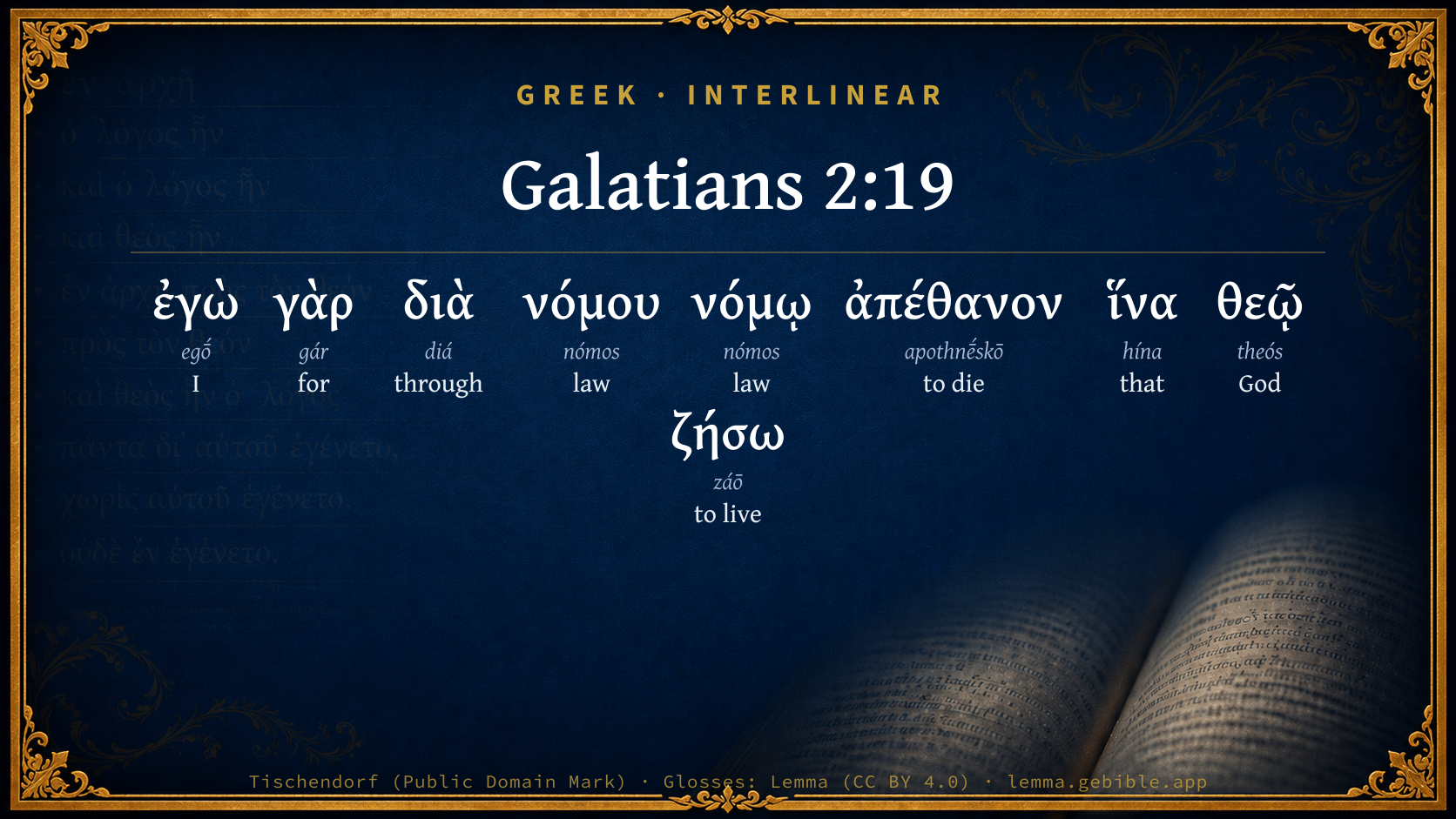
Download image
Cite this verse

Galatians 2:19 (World English Bible). Public Domain. Lemma interlinear Bible study tool, https://lemma.gebible.app/v/galatians/2/19.

Show BibTeX & RIS
BibTeX
RIS
English Translation
For I, through the law, died to the law, that I might live to God.
World English Bible · Public Domain
Download a study sheet

One document with this verse’s original text, its word-by-word gloss line, the meaning frame, cross-references with their text, attributed commentary, and full source and license credits — printable, and it pastes into notes with its structure intact.

This verse Autodidact and up

Study sheet (.html) Plain text (.txt)

A passage Seminary Student

Up to 50 verses in one chapter. A passage sheet keeps up to 6 commentary sources and 12 cross-references per verse, in the order this page ranks them, and says so on the sheet whenever that leaves anything out. Ask for a single verse and you get the Autodidact verse sheet above.

Everything on this page stays free to read, with no account — the sheet is a download of what is already on screen, not access to it.

Want to remove ads? Support Godless Engineer
Compare translations 3

The same verse in 3 English versions, stacked beneath the original-language interlinear above. Click any original word for its lexicon entry.

Each is an independent rendering of the whole verse — the interlinear is not word-aligned to these translations.

Highlighted words mark where these versions differ — a whole-verse word diff, not a word-by-word alignment.

  • World English Bible Public Domain
    For I, through the law, died to the law, that I might live to God.
  • King James Version Public Domain
    For I through the law am dead to the law, that I might live unto God.
  • unfoldingWord Literal Text CC BY-SA 4.0
    For I, through the law, died to the law so that I might live to God. I have been crucified with Christ,

unfoldingWord Literal Text — © unfoldingWord, licensed CC BY-SA 4.0. Word-aligned USFM3 via Door43 (git.door43.org/unfoldingWord/en_ult).

Versions to compare (up to 4)

3 of 4 selected

Show all 19 translations

Every available English version of this verse, each an independent rendering of the whole verse.

  • World English Bible Public Domain
    For I, through the law, died to the law, that I might live to God.
  • Berean Standard Bible Public Domain
    For through the law I died to the law so that I might live to God.
  • Majority Standard Bible Public Domain
    For through the law I died to the law so that I might live to God.
  • King James Version Public Domain
    For I through the law am dead to the law, that I might live unto God.
  • American Standard Version (1901) Public Domain
    For I through the law died unto the law, that I might live unto God.
  • Revised Version (1885) Public Domain
    For I through the law died unto the law, that I might live unto God.
  • Geneva Bible (1599) Public Domain
    For I through the Lawe am dead to the Lawe, that I might liue vnto God.
  • Douay-Rheims (1899) Public Domain
    For I, through the law, am dead to the law, that I may live to God: with Christ I am nailed to the cross.
  • Young's Literal Translation Public Domain
    for I through law, did die, that to God I may live;
  • Literal Standard Version CC BY-SA 4.0
    for I died through law that I may live to God;
  • Unlocked Literal Bible CC BY-SA 4.0
    For through the law I died to the law, so that I might live for God.
  • unfoldingWord Literal Text CC BY-SA 4.0
    For I, through the law, died to the law so that I might live to God. I have been crucified with Christ,
  • Darby Bible Public Domain
    For *I*, through law, have died to law, that I may live to God.
  • World Messianic Bible Public Domain
    For I through the law died to the law, that I might live to God.
  • Webster's Bible Public Domain
    For I through the law am dead to the law, that I may live to God.
  • Free Bible Version CC BY-SA 4.0
    For through the law I died to the law in order that I could live for God.
  • Bible in Basic English Public Domain
    For I, through the law, have become dead to the law, so that I might be living to God.
  • Text-Critical English NT CC BY 4.0
    For through the law I died to the law so that I might live for God.
  • Tyndale New Testament (1534) Public Domain
    But I thorow the lawe amen deed to the lawe: that I myght live vnto God.

Literal Standard Version (2020), Covenant Press — licensed CC BY-SA 4.0. Text via the HelloAO Bible API (eBible.org). Unlocked Literal Bible (unfoldingWord) — licensed CC BY-SA 4.0. Text via the HelloAO Bible API (eBible.org). unfoldingWord Literal Text — © unfoldingWord, licensed CC BY-SA 4.0. Word-aligned USFM3 via Door43 (git.door43.org/unfoldingWord/en_ult). Free Bible Version, Dr. Jonathan Gallagher — licensed CC BY-SA 4.0. Text via the HelloAO Bible API (eBible.org).

Word by word

More ways to search: Search by grammar → Find every occurrence → Compare this word →

Practice this passage: Drill this verse → Learn its vocabulary →

About this verse

These counts appear in no published source. They are computed here, from the morphology-tagged text and Lemma’s own curated glosses. What Lemma adds →

9
words
8
distinct lemmas
Pauline Epistles
section

Repetition

A word recurs within this verse:

  • νόμου law G3551 ×2

Cross-references

26

Topical passages linked to Galatians 2:19 in the Treasury of Scripture Knowledge — connected by theme and wording, ordered by reader-vote popularity; previews shown in the World English Bible.

  • Romans 7:4 Therefore, my brothers, you also were made dead to the law through the body of Christ, that you would be joined to another, to him who was raised from the dead, that we might bring forth fruit to God.
  • Romans 6:2 May it never be! We who died to sin, how could we live in it any longer?
  • 1 Thessalonians 5:10 who died for us, that, whether we wake or sleep, we should live together with him.
  • Romans 6:11 Thus also consider yourselves also to be dead to sin, but alive to God in Christ Jesus our Lord.
  • 2 Corinthians 5:15 He died for all, that those who live should no longer live to themselves, but to him who for their sakes died and rose again.
  • Romans 3:19–20 Now we know that whatever things the law says, it speaks to those who are under the law, that every mouth may be closed, and all the world may be brought under the judgment of God.
  • Romans 8:2 For the law of the Spirit of life in Christ Jesus made me free from the law of sin and of death.
  • Romans 14:7–8 For none of us lives to himself, and none dies to himself.
  • Romans 6:14 For sin will not have dominion over you. For you are not under law, but under grace.
  • Titus 2:14 who gave himself for us, that he might redeem us from all iniquity, and purify for himself a people for his own possession, zealous for good works.
  • 1 Peter 2:24 who his own self bore our sins in his body on the tree, that we, having died to sins, might live to righteousness; by whose stripes you were healed.
  • Romans 10:4–5 For Christ is the fulfillment of the law for righteousness to everyone who believes.
  • Galatians 2:20 I have been crucified with Christ, and it is no longer I that live, but Christ living in me. That life which I now live in the flesh, I live by faith in the Son of God, who loved me, and gave himself up for me.
  • Galatians 3:24 So that the law has become our tutor to bring us to Christ, that we might be justified by faith.
  • Colossians 2:20 If you died with Christ from the elements of the world, why, as though living in the world, do you subject yourselves to ordinances,
  • Hebrews 9:14 how much more will the blood of Christ, who through the eternal Spirit offered himself without blemish to God, cleanse your conscience from dead works to serve the living God?
  • 1 Peter 4:6 For to this end was the Gospel preached even to the dead, that they might be judged indeed as men in the flesh, but live as to God in the spirit.
  • Romans 4:15 For the law works wrath, for where there is no law, neither is there disobedience.
  • Romans 5:20 The law came in besides, that the trespass might abound; but where sin abounded, grace did abound more exceedingly;
  • Romans 7:6–11 But now we have been discharged from the law, having died to that in which we were held; so that we serve in newness of the spirit, and not in oldness of the letter.
  • Romans 7:14 For we know that the law is spiritual, but I am fleshly, sold under sin.
  • Romans 7:22–23 For I delight in God's law after the inward man,
  • 1 Corinthians 10:31 Whether therefore you eat, or drink, or whatever you do, do all to the glory of God.
  • Galatians 3:10 For as many as are of the works of the law are under a curse. For it is written, "Cursed is everyone who doesn't continue in all things that are written in the book of the law, to do them."
  • Colossians 3:3 For you died, and your life is hidden with Christ in God.
  • 1 Peter 4:1–2 Forasmuch then as Christ suffered for us in the flesh, arm yourselves also with the same mind; for he who has suffered in the flesh has ceased from sin;

Cross-references courtesy of OpenBible.info (CC BY 4.0).

Commentary

Notes on Galatians 2:19 from classic Christian and Jewish commentators (each source and its license shown beneath its notes). The classic Christian expositions comment on the surrounding passage and are grouped to its opening verse, so a note may address several verses; the Jewish commentaries on the Tanakh (Rashi and others) are per-verse, so they appear only where the commentator wrote on this verse.

Lemma curates 59 commentaries, every one of them public domain or Creative Commons licensed, each selected and text-cleaned for this edition rather than reprinted as found. About our sources →

The Biblical Illustrator

Joseph S. Exell

Gal_2:19

For I through the law am dead to the law.

Death and life

I. Those who are justified are qualified for the highest service--living to God.

II. Living to god is dying to sin.

1. The aim of crucifixion was the death of the body.

2. Its means: the Cross.

3. The death painful and protracted. So

(1) the aim of soul crucifixion is the death of sin (Rom_6:6).

(2) Its means: the Cross of Christ (Gal_6:14).

(3) The death,

(a) painful (Mat_5:29),

(b) protracted (Rom_7:23).

As Jesus lived to God by dying on the cross, so Christians live to God by dying to sin.

III. The power by which the cross of christ is made effectual to the death of sin.

1. By faith.

2. By the indwelling of Christ.

3. By the inspiration of Christs love. (W. Harris.)

Death to the law

I. What it means--freedom from its dominion in respect of--

1. The accusing and condemning sentence (Rom_8:1).

2. Its power (Rom_7:8).

3. Its vigour.

4. The obligation of conscience to conform to its ceremonies.

II. The instrument--the law itself.

1. It accuses, terrifies, condemns, and thus urges us to fly Christ who is the cause of our death to the law.

2. The law goes before, and effects an entrance for law-killing grace.

III. The end--living to God (Tit_2:12), which may be urged by the facts:

1. That through Christ we belong to God (1Co_6:20);

2. That the purpose of our justification and redemption is practical godliness;

3. That heaven hereafter depends on godliness here.

4. That this is the supreme end of the ministry. (W. Perkins.)

The paralyzing power of the sense of being alive to the law

Sir Walter Raleigh to find a gold mine at Guiana for the king, went out on his last voyage under an unremitted sentence of death that had been passed upon him fifteen years before. No wonder that the magnetic consciousness of a sword dangling over him by a hair should benumb his brain, distract his faculties, and turn his enterprize into a long tangle of blunders and calamities. Pity the adventurer who goes out on an evangelistic enterprize under the unremitted sentence of the law, a preacher of Christ crucified who has himself to be crucified; alive to the law and dead to God. (C. Stanford, D. D.)

Death to the law and life to God

When he said I died, lest any one should say, How then dost thou live? he subjoined also the cause of his life, and showed indeed that the law killed him when living, but that, Christ taking hold of him when dead, quickened him through death; and he exhibits a double wonder, both that Christ had recalled the dead to life, and through death had imparted life. (Chrysostom.)

The Christian dead to the law

What a collection of paradoxes might be made from St. Pauls Epistles.

I. Let us examine the state in which the apostle describes himself to be--I am dead to the law; but what can he mean by this? that the moral law of God has no longer any authority over him? We dare not say so. That moral law is the law of Gods universal empire, of heaven and earth, and of all the worlds that are. The believer continues under its dominion as long as he is a creature. He must escape from existence before he can escape from the law of God. He means that he is dead to the law as a covenant between God and himself. The law in its relation to us is more than a simple authoritative declaration of Gods will Besides commands, it consists of a promise and a threatening. This gives it the character of a covenant. He is dead to all hope from the law, to all expectation of salvation from it; he has no fear of condemnation from it. A man in his grave is free from every relationship of his former life; the servant is free from his master. So the believer, dead to the legal covenant, rests from it.

II. The means whereby the apostle has been brought into the state he describes--I through the law am dead to the law. This excludes a great number of those who call themselves Christians; who as regards their own feelings are utterly dead to it. They are dead to the law, to God, to Christ, to everything but the petty affairs of this life. But the apostles deadness was brought about by the law itself. The extent of the law and its unbending denunciations render it impossible for us to make our way to God by it. It penetrates within a man; it reaches to the affections, the will, the thoughts, the whole mind and heart. You say this is hard and unreasonable. Holy angels do not think so; they live under this law in happiness. But who, with a law like this before him, can hope for salvation from it? But this only partially accounts for St. Pauls deadness to the law. It explains how the law itself robbed him of all hope from it, but it does not tell us how he was saved from the fear of it. He was crucified with Christ. I have endured in the Person of my Redeemer the curse of the law, the chastisement of my sins has been laid upon him; and now when my faith is firm I no more fear the law than a debtor fears the bond which has been cancelled.

III. The design of this deadness to the law in the Christians soul--That I might live unto God. Naturally we know nothing of such a life as this. Through the influence of education, or the power of conscience, there may be some reference in our lives to God; it is but occasional and slight. Self is the ruling principle of our lives. This living to God dethrones self within the soul. The origin of this Divine life is that deadness to the law, which I began with describing. It is not a mere accompaniment of the deadness, but the effect of it; a life proceeding out of that death. His renunciation of his self-righteousness has gradually brought on other renunciations of self. The law driving him to Christ has been the happy means of driving him out of self altogether. It has brought him into the sphere of the gospel, and among those soul-stirring feelings connected with it. I can serve my God now, for He has set me free to serve Him. I can obey Him now and with delight, for He has brought me to love Him. It is not so much I who live this heavenly life; it is the God who dwells in heaven, who in condescension dwells in my soul. Learn:

1. to think more, in the first instance, of the law; to endeavour more to understand its character, and to be brought under its power. There is no greater mistake than to imagine that the gospel has destroyed the law; the gospel is indeed based on it; you will never rightly estimate the gospel till you have rightly understood the law, as a covenant of condemnation.

2. Are we amongst those who have taken refuge from the condemnation of the law in the blood and righteousness of Christ? Then the law has done its work in us. (C. Bradley.)

The law an obstacle in the way of salvation

Suppose a man anxious to pass from one country to another, from a dangerous and wretched country to a safe and happy one. Directly in his road stands a mountain which, it would appear, he must pass over, and which he at first imagines he can without much difficulty climb. He tries, but scarcely has he begun to breast it, when a precipice stops him. He descends and tries again in another direction. There another precipice or some other obstacle arrests his course; and still ever as he begins his ascent, he is baffled, and the little way he contrives to mount serves only to show him more and more of the prodigious height of the mountain, and its stern, rugged, impassable character. At last, wearied and worn, heart-sick with labour and disappointment, and thoroughly convinced that no efforts of his can carry him over, he lies down at the mountains foot in utter despair; longing still to be on the other side, but making not another movement to get there. Now ask him as he lies exhausted on the ground, what has occasioned his torpor and despair, he will say, that mountain itself; its situation between him and the land of his desires, and its inaccessible heights and magnitude. So stands the law of God between the Christian and the land he longs for. At first he thought he could obey it, so obey it as to find his way to God by it, and he made the effort, made perhaps many and long-continued efforts, but the result of them all has been disappointment and despair. The law itself has stripped him of all hope of getting to heaven by means of it. He is exactly in the situation of that traveller by the mountains side, whom you can no longer prevail on to move. Of what use is it? he says. I will try no more. I know the difficulty of the work, and I know my own weakness too well. Here lies the difficulty, or rather the impossibility to such creatures as we are, of making our way to God by means of the law, here in these two things--the extent of that Jaws requirements, and the unbending, inexorable character of its denunciations. (C. Bradley.)

Dead to the law

1. They are dead unto the law in the matter of justification, as it holdeth forth the condition of the covenant of works; in this respect they are dead unto the law (Rom_7:3; Rom_7:6), for, by obedience to the law in their own persons, they are not now to expect justification by the works of the law.

2. They are dead unto the curse and condemning power of the law, whereby it adjudgeth all that transgresseth it unto death, and the wrath of God. The law threateneth death to all that transgress it, and bindeth this wrath on all that are alive to it, and not yet delivered from it. Cursed is every one that continueth not in all things written in the book of the law to do them. Hence it is, that he that believeth not is condemned already, and the wrath of God abideth on him (Joh_3:18; Joh_3:36). For there is now no condemnation to them that are in Christ Jesus (Rom_8:1).

3. They are dead unto the law, as to its libels, indictments, and accusations, tending to bring them again under the lash or curse of the law, and sentence of its condemnation; and this clearly floweth from the former; for from it they are delivered from the sentence of death in the law; they are delivered from all accusations tending thereunto (Rom_8:33).

4. They are dead to the law, as it exacteth full obedience, under pains of breach of the covenant.

5. They are dead unto the law, as it exacts full obedience in their own strength, without any help from another, in whole or in part; for, now, help for them is laid upon one who is mighty (Psa_39:19), and God worketh all their works in them (Isa_26:12), and worketh in them both to will and to do (Php_2:13), so that in Christ that strengtheneth them, they can do all things (Php_4:13), and in Christ do they bring forth fruits (Joh_15:5).

6. They are dead to the law, as to its rigid obedience in their own persons; for the law, as such, doth not point out a contrary way; nor doth it positively admit of one, though it doth not positively exclude or refuse one. Adam, and all his posterity, were bound to personal obedience; but now the believer is freed from that rigidity, and has a cautioner, with whom he is one in law, to fulfil the law, and answer all its demands; and, by his obedience, they are made righteous, and attain to justification of life (Rom_5:15; Rom_5:19), so that they are complete in Him (Col_2:10).

7. They are dead unto the law, as to its rigid exacting full and actual performance, not regarding any sincerity of intention.

8. They are dead unto the law, as to its enslaving power, keeping the soul in bondage for fear of the curse, and pressing obedience on the unwilling, with arguments only taken for fear of the curse; for, now, though all fears are not fully removed, yet are they under sweeter and milder motives and encouragements to obedience--the love of Christ now constraineth them (2Co_5:14). Thoughts of the benefits of redemption lay on strong and sweet ties, and oil the wheels of the soul; so that obedience now is sweet, filial, and kindly, not forced and constrained; for the heart is willing, and the soul delighteth in the law of the Lord after the inner man, and duties now flow out more natively.

9. They are dead to the law, in respect of its being the strength of sin, as the apostle terms it (1Co_15:36), so that they are now more free from sin than formerly, both as to its guilt and dominion; the law cannot now so charge home guilt upon them as formerly, Christ being now accepted of as cautioner (Mat_12:18), and having made full satisfaction for the sinner of his own, the law cannot require double payment, or payment of both the cautioner and principal debtor; and therefore the believer is free of making any satisfaction to justice.

This lets us then see what a change is made on the state of believers from what it formerly was.

1. A great change, from being alive to the law and under its power, to a being dead unto the law.

2. It is a great change, and no imagined but a real change, having real effects, though it be a relative change; and this believers experience in themselves.

3. It is a necessary change, for, without it, no life nor salvation is obtained.

4. It is an honourable change. From slavery to freedom (Joh_8:36).

5. Therefore it is a most desirable change; for every one would desire to be free of a heavy yoke of slavery, and from under tyranny. How desirable, then, must it be to be free of this spiritual yoke, and this souls tyranny,

6. It is a most advantageous and profitable change: For

(1) There is much inward peace, quietness, and serenity of soul had hereby; the soul is now freed of these tossings and perturbations of mind that it was obnoxious unto before, by being under the restless and continual challenges and accusations of the law, and dreadful fear following thereupon; for the mouth of the law being stopped, the man is dead thereunto.

(2) This change yieldeth much joy and consolation to the soul that formerly was tossed with tempest, and had no comfort, but filled with heartbreaking sorrow and grief, as seeing no outgate, but living in the fearful expectation of the terrible sentence of the law, which was as water to their wine; but this sorrow is now abated, by this freedom from the law.

(3) This change is accompanied with a lively hope, which keepeth up the head, while before the poor soul was drowned in despair, sinking in that gulf, crying out, undone I and that it was cut off for its part, and so refused to be comforted! But it is not so now when dead unto the law.

(4) It addeth courage to the soul that was before heartless for any duty, and casten down with despondency of spirit; for now the law is removed out of the way: And so,

(5) It emboldeneth the soul, and gives it confidence in approaching to God. (J. Brown.)

That I might live unto God

I. We shall show what it is to live unto God, by pointing out some principal heads of, or ingredients in, as requisite to a living to God.

1. A reconciliation with God. Enemies cannot please one another.

2. A new principle of life. A dead man, as such, cannot live to God.

3. A hearty complying with the law of God as their rule.

4. It includeth a walking by the guidance of the Spirit of God.

5. It taketh in a holy life in all manner of conversation, and the study of sanctification.

6. It taketh in a lively, holy, divine, and spiritual manner of performing commanded duties.

7. It taketh in an eying of God and His glory, with singleness of heart in what they are doing.

8. It includeth a fixed, stayed, and constant walking thus, not by fits and starts.

II. That such as are alive yet unto the law cannot thus live unto God.

1. They are yet married to their old husband, and not brought out of that state of enmity wherein they were and are (Rom_7:4).

2. They have no principle but the old principle of nature, helped a little with some education; for they are growing still upon the old stock of nature.

3. They are not subject unto the law of God, neither indeed can be (Rom_8:7), their will, ease, pleasure, etc., is all their care, with this their heart complieth.

4. Their guide is the flesh; for they walk after the flesh (Rom_8:4).

5. Instead of holiness, they are yielding themselves servants of unrighteousness unto sin, and sin is reigning in them, and being the servants of sin, they are free from righteousness (Rom_6:13-20).

6. All the service they do is in the oldness of the letter (Rom_7:6), and not in newness of the Spirit; it is carnal, vain, and selfish, every way corrupt.

7. Their ultimate end is themselves; their own peace, quiet, ease, profit, esteem, to get a name, or to make a price to buy heaven to themselves, that they may have whereof to boast.

8. Their constant trade of life, is either to serve Satan, by following vile affections, their own lusts and pleasures, or the world; and thus their days are spent. (J. Brown.)

Living unto God

That which tells, says Professor Henry Drummond, speaking of Mission work, is the Shepherds life, his daily moving in and out amongst the people, and what is now wanted for Africa is a great many white men, with gentleness and kindness, and Christ-likeness, to simply go there and do nothing but live. If they can educate the people, so much the better.

The Biblical Illustrator, edited by Joseph S. Exell (c. 1880s–1900s) — public domain. Text from a community e-Sword module.

The Expositor's Bible

Chapter 10

THE PRINCIPLES AT STAKE.

Gal_2:19-21

PAULS personal apology is ended. He has proved his Apostolic independence, and made good his declaration, "My Gospel is not according to man." If he owed his commission to any man, it was to Peter; so his traducers persistently alleged. He has shown that, first without Peter, then in equality with Peter, and finally in spite of Peter, he had received and maintained it. Similarly in regard to James and the Jerusalem Church. Without their mediation Paul commenced his work; when that work was challenged, they could only approve it; and when afterwards men professing to act in their name disturbed his work, the Apostle had repelled them. He acted all along under the consciousness of a trust in the gospel committed to him directly by Jesus Christ, and an authority in its administration second to none upon earth. And events had justified this confidence.

Paul is compelled to say all this about himself. The vindication of his ministry is forced from him by the calumnies of false brethren. From the time of the conference at Jerusalem, and still more since he withstood Peter at Antioch, he had been a mark for the hatred of the Judaising faction. He was the chief obstacle to their success. Twice he had foiled them., when they counted upon victory. They had now set on foot a systematic agitation against him, with its headquarters at Jerusalem, carried on under some pretext of sanction from the authorities of the Church there. At Corinth and in Galatia the legalist emissaries had appeared simultaneously; they pursued in the main the same policy, adapting it to the character and disposition of the two Churches, and appealing with no little success to the Jewish predilections common even amongst Gentile believers in Christ.

In this controversy Paul and the gospel he preached were bound together. "I am set," he says, "for the defence of the gospel". {Php_1:16} He was the champion of the cross, the impersonation of the principle of salvation by faith. It is "the gospel of Christ," the "truth of the gospel," he reiterates, that is at stake. If he wards off blows falling upon him, it is because they are aimed through him at the truth for which he lives-nay, at Christ who lives in him. In his self-assertion there is no note of pride or personal anxiety. Never was there a man more completely lost in the greatness of a great cause, nor who felt himself in comparison with it more worthless. But that cause has lifted Paul with it to imperishable glory. Of all names named on earth, none stands nearer than his to that which is "above every name."

While Paul in chaps. 1 and 2 is busy with his own vindication, he is meantime behind the personal defence preparing the doctrinal argument. His address to Peter is an incisive outline of the gospel of grace. The three closing verses are the heart of Pauls theology {Gal_2:19-21}. Such a testimony was the Apostles best defense before his audience at Antioch; it was the surest means of touching the heart of Peter and convincing him of his error. And its recital was admirably calculated to enlighten the Galatians as to the true bearing of this dispute which had been so much misrepresented. From Gal_2:15-21 onwards, Paul has been all the while addressing, under the person of Peter, the conscience of his readers, and paving the way for the assault that he makes upon them. with so much vigour in the first verses of chap. 3. Read in the light of the foregoing narrative, this passage is a compendium of the Pauline Gospel, invested with the peculiar interest that belongs to a confession of personal faith, made at a signal crisis in the authors life. Let us examine this momentous declaration.

1. At the foundation of Pauls theology lies his conception of the grace of God.

Grace is the Apostles watchword. The word occurs twice as often in his Epistles as it does in the rest of the New Testament. Outside the Pauline Luke and Hebrews, and 1 Peter with its large infusion of Paulinism, it is exceedingly rare. In this word the character, spirit, and aim of the revelation of Christ, as Paul understood it, are summed up. "The grace of God" is the touchstone to which Peters dissimulation is finally brought. Christ is the embodiment of Divine grace-above all, in His death. So that it is one and the same thing to "bring to nought the grace of God," and "the death of Christ." Hence Gods grace is called "the grace of Christ,"-"of our Lord Jesus Christ" From Romans to Titus and Philemon, "grace reigns" in every Epistle. No one can counterfeit this mark of Paul, or speak of grace in his style and accent. Gods grace is not His love alone; it is redeeming love-love poured out upon the undeserving, love coming to seek and save the lost, "bringing salvation to all men". {Rom_5:1-8; Tit_2:2} Grace decreed redemption, made the sacrifice, proclaims the reconciliation, provides and bestows the new sonship of the Spirit, and schools its children into all the habits of godliness and virtue that beseem their regenerate life, which it- brings finally to its consummation in the life eternal. {Eph_1:5-9; 2Ti_1:9; Rom_3:24; Heb_2:9; 2Co_5:20-21; 2Co_6:1; Gal_4:5; Tit_3:5-7; Tit_2:11-14; Rom_5:21}

Grace in God is therefore the antithesis of sin in man, counterworking and finally triumphing over it. Grace belongs to the last Adam as eminently as sin to the first. The later thoughts of the Apostle on this theme are expressed in Tit_3:4-7, a passage singularly rich in its description of the working of Divine grace on human nature. "We were senseless," he says "disobedient wandering in error, in bondage to lusts and pleasures of many kinds, living in envy and malice, hateful, hating each other. But when the kindness and love to man of our Saviour God shone forth," - then all was changed: "not by works wrought in our own righteousness, but according to His mercy He saved us, through the washing of regeneration and renewing of the Holy Spirit, that, justified by His grace, we might be made heirs in hope of life eternal." The vision of the grace of God drives stubbornness, lust, and hatred from the soul. It brings about, for man and for society, the palingenesia, the new birth of Creation, rolling back the tide of evil and restoring the golden age of peace and innocence; and crowns the joy of a renovated earth with the glories of a recovered heaven.

Being the antagonist of sin, grace comes of necessity into contrast with the law. Law is intrinsically the opposer of sin; sin is "lawlessness," with Paul as much as with John. {Rom_7:12; Rom_7:14; 2Th_2:4-8; etc.} But law was powerless to cope with sin: it was "weak through the flesh." Instead of crushing sin, the interposition of law served to inflame and stimulate it, to bring into play its latent energy, reducing the man most loyally disposed to moral despair. "By the law therefore is the knowledge of sin; it worketh out wrath." Inevitably, it makes men transgressors; it brings upon them an inward condemnation, a crushing sense of the Divine anger and hostility. {Rom_3:20; Rom_4:15; Rom_5:20; Rom_7:5; Rom_7:24; Gal_2:16; Gal_3:10-11; Gal_3:19} That is all that law can do by itself. "Holy and just and good," notwithstanding, to our perverse nature it becomes death. {Rom_7:13; 1Co_15:56} It is actually "the strength of sin," lending itself to extend and confirm its power. We find in it a "law of sin and death." So that to be "under law" and "under grace" are two opposite and mutually exclusive states. In the latter condition only is sin "no longer our lord". {Rom_6:14} Peter and the Jews of Antioch therefore, in building up the legal principle again, were in truth "abolishing the grace of God." If the Galatians follow their example, Paul warns them that they will "fall from grace." Accepting circumcision, they become "debtors to perform the whole law,"-and that means transgression and the curse. {Gal_5:1-4; Gal_3:10-12; Gal_2:16-18}

While sin is the reply which mans nature makes to the demands of law, faith is the response elicited by grace; it is the door of the heart opening to grace. {Rom_3:24; Eph_2:8; etc.} Grace and Faith go hand in hand, as Law and Transgression. Limiting the domain of faith, Peter virtually denied the sovereignty of grace. He belied his confession made at the Council of Jerusalem: "By the grace of the Lord Jesus we trust to be saved, even as the Gentiles". {Act_15:11} With Law are joined such terms as Works, Debt, Reward, Glorying, proper to a "righteousness of ones own." {Rom_4:1-4; Rom_11:6; Gal_2:16; Gal_3:12} With Grace we associate Gift, Promise, Predestination, Call, Election, Adoption, Inheritance, belonging to the dialect of "the righteousness which is of God by faith." Grace operates in the region of the Spirit, making for freedom; but law, however spiritual in origin, has come to seek its accomplishment in the sphere of the flesh, where it "gendereth to bondage". {Gal_4:23-31; Gal_5:1-5; 2Co_3:6; 2Co_3:17} Grace appears, however, in another class of passages in Pauls Epistles, of which Gal_1:15; Gal_2:9 are examples. To the Divine grace Paul ascribes his personal salvation and Apostolic call. The revelation which made him a Christian and an Apostle, was above all things a manifestation of grace. Wearing this aspect, "the glory of God" appeared to him "in the face of Jesus Christ." The splendour that blinded and over whelmed Saul on his way to "Damascus, was the glory of His grace." The voice of Jesus that fell on the persecutors ear spoke in the accents of grace. No scourge of the Law, no thunders of Sinai, could have smitten down the proud Pharisee, and beaten or scorched out of him his strong self-will, like the complaint of Jesus. All the circumstances tended to stamp upon his soul, fused into penitence in that hour, the ineffaceable impression of "the grace of God and of our Saviour Jesus Christ." Such confessions as those of 1Co_15:8-10, and Eph_2:7; Eph_3:7-8, show how constantly this remembrance was present with the Apostle Paul and suffused his views of revelation, giving to his ministry its peculiar tenderness of humility and ardour of gratitude. This sentiment of bound less obligation to the grace of God, with its pervasive effect upon the Pauline doctrine, is strikingly expressed in the doxology of 1Ti_1:11-17, -words which it is almost a sacrilege to put into the mouth of a falsarius: "According to the gospel of the glory of the blessed God, herewith I was intrusted who was aforetime a blasphemer and persecutor But the grace of our Lord abounded even more exceedingly. Faithful is the saying, worthy to be received of all, Christ Jesus came into the world to save sinners-of whom I am chief. In me as chief Christ Jesus showed forth all His long-suffering Now to the King of the ages be honour and glory for ever. Amen." Who, reading the Apostles story, does not echo that Amen? No wonder that Paul became the Apostle of grace; even as John, "the disciple whom Jesus loved," must perforce be the Apostle of love. First to him was Gods grace revealed in its largest affluence, that through him it might be known to all men and to all ages.

2. Side by side with the grace of God, we find in Gal_2:21 the death of Christ. He sets aside the former, the Apostle argues, who by admitting legal righteousness nullifies the latter.

While grace embodies Pauls fundamental conception of the Divine character, the death of Christ is the fundamental fact in which that character manifests itself. So the cross becomes the centre of Pauls theology. But it was, in the first place, the basis of his personal life. Faith in the Son of God, "who loved me and gave Himself up for me," is the foundation of "the life he now lives in the flesh."

Here lay the stumbling-block of Judaism. Theocratic pride, Pharisaic tradition, could not, as we say, get over it. A crucified Messiah! How revolting the bare idea. But when, as in Pauls case, Judaistic pride did surmount this huge scandal and in spite of the offence of the cross arrive at faith in Jesus, it was at the cost of a severe fall. It was broken in pieces, -destroyed once and for ever. With the elder Apostles the change had been more gradual; they were never steeped in Judaism as Saul was. For him to accept the faith of Jesus was a revolution the most complete and drastic possible. As a Judaist, the preaching of the cross was an outrage on his faith and his Messianic hopes; now it was that which most of all subdued and entranced him. Its power was extreme, whether to attract or repel. The more he had loathed and mocked at it before, the more he is bound henceforth to exalt the cross of our Lord Jesus Christ. A proof of the Divine anger against the Nazarene he had once deemed it; now he sees in it the token of Gods grace in Him to the whole world.

For Paul therefore the death of Christ imported the end of Judaism. "I died to law," he writes, - "I am crucified with Christ." Once understanding what this death meant, and realising his own relation to it, on every account it was impossible to go back to Legalism. The cross barred all return. The law that put Him, the sinless One, to death, could give no life to sinful men. The Judaism that pronounced His doom, doomed itself. Who would make peace with it over the Saviours blood? From the moment that Paul knew the truth about the death of Jesus, he had done with Judaism for ever. Henceforth he knew nothing-cherished no belief or sentiment, acknowledged no maxim, no tradition, which did not conform itself to His death. The world to which he had belonged died, self-slain, when it slew Him. From Christs grave a new world was rising, for which alone Paul lived.

But why should the grace of God take expression in a fact so appalling as Christs death? What has death to do with grace? It is the legal penalty of sin. The conjunction of sin and death pervades the teaching of Scripture, and is a principle fixed in the conscience of mankind. Death, as man knows it, is the inevitable consequence and the universal witness of his transgression. He "carries about in his mortality the testimony that God is angry with the wicked every day" (Augustine). The death of Jesus Christ cannot be taken out of this category. He died a sinners death. He bore the penalty of guilt. The prophetic antecedents of Calvary, the train of circumstances connected with it, His own explanations in chief-are all in keeping with this purpose. With amazement we behold the Sinless "made sin," the Just dying for the unjust. He was "born of a woman, born under law": under law He lived-and died. Grace is no law-breaker. God must above all things be "just Himself," if He is to justify others. {Rom_3:26} The death of Jesus declares it. That sublime sacrifice is, as one might say, the resultant of grace and law. Grace "gives Him up for us all"; it meets the laws claims in Him., even to the extreme penalty, that from us the penalty may be lifted off. He puts Himself under law, in order "to buy out those under law". {Gal_4:4-5} In virtue of the death of Christ, therefore, men are dealt with on an extra-legal footing, on terms of grace; not because law is ignored or has broken down; but because it is satisfied beforehand. God has "set forth Christ Jesus a propitiation"; and in view of that. accomplished fact, He proceeds "in the present time" to "justify him who is of faith in Jesus". {Rom_3:22-26} Legalism is at an end, for the Law has spent itself on our Redeemer. For those that are in Him "there is now no condemnation." This is to anticipate the fuller teaching of chap. 3; but the vicarious sacrifice is already implied when Paul says, "He gave Himself up for me-gave Himself for our sins". {Gal_1:4}

The resurrection of Christ is, in Pauls thought, the other side of His death. They constitute one event, the obverse and reverse of the same reality. For Paul, as for the first Apostles, the resurrection of Jesus gave to His death an aspect wholly different from that it previously wore. But the transformation wrought in their minds during the "forty days" in his case came about in a single moment, and began from a different starting-point. Instead of being the merited punishment of a blasphemer and false Messiah, the death of Calvary became the glorious self-sacrifice of the Son of God. The dying and rising of Jews were blended in the Apostles mind; he always sees the one in the light of the other. The faith that saves, as he formulates it, is at once a faith that Christ died for our sins, and that God raised Him from the dead on the third day. Whichever {1Co_15:3-4; 1Co_15:11; Rom_4:24-25; Rom_10:9; 1Th_4:14} of the two one may first apprehend, it brings the other along with it. The resurrection is not an express topic of this Epistle. Nevertheless it meets us in its first sentence, where we discern that Pauls knowledge of the gospel and his call to proclaim it, rested upon this fact. In the passage before us the resurrection is manifestly assumed. If the Apostle is "crucified with Christ," - and yet "Christ lives in him," it is not simply the teaching, or the mission of Jesus that lives over again in Paul; the life of the risen Saviour has itself entered into his soul.

3. This brings us to the thought of the union of the believer with Christ in death and life, which is expressed in terms of peculiar emphasis and distinctness in Gal_2:20. "With Christ I have been crucified; and I live no longer; it is Christ that lives, in me. My earthly life is governed by faith in Him who loved me and died for me." Christ and Paul are one. When Christ died, Pauls former self died with Him. Now it is the Spirit of Christ in heaven that lives within Pauls body here on earth.

This union is first of all a communion with the dying Saviour. Paul does not think of the sacrifice of Calvary as something merely accomplished for him, outside himself, by a legal arrangement in which one person takes the place of another and, as it were, personates him. The nexus between Christ and Paul is deeper than this. Christ is the centre and soul of the race, holding towards it a spiritual primacy of which Adams natural headship was a type, mediating between men and God in all the relations which mankind holds to God. {Rom_5:14; 1Co_15:23; 1Co_15:45-48; 1Ti_2:5} The death of Jesus was more than substitutionary; it was representative. He had every right to act for us. He was the "One" who alone could "die for all"; in Him "all died". {2Co_5:14-15} He carried us with Him to the cross: His death was in effect the death of those whose sins He bore. There was no legal fiction here; no federal compact extemporised for the occasion. "The second Man from heaven," if second in order of time, was first and fundamental in the spiritual order, the organic Head of mankind, "the root," as well as "the offspring" of humanity. {1Co_15:45-49; comp. Col_1:15-17; Joh_1:4; Joh_1:9; Joh_1:15-16} The judgment that fell upon the race was a summons to Him who held in His hands its interests and destinies. Pauls faith apprehends and endorses what Christ has done on his behalf, "who loved me," he cries, "and gave Himself up for me." When the Apostle says, "I have been crucified with Christ," he goes back in thought to the scene of Calvary; there, potentially, all that was done of which he now realises in himself the issue. His present salvation is, so to speak, a rehearsal of the Saviours death, a "likeness" {Rom_6:5} of the supreme act of atonement, which took place once for all when Christ died for our sins.

Faith is the link between the past, objective sacrifice, and the present, subjective apprehension of it, by which its virtue becomes our own. Without such faith, Christ would have "died in vain." His death must then have been a great sacrifice thrown away. Wilful unbelief repudiates what the Redeemer has done, provisionally, on our behalf. This repudiation, as individuals, we are perfectly free to make." The objective reconciliation effected in Christs death can after all benefit actually, in their own personal consciousness, only those who know and acknowledge it, and feel themselves in their solidarity with Christ to be so much one with Him as to be able to appropriate inwardly His death and celestial life, and to live over again His life and death; those only, in a word, who truly believe in Christ. Thus the idea of substitution in Paul receives its complement and realisation in the mysticism of his conception of faith. While Christ objectively represents the whole race, that relation becomes a subjective reality only in the ease of those who connect themselves with Him in faith in such a way as to fuse together with Him into one spirit and one body, as to find in Him their Head, their soul, their life and self, and He in them His body, His members and His temple. Thereby the idea of one for all receives the stricter meaning of all in and with one."

Partaking the death of Christ, Paul has come to share in His risen life. On the cross he owned his Saviour-owned His wounds. His shame, His agony of death, and felt himself therein shamed, wounded, slain to death. Thus joined to his Redeemer, as by the nails that fastened Him to the tree, Paul is carried with Him down into the grave-into the grave, and out again! Christ is risen from the dead: so therefore is Paul. He "died to sin once," and now "liveth to God; "death lords it over Him no more": this Paul reckons equally true for himself. {Rom_6:3-11} The Ego, the "old man that Paul once was, lies buried in the grave of Jesus.

Jesus Christ alone, "the Lord of the Spirit" has risen from that sepulchre, -has risen in the spirit of Paul. "If any one should come to Pauls doorsand ask, Who lives here? he would answer, not Saul of Tarsus, but Jesus Christ lives in this body of mine." In this appropriation of the death and rising of the Lord Jesus, this interpenetration of the spirit of Paul and that of Christ, there are three stages corresponding to the Friday, Saturday, and Sunday of Eastertide. "Christ died for our sins: He was buried; He rose again the third day": so, by consequence, "I am crucified with Christ; no longer do I live; Christ liveth in me."

This mystic union of the soul and its Saviour bears fruit in the activities of outward life. Faith is no mere abstract and contemplative affection; but a working energy, dominating and directing all our human faculties. It makes even the flesh its instrument, which defied the law of God, and betrayed the man to the bondage of sin and death. There is a note of triumph in the words, - "the life I now live in the flesh, I live in faith!" The impossible has been accomplished. "The body of death" is possessed by the Spirit of life in Christ Jesus {Rom_6:12; Rom_7:23-25; Rom_8:1-2} The flesh-the despair of the law-has become the sanctified vessel of grace.

Pauls entire theology of Redemption is contained in this mystery of union with Christ. The office of the Holy Spirit, whose communion holds together the glorified Lord and His members upon earth, is implied in the teaching of Gal_2:20. This is manifest, when in Gal_3:2-5 we find the believers union with Christ described as "receiving the Spirit, beginning in the Spirit"; and when a little later "the promise of the Spirit" embraces the essential blessings of the newlife. Gal_3:14; Gal_4:6-7; 1Co_6:17; 1Co_6:19; Rom_8:9-16. The doctrine of the Church is also here. For those in whom Christ dwells have therein a common life, which knows no "Jew and Greek; all are one man" in Him. Gal_3:28; Col_3:11; Rom_15:5-7. Justification and sanctification alike are here; the former being the realisation of our share in Christs propitiation for sin, the latter our participation in His risen life, spent "to God." Finally, the resurrection to eternal life and the heavenly glory of the saints spring from their present fellowship with the Redeemer. "The Spirit that raised Jesus from the dead, dwelling in us, shall raise our mortal body" to share with the perfected spirit His celestial life. The resurrection of Christ is the earnest of that which all His members will attain, -nay, the material creation is to participate in the glory of the sons of God, made like to Him, the "firstborn of many brethren". {Rom_8:11; Rom_8:16-23; Rom_8:29-30; Php_3:20-21}

In all these vital truths Pauls gospel was traversed by the Legalism. countenanced by Peter at Antioch. The Judaistic doctrine struck directly, if not avowedly, at the cross, whose reproach its promoters sought to escape. This charge is the climax of the Apostles contention against Peter, and the starting-point of his expostulation with the Galatians in the following chapter. "If righteousness could be obtained by way of law, then Christ died for nought!" What could one say worse of any doctrine or policy, than that it led to this? And if works of law actually justified men, and circumcision is allowed to make a difference between Jew and Greek before God, the principle of legalism is admitted, and the intolerable consequence ensues which Paul denounces. What did Christ die for, all men are able to redeem themselves after this fashion? How can any one dare to build up in face of the cross his paltry edifice of self-wrought goodness, and say by doing so that the expiation of Calvary was superfluous and that Jesus Christ might have spared Himself all that trouble!

And so, on the one hand, Legalism impugns the grace of God. It puts human relations to God on the footing of a debtor and creditor account; it claims for man a ground for boasting in himself, {Rom_4:1-4} and takes from God the glory of His grace. In its devotion to statute and ordinance, it misses the soul of obedience, the love of God, only to be awakened by the knowledge of His love to us. {Gal_5:14; 1Jn_4:7-11} It sacrifices the Father in God to the King. It forgets that trust is the first duty of a rational creature toward his Maker, that the law of faith lies at the basis of all law for man.

On the other hand, and by the. same necessity, Legalism is fatal to the spiritual life in man. Whilst it clouds the Divine character, it dwarfs and petrifies the human. What becomes of the sublime mystery of the life hid with Christ in God, if its existence is made contingent on circumcision and ritual performance? To men who put "meat and drink" on a level with "righteousness and peace and joy in the Holy Ghost," or in their intercourse with fellow-Christians set points of ceremony above justice, mercy, and faith, the very idea of a spiritual kingdom of God is wanting. The religion of Jesus and of Paul regenerates the heart, and from that centre regulates and hallows the whole ongoing of life. Legalism guards the mouth, the hands, the senses, and imagines that through these it can drill the man into the Divine order. The latter theory makes religion a mechanical system; the former conceives it as an inward, organic life.

William Robertson Nicoll, ed., The Expositor's Bible (London: Hodder & Stoughton, 1887–1910) — public domain. 65 of 66 books (1 Corinthians is not separately keyed, as that volume carries no machine-parseable verse references); section-level commentary keyed to the opening verse. Introductory and overview sections not keyed to a specific passage are excluded.

Tyndale Open Study Notes

Tyndale Open Resources

2:19 when I tried to keep the law, it condemned me: Attempting to gain acceptance with God through keeping the law inevitably leads to sin (5:2-4; see Rom 7:5, 8-11), whereas living by the Spirit leads away from sin (Gal 5:16, 22-24). • I died to the law: The NLT adds an explanation that this means I stopped trying to meet all its requirements. Those who trust in Christ participate in his death (2:20); they are no longer under the law’s judgment (see Rom 6:2, 10-11; 7:2-6), and they stop seeing the law as a means of their salvation. Instead, Christians live for God in a new relationship with God through Christ (Gal 3:23–4:11; see Rom 6:10-11; 14:7-8; 2 Cor 5:15).

Tyndale Open Study Notes — © Tyndale Open Resources, licensed CC BY-SA 4.0. Text via the HelloAO Bible API.

Bengel's Gnomon

Johann Albrecht Bengel

Gal 2:19. Ἐγὼ γὰρ, for I) The reason assigned [aetiologia] for, God forbid. Christ is not the minister of sin and death, but the Establisher [Stator] of righteousness and life. I am entirely in Him. This is the very sum and marrow of Christianity.—διὰ νόμου νόμῳ) by the law of faith [I am dead] to the law of works, Rom 3:27. I do not do an injustice to the law; I depend on a law, not less divine. This is set forth as it were enigmatically, and is presently explained by the definition of the law of faith. In the same sense in which transgressor [παραβάτης] is used, law,[17] is used, in speaking of faith.—ἀπέθανον, ἵνα Θεῷ ζήσω) Rom 7:4; Rom 7:6, note.

[17] Referring to the law of works.—ED.

Bengel's Gnomon of the New Testament — English translation (T&T Clark, Edinburgh, 1860) — public domain. Text from a community e-Sword module.

Meyer's Critical & Exegetical Commentary

Heinrich August Wilhelm Meyer

f

Gal_2:19 f., containing the summa ac medulla Christianismi (Bengel), furnishes the confirmation of Gal_2:18; for which purpose Paul makes use of his own experience (notas Olshausen and Baumgarten-Crusius hold, contrary to the contextdesignating himself as representative of believers generally) with sublime self-assurance and in a way sufficient to shame Peter: For I for my own part (to give utterance here to the consciousness of my own experience, apart from the experience of others) am through the law dead to the law, in order to live to God. In this view the contrast to Χριστός is not expressed already by this ἐγώ (Hofmann); but only by the ἐγώ of Gal_2:20. The point confirmatory of Gal_2:18 lies in διὰ νόμου; for he, who through the law has passed out of the relation to the law which regulated his life, in order to stand in a higher relation, and yet reverts to his legally-framed life, acts against the law, παραβάτην ἑαυτὸν συνιστάνει. The νόμος in both cases must be the Mosaic law, because otherwise the probative force and the whole point of the passage would be lost; and because, if Paul had intended νόμου to refer to the gospel (Jerome, Ambrose, Erasmus, Luther, Vatablus, Zeger, Vorstius, Bengel, Michaelis, Koppe, Morus, Rosenmüller, Borger, Vater), he must have added some distinguishing definition (Rom_3:27; Rom_8:2; Rom_9:31; comp. 1Co_9:21). The immediate context, that is, the Χριστῷ συνεσταύρωμαι κ.τ.λ. which closely follows (and not Gal_2:16), supplies precise information how Paul intended the διὰ νόμου νόμῳ ἀπέθανον to be understood. By the crucifixion the curse of the law was fulfilled in Christ (Gal_3:13); and so far Christ died through the law, which demanded, and in Christs death received, the accomplishment of its curse. In one, therefore, who is crucified with Christ, the curse of the law is likewise fulfilled, so that in virtue of his ethical fellowship in the death of Jesus he knows himself to be dead διὰ νόμου[106] and consequently at the same time dead to the law (comp. Rom_7:4); because, now that the law has accomplished in his case its rights, the bond of union which joined him to the law is broken; for κατηργήθημεν ἀπὸ τοῦ νομοῦ, ἀποθανόντες ἐν ᾧ κατειχόμεθα, Rom_7:6. So, in all essential points, Chrysostom[107] and others, Zachariae, Usteri (Schott wavers in his view, Rückert still more so): comp. Lipsius, l.c. p. 81 f.; Weiss, bibl. Theol. p. 363; Möller on de Wette, p. 50. This is the only interpretation which keeps closely to the context, and is therefore to be preferred to the views of others, who understand διὰ νόμου to refer to the Messianic contents of the law and the prophets, by which Paul had been induced to abandon the law (Theodoret, Corn. a Lapide, Hammond, Grotius, and others; also Baumgarten-Crusius), and of others still, who find the insufficiency of the law for salvation expressed, as Winer (lex legem sustulit; ipsa lex, cum non posset mihi salutem impertire, mei me juris fecit atque a suo imperio liberavit), Olshausen, Matthias, and likewise Hofmann, who understands it to refer to the knowledge acquired through the law, that it was impossible to attain righteousness in the way of the law,which righteousness, therefore, could only be attained by means of faith; comp. Hilgenfeld, Reithmayr, also Ewald, whose interpretation would seem to call for διὰ τὸν νόμον. Neither is there suggested in the context the reference to the pedagogic functions of the law, Gal_3:24, which is found by Beza (lex enim terrens conscientiam ad Christum adducit, qui unus vere efficit, ut moriamur legi, quoniam nos justificando tollit conscientiae terrores), Calvin, Wolf, and others; also by Matthies, who, however, understands διά as quite through (having passed quite through the law, I have it behind me, and am no longer bound to it). De Wette thus explains the pedagogic thought which he supposes to be intended: By my having thoroughly lived in the law and experienced its character in my own case, I have become conscious of the need of a higher moral life, the life in the Spirit; and through the regeneration of my inner man I have made my way from the former to the latter. So also, in all essential points, Wieseler, although the usus paedagogicus of the law does not produce regeneration and thereby moral liberation from its yoke (which, however, διὰ νόμου must affirm), but only awakens the longing after it (Rom_7:21 ff.), and prepares the ground for justification and sanctification. The inner deliverance from the yoke of the law takes place διὰ πνεύματος (Gal_5:18; Rom_8:2). A clear commentary on our passage is Rom_7:4-6.

ἵνα Θεῷ ζήσω] that I might live to God, that my life (brought about by that ἀπέθανον) might be dedicated to God, and should not therefore again serve the νόμος,[108]which is the case with him who Ἃ ΚΑΤΈΛΥΣΕ ΤΑῦΤΑ ΠΆΛΙΝ ΟἸΚΟΔΟΜΕῖ (Gal_2:18). Comp., moreover, Rom_6:11.

ΧΡΙΣΤῷ ΣΥΝΕΣΤΑΎΡΩΜΑΙ] Situation in which he finds himself through that ΔΙᾺ ΝΌΜΟΥ ΝΌΜῼ ἈΠΈΘΑΝΟΝ, and accompanying information how this event took place in him. Corresponding with this, afterwards in Gal_2:20, Ζῶ … ΧΡΙΣΤΌς contains information as to the way in which ἵνα Θεῷ ζήσω was realized in him. With Christ I am crucified, thus expressing the consciousness of moral fellowship, brought about by faith, in the atoning death of Christ,a subjective fellowship, in which the believer knows that the curse of the law is accomplished on himself because it is accomplished on Christ (comp. Gal_3:13) (διὰ νόμου ἀπέθανον), and at the same time that his pre-Christian ethical state of life, which was subject to the law, is put an end to (ΝΟΜῷ ἈΠΈΘΑΝΟΝ). Comp. Rom_6:6; Rom_7:4, and on Col_2:20. Observe also how in this very passage it is evident from the whole context, that ΣΎΝ in ΣΥΝΕΣΤΑΎΡ. and in the corresponding expressions (Rom_6:8; Col_2:12; Col_2:20, et al.) denotes not the mere typical character of Christ or the resemblance to Him (Baumgarten-Crusius), but the actual fellowship, which, as accomplished and existing in the consciousness of faith, is matter of real experience. On the perfect, which expresses the blessed feeling of the continuance of what had taken place, comp. Gal_6:14. Here it is the continuance of the liberation of the moral personal life from the law, which was begun by the crucifixion with Christ.

[106] Not, therefore, as Hermann interprets, διὰ νόμον ὅν κατέλυσα, through the law rejected by myself.

[107] He indeed also specifies the interpretation, by which νόμου is understood of the gospel, as well as the view, which takes νόμου of the Mosaic law, but elucidates the relation of διά by Deu_18:18. He nevertheless evidently gives the preference to the interpretation given above.

[108] ἵνα Θεῷ ζήσω is therefore not (with Chrysostom, Cajetanus, Calvin, and others) to be joined to Χριστῷ συνεσταύρωμαι; for it essentially belongs to the completeness of the thought introduced by γάρ.

Meyer — Critical and Exegetical Commentary on the New Testament — English translation by Peter Christie, edited by Frederick Crombie (T&T Clark, 1880) — public domain. Text from a community e-Sword module.

Expositor's Greek Testament

ed. W. Robertson Nicoll

Gal 2:19 . Ἐγὼ . The stress laid on the personal pronoun shows that Paul is here referring to the facts of his personal history. He singles out his own conversion for the sake of the crucial example which it afforded of the difficulty of reconciling the commands of Christ with the traditional law of Israel, for he was actually bearing the commission of the high priest, and carrying out the orders of the Sanhedrim when Christ met him in the way and laid His commands upon him. He had to choose between the two: and at Christ’s word he flung up his office and renounced for ever the service of the Law. διὰ νόμου : though under law . The translation of these words in our versions through the law seems to me fatal to the sense: for the death to Law which is here recorded was not due to the instrumentality of Law, but was the immediate effect of the vision and words of Christ; and the express object of this reference to the conversion of Saul is to show how union with Christ annihilates the authority of an outward law. διὰ νόμου is really akin to διὰ γράμματος καὶ περιτομῆς in Rom 2:27 , and to διʼ ἀκροβυστίας in Rom 4:11 . In all these cases διά denotes the environment, whether of the letter, of circumcision, of uncircumcision, or of law, which was subsisting at the time. Saul was on official duty, surrounded by the circumstances and machinery of Law when Christ stayed him, and he became at once dead to the claim of Law upon him. νόμῳ ἀπέθανον . These words give a vivid description of the spiritual revulsion produced by his conversion in the heart of Saul. Whereas, hitherto, his whole mind had been set on fulfilling the whole Law, and he had counted its obligations all in all to him, he now entirely renounced the duty of obedience to its commands and repudiated its authority. And just as death works a final change, and leaves behind an indelible effect, so did his conversion affix a permanent stamp of lifelong change on all his after years: thenceforth he served another Master, owned absolute obedience to His will, listened for His inward voice or outward revelation, and drank of His Spirit.

The absence of the article before νόμῳ is noteworthy; whereas the Law of Moses, being the one revealed Law, is always designated the Law ( ὁ νόμος ), νόμῳ denotes law in the abstract, so that this clause comprehends emancipation from all control of external law. The freedom was, of course, purely spiritual: Paul continued fully to acknowledge the duty of outward submission to all duly ordained authority, but maintained the absolute independence of his spirit and conscience from its dictates. ἵνα Θεῷ ζήσω . This clause adds the motive for this death to Law. It was a veritable death unto life: Saul had striven in vain to obtain life before God by zealous fulfilment of every commandment; he now acknowledged his utter failure, surrendered all the pride and ambition of his life, and cast himself in humble trust at the feet of Jesus to receive from Him that precious life which he had sought in vain by his most zealous efforts under the Law.

The Expositor's Greek Testament, edited by W. Robertson Nicoll (1897–1910) — public domain. Text from a community e-Sword module.

Geneva Bible (1599)

Geneva Bible translators

The Law that terrifieth the conscience, bringeth us to Christ, and he only causeth us to die to the Law indeed, because that by making us righteous, he taketh away from us the terror of conscience, and by sanctifying us, causeth through the mortifying of lust in us, that it cannot take such occasion to sin by the restraint which the Law maketh, as it did before, Rom. 7:10-11.

Geneva Bible (1599) marginal notes — public domain. Text via Bolls.life.

Jamieson, Fausset & Brown

Robert Jamieson, A. R. Fausset & David Brown

Here Paul seems to pass from his exact words to Peter, to the general purport of his argument on the question. However, his direct address to the Galatians seems not to be resumed till Gal 3:1, "O foolish Galatians," &c.

For--But I am not a "transgressor" by forsaking the law. "For," &c. Proving his indignant denial of the consequence that "Christ is the minister of sin" (Gal 2:17), and of the premises from which it would follow. Christ, so far from being the minister of sin and death, is the establisher of righteousness and life. I am entirely in Him [BENGEL].

I--here emphatical. Paul himself, not Peter, as in the "I" (Gal 2:18).

through the law--which was my "schoolmaster to bring me to Christ" (Gal 3:24); both by its terrors (Gal 3:13; Rom 3:20) driving me to Christ, as the refuge from God's wrath against sin, and, when spiritually understood, teaching that itself is not permanent, but must give place to Christ, whom it prefigures as its scope and end (Rom 10:4); and drawing me to Him by its promises (in the prophecies which form part of the Old Testament law) of a better righteousness, and of God's law written in the heart (Deu 18:15-19; Jer 31:33; Act 10:43).

am dead to the law--literally, "I died to the law," and so am dead to it, that is, am passed from under its power, in respect to non-justification or condemnation (Col 2:20; Rom 6:14; Rom 7:4, Rom 7:6); just as a woman, once married and bound to a husband, ceases to be so bound to him when death interposes, and may be lawfully married to another husband. So by believing union to Christ in His death, we, being considered dead with Him, are severed from the law's past power over us (compare Gal 6:14; Co1 7:39; Rom 6:6-11; Pe1 2:24).

live unto God-- (Rom 6:11; Co2 5:15; Pe1 4:1-2).

Jamieson, Fausset & Brown — Commentary Critical and Explanatory on the Whole Bible (1871) — public domain (CC PDM 1.0). Text via the HelloAO Bible API.

Adam Clarke's Commentary

Verse 19. For I through the law am dead to the law] In consequence of properly considering the nature and requisitions of the law, I am dead to all hope and expectation of help or salvation from the law, and have been obliged to take refuge in the Gospel of Christ. Or, probably the word νομος, LAW, is here put for a system of doctrine; as if he had said, I through the Gospel am dead to the law. The law itself is consigned to death, and another, the Gospel of Christ, is substituted in its stead. The law condemns to death, and I have embraced the Gospel that I might be saved from death, and live unto God.

Adam Clarke's Commentary on the Bible (1810–1826) — public domain. Text from a community e-Sword/MySword module.

John Calvin's Commentaries

19. For I through the law. Now follows the direct reply, that we must not ascribe to Christ that work which properly belongs to the law. It was not necessary that Christ should destroy the righteousness of the law, for the law itself slays its disciples. As if he had said, “You deceive wretched men by the false notion, that they must live by the law; and, under that pretext, you keep them in the law. And yet you bring it as a charge against the Gospel, that it annihilates the righteousness which we have by the law. But it is the law which forces us to die to itself; for it threatens our destruction, leaves us nothing but despair, and thus drives us away from trusting to the law.”

This passage will be better understood by comparing it with the seventh chapter of the Epistle to the Romans. There Paul describes beautifully, that no man lives to the law, but he to whom the law is dead, that is, has lost all power and efficacy; for, as soon as the law begins to live in us, it inflicts a fatal wound by which we die, and at the same time breathes life into the man who is already dead to sin. Those who live to the law, therefore, have never felt the power of the law, or properly understood what the law means; for the law, when truly perceived, makes us die to itself, and it is from this source, and not from Christ, that sin proceeds.

To die to the law, may either mean that we renounce it, and are delivered from its dominion, so that we have no confidence in it, and, on the other hand, that it does not hold us captives under the yoke of slavery; or it may mean, that, as it allures us all to destruction, we find in it no life. The latter view appears to be preferable. It is not to Christ, he tells us, that it is owing that the law is more hurtful than beneficial; but the law carries within itself the curse which slays us. Hence it follows, that the death which is brought on by the law is truly deadly. With this is contrasted another kind of death, in the life-giving fellowship of the cross of Christ. He says, that he is crucified together with Christ, that he might live unto God. The ordinary punctuation of this passage obscures the true meaning. It is this: “I through the law am dead to the law, that I might live to God.” But the context will read more smoothly thus: “I through the law am dead to the law;” then, in a separate sentence, “That I might live to God, I am crucified with Christ.”

That I might live to God. He shews that the kind of death, on which the false apostles seized as a ground of quarrel, is a proper object of desire; for he declares that we are dead to the law, not by any means that we may live to sin, but that we may live to God. To live to God, sometimes means to regulate our life according to his will, so as to study nothing else in our whole life but to gain his approbation; but here it means to live, if we may be allowed the expression, the life of God. In this way the various points of the contrast are preserved; for in whatever sense we are said to die to sin, in the same sense do we live to God. In short, Paul informs us that this death is not mortal, but is the cause of a better life; because God snatches us from the shipwreck of the law, and by his grace raises us up to another life. I say nothing of other interpretations; but this appears to be the apostle’s real meaning.

John Calvin's Commentaries (1540-1563) — public domain. Text from the Calvin Translation Society English edition (1840s-50s) via the Christian Classics Ethereal Library (ccel.org). Calvin's coverage is partial (roughly two-thirds of the Bible); uncommented books and verses are honest gaps, never fabricated. The 19th-century editor's footnotes and remarks are omitted so the notes are faithfully Calvin's own voice.

Ellicott's Commentary for English Readers

(19) In the last verse the Apostle had been putting a supposed case, but by a not unnatural process of thought he gradually takes the “I” rather more in earnest, and appeals directly to his own personal experience. The “I” of Gal_2:18 is really St. Peter or the Judaisers; the “I” of this verse is St. Paul himself. The object of his appeal is to make good his assertion that to restore the dethroned Law to its old position is positively sinful.

Once having done with the Law I had done with it for ever. The Law itself had prepared me for this. It was a stage which I could not but pass through, but which was in its very nature temporary. It carried with it the sentence of its own dissolution.

For . . .—This assigns the reason for the use of the word “transgressor” in the verse before. It is a transgression to rebuild the demolished fabric of the Law, because the true Christian has done with the Law once for all.

Through the law am dead to the law.—In what sense can this be said? The Apostle himself had got rid of his obligations to the Law—not, however, by simply evading them from the first, but by passing through a period of subjection to them. The road to freedom from the Law lay through the Law. The Law, on its prophetic side, pointed to Christ. The Law, on its moral side, held up an ideal to which its votaries could not attain. It did not help them to attain to it. It bore the stamp of its own insufficiency. Men broke its precepts, and its weakness seemed to lead up to a dispensation that should supersede its own. St. Paul would not have become a Christian if he had not first sat at the feet of Gamaliel. If we could trace the whole under-current of silent, and perhaps only half-conscious, preparation, which led to the Apostle’s conversion, we should see how large a part was played in it by the sense, gradually wrought in him, of the Law’s insufficiency. Thus the negative side was given by his own private meditation; the positive side, faith in Christ, was given by the vision on the road to Damascus.

That I might live unto God.—We might not unnaturally expect here “unto Christ,” instead of “unto God.” But the Christian lives unto Christ in order that he may live unto God. The ultimate object of the Christian scheme is that he may be presented righteous before God. By the Law he could not obtain this righteousness. It is obtained in Christ.

A Bible Commentary for English Readers, edited by Charles John Ellicott (1878–1897) — public domain. Text from a community e-Sword module.

The Cambridge Bible for Schools and Colleges

gen. ed. J. J. S. Perowne

19. For it was through the law, through the conviction of its inability to give life, that I became dead to the law. The law demanded a perfect obedience, as a condition of justification. This none can render; and it was when I experienced its condemning power, that I fled to Christ for salvation. “When the commandment came, sin revived, and I died”, Rom_7:9. Thus it was through the law that I died to the law.

am dead to the law] Better, died to the law. The reference is to the time when deeply convinced that he could not be justified by his own obedience, he abandoned for ever all trust in his own “righteousness, which is of the law”; that he might “win Christ and be found in Him”, and might so possess the righteousness which is of God on the condition of faith only, Php_3:9. We observe that St Paul does not regard faith and works, Christ and the sinner, as supplementing one another. He is ‘dead to the law’, he has no more to do with it, as a means of justification or ground of merit, than if he were dead. The same expression occurs Rom_7:4, where the figure employed is that of the marriage tie, which is entirely dissolved by death.

that I might live unto God] not, that I might live in sin or carelessness. The Gospel which provides a perfect righteousness in Christ, which is justification, provides also a life of holiness by the Spirit, a life unto God, which is sanctification. These are distinct, but inseparable—nay, the latter is the end and the result of the former.

To live unto God, is to live with the eye of the soul ever turned upward, to have the affection set on things above. Its motto is ‘sursum corda’, its prayer ‘fiat voluntas tua’. The same form of expression occurs Rom_6:11, ‘Reckon ye yourselves dead unto sin, but living to God in Christ Jesus’.

The Cambridge Bible for Schools and Colleges (gen. ed. J. J. S. Perowne; Cambridge University Press, 1878–1918) — public domain. Text from a community e-Sword module.

John Gill's Exposition

For I through the law am dead to the law,.... The apostle further replies to the objection against the doctrine of justification, being a licentious one, from the end of his, and other believers, being dead to the law: he owns he was dead unto it, not in such sense as not to regard it as a rule of walk and conversation, but so as not to seek for life and righteousness by it, nor to fear its accusations, charges, menaces, curses, and condemnation: he was dead to the moral law as in the hands of Moses, but not as in the hands of Christ; and he was dead to it as a covenant of works, though not as a rule of action, and to the ceremonial law, even as to the observance of it, and much more as necessary to justification and salvation: and so he became "through the law"; that is, either through the law or doctrine of Christ; for the Hebrew word to which answers, signifies properly doctrine, and sometimes evangelical doctrine, the Gospel of Christ; see Isa 2:3 and then the sense is, that the apostle by the doctrine of grace was taught not to seek for pardon, righteousness, acceptance, life, and salvation, by the works of the law, but in Christ; by the doctrine of the Gospel, which says, believe on the Lord Jesus Christ and thou shall be saved; he became dead to the law, which says, do this and live: or through the books of the law, and the prophets, the writings of the Old Testament, which are sometimes called the law, he learnt that righteousness and forgiveness of sins were only to be expected from Christ, and not the works of the law; things, though manifested without the law, yet are witnessed to by the law and prophets: or through the law of his mind, the principle of grace formed in his soul, he became dead to the power and influence of the law of works, he being no longer under the bondage of that, but under grace, as a governing principle in his soul: or the word law, here twice used, may signify one and the same law of works; and the meaning be, either that through Christ's fulfilling the law in his room and stead, assuming an holy human nature the law required, and yielding perfect obedience to it, and submitting to the penalty of it, he became dead to it; that is, through the body of Christ, see Rom 7:4 and through what he did and suffered in his body to fulfil it; or through the use, experience, and knowledge of the law, when being convinced of sin by it, and seeing the spirituality of it, all his hopes of life were struck dead, and he entirely despaired of ever being justified by it. Now the end of his being dead unto it, delivered from it, and being directed to Christ for righteousness, was, says he,

that I might live unto God; not in sin, in the violation of the law, in neglect and defiance of it, or to himself, or to the lusts of men, but to the will of God revealed in his word, and to his honour and glory; whence it most clearly follows, that though believers are dead to the law, and seek to be justified by Christ alone, yet they do not continue, nor do they desire to continue in sin, or indulge themselves in a vicious course of living, but look upon themselves as under the greater obligation to live soberly, righteously, and godly, in this present world.

John Gill's Exposition of the Whole Bible (1746–1763) — public domain (CC PDM 1.0). Text via the HelloAO Bible API.

Albert Barnes' Notes on the Bible

For I through the law - On this passage the commentators are by no means agreed. It is agreed that in the phrase “am dead to the law,” the Law of Moses is referred to, and that the meaning is, that Paul had become dead to that as a ground or means of justification. He acted as though it were not; or it ceased to have influence over him. A dead man is insensible to all around him. He hears nothing; sees nothing; and nothing affects him. So when we are said to be dead to anything, the meaning is, that it does not have an influence over us. In this sense Paul was dead to the Law of Moses. He ceased to observe it as a ground of justification. It ceased to be the grand aim and purpose of his life, as it had been formerly, to obey it. He had higher purposes than that, and truly lived to God; see the note at Rom 6:2. But on the meaning of the phrase “through the law” (διὰ νόμου dia nomou) there has been a great variety of opinion.

Bloomfield, Rosenmuller, and some others suppose that he means the Christian religion, and that the meaning is, “by one law, or doctrine, I am dead to another;” that is, the Christian doctrine has caused me to cast aside the Mosaic religion. Doddridge, Clarke, Chandler, and most others, however, suppose that he here refers to the Law of Moses, and that the meaning is, that by contemplating the true character of the Law of Moses itself; by considering its nature and design; by understanding the extent of its requisitions, he had become dead to it; that is, he had laid aside all expectations of being justified by it. This seems to me to be the correct interpretation. Paul had formerly expected to be justified by the Law. He had endeavored to obey it. It had been the object of his life to comply with all its requisitions in order to be saved by it; Phi 3:4-6. But all this while he had not fully understood its nature; and when he was made fully to feel and comprehend its spiritual requirements, then all his hopes of justification by it died, and he became dead to it; see this sentiment more fully explained in the note at Rom 7:9.

That I might live unto God - That I might be truly alive, and might be found engaged in his service. He was dead to the Law, but not to every thing. He had not become literally inactive and insensible to all things, like a dead man, but he had become truly sensible to the commands and appeals of God, and had consecrated himself to his service; see the note at Rom 6:11.

Albert Barnes' Notes on the Bible (1834–1885) — public domain. Text from a community e-Sword/MySword module.

Haydock's Catholic Bible Commentary

He here expresses the change which had been wrought in him. The law to which he had been attached, had passed away from him. Now he was so united to Christ and his cross, that he says: Not I, but Christ liveth in me. The strong expressions made use of by St. Paul with regard to the Jewish law in this chapter, may appear strange, and very capable of a wrong interpretation. But we must ever bear in mind that St. Paul speaks exclusively of the ceremonial part of the law, and not of the moral, contained in the decalogue: of this later he says in his epistle to the Romans, (ii. 13.) the doers of the law shall be justified. But to effect this, was and is necessary the grace which Jesus Christ has merited and obtained for all, grace which God has shed on all, more or less, from the commencement of the world.

George Leo Haydock (1774–1849), Haydock's Catholic Family Bible and Commentary, 1859 edition — public domain. Excludes Psalms (Douay-Rheims chapter numbering differs from Protestant) and Deuterocanonical books (Catholic canon only).

Matthew Poole's English Annotations

Through the law of Christ, as some say; or rather, through the law of Moses, of which he had been before speaking: that is, say some, through the death of the law; the law itself being dead, as a covenant of works, Rom 7:6. Or rather, by means of the law, giving me a knowledge of sin, and condemning me for sin.

Am dead to the law, as to any expectation of being justified by obedience to it.

That I might live unto God; not that I might live in disobedience to it, as it is a rule of life, but that I might live more holily unto God: so as my being dead to the law, as a covenant of works, or as to any expectation of being justified from my obedience to it, gives me no liberty to sin at all; for this is the end why God hath freed me from the bondage and rigour of the law, that I might live unto him, and serve him without fear, in holiness and righteousness.

Matthew Poole's English Annotations on the Holy Bible (1683–1685) — public domain. Text from a community e-Sword/MySword module.

Whedon's Commentary on the Bible

Daniel D. Whedon

19. For I… am dead to the law—As a means of justification and life; and that, too, through the law, which provides penalty, but not pardon, for the sinner; death, not life.

Daniel D. Whedon (gen. ed.), Commentary on the Old and New Testaments (1874–1909) — public domain. Text from a community e-Sword module.

The Pulpit Commentary

For I through the Law am dead to the Law (ejgw gar diamou momw ajpeqanon,); for I, for my part, through the Law died unto the Law. This ejgw is not the hypothetical "I" of ver. 18, which in fact recites the personality of St. Peter, but is St. Paul himself in his own concrete historical personality. And the pronoun is in a measure antithetical; as if it were: for whatever may be your feeling, mine is this, that I," etc. The conjunction "for" points back to the whole passage (vers. 15-18), which has described the position to which St. Paul had himself been brought and on which he still now, when writing to the Galatians, is standing; he here justifies that description. "Through the Law;" through the Law"s own procuring, through what the Law itself did, I was broken off from all connection with the Law. From the words, "I have been crucified with Christ," in the next verse, and from what we read in Gal_3:13, most especially when taken in connection with the occurrences at Antioch which at any rate led to the present utterance, and with the hankering after Judaical ceremonialism in Galatia which occasioned the writing of this letter, we may with confidence draw the conclusion that St. Paul is thinking of the Law in its ceremonial aspect, that is, viewed as determining ceremonial purity and ceremonial pollution. He is here most immediately dealing with the question, whether Jewish believers could freely associate without defilement in God"s sight with Gentile believers who according to the Levitical Law were unclean, and could partake of the like food with them. The notion of becoming dead to the Law through the cross of Christ has other aspects besides this, as is evinced by Rom_7:1-6; a fact which is indeed glanced at by the apostle even here; but of the several aspects presented by this one and the same many-faced truth, the one which he here more particularly refers to is that which it bore towards the Law as a ceremonial institute. That which the Law as a ceremonial institute did in relation to Christ was this it pronounced him as crucified to be in the intensest degree ceremonially accursed and polluting; to be most absolutely cherem. But Christ in his death and resurrection-life is appointed by God to be the sinner"s only and complete salvation. It follows that he who by faith and sacrament is made one with Christ, does, together with the spiritual life which he draws from Christ, partake also in the pollution and accursedness which the Law fastens upon him; he is by the Law bidden away: he can thenceforth have no connection with it, the Law itself will have it so. "But (the apostle"s feeling is) the Law may curse on as it will: I have life with God and in God nevertheless." This same aspect of the death of Christ as disconnecting believers from the Law viewed as a ceremonial institute, through the pollutedness which the Law attached to most especially that form of death, is referred to inqhte Heb_13:10-13. The phrase, "I died unto the Law," is similar to that of "being made dead to the Law" (ejqanatw) tw nomw), and being "discharged or, "delivered" from the Law (kathrghqhmen ajpomou)," which we have Rom_7:4, Rom_7:6; though the particular aspect of the fact that the cross disconnects believers from the Law is not precisely the same in the two passages, since in the Romans the Law is viewed more in its character as a rule of moral and spiritual life. (see Rom_7:7-23) That I might live unto God (ina Qew zhsw); that I might become alive unto God. It is not likely that zhsw is a future indicative, although we have katadoulwsousin after ina in ver. 4, and the form zhsomen insomai, Rom_6:2; for the future would most probably have been zh) as in Gal_3:11, Gal_3:12; andzhsa, Rom_1:17 Rom_8:13 Rom_10:5. It is more likely to be the subjunctive of the aorist e which, according to the now accepted reading of ezhsen for ejnesth kaizhsen, we have inswmen Rom_14:9; where, as well as the zh of 1Th_5:10, it means "become alive." In verbs denoting a state of being, the aorist frequently (though not necessarily) means coming into that state, as for example, ejptwceuse, "became poor". (2Co_9:9) "Living unto God" here, as in Rom_6:10, does not so much denote any form of moral action towards God as that spiritual state towards him out of which suitable moral action would subsequently flow. The apostle died to the Law, in order that through Christ he might come into that vital union with God in which he might both serve him and find happiness in him; this service to God and joy in God being the "fruitbearing" in which the "life" is manifested. (Rom_7:5, Rom_7:6)

Vers. 19-21.

The death of legal hope the life of evangelical obedience.

Paul proceeds in the exposition of Peter"s mistake to show that it is only when through the Law we die to all legal hope, we can live unto God. When legal hope has died within us, Christ has room to live and be the source of our spiritual energy.

I CONSIDER THE DEATH OF LEGALISM. (Vers. 19, 20.) The idea of self-righteousness or Pharisaism was and is that we can live through the Law. But the more careful analysis of sin leads us to see that the Law can only condemn and slay us. The same experience became our Lord"s when he became our Representative. Though obeying the Law in every particular, he found that, in consequence of our sin, for which he had made himself responsible, the Law demanded his death in addition to his obedience, or rather "his obedience even unto death." Not until he was crucified had he satisfied the demands of Law. In his crucifixion, therefore, he died to the Law. It had after that no more claim upon him. When he said on the cross, "It is finished," he died to the Law. Now, it is only when we enter into this purpose of the crucifixion, and die to all hope from the Law, that we are in a position to live unto God. "The death of legal hope" is "the life of evangelical obedience." The legalism must die within us before we get into the large place of new obedience. Among the many purposes of our Lord"s death upon the cross, this was a prime one, viz. to wean us away from all idea of winning life by law-keeping, that we may gratefully receive it as the gift of free grace.

II CONSIDER THE LIFE UNTO GOD. (Vers. 19, 20.) Though legal hope has died, so that Paul is "dead to the Law" like Christ in Joseph"s tomb, he is at the same time enabled to "live unto God." In truth it is then that the life unto God begins. For life by the Law is life for self; whereas when we die to all legal hope, we are delivered from the self-life, and enabled to live the life of consecration to God. And when does this life of consecration to God come? By inspiration Christ comes and lives literally within us by his Spirit, so that we become in a real sense inspired persons. Consequently, Paul declares that it is not he himself who lives the consecrated life, but "Christ liveth in me." He abandoned himself to the Spirit of Christ, and thus made way for the life of consecration. Nothing is more important, then, than this self-abandonment to the Spirit of Christ, who is the Spirit of consecration. This is the holocaust of the Christian life, the abandonment of every faculty and power to the Divine fire, that all may rise in sublimity to heaven.

III CONSIDER THE LAW OF THE NEW LIFE. (Ver. 20.) Paul has abandoned himself to the Spirit of Christ. His life becomes in consequence one of simple dependence upon the Son of God: or, as it is here put, "The life which I now live in the flesh, I live by the faith of the Son of God;" or, as the Revised Version has it, "And that life which I now live in the flesh I live in faith, the faith which is in the Son of God." The self-abandoned life is the life of constant dependence upon the Son of God. But this being so, the law of Christ"s life necessarily becomes the law of the life of consecration. What, then, is the law of Christ"s life? It is the law of love leading to self-sacrifice; for of the Son of God it is here said by Paul, "Who loved me, and gave himself for me." Christ, in consecrating himself to God, dedicated himself to our salvation. He became the voluntary victim; he died that we might be redeemed. Hence self-sacrifice is the law of the new life. Now, no other system but Christianity secures such self-abandonment and self-abnegation. The Hindu self-abandonment to Brahma, for example, is abandonment to a desireless condition. "He remains," it has been said, "stupidly still (immobile), his arms in air. Brahma is his death, and not his life." Again, Mohammedan self-abandonment is crude fanaticism. "It is true," says the same writer, "that Allah does not kill all the faculties of the soul as Brahma does; but he renders them fatalistic, fanatic, and sanguinary. He is for his adorers the fire which consumes them, and not their life." The Jesuit, again, has a self-abandonment to the chief of his order at Rome; but in renouncing judgment, affections, will, and conscience to his superior, he allows his true life to be killed, and his obedience is only the galvanism of spiritual death. It thus turns out that all other self-abandonments but that to Christ are counterfeits, and his only stands the test of experience. He rouses us to action, to intelligent self-sacrifice. He teaches us to "live not unto ourselves, but unto him who died for Us, and rose again". (2Co_5:15)

IV IN THIS ARRANGEMENT THERE IS NO FRUSTRATION, BUT A MAGNIFYING OF THE GRACE OF GOD. (Ver. 21.) If righteousness came by ceremonialism, if ceremony were the secret of salvation, then assuredly the grace of God would be frustrated, and Christ have died in vain. If legal hopes are still legitimate, then the crucifixion of Christ was a mere martyrdom by mistake. On the other hand, when we have seen clearly, as Paul did, that the Law cannot save us, but must be given up as a ground of hope, then we gather round the cross of Christ, and we adore the devotion which thereby secured our salvation, and we magnify the grace of God. Legalism is the antithesis and frustration of Divine grace; whereas the life of consecration, which the death of all legalism secures, is the tree exaltation of God"s grace manifested in a crucified Saviour. Let us make sure, then, of the crucifixion of the legal spirit within us, and then the consecrated life which the contemplation of Christ crucified inspires shall be found to be the true way of magnifying the grace of God. R.M.E.

Dying to Law and living to God.

Here is a history of man"s experience with Law. At first the vision of Law crushes and terrifies. Then it works deliverance from the life that is wholly given up to it. This deliverance is not for antinomian licence, but for spiritual life in God.

I WHAT IS IT TO DIE TO LAW? Law here is not merely the Mosaic code. It is generic. Every nation has more or less some conception of law. We all feel it in our conscience. To live for this, to toil simply to meet its requirements, to be gloomy and despondent at our failure, is to live to Law. This by no means implies perfect or even partial obedience to Law. It may go with absolute failure; it is never found resulting in the complete harmony of Law and conduct. Sow, to die to Law is to be free from this galling yoke. It is to be liberated from the frightful vision of an obligation that is imperative and yet beyond our powers the nightmare feeling that we must do what we cannot do. It is freedom, too, from the habit of living in regard to Law as the rule and motive of life.

II HOW DOES LAW LEAD TO THIS RESULT? We can understand how the gospel does it by offering forgiveness and by calling us to a better method of holiness. But Law also strangles the life that dwells in it.

1. It condemns our failure, and so shows us that it is vain to attempt to live in it.

2. It proves itself impotent to give us the means of fulfilling its requirements. The longer we live in it the more do we see that such a life is fruitless. Thus we gradually cease to feel drawn to it. At length we confess our failure and abandon the attempt. The Law has then killed the life we had in it.

III WHAT IS THE OBJECT OF THIS DEATH TO LAW? Regarded by itself it is a miserable disaster. Law points to righteousness. To cease to live in Law is to dismiss the discredited guide in the wilderness and to be left alone. By itself the result would be ruinous. But it is only permitted in order to clear the way for something better. We must not rest in freedom from Law. To be free from the obligation and free from the penalty, and to have no new and better life, would be the collapse and degradation of all moral order. That is a false and fatal gospel which consists only in the promise of such a result. The only reason for allowing it is to secure the new life in God.

1. This means exchanging a blind submission to Law or a loving obedience to our Father in heaven.

2. It means abandoning the helpless command for the inspiration of aliving presence. This is the true Christian life. It is therefore no selfish salvation that is offered to us, but a life of self-dedication, a losing of self in God. Note that the Law does not lead to this result, nor does dying to the Law. Thus far only the way is prepared. The new life in God flows from the gospel of Christ. W.F.A.

The Pulpit Commentary (1880–1919), ed. H.D.M. Spence-Jones & Joseph S. Exell — public domain. Text from a community e-Sword module.

John Wesley's Explanatory Notes

For I through the law - Applied by the Spirit to my heart, and deeply convincing me of my utter sinfulness and helplessness. Am dead to the law - To all hope of justification from it. That I may live to God - Not continue in sin. For this very end am I, in this sense, freed from the law, that I may be freed from sin.

John Wesley, Explanatory Notes Upon the Whole Bible (1754–1765) — public domain. Text via the GEBible commentary corpus.

Luther on Galatians

Martin Luther

VERSE 19. For I through the law am dead to the law, that I might live unto God.

This cheering form of speech is frequently met with in the Scriptures, particularly in the writings of St. Paul, when the Law is set against the Law, and sin is made to oppose sin, and death is arrayed against death, and hell is turned loose against hell, as in the following quotations: "Thou hast led captivity captive," Psa 68:18. "O death, I will be thy plagues; O grave, I will be thy destruction," Hos 13:14. "And for sin, condemned sin in the flesh," Rom 8:3.

Here Paul plays the Law against the Law, as if to say: "The Law of Moses condemns me; but I have another law, the law of grace and liberty which condemns the accusing Law of Moses."

On first sight Paul seems to be advancing a strange and ugly heresy. He says, "I am dead to the law, that I might live unto God." The false apostles said the very opposite. They said, "If you do not live to the law, you are dead unto God."

The doctrine of our opponents is similar to that of the false apostles in Paul’s day. Our opponents teach, "If you want to live unto God, you must live after the Law, for it is written, Do this and thou shalt live." Paul, on the other hand, teaches, "We cannot live unto God unless we are dead unto the Law." If we are dead unto the Law, the Law can have no power over us.

Paul does not only refer to the Ceremonial Law, but to the whole Law. We are not to think that the Law is wiped out. It stays. It continues to operate in the wicked. But a Christian is dead to the Law. For example, Christ by His resurrection became free from the grave, and yet the grave remains. Peter was delivered from prison, yet the prison remains. The Law is abolished as far as I am concerned, when it has driven me into the arms of Christ. Yet the Law continues to exist and to function. But it no longer exists for me.

"I have nothing to do with the Law," cries Paul. He could not have uttered anything more devastating to the prestige of the Law. He declares that he does not care for the Law, that he does not intend ever to be justified by the Law.

To be dead to the Law means to be free of the Law. What right, then, has the Law to accuse me, or to hold anything against me? When you see a person squirming in the clutches of the Law, say to him: "Brother, get things straight. You let the Law talk to your conscience. Make it talk to your flesh. Wake up, and believe in Jesus Christ, the Conqueror of Law and sin. Faith in Christ will lift you high above the Law into the heaven of grace. Though Law and sin remain, they no longer concern you, because you are dead to the Law and dead to sin."

Blessed is the person who knows how to use this truth in times of distress. He can talk. He can say: "Mr. Law, go ahead and accuse me as much as you like. I know I have committed many sins, and I continue to sin daily. But that does not bother me. You have got to shout louder, Mr. Law. I am deaf, you know. Talk as much as you like, I am dead to you. If you want to talk to me about my sins, go and talk to my flesh. Belabor that, but don’t talk to my conscience. My conscience is a lady and a queen, and has nothing to do with the likes of you, because my conscience lives to Christ under another law, a new and better law, the law of grace."

We have two propositions: To live unto the Law, is to die unto God. To die unto the Law, is to live unto God. These two propositions go against reason. No law-worker can ever understand them. But see to it that you understand them. The Law can never justify and save a sinner. The Law can only accuse, terrify, and kill him. Therefore to live unto the Law is to die unto God. Vice versa, to die unto the Law is to live unto God. If you want to live unto God, bury the Law, and find life through faith in Christ Jesus.

We have enough arguments right here to conclude that justification is by faith alone. How can the Law effect our justification, when Paul so plainly states that we must be dead to the Law if we want to live unto God? If we are dead to the Law and the Law is dead to us, how can it possibly contribute anything to our justification? There is nothing left for us but to be justified by faith alone.

This nineteenth verse is loaded with consolation. It fortifies a person against every danger. It allows you to argue like this:

"I confess I have sinned."

"Then God will punish you."

"No, He will not do that."

"Why not? Does not the Law say so?"

"I have nothing to do with the Law."

"How so?"

"I have another law, the law of liberty."

"What do you mean--’liberty’?"

"The liberty of Christ, for Christ has made me free from the Law that held me down. That Law is now in prison itself, held captive by grace and liberty."

By faith in Christ a person may gain such sure and sound comfort, that he need not fear the devil, sin, death, or any evil. "Sir Devil," he may say, "I am not afraid of you. I have a Friend whose name is Jesus Christ, in whom I believe. He has abolished the Law, condemned sin, vanquished death, and destroyed hell for me. He is bigger than you, Satan. He has licked you, and holds you down. You cannot hurt me." This is the faith that overcomes the devil.

Paul manhandles the Law. He treats the Law as if it were a thief and a robber He treats the Law as contemptible to the conscience, in order that those who believe in Christ may take courage to defy the Law, and say: "Mr. Law, I am a sinner. What are you going to do about it?"

Or take death. Christ is risen from death. Why should we now fear the grave? Against my death I set another death, or rather life, my life in Christ.

Oh, the sweet names of Jesus! He is called my law against the Law, my sin against sin, my death against death. Translated, it means that He is my righteousness, my life, my everlasting salvation. For this reason was He made the law of the Law, the sin of sin, the death of death, that He might redeem me from the curse of the Law. He permitted the Law to accuse Him, sin to condemn Him, and death to take Him, to abolish the Law, to condemn sin, and to destroy death for me.

This peculiar form of speech sounds much sweeter than if Paul had said: "I through liberty am dead to the law." By putting it in this way, "I through the law am dead to the law," he opposes one law with another law, and has them fight it out.

In this masterly fashion Paul draws our attention away from the Law, sin, death, and every evil, and centers it upon Christ.

Martin Luther — Commentary on the Epistle to the Galatians (1535), English translation by Theodore Graebner (Zondervan, 1939) — public domain (U.S. copyright not renewed). Text from a community e-Sword module.

Burkitt's Expository Notes on the New Testament

William Burkitt

Here the apostle shews, that believers are so far from being justified by the law, that they are dead to the law, so as to put no confidence in their obedience to it for justification; particularly,

1. They are dead to the law; that is, they are delivered from the rigorous exactions of the law. Perfect, personal and perpetual obedience, is the duty which the law exacts at the believers’s hand, and he has performed it, though not in himself, yet in the person of Christ his Surety, who yielded as absolute and complete obedience to the law, as it could require or demand.

2. The law is dead to believers, and they to that, in regard to the condemnatory curse and sentence of the law; Christ hath redeemed them from the curse of the law: being made a curse for them, Gal 3:13. True, the believer’s violation of the royal and righteous law of God, in the smallest measure and degree, doth in its own nature, deserve the curse and condemnatory sentence; but Christ has discharged him from obnoxiousness to the curse, by being made a curse.

3. The law is dead to believers, as to its authority, to justify and save them. This is that the law cannot do, being made weak through the flesh? though properly speaking, the law is not weak to us, but we are weak to that; the law has not lost its authority to command, but we our ability to obey; it is as impossible for a fallen sinner to keep the law of God perfectly, as it is for a lame cripple to run a race swiftly.

Yet, 4. Believers are not dead, but alive to the law, as a rule of life and holy living; the law binds the believer (in Christ’s hand) as strictly to endeavour obedience to it, as it did Adam in innocency: But here is the believer’s privilege, that God the Father, upon the score of the covenant of grace, which the blood of Christ has ratified and confirmed, doth graciously accept the faithful endeavours of his children, instead of perfect performances; which obedience the law-covenant did rigorously exact and require.

Thus may every believer say with the apostle, I through the law am dead to the law, that I might live unto God, namely, a life of righteousness and true holiness.

William Burkitt's Expository Notes on the New Testament (1700–1703) — public domain. Text from a community e-Sword module.

McGarvey & Pendleton's Commentaries

J. W. McGarvey

For I through the law died unto the law, that I might live unto God

J. W. McGarvey (with Philip Y. Pendleton), Commentaries on the New Testament (The Fourfold Gospel, 1914; Acts; and the epistles) — public domain. Text from a community e-Sword/MySword module.

The People's New Testament

B. W. Johnson

19. For I through the law am dead to the law. Compare Rom. 7:4–6, and see notes there; also Col. 2:20. When the knowledge of Christ came, and he saw his faulty obedience to the law, he realized that he was dead in sin, slain by the law. But having died, he was freed from the law, when he became a new creature in Christ.

B. W. Johnson's The People's New Testament with Notes (1889–1891) — public domain. Electronic text from the Christian Classics Ethereal Library (CCEL) ThML edition.

Cambridge Greek Testament for Schools and Colleges

19. ἐγὼ γὰρ. ἐγώ not I in contrast to St Peter (Winer-Schmiedel, see note on κατέλυσα Gal 2:18), but I in my own experience, γάρ gives the reason for his statement that it was sinful to go back to the Law. My own experience has been that the Law was not a positive but only a negative means of blessing. The Law itself made me leave the Law. αὐτός με ὁ νόμος ἐνήγαγεν εἰς τὸ μηκέτι προσέχειν αὐτῷ (Chrys.).

διὰ νόμου νόμῳ ἀπέθανον ἵνα θεῷ ζήσω. A fundamental fact with St Paul. The Law itself (not Law in the abstract, Gal 2:16 note, but the Law as law) brought me to this state of death to it. The Law itself showing me my weakness and inability to fulfil it brought me to such a state of exhaustion as regards fulfilling its commands that my efforts altogether ceased—in order that I might live (in the fullest sense of life) not to it, but to God. The utter condemnation experienced by him who conscientiously endeavours to keep the moral demands of God’s Law drives him to seek deliverance in God Himself (cf. Rom 7:7 sqq.). This deliverance found, life in the highest sense (Col 3:3-4 notes) begins.

Cambridge Greek Testament for Schools and Colleges (Cambridge University Press, 1896; 21 vols, various authors incl. Carr, Maclear, Plummer, Farrar, Lumby, Moule, M. R. James, Simcox) — public domain. Text from a community e-Sword module.

Alford’s Greek Testament

Henry Alford

19.] For (the γάρ (agst Ellic.) retains, on our view of παραβάτης, its full exemplifying force) I (ἐγώ, for the first time expressed, is marked and emphatic. The first person of the last verse, serves as the transition point to treating, as he now does, of his own state and course. And this ἐγώ, as that in Rom_7, is purely and bona fide ‘I Paul;’ not ‘I and all believers’) by means of the law died to the law (Christ was the end of the law for righteousness: the law itself, properly apprehended by me, was my παιδαγωγός to Christ: and in Christ, who fulfilled the law, I died to the law: i.e. satisfied the law’s requirements, and passed out of its pale: the dative, as Ellic. remarks, is a sort of dativus commodi, as also in ζῆν θεῷ) that I should live to God (the end of Christ’s work, life unto God. ζήσω Isa_1 aor. subj. in subordination to the aor. preceding: not fut., as stated in former edd. [before 1865]. See Ellic.). Many of the Fathers (some as an alternative), Luther, Bengel, al., take the first νόμος here to mean the Gospel (the νόμος τοῦ πνεύματος τῆς ζωῆς of Rom 8:2); but it will be manifest to any who follow the argument, that this cannot be so. This διὰ νόμου νόμῳ ἀπέθανον is in fact a compendium of his expanded experience in Rom_7: and also of his argument in ch. 3:4 below.

I am (‘and have been,’ perf.) crucified with Christ (specification of the foregoing ἀπέθανον: the way in which I died to the law was, by being united to, and involved in the death of, that Body of Christ which was crucified): but it is no longer I that live, but (it is) Christ that liveth in me (the punctuation—χρ. συνεσταύρωμαι, ζῶ δέ· οὐκέτι ἐγώ, ζῇ δὲ ἐν ἐμ. χρ.,—as in E. V., &c.—is altogether wrong, and would require ἀλλά before οὐκέτι. The construction is one not without example, where the emphatic word is repeated in two parallel clauses, each time with δέ. Thus Eur. Iph. Taur. 1367, φιλεῖς δὲ καὶ σὺ τὸν κασίγνητον, θεά· φιλεῖν δὲ κἀμὲ τοὺς ὁμαίμονας δόκει: Xen. Cyr. vi. 2. 22, ἔνθα πολὺς μὲν οἶνος, πολλὰ δὲ σῦκα, πολὺ δὲ ἔλαιον, θάλαττα δὲ προσκλύζει. So that our second δέ is not sondern,—‘not I, but,’—but aber, as the first—q. d. ‘but the life is not mine,—but the life is Christ’s within me.’ Notice, not ὁ ἐν ἐμοὶ χρ.: Christ is the vine, we the branches: He lives, He, the same Christ, through and in every one of His believing people)—but (taken up again, parallel with ζῶ δὲ … ζῇ δέ) that which (i.e. ‘the life which,’ as E. V.) I now (since my conversion, as contrasted with the time before: not, as Rück., al., the present life contrasted with the future) live in the flesh (in the fleshly body;—which, though it appear to be a mere animal life, is not. So Luth.: “in carne quidem vivo, sed ego hanc vitam quantulacunque est, quæ in me agitur, non habeo pro vita. Non enim est vere vita, sed tantum larva vitæ, sub qua vivit alius, nempe Christus, qui est vere vita mea”) I live in (not ‘by,’ as E. V., Chr. (διὰ τὴν πίστιν), Œc., Thl., Thdrt. (διὰ τῆς πίστεως): ἐν π. corresponds to ἐν σαρκί: faith, and not the flesh, is the real element in which I live) faith, viz. that (the article particularizes, what sort of faith) of (having for its object, see on ver. 16) the Son of God (so named for solemnity, and because His eternal Sonship is the source of His life-giving power, cf. Joh 5:25, Joh 5:26) who loved me (the link, which binds the eternal Son of God to me) and (proved that love. in that He) gave Himself up (to death) for me (on my behalf).

Henry Alford, The Greek Testament (1849–1861) — public domain. Text from a community e-Sword module.

International Critical Commentary

19. ἐγὼ γὰρ διὰ νόμου νόμῳ ἀπέθανον, “for I through law died to law.” The use of the first person, which in the preceding verse was unemphatic because Paul was speaking of what would be equally true of any Christian, e. g., of Peter, and applied to himself only hypothetically, becomes now emphatic. Note the expressed ἐγώ, which together with the use of direct assertion indicates that the apostle is now speaking of his own personal experience. In the usage of Paul, “to die to” a thing is to cease to have any relation to it, so that it has no further claim upon or control over one. See Rom 6:2, Rom 6:10, Rom 6:11, Rom 6:7:6. That to which Paul here refers in νὀμου and νόμῳ is evidently law in some sense in which it has played a part in the preceding discussion, and most obviously divine law as a legalistic system, a body of statutes legalistically interpreted (see detached note on Νόμος, pp. 443-460, esp. V 2 (c), p. 457). Paul would certainly not say that he had died to law conceived of as consisting in the ethical principle of love (V 2 (d)), nor to law conceived of in the broad inclusive sense of the word (V 2 (b)). Law as a concrete historic fact without reference to the distinction between the legalistic and ethical interpretation would be a suitable meaning of διὰ νόμου, but could apply to νόμῳ only if we suppose that Paul thinks of dying to it not in every respect, but as respects subjection to its statutes. On the other hand, the legalistic meaning meets all the conditions of this verse and the context. It was on the basis of law in this sense that it was demanded that the Gentiles should be circumcised, and the Jewish Christians continue to obey the law of foods. It was this to which Paul refers in v. 16 in the phrase ἐξ ἔργων νόμου. It was under this that he had lived in his Pharisaic days, and under which he had ceased to live (died to it), and to this he may well have referred as that through which he had been led to take this step.

How the necessity of abandoning law was made evident to him by law, Paul does not here state. But there is no more probable explanation of his language here than that he has in mind the experience under the law to the result of which he refers in v. 16 and which he describes at length in Rom., chap. 7. There he tells how the law—by ὁ νόμος he doubtless means the Mosaic law in its legalistic interpretation—had by his experience under it taught him his own inability to meet its spiritual requirements and its own inability to make him righteous, and thus led him finally to abandon it and to seek salvation in Christ. Cf. also Php 3:5-9.

The sentence does indeed become somewhat more forcible, especially as more directly suggesting that he has divine authority for his repudiation of law, if νόμος be supposed to refer to divine law in a general sense (qualitatively considered, as is shown by the omission of the article), but with a constant shifting of emphasis from one phase to another. We may then mentally supply νόμου in this general sense after παραβάτην and read: “But if I build up again the authority of those statutes of the law which I broke down, i. e., insist again upon the obligation to obey them, I become a transgressor of divine law (in its deepest meaning), for through my experience in seeking justification under it interpreted as a legalistic system, divine law itself taught me to abandon it, as a body of statutes to be obeyed.” But the very complexity of the thought thus yielded is an objection to this interpretation, and the simpler, more direct and self-consistent one is probably, therefore, to be preferred.

The interpretation of διὰ νόμου according to which it refers to the fact expressed by the words διὰ τοῦ σώματος τοῦ χριστοῦ in Rom 7:4: ἐθανατώθητε τῷ νόμῳ διὰ τοῦ σώματος τοῦ χριστοῦ, and which assumes a reference to the curse of the law which falling upon Christ is thereby exhausted, leaving the believer in Christ free, is far less probably correct than the one proposed above. διὰ νόμου is by no means obviously equivalent to διὰ τοῦ σώματος τοῦ χριστοῦ in Rom 7:4. The words are different and the connection is different. There Paul is stating the objective grounds for freedom from the law; here, as the emphatic ἐγώ implies, he is appealing to personal experience. Had his thought been what this interpretation supposes, it would certainly have been more natural that he should write, ἡμεῖς διὰ (τοῦ) νόμου (τῷ) νόμῳ ἐθανατώθημεν. Moreover, it is by no means clear that Paul conceived of the law as demanding and causing the death of Christ. In chap. 3:13 he expresses the thought that the law pronounces a curse on the sinner, from which Christ by his death frees us. But it is essential to the interpretation now under consideration that he should have thought of the law as bringing Christ to his death, and thereby ending its own dominion over men who are joined with Christ by faith—a thought which Paul has nowhere expressed. That the work of Christ should avail to avert the curse of the law from man, and to end the dominion of law, affords a basis for the statement that through Christ I died to law (cf. Rom 8:2) but not for “through law I died to law.” See Sief. for defence of this general view and criticism of other interpretations, and Zahn for a criticism of it.

ἵνα θεῷ ζήσω· “that I might live to God.” Cf. Rom 6:10, Rom 6:11, Rom 6:14:7, Rom 6:8, 2Co 5:15. This clause expressing the purpose of the apostle’s death to law is in effect also an argument in defence of it. It is implied that subjection to law in reality prevented the unreserved devotion of the life to God—this is one vice of legalism, that it comes between the soul and God, interposing law in place of God—and that it had to be abandoned if the life was really to be given to God. This is a most important element of Paul’s anti-legalism, showing the basis of his opposition to legalism in its failure religiously, as in Rom 7:7-25 he sets forth its ethical failure.

The dative θεῷ is, as in Rom 6:10, Rom 6:11, primarily a dative of relation in antithesis to the dative νόμῳ in the preceding clause—but while it results from the nature of the verb ἀποθνήτκω that a dative of relation after it implies separation, it results equally from the nature of the verb ζάω that the dative of relation with it involves, or at least suggests, the force of a dative of advantage, as is clearly the case also in 2Co 5:15. On the force of θεός without the article see p. 89.

The verb ζάω is used by the apostle Paul in four senses, which are, however, not always sharply distinguished: 1. “To be alive, to be a living being”: (a) of men in contrast with dying or with the dead: 1Th 4:15, 1Th 4:17, 1Co 7:39, 1Co 7:15:45, 2Co 1:3, 2Co 4:11, 2Co 5:15* 6:9, Rom 6:11 (?) 7:1, 2, 3, 12:1, 14:7, 8 Php 1:21, Php 1:22; cf. 1Ti 5:6, 2Ti 4:1; (b) of God, in contrast with lifeless idols: 1Th 1:9, 2Co 3:3, 2Co 6:16, Rom 9:26, Rom 9:10:5, Rom 9:14:11; cf. 1Ti 3:15, 1Ti 3:4:10; (c) metaphorically, “to enjoy life,” “to live happily”: 1Th 3:8, Rom 7:9 (?); “to have one’s living”: 1Co 9:14.

International Critical Commentary — older volumes (1896–1929), various authors — public domain. Text from a community e-Sword module.

Vincent's Word Studies in the New Testament

Marvin R. Vincent

For [γαρ] . Justifying the previous thought that the reerection of the law as a standard of Christian life and a means of justification is a condemnation of the faith which relies on Christ alone for righteousness. I, through the law, am dead to the law [εγω δια νομου νομω απεθανον] . For am dead, render died. Faith in Christ created a complete and irreparable break with the law which is described as death to the law. Comp. Rom 7:4, 6. The law itself was the instrument of this break, see next verse Egw is emphatic. Paul appeals to his personal experience, his decided break with the law in contrast with Peter's vacillation.

Might live unto God [θεω ζησω] . With death to the law a new principle of life entered. For the phrase, see Rom 6:10, 11.

Marvin R. Vincent, Word Studies in the New Testament (1887–1900) — public domain. Text from a community e-Sword/MySword module.

Lesson kit

Teaching starters — assembled from the data on this page, not authored interpretation. Every prompt links to the verse data it draws on. Edit before teaching.

Galatians, in the Pauline Epistles, opens this verse with 9 words (8 distinct Greek lemmas). Its most distinctive word is apothnḗskō (“to die”). A historical commentator’s framing appears above. Read the whole chapter for the surrounding context.

Discussion questions

  1. What does “to die” (apothnḗskō) contribute to the verse as a whole?
  2. Romans 7:4 shares this passage’s theme. How do the two illuminate each other?
  3. “law” occurs 2× in this one verse. What is the effect of the repetition?
  4. These translations render this verse differently. What is at stake in choosing one wording over another?
  5. Reading how The Biblical Illustrator and The Expositor's Bible read this verse, where do the two commentators agree and where do they part?

Things to notice

  • These translations choose different wording for 7 words in this verse.
  • “law” occurs 2× in this single verse.
  • 8 distinct Greek lemmas span 9 words in this verse.

Reading settings

Reading text

Shown beneath each verse's original-language words.

Old Testament
Old Testament edition

Read the OT as the Masoretic Hebrew (MT) or the Greek Septuagint (LXX).

English shown for the Greek Septuagint (in the Hebrew ↔ Greek comparison).

Comparing translations? Open the Compare panel on any verse page to stack up to four side by side.