Revelation 8:9

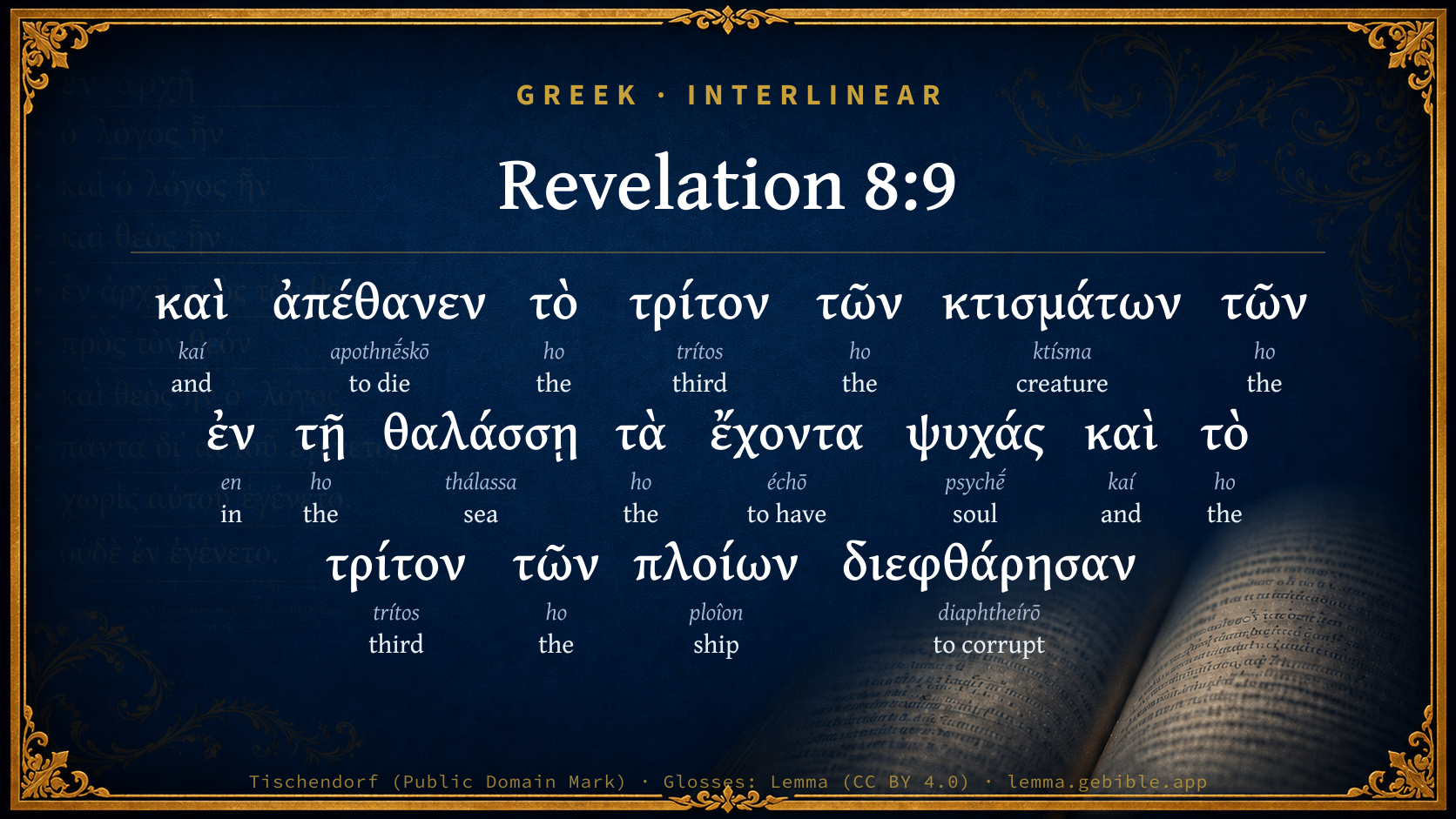
Greek (Tischendorf 8th ed.) Revelation 8:9 appears in the Greek New Testament. The text above is from the Tischendorf 8th edition. Each word links to its Strong’s number and a concise gloss. Click any word for its full Thayer’s Greek Lexicon entry.
Download image
Cite this verse

Revelation 8:9 (World English Bible). Public Domain. Lemma interlinear Bible study tool, https://lemma.gebible.app/v/revelation/8/9.

Show BibTeX & RIS
BibTeX
RIS
English Translation
and one third of the living creatures which were in the sea died. One third of the ships were destroyed.
World English Bible · Public Domain
Download a study sheet

One document with this verse’s original text, its word-by-word gloss line, the meaning frame, cross-references with their text, attributed commentary, and full source and license credits — printable, and it pastes into notes with its structure intact.

This verse Autodidact and up

Study sheet (.html) Plain text (.txt)

A passage Seminary Student

Up to 50 verses in one chapter. A passage sheet keeps up to 6 commentary sources and 12 cross-references per verse, in the order this page ranks them, and says so on the sheet whenever that leaves anything out. Ask for a single verse and you get the Autodidact verse sheet above.

Everything on this page stays free to read, with no account — the sheet is a download of what is already on screen, not access to it.

Want to remove ads? Support Godless Engineer
Compare translations 3

The same verse in 3 English versions, stacked beneath the original-language interlinear above. Click any original word for its lexicon entry.

Each is an independent rendering of the whole verse — the interlinear is not word-aligned to these translations.

Highlighted words mark where these versions differ — a whole-verse word diff, not a word-by-word alignment.

  • World English Bible Public Domain
    and one third of the living creatures which were in the sea died. One third of the ships were destroyed.
  • King James Version Public Domain
    And the third part of the creatures which were in the sea, and had life, died; and the third part of the ships were destroyed.
  • unfoldingWord Literal Text CC BY-SA 4.0
    and a third of the creatures having life in the sea died, and a third of the ships were destroyed.

unfoldingWord Literal Text — © unfoldingWord, licensed CC BY-SA 4.0. Word-aligned USFM3 via Door43 (git.door43.org/unfoldingWord/en_ult).

Versions to compare (up to 4)

3 of 4 selected

Show all 19 translations

Every available English version of this verse, each an independent rendering of the whole verse.

  • World English Bible Public Domain
    and one third of the living creatures which were in the sea died. One third of the ships were destroyed.
  • Berean Standard Bible Public Domain
    a third of the living creatures in the sea died, and a third of the ships were destroyed.
  • Majority Standard Bible Public Domain
    a third of the living creatures in the sea died, and a third of the ships were destroyed.
  • King James Version Public Domain
    And the third part of the creatures which were in the sea, and had life, died; and the third part of the ships were destroyed.
  • American Standard Version (1901) Public Domain
    and there died the third part of the creatures which were in the sea, `even' they that had life; and the third part of the ships was destroyed.
  • Revised Version (1885) Public Domain
    and there died the third part of the creatures which were in the sea, even they that had life; and the third part of the ships was destroyed.
  • Geneva Bible (1599) Public Domain
    And the thirde part of the creatures, which were in the sea, and had life, died, and the thirde part of shippes were destroyed.
  • Douay-Rheims (1899) Public Domain
    And the third part of those creatures died, which had life in the sea, and the third part of the ships was destroyed.
  • Young's Literal Translation Public Domain
    and die did the third of the creatures that `are' in the sea, those having life, and the third of the ships were destroyed.
  • Literal Standard Version CC BY-SA 4.0
    and the third of the creatures that [are] in the sea died, those having life, and the third of the ships were destroyed.
  • Unlocked Literal Bible CC BY-SA 4.0
    a third of the living creatures in the sea died, and a third of the ships were destroyed.
  • unfoldingWord Literal Text CC BY-SA 4.0
    and a third of the creatures having life in the sea died, and a third of the ships were destroyed.
  • Darby Bible Public Domain
    and the third part of the creatures which were in the sea which had life died; and the third part of the ships were destroyed.
  • World Messianic Bible Public Domain
    and one third of the living creatures which were in the sea died. One third of the ships were destroyed.
  • Webster's Bible Public Domain
    And the third part of the creatures which were in the sea, and had life, died; and the third part of the ships were destroyed.
  • Free Bible Version CC BY-SA 4.0
    and one third of the creatures that lived in the sea died, and one third of all ships were destroyed.
  • Bible in Basic English Public Domain
    And destruction came on a third part of the living things which were in the sea, and on a third part of the ships.
  • Text-Critical English NT CC BY 4.0
    a third of the living creatures in the sea died, and a third of the ships were destroyed.
  • Tyndale New Testament (1534) Public Domain
    and the thyrde parte of the see tourned to bloud and the thyrde parte of the creatures which had lyfe dyed and the thyrde part of shippes were destroyed.

Literal Standard Version (2020), Covenant Press — licensed CC BY-SA 4.0. Text via the HelloAO Bible API (eBible.org). Unlocked Literal Bible (unfoldingWord) — licensed CC BY-SA 4.0. Text via the HelloAO Bible API (eBible.org). unfoldingWord Literal Text — © unfoldingWord, licensed CC BY-SA 4.0. Word-aligned USFM3 via Door43 (git.door43.org/unfoldingWord/en_ult). Free Bible Version, Dr. Jonathan Gallagher — licensed CC BY-SA 4.0. Text via the HelloAO Bible API (eBible.org).

Word by word

More ways to search: Search by grammar → Find every occurrence → Compare this word →

Practice this passage: Drill this verse → Learn its vocabulary →

κτισμάτων
ktísma
G2938
“creature”
Noun, Genitive, Plural, Neuter
Part of Speech
Noun
Case
Genitive
Number
Plural
Gender
Neuter
Full Thayer's Definition

Origin: from G2936

TDNT: 19:40,5

1. thing founded 2. created thing
  1. καὶ kaí G2532 “and” Conjunction
  2. ἀπέθανεν apothnḗskō G599 “to die” Verb, Aorist, Active, Indicative, 3rd person, Singular
  3. τὸ ho G3588 “the” Article, Nominative, Singular, Neuter
  4. τρίτον trítos G5154 “third” Adjective, Nominative, Singular, Neuter
  5. τῶν ho G3588 “the” Article, Genitive, Plural, Neuter
  6. τῶν ho G3588 “the” Article, Genitive, Plural, Neuter
  7. ἐν en G1722 “in” Preposition
  8. τῇ ho G3588 “the” Article, Dative, Singular, Feminine
  9. θαλάσσῃ thálassa G2281 “sea” Noun, Dative, Singular, Feminine
  10. τὰ ho G3588 “the” Article, Nominative, Plural, Neuter
  11. ἔχοντα échō G2192 “to have” Verb, Present, Active, Participle, Nominative, Plural, Neuter
  12. ψυχάς psychḗ G5590 “soul” Noun, Accusative, Plural, Feminine
  13. καὶ kaí G2532 “and” Conjunction
  14. τὸ ho G3588 “the” Article, Nominative, Singular, Neuter
  15. τρίτον trítos G5154 “third” Adjective, Nominative, Singular, Neuter
  16. τῶν ho G3588 “the” Article, Genitive, Plural, Neuter
  17. πλοίων ploîon G4143 “ship” Noun, Genitive, Plural, Neuter
  18. διεφθάρησαν diaphtheírō G1311 “to corrupt” Verb, Aorist, Passive, Indicative, 3rd person, Plural

About this verse

These counts appear in no published source. They are computed here, from the morphology-tagged text and Lemma’s own curated glosses. What Lemma adds →

19
words
11
distinct lemmas
Revelation
section

Notable vocabulary

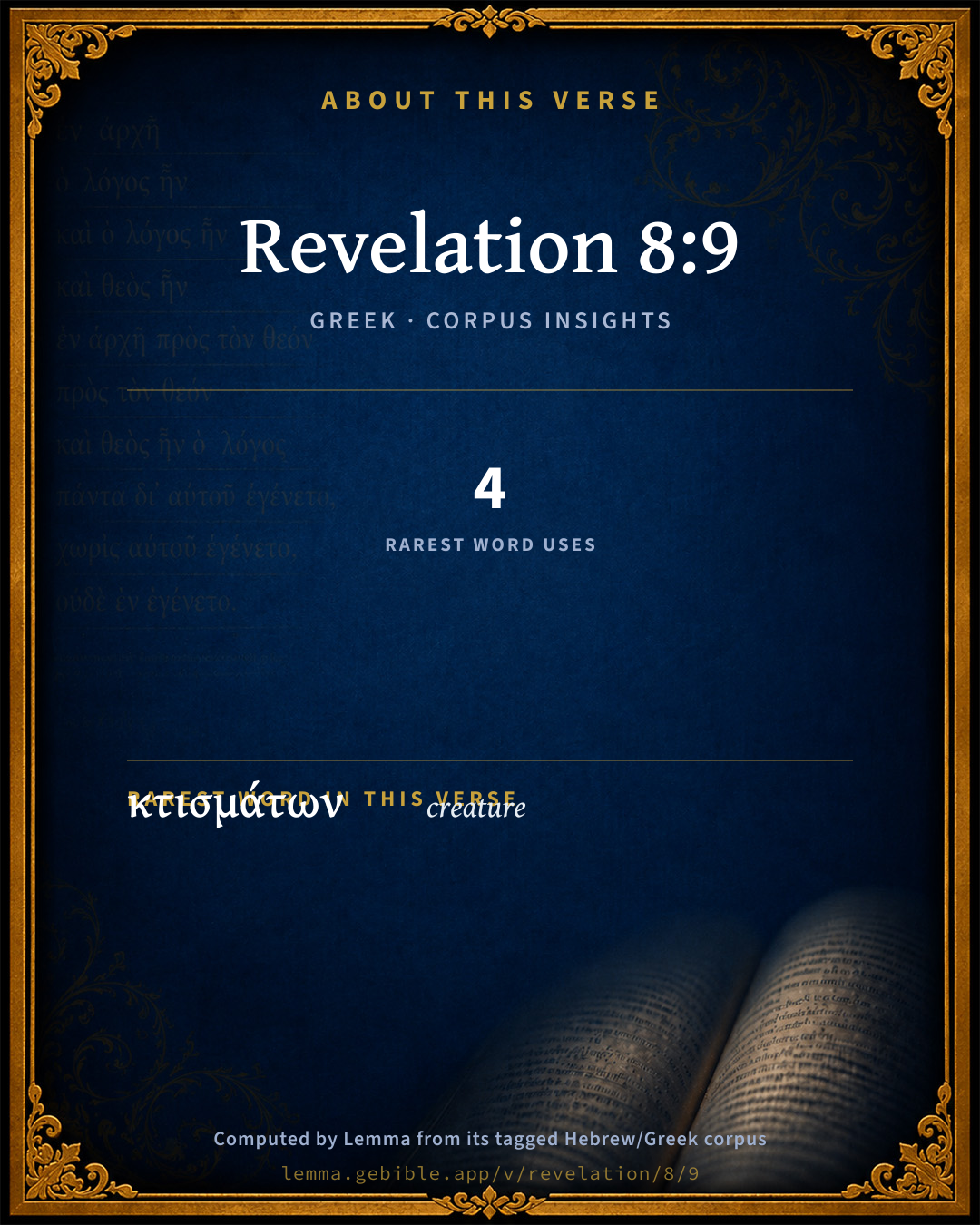
The rarest word here is κτισμάτων creature G2938 — appearing just 4 times in the whole Greek New Testament.

Shared distinctive vocabulary

κτισμάτων creature G2938 occurs in 4 verses of the Greek New Testament. Also found in:

Repetition

Words recur within this verse:

Cross-references

9

Topical passages linked to Revelation 8:9 in the Treasury of Scripture Knowledge — connected by theme and wording, ordered by reader-vote popularity; previews shown in the World English Bible.

  • Isaiah 2:16 For all the ships of Tarshish, And for all pleasant imagery.
  • Revelation 8:7 The first sounded, and there followed hail and fire, mixed with blood, and they were thrown to the earth. One third of the earth was burnt up, and one third of the trees were burnt up, and all green grass was burnt up.
  • Revelation 16:3 The second angel poured out his bowl into the sea, and it became blood as of a dead man. Every living thing in the sea died.
  • Psalms 48:7 With the east wind, you break the ships of Tarshish.
  • Revelation 8:10 The third angel sounded, and a great star fell from the sky, burning like a torch, and it fell on one third of the rivers, and on the springs of the waters.
  • Revelation 8:12 The fourth angel sounded, and one third of the sun was struck, and one third of the moon, and one third of the stars; so that one third of them would be darkened, and the day wouldn't shine for one third of it, and the night in the same way.
  • Zechariah 13:8 It shall happen that in all the land," says Yahweh, Two parts in it will be cut off and die; But the third will be left in it.
  • Exodus 7:21 The fish that were in the river died; and the river became foul, and the Egyptians couldn't drink water from the river; and the blood was throughout all the land of Egypt.
  • Isaiah 23:1 The burden of Tyre. Howl, you ships of Tarshish; for it is laid waste, so that there is no house, no entering in: from the land of Kittim it is revealed to them.

Cross-references courtesy of OpenBible.info (CC BY 4.0).

Commentary

Notes on Revelation 8:9 from classic Christian and Jewish commentators (each source and its license shown beneath its notes). The classic Christian expositions comment on the surrounding passage and are grouped to its opening verse, so a note may address several verses; the Jewish commentaries on the Tanakh (Rashi and others) are per-verse, so they appear only where the commentator wrote on this verse.

Lemma curates 59 commentaries, every one of them public domain or Creative Commons licensed, each selected and text-cleaned for this edition rather than reprinted as found. About our sources →

Bengel's Gnomon

Johann Albrecht Bengel

Rev 8:9. Διεφθάρησαν[93]) See App. Ed. ii. The Singular number, at the beginning of a sentence, creates no difficulty: for the singular is followed by the plural also in Rev 8:7, ἘΓΈΝΕΤΟ ΧΆΛΑΖΑ ΚΑῚ ΠῦΡ ΜΕΜΙΓΜΈΝΑ ἘΝ ΑἽΜΑΤΙ. That is a similar instance which Wolf notices, a third part of the men were slain: ch. Rev 9:18.

[93] A has διεφθάρησαν. Bh Vulg. have διεφθάρη: so Rec. Text—E.

Bengel's Gnomon of the New Testament — English translation (T&T Clark, Edinburgh, 1860) — public domain. Text from a community e-Sword module.

Jamieson, Fausset & Brown

Robert Jamieson, A. R. Fausset & David Brown

The symbolical interpreters take the ships here to be churches. For the Greek here for ships is not the common one, but that used in the Gospels of the apostolic vessel in which Christ taught: and the first churches were in the shape of an inverted ship: and the Greek for destroyed is also used of heretical corruptings (Ti1 6:5).

Jamieson, Fausset & Brown — Commentary Critical and Explanatory on the Whole Bible (1871) — public domain (CC PDM 1.0). Text via the HelloAO Bible API.

Adam Clarke's Commentary

Verse 9. The third part of the ships were destroyed.] These judgments seem to be poured out upon some maritime nation, destroying much of its population, and much of its traffic.

Adam Clarke's Commentary on the Bible (1810–1826) — public domain. Text from a community e-Sword/MySword module.

John Gill's Exposition

And the third part of the creatures which were in the sea,.... The fishes; by whom men are meant, the inhabitants of the Roman empire; see Eze 29:4, where by fish the Targum understands mighty princes and governors:

and had life, died; were put to death by these savage and barbarous people, who killed all they met with, men, women, and children, young and old, rich and poor, high and low:

and the third part of the ships were destroyed; by which may be designed either the cities and towns within such a part of the Roman jurisdiction, which were burnt or plundered by them; or their goods and effects, which they pillaged, and carried off the wealth and riches of the people, even all their substance, as Austin (p) and Jerom (q), who lived in those times, affirm.

(p) De Civitate Dei, l. 1. c. 10. vid. L. Vivem in ib. (q) Ad Eustochium.

John Gill's Exposition of the Whole Bible (1746–1763) — public domain (CC PDM 1.0). Text via the HelloAO Bible API.

Trapp's Complete Commentary

John Trapp

9 And the third part of the creatures which were in the sea, and had life, died; and the third part of the ships were destroyed.

Ver. 9. And the third part] Heresy as a gangrene spreads and kills; as the leprosy in the head, it renders a man utterly unclean, Lev 13:44. So cunning are some seducers, and so close in the conveyance of their collusion, that if possible the very elect may be deceived.

And the third part of the ships were destroyed] That is, of the Churches, even those that were planted by the apostles themselves, those principal pilots. Howbeit not all the Churches, but a third part only: when the Church was in the wilderness, when Antichrist most reigned and raged, God did preserve some ships, some fundamental doctrines, and the essence of baptism, and the essence of a true ministry dispensing them; and they, that is, her pastors, fed her there, Rev 12:6-14.

" Niteris incassum Christi submergere navem;

Fluctuat, at nunquam mergitur illa ratis."

John Trapp, A Commentary or Exposition upon All the Books of the Old and New Testament (1647–1656) — public domain. Text from a community e-Sword module.

Albert Barnes' Notes on the Bible

And the third part of the creatures which were in the sea, and had life, died - The effect was as if one-third of all the fish in the sea were cut off. Of course this is not to be taken literally. It is designed to describe an effect, pertaining to the maritime portion of the world, as if a third portion of all that was in the sea should perish. The natural interpretation would be to apply it to some invasion or calamity pertaining to the sea - to the islands, to the maritime regions, or to commerce. If the whole description pertains to the Roman empire, then this might be supposed to have particular reference to something that would have a bearing on the maritime parts of that empire.

And the third part of the ships were destroyed - This also pertains to the same general calamity, affecting the commerce of the empire. The destruction of the “ships” was produced, in some way, by casting the mountain into the sea - either by their being consumed by the contact with the burning mass, or by being sunk by the agitation of the waters. The essential idea is, that the calamity would be of such a nature as would produce the destruction of vessels at sea - either naval armaments, or ships of commerce. In looking now for the application or fulfillment of this, it is necessary:

(a)To find some event or events which would have a particular bearing on the maritime or commercial part of the world; and,

(b)Some such event or events that, on the supposition that they were the things referred to, would be properly symbolized by the image here employed:

(1) If the first trumpet had reference to the invasion of Alaric and the Goths, then in this we naturally look for the next succeeding act of invasion which shook the Roman empire, and contributed to its fall.

(2) The next invasion was that under Genseric, at the head of the Vandals (Gibbon, ii. 306ff). This occurred 428-468 ad.

(3) The symbol of a blazing or burning mountain, torn from its foundation, and precipitated into the ocean, would well represent this mighty nation moved from its ancient seat, and borne along toward the maritime parts of the empire, and its desolations there - as will be shown in the following remarks.

(4) The acts of the Vandals, under Genseric, corresponded with the ideas expressed by the symbol. In illustrating this I shall be indebted, as heretofore, principally to Mr. Gibbon:

(a) His general account of the Vandals is this: they are supposed (i. 138) to have been originally the same people with the Goths, the Goths and Vandals constituting one great nation living on the shores of the Baltic. They passed in connection with them over the Baltic; emigrated to Prussia and the Ukraine; invaded the Roman provinces; received tribute from the Romans; subdued the countries about the Bosphorus; plundered the cities of Bithynia; ravaged Greece and Illyrium, and were at last settled in Thrace under the emperor Theodosius (Gibbon, i. 136-166; ii. 110-150). They were then driven forward by the Huns, and having passed through France and Spain into Africa, conquered the Carthaginian territory, established an independent government, and thence through a long period harassed the neighboring islands, and the coasts of the Mediterranean by their predatory incursions, destroying the ships and the commerce of the Romans, and were distinguished in the downfall of the empire by their ravages on the islands and the sea. Thus, they were moved along from place to place until the scene of their desolations became more distinctly the maritime parts of the empire; and the effect of their devastations might be well compared with a burning mountain moved from its ancient base, and then thrown into the sea.

(b) This will be apparent from the statements of Mr. Gibbon in regard to their ravages under their leader Genseric. “Seville and Carthagena became the reward, or rather the prey of the ferocious conquerors” (after they had defeated the Roman Castinus), “and the vessels which they found in the harbor of Carthagena might easily transport them to the isles of Majorca and Minorca, where the Spanish fugitives, as in a secure recess, had vainly concealed their families and fortunes. The experience of navigation, and perhaps the prospect of Africa, encouraged the Vandals to accept the invitation which they received from Count Boniface” (to aid him in his apprehended difficulties with Rome, and to enter into an alliance with him by settling permanently in Africa (Gibbon, ii. 305, 306)): “and the death of Goaderic” (the Vandal king) “served only to forward and animate the bold enterprise. In the room of a prince, not conspicuous for any superior powers of the mind or body, they acquired his bastard brother, the terrible Genseric - a name which, in the destruction of the Roman empire, has deserved an equal rank with the names of Alaric and Attila.” “The ambition of Genseric was almost without bounds, and without scruples; and the warrior could dexterously employ the dark engines of policy to solicit the allies who might be useful to his success, or to scatter among his enemies the seeds of enmity and contention. Almost in the moment of his departure he was informed that Hermanric, king of the Suevi, had presumed to ravage the Spanish territories, which he was resolved to abandon. Impatient of the insult, Genseric pursued the hasty retreat of the Suevi as far as Merida; precipitated the king and his army into the river Anas, and calmly returned to the seashore to embark his troops. The vessels which transported the Vandals over the modern Straits of Gibraltar, a channel only twelve miles in breadth, were furnished by the Spaniards, who anxiously wished for their departure; and by the African general who had implored their formidable assistance” (Gibbon, ii. 306. Genseric, in the accomplishment of his purposes, soon took possession of the northern coast of Africa, defeating the armies of Boniface, and “Carthage, Cirta, and Hippo Regius were the only cities that appeared to rise above the general inundation” (Gibbon, ii. 308). “On a sudden,” says Mr. Gibbon (ii. 309), “the seven fruitful provinces, from Tangier to Tripoli, were overwhelmed by the invasion of the Vandals; whose destructive rage has perhaps been exaggerated by popular animosity, religious zeal, and extravagant declamation. War in its fairest form implies a perpetual violation of humanity and justice; and the hostilities of barbarians are inflamed by the fierce and lawless spirit which perpetually disturbs their peaceful and domestic society. The Vandals, where they found resistance, seldom gave quarter; and the deaths of their valiant countrymen were expiated by the ruin of the cities under whose walls they had fallen,” etc.

The result of the invasion was the conquest of all northern Africa; the reduction of Hippo and Carthage, and the establishment of a government under Genseric in Africa that waged a long war with Rome (Gibbon, ii. 310, 311). The symbol before us has particular reference to maritime or naval operations and desolations, and the following extracts from Mr. Gibbon will show with what propriety, if this symbol was designed to refer to him, these images were employed. “The discovery and conquest of the black nations (in Africa) that might dwell beneath the torrid zone could not tempt the rational ambition of Genseric; but he east his eyes toward the sea; he resolved to create a naval power, and his bold resolution was executed with steady and active perseverance. The woods of Mount Atlas afforded an inexhaustible supply of timber; his new subjects were skilled in the arts of navigation and ship-building; he animated his daring Vandals to embrace a mode of warfare which would render every maritime country accessible to their arms; the Moors and Africans were allured by the hope of plunder; and after an interval of six centuries the fleets that issued from the port of Carthage again claimed the empire of the Mediterranean. The success of the Vandals, the conquest of Sicily, the sack of Palermo, and the frequent descents on the coasts of Lucania, awakened and alarmed the mother of Valentinian and the sister of Theodosius. Alliances were formed; and armaments, expensive and ineffectual, were prepared for the destruction of the common enemy, who reserved his courage to encounter those dangers which his policy could not prevent or elude.

The revolutions of the palace, which left the Western empire without a defender and without a lawful prince, dispelled the apprehension and stimulated the avarice of Genseric. He immediately equipped a numerous fleet of Vandals and Moors, and cast anchor at the mouth of the Tiber,” etc. (Gibbon, ii. 352). “On the third day after the tumult (455 a.d., on the death of Maximus) Genseric boldly advanced from the port of Ostia to the gates of the defenseless city. Instead of a sally of the Roman youth, there issued from the gates an unarmed and venerable procession of the bishop at the head of the clergy. But Rome and its inhabitants were delivered to the licentiousness of the Vandals and the Moors, whose blind passions revenged the injuries of Carthage. The pillage lasted fourteen days and nights; and all that yet remained of public or private wealth, of sacred or profane treasure, was diligently transported to the vessels of Genseric,” etc.

See the account of this pillage in Gibbon, ii. 355-366. The emperor Majorian (457 a.d.) endeavored to “restore the happiness of the Romans,” but he encountered the arms of Genseric, from his character and situation their most formidable enemy. A fleet of Vandals and Moors landed at the mouth of the Liris, or Garigliano; but the imperial troops surprised and attacked the disorderly barbarians, who were encumbered with the spoils of Campania; they were chased with slaughter to their ships; and their leader, the king’s brother-in-law, was found in the number of the slain. Such vigilance might announce the character of the new reign; but the strictest vigilance, and the most numerous forces, were insufficient to protect the long-extended coast of Italy from the depredations of a naval war” (Gibbon, ii. 363). “The emperor had foreseen that it was impossible, without a maritime power, to achieve the conquest of Africa. In the first Punic war the republic had exerted such incredible diligence, that within sixty days after the first stroke of the axe had been given in the forest a fleet of one hundred and sixty galleys proudly rode at anchor in the sea. Under circumstances much less favorable Majorian equalled the spirit and perseverance of the ancient Romans. The woods of the Apennines were felled, the arsenals and manufactures of Ravenna and Misenium were restored, Italy and Gaul vied with each other in liberal contributions to the public service; and the imperial navy of 300 large galleys, with an adequate proportion of transports and smaller vessels, was collected in the secure and capacious harbor of Carthagena in Spain” (Gibbon, ii. 363, 364).

The fate of this large navy is thus described by Mr. Gibbon: “Genseric was saved from impending and inevitable ruin by the treachery of some powerful subjects; envious or apprehensive of their master’s success. Guided by their secret intelligence, he surprised the unguarded fleet in the bay of Carthagena; many of the ships were sunk, or taken, or burnt; and the preparations of three years were destroyed in a single day,” ii. 364. The further naval operations and maritime depredations of the Vandals under Genseric are thus stated by Mr. Gibbon: “The kingdom of Italy, a name to which the Western empire was gradually reduced, was afflicted, under the reign of Ricimer, by the incessant depredations of Vandal pirates. In the spring of each year they equipped a formidable navy in the port of Carthage; and Genseric himself, though in very advanced age, still commanded in person the most important expeditions. His designs were concealed with impenetrable secrecy until the moment that he hoisted sail. When he was asked by the pilot what course he should steer - ‘Leave the determination to the winds,’ replied the barbarian, with pious arrogance; ‘they will transport us to the guilty coast whose inhabitants have provoked the divine justice;’ but if Genseric himself deigned to issue more precise orders, he judged the most wealthy to be the most criminal.

The Vandals repeatedly visited the coasts of Spain, Liguria, Tuscany, Campania, Lucania, Bruttium, Apulia, Calabria, Venetia, Dalmatia, Epirus, Greece, and Sicily; they were tempted to subdue the island of Sardinia, so advantageously placed in the center of the Mediterranean; and their arms spread desolation, or terror, from the Columns of Hercules to the mouth of the Nile. As they were more ambitious of spoil than of glory, they seldom attacked any fortified cities, or engaged any regular troops in the open field. But the celerity of their motions enabled them, almost at the same time, to threaten and to attack the most distant objects which attracted their desires; and as they always embarked a sufficient number of horses, they had no sooner landed than they swept the dismayed country with a body of light cavalry,” ii. 366. How far this description agrees with the symbol in the passage before us - “a great mountain burning with fire cast into the sea”; “the third part of the ships were destroyed” - must be left to the reader to judge.

It may be asked, however, with at least some show of reason, whether, if it be admitted that it was the design of the author of the Book of Revelation to refer to the movements of the Vandals under Genseric as one of the important and immediate causes of the ruin of the Roman empire, he could have found a more expressive symbol than this? Indeed, is there now any symbol that would be more striking and appropriate? If one should now undertake to represent this as one of the causes of the (downfall of the empire by a symbol, could he easily find one that would be more expressive? It is a matter that is in itself perhaps of no importance, but it may serve to show that the interpretation respecting the second trumpet was not forced, to remark that I had gone through with the interpretation of the language of the symbol before I looked into Mr. Gibbon with any reference to the application.

Albert Barnes' Notes on the Bible (1834–1885) — public domain. Text from a community e-Sword/MySword module.

Matthew Poole's English Annotations

Phrases all signifying the miserable catastrophe that should follow the destruction of this city, by the slaughter of men, the ruin of houses and towns in Italy, &c. History (as Mr. Mede showeth) excellently agreeth with this. In the year 410, Rome was taken by Alaricus; this was followed with great devastations both in France and Spain. Honorius, to recover the empire, was glad to give the Goths a seat and government in France, and the Burgundians and Vandals a place near unto the river Rhone; and, Anno 415, to the Vandals a place in Spain; and, Anno 455, Rome was again taken by Gensericus the Vandal, who divided the whole empire into ten kingdoms:

1. That of the Britrons, ruled by Vortimer.

2. The Saxons, ruled by Hengist.

3. The Franks, ruled by Childeric.

4. The Burgundians, ruled by Gundericus.

5. The Visigoths, ruled by Theodoricus II.

6. The Alans and Suevi, ruled by Riciarius.

7. The Vandals, ruled by Gensericus.

8. The Germans, ruled by Sumanus.

9. The Ostrogoths, ruled by Theodemirus.

10. The Grecians, ruled by Marcianus.

This is the sum of what Mr. Mede saith, and to this tract of time, between the years 410 and 455, the second trumpet seemeth to relate.

Matthew Poole's English Annotations on the Holy Bible (1683–1685) — public domain. Text from a community e-Sword/MySword module.

John Wesley's Explanatory Notes

And the third part of the creatures that were in the sea - That is, of all sorts of men, of every station and degree. Died - By those merciless invaders. And the third part of the ships were destroyed - It is a frequent thing to resemble a state or republic to a ship, wherein many people are embarked together, and share in the same dangers. And how many states were utterly destroyed by those inhuman conquerors! Much likewise of this was literally fulfilled. How often was the sea tinged with blood! How many of those who dwelt mostly upon it were killed! And what number of ships destroyed!

John Wesley, Explanatory Notes Upon the Whole Bible (1754–1765) — public domain. Text via the GEBible commentary corpus.

Cambridge Greek Testament for Schools and Colleges

9. τὸ τρίτον (pr.). א adds μέρος, the Latins everywhere have tertia pars.

τῶν κτισμάτων τῶν ἐν τῇ θαλάσσῃ, τὰ ἔχ. ψυχάς. Primas[296] reads piscium, but quotes from Tyc[297] habentium animas. Cod. flor[298] reads animalium quae erat in mari.

[296] Primasius, edited by Haussleiter.

[297] Tyconius.

[298] flor. Codex Toletanus 10th century at Madrid.

9. τὰ ἔχοντα ψυχάς. Cf. Rev 2:20 n.; here it might be a question whether τὰ ἔχ. ψυχὰς is in apposition to τὸ τρίτον or τῶν κτισμάτων.

Cambridge Greek Testament for Schools and Colleges (Cambridge University Press, 1896; 21 vols, various authors incl. Carr, Maclear, Plummer, Farrar, Lumby, Moule, M. R. James, Simcox) — public domain. Text from a community e-Sword module.

Vincent's Word Studies in the New Testament

Marvin R. Vincent

Life [ψυχας] . See on 3Jo 1:2.

Ships [πλοιων] . See on Luk 5:2.

Marvin R. Vincent, Word Studies in the New Testament (1887–1900) — public domain. Text from a community e-Sword/MySword module.

Lesson kit

Teaching starters — assembled from the data on this page, not authored interpretation. Every prompt links to the verse data it draws on. Edit before teaching.

Revelation, in the Revelation, opens this verse with 19 words (11 distinct Greek lemmas). Its most distinctive word is ktísma (“creature”). A historical commentator’s framing appears above. Read the whole chapter for the surrounding context.

Discussion questions

  1. How does “creature” (ktísma) shape what this verse is saying?
  2. 1 Timothy 4:4 shares the word «creature» with this verse. How do the two illuminate each other?
  3. “third” occurs 2× in this one verse. What is the effect of the repetition?
  4. These translations render this verse differently. What is at stake in choosing one wording over another?
  5. Reading how Bengel's Gnomon and Jamieson, Fausset & Brown read this verse, where do the two commentators agree and where do they part?

Things to notice

  • These translations choose different wording for 7 words in this verse.
  • “third” occurs 2× in this single verse.
  • 11 distinct Greek lemmas span 19 words in this verse.

Reading settings

Reading text

Shown beneath each verse's original-language words.

Old Testament
Old Testament edition

Read the OT as the Masoretic Hebrew (MT) or the Greek Septuagint (LXX).

English shown for the Greek Septuagint (in the Hebrew ↔ Greek comparison).

Comparing translations? Open the Compare panel on any verse page to stack up to four side by side.