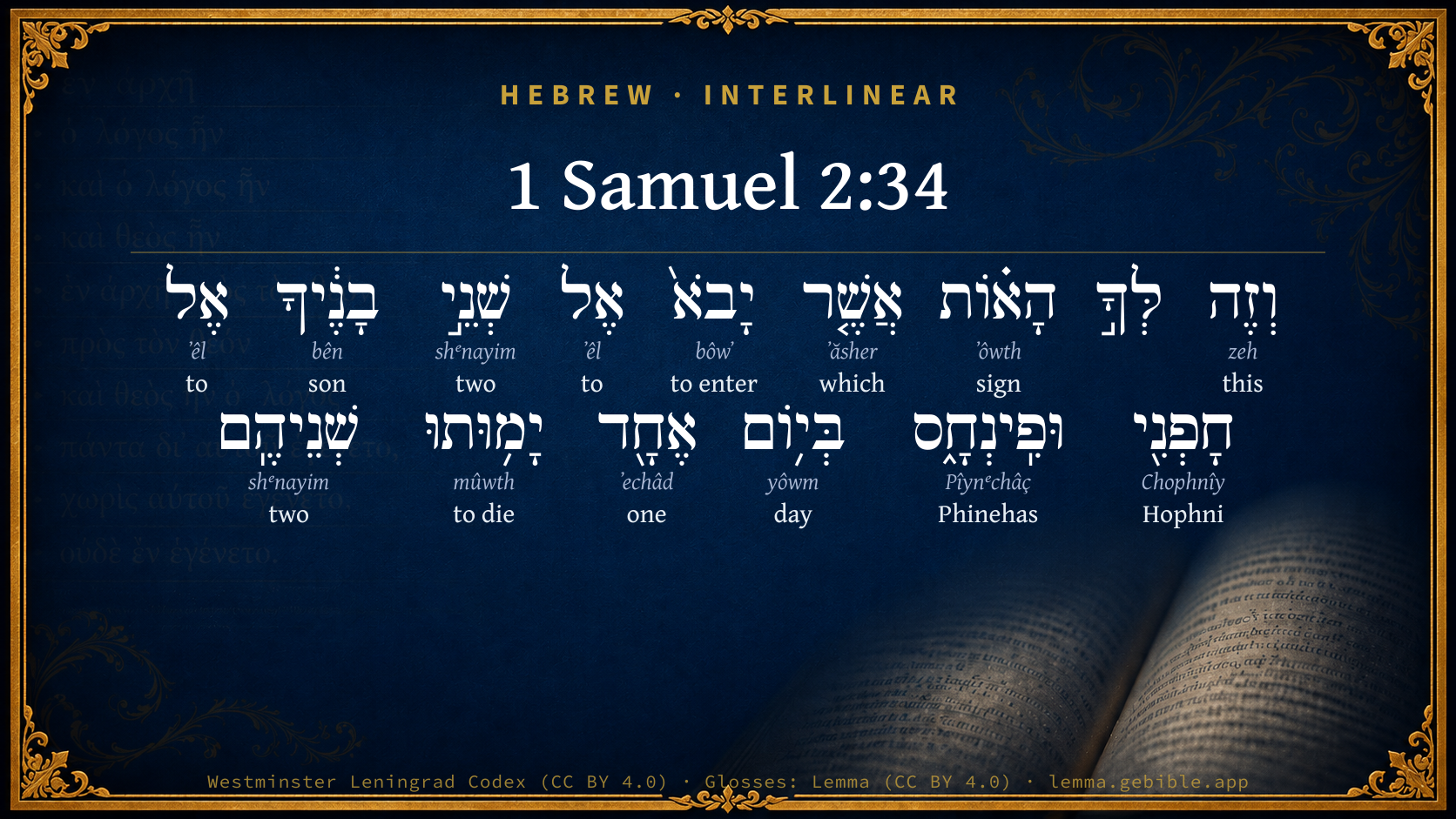
1 Samuel 2:34

Hebrew (Westminster Leningrad Codex) 1 Samuel 2:34 appears in the Hebrew Old Testament. The text above is from the Westminster Leningrad Codex. Each word links to its Strong’s number, a concise gloss, and parsing drawn from the Open Scriptures Hebrew Bible morphology. Click any word for its full Brown-Driver-Briggs (BDB) entry.
Download image
Cite this verse

1 Samuel 2:34 (World English Bible). Public Domain. Lemma interlinear Bible study tool, https://lemma.gebible.app/v/1-samuel/2/34.

Show BibTeX & RIS
BibTeX
RIS
English Translation
This shall be the sign to you, that shall come on your two sons, on Hophni and Phinehas: in one day they shall die both of them.
World English Bible · Public Domain
Download a study sheet

One document with this verse’s original text, its word-by-word gloss line, the meaning frame, cross-references with their text, attributed commentary, and full source and license credits — printable, and it pastes into notes with its structure intact.

This verse Autodidact and up

Study sheet (.html) Plain text (.txt)

A passage Seminary Student

Up to 50 verses in one chapter. A passage sheet keeps up to 6 commentary sources and 12 cross-references per verse, in the order this page ranks them, and says so on the sheet whenever that leaves anything out. Ask for a single verse and you get the Autodidact verse sheet above.

Everything on this page stays free to read, with no account — the sheet is a download of what is already on screen, not access to it.

Want to remove ads? Support Godless Engineer
Compare translations 3

The same verse in 3 English versions, stacked beneath the original-language interlinear above. Click any original word for its lexicon entry.

Each is an independent rendering of the whole verse — the interlinear is not word-aligned to these translations.

Highlighted words mark where these versions differ — a whole-verse word diff, not a word-by-word alignment.

  • World English Bible Public Domain
    This shall be the sign to you, that shall come on your two sons, on Hophni and Phinehas: in one day they shall die both of them.
  • King James Version Public Domain
    And this shall be a sign unto thee, that shall come upon thy two sons, on Hophni and Phinehas; in one day they shall die both of them.
  • unfoldingWord Literal Text CC BY-SA 4.0
    And this the sign for you that will come to the two of your sons, to Hophni and Phinehas: in one day the two of them will die.

unfoldingWord Literal Text — © unfoldingWord, licensed CC BY-SA 4.0. Word-aligned USFM3 via Door43 (git.door43.org/unfoldingWord/en_ult).

Versions to compare (up to 4)

3 of 4 selected

Show all 18 translations

Every available English version of this verse, each an independent rendering of the whole verse.

  • World English Bible Public Domain
    This shall be the sign to you, that shall come on your two sons, on Hophni and Phinehas: in one day they shall die both of them.
  • Berean Standard Bible Public Domain
    And this sign shall come to you concerning your two sons Hophni and Phinehas: They will both die on the same day.
  • Majority Standard Bible Public Domain
    And this sign shall come to you concerning your two sons Hophni and Phinehas: They will both die on the same day.
  • King James Version Public Domain
    And this shall be a sign unto thee, that shall come upon thy two sons, on Hophni and Phinehas; in one day they shall die both of them.
  • American Standard Version (1901) Public Domain
    And this shall be the sign unto thee, that shall come upon thy two sons, on Hophni and Phinehas: in one day they shall die both of them.
  • Revised Version (1885) Public Domain
    And this shall be the sign unto thee, that shall come upon thy two sons, on Hophni and Phinehas; in one day they shall die both of them.
  • Geneva Bible (1599) Public Domain
    And this shalbe a signe vnto thee, that shall come vpon thy two sonnes Hophni and Phinehas: in one day they shall die both.
  • Douay-Rheims (1899) Public Domain
    And this shall be a sign to thee, that shall come upon thy two sons, Ophni and Phinees: In one day they shall both of them die.
  • Young's Literal Translation Public Domain
    and this `is' to thee the sign that cometh unto thy two sons, unto Hophni and Phinehas -- in one day they die both of them;
  • Literal Standard Version CC BY-SA 4.0
    and this [is] the sign to you that comes to your two sons, to Hophni and Phinehas—in one day both of them die;
  • Unlocked Literal Bible CC BY-SA 4.0
    This will be the sign for you that will come on your two sons, on Hophni and Phinehas: They will both die on the same day.
  • unfoldingWord Literal Text CC BY-SA 4.0
    And this the sign for you that will come to the two of your sons, to Hophni and Phinehas: in one day the two of them will die.
  • Darby Bible Public Domain
    And this shall be the sign to thee, which shall come upon thy two sons, upon Hophni and Phinehas: in one day they shall die, both of them.
  • World Messianic Bible Public Domain
    This will be the sign to you that will come on your two sons, on Hophni and Phinehas: in one day they will both die.
  • Webster's Bible Public Domain
    And this shall be a sign to thee, that shall come upon thy two sons, on Hophni and Phinehas: in one day they shall die both of them.
  • Free Bible Version CC BY-SA 4.0
    Here is a sign for you that this will happen regarding your two sons Hophni and Phinehas: both will die on the same day.
  • Bible in Basic English Public Domain
    And this will be the sign to you, which will come on Hophni and Phinehas, your sons; death will overtake them on the same day.
  • JPS Tanakh (1917) Public Domain
    And this shall be the sign unto thee, that which shall come upon thy two sons, on Hophni and Phinehas: in one day they shall die both of them.

Literal Standard Version (2020), Covenant Press — licensed CC BY-SA 4.0. Text via the HelloAO Bible API (eBible.org). Unlocked Literal Bible (unfoldingWord) — licensed CC BY-SA 4.0. Text via the HelloAO Bible API (eBible.org). unfoldingWord Literal Text — © unfoldingWord, licensed CC BY-SA 4.0. Word-aligned USFM3 via Door43 (git.door43.org/unfoldingWord/en_ult). Free Bible Version, Dr. Jonathan Gallagher — licensed CC BY-SA 4.0. Text via the HelloAO Bible API (eBible.org).

Word by word

More ways to search: Search by grammar → Find every occurrence → Compare this word →

Practice this passage: Drill this verse → Learn its vocabulary →

חָפְנִ֖י
Chophnîy
H2652
“Hophni”
Noun, Proper
Part of Speech
Noun
Type
Proper
Full BDB Definition

Origin: from H2651

TWOT: None

Hophni = "pugilist" - one of the two sons of Eli who were priests at Shiloh and were noted for their brutality and lust; their sinfulness provoked a curse against their father's house and were judged by the Lord when they took the ark into battle; the ark was lost and both brothers were killed and Eli died when he heard the news
  1. וְזֶה zeh H2088 “and · this” Conjunction + Pronoun, Demonstrative, Masculine, Singular
  2. הָא֗וֹת ʼôwth H226 “the · sign” Particle, Definite Article + Noun, Common, Both, Singular, Absolute
  3. אֲשֶׁ֤ר ʼăsher H834 “which” Particle, Relative
  4. יָבֹא֙ bôwʼ H935 “to enter” Verb, Qal, Imperfect, 3rd Person, Masculine, Singular
  5. אֶל ʼêl H413 “to” Preposition
  6. שְׁנֵ֣י shᵉnayim H8147 “two” Adjective, Cardinal number, Masculine, Dual, Construct
  7. בָנֶ֔יךָ bên H1121 “sons · your” Noun, Common, Masculine, Plural, Construct + Suffix, Personal, 2nd Person, Masculine, Singular
  8. אֶל ʼêl H413 “to” Preposition
  9. וּפִֽינְחָ֑ס Pîynᵉchâç H6372 “and · Phinehas” Conjunction + Noun, Proper
  10. בְּי֥וֹם yôwm H3117 “in/at · day” Preposition + Noun, Common, Masculine, Singular, Absolute
  11. אֶחָ֖ד ʼechâd H259 “one” Adjective, Cardinal number, Masculine, Singular, Absolute
  12. יָמ֥וּתוּ mûwth H4191 “to die” Verb, Qal, Imperfect, 3rd Person, Masculine, Plural
  13. שְׁנֵיהֶֽם shᵉnayim H8147 “two · their” Adjective, Cardinal number, Masculine, Dual, Construct + Suffix, Personal, 3rd Person, Masculine, Plural

About this verse

These counts appear in no published source. They are computed here, from the morphology-tagged text and Lemma’s own curated glosses. What Lemma adds →

15
words
12
distinct lemmas
Historical
section

Notable vocabulary

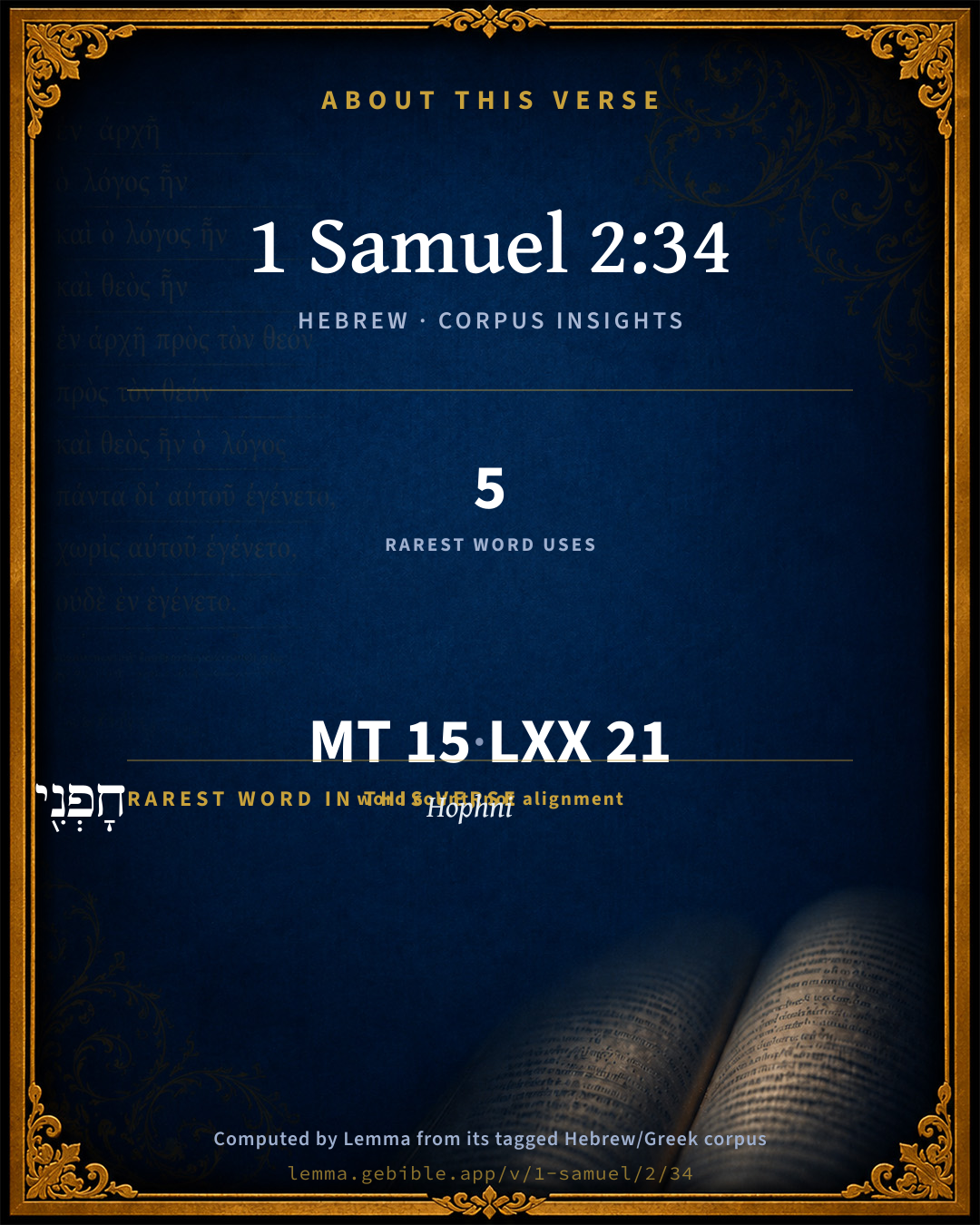
The rarest word here is חָפְנִ֖י Hophni H2652 — appearing just 5 times in the whole Hebrew Bible.

Shared distinctive vocabulary

חָפְנִ֖י Hophni H2652 occurs in 5 verses of the Hebrew Bible. Also found in:

Grammatical profile

  • 2 verbs
  • 5 nouns
  • 3 adjectives
  • 1 pronoun
  • 3 prepositions
  • 1 particle

Verb forms

  • יָבֹא֙ Qal · Imperfect
  • יָמ֥וּתוּ Qal · Imperfect

Repetition

Words recur within this verse — often emphatic in Hebrew:

  • שְׁנֵ֣י two H8147 ×2
  • אֶל to H413 ×2

Hebrew & Septuagint length

In English translation the verse runs 27 words from the Hebrew and 25 from the Septuagint (LXX English) — closely comparable.

A rough comparison of the two English renderings, which tokenize alike — not a word-level alignment.

Word counts can differ between the Hebrew and the Greek without any difference in meaning — e.g. the Hebrew direct-object marker אֵת has no separate Greek word, and Greek often adds the article ὁ.

In the original languages it is 15 Hebrew tokens and 21 Greek tokens — but the two are counted differently (Hebrew bundles its prefixes and suffixes into one token; the Greek is in lemma form), so that isn’t a like-for-like length.

Cross-references

5

Topical passages linked to 1 Samuel 2:34 in the Treasury of Scripture Knowledge — connected by theme and wording, ordered by reader-vote popularity; previews shown in the World English Bible.

  • 1 Samuel 4:11 The ark of God was taken; and the two sons of Eli, Hophni and Phinehas, were slain.
  • 1 Kings 13:3 He gave a sign the same day, saying, This is the sign which Yahweh has spoken: Behold, the altar shall be torn, and the ashes that are on it shall be poured out.
  • 1 Samuel 4:17 He who brought the news answered, Israel is fled before the Philistines, and there has been also a great slaughter among the people, and your two sons also, Hophni and Phinehas, are dead, and the ark of God is taken.
  • 1 Samuel 3:12 In that day I will perform against Eli all that I have spoken concerning his house, from the beginning even to the end.
  • 1 Kings 14:12 Arise you therefore, get you to your house: [and] when your feet enter into the city, the child shall die.

Cross-references courtesy of OpenBible.info (CC BY 4.0).

Hebrew and Greek witnesses Masoretic Hebrew ↔ Greek Septuagint

The same verse in the two great witnesses to the Old Testament, shown verse-for-verse.

These are two independent witnesses, not word-aligned to each other, and the Septuagint is shown in lemma (dictionary) form.

Hebrew 1 Samuel 2:34 Masoretic · Westminster Leningrad Codex

וְזֶה לְּךָ֣ הָא֗וֹת אֲשֶׁ֤ר יָבֹא֙ אֶל שְׁנֵ֣י בָנֶ֔יךָ אֶל חָפְנִ֖י וּפִֽינְחָ֑ס בְּי֥וֹם אֶחָ֖ד יָמ֥וּתוּ שְׁנֵיהֶֽם

This shall be the sign to you, that shall come on your two sons, on Hophni and Phinehas: in one day they shall die both of them.

World English Bible · Public Domain

Greek LXX 1 Samuel 2:34 Septuagint · lemma form

καί οὗτος σύ ὁ σημεῖον ὅς ἥκω ἐπί ὁ δύο υἱός σύ οὗτος οφνι καί φινεες ἐν ἡμέρα εἷς ἀποθνήσκω ἀμφότεροι

And this which shall come upon your two sons Ophni and Phinees shall be a sign to you; in one day they shall both die.

LXX2012 (modern English Septuagint) · Public Domain

Hebrew: Westminster Leningrad Codex (CC BY 4.0). Greek: Septuagint (public domain); English from LXX2012 (modern English Septuagint) (Public Domain). How the Septuagint differs from the Hebrew →

Targum (Aramaic paraphrase)

1

The Targum is the ancient Jewish Aramaic paraphrase of the Hebrew Scriptures — an interpretive translation, not the Hebrew text itself. Onkelos (literal) and Pseudo-Jonathan (expansive) render the Torah, and Jonathan the Prophets. Coverage is partial: where no permissively-licensed English translation exists for a verse, only the Aramaic is shown. This is verse-level text, not a word-by-word alignment to the Hebrew.

  1. Targum Jonathan Prophets (Joshua–Malachi)
    וְדֵין לָךְ אָתָא דְתֵיתֵי לְוַת תְּרֵין בְּנָךְ לְוַת חָפְנִי וּפִנְחָס בְּיוֹמָא חַד יִתְקַטְלוּן תַּרְוֵיהוֹן:

    (no public-domain English translation for this verse)

    Targum Jonathan — Aramaic: “Mikraot Gedolot” (public domain). English: “Sefaria Community Translation” (CC0 1.0 (public-domain dedication)); “London "Chaldee Paraphrase," 1871” (public domain). Text via Sefaria.

Commentary

Notes on 1 Samuel 2:34 from classic Christian and Jewish commentators (each source and its license shown beneath its notes). The classic Christian expositions comment on the surrounding passage and are grouped to its opening verse, so a note may address several verses; the Jewish commentaries on the Tanakh (Rashi and others) are per-verse, so they appear only where the commentator wrote on this verse.

Lemma curates 59 commentaries, every one of them public domain or Creative Commons licensed, each selected and text-cleaned for this edition rather than reprinted as found. About our sources →

Trapp's Complete Commentary

John Trapp

1Sa 2:34 And this [shall be] a sign unto thee, that shall come upon thy two sons, on Hophni and Phinehas; in one day they shall die both of them.

Ver. 35. And this shall be a sign.] One part of the threatening fulfilled shall ascertain the truth of the rest. See Zep 3:5.

John Trapp, A Commentary or Exposition upon All the Books of the Old and New Testament (1647–1656) — public domain. Text from a community e-Sword module.

Adam Clarke's Commentary

Verse 34. They shall die both of them.] Hophni and Phinehas were both killed very shortly after in the great battle with the Philistines in which the Israelites were completely routed, and the ark taken. See 1Sa 4:1-11.

Adam Clarke's Commentary on the Bible (1810–1826) — public domain. Text from a community e-Sword/MySword module.

Ellicott's Commentary for English Readers

(34) In one day they shall die both of them.—See for a literal fulfilment the recital in 1Sa_4:11. This foreshadowing of terrible calamity which was to befal Israel was to be a sign to Eli that all the awful predictions concerning the fate of his doomed house would be carried out to the bitter end.

A Bible Commentary for English Readers, edited by Charles John Ellicott (1878–1897) — public domain. Text from a community e-Sword module.

The Cambridge Bible for Schools and Colleges

gen. ed. J. J. S. Perowne

34. this shall be a sign unto thee] The immediate fulfilment of one prediction will serve as a sign or assurance that the rest will not fail to come to pass. Such signs were often given by prophets as the credentials of their mission. Cp. ch. 1Sa_10:7-9; 1Ki_13:3; 2Ki_20:8-9; Luk_1:18; Luk_1:20.

in one day they shall die] See ch. 1Sa_4:11.

The Cambridge Bible for Schools and Colleges (gen. ed. J. J. S. Perowne; Cambridge University Press, 1878–1918) — public domain. Text from a community e-Sword module.

John Gill's Exposition

And I will raise up a faithful priest,.... Not Samuel, as some, for he was not of the seed of Aaron, and of the priestly race; nor had he a sure house, for his sons declined from the ways of truth and justice; but Zadok, as it is commonly interpreted, who was put into the office of the high priest by Solomon when he came to the throne, in the room of Abiathar, of the line of Eli; who was an upright man, and faithfully discharged his office, and answered to his name, which signifies righteous, see Eze 44:15 that shall do according to that which is in my heart, and in my mind: according to the secret will and pleasure of God, as revealed in his word; do everything relating to the office of an high priest, according to the laws of God respecting it; so the Targum,"that shall do according to my word, and according to my will:"

and I will build him a sure house; which some understand of a numerous family and posterity he should have to succeed him, so that there should never be wanting one of his seed to fill up that high office; or rather it may design the establishment of the high priesthood in his family, which was an everlasting one, as promised to Phinehas his ancestor, and which continued unto the times of the Messiah, who put an end to it, by fulfilling it; unless it can be thought that this may refer to the temple built by Solomon, which was a firm house, in comparison of the tabernacle, which was a movable one; it was built for Zadok and his posterity, who was the first that officiated in it as a legal priest. There is one writer, who says (m),"this agrees with no man, only with our Lord Jesus, who is called our high priest, that offered up a sacrifice to the Father for us therefore to Christ properly this prophecy belongs; but, according to the history; to Zadok:''and Christ is said indeed to be a faithful, as well as a merciful high priest, faithful to him that appointed him, and faithful to those for whom he officiated; he always did the things which pleased his Father, was obedient to his will and commands in all respects; and a sure house is built by him, his church, against which the gates of hell can never prevail: however, the next clause is by others interpreted of him:

and he shall walk before mine anointed for ever; or "before my Messiah", as the high priests did; they were types of Christ, and represented him, and acted under him, and in his stead, and prefigured and pointed at what he was to do, when he came in the flesh, and now does in the most holy place in heaven. Though it is more commonly understood of Zadok and his posterity, walking or ministering, as the Targum, before Solomon the Lord's anointed, and before the kings of the house of David, as they did until the Babylonish captivity.

(m) Procopius Gazaeus in loc.

John Gill's Exposition of the Whole Bible (1746–1763) — public domain (CC PDM 1.0). Text via the HelloAO Bible API.

Matthew Poole's English Annotations

This shall be a sign unto thee, to wit, of the certain truth of those sad predictions; and it was fulfilled, 1Sa 4:11.

Matthew Poole's English Annotations on the Holy Bible (1683–1685) — public domain. Text from a community e-Sword/MySword module.

Whedon's Commentary on the Bible

Daniel D. Whedon

34. And this… a sign — The death of Hophni and Phinehas in one day should be a sign that all these woful predictions should surely come to pass.

Daniel D. Whedon (gen. ed.), Commentary on the Old and New Testaments (1874–1909) — public domain. Text from a community e-Sword module.

The Pulpit Commentary

With this the sign here given exactly agrees. Hophni and Phinehas died fighting valiantly in battle, and then came the sacking of Shiloh, and the slaughter of the ministering priests. (Psa_78:64) Upon this followed a long delay. For first Eli"s grandson, Ahitub, the son of Phinehas, was high priest, and then his two sons, Ahiah and Ahimelech, and then Abiathar, the son of Ahimelech. It was in Ahimelech"s days that the slaughter took place at Nob, from which the house of Ithamar seems never to have fully recovered.

The Pulpit Commentary (1880–1919), ed. H.D.M. Spence-Jones & Joseph S. Exell — public domain. Text from a community e-Sword module.

unfoldingWord translationNotes

Door43 World Missions Community

I will raise up ... a faithful priest

This is an idiom. AT: "I will cause a man to become priest" (See: Idiom)

for myself

This is an idiom. AT: "to serve me" (See: Idiom)

what is in my heart and in my soul

"what I want him to do and what I tell him to do"

I will build him a sure house

Here "house" is an idiom used for "descendants." AT: "I will ensure that he always has a descendant who serves as high priest" (See: Idiom)

translationWords

sign

faithful

priest

heart

soul

house

anoint

king

unfoldingWord translationNotes — © Distant Shores Media and the Door43 World Missions Community, licensed CC BY-SA 4.0. Source: git.door43.org/Door43/en_tn.

Rashi

Rabbi Shlomo Yitzchaki (Rashi)

This is the sign to you. That the prophecy will be fulfilled: In one day your two sons will die, and this will be the sign for you for the fulfillment of all the retribution that was said to you, "and you will see a rival in My Sanctuary," "and all those raised in your house will die as [young] men."

Rashi on the Tanakh — English translations: “The Judaica Press complete Tanach with Rashi, translated by A. J. Rosenberg” (CC BY 4.0); “Pentateuch with Rashi's commentary by M. Rosenbaum and A.M. Silbermann, 1929-1934” (public domain); “The Metsudah Tanach series, Lakewood, N.J” (CC BY 4.0); and “The Book of Joshua, Metsudah Publications, 1997” (CC BY 4.0). Text via Sefaria.

Lesson kit

Teaching starters — assembled from the data on this page, not authored interpretation. Every prompt links to the verse data it draws on. Edit before teaching.

1 Samuel, in the Historical, opens this verse with 15 words (12 distinct Hebrew lemmas). Its most distinctive word is Chophnîy (“Hophni”). A historical commentator’s framing appears above. Read the whole chapter for the surrounding context.

Discussion questions

  1. How does “Hophni” (Chophnîy) shape what this verse is saying?
  2. How does 1 Samuel 1:3, which shares the word «Hophni», read alongside this verse?
  3. What does the repetition of “two” (2× in this one verse) do in this verse?
  4. The translations on this page render this verse differently — a whole-verse word diff, not a word-by-word alignment. What might account for the different wordings?
  5. «יָבֹא֙» is a Qal Imperfect verb. How does that grammatical form shape the action described?
  6. Compare how Trapp's Complete Commentary and Adam Clarke's Commentary read this verse. Where do they agree or differ?

Things to notice

Reading settings

Reading text

Shown beneath each verse's original-language words.

Old Testament
Old Testament edition

Read the OT as the Masoretic Hebrew (MT) or the Greek Septuagint (LXX).

English shown for the Greek Septuagint (in the Hebrew ↔ Greek comparison).

Comparing translations? Open the Compare panel on any verse page to stack up to four side by side.