2 Corinthians 6:9

Greek (Tischendorf 8th ed.) 2 Corinthians 6:9 appears in the Greek New Testament. The text above is from the Tischendorf 8th edition. Each word links to its Strong’s number and a concise gloss. Click any word for its full Thayer’s Greek Lexicon entry.
Download image
Cite this verse

2 Corinthians 6:9 (World English Bible). Public Domain. Lemma interlinear Bible study tool, https://lemma.gebible.app/v/2-corinthians/6/9.

Show BibTeX & RIS
BibTeX
RIS
English Translation
as unknown, and yet well known; as dying, and behold, we live; as punished, and not killed;
World English Bible · Public Domain
Download a study sheet

One document with this verse’s original text, its word-by-word gloss line, the meaning frame, cross-references with their text, attributed commentary, and full source and license credits — printable, and it pastes into notes with its structure intact.

This verse Autodidact and up

Study sheet (.html) Plain text (.txt)

A passage Seminary Student

Up to 50 verses in one chapter. A passage sheet keeps up to 6 commentary sources and 12 cross-references per verse, in the order this page ranks them, and says so on the sheet whenever that leaves anything out. Ask for a single verse and you get the Autodidact verse sheet above.

Everything on this page stays free to read, with no account — the sheet is a download of what is already on screen, not access to it.

Want to remove ads? Support Godless Engineer
Compare translations 3

The same verse in 3 English versions, stacked beneath the original-language interlinear above. Click any original word for its lexicon entry.

Each is an independent rendering of the whole verse — the interlinear is not word-aligned to these translations.

Highlighted words mark where these versions differ — a whole-verse word diff, not a word-by-word alignment.

  • World English Bible Public Domain
    as unknown, and yet well known; as dying, and behold, we live; as punished, and not killed;
  • King James Version Public Domain
    As unknown, and yet well known; as dying, and, behold, we live; as chastened, and not killed;
  • unfoldingWord Literal Text CC BY-SA 4.0
    as being unknown, yet being well known; as dying yet—behold!—living; as being disciplined, yet not being put to death;

unfoldingWord Literal Text — © unfoldingWord, licensed CC BY-SA 4.0. Word-aligned USFM3 via Door43 (git.door43.org/unfoldingWord/en_ult).

Versions to compare (up to 4)

3 of 4 selected

Show all 19 translations

Every available English version of this verse, each an independent rendering of the whole verse.

  • World English Bible Public Domain
    as unknown, and yet well known; as dying, and behold, we live; as punished, and not killed;
  • Berean Standard Bible Public Domain
    as unknown, yet well-known; dying, and yet we live on; punished, yet not killed;
  • Majority Standard Bible Public Domain
    unknown, yet well-known; dying, and yet we live on; punished, yet not killed;
  • King James Version Public Domain
    As unknown, and yet well known; as dying, and, behold, we live; as chastened, and not killed;
  • American Standard Version (1901) Public Domain
    as unknown, and `yet' well known; as dying, and behold, we live; as chastened, and not killed;
  • Revised Version (1885) Public Domain
    as unknown, and yet well known; as dying, and behold, we live; as chastened, and not killed;
  • Geneva Bible (1599) Public Domain
    As vnknowen, and yet knowen: as dying, and beholde, we liue: as chastened, and yet not killed:
  • Douay-Rheims (1899) Public Domain
    As dying, and behold we live; as chastised, and not killed;
  • Young's Literal Translation Public Domain
    as unknown, and recognized; as dying, and lo, we live; as chastened, and not put to death;
  • Literal Standard Version CC BY-SA 4.0
    as unknown, and recognized; as dying, and behold, we live; as disciplined, and not put to death;
  • Unlocked Literal Bible CC BY-SA 4.0
    We work as if we were unknown and we are still well known. We work as dying and—see!—we are still living. We work as being punished for our actions but not as condemned to death.
  • unfoldingWord Literal Text CC BY-SA 4.0
    as being unknown, yet being well known; as dying yet—behold!—living; as being disciplined, yet not being put to death;
  • Darby Bible Public Domain
    as unknown, and well known; as dying, and behold, we live; as disciplined, and not put to death;
  • World Messianic Bible Public Domain
    as unknown and yet well known, as dying and behold—we live, as punished and not killed,
  • Webster's Bible Public Domain
    As unknown, and yet well known; as dying, and behold, we live; as chastened, and not killed;
  • Free Bible Version CC BY-SA 4.0
    We are disregarded, even though we are well-known; given up for dead, but we're still alive; lashed, but not killed.
  • Bible in Basic English Public Domain
    Unnoted, but still kept fully in mind; as near to death, but still living; as undergoing punishment, but not put to death;
  • Text-Critical English NT CC BY 4.0
    as unknown, and yet well known; as dying, and behold, we live; as punished, and yet not put to death;
  • Tyndale New Testament (1534) Public Domain
    as unknowen and yet knowen: as dyinge and beholde we yet live: as chastened and not killed:

Literal Standard Version (2020), Covenant Press — licensed CC BY-SA 4.0. Text via the HelloAO Bible API (eBible.org). Unlocked Literal Bible (unfoldingWord) — licensed CC BY-SA 4.0. Text via the HelloAO Bible API (eBible.org). unfoldingWord Literal Text — © unfoldingWord, licensed CC BY-SA 4.0. Word-aligned USFM3 via Door43 (git.door43.org/unfoldingWord/en_ult). Free Bible Version, Dr. Jonathan Gallagher — licensed CC BY-SA 4.0. Text via the HelloAO Bible API (eBible.org).

Word by word

More ways to search: Search by grammar → Find every occurrence → Compare this word →

Practice this passage: Drill this verse → Learn its vocabulary →

θανατούμενοι
thanatóō
G2289
“to put to death”
Verb, Present, Passive, Participle, Nominative, Plural, Masculine
Part of Speech
Verb
Tense
Present
Voice
Passive
Mood
Participle
Case
Nominative
Number
Plural
Gender
Masculine
Full Thayer's Definition

Origin: from G2288

TDNT: 03:21,3

1. to put to death 2. metaph. a. to make to die i.e. destroy, render extinct b. by death to be liberated from the bond of anything, literally to be made dead in relation to (something)
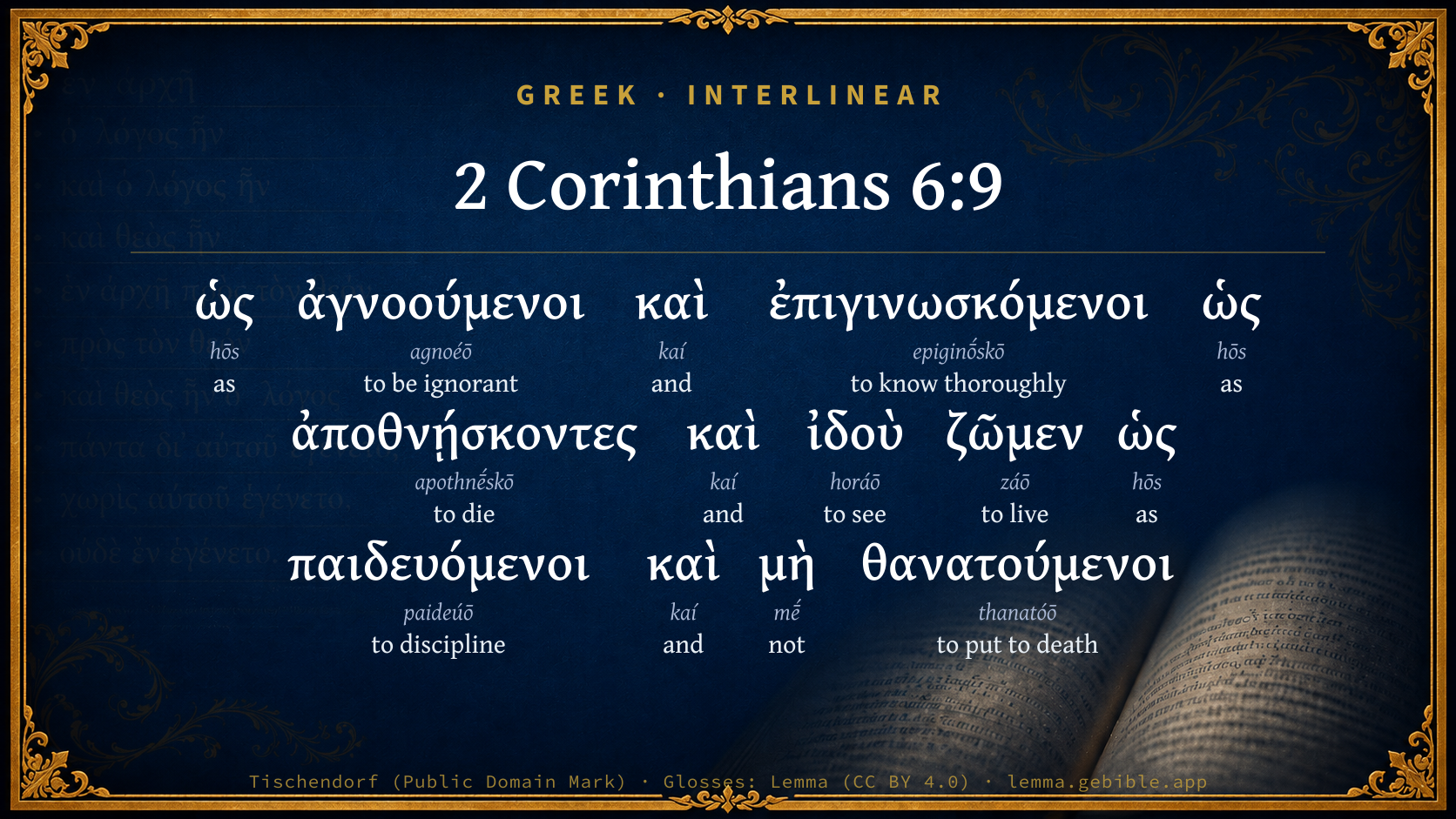
  1. ὡς hōs G5613 “as” Adverb
  2. ἀγνοούμενοι agnoéō G50 “to be ignorant” Verb, Present, Passive, Participle, Nominative, Plural, Masculine
  3. καὶ kaí G2532 “and” Conjunction
  4. ἐπιγινωσκόμενοι epiginṓskō G1921 “to know thoroughly” Verb, Present, Passive, Participle, Nominative, Plural, Masculine
  5. ὡς hōs G5613 “as” Adverb
  6. ἀποθνῄσκοντες apothnḗskō G599 “to die” Verb, Present, Active, Participle, Nominative, Plural, Masculine
  7. καὶ kaí G2532 “and” Conjunction
  8. ἰδοὺ horáō G3708 “to see” Verb, Aorist, Middle, Imperative, 2nd person, Singular
  9. ζῶμεν záō G2198 “to live” Verb, Present, Active, Indicative, 1st person, Plural
  10. ὡς hōs G5613 “as” Adverb
  11. παιδευόμενοι paideúō G3811 “to discipline” Verb, Present, Passive, Participle, Nominative, Plural, Masculine
  12. καὶ kaí G2532 “and” Conjunction
  13. μὴ mḗ G3361 “not” Particle, Negative

About this verse

These counts appear in no published source. They are computed here, from the morphology-tagged text and Lemma’s own curated glosses. What Lemma adds →

14
words
10
distinct lemmas
Pauline Epistles
section

Notable vocabulary

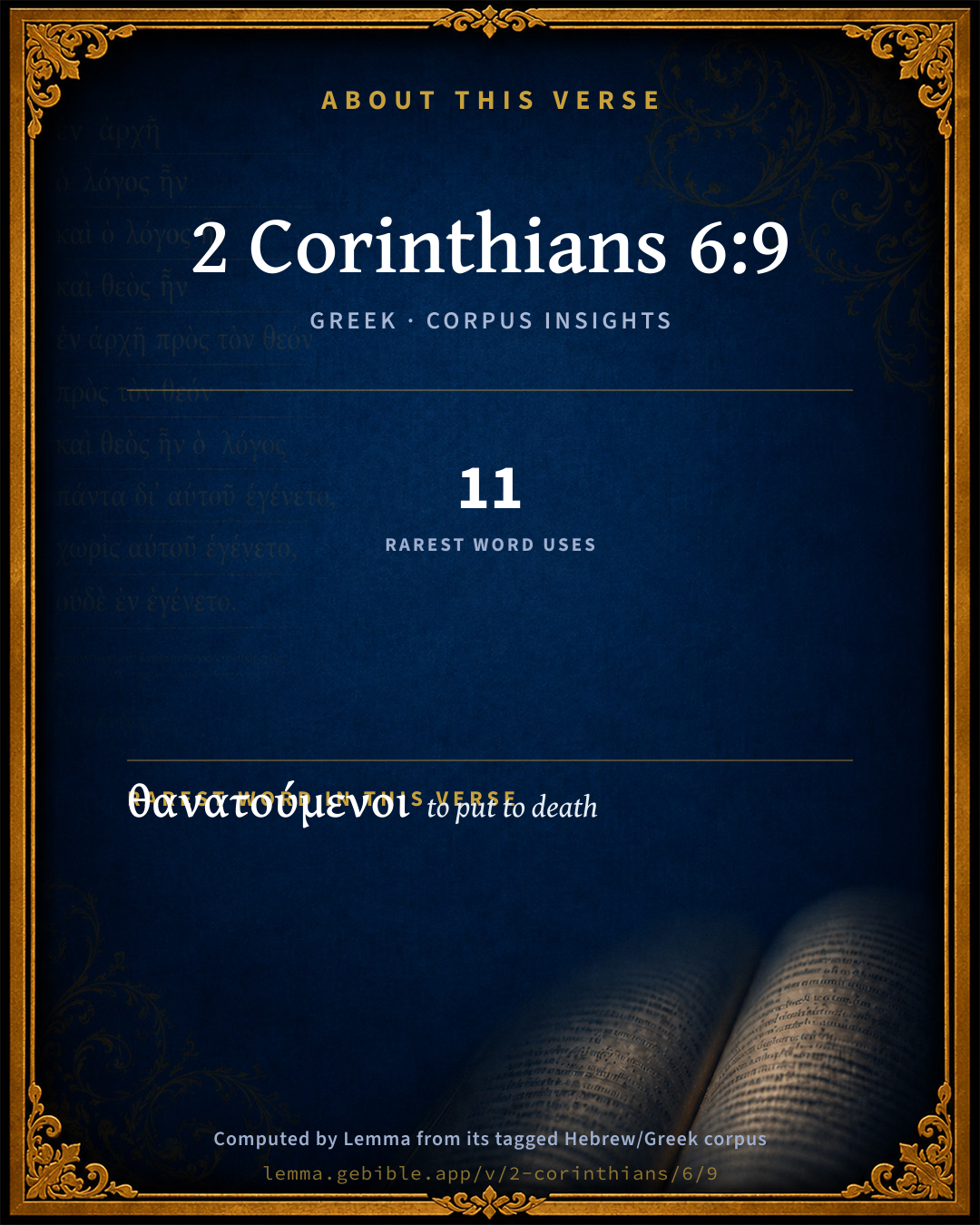
The rarest word here is θανατούμενοι to put to death G2289 — appearing just 11 times in the whole Greek New Testament.

Shared distinctive vocabulary

θανατούμενοι to put to death G2289 occurs in 11 verses of the Greek New Testament. Also found in:

Repetition

Words recur within this verse:

Cross-references

18

Topical passages linked to 2 Corinthians 6:9 in the Treasury of Scripture Knowledge — connected by theme and wording, ordered by reader-vote popularity; previews shown in the World English Bible.

  • 2 Corinthians 4:10–11 always carrying in the body the putting to death of the Lord Jesus, that the life of Jesus may also be revealed in our body.
  • Romans 8:36 Even as it is written, "For your sake we are killed all day long. We were accounted as sheep for the slaughter."
  • 2 Corinthians 1:8–10 For we don't desire to have you uninformed, brothers, concerning our affliction which happened to us in Asia, that we were weighed down exceedingly, beyond our power, so much that we despaired even of life.
  • 2 Corinthians 4:2 But we have renounced the hidden things of shame, not walking in craftiness, nor handling the word of God deceitfully; but by the manifestation of the truth commending ourselves to every man's conscience in the sight of God.
  • Psalms 118:17–18 I will not die, but live, And declare Yah's works.
  • 1 Corinthians 4:9 For, I think that God has displayed us, the apostles, last of all, like men sentenced to death. For we are made a spectacle to the world, both to angels and men.
  • 2 Corinthians 11:6 But though I am unskilled in speech, yet I am not unskilled in knowledge. No, in every way we have been revealed to you in all things.
  • Acts 17:18 Some of the Epicurean and Stoic philosophers also were conversing with him. Some said, "What does this babbler want to say?" Others said, "He seems to be advocating foreign deities," because he preached Jesus and the resurrection.
  • Acts 19:26 You see and hear, that not at Ephesus alone, but almost throughout all Asia, this Paul has persuaded and turned away many people, saying that they are no gods, that are made with hands.
  • Acts 21:37–38 As Paul was about to be brought into the barracks, he asked the commanding officer, "May I speak to you?" He said, "Do you know Greek?
  • Acts 25:14–15 As he stayed there many days, Festus laid Paul's case before the king, saying, "There is a certain man left a prisoner by Felix;
  • Acts 25:19 but had certain questions against him about their own religion, and about one Jesus, who was dead, whom Paul affirmed to be alive.
  • Acts 25:26 Of whom I have no certain thing to write to my lord. Therefore I have brought him forth before you, and especially before you, King Agrippa, that, after examination, I may have something to write.
  • Romans 15:19 in the power of signs and wonders, in the power of God's Spirit; so that from Jerusalem, and around as far as to Illyricum, I have fully preached the Gospel of Christ;
  • 1 Corinthians 11:32 But when we are judged, we are punished by the Lord, that we may not be condemned with the world.
  • 1 Corinthians 15:31 I affirm, by the boasting in you which I have in Christ Jesus our Lord, I die daily.
  • 2 Corinthians 5:11 Knowing therefore the fear of the Lord, we persuade men, but we are revealed to God; and I hope that we are revealed also in your consciences.
  • Galatians 1:22–24 I was still unknown by face to the assemblies of Judea which were in Christ,

Cross-references courtesy of OpenBible.info (CC BY 4.0).

Commentary

Notes on 2 Corinthians 6:9 from classic Christian and Jewish commentators (each source and its license shown beneath its notes). The classic Christian expositions comment on the surrounding passage and are grouped to its opening verse, so a note may address several verses; the Jewish commentaries on the Tanakh (Rashi and others) are per-verse, so they appear only where the commentator wrote on this verse.

Lemma curates 59 commentaries, every one of them public domain or Creative Commons licensed, each selected and text-cleaned for this edition rather than reprinted as found. About our sources →

The Biblical Illustrator

Joseph S. Exell

2Co_6:9-10

As unknown, and yet well known.

A catalogue of contradictions

In these and preceding verses we have the grand characteristics of apostolic life.

1. Their difficulties and dangers.

2. The methods of their ministry.

3. The seeming contradictions that made up their life. Examining these in order, notice--

I. Conspicuousness in obscurity.

1. Gods people are hidden ones. The world knoweth us not, because it knew Him not. What conies within the range of the senses the world can understand; but what is only spiritually discerned the world cannot know.

2. But these hidden ones occupy a most prominent position before God, and all spiritual intelligences. The eyes of the Lord are over the righteous. The entirety of their inner and outer life is well known in heaven. Their names are registered in the Book of Life.

II. Life in death.

1. The life of the old man dies by the painful, lingering process of crucifixion.

2. A new Divine life is planted in the soul which develops in proportion as the old man is crucified.

III. Safety in afflictive providences.

1. The primal spring of the chastisement of a child of God is parental love (Heb_13:1-25.). Without it, we should be condemned with the world; the dross of our many sins and corruptions would remain, and should not be wrought for us. We should fail to be conformed to the Lord Jesus, who was made perfect through sufferings.

2. But observe the safety guaranteed. Not killed. That is impossible, for omnipotence upholds them (Rom_8:35-39).

IV. Joy in sorrow.

1. The sources of a believers sorrows.

(1) In his heart and life there is much to cause depression, much that grieves the Holy Spirit.

(2) In his circumstances.

2. But he can look beyond all these to the counterbalancing joy. The joy of the Lord is his strength.

V. Munificence in poverty.

1. Gods people are often poor as to this world. God hath chosen the poor rich in faith. Christ Himself was a poor man. But apart altogether from external circumstances, Gods people are, and feel themselves to be, spiritually poor. In the fall man lost everything.

2. But a rich connection has been formed on the part of Gods chosen ones with the Lord of all, who has unsearchable riches. Hence it follows that he who is poor can make many rich. A true saint, who has nothing in himself, but all things in Christ, is the greatest benefactor of his race.

VI. Boundless possessions in utter destitution. (P. Morrison.)

Opposite views of a good mans life

I. To the secular eye he was unknown; to the spiritual, well known.

1. The world has never yet rightly understood the real life of a Christian. To the world, Paul appeared a fanatic. John says, the world knoweth us not. The world does not understand self-sacrificing love. It understands ambition, greed, revenge, but not this.

2. This explains martyrdom, ay, and the crucifixion of Christ. But though thus unknown to men, they are well-known--

(1) To Christ, Christ knows all about His disciples; their inner life and outward circumstances.

(2) To heavenly spirits. They are famous in heaven. At their conversion heaven rejoiced, and over every step of their subsequent history heaven watches with a loving care. He giveth His angels charge over thee.

II. To the one dying; to the other living.

1. To worldly men Paul appeared as mortal as other men; with a frame scourged, wasted, he was nothing but a dying man.

2. But, spiritually, he was living. The soul within that dying body was living a wonderful life--a life of Christly inspirations and aims.

III. To the one, much tried; to the other, not destroyed. The word chastened here refers to his scourgings. For a catalogue of his sufferings, see 2Co_11:23-27. To worldly spectators he, with all his wounds, would appear a dead man; but his spiritual purposes, enjoyments, and hopes were not killed,

IV. To the one, very sorrowful; to the other, always rejoicing.

V. TO the one, very poor; to the other, wealth-giving.

1. Paul and his colleagues had suffered the loss of all things. Often breadless, homeless, and clad in rags.

2. Yet spiritually they were not only rich, but made others rich.

(1) The highest work of man is to impart spiritual riches to his brother man. The most dignified and delectable work is this.

(2) Worldly poverty does not disqualify a man for the discharge of this sublime mission. The gospel is to be diffused not by man as a scholar, philosopher, but by man as man.

VI. To the one, destitute; to the other, enormously rich. All things are yours. Christliness gives us an interest in all things. They are given to man to enjoy. Conclusion: Do not estimate life by appearances. (D. Thomas, D. D.)

Literary altruism

In the Scriptures we continually come upon double statements of this kind:--unknown, yet well known; possible, yet impossible; absent, yet present; on earth, yet in heaven; knowing nothing, yet judging all things. So we are at liberty to apply the words, which in their first meaning were restricted to personal experience, to the illustration of profounder truths and wider doctrines. Suppose we suggest future time. That is unknown, yet well known. Futurity is the mystery of life. We live for the future, even whilst we may deny its broader aspects. What is this magnet that draws us on? Its name is To-morrow. No man hath seen To-morrow at any time, any more than any man hath seen God at any time. Yet we cannot deny it, though we have never seen it, we have never lived it, we have no experience of it; we have a symbol by which we represent it, we acknowledge its inspiration, its mysterious, elevating, animating influence; but what it is, whence it comes, what it will bring, in what shape it will accost us, in what tone of voice, how grim its silence, how eloquent its salutation, none can tell. So we say the future is unknown, yet well known. Thus, in detail, for one moment. The farmer speaks of next harvest: will there be a harvest time? No man doubts it. What will it be in yield and in value? None can tell. It is known, yet unknown--known as a broad fact, unknown in all the minuteness of its detail, and the palpitation of its immediate results. Take the grim certainty of death. We now call it a commonplace when we say all men are mortal. That is undoubted. By what gate will you go out of this little land into the unknown territory? Will you begin to die in the feet or at the head? Will your heart suddenly stop like a hindered pendulum? So we have the known and the unknown. Is there anything else that combines these marvellous features of being at once unknown, yet well known? Take life. Who knows it? No man. It is as mysterious as God. The man who can accept life ought to have no difficulty in accepting the Triune God. What is life? No man has ever told. Where is it? No man has seen its sanctuary. Is there any other illustration open to the general mind which confirms this altruism, which the apostle so graphically represented? Take character. What is character? How is it made up? Can you handle it and say, Behold, such is its figure? Can you weigh it in pounds troy, and assign its weight, to the utmost ounce or carat? Can you walk around it? Have you ever seen it? Only in incarnation, just as you have seen God. What do you know about a beautiful character? You say how mild, how modest, how genial, how courteous. How do you know? We know nothing about character. Call no man good until he is dead, and even after death there may come revelations which will fright the isle from its propriety. So we come to the great mystery of all--God. He is unknown. We acknowledge it. The Bible says so. Yet God is well known. We cannot tell how we know Him, but we do know Him; imagination knows Him, the heart knows Him, reason feels Him near, conscience hushes the whole being into silence, because of a mysterious presence. We know some realities by the power of love, not by the power of genius. So we enlarge the whole sphere of altruistic vision, and come upon such words as possible, yet impossible. With God all things are possible, says Jesus Christ, and one of His apostles wrote in an epistle, it is impossible for God. Both statements are true, and both are needed to complete a statement of the truth. We refer to this now, because it helps us to a most practical point. It is possible for you to pull down your house, brick by brick, stone by stone, and to begin immediately to unroof the family dwelling; you have strength, you cannot procure instruments, all needful aids are at your service; you could in one short day dismantle and destroy your dwelling; yet you could not, you could do nothing of the kind. What hinders you? An invisible power. What is its name? Reason, common-sense, a correct apprehension of justice and righteousness. Then we are under spiritual control, notwithstanding our irreligiousness? (J. Parker, D. D.)

As sorrowful, yet alway rejoicing--

Sorrowing, yet always rejoicing

I. We all want to find a way of so mingling sorrow and joy together, that neither shall contradict or weaken the other. You see people hugging a sorrow, feeding upon it. The wild cry of Constance, Grief fills the room up of my absent child, has been the cry of many a mother. You perceive that such indulgence is morbid and dangerous; but you take, in general, very unsatisfactory methods of curing it. You try to dissipate the patients mind, to present other objects which may cause the object on which it dwells to be forgotten. Often you succeed. But something is destroyed which should have been preserved. The waters of Lethe are not those which purge the spirit. They take away much that is best and strongest in it; they leave weeds and mud behind. Depend upon it, sorrow has that in it which we need and cannot afford to part with. He is a thief and an enemy who would take it from us. This is so, whatever be the occasion of the sorrow. Do not say, This is a poor, mean occasion for a man to grieve about. The loss is a calamity. The grief for it is a gift which you may turn into a curse or into a blessing. An illustrious historian said that he could discover in eminent men, of various periods, an impoverishment and decay of heart and intellect, dating from a crisis of their lives, when they had wilfully thrown off some great sorrow which might have given them consistency and depth. The question is, whether we shall merely nurse sorrow as if it were a warrant for misanthropy, or accept it as a message from above to teach us more of our relations to other men and of our relation to God. In this sense Paul was always sorrowing. There is not a trace in any of his Epistles of morbidness. He is always in action. He is thinking, feeling for others. In one sense he forgets the things that are behind. He determines that they shall not impede him. But in another sense, nothing is forgotten. All is coloured and shaped by his own previous experiences. What he has suffered enables him to look with straight eyes upon the suffering of the world. He regards it as a sign of derangement in that which is divinely good; therefore it makes him mourn. He regards it as one of the instruments for removing that which is deranged; therefore it cannot make him despair. St. Paul learnt to sorrow when he learnt to hope. He knew the anguish of conscience before; but he did not know sorrow till he had a revelation of One who cared for him, mourned for him, died for him. There then arose upon him the vision of a Man of Sorrows; and now he could desire nothing better than to enter into the mind of Christ.

II. A man who is always sorrowing in this way, must be also always rejoicing. Such a weight of sorrow could only have been sustained by a joy that was commensurate with it.

1. We all confess this truth in one way or another. The most frivolous person says, I have had much trial of late; I must have more than ordinary pleasure that I may endure it. We often denounce such language, but there is a meaning in it, though an inverted one. The joy which we seek for to quench sorrow, is on the whole a poor flimsy joy; not the joy which penetrates far below the surface. That joy which lies at the very root of our being, which is as necessary for human life as moisture is for vegetable life--that joy which, amid the frosts of the world, would perish utterly if Heaven did not watch ever it--that joy does not seek to escape from sorrow, but encounters it and finds its own strength in enduring it. As Paul found in the Son of Man the climax of all human sorrow, so he owned in that same Son of Man and Son of God the source and climax of all human joy. As he recollected what the work of the Sorrower on earth had been--how every act He had done was to take away some disease, some death-anguish, it was not possible but that he should believe that there was another cup besides that which His Father had given Him, and which He drained to the dregs. Every hour that Jesus was walking among men He was giving them some foretaste of this joy, some token that He came to make them inheritors of it. But there was a special hour in which we are told He rejoiced in His own Spirit (Mat_11:25-27). I think I read here the secret of St. Pauls continual joy in the midst of his continual sorrow. (F. D. Maurice, M. A.)

The sorrows and pleasures attendant on true piety

I. The causes of the believers sorrow.

1. The painful sense he entertains of his remaining imperfections, sinfulness, and weakness.

2. The difficulty of maintaining a steadfast belief in the great and essential truths of the gospel of our salvation.

3. The prevalent impiety, the wide-spreading moral wretchedness, with which he sees himself continually surrounded.

4. The natural evil, the physical suffering, which prevails to so wide an extent in the world around him.

II. The sources of his joy.

1. The blessed hope that when he shall have accomplished his day, he shall find admittance into that blissful region where all tears shall be wiped from all eyes, and sorrow and sighing shall flee away for ever.

2. The privilege of drawing near to God in acts of public and private devotion.

3. Christian fellowship with persons of a kindred spirit with his own.

4. Grateful and sincere obedience to his heavenly Fathers will--more especially in kindness to those whom our Redeemer calls His brethren. (C. Townsend, M. A.)

Rejoicing in sorrow

Joy lives in the midst of the sorrow; the sorrow springs from the same root as the gladness. The two do not clash against each other, or reduce the emotion to a neutral indifference, but they blend into one another; just as, in the Arctic regions, deep down beneath the cold snow, with its white desolation and its barren death, you shall find the budding of the early spring flowers and the fresh green grass; just as some kinds of fire burn below the water; just as, in the midst of the barren and undrinkable sea, there may be welling up some little fountain of fresh water that comes from a deeper depth than the great ocean around it, and pours its sweet streams along the surface of the salt waste. (A. Maclaren, D. D.)

As poor, yet making many rich.--

Poor, yet rich, and enriching others

I. Wealth without the riches of the world. Having nothing, yet possessing all things.

1. This may be true of men as men.

(1) Knowledge is wealth. A child well educated is better endowed, though his parents do not give him a single penny, than the child who is uneducated, and who is heir to a large fortune.

(2) Wisdom is wealth. The prudence and sagacity which enable a man to see what is best is the most valuable capital with which a man can conduct business.

(3) Contentment is wealth. To make the best of things as things are.

(4) Hope is wealth. Because a man has but brass to-day, and is looking forward to gold tomorrow.

(5) Cheerfulness is wealth.

(6) Love awakened by all that is true, beautiful, and good, is wealth.

2. But look specially at the wealth of a true Christian. He possesses--

(1) The Spirit of God, and in Him light and life and love.

(2) In the Son of God a Redeemer who is devoted to him, to save him from his sins.

(3) In the God to whom he is reconciled, a Father. He is an heir of God, and a joint heir with Christ.

(4) In salvation the greatest good which God can bestow and a title to an inheritance incorruptible and undefiled, and that fadeth not away. 15) As a saved and sanctified man, knowledge, wisdom, contentment, cheerfulness, hope, love.

(6) All the most useful things--living bread, living water, raiment that waxeth not old--robes of righteousness and garments of salvation.

(7) All the most enduring things--an inheritance that is incorruptible and undefiled and that fadeth not away.

(8) All the most precious things, for all things are yours. My God shall supply all your need from His glorious riches by Christ Jesus. He that overcometh shall inherit all things.

II. The power of enriching others co-existing with poverty. The making many rich is not dependent on material wealth.

1. Well doing is required of all, irrespective of poverty or of riches. Multitudes have done good without material wealth. The chief benevolent and religious works are done by those who live by their daily labour. Look through our Sunday and Ragged Schools, etc., and the evidence is complete. Some of you who possess all things, in another sense, are keeping back from making many rich.

2. True riches cannot be purchased with money, and the rich are not Gods elect to make others rich. God hath chosen the poor of this world, rich in faith, etc.

Conclusion:

1. Rich Christians who have been brought low may learn a cheerful lesson. I want such to see that they possess all things--a Saviour enthroned, a Father in heaven, the Holy Ghost the Comforter.

2. The poor, Who are kept poor, may learn a lesson of contentment. It is Gods arrangement. God is using this as a means of discipline; He is teaching you certain things by poverty that you could not so well learn from any other tutor.

3. Let Christians learn--

(1) Their responsibility. Now there are some who are ever ready to sing, How vast the treasure we possess! But it would puzzle some of you to find anybody enriched by you--by your instruction or consolation.

(2) Their privilege. To possess all things is a privilege, but it is a far greater privilege to make others rich. Oh! to make one poor neglected brother rich. But to make many rich, this is to share the joy of heaven--this is to taste that satisfaction of the Saviour which rewarded Him for the travail of His soul. Let this stimulate you. If God put money into your hand, He does so prudently and properly to scatter, not to hoard. You may do as much good in circulating your money in employing labour as by bestowing it in what is called charity. There is like danger of covetousness with regard to our spiritual privileges. If we do possess all things, we should certainly be moved by such a possession to strive to make others rich. (S. Martin.)

The affluent poor

Note--

1. That the gospel is a system to enrich man. Some religious systems impoverish both mind and body. The enrichment of the gospel gives man a property in all things. This spiritual wealth is inalienable, whereas the wealthiest carry not a fraction of all their possessions to the grave, Moral goodness is worth, everywhere and for ever.

2. The gospel enriches man through the agency of poor men. The poor can receive the gospel, and do indeed receive it to a greater extent than any other class. Heaven has placed no obstacle in the way of any class. But if the poor can receive it they can also propagate it. It came into the world through a poor man. Ye know the grace of our Lord Jesus Christ, etc. He elected to carry on His work by poor fishermen. These He sent forth without purse or scrip. The same order has been more or less observed up to the present day. Our great reformers, theologians, missionaries, and ministers have, with but few exceptions, sprung from the ranks of the poor. I infer from all this--

I. The kind of instrumentality on which the diffusion of Gods gospel necessarily depends. If the poor can propagate this system, then legislative enactments, worldly influence, high intellectual culture, may be dispensed with. But what of worldly wealth? All that money can do is to furnish machinery--temples, Bibles, and preachers; and these we have in abundance now. The necessary instrumentality is Christ-like thought, spirit, and life.

II. That no Christian man is freed from the obligation to diffuse the gospel of God. If the poor can promote the gospel, how much greater is the obligation of every higher grade in society!

1. The wealthy. Though wealth is not an indispensable qualification, it is undoubtedly a talent suited to augment mans power for this glorious mission.

2. Men of leisure. The poor are doomed to toil for the mere means of subsistence, and can scarcely snatch an hour for spiritual usefulness. How will those amongst us who kill time by idle amusements stand in the Last Judgment?

3. The educated.

III. That there is no ground for self-gratulation in the success of our evangelical efforts. Had angels been employed we might have referred its triumphs to their brilliant talents. But finding that the poorest can achieve the grandest spiritual results, there is no alternative but to trace success in all cases to God.

IV. That the highest honour is within the reach of all. This is not to have lordly inheritance or a famous name, but to be the regenerator of souls.

V. That there is good reason to hope for the universal diffusion of the gospel. The poor can spread it, and therefore the gospel is not dependent upon any class. And then, moreover, the poor have the largest amount of power; they have always been and still are the millions--the muscles of the world. My poor brother! repine not because of thy worldly lot. Luther was the son of a miner; Bunyan was a tinker, Carey a cobbler, Morison a last-maker; and Knibb, who smote slavery in Jamaica; Williams, who bore the gospel to the Coral Islands; Moffatt, the apostle of Africa, were the children of the sons of toil. Who was John Pounds, the originator of Ragged Schools? He earned his miserable pittance as one of the humblest cobblers in Portsmouth. (D. Thomas, D. D.)

Rich poverty

I. As having nothing. Learn--

1. That the truly great are not essentially the visibly rich. We live in an age so material that this needs to be proclaimed with trumpet blast.

2. That it becomes us to make greater self-denials. How seldom do our poverties arise from self-sacrifices!

3. That God does not reward His servants with material pay. If any man had a claim for such reward, it was Paul. But why is this?.

(1) God does not attach the false importance to material, possessions that, we do.

(2) He will let us do and dare for Him without a bribe.

4. That Gods poor are the best off. For see the heritage to which they know that they are begotten!

II. And yet possessing all things. A good man owns all things.

1. By holding a true relation to things--

(1) He is instructed by them. Because a man has a lot of works of art in his gallery, and books in his library, it does not follow that he is their truest owner.

(2) He gets enjoyment from them. And what more can any owner do? There are men that sit in their lordly mansions that might as well be immured in a dungeon for aught of joy they gut.

(3) He gets growth in the midst of them. If a mans nature is ripened, enriched by things, what can make him in such a great sense their owner?

2. By holding a true relation to Christ he becomes possessor of all things (Rom_8:17; Rev_3:21). (H. Martyn.)

The Biblical Illustrator, edited by Joseph S. Exell (c. 1880s–1900s) — public domain. Text from a community e-Sword module.

Bengel's Gnomon

Johann Albrecht Bengel

2Co 6:9. Ἀγνοούμενοι, unknown) [so that we are either quite unknown and neglected, or we are considered altogether different from what we really are.—V. g.]—Gal 1:22; Col 2:1.—ἐπιγινωσκόμενοι) well known.—[35] ἰδοὺ, behold) suddenly and contrary to hope.

[35] Ἀποθνήσκοντες, dying) 2Co 11:23.—V. g.

Bengel's Gnomon of the New Testament — English translation (T&T Clark, Edinburgh, 1860) — public domain. Text from a community e-Sword module.

Meyer's Critical & Exegetical Commentary

Heinrich August Wilhelm Meyer

2Co_6:9-10. Ἀγνοούμενοι] not: mistaken or misjudged (Flatt, Hofmann, and others), nor yet: people, for whom nobody cares (Grotius), but: people, whom no one is acquainted with (Gal_1:22); obscure men, of whom no one knows anything. Comp. ἀγνώς and the contrasted γνώριμος, Plato, Pol. ii. p. 375 E; also Demosth. 851. 27.

ἐπιγινωσκ.] becoming well known; comp. on 1Co_13:12; Mat_11:27. By whom? Rückert thinks: by God. But without ground in the text, which rather demands the reference to men, as Chrysostom rightly saw: ὡς ἀγν. κ. ἐπιγινωσκ., τοῦτο ἔστι διὰ δόξης καὶ ἀτιμίας, τοῖς μὲν γὰρ ἦσαν γνώριμοι καὶ περισπούδαστοι, οἱ δὲ οὐδὲ εἰδέναι αὐτοὺς ἠξίουν. Hence: as people who are unknown (viz. according to the contemptuous judgment of opponents), and well known (in reality among all true believers).

ἀποθνήσκοντες] The continual sufferings and deadly perils of the apostle gave to his opponents occasion to say: he is on the point of death, he is at his last! Paul considered himself as moribundus (1Co_15:31), but from what an entirely different point of view! See 2Co_4:7-15.

καὶ ἰδοὺ ζῶμεν] and, behold, we are in life! We find a commentary on this in 2Co_4:7 ff. Comp. 2Co_1:10. The construction often varies so, that after the use of the participle the discourse passes over to the finite verb (Buttmann, neut. Gram. p. 327 f. [E. T. 382 f.]); but here, in the variation introduced with a lively surprise by ἰδού (comp. 2Co_5:17), there is implied a joyful feeling of victory. Vides non per negligentiam veteres hoc genere uti, sed consulto, ubi quae conjuncta sunt ad vim sententiae simul tamen distinguere volunt paulo expressius, Dissen, ad Pind. Isthm. p. 527.

ὡς παιδενόμενοι κ. μὴ θανατ.] a reminiscence, perhaps, of Psa_118:18; παιδ. is not, however, to be understood of actual chastisements by scourging and the like (Cajetanus, Menochius, Estius, Flatt). This, judged by the analogy of the other clauses, would be too much a matter of detail, and it would be specially inappropriate, because in all the clauses the view of His opponents is placed side by side with the true state of the case. We must rather think of God as the παιδεύων. The sorrowful condition of the apostle gave his opponents occasion for concluding: he is a chastened man! a man who is under the divine chastening rod!

καὶ μὴ θανατ.] In his humble piety he does not deny that he stands under Gods discipline (hence there is here no opposite of the first clause); but he knows that Gods discipline will not proceed to extremity, as His opponents thought; therefore he adds: and not becoming killed! not sinking under this chastening.2Co_6:10. In the opinion and judgment of our enemies we are people full of sorrow, poor, and having nothing (starving and penniless wretches!); and in reality we are at all times rejoicing (through our Christian frame of mind, comp. Rom_5:3, and the χαρὰ ἐν πνεύματι ἁγίῳ, Rom_14:17; 1Th_4:6), enriching many (with spiritual benefits, 1Co_1:5; 2Co_8:9), and having in possession everything (because entrusted with the store of all divine benefits in order to impart them to others). This πάντα κατέχ., like the previous πολλοὺς πλουτίζ., is by Chrysostom, Theodoret, Grotius, Estius, explained in this way, that Paul could have disposed of the property of the Christians, and have enriched many by instituting collections. But such an inferior reference is altogether out of keeping with the lofty tone of the passage, more especially at its close, where it reaches its acme. Comp. also Gemara Nedarim f. 40. 2 : Recipimus non esse pauperem nisi in scientia. In Occidente seu terra Israel dixerunt: in quo scientia est, is est ut ille, in quo omnia sunt; in quo ilia deest, quid est in eo? Rückerts opinion, that in those two clauses Paul was thinking of nothing definite at all, is unjust towards the apostle. Olshausen, followed by Neander, wishes to find the explanation of πάντα κατέχ. in 1Co_3:22. But this is less suitable to the πολλοὺς πλουτίζ., evidently referring to the spiritual gifts, to which it is related by way of climax.

Meyer — Critical and Exegetical Commentary on the New Testament — English translation by Peter Christie, edited by Frederick Crombie (T&T Clark, 1880) — public domain. Text from a community e-Sword module.

Expositor's Greek Testament

ed. W. Robertson Nicoll

2Co 6:9 . ὡς ἀγνοούμενοι καὶ ἐπιγινωσκόμενοι : as unknown, sc. , an obscure person without proper credentials ( cf. 2Co 3:2 , 2Co 10:10 ), and yet well known ( cf. 2Co 11:6 ). ὡς ἀποθνήσκοντες καὶ ἰδοὺ ζῶμεν : as dying (as was doubtless often reported when he was ill; see on 2Co 1:8 above, and cf. 2Co 11:23 , where he speaks of the continual hazards of his life), and behold we live ( cf. 2Co 4:10 , where the death of the body is contrasted with the daily manifestation of the true life). ὡς παιδευόμενοι καὶ μὴ θανατούμενοι : as chastened, sc. , as a punishment for his sins, which had very probably been said of him when the news of his grievous sickness (2Co 1:8 , etc.) reached his foes at Corinth, but not killed . He does not deny that he has been “chastened” (see reff. and cf. chap. 2Co 12:7-9 ), but he recalls in thankfulness the words of Ps. 117:18, παιδεύων ἐπαίδευσέν με Κύριος , καὶ τῷ θανάτῳ οὐ παρέδωκέν με .

The Expositor's Greek Testament, edited by W. Robertson Nicoll (1897–1910) — public domain. Text from a community e-Sword module.

Cambridge Greek Testament for Schools and Colleges

9. ὡς ἀγνοούμενοι καὶ ἐπιγινωσκόμενοι. This does not mean that he was known to some and not known to others; but that his opponents said that he was an insignificant teacher, about whose authority nothing was known, and yet, he was ‘becoming well known’ to very many. Many were coming round to his side (2Co 1:14, 2Co 3:2). The compound, ἐπιγιν., makes the antithesis more complete: comp. 1Co 13:12. Cremer, Lex. p. 159.

ὡς ἀποθνήσκοντες καὶ ἰδοὺ ζῶμεν. In this and the four remaining clauses the contrast between δυσφημία and fact no longer holds. Rather, the contrast, so far as there is one, is between different sides of the same fact. His adversaries may have rejoiced over him as a dying man, of whom they would soon be rid; but more probably the thought is similar to that in 2Co 4:10-11; he is always in a dying state, and he is always being revived in the life of Christ. This seems to be the view of both A.V. and R.V., which here drop ‘and yet,’ and have simply ‘and’ for καί. In his joyous recognition of the other side of the fact S. Paul changes the simple participle into ἰδοὺ ζῶμεν. It would have been much less forcible to say καὶ ζῶντες.

ὡς παιδευόμενοι καὶ μὴ θανατούμενοι. The present participles throughout 2Co 6:9-10 should be noted: as being chastened and not being killed. This is parallel to the preceding couplet, and it confirms the view that both members express, from different points of view, what is the fact. Both couplets seem to be taken from Psalms 118; οὐκ ἀποθανοῦμαι ἀλλὰ ζήσομαι … παιδεύων ἐπαίδευσέν με Κύριος, καὶ τῷ θανάτῳ οὐ παρέδωκέν με (17, 18). Here, as in the psalm, the chastening is that of God. Persecution by man, though not excluded, is not specially meant, having been mentioned in 2Co 6:5.

Cambridge Greek Testament for Schools and Colleges (Cambridge University Press, 1896; 21 vols, various authors incl. Carr, Maclear, Plummer, Farrar, Lumby, Moule, M. R. James, Simcox) — public domain. Text from a community e-Sword module.

Jamieson, Fausset & Brown

Robert Jamieson, A. R. Fausset & David Brown

unknown . . . yet well known--"unknown" in our true character to those who "evil report" of us, "well known" to those who hold us in "good report" (Co2 6:8). CONYBEARE explains, "Unknown by men, yet acknowledged by God" (Co1 13:12). Perhaps both God and men (believers) are intended as knowing him (Co2 5:11; Co2 11:6).

dying . . . live-- (Co2 1:9; Co2 4:10-11; Co2 11:23). Compare GAUSSEN'S remark, see on Co2 6:5. "Behold" calls attention to the fact as something beyond all expectation.

chastened . . . not killed--realizing Psa 118:18.

Jamieson, Fausset & Brown — Commentary Critical and Explanatory on the Whole Bible (1871) — public domain (CC PDM 1.0). Text via the HelloAO Bible API.

Adam Clarke's Commentary

Verse 9. As unknown] Persons who are to be suspected as harbouring dark designs; persons of neither birth, parentage, nor respectable connections in life;

And yet well known] Proved by our whole conduct to have no such designs, and demonstrated to be holy, upright, and useful, by the whole train of our peregrinations, through which we can be readily traced from place to place; having preached openly, and done nothing in a corner.

As dying] Through continual dangers, fatigues, and persecutions;

And, behold, we live] We are preserved by the mighty power of God in the greatest dangers and deaths.

As chastened] As though we were disobedient children;

And not killed] Though we continue in the very same line of conduct that is supposed to bring on us those chastisements, and which, if it were criminal, would justly expose us to death for incorrigible obstinacy; but our preservation is a proof that we please God.

Adam Clarke's Commentary on the Bible (1810–1826) — public domain. Text from a community e-Sword/MySword module.

Ellicott's Commentary for English Readers

(9) As unknown, and yet well known.—In the absence of fuller information as to what disparaging language had been used in reference to St. Paul, it is not easy to appreciate the precise force of the words thus used. Possibly, he had been spoken of as a man of “unknown” or obscure antecedents, and his answer to that taunt is, as in 2Co_1:13-14, that where he was known at all he was recognised as being what indeed he was. He could show even to them, to some of them at least, whether it were not so. In “dying, and, behold, we live” we may trace a reference partly to the “sentence of death” which had, as it were, been passed upon him (2Co_1:9), partly to the malignant exultation with which that fact had been received, or was likely, he thought, to be received by those who hated him. We can picture them as saying, “His course will soon be over; he will not trouble us long;” and his answer to that imagined sneer is that he is still in full energy. What has befallen him has been a chastening and a discipline, but he is not yet, as they fondly thought, “killed” and delivered over unto death.

A Bible Commentary for English Readers, edited by Charles John Ellicott (1878–1897) — public domain. Text from a community e-Sword module.

The Cambridge Bible for Schools and Colleges

gen. ed. J. J. S. Perowne

9. as unknown, and yet well known] The passage would be better without the ‘yet’ interpolated by our translators (following Tyndale). St Paul was ‘unknown’ to some, and ‘well known’ to others. Cf. ch. 2Co_3:1-2, 2Co_4:2, 2Co_5:11.

as dying, and behold, we live] See ch. 2Co_4:10-11. Also Rom_8:36-37; 1Co_4:9; 1Co_15:31; Eph_2:6; Col_2:13; Col_3:1-4.

as chastened, and not killed] Cf. Psa_118:18, which was no doubt in the Apostle’s mind. Also ch. 2Co_7:4.

The Cambridge Bible for Schools and Colleges (gen. ed. J. J. S. Perowne; Cambridge University Press, 1878–1918) — public domain. Text from a community e-Sword module.

John Gill's Exposition

As sorrowful, yet always rejoicing,.... As to their outward appearance they are

sorrowful, and oftentimes really so on account of sin, their own and others, by reason of afflictions, temporal and spiritual; and as to the state and condition of the church of Christ, and the interest of religion: and

yet always rejoicing; not in themselves, or in any creature, but in the Lord, in the person, blood, and righteousness of Christ, and salvation by him. As poor, yet making many rich. It is, generally speaking, the lot of Christ's ministers to be poor in this world; and there are some reasons for it, why it is, and should be so; as that they might be maintained by the people, which is the ordinance of God; that it might appear that Christ's kingdom is not of this world; that the faith of men might not stand in the riches of the world, but in the power of God; that ministers might not be above their work, nor neglect it, nor drop it; and that they might not be ensnared and encumbered with the things of life.

And yet making many rich: are instruments in making many souls rich in things spiritual; by showing them their spiritual poverty, stripping them of what they trusted in, and valued themselves upon; directing them where true riches are, and furnishing them with spiritual knowledge, with the knowledge of things more worth than thousands of gold and silver.

As having nothing, and yet possessing all things; for the apostles left all for Christ, were sent out bare by him; what they had they gave away, and were very destitute of worldly enjoyments: "and possessing all things"; they had food and raiment, with which they were content, what was sufficient for them, and which they had in mercy, and with a blessing; and then they enjoyed all spiritual good things; they had not only a right unto them, but were possessed of them; they had all things pertaining to life and godliness; they had Christ, and all things with him, and therefore could say as Jacob did, that they had enough, yea, that they had all things.

John Gill's Exposition of the Whole Bible (1746–1763) — public domain (CC PDM 1.0). Text via the HelloAO Bible API.

Trapp's Complete Commentary

John Trapp

9 As unknown, and yet well known; as dying, and, behold, we live; as chastened, and not killed;

Ver. 9. As unknown] To the world, 1Jn 3:1-2. A prince in a strange land is little set by, as not known. Unkent, unkist, as the northern proverb hath it.

Well known] To those who have spiritual judgment, and can prize a person to his worth, which the world’s wizards cannot do, Isa 53:2-3.

And not killed] God will have a care of that; he corrects in measure, he smites his not at the root, but in the branches, Isa 27:8. As it is a rule in medicine still to maintain nature, &c., so doth God still keep up the spirits of his people by cordials, Isa 57:16.

John Trapp, A Commentary or Exposition upon All the Books of the Old and New Testament (1647–1656) — public domain. Text from a community e-Sword module.

Albert Barnes' Notes on the Bible

As unknown - As those who are deemed to be of an obscure and ignoble rank in life, unknown to the great, unknown to fame. The idea, I think, is, that they went as strangers, as persons unknown, in preaching the gospel. Yet, though thus unknown they endeavor to commend themselves as the ministers of God. Though among strangers; though having no introduction from the great and the noble, yet they endeavored so to act as to convince the world that they were the ministers of God. This could he done only by a holy life, and by the evidence of the divine approbation which would attend them in their work. And by this, the ministers of religion, if they are faithful, may make themselves known even among those who were strangers, and may live so as to “give no offence.” Every minister and every Christian, even when they are “unknown” and when among strangers, should remember their high character as the servants of God, and should so live as to commend the religion which they profess to love, or which they are called on to preach. And yet how often is it that ministers when among strangers seem to feel themselves at liberty to lay aside their ministerial character, and to engage in conversation, and even partake of amusements which they themselves would regard as wholly improper if it were known that they were the ambassadors of God! And how often is it the case that professing Christians when traveling, when among strangers, when in foreign lands, forget their high calling, and conduct in a manner wholly different from what they did when surrounded by Christians; and when restrained by the sentiments and by the eyes of a Christian community!

And yet well known - Our sentiments and our principles are well known. We have no concealments to make. We practice no disguise. We attempt to impose on no one. Though obscure in our origin; though without rank, of wealth, or power, or patronage, to commend ourselves to favor, yet we have succeeded in making ourselves known to the world. Though obscure in our origin, we are not obscure now. Though suspected of dark designs, yet our principles are all well known to the world. No people of the same obscurity of birth ever succeeded in making themselves more extensively known than did the apostles. The world at large became acquainted with them; and by their self-denial, zeal, and success, they extended their reputation around the globe.

As dying - That is, regarded by others as dying. As condemned often to death; exposed to death; in the midst of trials that expose us to death, and that are ordinarily followed by death; see the note on 1Co 15:31, on the phrase, “I die daily.” They passed through so many trials that it might he said that they were constantly dying. “And, behold, we live.” Strange as it may seem, we still survive. Through all our trials we are preserved, and though often exposed to death, yet we still live. The idea here is, that in all these trials, and in these exposures to death, they endeavored to commend themselves as the ministers of God. They bore their trials with patience; submitted to these exposures without a complaint; and ascribed their preservation to the interposition of God.

As chastened - The word “chastened” (παιδευόμενοι paideuomenoi) means corrected, “chastised.” It is applied to the chastening which God causes by afflictions and calamities; 1Co 11:32; Rev 3:19; Heb 12:6. It refers here, not to the scourgings to which they were subjected in the synagogues and elsewhere, but to the chastisements which God inflicted; the trials to which he subjected them. And the idea is, that in the midst of these trials, they endeavored to act as became the ministers of God. They bore them with patience. They submitted to them as coming from his hand. They felt that they were right; and they submitted without a complaint.

And not killed - Though severely chastened, yet we are not put to death. We survive them - preserved by the interposition of God.

Albert Barnes' Notes on the Bible (1834–1885) — public domain. Text from a community e-Sword/MySword module.

Matthew Poole's English Annotations

As unknown, and yet well known; dealt with by Jews and heathens as persons wholly unknown to them, though we be sufficiently known; or being such whom the world knoweth not, as to our state towards God, and interest in him, though it knows us well enough as to our other circumstances.

As dying, and, behold, we live; so hunted and persecuted, as that we appear every day dying; yet such hath been the power of God’s providence, that we yet live:

As chastened, and not killed; and though our heavenly Father chasteneth us, yet we are not utterly consumed: the apostle alludeth to that, Psa 118:18; The Lord hath chastened me sore; but he hath not given me over to death.

Matthew Poole's English Annotations on the Holy Bible (1683–1685) — public domain. Text from a community e-Sword/MySword module.

Whedon's Commentary on the Bible

Daniel D. Whedon

9. As unknown—Ignored and un-recognised.

Yet well known—To those who have accepted the gospel, and every-where spoken against by those who ignore us.

Behold, we live—A triumphant retort; we are not so dead as you think us.

Chastened—Chastised; whipped, but not to death.

Daniel D. Whedon (gen. ed.), Commentary on the Old and New Testaments (1874–1909) — public domain. Text from a community e-Sword module.

The Pulpit Commentary

As unknown; literally, as being ignored; as those whom no one cares to recognize. And yet well known. "And becoming fully recognized." "Recognized" by God, (1Co_13:12) and ultimately by all good men, (2Co_11:6) though they might be contemptuously ignored by men. As dying. (2Co_1:9 2Co_4:10, 2Co_4:11) Behold. The word calls attention to what seemed like a daily miracle. The paradox of the Greek tragedian

Who knows if life be death, and death be life?

which seemed so supremely amusing to Aristophanes and the wits of Athens, became a familiar fact to the early Christians (Rom_8:36; 1Co_15:31; Eph_2:5, Eph_2:6; Col_2:13, etc.) As chastened. The daily Divine education of suffering. (Psa_118:18)

Vers. 9, 10.

Things are not what they seem.

unknown, and yet well known," etc. Against misrepresentations and slanders, Paul, in the context, vindicates his apostolic authority, and proclaims at the same time the unworldly principle which animated both him and his fellow workers. These words present to us the two opposite sides of a good man"s life the secular and the spiritual The side revealed, as seen by man, and the side in the sight of God.

I TO THE SECULAR EYE HE WAS UNKNOWN; TO THE SPIRITUAL WELL KNOWN. "As unknown, and yet well known." The world has never yet rightly interpreted and understood the real life of a genuine disciple of Christ. To the world, Paul appeared an ignominious fanatic. John says, "The world knoweth us not." The world does not understand self-sacrificing love, the animating, shaping, directing principle of a godly man"s life. It understands ambition, greed, revenge, but not this. Hence men in every age, so far as they have come under the rule of this "new commandment," have been regarded as monsters unworthy of life. This explains martyrdom, ay, and the crucifixion of Christ. But, though thus unknown to men, they are well known to others.

1. Well known to Christ. "I know my sheep." Christ knows all his disciples.

2. Well known to heavenly spirits. They are famous in heaven. At their conversion heaven rejoiced, and over every step of their subsequent history heaven watches with a loving care.

II TO THE SECULAR EYE HE WAS DYING; TO THE SPIRITUAL HE WAS LIVING, "As dying, and, behold, we live." To worldly men Paul appeared as mortal as other men; with a frame scourged by persecution, shattered by perils, wasted by labour and want, he was nothing but a dying man. His contemporaries knew that he would soon run himself out, and mingle with the dust of all departed men. But spiritually he was living. "Behold, we live." The soul within that dying body of his was living a wonderful life a life of Christly inspiration and aims, a life of communion with heaven; a life destined to become more sunny, vigorous, and beautiful with every aspiration and act. Living is not body breathing, but spirit acting, acting according to the Divine laws of our constitution.

III TO THE SECULAR EYE HE WAS MUCH TRIED; TO THE SPIRITUAL HE WAS NOT DESTROYED. "Chastened, and not killed." The word "chastened" here refers, I think, to his various scourgings, suffered in the synagogues and elsewhere. To worldly spectators he, with all his wounds, would appear a dead man; but he was spiritually alive. The hardships and the strifes did not touch his soul; his spiritual purposes, enjoyments, and hopes were not killed. Spiritual life is unkillable; like certain plants in the vegetable kingdom, which have their germs or roots so deep down in the soil, and so thoroughly mixed up with it, that, though you cut down the trunk, or pull up the roots from the earth, their life will break out again.

IV TO THE SECULAR EYE HE WAS VERY SORROWFUL; TO THE SPIRITUAL HE WAS ALWAYS REJOICING. "As sorrowful, yet alway rejoicing." As if Paul had said, "Under our sufferings, we seem to be very cast down and sad; dreary, degraded, and wretched does our life seem to the worldly men around us." So it often is with the life of a Christian man. But, on the spiritual side, a truly godly man is "always rejoicing," rejoicing in a good conscience, rejoicing in a stream of pure and noble thoughts, rejoicing in a consciousness of Divine favour.

V TO THE SECULAR EYE HE WAS VERY POOR; TO THE SPIRITUAL HE WAS WEALTH GIVING. "As poor, yet making many rich." Paul and his colleagues were poor; they had suffered the loss of all things. Yet spiritually they were not only rich, but made others rich.

1. The highest work of man is to impart spiritual riches to his brother man.

2. Worldly poverty does not disqualify a man for the discharge of thissublime mission.

VI TO THE SECULAR EYE HE WAS DESTITUTE; TO THE SPIRITUAL HE WAS ENORMOUSLY RICH. "Having nothing, and yet possessing all things." Nothing of this world"s good, yet "possessing all things," not legally, but morally. Christliness gives us an interest in all things. "All things are yours.

Do not estimate life by appearances things are not what they seem. Christliness with poverty, persecution, and suffering, is infinitely to be preferred to wickedness with the whole world at its command.

The Pulpit Commentary (1880–1919), ed. H.D.M. Spence-Jones & Joseph S. Exell — public domain. Text from a community e-Sword module.

John Wesley's Explanatory Notes

As unknown - For the world knoweth us not, as it knew him not. Yet well known - To God, and to those who are the seals of our ministry. As dying, yet behold - Suddenly, unexpectedly, God interposes, and we live.

John Wesley, Explanatory Notes Upon the Whole Bible (1754–1765) — public domain. Text via the GEBible commentary corpus.

Burkitt's Expository Notes on the New Testament

William Burkitt

As if the apostle had said, Verily our life is made up of seeming, but not real contradictions. The wise men of the world look upon us as deceivers, but we are the true dispensers of the word of life unto them; we are looked upon by the world as unknown, obscure persons; but we are well known to God and good men by our doctrine and miracles; we are as dying persons daily, by our passing through so many perils, and by being exposed to continual persecutions, and yet you see we are still alive; and we are sometimes chastened by God, as well as persecuted by men, but we are not killed, nor given over unto death.

Outwardly we are sorrowful, but inwardly always rejoicing in God, and in the testimony of a good conscience; in worldly goods and outward circumstances we are very poor, yet making many spiritually rich in grace and good works. We have nothing we can call our own, yet in Christ all things are ours.

Hence observe, What has been the lot and portion of the faithful ambassadors and ministers of Christ from the first beginning of Christianity; the dirt of a thousand scandals have been thrown upon their faces, which in the day of Christ’s appearance will be as crowns upon their heads.

Observe, 2. That all outward evils are to be received by the ministers and members of Christ, in the same manner, and with the same mind, that good things are received with. Honour and dishonour, good report and evil report, must be entertained with the same evenness and constancy of mind, because God is the same in all variety of estates. Though men change their opinions of us, yet God changes not his judgment concerning us: he loves his ministers and members when poor, as well as when rich; when the world smites us, as well as when it smiles upon us; therefore if God be the same to us at all times, it is our wisdom and duty to keep the temper of our minds, and to be always the same to him, and to ourselves. Whatever we meet with from the world, we have no reason to be dissatisfied if our integrity be safe.

Observe, 3. How rich the apostle was without earthly riches, and how abounding in wealth, when he had nothing of worldly treasure to rejoice in: Having nothing, yet he possessed all things.

But how? and in what sense?

Answer, He and they possessed all things,

1. In Christ, by whom they had a title to all things.

2. They had all things in the covenant, favour, and grace of God; he hath all things, who hath him that hath all things.

3. They had all things virtually in that contentment of mind which they did enjoy: they possessed all things in possessing themselves; and wanted nothing which they could deny themselves. The contented man is only rich; he is not rich that has much, but he that has enough; that man is poor that covets more.

4. They possessed all things eventually; they had the good of all things, when they had not the actual possession of all things; their poverty was a blessing, and their very wants, in the event, worked for good.

5. They possessed all things in future expectation: they looked and longed for heaven and everlasting happiness, which would swallow up their desires with fruition; for he that overcometh shall inherit all things, Rev 21:7. Thus is this apostolical paradox unriddled, As having nothing, and yet possessing all things. True faith apprehends and enjoys all things in God, which it wanteth in the creature.

William Burkitt's Expository Notes on the New Testament (1700–1703) — public domain. Text from a community e-Sword module.

McGarvey & Pendleton's Commentaries

J. W. McGarvey

as unknown, and yet well known [ignored and unrecognized by the rulers and the general public, yet well known by all those in any way interested in the gospel of Christ, either as friends or enemies]; as dying, and behold, we live [the life of the apostle was constantly exposed to death and just as constantly delivered and preserved]; as chastened, and not killed [Paul was being continually schooled and educated by suffering and yet the suffering was not more than he could bear-- Psa_118:18 ; Heb_12:5-10 ];

J. W. McGarvey (with Philip Y. Pendleton), Commentaries on the New Testament (The Fourfold Gospel, 1914; Acts; and the epistles) — public domain. Text from a community e-Sword/MySword module.

The People's New Testament

B. W. Johnson

9. As unknown, and yet well known. Obscure in the great, indifferent world, but well known in the church and to God. As dying. Always exposed to death, and yet preserved, and having eternal life. Chastened, and not killed. See Psalm 118:18. Though many a blow fell upon him, his life was spared.

B. W. Johnson's The People's New Testament with Notes (1889–1891) — public domain. Electronic text from the Christian Classics Ethereal Library (CCEL) ThML edition.

Alford’s Greek Testament

Henry Alford

9.] καὶ ἰδοὺ ζῶμεν is much stronger, more triumphant, than καὶ ζῶντες. There is something still of the idea of one reputed dead and found to be alive; though I would not say with Meyer that ὡς ἀποθν. altogether refers to a supposd triumph of his adversaries, “Now it is all over with him! His course is ended!”

ὡς παιδ.] Surely we must now drop altogether the putative meaning of the ὡς. The sense has been (see above) some time verging that way, and in the clauses which follow, the ὡς expresses just what it does in ὡς θεοῦ διάκονοι, viz. ‘quippe qui simus.’

Ps. 117:18, LXX, seems to have been in his mind: παιδεύων ἐπαίδευσέ με ὁ (om ὁ ) κύριος, καὶ τῷ θανάτῳ οὐ παρέδωκέ με …

Henry Alford, The Greek Testament (1849–1861) — public domain. Text from a community e-Sword module.

International Critical Commentary

9. ὡς ἀγνοούμενοι καὶ ἐπιγινωσκόμευοι. The present participles, of what is habitual and constant, continue throughout these two verses. ‘As being known to none, and becoming known to all.’ † Ἀγνοούμενοι does not mean ‘being misunderstood, misread,’ but ‘being nonentities, not worth knowing,’ homines ignoti, obscuri, without proper credentials; τοῖς μὲν γὰρ ἦσαν γνώριμοι καὶ περισπούδαστοι, οἱ δέ οὐδὲ εἰδέναι αὐτοὺς ἠξίουν (Chrys.). This was the view that contemptuous critics took of them, while from those who could appreciate them, they got more and more recognition. See on 1Co 13:12.

With this couplet the ἀτιμία and δυσφημία received from opponents almost passes out of view. The four remaining couplets consist, not of two contradictories, one of which is false, but of two contrasted ways of looking at facts, both of which, from different points of view, are true; διὰ τῶν ἐναντίων τὴν μίαν ἐκέρασεν ἀρετήν (Thdrt.).

ὡς ἀποθνήσκοντες καὶ ἰδοὺ ζῶμεν. He is not thinking that his enemies regarded him as a doomed man over whose desperate condition they rejoiced; he is taking his own point of view (4:10, 11), ἐν θανάτοις πολλάκις (11:23), καθʼ ἡμέραν ἀποθνήσκων (1Co 15:13). He is moribund through infirmities of body, and is exposed to afflictions and dangers which may any day prove fatal. But he bears within himself ‘the life of Jesus’ which continues to triumph over everything, and will continue to do so (1Co 1:10). The change from the participle to καὶ ἰδοὺ ζῶμεν marks the exulting and confident feeling; ἰδού as in v. 2 and 5:17.

ὡς παιδευόμενοι καὶ μὴ θανατούμενοι. * He regards himself as requiring chastening. His enemies might regard it as a sign of Divine displeasure, but he knows that the chastening is a merciful dispensation of God. He is probably thinking of Psa 118:17, Psa 118:18, οὐκ ἀποθανοῦμαι ἀλλὰ ζήσομαι … παιδεύων ἐπαίδευσέν με Κύριος, καὶ τῷ θανάτῳ οὐ παρέδωκέν με.

International Critical Commentary — older volumes (1896–1929), various authors — public domain. Text from a community e-Sword module.

Vincent's Word Studies in the New Testament

Marvin R. Vincent

Chastened. See ch. 2Co 12:7 - 9, and compare Psa 118:18.

Marvin R. Vincent, Word Studies in the New Testament (1887–1900) — public domain. Text from a community e-Sword/MySword module.

Lesson kit

Teaching starters — assembled from the data on this page, not authored interpretation. Every prompt links to the verse data it draws on. Edit before teaching.

2 Corinthians, in the Pauline Epistles, opens this verse with 14 words (10 distinct Greek lemmas). Its most distinctive word is thanatóō (“to put to death”). A historical commentator’s framing appears above. Read the whole chapter for the surrounding context.

Discussion questions

  1. The word thanatóō carries the sense “to put to death.” How does it shape the verse?
  2. How does Matthew 10:21, which shares the word «to put to death», read alongside this verse?
  3. What does the repetition of “as” (3× in this one verse) do in this verse?
  4. These translations render this verse differently. What is at stake in choosing one wording over another?
  5. Compare how The Biblical Illustrator and Bengel's Gnomon read this verse. Where do they agree or differ?

Things to notice

Reading settings

Reading text

Shown beneath each verse's original-language words.

Old Testament
Old Testament edition

Read the OT as the Masoretic Hebrew (MT) or the Greek Septuagint (LXX).

English shown for the Greek Septuagint (in the Hebrew ↔ Greek comparison).

Comparing translations? Open the Compare panel on any verse page to stack up to four side by side.