

Hebrews 11:37
Greek (Tischendorf 8th ed.) Hebrews 11:37 appears in the Greek New Testament. The text above is from the Tischendorf 8th edition. Each word links to its Strong’s number and a concise gloss. Click any word for its full Thayer’s Greek Lexicon entry.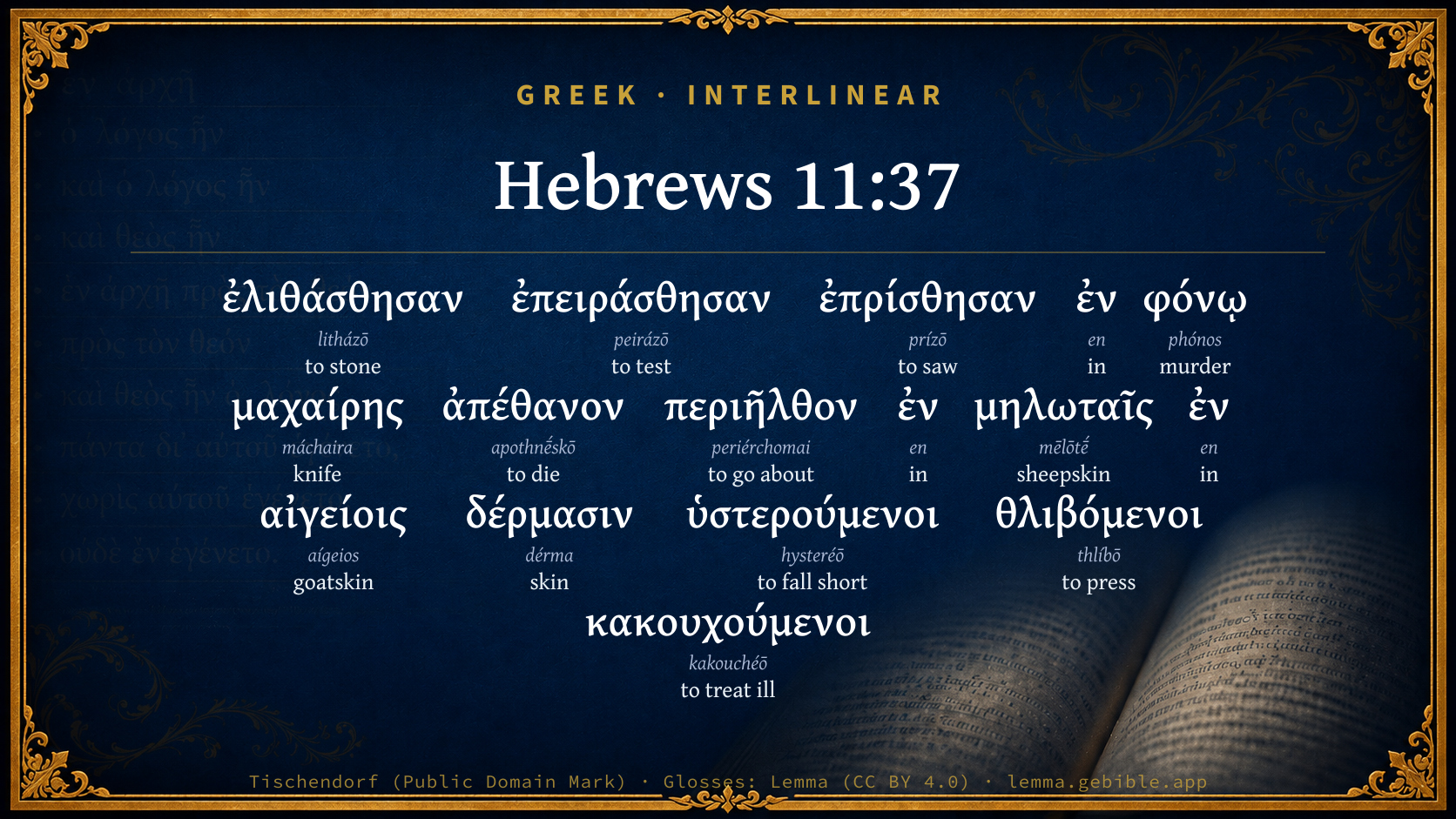
They were stoned. They were sawn apart. They were tempted. They were slain with the sword. They went around in sheep skins and in goat skins; being destitute, afflicted, ill-treated
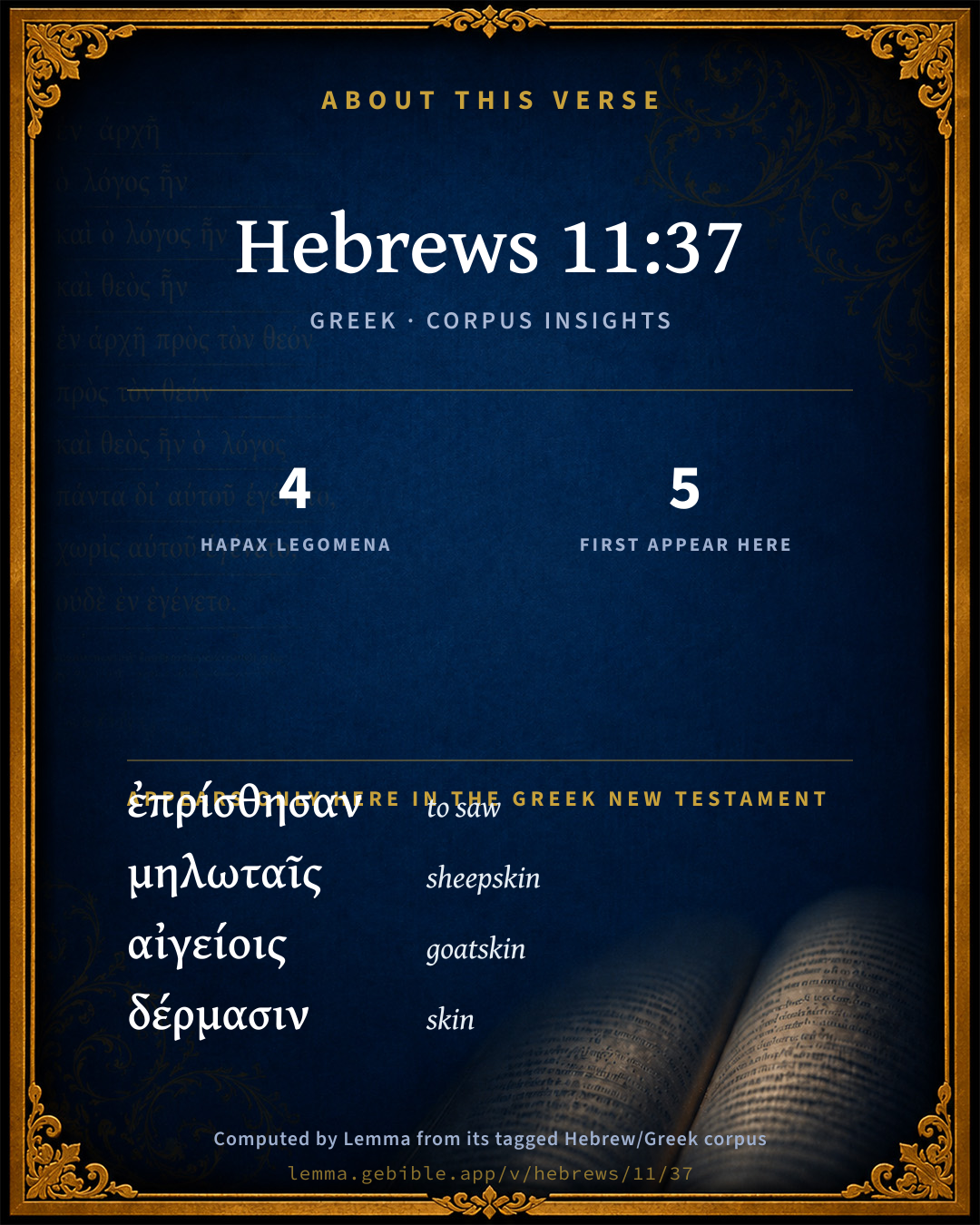
- 4 hapax legomena — only here in the Greek New Testament
- 5 first appearances in the Greek New Testament
Download a study sheet
One document with this verse’s original text, its word-by-word gloss line, the meaning frame, cross-references with their text, attributed commentary, and full source and license credits — printable, and it pastes into notes with its structure intact.
This verse Autodidact and up
A passage Seminary Student
Up to 50 verses in one chapter. A passage sheet keeps up to 6 commentary sources and 12 cross-references per verse, in the order this page ranks them, and says so on the sheet whenever that leaves anything out. Ask for a single verse and you get the Autodidact verse sheet above.
Everything on this page stays free to read, with no account — the sheet is a download of what is already on screen, not access to it.
Compare translations 3
The same verse in 3 English versions, stacked beneath the original-language interlinear above. Click any original word for its lexicon entry.
Each is an independent rendering of the whole verse — the interlinear is not word-aligned to these translations.
Highlighted words mark where these versions differ — a whole-verse word diff, not a word-by-word alignment.
-
World English Bible Public Domain
They were stoned. They were sawn apart. They were tempted. They were slain with the sword. They went around in sheep skins and in goat skins; being destitute, afflicted, ill-treated
-
King James Version Public Domain
They were stoned, they were sawn asunder, were tempted, were slain with the sword: they wandered about in sheepskins and goatskins; being destitute, afflicted, tormented;
-
unfoldingWord Literal Text CC BY-SA 4.0
They were stoned, they were sawn in two, they were tried, they died with slaughter of a sword, they went about in sheepskins in goatskins, destitute, oppressed, mistreated;
unfoldingWord Literal Text — © unfoldingWord, licensed CC BY-SA 4.0. Word-aligned USFM3 via Door43 (git.door43.org/unfoldingWord/en_ult).
Show all 19 translations
Every available English version of this verse, each an independent rendering of the whole verse.
-
World English Bible Public Domain
They were stoned. They were sawn apart. They were tempted. They were slain with the sword. They went around in sheep skins and in goat skins; being destitute, afflicted, ill-treated
-
Berean Standard Bible Public Domain
They were stoned, they were sawed in two, they were put to death by the sword. They went around in sheepskins and goatskins, destitute, oppressed, and mistreated.
-
Majority Standard Bible Public Domain
They were stoned, they were sawed in two, they were put to the test, they were put to death by the sword. They went around in sheepskins and goatskins, destitute, oppressed, and mistreated.
-
King James Version Public Domain
They were stoned, they were sawn asunder, were tempted, were slain with the sword: they wandered about in sheepskins and goatskins; being destitute, afflicted, tormented;
-
American Standard Version (1901) Public Domain
they were stoned, they were sawn asunder, they were tempted, they were slain with the sword: they went about in sheepskins, in goatskins; being destitute, afflicted, ill-treated
-
Revised Version (1885) Public Domain
they were stoned, they were sawn asunder, they were tempted, they were slain with the sword: they went about in sheepskins, in goatskins; being destitute, afflicted, evil entreated
-
Geneva Bible (1599) Public Domain
They were stoned, they were hewen asunder, they were tempted, they were slaine with the sworde, they wandred vp and downe in sheepes skinnes, and in goates skinnes, being destitute, afflicted, and tormented:
-
Douay-Rheims (1899) Public Domain
They were stoned, they were cut asunder, they were tempted, they were put to death by the sword, they wandered about in sheepskins, in goatskins, being in want, distressed, afflicted:
-
Young's Literal Translation Public Domain
they were stoned, they were sawn asunder, they were tried; in the killing of the sword they died; they went about in sheepskins, in goatskins -- being destitute, afflicted, injuriously treated,
-
Literal Standard Version CC BY-SA 4.0
they were stoned, they were sawn apart, they were tried; they died in the killing of the sword; they went around in sheepskins, in goatskins—being destitute, afflicted, injuriously treated,
-
Unlocked Literal Bible CC BY-SA 4.0
They were stoned. They were sawn in two. They were killed with the sword. They went about in sheepskins and goatskins. They were destitute, oppressed, mistreated.
-
unfoldingWord Literal Text CC BY-SA 4.0
They were stoned, they were sawn in two, they were tried, they died with slaughter of a sword, they went about in sheepskins in goatskins, destitute, oppressed, mistreated;
-
Darby Bible Public Domain
They were stoned, were sawn asunder, were tempted, died by the death of the sword; they went about in sheepskins, in goatskins, destitute, afflicted, evil treated,
-
World Messianic Bible Public Domain
They were stoned. They were sawn apart. They were tempted. They were slain with the sword. They went around in sheep skins and in goat skins; being destitute, afflicted, ill-treated—
-
Webster's Bible Public Domain
They were stoned, they were sawn asunder, were tempted, were slain with the sword: they wandered about in sheep-skins, and goat-skins; being destitute, afflicted, tormented;
-
Free Bible Version CC BY-SA 4.0
Some were stoned, cut in pieces, tempted, killed by the sword. Some dressed in sheepskins and goatskins: destitute, oppressed, and mistreated.
-
Bible in Basic English Public Domain
They were stoned, they were cut up with knives, they were tested, they were put to death with the sword, they went about in sheepskins and in goatskins; being poor and in pain and cruelly attacked,
-
Text-Critical English NT CC BY 4.0
They were stoned, they were sawn in two, they were tempted, and they were killed with the sword. They went around in sheepskins and goatskins; they were destitute, afflicted, and mistreated.
-
Tyndale New Testament (1534) Public Domain
were stoned were hewen a sunder were tepted were slayne with sweardes walked vppe and doune in shepes skynnes in gotes skynnes in nede tribulacion and vexacion
Literal Standard Version (2020), Covenant Press — licensed CC BY-SA 4.0. Text via the HelloAO Bible API (eBible.org). Unlocked Literal Bible (unfoldingWord) — licensed CC BY-SA 4.0. Text via the HelloAO Bible API (eBible.org). unfoldingWord Literal Text — © unfoldingWord, licensed CC BY-SA 4.0. Word-aligned USFM3 via Door43 (git.door43.org/unfoldingWord/en_ult). Free Bible Version, Dr. Jonathan Gallagher — licensed CC BY-SA 4.0. Text via the HelloAO Bible API (eBible.org).
Word by word
More ways to search: Search by grammar → Find every occurrence → Compare this word →
Practice this passage: Drill this verse → Learn its vocabulary →
- Appears 1× in the Greek New Testament
- First appears here
- Part of Speech
- Verb
- Tense
- Aorist
- Voice
- Passive
- Mood
- Indicative
- Person
- 3rd person
- Number
- Plural
Full Thayer's Definition
- ἐλιθάσθησαν litházō G3034 “to stone” Verb, Aorist, Passive, Indicative, 3rd person, Plural
- ἐπειράσθησαν peirázō G3985 “to test” Verb, Aorist, Passive, Indicative, 3rd person, Plural
- ἐπρίσθησαν prízō G4249 “to saw” Verb, Aorist, Passive, Indicative, 3rd person, Plural
- ἐν en G1722 “in” Preposition
- φόνῳ phónos G5408 “murder” Noun, Dative, Singular, Masculine
- μαχαίρης máchaira G3162 “knife” Noun, Genitive, Singular, Feminine
- ἀπέθανον apothnḗskō G599 “to die” Verb, Aorist, Active, Indicative, 3rd person, Plural
- περιῆλθον periérchomai G4022 “to go about” Verb, Aorist, Active, Indicative, 3rd person, Plural
- ἐν en G1722 “in” Preposition
- μηλωταῖς mēlōtḗ G3374 “sheepskin” Noun, Dative, Plural, Feminine
- ἐν en G1722 “in” Preposition
- αἰγείοις aígeios G122 “goatskin” Adjective, Dative, Plural, Neuter
- δέρμασιν dérma G1192 “skin” Noun, Dative, Plural, Neuter
- ὑστερούμενοι hysteréō G5302 “to fall short” Verb, Present, Passive, Participle, Nominative, Plural, Masculine
- θλιβόμενοι thlíbō G2346 “to press” Verb, Present, Passive, Participle, Nominative, Plural, Masculine
- κακουχούμενοι kakouchéō G2558 “to treat ill” Verb, Present, Passive, Participle, Nominative, Plural, Masculine
About this verse
These counts appear in no published source. They are computed here, from the morphology-tagged text and Lemma’s own curated glosses. What Lemma adds →
- 16
- words
- 14
- distinct lemmas
- General Epistles
- section
Notable vocabulary
4 hapax legomena — words that appear only here in the entire Greek New Testament:
First appearance in Scripture
These words make their first canonical appearance in the Greek New Testament here:
Shared distinctive vocabulary
κακουχούμενοι to treat ill G2558 occurs in 2 verses of the Greek New Testament. Also found in:
Repetition
A word recurs within this verse:
- ἐν in G1722 ×3
Cross-references
31Topical passages linked to Hebrews 11:37 in the Treasury of Scripture Knowledge — connected by theme and wording, ordered by reader-vote popularity; previews shown in the World English Bible.
- 2 Chronicles 24:21 They conspired against him, and stoned him with stones at the commandment of the king in the court of the house of Yahweh.
- Jeremiah 26:23 and they fetched forth Uriah out of Egypt, and brought him to Jehoiakim the king, who killed him with the sword, and cast his dead body into the graves of the common people.
- 1 Kings 19:10 He said, I have been very jealous for Yahweh, the God of hosts; for the children of Israel have forsaken your covenant, thrown down your altars, and slain your prophets with the sword: and I, even I only, am left; and they seek my life, to take it away.
- 1 Kings 21:13–15 The two men, the base fellows, came in and sat before him: and the base fellows bore witness against him, even against Naboth, in the presence of the people, saying, Naboth did curse God and the king. Then they carried him forth out of the city, and stoned him to death with stones.
- 2 Kings 1:8 They answered him, He was a hairy man, and girt with a belt of leather about his loins. He said, It is Elijah the Tishbite.
- 1 Kings 21:10 and set two men, base fellows, before him, and let them testify against him, saying, You did curse God and the king. Then carry him out, and stone him to death.
- Acts 7:52 Which of the prophets didn't your fathers persecute? They killed those who foretold the coming of the Righteous One, of whom you have now become betrayers and murderers.
- 1 Samuel 22:17–19 The king said to the guard who stood about him, Turn, and kill the priests of Yahweh; because their hand also is with David, and because they knew that he fled, and didn't disclose it to me. But the servants of the king wouldn't put forth their hand to fall on the priests of Yahweh.
- 1 Kings 18:4 for it was so, when Jezebel cut off the prophets of Yahweh, that Obadiah took one hundred prophets, and hid them by fifty in a cave, and fed them with bread and water.)
- 1 Kings 18:13 Wasn't it told my lord what I did when Jezebel killed the prophets of Yahweh, how I hid one hundred men of Yahweh's prophets by fifty in a cave, and fed them with bread and water?
- 1 Kings 19:1 Ahab told Jezebel all that Elijah had done, and withal how he had slain all the prophets with the sword.
- 1 Kings 19:14 He said, I have been very jealous for Yahweh, the God of hosts; for the children of Israel have forsaken your covenant, thrown down your altars, and slain your prophets with the sword; and I, even I only, am left; and they seek my life, to take it away.
- Jeremiah 2:30 In vain have I struck your children; they received no correction: your own sword has devoured your prophets, like a destroying lion.
- Lamentations 4:13–14 [It is] because of the sins of her prophets, [and] the iniquities of her priests, That have shed the blood of the just in the midst of her.
- Zechariah 13:9 I will bring the third part into the fire, And will refine them as silver is refined, And will test them like gold is tested. They will call on my name, and I will hear them. I will say, 'It is my people;' And they will say, 'Yahweh is my God.'"
- Matthew 3:4 Now John himself wore clothing made of camel's hair, with a leather belt around his waist. His food was locusts and wild honey.
- Matthew 8:20 Jesus said to him, "The foxes have holes, and the birds of the sky have nests, but the Son of Man has nowhere to lay his head."
- Matthew 21:35 The farmers took his servants, beat one, killed another, and stoned another.
- Matthew 23:35–37 that on you may come all the righteous blood shed on the earth, from the blood of righteous Abel to the blood of Zachariah son of Barachiah, whom you killed between the sanctuary and the altar.
- Luke 11:51–54 from the blood of Abel to the blood of Zachariah, who perished between the altar and the sanctuary.' Yes, I tell you, it will be required of this generation.
- Luke 13:34 "Jerusalem, Jerusalem, that kills the prophets, and stones those who are sent to her! How often I wanted to gather your children together, like a hen gathers her own brood under her wings, and you refused!
- John 10:31–33 Therefore Jews took up stones again to stone him.
- Acts 7:58–59 They threw him out of the city, and stoned him. The witnesses placed their garments at the feet of a young man named Saul.
- Acts 12:2–3 He killed James, the brother of John, with the sword.
- Acts 14:19 But some Jews from Antioch and Iconium came there, and having persuaded the multitudes, they stoned Paul, and dragged him out of the city, supposing that he was dead.
- 1 Corinthians 4:9–13 For, I think that God has displayed us, the apostles, last of all, like men sentenced to death. For we are made a spectacle to the world, both to angels and men.
- 2 Corinthians 11:23–27 Are they servants of Christ? (I speak as one beside himself) I am more so; in labors more abundantly, in prisons more abundantly, in stripes above measure, in deaths often.
- 2 Corinthians 12:10 Therefore I take pleasure in weaknesses, in injuries, in necessities, in persecutions, in distresses, for Christ's sake. For when I am weak, then am I strong.
- Hebrews 12:1–3 Therefore let us also, seeing we are surrounded by so great a cloud of witnesses, lay aside every weight and the sin which so easily entangles us, and let us run with patience the race that is set before us,
- James 5:10–11 Take, brothers, for an example of suffering and of patience, the prophets who spoke in the name of the Lord.
- Revelation 11:3 I will give power to my two witnesses, and they will prophesy one thousand two hundred sixty days, clothed in sackcloth."
Cross-references courtesy of OpenBible.info (CC BY 4.0).
Where the printed editions differ
1 variantPlaces in this verse where the major printed Greek editions disagree on the wording in a way that affects the translation — a comparison of editions, not a manuscript-by-manuscript collation. The editions are the modern critical texts (Nestlé-Aland 28/27, SBL, Westcott-Hort, Tregelles, Tyndale House) and the traditional texts behind the KJV (the Textus Receptus and the Byzantine/Majority text). It is not a claim about which reading is original.
-
Extra text
ἐπειράσθησαν,
“tested”
In TynWHTRByz Not in NA28NA27SBLTregἐπειράσθησαν, (epeirasthēsan) 'tested' is only in traditional manuscripts (Tyn+WH+TR+Byz)
Textual data: Translators Amalgamated Greek New Testament (STEPBible TAGNT) · CC BY 4.0.
Lesson kit
Teaching starters — assembled from the data on this page, not authored interpretation. Every prompt links to the verse data it draws on. Edit before teaching.
Hebrews, in the General Epistles, opens this verse with 16 words (14 distinct Greek lemmas). Its most distinctive word is prízō (“to saw”). A historical commentator’s framing appears above. Read the whole chapter for the surrounding context.
Discussion questions
- The word prízō carries the sense “to saw.” How does it shape the verse?
- This verse holds 4 words here found nowhere else in the Greek New Testament. What might the rare words draw attention to?
- 5 words here appear for the first time in Scripture. What is being introduced at this debut?
- Hebrews 13:3 shares the word «to treat ill» with this verse. How do the two illuminate each other?
- “in” occurs 3× in this one verse. What is the effect of the repetition?
- These translations render this verse differently. What is at stake in choosing one wording over another?
- Reading how The Biblical Illustrator and Joseph Benson's Commentary read this verse, where do the two commentators agree and where do they part?
Things to notice
- 4 words in this verse appear nowhere else in the Greek New Testament.
- 5 words make their first canonical appearance in Scripture here.
- These translations choose different wording for 23 words in this verse.
- “in” occurs 3× in this single verse.
- 14 distinct Greek lemmas span 16 words in this verse.
Commentary
Notes on Hebrews 11:37 from classic Christian and Jewish commentators (each source and its license shown beneath its notes). The classic Christian expositions comment on the surrounding passage and are grouped to its opening verse, so a note may address several verses; the Jewish commentaries on the Tanakh (Rashi and others) are per-verse, so they appear only where the commentator wrote on this verse.
Lemma curates 59 commentaries, every one of them public domain or Creative Commons licensed, each selected and text-cleaned for this edition rather than reprinted as found. About our sources →
The Biblical Illustrator
Joseph S. Exell
The Biblical Illustrator, edited by Joseph S. Exell (c. 1880s–1900s) — public domain. Text from a community e-Sword module.
Joseph Benson's Commentary
Joseph Benson's Commentary on the Old and New Testaments (1811–1818) — public domain. Text from a community e-Sword module.
Tyndale Open Study Notes
Tyndale Open Resources
Tyndale Open Study Notes — © Tyndale Open Resources, licensed CC BY-SA 4.0. Text via the HelloAO Bible API.
Bengel's Gnomon
Johann Albrecht Bengel
Bengel's Gnomon of the New Testament — English translation (T&T Clark, Edinburgh, 1860) — public domain. Text from a community e-Sword module.
Meyer's Critical & Exegetical Commentary
Heinrich August Wilhelm Meyer
Meyer — Critical and Exegetical Commentary on the New Testament — English translation by Peter Christie, edited by Frederick Crombie (T&T Clark, 1880) — public domain. Text from a community e-Sword module.
Geneva Bible (1599)
Geneva Bible translators
Geneva Bible (1599) marginal notes — public domain. Text via Bolls.life.
Jamieson, Fausset & Brown
Robert Jamieson, A. R. Fausset & David Brown
Jamieson, Fausset & Brown — Commentary Critical and Explanatory on the Whole Bible (1871) — public domain (CC PDM 1.0). Text via the HelloAO Bible API.
Adam Clarke's Commentary
Adam Clarke's Commentary on the Bible (1810–1826) — public domain. Text from a community e-Sword/MySword module.
Ellicott's Commentary for English Readers
A Bible Commentary for English Readers, edited by Charles John Ellicott (1878–1897) — public domain. Text from a community e-Sword module.
The Cambridge Bible for Schools and Colleges
gen. ed. J. J. S. Perowne
The Cambridge Bible for Schools and Colleges (gen. ed. J. J. S. Perowne; Cambridge University Press, 1878–1918) — public domain. Text from a community e-Sword module.
John Gill's Exposition
John Gill's Exposition of the Whole Bible (1746–1763) — public domain (CC PDM 1.0). Text via the HelloAO Bible API.
Trapp's Complete Commentary
John Trapp
John Trapp, A Commentary or Exposition upon All the Books of the Old and New Testament (1647–1656) — public domain. Text from a community e-Sword module.
Albert Barnes' Notes on the Bible
Albert Barnes' Notes on the Bible (1834–1885) — public domain. Text from a community e-Sword/MySword module.
Haydock's Catholic Bible Commentary
George Leo Haydock (1774–1849), Haydock's Catholic Family Bible and Commentary, 1859 edition — public domain. Excludes Psalms (Douay-Rheims chapter numbering differs from Protestant) and Deuterocanonical books (Catholic canon only).
Matthew Poole's English Annotations
Matthew Poole's English Annotations on the Holy Bible (1683–1685) — public domain. Text from a community e-Sword/MySword module.
Whedon's Commentary on the Bible
Daniel D. Whedon
Daniel D. Whedon (gen. ed.), Commentary on the Old and New Testaments (1874–1909) — public domain. Text from a community e-Sword module.
John Wesley's Explanatory Notes
John Wesley, Explanatory Notes Upon the Whole Bible (1754–1765) — public domain. Text via the GEBible commentary corpus.
The People's New Testament
B. W. Johnson
B. W. Johnson's The People's New Testament with Notes (1889–1891) — public domain. Electronic text from the Christian Classics Ethereal Library (CCEL) ThML edition.
Cambridge Greek Testament for Schools and Colleges
Cambridge Greek Testament for Schools and Colleges (Cambridge University Press, 1896; 21 vols, various authors incl. Carr, Maclear, Plummer, Farrar, Lumby, Moule, M. R. James, Simcox) — public domain. Text from a community e-Sword module.
Alford’s Greek Testament
Henry Alford
Henry Alford, The Greek Testament (1849–1861) — public domain. Text from a community e-Sword module.