

Romans 7:3
Greek (Tischendorf 8th ed.) Romans 7:3 appears in the Greek New Testament. The text above is from the Tischendorf 8th edition. Each word links to its Strong’s number and a concise gloss. Click any word for its full Thayer’s Greek Lexicon entry.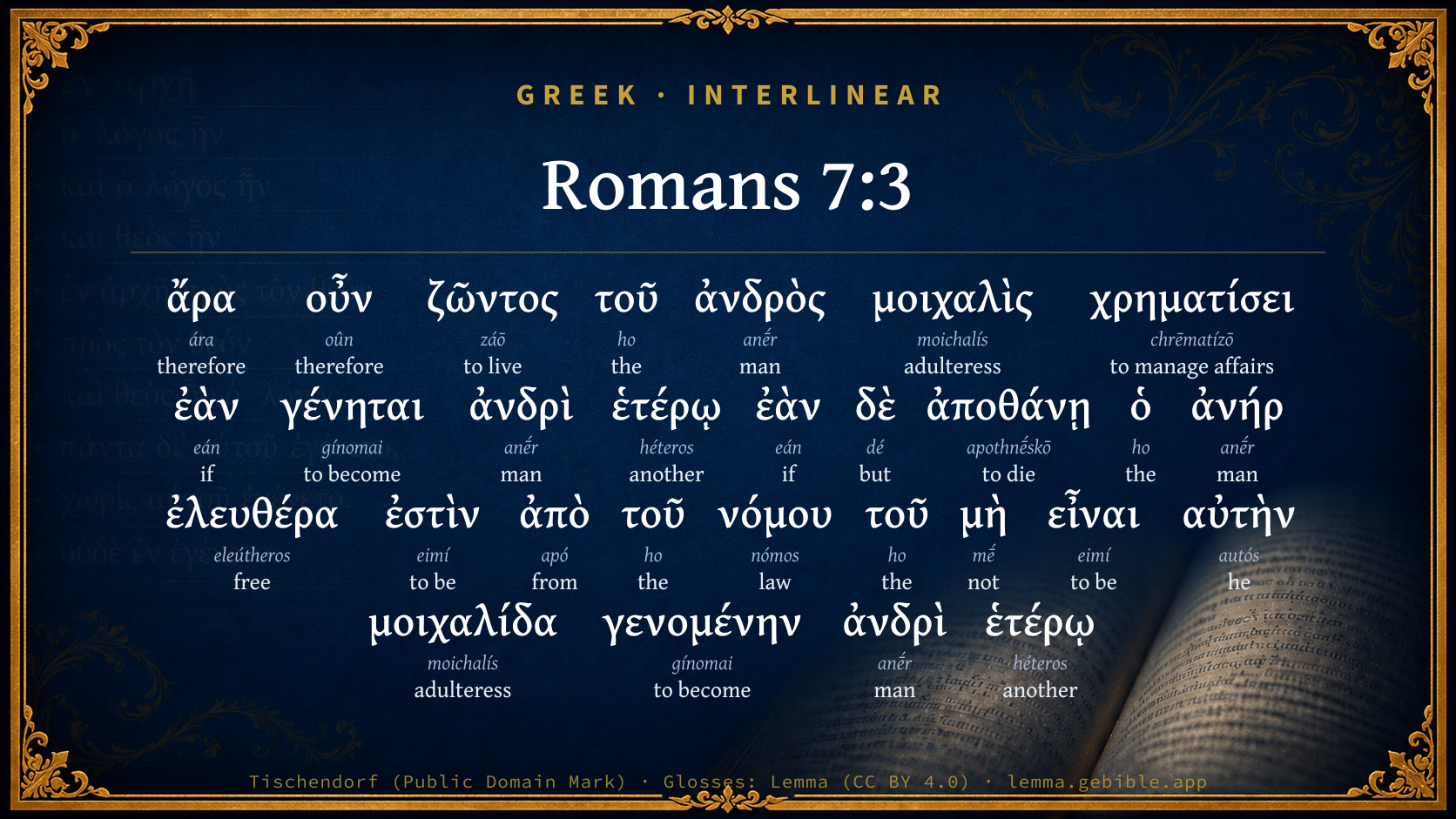
So then if, while the husband lives, she is joined to another man, she would be called an adulteress. But if the husband dies, she is free from the law, so that she is no adulteress, though she is joined to another man.
Download a study sheet
One document with this verse’s original text, its word-by-word gloss line, the meaning frame, cross-references with their text, attributed commentary, and full source and license credits — printable, and it pastes into notes with its structure intact.
This verse Autodidact and up
A passage Seminary Student
Up to 50 verses in one chapter. A passage sheet keeps up to 6 commentary sources and 12 cross-references per verse, in the order this page ranks them, and says so on the sheet whenever that leaves anything out. Ask for a single verse and you get the Autodidact verse sheet above.
Everything on this page stays free to read, with no account — the sheet is a download of what is already on screen, not access to it.
Compare translations 3
The same verse in 3 English versions, stacked beneath the original-language interlinear above. Click any original word for its lexicon entry.
Each is an independent rendering of the whole verse — the interlinear is not word-aligned to these translations.
Highlighted words mark where these versions differ — a whole-verse word diff, not a word-by-word alignment.
-
World English Bible Public Domain
So then if, while the husband lives, she is joined to another man, she would be called an adulteress. But if the husband dies, she is free from the law, so that she is no adulteress, though she is joined to another man.
-
King James Version Public Domain
So then if, while her husband liveth, she be married to another man, she shall be called an adulteress: but if her husband be dead, she is free from that law; so that she is no adulteress, though she be married to another man.
-
unfoldingWord Literal Text CC BY-SA 4.0
So then, the husband being alive, if she becomes to another husband, she will be titled an adulteress. But if the husband dies, she is free from the law, so that she is not an adulteress, having become to another husband.
unfoldingWord Literal Text — © unfoldingWord, licensed CC BY-SA 4.0. Word-aligned USFM3 via Door43 (git.door43.org/unfoldingWord/en_ult).
Show all 19 translations
Every available English version of this verse, each an independent rendering of the whole verse.
-
World English Bible Public Domain
So then if, while the husband lives, she is joined to another man, she would be called an adulteress. But if the husband dies, she is free from the law, so that she is no adulteress, though she is joined to another man.
-
Berean Standard Bible Public Domain
So then, if she is joined to another man while her husband is still alive, she is called an adulteress; but if her husband dies, she is free from that law and is not an adulteress, even if she marries another man.
-
Majority Standard Bible Public Domain
So then, if she is joined to another man while her husband is still alive, she is called an adulteress; but if her husband dies, she is free from that law and is not an adulteress if she marries another man.
-
King James Version Public Domain
So then if, while her husband liveth, she be married to another man, she shall be called an adulteress: but if her husband be dead, she is free from that law; so that she is no adulteress, though she be married to another man.
-
American Standard Version (1901) Public Domain
So then if, while the husband liveth, she be joined to another man, she shall be called an adulteress: but if the husband die, she is free from the law, so that she is no adulteress, though she be joined to another man.
-
Revised Version (1885) Public Domain
So then if, while the husband liveth, she be joined to another man, she shall be called an adulteress: but if the husband die, she is free from the law, so that she is no adulteress, though she be joined to another man.
-
Geneva Bible (1599) Public Domain
So then, if while the man liueth, she taketh another man, she shalbe called an adulteresse: but if the man be dead, she is free from the Law, so that shee is not an adulteresse, though shee take another man.
-
Douay-Rheims (1899) Public Domain
Therefore, whilst her husband liveth, she shall be called an adulteress, if she be with another man: but if her husband be dead, she is delivered from the law of her husband; so that she is not an adulteress, if she be with another man.
-
Young's Literal Translation Public Domain
so, then, the husband being alive, an adulteress she shall be called if she may become another man's; and if the husband may die, she is free from the law, so as not to be an adulteress, having become another man's.
-
Literal Standard Version CC BY-SA 4.0
so then, the husband being alive, she will be called an adulteress if she may become another man’s; and if the husband may die, she is free from the law, so as not to be an adulteress, having become another man’s.
-
Unlocked Literal Bible CC BY-SA 4.0
So then, while her husband is living, if she lives with another man, she will be called an adulteress. But if the husband dies, she is free from the law, so she is not an adulteress if she lives with another man.
-
unfoldingWord Literal Text CC BY-SA 4.0
So then, the husband being alive, if she becomes to another husband, she will be titled an adulteress. But if the husband dies, she is free from the law, so that she is not an adulteress, having become to another husband.
-
Darby Bible Public Domain
so then, the husband being alive, she shall be called an adulteress if she be to another man; but if the husband should die, she is free from the law, so as not to be an adulteress, though she be to another man.
-
World Messianic Bible Public Domain
So then if, while the husband lives, she is joined to another man, she would be called an adulteress. But if the husband dies, she is free from the law, so that she is no adulteress, though she is joined to another man.
-
Webster's Bible Public Domain
So then, if while her husband liveth, she is married to another man, she shall be called an adulteress: but if her husband is dead, she is free from that law; so that she is no adulteress, though she be married to another man.
-
Free Bible Version CC BY-SA 4.0
So if she lives with another man while her husband is alive, she would be committing adultery. However, if her husband dies and then she marries another man, she wouldn't be guilty of adultery.
-
Bible in Basic English Public Domain
So if, while the husband is living, she is joined to another man, she will get the name of one who is untrue to her husband: but if the husband is dead, she is free from the law, so that she is not untrue, even if she takes another man.
-
Text-Critical English NT CC BY 4.0
So then, she will be called an adulteress if she is joined to another man while her husband is alive. But if her husband dies, she is free from that law and is not committing adultery if she is joined to another man.
-
Tyndale New Testament (1534) Public Domain
So then yf whill the man liveth she couple her selfe with another man she shalbe counted a wedlocke breaker. But yf the man be deed she is fre from the lawe: so that she is no wedlocke breaker though she couple her selfe with another man.
Literal Standard Version (2020), Covenant Press — licensed CC BY-SA 4.0. Text via the HelloAO Bible API (eBible.org). Unlocked Literal Bible (unfoldingWord) — licensed CC BY-SA 4.0. Text via the HelloAO Bible API (eBible.org). unfoldingWord Literal Text — © unfoldingWord, licensed CC BY-SA 4.0. Word-aligned USFM3 via Door43 (git.door43.org/unfoldingWord/en_ult). Free Bible Version, Dr. Jonathan Gallagher — licensed CC BY-SA 4.0. Text via the HelloAO Bible API (eBible.org).
Word by word
More ways to search: Search by grammar → Find every occurrence → Compare this word →
Practice this passage: Drill this verse → Learn its vocabulary →
- Appears 7× in the Greek New Testament
- First appears at Matthew 12:39
- Part of Speech
- Noun
- Case
- Nominative
- Number
- Singular
- Gender
- Feminine
Full Thayer's Definition
- ἄρα ára G686 “therefore” Particle
- οὖν oûn G3767 “therefore” Conjunction
- ζῶντος záō G2198 “to live” Verb, Present, Active, Participle, Genitive, Singular, Masculine
- τοῦ ho G3588 “the” Article, Genitive, Singular, Masculine
- ἀνδρὸς anḗr G435 “man” Noun, Genitive, Singular, Masculine
- μοιχαλὶς moichalís G3428 “adulteress” Noun, Nominative, Singular, Feminine
- χρηματίσει chrēmatízō G5537 “to manage affairs” Verb, Future, Active, Indicative, 3rd person, Singular
- ἐὰν eán G1437 “if” Conditional
- γένηται gínomai G1096 “to become” Verb, Aorist, Middle deponent, Subjunctive, 3rd person, Singular
- ἀνδρὶ anḗr G435 “man” Noun, Dative, Singular, Masculine
- ἑτέρῳ héteros G2087 “another” Adjective, Dative, Singular, Masculine
- ἐὰν eán G1437 “if” Conditional
- δὲ dé G1161 “but” Conjunction
- ἀποθάνῃ apothnḗskō G599 “to die” Verb, Aorist, Active, Subjunctive, 3rd person, Singular
- ὁ ho G3588 “the” Article, Nominative, Singular, Masculine
- ἀνήρ anḗr G435 “man” Noun, Nominative, Singular, Masculine
- ἐλευθέρα eleútheros G1658 “free” Adjective, Nominative, Singular, Feminine
- ἐστὶν eimí G1510 “to be” Verb, Present, Active, Indicative, 3rd person, Singular
- ἀπὸ apó G575 “from” Preposition
- τοῦ ho G3588 “the” Article, Genitive, Singular, Masculine
- νόμου nómos G3551 “law” Noun, Genitive, Singular, Masculine
- τοῦ ho G3588 “the” Article, Genitive, Singular, Neuter
- μὴ mḗ G3361 “not” Particle, Negative
- εἶναι eimí G1510 “to be” Verb, Present, Active, Infinitive
- αὐτὴν autós G846 “he” Personal pronoun, Accusative, Singular, Feminine
- μοιχαλίδα moichalís G3428 “adulteress” Noun, Accusative, Singular, Feminine
- γενομένην gínomai G1096 “to become” Verb, Aorist, Middle deponent, Participle, Accusative, Singular, Feminine
- ἀνδρὶ anḗr G435 “man” Noun, Dative, Singular, Masculine
- ἑτέρῳ héteros G2087 “another” Adjective, Dative, Singular, Masculine
About this verse
These counts appear in no published source. They are computed here, from the morphology-tagged text and Lemma’s own curated glosses. What Lemma adds →
- 29
- words
- 18
- distinct lemmas
- Pauline Epistles
- section
Cross-references
9Topical passages linked to Romans 7:3 in the Treasury of Scripture Knowledge — connected by theme and wording, ordered by reader-vote popularity; previews shown in the World English Bible.
- Exodus 20:14 "You shall not commit adultery.
- Matthew 5:32 but I tell you that whoever puts away his wife, except for the cause of sexual immorality, makes her an adulteress; and whoever marries her when she is put away commits adultery.
- Mark 10:6–12 But from the beginning of the creation, 'God made them male and female.
- Leviticus 20:10 "'The man who commits adultery with another man's wife, even he who commits adultery with his neighbor's wife, the adulterer and the adulteress shall surely be put to death.
- Deuteronomy 22:22–24 If a man be found lying with a woman married to a husband, then they shall both of them die, the man who lay with the woman, and the woman: so shall you put away the evil from Israel.
- John 8:3–5 The scribes and the Pharisees brought a woman taken in adultery. Having set her in the midst,
- 1 Timothy 5:11–14 But refuse younger widows, for when they have grown wanton against Christ, they desire to marry;
- Numbers 5:13–31 and a man lies with her carnally, and it is hidden from the eyes of her husband, and is kept close, and she is defiled, and there is no witness against her, and she isn't taken in the act;
- Ruth 2:13 Then she said, Let me find favor in your sight, my lord, because you have comforted me, and because you have spoken kindly to your handmaid, though I am not as one of your handmaidens.
Cross-references courtesy of OpenBible.info (CC BY 4.0).
Lesson kit
Teaching starters — assembled from the data on this page, not authored interpretation. Every prompt links to the verse data it draws on. Edit before teaching.
Romans, in the Pauline Epistles, opens this verse with 29 words (18 distinct Greek lemmas). Its most distinctive word is moichalís (“adulteress”). A historical commentator’s framing appears above. Read the whole chapter for the surrounding context.
Discussion questions
- How does “adulteress” (moichalís) shape what this verse is saying?
- Matthew 12:39 shares the word «adulteress» with this verse. How do the two illuminate each other?
- “man” occurs 4× in this one verse. What is the effect of the repetition?
- These translations render this verse differently; the difference is in the English rendering, not the original. What questions does that raise?
- Reading how Bengel's Gnomon and Meyer's Critical & Exegetical Commentary read this verse, where do the two commentators agree and where do they part?
Things to notice
- These translations choose different wording for 19 words in this verse.
- “man” occurs 4× in this single verse.
- 18 distinct Greek lemmas span 29 words in this verse.
Commentary
Notes on Romans 7:3 from classic Christian and Jewish commentators (each source and its license shown beneath its notes). The classic Christian expositions comment on the surrounding passage and are grouped to its opening verse, so a note may address several verses; the Jewish commentaries on the Tanakh (Rashi and others) are per-verse, so they appear only where the commentator wrote on this verse.
Lemma curates 59 commentaries, every one of them public domain or Creative Commons licensed, each selected and text-cleaned for this edition rather than reprinted as found. About our sources →
Bengel's Gnomon
Johann Albrecht Bengel
Bengel's Gnomon of the New Testament — English translation (T&T Clark, Edinburgh, 1860) — public domain. Text from a community e-Sword module.
Meyer's Critical & Exegetical Commentary
Heinrich August Wilhelm Meyer
Meyer — Critical and Exegetical Commentary on the New Testament — English translation by Peter Christie, edited by Frederick Crombie (T&T Clark, 1880) — public domain. Text from a community e-Sword module.
Hodge's Commentary on Romans, Ephesians & First Corinthians
Charles Hodge
Charles Hodge — Commentary on Romans (1835), First Corinthians (1857), and Ephesians (1856) — public domain. Text from a community e-Sword module.
Geneva Bible (1599)
Geneva Bible translators
Geneva Bible (1599) marginal notes — public domain. Text via Bolls.life.
Jamieson, Fausset & Brown
Robert Jamieson, A. R. Fausset & David Brown
Jamieson, Fausset & Brown — Commentary Critical and Explanatory on the Whole Bible (1871) — public domain (CC PDM 1.0). Text via the HelloAO Bible API.
Adam Clarke's Commentary
Adam Clarke's Commentary on the Bible (1810–1826) — public domain. Text from a community e-Sword/MySword module.
The Cambridge Bible for Schools and Colleges
gen. ed. J. J. S. Perowne
The Cambridge Bible for Schools and Colleges (gen. ed. J. J. S. Perowne; Cambridge University Press, 1878–1918) — public domain. Text from a community e-Sword module.
John Gill's Exposition
John Gill's Exposition of the Whole Bible (1746–1763) — public domain (CC PDM 1.0). Text via the HelloAO Bible API.
Trapp's Complete Commentary
John Trapp
John Trapp, A Commentary or Exposition upon All the Books of the Old and New Testament (1647–1656) — public domain. Text from a community e-Sword module.
Albert Barnes' Notes on the Bible
Albert Barnes' Notes on the Bible (1834–1885) — public domain. Text from a community e-Sword/MySword module.
Matthew Poole's English Annotations
Matthew Poole's English Annotations on the Holy Bible (1683–1685) — public domain. Text from a community e-Sword/MySword module.
McGarvey & Pendleton's Commentaries
J. W. McGarvey
J. W. McGarvey (with Philip Y. Pendleton), Commentaries on the New Testament (The Fourfold Gospel, 1914; Acts; and the epistles) — public domain. Text from a community e-Sword/MySword module.
Cambridge Greek Testament for Schools and Colleges
Cambridge Greek Testament for Schools and Colleges (Cambridge University Press, 1896; 21 vols, various authors incl. Carr, Maclear, Plummer, Farrar, Lumby, Moule, M. R. James, Simcox) — public domain. Text from a community e-Sword module.
Alford’s Greek Testament
Henry Alford
Henry Alford, The Greek Testament (1849–1861) — public domain. Text from a community e-Sword module.
International Critical Commentary
International Critical Commentary — older volumes (1896–1929), various authors — public domain. Text from a community e-Sword module.
Vincent's Word Studies in the New Testament
Marvin R. Vincent
Marvin R. Vincent, Word Studies in the New Testament (1887–1900) — public domain. Text from a community e-Sword/MySword module.
Godet's Commentaries
Frédéric Louis Godet
Frédéric Louis Godet — Commentaries on Luke, John, Romans, and 1 Corinthians — English translation (T&T Clark, Edinburgh, 1870s–1890s) — public domain. Text from a community e-Sword module.