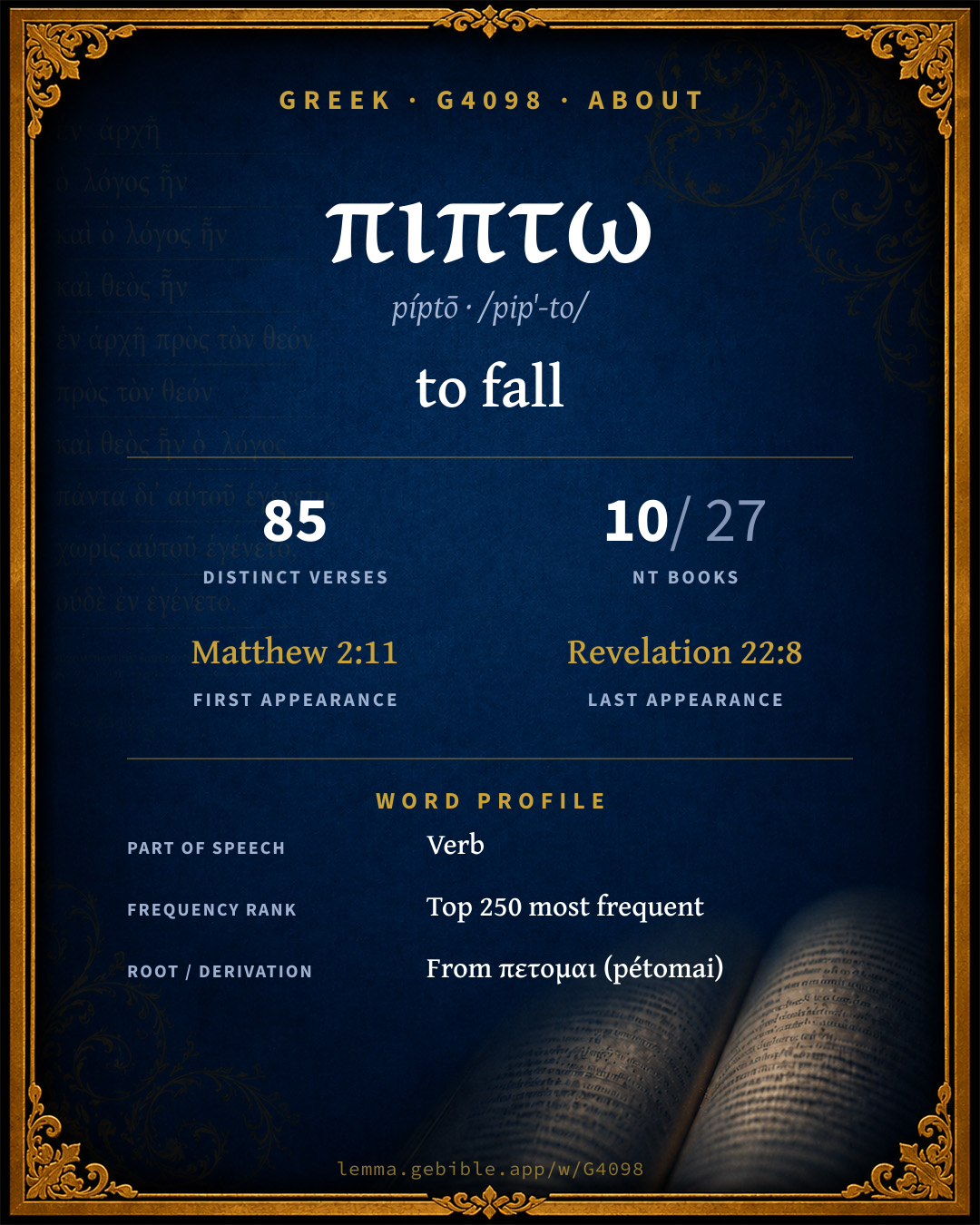
πιπτω
to fall
‘to fall’ is one of 2 main senses fuller range ↓
Full lexicon entry — Thayer's Greek Lexicon
From Thayer's Greek Lexicon
Where this word appears
See every Aorist-tense verb in the Greek New Testament →
Grammar key — what these labels mean
Part of speech
- Verb
- An action or state-of-being word.
Tense
- Aorist
- Action viewed as a simple whole, without regard to duration — often past (perfective aspect).
- Present
- Ongoing or general action in present time (imperfective aspect).
- Future
- Action expected in future time.
- Imperfect
- Continuous or repeated action in past time (“was writing”).
- Perfect
- A completed past action with continuing present results.
Voice
- Active
- The subject performs the action.
- Middle or Passive deponent
- Middle/passive in form but active in meaning.
- Middle deponent
- Middle in form but active in meaning.
Mood
- Indicative
- States a fact or asks a factual question (the mood of reality).
- Participle
- A verbal adjective (“writing,” “having written”).
- Subjunctive
- Expresses probability, purpose, or possibility (the mood of contingency).
- Imperative
- Expresses a command or request.
- Infinitive
- A verbal noun (“to write”), unmarked for person or number.
Case
- Nominative
- The case of the subject (and the predicate nominative).
- Genitive
- The case of source, possession, or “of” — answers “whose / from what.”
- Accusative
- The case of the direct object and of extent.
Person
- 3rd person
- The one spoken about (“he / she / it / they”).
- 1st person
- The speaker (“I / we”).
- 2nd person
- The one addressed (“you”).
Gender
- Masculine
- Grammatically masculine.
- Neuter
- Grammatically neuter.
- Feminine
- Grammatically feminine.
Number
- Singular
- One.
- Plural
- More than one.
Grammatical forms 22 distinct
- Verb, Aorist, Active, Indicative, 3rd person, Singular 30 times (34%)
- Verb, Aorist, Active, Indicative, 3rd person, Plural 12 times (13%)
- Verb, Aorist, Active, Participle, Nominative, Singular, Masculine 12 times (13%)
- Verb, Present, Active, Indicative, 3rd person, Singular 5 times (6%)
- Verb, Aorist, Active, Indicative, 1st person, Singular 4 times (4%)
- Verb, Aorist, Active, Subjunctive, 3rd person, Singular 4 times (4%)
- Verb, Future, Middle or Passive deponent, Indicative, 3rd person, Plural 4 times (4%)
- Verb, Future, Middle deponent, Indicative, 3rd person, Singular 2 times (2%)
+14 more forms (16 occurrences)
Parsed forms decoded from the imported morphology (Robinson–Tischendorf, public domain), counted across 89 parsed occurrences — not distinct verses.
Every verse where G4098 appears — 85 distinct verses across 10 books. Click any verse to open its interlinear word-by-word view. Verse text shown in the World English Bible for context — . Each verse’s Greek form is shown with its reference; the English is not keyword-highlighted, since the data carries no word-level English alignment. Use “Compare translations” on any verse to read it across multiple English versions. This concordance covers the Greek New Testament; Septuagint (Greek Old Testament) occurrences of this word are not indexed here.
Matthew 17 verses
- Matthew 2:11 πεσόντες aor act ptcp nom pl masc They came into the house and saw the young child with Mary, his mother, and they fell down and worshiped him. Opening their treasures, they offered to him gifts: gold, frankincense, and myrrh.
- Matthew 4:9 πεσὼν aor act ptcp nom sg masc He said to him, "I will give you all of these things, if you will fall down and worship me."
- Matthew 7:25 ἔπεσεν aor act ind 3sg The rain came down, the floods came, and the winds blew, and beat on that house; and it didn't fall, for it was founded on the rock.
- Matthew 7:27 ἔπεσεν aor act ind 3sg The rain came down, the floods came, and the winds blew, and beat on that house; and it fell--and great was its fall."
- Matthew 10:29 πεσεῖται fut mid.dep ind 3sg "Aren't two sparrows sold for an assarion? Not one of them falls on the ground apart from your Father's will,
- Matthew 13:4 ἔπεσεν aor act ind 3sg As he sowed, some seeds fell by the roadside, and the birds came and devoured them.
- Matthew 13:5 ἔπεσεν aor act ind 3sg Others fell on rocky ground, where they didn't have much soil, and immediately they sprang up, because they had no depth of earth.
- Matthew 13:7 ἔπεσεν aor act ind 3sg Others fell among thorns. The thorns grew up and choked them:
- Matthew 13:8 ἔπεσεν aor act ind 3sg and others fell on good soil, and yielded fruit: some one hundred times as much, some sixty, and some thirty.
- Matthew 15:14 πεσοῦνται fut mid/pass.dep ind 3pl Leave them alone. They are blind guides of the blind. If the blind guide the blind, both will fall into a pit."
- Matthew 15:27 πιπτόντων pres act ptcp gen pl neut But she said, "Yes, Lord, but even the dogs eat the crumbs which fall from their masters' table."
- Matthew 17:6 ἔπεσαν aor act ind 3pl When the disciples heard it, they fell on their faces, and were very afraid.
- Matthew 17:15 πίπτει pres act ind 3sg "Lord, have mercy on my son, for he is epileptic, and suffers grievously; for he often falls into the fire, and often into the water.
- Matthew 18:26 πεσὼν aor act ptcp nom sg masc The servant therefore fell down and kneeled before him, saying, 'Lord, have patience with me, and I will repay you all!'
- Matthew 18:29 πεσὼν aor act ptcp nom sg masc "So his fellow servant fell down at his feet and begged him, saying, 'Have patience with me, and I will repay you!'
- Matthew 24:29 πεσοῦνται fut mid/pass.dep ind 3pl But immediately after the oppression of those days, the sun will be darkened, the moon will not give its light, the stars will fall from the sky, and the powers of the heavens will be shaken;
- Matthew 26:39 ἔπεσεν aor act ind 3sg He went forward a little, fell on his face, and prayed, saying, "My Father, if it is possible, let this cup pass away from me; nevertheless, not what I desire, but what you desire."
Mark 8 verses
- Mark 4:4 ἔπεσεν aor act ind 3sg and it happened, as he sowed, some seed fell by the road, and the birds came and devoured it.
- Mark 4:5 ἔπεσεν aor act ind 3sg Others fell on the rocky ground, where it had little soil, and immediately it sprang up, because it had no depth of soil.
- Mark 4:7 ἔπεσεν aor act ind 3sg Others fell among the thorns, and the thorns grew up, and choked it, and it yielded no fruit.
- Mark 4:8 ἔπεσεν aor act ind 3sg Others fell into the good ground, and yielded fruit, growing up and increasing. Some brought forth thirty times, some sixty times, and some one hundred times as much."
- Mark 5:22 πίπτει pres act ind 3sg Behold, one of the rulers of the synagogue, Jairus by name, came; and seeing him, he fell at his feet,
- Mark 9:20 πεσὼν aor act ptcp nom sg masc They brought him to him, and when he saw him, immediately the spirit convulsed him, and he fell on the ground, wallowing and foaming at the mouth.
- Mark 13:25 πίπτοντες pres act ptcp nom pl masc the stars will be falling from the sky, and the powers that are in the heavens will be shaken.
- Mark 14:35 ἔπιπτεν impf act ind 3sg He went forward a little, and fell on the ground, and prayed that, if it were possible, the hour might pass away from him.
Luke 17 verses
- Luke 5:12 πεσὼν aor act ptcp nom sg masc It happened, while he was in one of the cities, behold, there was a man full of leprosy. When he saw Jesus, he fell on his face, and begged him, saying, "Lord, if you want to, you can make me clean."
- Luke 6:49 συνέπεσεν aor act ind 3sg But he who hears, and doesn't do, is like a man who built a house on the earth without a foundation, against which the stream broke, and immediately it fell, and the ruin of that house was great."
- Luke 8:5 ἔπεσεν aor act ind 3sg "The farmer went out to sow his seed. As he sowed, some fell along the road, and it was trampled under foot, and the birds of the sky devoured it.
- Luke 8:7 ἔπεσεν aor act ind 3sg Other fell amid the thorns, and the thorns grew with it, and choked it.
- Luke 8:8 ἔπεσεν aor act ind 3sg Other fell into the good ground, and grew, and brought forth fruit one hundred times." As he said these things, he called out, "He who has ears to hear, let him hear!"
- Luke 8:14 πεσόν aor act ptcp nom sg neut That which fell among the thorns, these are those who have heard, and as they go on their way they are choked with cares, riches, and pleasures of life, and bring no fruit to maturity.
- Luke 8:41 πεσὼν aor act ptcp nom sg masc Behold, there came a man named Jairus, and he was a ruler of the synagogue. He fell down at Jesus' feet, and begged him to come into his house,
- Luke 10:18 πεσόντα aor act ptcp acc sg masc He said to them, "I saw Satan having fallen like lightning from heaven.
- Luke 11:17 πίπτει pres act ind 3sg But he, knowing their thoughts, said to them, "Every kingdom divided against itself is brought to desolation. A house divided against itself falls.
- Luke 13:4 ἔπεσεν aor act ind 3sg Or those eighteen, on whom the tower in Siloam fell, and killed them; do you think that they were worse offenders than all the men who dwell in Jerusalem?
- Luke 14:5 πεσεῖται fut mid.dep ind 3sg He answered them, "Which of you, if your son or an ox fell into a well, wouldn't immediately pull him out on a Sabbath day?"
- Luke 16:17 πεσεῖν aor act inf But it is easier for heaven and earth to pass away, than for one tiny stroke of a pen in the law to fall.
- Luke 16:21 πιπτόντων pres act ptcp gen pl neut and desiring to be fed with the crumbs that fell from the rich man's table. Yes, even the dogs came and licked his sores.
- Luke 17:16 ἔπεσεν aor act ind 3sg He fell on his face at Jesus' feet, giving him thanks; and he was a Samaritan.
- Luke 20:18 πεσὼν πέσῃ aor act ptcp nom sg masc aor act subj 3sg "Everyone who falls on that stone will be broken to pieces, But it will crush whomever it falls on to dust."
- Luke 21:24 πεσοῦνται fut mid/pass.dep ind 3pl They will fall by the edge of the sword, and will be led captive into all the nations. Jerusalem will be trampled down by the Gentiles, until the times of the Gentiles are fulfilled.
- Luke 23:30 πέσατε aor act impv 2pl Then they will begin to tell the mountains, 'Fall on us!' and tell the hills, 'Cover us.'
John 3 verses
- John 11:32 ἔπεσεν aor act ind 3sg Therefore when Mary came to where Jesus was, and saw him, she fell down at his feet, saying to him, "Lord, if you would have been here, my brother wouldn't have died."
- John 12:24 πεσὼν aor act ptcp nom sg masc Most assuredly I tell you, unless a grain of wheat falls into the earth and dies, it remains by itself alone. But if it dies, it bears much fruit.
- John 18:6 ἔπεσαν aor act ind 3pl When therefore he said to them, "I AM," they went backward, and fell to the ground.
Acts 9 verses
- Acts 1:26 ἔπεσεν aor act ind 3sg They drew lots for them, and the lot fell on Matthias, and he was numbered with the eleven apostles.
- Acts 5:5 πεσὼν aor act ptcp nom sg masc Ananias, hearing these words, fell down and died. Great fear came on all who heard these things.
- Acts 5:10 ἔπεσεν aor act ind 3sg She fell down immediately at his feet, and died. The young men came in and found her dead, and they carried her out and buried her by her husband.
- Acts 9:4 πεσὼν aor act ptcp nom sg masc He fell on the earth, and heard a voice saying to him, "Saul, Saul, why do you persecute me?"
- Acts 10:25 πεσὼν aor act ptcp nom sg masc When it happened that Peter entered, Cornelius met him, fell down at his feet, and worshiped him.
- Acts 13:11 ἔπεσεν aor act ind 3sg Now, behold, the hand of the Lord is on you, and you will be blind, not seeing the sun for a season!" Immediately there fell on him a mist and darkness. He went around seeking someone to lead him by the hand.
- Acts 15:16 πεπτωκυῖαν perf act ptcp acc sg fem 'After these things I will return. I will again build the tent of David, which has fallen. I will again build its ruins. I will set it up,
- Acts 20:9 ἔπεσεν aor act ind 3sg A certain young man named Eutychus sat in the window, weighed down with deep sleep. As Paul spoke still longer, being weighed down by his sleep, he fell down from the third story, and was taken up dead.
- Acts 22:7 ἔπεσά aor act ind 1sg I fell to the ground, and heard a voice saying to me, 'Saul, Saul, why are you persecuting me?'
Romans 3 verses
- Romans 11:11 πέσωσιν aor act subj 3pl I ask then, did they stumble that they might fall? May it never be! But by their fall salvation has come to the Gentiles, to provoke them to jealousy.
- Romans 11:22 πεσόντας aor act ptcp acc pl masc See then the goodness and severity of God. Toward those who fell, severity; but toward you, goodness, if you continue in his goodness; otherwise you also will be cut off.
- Romans 14:4 πίπτει pres act ind 3sg Who are you who judge another's servant? To his own lord he stands or falls. Yes, he will be made to stand, for God has power to make him stand.
1 Corinthians 4 verses
- 1 Corinthians 10:8 ἔπεσαν aor act ind 3pl Neither let us commit sexual immorality, as some of them committed, and in one day twenty-three thousand fell.
- 1 Corinthians 10:12 πέσῃ aor act subj 3sg Therefore let him who thinks he stands be careful that he doesn't fall.
- 1 Corinthians 13:8 πίπτει pres act ind 3sg Love never fails. But where there are prophecies, they will be done away with. Where there are various languages, they will cease. Where there is knowledge, it will be done away with.
- 1 Corinthians 14:25 πεσὼν aor act ptcp nom sg masc And thus the secrets of his heart are revealed. So he will fall down on his face and worship God, declaring that God is among you indeed.
Hebrews 3 verses
- Hebrews 3:17 ἔπεσεν aor act ind 3sg With whom was he displeased forty years? Wasn't it with those who sinned, whose bodies fell in the wilderness?
- Hebrews 4:11 πέσῃ aor act subj 3sg Let us therefore give diligence to enter into that rest, lest anyone fall after the same example of disobedience.
- Hebrews 11:30 ἔπεσαν aor act ind 3pl By faith, the walls of Jericho fell down, after they had been encircled for seven days.
James 1 verse
Revelation 20 verses
- Revelation 1:17 ἔπεσα aor act ind 1sg When I saw him, I fell at his feet like a dead man. He laid his right hand on me, saying, "Don't be afraid. I am the first and the last,
- Revelation 2:5 πέπτωκες perf act ind 2sg Remember therefore from where you have fallen, and repent and do the first works; or else I am coming to you swiftly, and will move your lampstand out of its place, unless you repent.
- Revelation 4:10 πεσοῦνται fut mid/pass.dep ind 3pl the twenty-four elders fall down before him who sits on the throne, and worship him who lives forever and ever, and throw their crowns before the throne, saying,
- Revelation 5:8 ἔπεσαν aor act ind 3pl Now when he had taken the book, the four living creatures and the twenty-four elders fell down before the Lamb, each one having a harp, and golden bowls full of incense, which are the prayers of the saints.
- Revelation 5:14 ἔπεσαν aor act ind 3pl The four living creatures said, "Amen!" The elders fell down and worshiped.
- Revelation 6:13 ἔπεσαν aor act ind 3pl The stars of the sky fell to the earth, like a fig tree dropping its unripe figs when it is shaken by a great wind.
- Revelation 6:16 πέσετε aor act impv 2pl They told the mountains and the rocks, "Fall on us, and hide us from the face of him who sits on the throne, and from the wrath of the Lamb,
- Revelation 7:11 ἔπεσαν aor act ind 3pl All the angels were standing around the throne, the elders, and the four living creatures; and they fell on their faces before his throne, and worshiped God,
- Revelation 7:16 πέσῃ aor act subj 3sg They will never be hungry, neither thirsty any more; neither will the sun beat on them, nor any heat;
- Revelation 8:10 ἔπεσεν ἔπεσεν aor act ind 3sg aor act ind 3sg The third angel sounded, and a great star fell from the sky, burning like a torch, and it fell on one third of the rivers, and on the springs of the waters.
- Revelation 9:1 πεπτωκότα perf act ptcp acc sg masc The fifth angel sounded, and I saw a star from the sky which had fallen to the earth. The key to the pit of the abyss was given to him.
- Revelation 11:13 ἔπεσεν aor act ind 3sg In that day there was a great earthquake, and a tenth of the city fell. Seven thousand people were killed in the earthquake, and the rest were terrified, and gave glory to the God of heaven.
- Revelation 11:16 ἔπεσαν aor act ind 3pl The twenty-four elders, who sit on their thrones before God's throne, fell on their faces and worshiped God,
- Revelation 14:8 ἔπεσεν ἔπεσεν aor act ind 3sg aor act ind 3sg Another, a second angel, followed, saying, "Babylon the great has fallen, which has made all the nations to drink of the wine of the wrath of her sexual immorality."
- Revelation 16:19 ἔπεσαν aor act ind 3pl The great city was divided into three parts, and the cities of the nations fell. Babylon the great was remembered in the sight of God, to give to her the cup of the wine of the fierceness of his wrath.
- Revelation 17:10 ἔπεσαν aor act ind 3pl They are seven kings. Five have fallen, the one is, the other has not yet come. When he comes, he must continue a little while.
- Revelation 18:2 ἔπεσεν ἔπεσεν aor act ind 3sg aor act ind 3sg He cried with a mighty voice, saying, "Fallen, fallen is Babylon the great, and she has become a habitation of demons, a prison of every unclean spirit, and a prison of every unclean and hateful bird!
- Revelation 19:4 ἔπεσαν aor act ind 3pl The twenty-four elders and the four living creatures fell down and worshiped God who sits on the throne, saying, "Amen! Hallelujah!"
- Revelation 19:10 ἔπεσα aor act ind 1sg I fell down before his feet to worship him. He said to me, "Look! Don't do it! I am a fellow bondservant with you and with your brothers who hold the testimony of Jesus. Worship God, for the testimony of Jesus is the Spirit of Prophecy."
- Revelation 22:8 ἔπεσα aor act ind 1sg Now I, John, am the one who heard and saw these things. When I heard and saw, I fell down to worship before the feet of the angel who had shown me these things.
About this entry
At a glance — auto-summarized from this page’s data, not written by a person. Every figure links to its source below. This summary describes the numbers; it doesn’t interpret them.
The Greek verb πιπτω centers on the idea of “to fall.” Its earliest occurrence is Matthew 2:11. The Greek New Testament uses it across 85 verses — moderately common. Thayer's distinguishes 2 senses for it. Sharing its root, it stands alongside πετομαι, πετεινον and πτερυξ. For the data behind this summary, explore the sense tree and the renderings breakdown below.
Gloss history
Strong's 1890 vs modern scholarship

About this word
Strong's G4098 catalogs a Greek word from the Greek New Testament.
These counts are not copied from any lexicon or concordance. They are computed here, from the morphology-tagged Greek New Testament. What Lemma adds →
- 85
- distinct verses
- The word appears in 85 distinct verses.
- 10 / 27
- NT books
- The word appears in 10 of 27 New Testament books.
- #195
- by frequency
- Top 250 most frequent Greek words (rank 195 of 5,347 Greek words by occurrence).
View all 85 occurrences in the concordance →
Most concentrated in
- Revelation 20 verses 24%
- Matthew 17 verses 20%
- Luke 17 verses 20%
By section of the New Testament
By traditional corpus
Conventional, traditional groupings — biblical authorship is debated, so this is a traditional corpus grouping, not an authorship claim. Some books belong to more than one corpus (Luke is in both the Gospels and the Lukan corpus, and so on), so these shares overlap and need not total 100%. Each figure is a share of the word’s 85 distinct verses.
- Gospels 45 verses · 53%
- Lukan (Luke–Acts) 26 verses · 31%
- Johannine 23 verses · 27%
- Revelation 20 verses · 24%
- Pauline corpus 7 verses · 8%
- Hebrews 3 verses · 4%
- General (Catholic) Epistles 1 verse · 1%
How translations render this word
Counts come from each version’s own published word-to-Strong’s tagging or interlinear alignment — an approximate guide to how each version renders this word, not a word-level alignment the data otherwise carries. Because each total is that version’s own tagged count, the per-version totals vary from one another and need not match the appearance or distinct-verse counts above. These counts may also differ from a printed concordance because Lemma counts each distinctly tagged rendering and does not collapse phrase taggings into a single head-word total. This is a fixed set of word-tagged versions (KJV, ASV, BSB, ULT) and does not change with the reading translation you choose elsewhere. Each version’s license is shown beside its name below (and on Sources).
- King James Version: Fell 33×, Fall 10×, Fell down 10×
- American Standard Version: Fell 29×, Fell down 9×, Fall 8×
- Berean Standard Bible: Fell 25×, He fell 8×, Falls 7×
- unfoldingWord Literal Text: Fell 26×, Fall 8×, Having fallen 8×
King James Version Public Domain
Renders G4098 across 92 tagged occurrences — most commonly:
Plus 19 renderings that appear only once — usually multi-word phrases or single function words the recovered tagging swept in, not distinct renderings. Not rendered by a distinct English word in 1 further occurrence.
American Standard Version Public Domain
Renders G4098 across 90 tagged occurrences — most commonly:
Plus 23 renderings that appear only once — usually multi-word phrases or single function words the recovered tagging swept in, not distinct renderings.
Berean Standard Bible Public Domain
Renders G4098 across 90 tagged occurrences — most commonly:
Plus 23 renderings that appear only once — usually multi-word phrases or single function words the recovered tagging swept in, not distinct renderings. Not rendered by a distinct English word in 1 further occurrence.
unfoldingWord Literal Text CC BY-SA 4.0
Renders G4098 across 96 tagged occurrences — most commonly:
Plus other, less common renderings. Plus 17 renderings that appear only once — usually multi-word phrases or single function words the recovered tagging swept in, not distinct renderings.
Senses in Thayer's
The 2 senses Thayer's distinguishes for this word, in lexicon order (not ranked by frequency or importance). The full entry — with sub-senses — is in the Lexicon Entry tab.
- to descend from a higher place to a lower
- to descend from an erect to a prostrate position
Word origin
Derived from πετομαι (pétomai) (G4072) — to fly.
the first is a reduplicated and contracted form of the second (which occurs only as an alternate in certain tenses); probably akin to G4072 through the idea of alighting ; to fall (literally of figuratively): - fail fall (down) light on.
— Strong’s Exhaustive Concordance (1890), public domain.
Forms in the corpus
The 25 distinct written forms G4098 takes in the Greek New Testament, most frequent first — each parse links to that tense’s occurrences in the concordance.
Same root — word family
Other Thayer's entries built from the same root as G4098, grouped by Strong’s listed origin. These share a root / origin per the lexicon — not necessarily a shared meaning. Each links to that word’s own entry.
Derives from
Shares the same root
Derived from this word
- πταιω ptaíō G4417 to stumble
- πτοεω ptoéō G4422 to terrify
- πτωμα ptōma G4430 fall
- πτωσις ptōsis G4431 falling
Compare all same-root words → Showing 4 of 9 — not the complete family. They share a root, not necessarily a meaning.
Septuagint usage
The same Greek word πιπτω appears 307 times in the Greek Old Testament (Septuagint), across 289 verses in 31 books.
- 307
- LXX occurrences
- Tagged occurrences of this Greek word in the Septuagint.
- 289
- verses
- Distinct Septuagint verses containing this word.
- 31 / 39
- OT books
- The word appears in 31 of the 39 Old Testament books.
Sample Septuagint occurrences
- Genesis 17:3 πίπτω
- Exodus 9:19 πίπτω
- Leviticus 9:24 πίπτω
- Numbers 14:3 πίπτω
- Deuteronomy 21:1 πίπτω
- Joshua 5:14 πίπτω
- Judges 3:25 πίπτω
- Ruth 2:10 πίπτω
- 1 Samuel 2:33 πίπτω
- 2 Samuel 1:2 πίπτω
- 1 Kings 1:52 πίπτω
- 2 Kings 1:2 πίπτω
Septuagint occurrences (same lexeme)
Every verse where the same Strong’s number (G4098) appears in the Greek Septuagint — showing the first 50 of 289. Verse text shown in the World English Bible for context; the Greek form is the matched word — the English is not keyword-highlighted.
- Genesis 17:3 πίπτω Abram fell on his face. God talked with him, saying,
- Genesis 17:17 πίπτω Then Abraham fell on his face, and laughed, and said in his heart, "Will a child be born to him who is one hundred years old? Will Sarah, who is ninety years old, give birth?"
- Genesis 44:14 πίπτω Judah and his brothers came to Joseph's house, and he was still there. They fell on the ground before him.
- Genesis 49:17 πίπτω Dan will be a serpent in the way, An adder in the path, That bites the horse's heels, So that his rider falls backward.
- Exodus 9:19 πίπτω Now therefore command that all of your cattle and all that you have in the field be brought into shelter. Every man and animal that is found in the field, and isn't brought home, the hail shall come down on them, and they shall die."'"
- Exodus 19:21 πίπτω Yahweh said to Moses, "Go down, charge the people, lest they break through to Yahweh to gaze, and many of them perish.
- Exodus 23:5 πίπτω If you see the donkey of him who hates you fallen down under his burden, don't leave him, you shall surely help him with it.
- Exodus 32:28 πίπτω The sons of Levi did according to the word of Moses: and there fell of the people that day about three thousand men.
- Leviticus 9:24 πίπτω There came forth fire from before Yahweh, and consumed the burnt offering and the fat upon the altar: and when all the people saw it, they shouted, and fell on their faces.
- Leviticus 11:33 πίπτω Every earthen vessel, into which any of them falls, all that is in it shall be unclean, and you shall break it.
- Leviticus 11:35 πίπτω Everything whereupon part of their carcass falls shall be unclean; whether oven, or range for pots, it shall be broken in pieces: they are unclean, and shall be unclean to you.
- Leviticus 26:7 πίπτω You shall chase your enemies, and they shall fall before you by the sword.
- Leviticus 26:8 πίπτω Five of you shall chase a hundred, and a hundred of you shall chase ten thousand; and your enemies shall fall before you by the sword.
- Leviticus 26:17 πίπτω I will set my face against you, and you will be struck before your enemies. Those who hate you will rule over you; and you will flee when no one pursues you.
- Leviticus 26:36 πίπτω "'As for those of you who are left, I will send a faintness into their hearts in the lands of their enemies: and the sound of a driven leaf will put them to flight; and they shall flee, as one flees from the sword; and they will fall when no one pursues.
- Numbers 14:3 πίπτω Why does Yahweh bring us to this land, to fall by the sword? Our wives and our little ones will be a prey: wouldn't it be better for us to return into Egypt?
- Numbers 14:5 πίπτω Then Moses and Aaron fell on their faces before all the assembly of the congregation of the children of Israel.
- Numbers 14:29 πίπτω your dead bodies shall fall in this wilderness; and all who were numbered of you, according to your whole number, from twenty years old and upward, who have murmured against me,
- Numbers 14:32 πίπτω But as for you, your dead bodies shall fall in this wilderness.
- Numbers 14:42 πίπτω Don't go up, for Yahweh isn't among you; that you not be struck down before your enemies.
- Numbers 14:43 πίπτω For there the Amalekite and the Canaanite are before you, and you shall fall by the sword: because you are turned back from following Yahweh, therefore Yahweh will not be with you.
- Numbers 16:4 πίπτω When Moses heard it, he fell on his face:
- Numbers 16:22 πίπτω They fell on their faces, and said, God, the God of the spirits of all flesh, shall one man sin, and will you be angry with all the congregation?
- Numbers 17:10 πίπτω Yahweh said to Moses, Put back the rod of Aaron before the testimony, to be kept for a token against the children of rebellion; that you may make an end of their murmurings against me, that they not die.
- Numbers 20:6 πίπτω Moses and Aaron went from the presence of the assembly to the door of the tent of meeting, and fell on their faces: and the glory of Yahweh appeared to them.
- Deuteronomy 21:1 πίπτω If one be found slain in the land which Yahweh your God gives you to possess it, lying in the field, and it isn't known who has struck him;
- Deuteronomy 22:4 πίπτω You shall not see your brother's donkey or his ox fallen down by the way, and hide yourself from them: you shall surely help him to lift them up again.
- Deuteronomy 22:8 πίπτω When you build a new house, then you shall make a battlement for your roof, that you don't bring blood on your house, if any man fall from there.
- Joshua 5:14 πίπτω He said, No; but [as] prince of the host of Yahweh am I now come. Joshua fell on his face to the earth, and did worship, and said to him, What says my lord to his servant?
- Joshua 6:5 πίπτω It shall be that when they make a long blast with the ram's horn, and when you hear the sound of the trumpet, all the people shall shout with a great shout; and the wall of the city shall fall down flat, and the people shall go up every man straight before him.
- Joshua 6:20 πίπτω So the people shouted, and [the priests] blew the trumpets; and it happened, when the people heard the sound of the trumpet, that the people shouted with a great shout, and the wall fell down flat, so that the people went up into the city, every man straight before him, and they took the city.
- Joshua 7:6 πίπτω Joshua tore his clothes, and fell to the earth on his face before the ark of Yahweh until the evening, he and the elders of Israel; and they put dust on their heads.
- Joshua 7:10 πίπτω Yahweh said to Joshua, Get you up; why are you thus fallen on your face?
- Joshua 8:25 πίπτω All that fell that day, both of men and women, were twelve thousand, even all the men of Ai.
- Joshua 17:5 πίπτω There fell ten parts to Manasseh, besides the land of Gilead and Bashan, which is beyond the Jordan;
- Judges 3:25 πίπτω They waited until they were ashamed; and, behold, he didn't open the doors of the upper room: therefore they took the key, and opened [them], and, behold, their lord was fallen down dead on the earth.
- Judges 4:16 πίπτω But Barak pursued after the chariots, and after the host, to Harosheth of the Gentiles: and all the host of Sisera fell by the edge of the sword; there was not a man left.
- Judges 5:27 πίπτω At her feet he bowed, he fell, he lay; At her feet he bowed, he fell; Where he bowed, there he fell down dead.
- Judges 7:13 πίπτω When Gideon had come, behold, there was a man telling a dream to his fellow; and he said, Behold, I dreamed a dream; and, behold, a cake of barley bread tumbled into the camp of Midian, and came to the tent, and struck it so that it fell, and turned it upside down, so that the tent lay flat.
- Judges 8:10 πίπτω Now Zebah and Zalmunna were in Karkor, and their hosts with them, about fifteen thousand men, all who were left of all the host of the children of the east; for there fell one hundred twenty thousand men who drew sword.
- Judges 9:40 πίπτω Abimelech chased him, and he fled before him, and there fell many wounded, even to the entrance of the gate.
- Judges 12:6 πίπτω then said they to him, Say now Shibboleth; and he said Sibboleth; for he couldn't manage to pronounce it right: then they laid hold on him, and killed him at the fords of the Jordan. There fell at that time of Ephraim forty-two thousand.
- Judges 13:20 πίπτω For it happened, when the flame went up toward the sky from off the altar, that the angel of Yahweh ascended in the flame of the altar: and Manoah and his wife looked on; and they fell on their faces to the ground.
- Judges 16:30 πίπτω Samson said, Let me die with the Philistines. He bowed himself with all his might; and the house fell on the lords, and on all the people who were therein. So the dead that he killed at his death were more than those who he killed in his life.
- Judges 19:26 πίπτω Then came the woman in the dawning of the day, and fell down at the door of the man's house where her lord was, until it was light.
- Judges 19:27 πίπτω Her lord rose up in the morning, and opened the doors of the house, and went out to go his way; and, behold, the woman his concubine was fallen down at the door of the house, with her hands on the threshold.
- Judges 20:32 πίπτω The children of Benjamin said, They are struck down before us, as at the first. But the children of Israel said, Let us flee, and draw them away from the city to the highways.
- Judges 20:39 πίπτω The men of Israel turned in the battle, and Benjamin began to strike and kill of the men of Israel about thirty persons; for they said, Surely they are struck down before us, as in the first battle.
- Judges 20:44 πίπτω There fell of Benjamin eighteen thousand men; all these [were] men of valor.
- Judges 20:46 πίπτω So that all who fell that day of Benjamin were twenty-five thousand men who drew the sword; all these [were] men of valor.
These are occurrences of the same Greek lexeme (G4098) in the Septuagint — not a translation of any one Hebrew word. The store carries no word-level Hebrew↔Greek alignment, so no Hebrew original is asserted here. Counts come from the recovered LXX Strong's tagging — high-frequency vocabulary is well covered, while rare or late forms may be untagged — so they reflect tagged occurrences and may slightly undercount.