
Acts 1:26

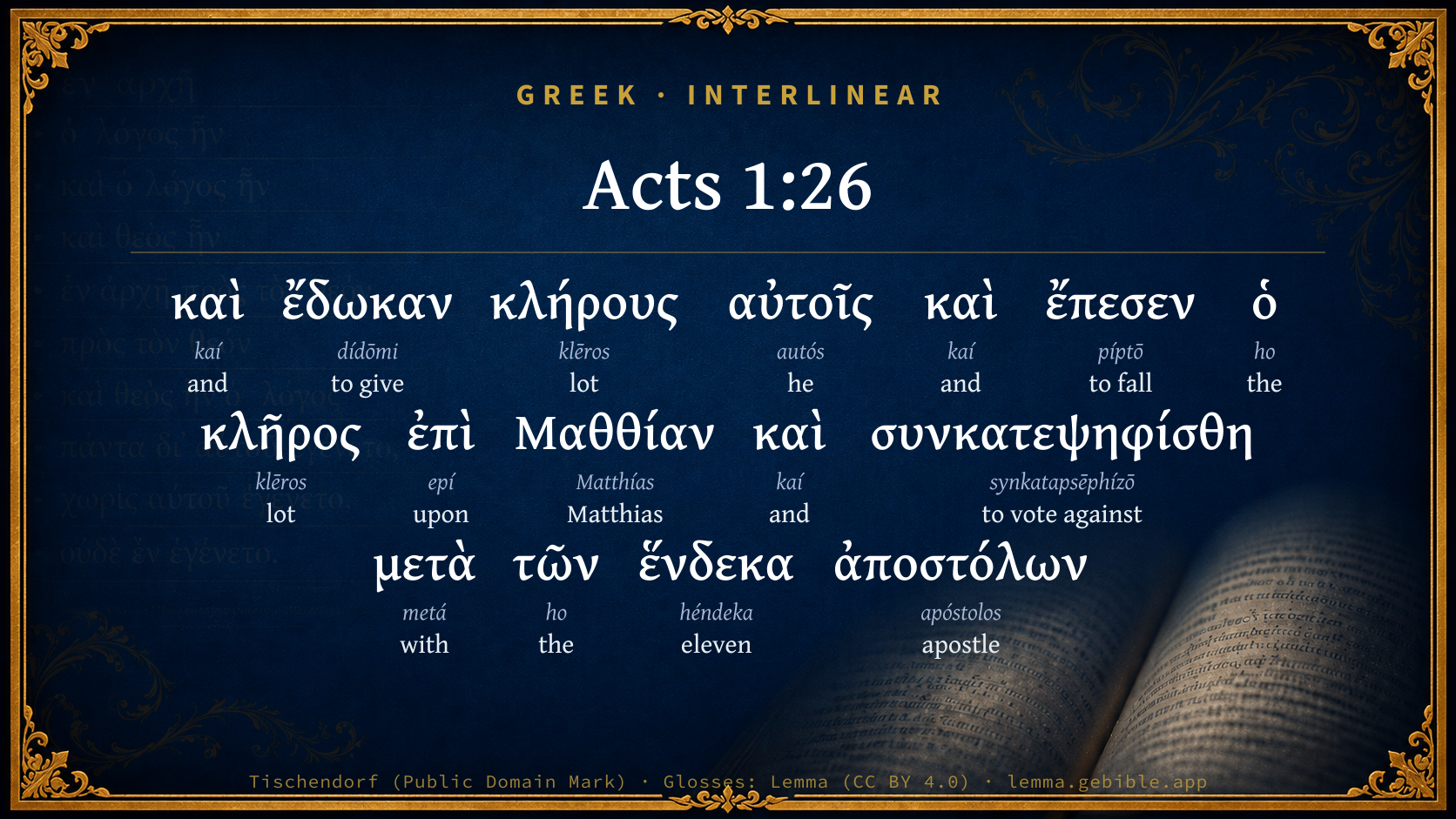
Greek (Tischendorf 8th ed.) Acts 1:26 appears in the Greek New Testament. The text above is from the Tischendorf 8th edition. Each word links to its Strong’s number and a concise gloss. Click any word for its full Thayer’s Greek Lexicon entry.
Download image
Cite this verse

Acts 1:26 (World English Bible). Public Domain. Lemma interlinear Bible study tool, https://lemma.gebible.app/v/acts/1/26.

Show BibTeX & RIS
BibTeX
RIS
English Translation
They drew lots for them, and the lot fell on Matthias, and he was numbered with the eleven apostles.
World English Bible · Public Domain
Highlights
  • 1 hapax legomenon — only here in the Greek New Testament
  • 1 first appearance in the Greek New Testament
Full analysis ↓
Download a study sheet

One document with this verse’s original text, its word-by-word gloss line, the meaning frame, cross-references with their text, attributed commentary, and full source and license credits — printable, and it pastes into notes with its structure intact.

This verse Autodidact and up

Study sheet (.html) Plain text (.txt)

A passage Seminary Student

Up to 50 verses in one chapter. A passage sheet keeps up to 6 commentary sources and 12 cross-references per verse, in the order this page ranks them, and says so on the sheet whenever that leaves anything out. Ask for a single verse and you get the Autodidact verse sheet above.

Everything on this page stays free to read, with no account — the sheet is a download of what is already on screen, not access to it.

Want to remove ads? Support Godless Engineer
Compare translations 3

The same verse in 3 English versions, stacked beneath the original-language interlinear above. Click any original word for its lexicon entry.

Each is an independent rendering of the whole verse — the interlinear is not word-aligned to these translations.

Highlighted words mark where these versions differ — a whole-verse word diff, not a word-by-word alignment.

  • World English Bible Public Domain
    They drew lots for them, and the lot fell on Matthias, and he was numbered with the eleven apostles.
  • King James Version Public Domain
    And they gave forth their lots; and the lot fell upon Matthias; and he was numbered with the eleven apostles.
  • unfoldingWord Literal Text CC BY-SA 4.0
    And they cast lots for them, and the lot fell to Matthias, and he was chosen together with the 11 apostles.

unfoldingWord Literal Text — © unfoldingWord, licensed CC BY-SA 4.0. Word-aligned USFM3 via Door43 (git.door43.org/unfoldingWord/en_ult).

Versions to compare (up to 4)

3 of 4 selected

Show all 19 translations

Every available English version of this verse, each an independent rendering of the whole verse.

  • World English Bible Public Domain
    They drew lots for them, and the lot fell on Matthias, and he was numbered with the eleven apostles.
  • Berean Standard Bible Public Domain
    Then they cast lots, and the lot fell to Matthias; so he was added to the eleven apostles.
  • Majority Standard Bible Public Domain
    Then they cast lots, and the lot fell to Matthias. So he was added to the eleven apostles.
  • King James Version Public Domain
    And they gave forth their lots; and the lot fell upon Matthias; and he was numbered with the eleven apostles.
  • American Standard Version (1901) Public Domain
    And they gave lots for them; and the lot fell upon Matthias; and he was numbered with the eleven apostles.
  • Revised Version (1885) Public Domain
    And they gave lots for them; and the lot fell upon Matthias; and he was numbered with the eleven apostles.
  • Geneva Bible (1599) Public Domain
    Then they gaue foorth their lottes: and the lotte fell on Matthias, and hee was by a common consent counted with the eleuen Apostles.
  • Douay-Rheims (1899) Public Domain
    And they gave them lots, and the lot fell upon Matthias, and he was numbered with the eleven apostles.
  • Young's Literal Translation Public Domain
    and they gave their lots, and the lot fell upon Matthias, and he was numbered with the eleven apostles.
  • Literal Standard Version CC BY-SA 4.0
    and they gave their lots, and the lot fell on Matthias, and he was numbered with the eleven apostles.
  • Unlocked Literal Bible CC BY-SA 4.0
    They cast lots for them, and the lot fell to Matthias, and he was numbered with the eleven apostles.
  • unfoldingWord Literal Text CC BY-SA 4.0
    And they cast lots for them, and the lot fell to Matthias, and he was chosen together with the 11 apostles.
  • Darby Bible Public Domain
    And they gave lots on them, and the lot fell on Matthias, and he was numbered with the eleven apostles.
  • World Messianic Bible Public Domain
    They drew lots for them, and the lot fell on Matthiah; and he was counted with the Eleven emissaries.
  • Webster's Bible Public Domain
    And they gave forth their lots; and the lot fell upon Matthias; and he was numbered with the eleven apostles.
  • Free Bible Version CC BY-SA 4.0
    They cast lots, and Matthias was chosen. He was counted as an apostle with the other eleven.
  • Bible in Basic English Public Domain
    And they put it to the decision of chance, and the decision was given for Matthias, and he was numbered with the eleven Apostles.
  • Text-Critical English NT CC BY 4.0
    Then they cast lots for them, and the lot fell to Matthias, so he was added to the eleven apostles.
  • Tyndale New Testament (1534) Public Domain
    And they gave forthe their lottes and the lot fell on Mathias and he was counted with the eleven Apostles.

Literal Standard Version (2020), Covenant Press — licensed CC BY-SA 4.0. Text via the HelloAO Bible API (eBible.org). Unlocked Literal Bible (unfoldingWord) — licensed CC BY-SA 4.0. Text via the HelloAO Bible API (eBible.org). unfoldingWord Literal Text — © unfoldingWord, licensed CC BY-SA 4.0. Word-aligned USFM3 via Door43 (git.door43.org/unfoldingWord/en_ult). Free Bible Version, Dr. Jonathan Gallagher — licensed CC BY-SA 4.0. Text via the HelloAO Bible API (eBible.org).

Word by word

More ways to search: Search by grammar → Find every occurrence → Compare this word →

Practice this passage: Drill this verse → Learn its vocabulary →

συνκατεψηφίσθη
synkatapsēphízō
G4785
“to vote against”
Verb, Aorist, Passive, Indicative, 3rd person, Singular
Part of Speech
Verb
Tense
Aorist
Voice
Passive
Mood
Indicative
Person
3rd person
Number
Singular
Full Thayer's Definition

Origin: from G4862 and a compound of G2596 and G5585

TDNT: 9:604,*

1. be depositing a ballot in the urn (i.e. by voting for) to assign one a place among, to vote one a place among 2. to vote against with others, i.e. to condemn with others
  1. καὶ kaí G2532 “and” Conjunction
  2. ἔδωκαν dídōmi G1325 “to give” Verb, Aorist, Active, Indicative, 3rd person, Plural
  3. κλήρους klēros G2819 “lot” Noun, Accusative, Plural, Masculine
  4. αὐτοῖς autós G846 “he” Personal pronoun, Dative, Plural, Masculine
  5. καὶ kaí G2532 “and” Conjunction
  6. ἔπεσεν píptō G4098 “to fall” Verb, Aorist, Active, Indicative, 3rd person, Singular
  7. ὁ ho G3588 “the” Article, Nominative, Singular, Masculine
  8. κλῆρος klēros G2819 “lot” Noun, Nominative, Singular, Masculine
  9. ἐπὶ epí G1909 “upon” Preposition
  10. Μαθθίαν Matthías G3159 “Matthias” Noun, Accusative, Singular, Masculine
  11. καὶ kaí G2532 “and” Conjunction
  12. μετὰ metá G3326 “with” Preposition
  13. τῶν ho G3588 “the” Article, Genitive, Plural, Masculine
  14. ἕνδεκα héndeka G1733 “eleven” Adjective, Numeral (indeclinable)
  15. ἀποστόλων apóstolos G652 “apostle” Noun, Genitive, Plural, Masculine

About this verse

These counts appear in no published source. They are computed here, from the morphology-tagged text and Lemma’s own curated glosses. What Lemma adds →

16
words
12
distinct lemmas
Acts
section

Notable vocabulary

1 hapax legomenon — a word that appears only here in the entire Greek New Testament:

  • συνκατεψηφίσθη to vote against G4785

First appearance in Scripture

This word makes its first canonical appearance in the Greek New Testament here:

  • συνκατεψηφίσθη to vote against G4785

Shared distinctive vocabulary

Μαθθίαν Matthias G3159 occurs in 2 verses of the Greek New Testament. Also found in:
Repetition

Words recur within this verse:

Cross-references

5

Topical passages linked to Acts 1:26 in the Treasury of Scripture Knowledge — connected by theme and wording, ordered by reader-vote popularity; previews shown in the World English Bible.

  • Leviticus 16:8 Aaron shall cast lots for the two goats; one lot for Yahweh, and the other lot for the scapegoat.
  • Joshua 18:10 Joshua cast lots for them in Shiloh before Yahweh: and there Joshua divided the land to the children of Israel according to their divisions.
  • 1 Samuel 14:41–42 Therefore Saul said to Yahweh, the God of Israel, Show the right. Jonathan and Saul were taken [by lot]; but the people escaped.
  • Jonah 1:7 They all said to each other, "Come, let us cast lots, that we may know for whose cause this evil is on us." So they cast lots, and the lot fell on Jonah.
  • 1 Chronicles 24:5 Thus were they divided impartially by drawing lots; for there were princes of the sanctuary, and princes of God, both of the sons of Eleazar, and of the sons of Ithamar.

Cross-references courtesy of OpenBible.info (CC BY 4.0).

Commentary

Notes on Acts 1:26 from classic Christian and Jewish commentators (each source and its license shown beneath its notes). The classic Christian expositions comment on the surrounding passage and are grouped to its opening verse, so a note may address several verses; the Jewish commentaries on the Tanakh (Rashi and others) are per-verse, so they appear only where the commentator wrote on this verse.

Lemma curates 59 commentaries, every one of them public domain or Creative Commons licensed, each selected and text-cleaned for this edition rather than reprinted as found. About our sources →

Joseph Benson's Commentary

Act 1:26. And they gave forth their lots — That is, saith Grotius, they put two lots into two urns, the one containing the two names of Joseph and Matthias, the other a blank and the word apostle: and then drawing forth the name of Joseph and the blank, they knew that the lot containing the name of an apostle belonged to Matthias. This being in answer to their prayers, they concluded that Matthias was the man whom the Lord had chosen to the apostleship. The honour God had conferred on inquiries by lot, (Jos 7:14-15; 1Sa 10:20-21,) and the custom of fixing the offices of the priests in the temple, while in waiting there, by lot, (1Ch 24:5; Luk 1:9,) might lead them to take this method of knowing the will of God. Here, therefore, commenced in the Christian Church the proper use of the lot, whereby a matter of importance, which cannot be determined by any ordinary method, is committed to the divine decision. And he was numbered with the eleven apostles — The rest of the apostles gave him the right hand of fellowship, so that for the future he made the twelfth of that venerable society of men.

Joseph Benson's Commentary on the Old and New Testaments (1811–1818) — public domain. Text from a community e-Sword module.

The Pulpit Commentary

They gave lots for them for they gave forth their lots, A.V. and T.R. (aujtoiv for aujtwn); but the T.R. gives the easiest sense. The exact mode of taking the lot does not appear. Some think the name of each candidate was written on a tablet, and that the first name which fell out of the urn after it had been shaken was the one chosen. Some think the lot was taken by dice. But however the taking of the lot was managed, the effect was to leave the choice to God in answer to prayer.

The earnest of zeal and fidelity exhibited by the Church expectant.

they gave forth their lots; and the lot fell upon Matthias; and he was numbered with the eleven apostles." The events with which the passage has to do belong to that brief but remarkable interval of some eight to ten days dining which the eleven apostles were bidden to remain in Jerusalem, and were, in a sense, left alone, their Master and Savior having ascended, and the Spirit, the promised Comforter, not having yet descended. The brief interval invites not a little conjecture, but so much the more than it otherwise might have done, because of the silence broken in this very passage. Had the concord of the eleven, and their united worship and services of prayer and praise in company with the large circle of the hundred and twenty brethren (as given vers. 12-14), been our only record of the period, there would have been less stir of conjecture. But, as it is, we are led to wonder whether, while Jesus spoke to the eleven apostles of "the things pertaining to the kingdom of God," he had possibly warranted them to add one to their number. We can only doubtfully answer "No." For while, on the one hand, it would seem strange, if Christ had done so, that Peter should not quote the fact to the general assembly, on the other hand it does seem very strange that Peter should take upon himself to assert the necessity of such a step at such a time of unsettledness as regards the constitution of the Church. Again, beyond the fact that the two, Joseph and Matthias, had been companions of Christ and of the disciples from the time of the baptism of John (Joh_1:26) to the time of the Resurrection, we know nothing of them. We do not know on what principle the two were selected first of all from any others who might have answered to the same qualifications of having "companied with" the disciples; we do not know how the casting of lots was managed; we do not know whether Matthias ever really ranked with the apostles to any practical purpose, though he was "voted in;" nor do we know one authentic syllable of his succeeding work or of his death. To conjecture is as unsatisfying as it is easy. Setting aside any detail of mere curiosity, we should certainly have liked to know whether the transaction of this election was authorized; if it were not, whether nevertheless it was legitimate, or whether it was possibly a fresh illustration of the ready zeal, without authority, of Peter. It need scarcely be said, however, that in the absence of any evidence or of any strong reason to believe the latter, we assume the legitimateness of the whole proceeding. And on this showing we notice

I THE DEVOTED ZEAL OF PETER. He is a born leader. He had often shown a forward zeal. In the fort of many, many characters lurks also their weakness. Purified from this, the strength becomes apparent again, and the advantage becomes real. It is he who now takes the lead, and says, "It behooves" to fill up the perfect number.

II THE DISCERNING ZEAL OF PETER. He enthrones this great historic fact of the resurrection of Jesus in its proper seat in the Church for all time. The "eleven," to be now strengthened by one more, are to accept this as their chiefest mission and commission, to be "witnesses of the Resurrection.

III THE CORRECTLY PROPHETIC ZEAL OF PETER. He takes it that part of the work and of the organizing of the work of Christ is to devolve upon man, and upon those who were the already "chosen" apostles, together with the body of his people and disciples. He calls upon all to join, and arranges for all to join in this proposed election.

IV THE PRAYERFUL AND DEPENDENT ZEAL OF PETER. Still the wisdom and the choice and the appointment are to rest with him whom we call the Head of the Church. It may not be certain that, so far as the terms of Peter"s prayer go, he means it to be addressed exclusively to the risen Lord, yet even this is most probable; and all the more so from his likely recalling of the words of Jesus himself. (Joh_15:16 Joh_6:70 Joh_21:17) B.

The Pulpit Commentary (1880–1919), ed. H.D.M. Spence-Jones & Joseph S. Exell — public domain. Text from a community e-Sword module.

Bengel's Gnomon

Johann Albrecht Bengel

Act 1:26. Ἔδωκαν, they gave forth) They cast.—κλήρους αὐτῶν, their lots) the lots of Joseph and Matthias [not their own lots]. [With prudent consideration they had brought forward two out of the whole multitude, for the purpose of making choice between them: but there remained now no other way of deciding between these two, save that of casting lots.—V. g.] Whilst the apostles had the Lord with them, they had no recourse to lots; nor did they employ them after the coming of the Paraclete, ch. Act 10:19, Act 16:6, etc. [The Holy Spirit guided them]: but at this intermediate time alone, and in the case of this one business, they employed them most appropriately.—συγκατεψηφίσθη, he was numbered among) All acquiesced in the showing (the direction) of the Divine choice. Hands are not said to have been laid on the new apostle; for he was ordained by an altogether immediate call.

Bengel's Gnomon of the New Testament — English translation (T&T Clark, Edinburgh, 1860) — public domain. Text from a community e-Sword module.

Meyer's Critical & Exegetical Commentary

Heinrich August Wilhelm Meyer

Act_1:26. And they (namely, those assembled) gave for them (αὐτοῖς, see the critical notes) lotsi.e. tablets, which were respectively inscribed with one of the two names of those proposed for electionnamely, into the vessel in which the lots were collected, Lev_16:8. The expression ἔδωκαν is opposed to the idea of casting lots; comp. Luk_23:34 and parallels.

ἔπεσεν ὁ κλῆρος] the lot (giving the decision by its falling out) fell (by the shaking of the vessel, πάλλειν; comp. Hom. Il. iii. 316. 324, vii. 181, Od. xi. 206, al.).

ἐπὶ Ματθ.] on Matthias, according to the figurative conception of the lot being shaken over both (Hom. Od. xiv. 209; Psa_22:19, al.). Comp. LXX. Eze_24:6; Joh_1:7.

This decision by the θεία τύχη (Plat. Legg. 6:759 C; comp. Pro_16:33) of the lot is an Old Testament practice (Num_26:52 ff.; Jos_7:14; 1Sa_10:20; 1Ch_24:5; 1Ch_25:8; Pro_16:33; comp. also Luk_1:9), suitable for the time before the effusion of the Spirit, but not recurring afterwards, and therefore not to be justified in the Christian congregational life by our passage.

συγκατεψηφ. μετὰ τ. ἕνδ. ἀπ.] he was numbered along with[108] the eleven apostles, so that, in consequence of that decision by lot, he was declared by those assembled to be the twelfth apostle. Bengel correctly adds the remark: Non dicuntur manus novo apostolo impositae, erat enim prorsus immediate constitutus. It is otherwise at Act_6:6.

The view which doubts the historical character of the supplementary election at all (see especially Zeller), and assumes that Matthias was only elected at a later period after the gradual consolidation of the church, rests on presuppositions (it is thought that the event of Pentecost must have found the number of the apostles complete) which break down in presence of the naturalness of the occurrence, and of the artless simplicity of its description.

[108] συγκαταψηφίζεσθαι in this sense, thus equivalent to συμψηφίζεσθαι (Act_19:19), is not elsewhere found; D actually has συνεψηφίσθη as the result of a correct explanation. The word is, altogether, very rare; in Plut. Them. 21 it signifies to condemn with. Frequently, and quite in the sense of συγκαταψηφ. here, συγκαταριθμεῖσθαι is found. א* has only κατεψηφίσθη. So also Constitt. ap. vi.12.1.

Meyer — Critical and Exegetical Commentary on the New Testament — English translation by Peter Christie, edited by Frederick Crombie (T&T Clark, 1880) — public domain. Text from a community e-Sword module.

Expositor's Greek Testament

ed. W. Robertson Nicoll

Act 1:26 . καὶ ἔδωκαν κλήρους αὐτῶν , “they gave forth their lots,” A.V. But R.V. reads αὐτοῖς , “they gave lots for them”. R.V. margin, “unto them”. It is difficult to decide whether the expression means that they gave lots unto the candidates themselves or whether they cast lots for them i.e. , on their behalf, or to see which of the two would be selected. How the lot was decided we cannot positively say. According to Hamburger ( Real-Encyclopädie des Judentums , i., 5, p. 723) the Bible does not tell us, as the expressions used point sometimes to a casting, sometimes to a drawing out, of the lots; cf. Pro 16:33 : “Quo modo et ratione uti sunt Apostoli incertum est. Certum est Deum per earn declarasse Mathiam tum dirigendo sortem ut caderet in Mathiam juxta illud Pro 16:33 ” (Corn. à Lapide). For the expression cf. Lev 16:8 . Hebraismus (Wetstein), so Blass. καὶ ἔπεσεν , i.e. , through shaking the vessel, Jon 1:7 ; cf. Livy, xxiii., 3; so in Homer and Sophocles πάλλειν , cf. Josephus, Ant. , vi., 5. συγκατεψηφίσθη : only here in N.T. “he was numbered with the eleven Apostles,” i.e. , as the twelfth. The verb is used in the middle voice for condemning with others, Plut., Them. , 21, but as it occurs nowhere else we have no parallels to its use here. Grimm explains it “deponendo ( κατά ) in urnam calculo, i.e. , suffragando assigno (alicui) locum inter ( σύν )”. But here it is used rather as an equivalent of συγκαταριθμεῖσθαι ; cf. Act 1:17 (and also Act 19:19 ), (Blass and Wendt, in loco ) = ἐναρίθμιος , συμψηφισθείς , καταριθμηθείς , Hesychius. Wendt as against Meyer maintains that it is not proved that recourse was never again had to lots, because no other instance of such an appeal is recorded in Acts. But it is most significant that this one instance should be recorded between the departure of the Lord and the outpouring of the Spirit on the Day of Pentecost, and that after Pentecost no further reference is made to such a mode of decision. Cf., e.g. , Act 10:19 , Act 16:6 . With regard to the historical character of the election of Matthias, Wendt sees no ground to doubt it in the main, although he is not prepared to vouch for all the details, but he finds no reason to place such an event at a later date of the Church’s history, as Zeller proposed. To question the validity of the appointment is quite unreasonable, as not only is it presupposed in Act 2:14 , Act 6:2 , but even the way in which both St. Paul (1Co 15:5 ) and the Apocalypse (Act 21:14 ) employ the number twelve in a technical sense of the Twelve Apostles, makes the after choice of Matthias as here described very probable (so Overbeck, in loco ). No mention is made of the laying on of hands, but “non dicuntur manus novo Apostolo impositæ; erat enim prorsus immediate constitutus,” Bengel. See also on Act 1:25 , and Act 13:3 .

Ascension of our Lord . Friedrich in his Das Lucasevangelium , p. 47 ff., discusses not only similarity of words and phrases, but similarity of contents in St. Luke’s writings. With reference to the latter, he examines the two accounts of the Ascension as given in St. Luke’s Gospel and in the Acts. There are, he notes, four points of difference (the same four in fact as are mentioned by Zeller, Acts of the Apostles , i., 166, E. T.): (1) Bethany as the place of the Ascension, Luk 24:30 ; Act 1:12 , the Mount of Olives; (2) the time of the Ascension; according to Acts the event falls on the fortieth day after the Resurrection, Act 1:3 ; according to the Gospel on the Resurrection day itself; (3) the words of Jesus before the Ascension are not quite the same in the two narratives; (4) in the Gospel the words appear to be spoken in Jerusalem, in the Acts at the place of the Ascension. Friedrich points out what Zeller fully admitted, that (1) has no importance, for Bethany lay on the Mount of Olives, and the neighbourhood of Bethany might be described quite correctly as ὄρος ἐλαιῶνος ; (3) is not of any great importance (as Zeller also admitted), since Luk 24:47-49 and Act 1:4-8 agree in the main. With regard to (4), Friedrich is again in agreement with Zeller in holding that the difficulty might easily be solved by supposing some slight inaccuracy, or that the words in question were uttered on the way from Jerusalem to the Mount of Olives; but he agrees also with Zeller in maintaining that the time of the Ascension as given in Luke’s Gospel and in Acts constitutes the only definite contradiction between the two writings. But even this difficulty presents itself to Friedrich as by no means insuperable, since the author has not attempted to avoid apparent contradictions in other places in the Acts, and therefore he need not have felt himself called upon to do so in the passage before us, where the book seems at variance with his Gospel (see pp. 48, 49).

But Friedrich proceeds to emphasise the many points in which the history of the Ascension in Acts reminds us of the close of the Gospel (see also Zeller, u. s. , ii., pp. 226, 227, E.T., and also Feine). Only St. Luke knows of the command of Jesus, that the Apostles should not leave Jerusalem, and of the promise of the Holy Spirit associated with it, Luk 24:49 , and Act 1:4-8 . So also Luk 24:47 reminds us unmistakably of Act 1:8 ; also Luk 24:52 and Act 1:12 , Luk 24:53 and Act 1:14 (Act 2:14 ) ( cf. also Act 1:5 and Luk 3:16 ). But there is no need to adopt Friedrich’s defence of the supposed contradiction with regard to the time of the Ascension. Certainly in the Gospel of St. Luke nothing is said of any interval between the Resurrection and the Ascension, but it is incredible that “the author can mean that late at night, Luk 3:29 ; Luk 3:33 , Jesus led the disciples out to Bethany and ascended in the dark!” Plummer, St. Luke , p. 569, see also Felten, Apostelgeschichte , p. 59, and Blass, Acta Apostolorum , p. 44. It is of course possible that St. Luke may have gained his information as to the interval of the forty days between the writing of his two works, but however this may be ( cf. Plummer, but against this view Zöckler, Apostelgeschichte , p. 173), it becomes very improbable that even if a tradition existed that the Ascension took place on the evening of the Resurrection, and that Luke afterwards in Acts followed a new and more trustworthy account (so Wendt), that the Evangelist, the disciple of St. Paul, who must have been acquainted with the continuous series of the appearances of the Risen Christ in 1Co 15 , should have favoured such a tradition for a moment (see Zöckler, u. s. ). On the undue stress laid by Harnack upon the famous passage in Barnabas, Epist. , xv., see Dr. Swete, The Apostle’s Creed , p. 68, Plummer, u. s. , p. 564, and on this point and also the later tradition of a lengthy interval, Zöckler, u. s. For the early testimony to the fact of the Ascension in the Apostolic writings, and for the impossibility of accounting for the belief in the fact either from O.T. precedents or from pagan myths, see Zahn, Das Apostolische Symbolum , pp. 76 78, and Witness of the Epistles (Longmans), p. 400 ff. The view of Steinneyer that St. Luke gives us a full account of the Ascension in the Acts rather than in his Gospel, because he felt that the true position of such an event was to emphasise it more as the beginning of a new period than as a conclusion of the Gospel history, Die Auferstehungsgeschichte des Herrn , pp. 226, 227, deserves attention, and may be fitly compared with W.H [113] , Notes on Select Readings , p. 73.

[113] Westcott and Hort’s The New Testament in Greek: Critical Text and Notes.

The Expositor's Greek Testament, edited by W. Robertson Nicoll (1897–1910) — public domain. Text from a community e-Sword module.

Jamieson, Fausset & Brown

Robert Jamieson, A. R. Fausset & David Brown

was numbered--"voted in" by general suffrage.

with the eleven apostles--completing the broken Twelve.

Next: Acts Chapter 2

Jamieson, Fausset & Brown — Commentary Critical and Explanatory on the Whole Bible (1871) — public domain (CC PDM 1.0). Text via the HelloAO Bible API.

Adam Clarke's Commentary

Verse 26. They gave forth their lots] In what manner this or any other question was decided by lot, we cannot precisely say. The most simple form was to put two stones, pieces of board, metal, or slips of parchment, with the names of the persons inscribed on them, into an urn; and after prayer, sacrifice, c., to put in the hand and draw out one of the lots, and then the case was decided. I have considered this subject at large on Le 16:8, Le 16:9; and Jos 14:2.

He was numbered with the eleven apostles.] The word συγκατεψηφισθη, comes from συν, together with, κατα, according to, and ψηφος, a pebble or small stone, used for lots, and as a means of enumeration among the Greeks, Romans, and Egyptians; hence the words calculate, calculation, c., from calculus, a small stone or pebble. From this use of the word, though it signifies in general to sum up, associate, c., we may conjecture that the calculus or pebble was used on this occasion. The brethren agreed that the matter should be determined by lot the lots were cast into the urn God was entreated to direct the choice; one drew out a lot; the person whose name was inscribed on it was thereby declared to be the object of God's choice, and accordingly associated with the disciples. But it is possible that the whole was decided by what we commonly call ballot, God inclining the hearts of the majority to ballot for Matthias. Nothing certain can, however, be stated on this head. Thus the number twelve was made up, that these might be the fountains under God of the whole Christian Church, as the twelve sons of Jacob had been of the Jewish Church. For it has already been remarked that our Lord formed his Church on the model of the Jewish. See Clarke on Joh 17:1, c. As the Holy Ghost, on the day of pentecost, was to descend upon them and endue them with power from on high, it was necessary that the number twelve should be filled up previously, that the newly elected person might also be made partaker of the heavenly gift. How long it was found necessary to keep up the number twelve, we are not informed: the original number was soon broken by persecution and death.

ON the death of Judas there is a great diversity of opinion among learned men and divines.

1. It is supposed, following the bare letter of the text, that Judas hanged himself, and that, the rope breaking, he fell down, was burst with the fall, and thus his bowels gushed out.

2. That, having hanged himself, he was thrown on the dunghill, and, the carcass becoming putrid, the abdomen, which soonest yields to putrefaction burst, and the bowels were thus shed from the body, and possibly torn out by dogs.

3. That, being filled with horror and despair, he went to the top of the house, or to some eminences and threw himself down and thus, failing headlong, his body was broken by the fall, and his bowels gushed out.

4. That Satan, having entered into him, caught him up in the air, and thence precipitated him to the earth; and thus, his body being broken to pieces, his bowels gushed out. This is Dr. Lightfoot's opinion, and has been noticed on Mt 27:5.

5. Others think that he died or was suffocated through excessive grief; and that thus the terms in the text, and in Mt 27:5, are to be understood. The late Mr. Wakefield defends this meaning with great learning and ingenuity.

6. Others suppose the expressions to be figurative: Judas having been highly exalted, in being an apostle, and even the purse-bearer to his Lord and brother disciples, by his treason forfeited this honour, and is represented as falling from a state of the highest dignity into the lowest infamy, and then dying through excessive grief. The Rev. John Jones, in his Illustrations of the four Gospels, sums up this opinion thus: "So sensible became the traitor of the distinguished rank which he forfeited, and of the deep disgrace into which he precipitated himself, by betraying his Master, that he was seized with such violent grief as occasioned the rupture of his bowels, and ended in suffocation and death." P. 571.

After the most mature consideration of this subject, on which I hesitated to form an opinion in the note, See Clarke on Mt 27:5, I think the following observations may lead to a proper knowledge of the most probable state of the case. 1. Judas, like many others, thought that the kingdom of the Messiah would be a secular kingdom; and that his own secular interests must be promoted by his attachment to Christ. Of this mind all the disciples seem to have been, previously to the resurrection of Christ. 2. From long observation of his Master's conduct, he was now convinced that he intended to erect no such kingdom; and that consequently the expectations which he had built on the contrary supposition must be ultimately disappointed. 3. Being poor and covetous, and finding there was no likelihood of his profiting by being a disciple of Christ, he formed the resolution (probably at the instigation of the chief priests) of betraying him for a sum of money sufficient to purchase a small inheritance, on which he had already cast his eye. 4. Well knowing the uncontrollable power of his Master, he might take it for granted that, though betrayed, he would extricate himself from their hands; and that they would not be capable of putting him either to pain or death. 5. That having betrayed him, and finding that he did not exert his power to deliver himself out of the hands of the Jews, and seeing, from their implacable malice, that the murder of his most innocent Master was likely to be the consequence, he was struck with deep compunction at his own conduct, went to the chief priests, confessed his own profligacy, proclaimed the innocence of his Master, and returned the money for which he had betrayed him; probably hoping that they might be thus influenced to proceed no farther in this unprincipled business, and immediately dismiss Christ. 8. Finding that this made no impression upon them, from their own words, What is that to us? See thou to that, and that they were determined to put Jesus to death, seized with horror at his crime and its consequences, the remorse and agitation of his mind produced a violent dysentery, attended with powerful inflammation; (which, in a great variety of cases, has been brought on by strong mental agitation;) and while the distressful irritation of his bowels obliged him to withdraw for relief, he was overwhelmed with grief and affliction, and, having fallen from the seat, his bowels were found to have gushed out, through the strong spasmodic affections with which the disease was accompanied. I have known cases of this kind, where the bowels appeared to come literally away by piece meal.

Now; when we consider that the word απηγξατο, Mt 27:5, which we translate hanged himself, is by the very best critics thus rendered, was choked, and that the words of the sacred historian in this place, falling headlong, he burst asunder in the midst, and all his bowels gushed out, may be no other than a delicate mode of expressing the circumstance to which I have alluded under observation 6, perhaps this way of reconciling and explaining the evangelist and historian will appear, not only probable, but the most likely. To strengthen this interpretation, a few facts may be adduced of deaths brought about in the same way with that in which I suppose Judas to have perished. The death of Jehoram is thus related, 2Ch 21:18-19 : And after all this, the Lord smote him in his bowels with an incurable disease: and it came to pass that, after the end of two years, HIS BOWELS FELL OUT, by reason of his sickness; so he died of sore diseases; בתחלאים bethachaluim, with inflammations, or ulcers. The death of Herod was probably of the same kind, Ac 12:23. That of Aristobulus, as described by Josephus, WAR, book i. chap. 3, is of a similar nature. Having murdered his mother and brother, his mind was greatly terrified, and his bowels being torn with excruciating torments, he voided much blood, and died in miserable agonies. Again, in his ANTIQ. book xv. chap. 10., sect. 3, he thus describes the death of Zenodorus: "His bowels bursting, and his strength exhausted by the loss of much blood, he died at Antioch in Syria."

Taking it for granted that the death of Judas was probably such as related above, collating all the facts and evidences together, can any hope be formed that he died within the reach of mercy? Let us review the whole of these transactions.

I. It must be allowed that his crime was one of the most inexcusable ever committed by man: nevertheless, it has some alleviations.

1. It is possible that he did not think his Master could be hurt by the Jews.

2. When he found that he did not use his power to extricate himself from their hands, he deeply relented that he had betrayed him.

3. He gave every evidence of the sincerity of his repentance, by going openly to the Jewish rulers:

(1.) Confessing his own guilt;

(2.) asserting the innocence of Christ;

(3.) returning the money which he had received from them; and there

(4.) the genuineness of his regret was proved by its being the cause of his death.

But,

II. Judas might have acted a much worse part than he did:

1. By persisting in his wickedness.

2. By slandering the character of our Lord both to the Jewish rulers and to the Romans; and, had he done so, his testimony would have been credited, and our Lord would then have been put to death as a malefactor, on the testimony of one of his own disciples; and thus the character of Christ and his Gospel must have suffered extremely in the sight of the world, and these very circumstances would have been pleaded against the authenticity of the Christian religion by every infidel in all succeeding ages. And,

3. Had he persisted in his evil way, he might have lighted such a flame of persecution against the infant cause of Christianity as must, without the intervention of God, have ended in its total destruction: now, he neither did, nor endeavoured to do, any of these things. In other cases these would be powerful pleadings.

Judas was indisputably a bad man; but he might have been worse: we may plainly see that there were depths of wickedness to which he might have proceeded, and which were prevented by his repentance. Thus things appear to stand previously to his end. But is there any room for hope in his death? In answer to this it must be understood,

1. That there is presumptive evidence that he did not destroy himself; and,

2. That his repentance was sincere.

If so, was it not possible for the mercy of God to extend even to his case? It did so to the murderers of the Son of God; and they were certainly worse men (strange as this assertion may appear) than Judas. Even he gave them the fullest proof of Christ's innocence: their buying the field with the money Judas threw down was the full proof of it; and yet, with every convincing evidence before them, they crucified our Lord. They excited Judas to betray his Master, and crucified him when they had got him into their power; and therefore St. Stephen calls them both the betrayers and murderers of that Just One, Ac 7:52: in these respects they were more deeply criminal than Judas himself; yet even to those very betrayers and murderers Peter preaches repentance, with the promise of remission of sins, and the gift of the Holy Ghost, Ac 3:12-26.

If, then, these were within the reach of mercy, and we are informed that a great company of the priests became obedient to the faith, Ac 6:7, then certainly Judas was not in such a state as precluded the possibility of his salvation. Surely the blood of the covenant could wash out even his stain, as it did that more deeply engrained one of the other betrayers and murderers of the Lord Jesus.

Should the 25th verse be urged against this possibility, because it is there said that Judas fell from his ministry and apostleship, that he might go to his own place, and that this place is hell; I answer,

1. It remains to be proved that this place means hell; and,

2. It is not clear that the words are spoken of Judas at all, but of Matthias: his own place meaning that vacancy in the apostolate to which he was then elected. See Clarke on Ac 1:25.

To say that the repentance of Judas was merely the effect of his horror; that it did not spring from compunction of heart; that it vas legal, and not evangelical, c., c., is saying what none can with propriety say, but God himself, who searches the heart. What renders his case most desperate are the words of our Lord, Mt 26:24: Wo unto that man by whom the Son of man is betrayed! It had been good for that man if he had not been born! I have considered this saying in a general point of view in my note on Mt 26:24 and, were it not a proverbial form of speech among the Jews, to express the state of any flagrant transgressor, I should be led to apply it in all its literal import to the case of Judas, as I have done, in the above note, to the case of any damned soul but when I find that it was a proverbial saying, and that it has been used in many cases where the fixing of the irreversible doom of a sinner is not implied, it may be capable of a more favourable interpretation than what is generally given to it. I shall produce a few of those examples from Schoettgen, to which I have referred in my note, See Clarke on Mt 26:24.

In CHAGIGAH, fol. ii. 2, it is said: "Whoever considers these four things, it would have been better for him had he never come into the world, viz. That which is above-that which is below-that which is before-and that which is behind; and whosoever does not attend to the honour of his Creator, it were better for him had he never been born."

In SHEMOTH RABBA, sect. 40, fol. 135, 1, 2, it is said: "Whosoever knows the law, and does not do it, it had been better for him had he never come into the world."

In VIYIKRA RABBA, sect. 36, fol. 179, 4, and MIDRASH COHELETH, fol. 91, 4, it is thus expressed: "It were better for him had he never been created; and it would have been better for him had he been strangled in the womb, and never have seen the light of this world."

In SOHAR GENES. fol. 71, col. 282, it is said: "If any man be parsimonious towards the poor, it had been better for him had he never came into the world." Ibid. fol. 84, col. 333: "If any performs the law, not for the sake of the law, it were good for that man had he never been created." These examples sufficiently prove that this was a common proverb, and is used with a great variety and latitude of meaning, and seems intended to show that the case of such and such persons was not only very deplorable, but extremely dangerous; but does not imply the positive impossibility either of their repentance or salvation.

The utmost that can be said for the case of Judas is this he committed a heinous act of sin and ingratitude; but he repented, and did what he could to undo his wicked act: he had committed the sin unto death, i.e. a sin that involves the death of the body; but who can say (if mercy was offered to Christ's murderers, and the Gospel was first to be preached at Jerusalem that these very murderers might have the first offer of salvation through him whom they had pierced) that the same mercy could not be extended to the wretched Judas? I contend that the chief priests, c., who instigated Judas to deliver up his Master, and who crucified him-and who crucified him too as a malefactor-having at the same time the most indubitable evidence of his innocence, were worse men than Judas Iscariot himself and that, if mercy was extended to those, the wretched penitent traitor did not die out of the reach of the yearning of its bowels. And I contend, farther, that there is no positive evidence of the final damnation of Judas in the sacred text.

I hope it will not displease the humane reader that I have entered so deeply into the consideration of this most deplorable case. I would not set up knowingly any plea against the claims of justice; and God forbid that a sinner should be found capable of pleading against the cries of mercy in behalf of a fellow culprit! Daily, innumerable cases occur of persons who are betraying the cause of God, and selling, in effect, Christ and their souls for money. Every covetous man, who is living for this world alone, is of this stamp. And yet, while they live, we do not despair of their salvation, though they are continually repeating the sin of Judas, with all its guilt and punishment before their eyes! Reader! learn from thy Lord this lesson, Blessed are the merciful, for they shall obtain mercy. The case is before the Judge, and the Judge of all the earth will do right.

Adam Clarke's Commentary on the Bible (1810–1826) — public domain. Text from a community e-Sword/MySword module.

John Calvin's Commentaries

26. They gave in their lots We will not, in this place, make any long disputation about lots. Those men who think it to be wickedness to cast lots at all, offend partly through ignorance, and partly they understand not the force of this word. There is nothing which men do not corrupt with their boldness and vanity, whereby it is come to pass that they have brought lots into great abuse and superstition. For that divination or conjecture which is made by lots is altogether devilish. But when magistrates divide provinces among them, and brethren their inheritance, it is a thing lawful. Which thing Solomon doth plainly testify, when he maketh God the governor of the event.

“The lots (saith he) are cast into the bosom, and the judgment of them cometh forth from the Lord,” (Proverbs 16:33.)

This ordinance or custom is no more corrupt and depraved by corruption, than the corrupt vanity of the Chaldeans doth corrupt true and natural astrology. Whilst the Chaldeans go about, with the name of astrology, to cloak and color their wicked curiosity, they defame a science both profitable and praiseworthy. The same do those which tell men their destinies (as they call them) by casting lots; but it is our duty to discern the lawful use from the corruption. He saith the lots were given, that being put into a pot, or one of their laps, they might afterwards be drawn out. And here we must also note that this word lot is diversely taken in this place; for when he said before that Judas had obtained a lot of the ministry, his meaning was, (according to the common custom of the Scripture,) that he had a portion given him of the Lord. He speaketh afterwards properly, and without any figure of a lot, yet is it likely, forasmuch as the word גראל, (goral) is commonly used by the Hebrews for both things, that Peter meant to allude unto that which they were about to do, and that Luke had respect unto the self-same thing.

The lot fell upon Matthias. It came to pass as no man would have looked for; for we may gather by that which goeth before, that there was not so great account made of Matthias as of the other; for, besides that Luke gave him the former place, the two sirnames which Barsabas had do show that he was in great estimation. He was called Barsabas, (that is, the son of an oath, or of rest,) of the thing itself, as if he were some mirror, either of faithfulness and innocency, or of a quiet and modest nature. The other sirname did import singular honesty. This man, therefore, in men’s judgment, was the former, [superior;] but God did prefer Matthias before him. Whereby we are taught that we must not glory if we be extolled unto the skies in the opinion of men, and if by their voices and consents we be judged to be most excellent men; but we must rather have regard of this, to approve ourselves unto God, who alone is the most lawful and just judge, by whose sentence and judgment we stand or fall. And we may oftentimes mark this also, that God passeth over him which is the chiefest in the sight of men, that he may throw down all pride which is in man. In that he addeth, that he was reckoned amongst the rest, he wipeth away all sinister note of rashness from the casting of lots, because the Church did embrace him as chosen by God on whom the lot fell.

John Calvin's Commentaries (1540-1563) — public domain. Text from the Calvin Translation Society English edition (1840s-50s) via the Christian Classics Ethereal Library (ccel.org). Calvin's coverage is partial (roughly two-thirds of the Bible); uncommented books and verses are honest gaps, never fabricated. The 19th-century editor's footnotes and remarks are omitted so the notes are faithfully Calvin's own voice.

Ellicott's Commentary for English Readers

(26) And they gave forth their lots.—As interpreted by the prayer of Act_1:24, and by the word “fell” here, there can be no doubt that the passage speaks of “lots” and not “votes.” The two men were chosen by the disciples as standing, as far as they could see, on the same level. It was left for the Searcher of hearts to show, by the exclusion of human will, which of the two He had chosen. The most usual way of casting lots in such cases was to write each name on a tablet, place them in an urn, and then shake the urn till one came out. A like custom prevailed among the Greeks, as in the well-known story of the stratagem of Cresphontes in the division of territory after the Doriar invasion (Sophocles, Aias. 1285; comp. Pro_16:33). The practice was recognised, it may be noted, in the Law (Lev_16:8).

He was numbered with the eleven apostles.—The Greek word is not the same as in Act_1:17, and implies that Matthias was “voted in,” the suffrage of the Church unanimously confirming the indication of the divine will which had been given by the lot. It may be that the new Apostle took the place which Judas had left vacant, and was the last of the Twelve.

A Bible Commentary for English Readers, edited by Charles John Ellicott (1878–1897) — public domain. Text from a community e-Sword module.

The Cambridge Bible for Schools and Colleges

gen. ed. J. J. S. Perowne

26. And they gave forth their lots] Better, And they gave lots for them, in accordance with MSS. The process probably was that each member of the company wrote on a tablet or ticket the name of one of the chosen two; the whole were then placed in some vessel and shaken together, and that tablet which was first drawn out decided the election. The casting of lots, though not now permitted to the Jews (see Shulkhan Aruch Joreh Deah par. 179. 1), was used by a provision of the Mosaic Law (Lev_16:8) for the selection of one out of the two goats for the Lord. “The goat upon which the Lord’s lot fell” was offered for a sin offering. The Apostles had not yet received the Spirit which was to “guide them into all truth.” When the Holy Ghost had been given, they, as St Chrysostom notices (In Act. Ap. Hom. III.), used no more casting of lots.

The Cambridge Bible for Schools and Colleges (gen. ed. J. J. S. Perowne; Cambridge University Press, 1878–1918) — public domain. Text from a community e-Sword module.

John Gill's Exposition

And they gave forth their lots,.... Or "gave forth lots for them", as the Vulgate Latin and Ethiopic versions; for Joseph and Matthias; some for one, and some for another; and which were cast into a man's lap, or into a vessel, and was no other than balloting for them; and so he that had the majority upon casting them up, when taken out, was declared the person chosen; or "they cast their lots"; that is, into an urn, or vessel; which lots had the names of the two persons on them; and into another vessel, as is thought, were put two other lots; the one had the name of "apostle" upon it, and the other nothing; and these being taken out by persons appointed for that purpose, the lot with Matthias's name on it, was taken out against that which had the name of apostle on it, upon which he was declared to be the apostle: it may be that this was done in the same manner, as the goats on the day of atonement had lots cast on them, Lev 16:8 which the Jews say was thus performed: there was a vessel which they call "Kalphi", set in the court, into which two lots, which were made of wood, or stone, or metal, were put; the one had written on it, for Jehovah, and on the other was written, "for the scapegoat"; the two goats being, the one at the right hand of the priest, and the other at the left; the priest shook the vessel, and with his two hands took out the two lots, and laid the lots on the two goats; the right on that which was at his right hand, and the left on that which was at his left (i); and so the goat which had the lot put upon him, on which was written, "for the Lord", was killed; and that which had the other lot, on which was written, for the scapegoat, was presented alive; so the lot here is said to fall upon Matthias: or the lots being cast into the vessel, as above related, these two drew them out themselves; and Matthias taking out that which had the word apostle on it, the lot fell on him: the manner of Moses's choosing the seventy elders, is said to be this (k):

"Moses took seventy two papers, and on seventy of them he wrote, "an elder"; and upon two, "a part"; and he chose six out of every tribe, and there were seventy two; he said unto them, take your papers out of the vessel; he into whose hand came up "an elder" (i.e. the paper on which it was so written) he was sanctified (or set apart to the office); and he, in whose hand came up "a part" (the paper that had that on it), to him he said, the Lord does not delight in thee.

And the lot fell upon Matthias; that is, either he had the largest number for him, their minds being so disposed by the providence of God; and it may be, contrary to the first thoughts and general sense of the body; since Joseph is mentioned first, and was a man of great character, and of many names and titles; but God, who knows the hearts: of men, and can turn them as he pleases, and to whom they sought for direction, inclined their minds to vote for the latter; or it was so ordered by divine providence, that in the casting or drawing the lots, the lot of the apostleship should fall on him:

and he was numbered with the eleven apostles; either chosen by the common suffrages of the people, as the word used signifies; or rather, he took his place among the apostles; he was registered among them, and ever after was reckoned one of them; Beza's ancient copy reads, "with the twelve apostles", their number being now complete,

(i) Maimon. Hilchot Yom Hacippurim, c. 3. sect. 1, 2, 3. Misn. Yoma, c. 4. 1. & Bartenora in ib. (k) Jarchi in Numb. xi. 26. Bemidbar Rabba, sect. 15. fol. 218. 3.

Next: Acts Chapter 2

John Gill's Exposition of the Whole Bible (1746–1763) — public domain (CC PDM 1.0). Text via the HelloAO Bible API.

Trapp's Complete Commentary

John Trapp

26 And they gave forth their lots; and the lot fell upon Matthias; and he was numbered with the eleven apostles.

Ver. 26. They gave forth their lot] Either into the bosom, Pro 16:23, or lap, or pot, or some other vessel in use for that purpose.

John Trapp, A Commentary or Exposition upon All the Books of the Old and New Testament (1647–1656) — public domain. Text from a community e-Sword module.

Albert Barnes' Notes on the Bible

And they gave forth their lots - Some have supposed that this means they voted. But to this interpretation there are insuperable objections:

The word “lots,” κλήρους klērous, is not used to express votes, or suffrage. The expression “the lot fell upon” is not consistent with the notion of voting. It is commonly expressive of casting lots. Casting lots was common among the Jews on important and difficult occasions, and it was natural that the apostles should resort to it in this.

Thus, David divided the priests by lot, 1Ch 24:5. The land of Canaan was divided by lot, Num 26:55; Jos. 15; Jos 16:1-10; Jos. 17; etc. Jonathan, son of Saul, was detected as having violated his father’s command. and as bringing calamity on the Israelites by lot, 1Sa 14:41-42. Achan was detected by lot, Jos 7:16-18. In these instances the use of the lot was regarded as a solemn appeal to God for his direct interference in cases which they could not themselves decide. Pro 16:33, “the lot is cast into the lap, but the whole disposing thereof is of the Lord.” The choice of an apostle was an event of the same kind, and was regarded as a solemn appeal to God for his direction and guidance in a case which the apostles could not determine. The manner in which this was done is not certainly known. The common mode of casting lots was to write the names of the persons on pieces of stone, wood, etc., and put them in one urn, and the name of the office, portion, etc., on others.

These were then placed in an urn with other pieces of stone, etc., which were blank. The names were then drawn at random, and also the other pieces, and this settled the case. The casting of a lot is determined by laws of nature as regularly as anything else. There is properly no chance in it. We do not know how a die may turn up; but this does not imply that it will turn up without any regard to rule, or at haphazard. We cannot trace the influences which may determine either this or that side to come up; but it is done by regular and proper laws, and according to the circumstances of position, force, etc., in which it is cast. Still, although it does not imply any special or miraculous interposition of Providence; though it may not be absolutely wrong, in cases which cannot otherwise be determined, to use the lot, yet it does not follow that it is proper often to make this appeal.

Almost all cases of doubt can be determined more satisfactorily in some other way than by the lot. The habit of appealing to it engenders the love of hazards and of games; leads to heart-burnings, to jealousies, to envy, to strife, and to dishonesty. Still less does the example of the apostles authorize games of hazard, or lotteries, which are positively evil, and attended with ruinous consequences, apart from any inquiry about the lawfulness of the lot. They either originate in, or promote covetousness, neglect of regular industry, envy, jealousy, disappointment, dissipation, bankruptcy, falsehood, and despair. What is gained by one is lost by another, and both the gain and the loss promote some of the worst passions of man boasting, triumph, self-confidence, indolence, dissipation, on the one hand; and envy, disappointment, sullenness, desire of revenge, remorse, and ruin on the other. God intended that man should live by sober toil. All departures from this great law of our social existence lead to ruin.

Their lots - The lots which were to decide their case. They are called theirs, because they were to determine which of them should be called to the apostolic office.

The lot fell - This is an expression applicable to casting lots, not to voting.

He was numbered - By the casting of the lot, συγκατεψηφίζη sugkatepsēphisthē. This word is from ψῆφος psēphos - a calculus, or pebble, by which votes were given or lots were cast. It means, that by the result of the lot he was reckoned as an apostle. Nothing further is related of Matthias in the New Testament. Where he labored, and when and where he died, is unknown; nor is there any tradition on which reliance is to be placed. The election of Matthias, however, throws some light on the organization of the church.

1. He was chosen to fill the place vacated by Judas, and for a specific purpose, to be a witness of the resurrection of Christ. There is no mention of any other design. It was not to ordain men exclusively, or to rule over the churches, but to be a witness to an important fact.

2. There is no intimation that it was designed that there should be successors to the apostles in the special duties of the apostolic office. The election was for a definite object, and was therefore temporary. It was to fill up the number originally appointed by Christ. When the purpose for which he was appointed was accomplished, the special part of the apostolic work ceased of course.

3. There could be no succession in future ages to the special apostolic office. They were to be witnesses of the work of Christ, and when the desired effect resulting from such a witnessing was accomplished, the office itself would cease. Hence, there is no record that after this the church even pretended to appoint successors to the apostles, and hence, no ministers of the gospel can now pretend to be their successors in the unique and original design of the appointment of the apostles.

4. The only other apostle mentioned in the New Testament is the apostle Paul, not appointed as the successor of the others, not with any special design except to be an apostle to the Gentiles, as the others were to the Jews, and appointed for the same end, to testify that Jesus Christ was alive, and that he had seen him after he rose, 1Co 15:8; 1Co 9:1, 1Co 9:15; Act 22:8-9, Act 22:14-15; Act 26:17-18. The ministers of religion, therefore, are successors of the apostles, not in their special office as witnesses, but as preachers of the Word, and as appointed to establish, to organize, to edify, and to rule the churches. The unique work of the apostleship ceased with their death. The ordinary work of the ministry, which they held in common with all others who preach the gospel, will continue to the end of time.

Albert Barnes' Notes on the Bible (1834–1885) — public domain. Text from a community e-Sword/MySword module.

Haydock's Catholic Bible Commentary

And he gave them lots, which they might lawfully do, when they knew that both of them were fit, and every way qualified for the office. (Witham) --- Lots. This method of deciding the election of ministers by lots, is one of those extraordinary methods which was inspired by God; but can seldom or ever be imitated. Where both candidates appeared equally worthy, as in the present case, and human judgment cannot determine which is to be preferred, it cannot be said that it was wrong to decide it by lots. Thus were avoided any of the evil consequences which might have happened by one party being preferred before the other. St. Augustine observes, that in a doubtful case, where neither part is bad, to decide by lots is not in itself wrong. Sors enim non aliquid mali est, sed res est in dubitatione humana divinam indicans voluntatem. (In Psalm xxx.) (Haydock)

George Leo Haydock (1774–1849), Haydock's Catholic Family Bible and Commentary, 1859 edition — public domain. Excludes Psalms (Douay-Rheims chapter numbering differs from Protestant) and Deuterocanonical books (Catholic canon only).

Matthew Poole's English Annotations

They gave forth their lots; the manner is not so certain, nor necessary to be known; but the whole disposing of the lot being from the Lord, as Pro 16:33, they were thus as it were immediately chosen by God, and were consecrated by Christ himself; no apostle ordaining another, but all of them being called and ordained by Christ.

He was numbered with the eleven apostles; the rest of the apostles, and the whole church, agreeing with that Divine choice which was made.

Matthew Poole's English Annotations on the Holy Bible (1683–1685) — public domain. Text from a community e-Sword/MySword module.

Whedon's Commentary on the Bible

Daniel D. Whedon

26. Gave forth their lots—Their refers to the candidates, as the lots were supposed to belong to those who underwent their decision. For a method of casting lots, see our note on Joh_19:24. Grotius says they put two tablets, inscribed each with a name, into one urn; and into another urn they put one tablet blank, and one inscribed with the word Apostle. They then drew one from each urn, and the concurrence of the two decided the case.

The choosing of rulers, both sacred and secular, by lot, was very customary in Pagan and Jewish history. In both cases it was doubtless done under the assumption that Divine Providence decided the lot. By lot David distributed the functions of the priests, (1Ch_24:5,) and Moses assigned the inheritance of the twelve tribes, Num_26:52-56. Calvin says, “When magistrates divide provinces, and brethren their inheritance, the lot is a thing lawful. Which thing Solomon doth plainly testify: The lot is cast into the lap, but the whole disposing thereof is of the Lord.” The Moravians use the lot religiously; and Mr. Wesley once adopted it from them.

Ordinarily, when a lot is deposited in a receiver, the train of events through which every lot passes is, of course, as truly controlled by a succession of natural causes as any event whatever. This train of causes is, indeed, immediately out of sight, and uncontrolled by any conscious human will. But as no divine interference is any more likely to take place because the process is concealed from our eyes, so the practice of deciding sacred things by lot is superstitious and absurd. It is only when, as in the theocracy or as in this case, the divine guidance is assured, that the sacred lot can be used. Then it is an act of committing the result to God, who, in his supreme wisdom, secures the event to accord with his will, either by overruling the volition or the motion of the depositor, or by some physical interference with the movements of the lot itself.

He was numbered—An arithmetical word. That the legitimate number was permanently considered as filled is certain from Act_2:14; Act_6:2, where see notes. Paul, therefore, was not one of the twelve, but singly and alone the Apostle of the Gentiles.

The preparatories are now completed, and the lapse of the due fifty days from the crucifixion brings the PENTECOST.

Daniel D. Whedon (gen. ed.), Commentary on the Old and New Testaments (1874–1909) — public domain. Text from a community e-Sword module.

McGarvey & Pendleton's Commentaries

J. W. McGarvey

See notes on verse 23

J. W. McGarvey (with Philip Y. Pendleton), Commentaries on the New Testament (The Fourfold Gospel, 1914; Acts; and the epistles) — public domain. Text from a community e-Sword/MySword module.

The People's New Testament

B. W. Johnson

26. The lot fell on Matthias. Some have held that the choice of Matthias was unauthorized and that he was never accepted as an apostle. The reasons for this view are that he is not named again, and Paul was finally chosen as an apostle. To this it may be replied: (1) Neither are more than half the other names in the apostolic band again mentioned, Thomas, Thaddeus and Bartholomew, for example. (2) Paul was not an apostle to the Jews, but to the Gentiles, and hence, not one of the Twelve. (3) There is no hint anywhere in Acts, or elsewhere, that the selection of Matthias was not recognized. (4) In Acts 6:2, “the twelve” are spoken of, and he must have been one of “the twelve,” for Paul was not yet converted. These facts show that such speculations as those referred to above are without foundation.

B. W. Johnson's The People's New Testament with Notes (1889–1891) — public domain. Electronic text from the Christian Classics Ethereal Library (CCEL) ThML edition.

Cambridge Greek Testament for Schools and Colleges

26. κλήρους. The giving of lots was a provision in the Law (Lev 16:8) by which one of the two goats offered on the great Day of Atonement was to be selected for the Lord. ‘The goat upon which the Lord’s lot fell’ was offered for a sin offering. Most probably in this case each one of the Eleven wrote on a tablet the name of that one of the two men for whom in his heart he was prompted to vote, and he who had most votes was chosen to fill the vacant place among the Apostolic band.

St Chrysostom, on this passage, remarks that these events took place before Pentecost. After the Holy Ghost had been given they used no more casting of lots.

συγκατεψηφίσθη μετά, he was numbered (literally together) with. This is an example of redundancy of prepositions with which may be compared LXX. Psa 46:10, ἄρχοντες λαῶν συνήχθησαν μετὰ τοῦ θεοῦ Ἀβραάμ. See also Eze 28:7.

Cambridge Greek Testament for Schools and Colleges (Cambridge University Press, 1896; 21 vols, various authors incl. Carr, Maclear, Plummer, Farrar, Lumby, Moule, M. R. James, Simcox) — public domain. Text from a community e-Sword module.

Alford’s Greek Testament

Henry Alford

26. ἔδωκ. κλήρους αὐτοῖς] They cast lots for them, αὐτοῖς being a dativus commodi. The ordinary reading, whether αὐτῶν is referred to the Apostles or to the candidates, would require τοὺς κλήρους. Αὐτῶν has been an alteration, to avoid the rendering ‘they gave lots to them.’ These lots were probably tablets, with the names of the persons written on them, and shaken in a vessel, or in the lap of a robe (Pro 16:33); he whose lot first leaped out being the person designated.

συγκατ.] The lot being regarded as the divine choice, the suffrages of the assembly were unanimously given (not in form, but by cheerful acquiescence) to the candidate thus chosen, and he was ‘voted in’ among the eleven Apostles, i.e. as a twelfth. That Luke does not absolutely say so, and never afterwards speaks of the twelve Apostles, is surely no safe ground on which to doubt this.

Stier seems disposed to question (in his Reden der Apostel, 1:18 ff., which however was a work of his youth) whether this step of electing a twelfth Apostle was altogether suitable to the then waiting position of the Church, and whether Paul was not in reality the twelfth, chosen by the Lord Himself. But I do not see that any of his seven queries touch the matter. We have the precedent, of all others most applicable, of the twelve tribes, to shew that the number, though ever nominally kept, was really exceeded. And this incident would not occupy a prominent place in a book where Paul himself has so conspicuous a part, unless it were by himself considered as being what it professed to be, the filling up of the vacant Apostleship.

Henry Alford, The Greek Testament (1849–1861) — public domain. Text from a community e-Sword module.

Vincent's Word Studies in the New Testament

Marvin R. Vincent

He was numbered [συγκατεψηφισθη] . Only here in New Testament. See on counteth, Luk 14:28.

Marvin R. Vincent, Word Studies in the New Testament (1887–1900) — public domain. Text from a community e-Sword/MySword module.

Lesson kit

Teaching starters — assembled from the data on this page, not authored interpretation. Every prompt links to the verse data it draws on. Edit before teaching.

Acts, in the Acts, opens this verse with 16 words (12 distinct Greek lemmas). Its most distinctive word is synkatapsēphízō (“to vote against”). A historical commentator’s framing appears above. Read the whole chapter for the surrounding context.

Discussion questions

  1. The word synkatapsēphízō carries the sense “to vote against.” How does it shape the verse?
  2. This verse holds 1 word here found nowhere else in the Greek New Testament. What might the rare word draw attention to?
  3. The word “to vote against” first appears here in Scripture. What is being introduced at this debut?
  4. Acts 1:23 shares the word «Matthias» with this verse. How do the two illuminate each other?
  5. “lot” occurs 2× in this one verse. What is the effect of the repetition?
  6. The translations on this page render this verse differently — a whole-verse word diff, not a word-by-word alignment. What might account for the different wordings?
  7. Reading how Joseph Benson's Commentary and The Pulpit Commentary read this verse, where do the two commentators agree and where do they part?

Things to notice

  • 1 word in this verse appears nowhere else in the Greek New Testament.
  • 1 word makes its first canonical appearance in Scripture here.
  • These translations choose different wording for 10 words in this verse.
  • “lot” occurs 2× in this single verse.
  • 12 distinct Greek lemmas span 16 words in this verse.

Reading settings

Reading text

Shown beneath each verse's original-language words.

Old Testament
Old Testament edition

Read the OT as the Masoretic Hebrew (MT) or the Greek Septuagint (LXX).

English shown for the Greek Septuagint (in the Hebrew ↔ Greek comparison).

Comparing translations? Open the Compare panel on any verse page to stack up to four side by side.