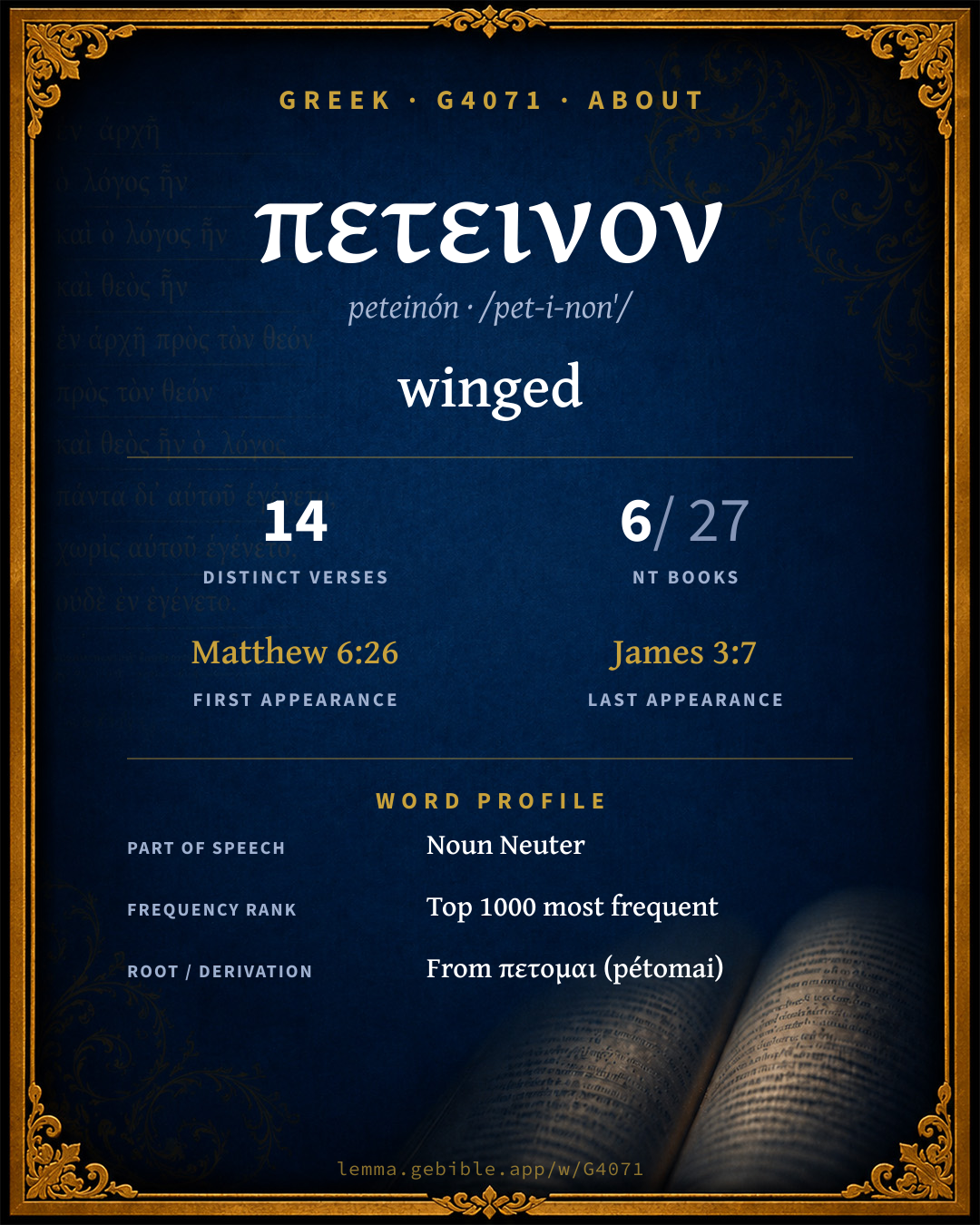
πετεινόν
winged
‘winged’ is one of 2 main senses fuller range ↓
Full lexicon entry — Thayer's Greek Lexicon
From Thayer's Greek Lexicon
Where this word appears
See every Nominative-case word in the Greek New Testament →
Grammar key — what these labels mean
Part of speech
- Noun
- A naming word — a person, place, thing, or idea.
Case
- Nominative
- The case of the subject (and the predicate nominative).
- Accusative
- The case of the direct object and of extent.
- Genitive
- The case of source, possession, or “of” — answers “whose / from what.”
Gender
- Neuter
- Grammatically neuter.
Number
- Plural
- More than one.
Grammatical forms
- Noun, Nominative, Plural, Neuter 7 times (50%)
- Noun, Accusative, Plural, Neuter 4 times (29%)
- Noun, Genitive, Plural, Neuter 3 times (21%)
Parsed forms decoded from the imported morphology (Robinson–Tischendorf, public domain), counted across 14 parsed occurrences — not distinct verses.
Every verse where G4071 appears — 14 distinct verses across 6 books. Click any verse to open its interlinear word-by-word view. Verse text shown in the World English Bible for context — . Each verse’s Greek form is shown with its reference; the English is not keyword-highlighted, since the data carries no word-level English alignment. Use “Compare translations” on any verse to read it across multiple English versions. This concordance covers the Greek New Testament; Septuagint (Greek Old Testament) occurrences of this word are not indexed here.
Matthew 4 verses
- Matthew 6:26 πετεινὰ n acc pl neut See the birds of the sky, that they don't sow, neither do they reap, nor gather into barns. Your heavenly Father feeds them. Aren't you of much more value than they?
- Matthew 8:20 πετεινὰ n nom pl neut Jesus said to him, "The foxes have holes, and the birds of the sky have nests, but the Son of Man has nowhere to lay his head."
- Matthew 13:4 πετεινὰ n nom pl neut As he sowed, some seeds fell by the roadside, and the birds came and devoured them.
- Matthew 13:32 πετεινὰ n acc pl neut which indeed is smaller than all seeds. But when it is grown, it is greater than the herbs, and becomes a tree, so that the birds of the air come and lodge in its branches."
Mark 2 verses
- Mark 4:4 πετεινὰ n nom pl neut and it happened, as he sowed, some seed fell by the road, and the birds came and devoured it.
- Mark 4:32 πετεινὰ n acc pl neut yet when it is sown, grows up, and becomes greater than all the herbs, and puts out great branches, so that the birds of the sky can lodge under its shadow."
Luke 4 verses
- Luke 8:5 πετεινὰ n nom pl neut "The farmer went out to sow his seed. As he sowed, some fell along the road, and it was trampled under foot, and the birds of the sky devoured it.
- Luke 9:58 πετεινὰ n nom pl neut Jesus said to him, "The foxes have holes, and the birds of the sky have nests, but the Son of Man has no place to lay his head."
- Luke 12:24 πετεινῶν n gen pl neut Consider the ravens: they don't sow, they don't reap, they have no warehouse or barn, and God feeds them. How much more valuable are you than birds!
- Luke 13:19 πετεινὰ n nom pl neut It is like a grain of mustard seed, which a man took, and put in his own garden. It grew, and became a large tree, and the birds of the sky lodged in its branches."
Acts 2 verses
- Acts 10:12 πετεινὰ n nom pl neut in which were all kinds of four-footed animals of the earth, wild animals, reptiles, and birds of the sky.
- Acts 11:6 πετεινὰ n acc pl neut When I had looked intently at it, I considered, and saw the four-footed animals of the earth, wild animals, creeping things, and birds of the sky.
Romans 1 verse
James 1 verse
About this entry
At a glance — auto-summarized from this page’s data, not written by a person. Every figure links to its source below. This summary describes the numbers; it doesn’t interpret them.
πετεινον (peteinón) is a Greek noun most often rendered “winged.” Scripture first uses it in Matthew 6:26. Spanning 14 verses in 6 books, it ranks among the uncommon words of the Greek New Testament. Matthew dominates its distribution — 4 of 14 verses. Ranging over 2 senses, it is not a single-sense word. The sections below give every sense, occurrence, and version rendering.
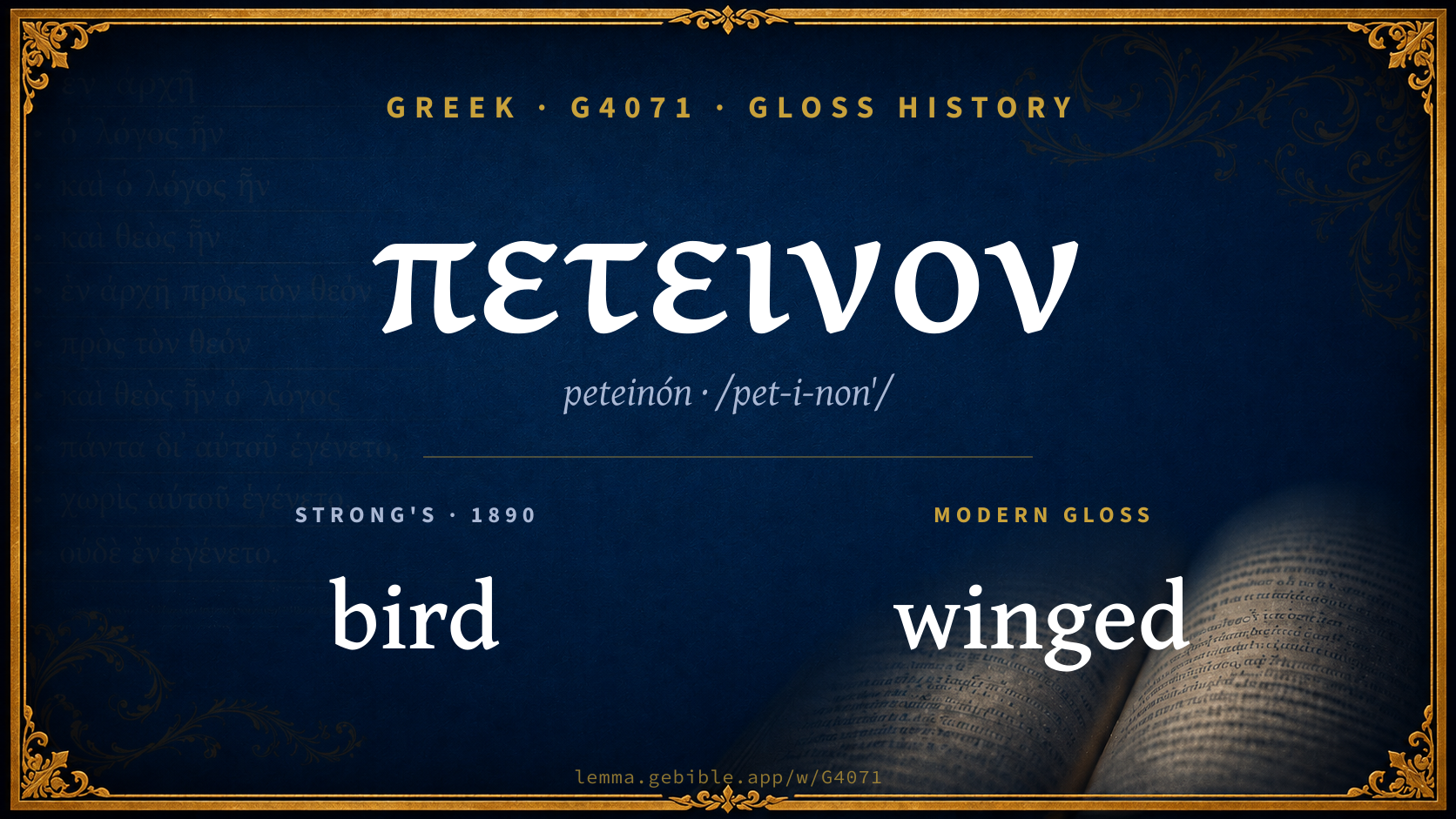
Gloss history
Strong's 1890 vs modern scholarship
About this word
Strong's G4071 catalogs a Greek word from the Greek New Testament.
These counts are not copied from any lexicon or concordance. They are computed here, from the morphology-tagged Greek New Testament. What Lemma adds →
- 14
- distinct verses
- The word appears in 14 distinct verses.
- 6 / 27
- NT books
- The word appears in 6 of 27 New Testament books.
- #814
- by frequency
- Top 1000 most frequent Greek words (rank 814 of 5,347 Greek words by occurrence).
View all 14 occurrences in the concordance →
By section of the New Testament
By traditional corpus
Conventional, traditional groupings — biblical authorship is debated, so this is a traditional corpus grouping, not an authorship claim. Some books belong to more than one corpus (Luke is in both the Gospels and the Lukan corpus, and so on), so these shares overlap and need not total 100%. Each figure is a share of the word’s 14 distinct verses.
- Gospels 10 verses · 71%
- Lukan (Luke–Acts) 6 verses · 43%
- Pauline corpus 1 verse · 7%
- General (Catholic) Epistles 1 verse · 7%
How translations render this word
Counts come from each version’s own published word-to-Strong’s tagging or interlinear alignment — an approximate guide to how each version renders this word, not a word-level alignment the data otherwise carries. Because each total is that version’s own tagged count, the per-version totals vary from one another and need not match the appearance or distinct-verse counts above. These counts may also differ from a printed concordance because Lemma counts each distinctly tagged rendering and does not collapse phrase taggings into a single head-word total. This is a fixed set of word-tagged versions (KJV, ASV, BSB, ULT) and does not change with the reading translation you choose elsewhere. Each version’s license is shown beside its name below (and on Sources).
- King James Version: Fowls 9×, Birds 5×
- American Standard Version: Birds 12×
- Berean Standard Bible: Birds 14×
- unfoldingWord Literal Text: Birds 14×
King James Version Public Domain
Renders G4071 across 14 tagged occurrences — most commonly:
American Standard Version Public Domain
Renders G4071 across 13 tagged occurrences — most commonly:
Plus 1 rendering that appears only once — usually multi-word phrases or single function words the recovered tagging swept in, not distinct renderings.
Berean Standard Bible Public Domain
Renders G4071 across 14 tagged occurrences — most commonly:
unfoldingWord Literal Text CC BY-SA 4.0
Renders G4071 across 14 tagged occurrences — most commonly:
Senses in Thayer's
The 2 senses Thayer's distinguishes for this word, in lexicon order (not ranked by frequency or importance). The full entry — with sub-senses — is in the Lexicon Entry tab.
- flying, winged
- flying or winged animals, birds
Word origin
Derived from πετομαι (pétomai) (G4072) — to fly.
Neuter of a derivative of G4072 ; a flying animal that is bird : - bird fowl.
— Strong’s Exhaustive Concordance (1890), public domain.
Forms in the corpus
The 2 distinct written forms G4071 takes in the Greek New Testament, most frequent first — each parse links to that case’s occurrences in the concordance.
| Form | Parsing | Example | Uses |
|---|---|---|---|
| πετεινὰ peteinà | Noun, Nominative, Plural, Neuter | Matthew 8:20 | 11 |
| πετεινῶν peteinō̂n | Noun, Genitive, Plural, Neuter | Luke 12:24 | 3 |
Same root — word family
Other Thayer's entries built from the same root as G4071, grouped by Strong’s listed origin. These share a root / origin per the lexicon — not necessarily a shared meaning. Each links to that word’s own entry.
Derives from
Shares the same root
Derived from this word
Compare all same-root words → Showing 4 of 6 — not the complete family. They share a root, not necessarily a meaning.
Septuagint usage
The same Greek word πετεινον appears 75 times in the Greek Old Testament (Septuagint), across 72 verses in 14 books.
- 75
- LXX occurrences
- Tagged occurrences of this Greek word in the Septuagint.
- 72
- verses
- Distinct Septuagint verses containing this word.
- 14 / 39
- OT books
- The word appears in 14 of the 39 Old Testament books.
Sample Septuagint occurrences
- Genesis 1:20 πετεινόν
- Leviticus 1:14 πετεινόν
- Deuteronomy 14:19 πετεινόν
- 1 Samuel 17:24 πετεινόν
- 1 Kings 5:13 πετεινόν
- Job 28:7 πετεινόν
- Psalms 8:9 πετεινόν
- Ecclesiastes 10:20 πετεινόν
- Isaiah 16:2 πετεινόν
- Jeremiah 4:25 πετεινόν
- Ezekiel 17:23 πετεινόν
- Daniel 2:38 πετεινόν
Septuagint occurrences (same lexeme)
Every verse where the same Strong’s number (G4071) appears in the Greek Septuagint — showing the first 50 of 72. Verse text shown in the World English Bible for context; the Greek form is the matched word — the English is not keyword-highlighted.
- Genesis 1:20 πετεινόν God said, "Let the waters swarm with swarms of living creatures, and let birds fly above the earth in the open expanse of sky."
- Genesis 1:21 πετεινόν God created the large sea creatures, and every living creature that moves, with which the waters swarmed, after their kind, and every winged bird after its kind. God saw that it was good.
- Genesis 1:22 πετεινόν God blessed them, saying, "Be fruitful, and multiply, and fill the waters in the seas, and let birds multiply on the earth."
- Genesis 1:26 πετεινόν God said, "Let us make man in our image, after our likeness: and let them have dominion over the fish of the sea, and over the birds of the sky, and over the cattle, and over all the earth, and over every creeping thing that creeps on the earth."
- Genesis 1:28 πετεινόν God blessed them. God said to them, "Be fruitful, multiply, fill the earth, and subdue it. Have dominion over the fish of the sea, over the birds of the sky, and over every living thing that moves on the earth."
- Genesis 1:30 πετεινόν To every animal of the earth, and to every bird of the sky, and to everything that creeps on the earth, in which there is life, I have given every green herb for food." And it was so.
- Genesis 2:19 πετεινόν Out of the ground Yahweh God formed every animal of the field, and every bird of the sky, and brought them to the man to see what he would call them. Whatever the man called every living creature, that was its name.
- Genesis 2:20 πετεινόν The man gave names to all cattle, and to the birds of the sky, and to every animal of the field; but for man there was not found a helper suitable for him.
- Genesis 6:7 πετεινόν Yahweh said, "I will destroy man whom I have created from the surface of the ground; man, along with animals, creeping things, and birds of the sky; for I am sorry that I have made them."
- Genesis 6:20 πετεινόν Of the birds after their kind, of the cattle after their kind, of every creeping thing of the ground after its kind, two of every sort shall come to you, to keep them alive.
- Genesis 7:3 πετεινόν Also of the birds of the sky, seven and seven, male and female, to keep seed alive on the surface of all the earth.
- Genesis 7:8 πετεινόν Clean animals, animals that are not clean, birds, and everything that creeps on the ground
- Genesis 7:14 πετεινόν they, and every animal after its kind, all the cattle after their kind, every creeping thing that creeps on the earth after its kind, and every bird after its kind, every bird of every sort.
- Genesis 7:21 πετεινόν All flesh died that moved on the earth, including birds, cattle, animals, every creeping thing that creeps on the earth, and every man.
- Genesis 7:23 πετεινόν Every living thing was destroyed that was on the surface of the ground, including man, cattle, creeping things, and birds of the sky. They were destroyed from the earth. Only Noah was left, and those who were with him in the ark.
- Genesis 8:1 πετεινόν God remembered Noah, all the animals, and all the cattle that were with him in the ark; and God made a wind to pass over the earth. The waters subsided.
- Genesis 8:17 πετεινόν Bring forth with you every living thing that is with you of all flesh, including birds, cattle, and every creeping thing that creeps on the earth; that they may breed abundantly in the earth, and be fruitful, and multiply on the earth."
- Genesis 8:19 πετεινόν Every animal, every creeping thing, and every bird, whatever moves on the earth, after their families, went forth out of the ark.
- Genesis 8:20 πετεινόν Noah built an altar to Yahweh, and took of every clean animal, and of every clean bird, and offered burnt offerings on the altar.
- Genesis 40:17 πετεινόν In the uppermost basket there was all kinds of baked food for Pharaoh, and the birds ate them out of the basket on my head."
- Leviticus 1:14 πετεινόν "'If his offering to Yahweh is a burnt offering of birds, then he shall offer his offering of turtledoves, or of young pigeons.
- Leviticus 7:26 πετεινόν You shall not eat any blood, whether it is of bird or of animal, in any of your dwellings.
- Leviticus 11:13 πετεινόν "'These you shall detest among the birds; they shall not be eaten, they are an abomination: the eagle, and the vulture, and the black vulture,
- Leviticus 11:20 πετεινόν "'All flying insects that walk on all fours are an abomination to you.
- Leviticus 11:21 πετεινόν Yet you may eat these: of all winged creeping things that go on all fours, which have legs above their feet, with which to hop on the earth.
- Leviticus 11:23 πετεινόν But all winged creeping things which have four feet, are an abomination to you.
- Leviticus 11:46 πετεινόν "'This is the law of the animal, and of the bird, and of every living creature that moves in the waters, and of every creature that creeps on the earth,
- Leviticus 17:13 πετεινόν "'Whatever man there is of the children of Israel, or of the strangers who live as foreigners among them, who takes in hunting any animal or bird that may be eaten; he shall pour out its blood, and cover it with dust.
- Leviticus 20:25 πετεινόν "'You shall therefore make a distinction between the clean animal and the unclean, and between the unclean fowl and the clean: and you shall not make yourselves abominable by animal, or by bird, or by anything with which the ground teems, which I have separated from you as unclean for you.
- Deuteronomy 14:19 πετεινόν All winged creeping things are unclean to you: they shall not be eaten.
- Deuteronomy 14:20 πετεινόν Of all clean birds you may eat.
- Deuteronomy 28:26 πετεινόν Your dead body shall be food to all birds of the sky, and to the animals of the earth; and there shall be none to frighten them away.
- 1 Samuel 17:24 πετεινόν All the men of Israel, when they saw the man, fled from him, and were sore afraid.
- 1 Samuel 17:26 πετεινόν David spoke to the men who stood by him, saying, What shall be done to the man who kills this Philistine, and takes away the reproach from Israel? for who is this uncircumcised Philistine, that he should defy the armies of the living God?
- 1 Kings 5:13 πετεινόν King Solomon raised a levy out of all Israel; and the levy was thirty thousand men.
- 1 Kings 12:24 πετεινόν Thus says Yahweh, You shall not go up, nor fight against your brothers the children of Israel: return every man to his house; for this thing is of me. So they listened to the word of Yahweh, and returned and went their way, according to the word of Yahweh.
- 1 Kings 16:4 πετεινόν Him who dies of Baasha in the city shall the dogs eat; and him who dies of his in the field shall the birds of the sky eat.
- 1 Kings 20:24 πετεινόν Do this thing: take the kings away, every man out of his place, and put captains in their room;
- Job 28:7 πετεινόν That path no bird of prey knows, Neither has the falcon's eye seen it.
- Job 28:21 πετεινόν Seeing it is hidden from the eyes of all living, And kept close from the birds of the sky.
- Job 35:11 πετεινόν Who teaches us more than the animals of the earth, And makes us wiser than the birds of the sky?'
- Psalms 8:9 πετεινόν Yahweh, our Lord, How majestic is your name in all the earth!
- Psalms 49:11 πετεινόν Their inward thought is that their houses will endure forever, And their dwelling places to all generations. They name their lands after themselves.
- Psalms 77:27 πετεινόν
- Psalms 78:2 πετεινόν I will open my mouth in a parable. I will utter dark sayings of old,
- Psalms 103:12 πετεινόν As far as the east is from the west, So far has he removed our transgressions from us.
- Psalms 148:10 πετεινόν Wild animals and all cattle; Small creatures and flying birds;
- Ecclesiastes 10:20 πετεινόν Don't curse the king, no, not in your thoughts; And don't curse the rich in your bedchamber: For a bird of the sky may carry your voice, And that which has wings may tell the matter.
- Isaiah 16:2 πετεινόν For it shall be that, as wandering birds, as a scattered nest, so shall the daughters of Moab be at the fords of the Arnon.
- Isaiah 18:6 πετεινόν They shall be left together to the ravenous birds of the mountains, and to the animals of the earth; and the ravenous birds shall summer on them, and all the animals of the earth shall winter on them.
These are occurrences of the same Greek lexeme (G4071) in the Septuagint — not a translation of any one Hebrew word. The store carries no word-level Hebrew↔Greek alignment, so no Hebrew original is asserted here. Counts come from the recovered LXX Strong's tagging — high-frequency vocabulary is well covered, while rare or late forms may be untagged — so they reflect tagged occurrences and may slightly undercount.