

Revelation 19:4
Greek (Tischendorf 8th ed.) Revelation 19:4 appears in the Greek New Testament. The text above is from the Tischendorf 8th edition. Each word links to its Strong’s number and a concise gloss. Click any word for its full Thayer’s Greek Lexicon entry.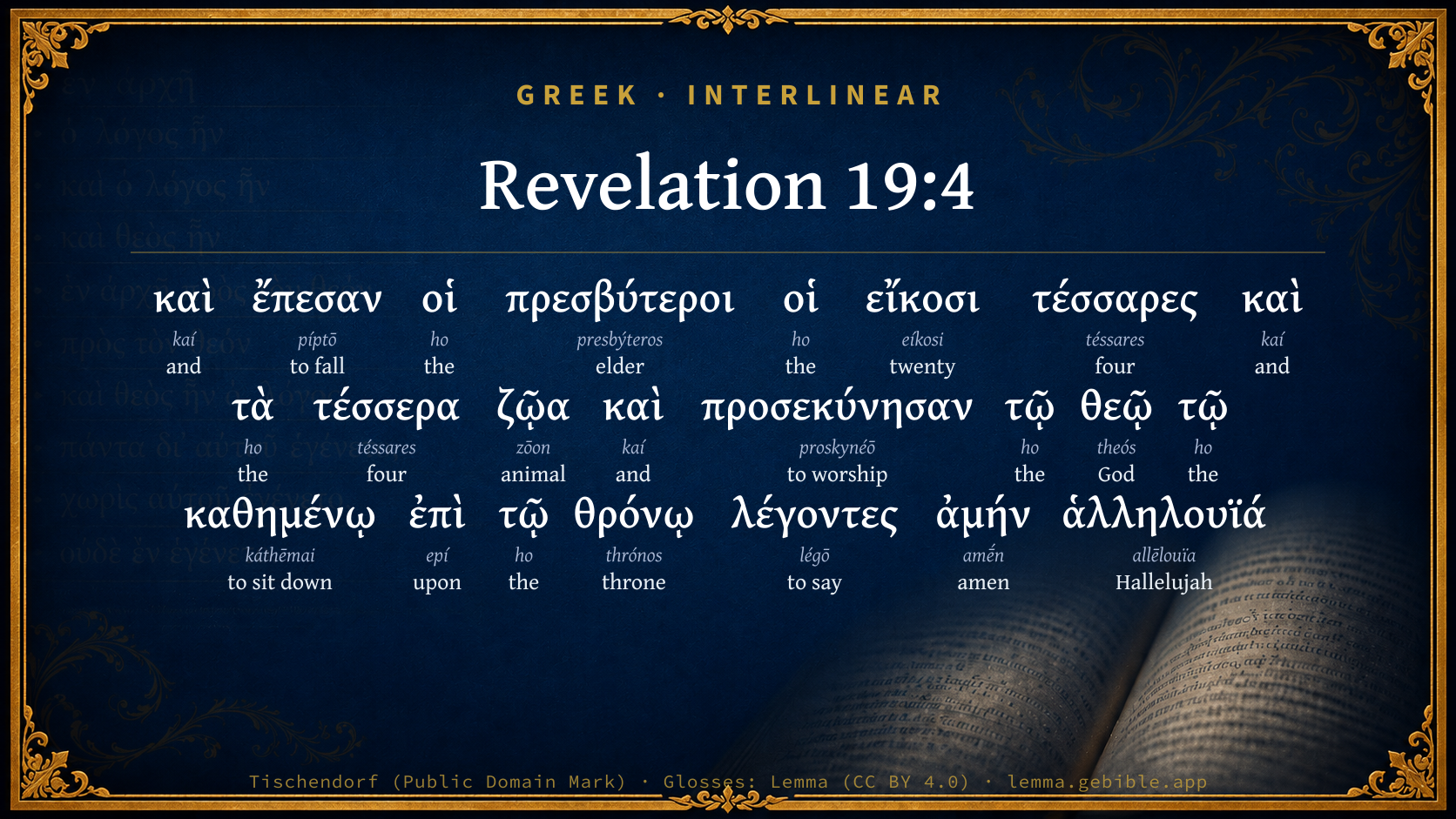
The twenty-four elders and the four living creatures fell down and worshiped God who sits on the throne, saying, "Amen! Hallelujah!"
Download a study sheet
One document with this verse’s original text, its word-by-word gloss line, the meaning frame, cross-references with their text, attributed commentary, and full source and license credits — printable, and it pastes into notes with its structure intact.
This verse Autodidact and up
A passage Seminary Student
Up to 50 verses in one chapter. A passage sheet keeps up to 6 commentary sources and 12 cross-references per verse, in the order this page ranks them, and says so on the sheet whenever that leaves anything out. Ask for a single verse and you get the Autodidact verse sheet above.
Everything on this page stays free to read, with no account — the sheet is a download of what is already on screen, not access to it.
Compare translations 3
The same verse in 3 English versions, stacked beneath the original-language interlinear above. Click any original word for its lexicon entry.
Each is an independent rendering of the whole verse — the interlinear is not word-aligned to these translations.
Highlighted words mark where these versions differ — a whole-verse word diff, not a word-by-word alignment.
-
World English Bible Public Domain
The twenty-four elders and the four living creatures fell down and worshiped God who sits on the throne, saying, "Amen! Hallelujah!"
-
King James Version Public Domain
And the four and twenty elders and the four beasts fell down and worshipped God that sat on the throne, saying, Amen; Alleluia.
-
unfoldingWord Literal Text CC BY-SA 4.0
And the 24 elders and the four living creatures fell down and worshiped God, the One sitting on the throne, saying, “Amen. Hallelujah!”
unfoldingWord Literal Text — © unfoldingWord, licensed CC BY-SA 4.0. Word-aligned USFM3 via Door43 (git.door43.org/unfoldingWord/en_ult).
Show all 19 translations
Every available English version of this verse, each an independent rendering of the whole verse.
-
World English Bible Public Domain
The twenty-four elders and the four living creatures fell down and worshiped God who sits on the throne, saying, "Amen! Hallelujah!"
-
Berean Standard Bible Public Domain
And the twenty-four elders and the four living creatures fell down and worshiped God who sits on the throne, saying: “Amen, Hallelujah!”
-
Majority Standard Bible Public Domain
And the twenty-four elders and the four living creatures fell down and worshiped God who sits on the throne, saying: “Amen, Hallelujah!”
-
King James Version Public Domain
And the four and twenty elders and the four beasts fell down and worshipped God that sat on the throne, saying, Amen; Alleluia.
-
American Standard Version (1901) Public Domain
And the four and twenty elders and the four living creatures fell down and worshipped God that sitteth on the throne, saying, Amen; Hallelujah.
-
Revised Version (1885) Public Domain
And the four and twenty elders and the four living creatures fell down and worshipped God that sitteth on the throne, saying, Amen; Hallelujah.
-
Geneva Bible (1599) Public Domain
And the foure and twentie Elders, and the foure beastes fell downe, and worshipped God that sate on the throne, saying, Amen, Hallelu-iah.
-
Douay-Rheims (1899) Public Domain
And the four and twenty ancients, and the four living creatures fell down and adored God that sitteth upon the throne, saying: Amen; Alleluia.
-
Young's Literal Translation Public Domain
And fall down did the elders -- the twenty and four -- and the four living creatures, and they did bow before God who is sitting upon the throne, saying, `Amen, Alleluia.'
-
Literal Standard Version CC BY-SA 4.0
And the twenty-four elders and the four living creatures fell down and they worshiped God who is sitting on the throne, saying, “Amen! Hallelujah!”
-
Unlocked Literal Bible CC BY-SA 4.0
The twenty-four elders and the four living creatures fell down and worshiped God who was seated on the throne. They were saying, “Amen. Hallelujah!”
-
unfoldingWord Literal Text CC BY-SA 4.0
And the 24 elders and the four living creatures fell down and worshiped God, the One sitting on the throne, saying, “Amen. Hallelujah!”
-
Darby Bible Public Domain
And the twenty-four elders and the four living creatures fell down and did homage to God who sits upon the throne, saying, Amen, Hallelujah.
-
World Messianic Bible Public Domain
The twenty-four elders and the four living creatures fell down and worshiped God who sits on the throne, saying, “Amen! Hallelujah!”
-
Webster's Bible Public Domain
And the four and twenty elders and the four living beings fell down and worshiped God who sat on the throne, saying, Amen; Alleluia.
-
Free Bible Version CC BY-SA 4.0
The twenty-four elders and the four living creatures fell down and worshiped God who sits on the throne. “Amen! Hallelujah!” they shouted.
-
Bible in Basic English Public Domain
And the four and twenty rulers and the four beasts went down on their faces and gave worship to God who was seated on the high seat, saying, Even so, praise to the Lord.
-
Text-Critical English NT CC BY 4.0
Then the twenty-four elders and the four living creatures fell down and worshiped God, who sits on the throne, saying, “Amen. Hallelujah!”
-
Tyndale New Testament (1534) Public Domain
And the xxiiii. elders and the iiii. bestes fell doune and worshypped god that sate on the seate sayinge: Amen Alleluya.
Literal Standard Version (2020), Covenant Press — licensed CC BY-SA 4.0. Text via the HelloAO Bible API (eBible.org). Unlocked Literal Bible (unfoldingWord) — licensed CC BY-SA 4.0. Text via the HelloAO Bible API (eBible.org). unfoldingWord Literal Text — © unfoldingWord, licensed CC BY-SA 4.0. Word-aligned USFM3 via Door43 (git.door43.org/unfoldingWord/en_ult). Free Bible Version, Dr. Jonathan Gallagher — licensed CC BY-SA 4.0. Text via the HelloAO Bible API (eBible.org).
Word by word
More ways to search: Search by grammar → Find every occurrence → Compare this word →
Practice this passage: Drill this verse → Learn its vocabulary →
- Appears 4× in the Greek New Testament
- First appears at Revelation 19:1
- Part of Speech
- Hebrew transliteration
Full Thayer's Definition
- καὶ kaí G2532 “and” Conjunction
- ἔπεσαν píptō G4098 “to fall” Verb, Aorist, Active, Indicative, 3rd person, Plural
- οἱ ho G3588 “the” Article, Nominative, Plural, Masculine
- πρεσβύτεροι presbýteros G4245 “elder” Adjective, Nominative, Plural, Masculine, Comparative
- οἱ ho G3588 “the” Article, Nominative, Plural, Masculine
- εἴκοσι eíkosi G1501 “twenty” Adjective, Numeral (indeclinable)
- τέσσαρες téssares G5064 “four” Adjective, Nominative, Plural, Masculine
- καὶ kaí G2532 “and” Conjunction
- τὰ ho G3588 “the” Article, Nominative, Plural, Neuter
- τέσσερα téssares G5064 “four” Adjective, Nominative, Plural, Neuter
- ζῷα zōon G2226 “animal” Noun, Nominative, Plural, Neuter
- καὶ kaí G2532 “and” Conjunction
- προσεκύνησαν proskynéō G4352 “to worship” Verb, Aorist, Active, Indicative, 3rd person, Plural
- τῷ ho G3588 “the” Article, Dative, Singular, Masculine
- θεῷ theós G2316 “God” Noun, Dative, Singular, Masculine
- τῷ ho G3588 “the” Article, Dative, Singular, Masculine
- καθημένῳ káthēmai G2521 “to sit down” Verb, Present, Middle or Passive deponent, Participle, Dative, Singular, Masculine
- ἐπὶ epí G1909 “upon” Preposition
- τῷ ho G3588 “the” Article, Dative, Singular, Masculine
- θρόνῳ thrónos G2362 “throne” Noun, Dative, Singular, Masculine
- λέγοντες légō G3004 “to say” Verb, Present, Active, Participle, Nominative, Plural, Masculine
- ἀμήν amḗn G281 “amen” Hebrew transliteration
- ἁλληλουϊά allēlouïa G239 “Hallelujah” Hebrew transliteration
About this verse
These counts appear in no published source. They are computed here, from the morphology-tagged text and Lemma’s own curated glosses. What Lemma adds →
- 23
- words
- 15
- distinct lemmas
- Revelation
- section
Cross-references
17Topical passages linked to Revelation 19:4 in the Treasury of Scripture Knowledge — connected by theme and wording, ordered by reader-vote popularity; previews shown in the World English Bible.
- Revelation 5:14 The four living creatures said, "Amen!" The elders fell down and worshiped.
- Nehemiah 8:6 and Ezra blessed Yahweh, the great God. All the people answered, Amen, Amen, with the lifting up of their hands: and they bowed their heads, and worshiped Yahweh with their faces to the ground.
- Psalms 106:48 Blessed be Yahweh, the God of Israel, From everlasting even to everlasting! Let all the people say, "Amen." Praise Yah!
- 1 Chronicles 16:36 Blessed be Yahweh, the God of Israel, From everlasting even to everlasting. All the people said, Amen, and praised Yahweh.
- Nehemiah 5:13 Also I shook out my lap, and said, So God shake out every man from his house, and from his labor, that doesn't perform this promise; even thus be he shaken out, and emptied. All the assembly said, Amen, and praised Yahweh. The people did according to this promise.
- Psalms 41:13 Blessed be Yahweh, the God of Israel, From everlasting and to everlasting! Amen and amen.
- Psalms 72:19 Blessed be his glorious name forever! Let the whole earth be filled with his glory! Amen and amen.
- Psalms 89:52 Blessed be Yahweh forevermore. Amen, and Amen.
- Jeremiah 28:6 even the prophet Jeremiah said, Amen: Yahweh do so; Yahweh perform your words which you have prophesied, to bring again the vessels of Yahweh's house, and all them of the captivity, from Babylon to this place.
- Revelation 4:4–10 Around the throne were twenty-four thrones. On the thrones were twenty-four elders sitting, dressed in white garments, with crowns of gold on their heads.
- Revelation 5:8–11 Now when he had taken the book, the four living creatures and the twenty-four elders fell down before the Lamb, each one having a harp, and golden bowls full of incense, which are the prayers of the saints.
- Revelation 11:15–16 The seventh angel sounded, and great voices in heaven followed, saying, "The kingdom of the world has become the Kingdom of our Lord, and of his Christ. He will reign forever and ever!"
- Revelation 15:7 One of the four living creatures gave to the seven angels seven golden bowls full of the wrath of God, who lives forever and ever.
- Revelation 19:1 After these things I heard something like a loud voice of a great multitude in heaven, saying, "Hallelujah! Salvation, power, and glory belong to our God:
- Matthew 28:20 teaching them to observe all things that I commanded you. Behold, I am with you always, even to the end of the age." Amen.
- 1 Corinthians 14:16 Otherwise if you bless with the spirit, how will he who fills the place of the unlearned say the "Amen" at your giving of thanks, seeing he doesn't know what you say?
- Matthew 6:13 Bring us not into temptation, but deliver us from the evil one. For yours is the Kingdom, the power, and the glory forever. Amen.'
Cross-references courtesy of OpenBible.info (CC BY 4.0).
Lesson kit
Teaching starters — assembled from the data on this page, not authored interpretation. Every prompt links to the verse data it draws on. Edit before teaching.
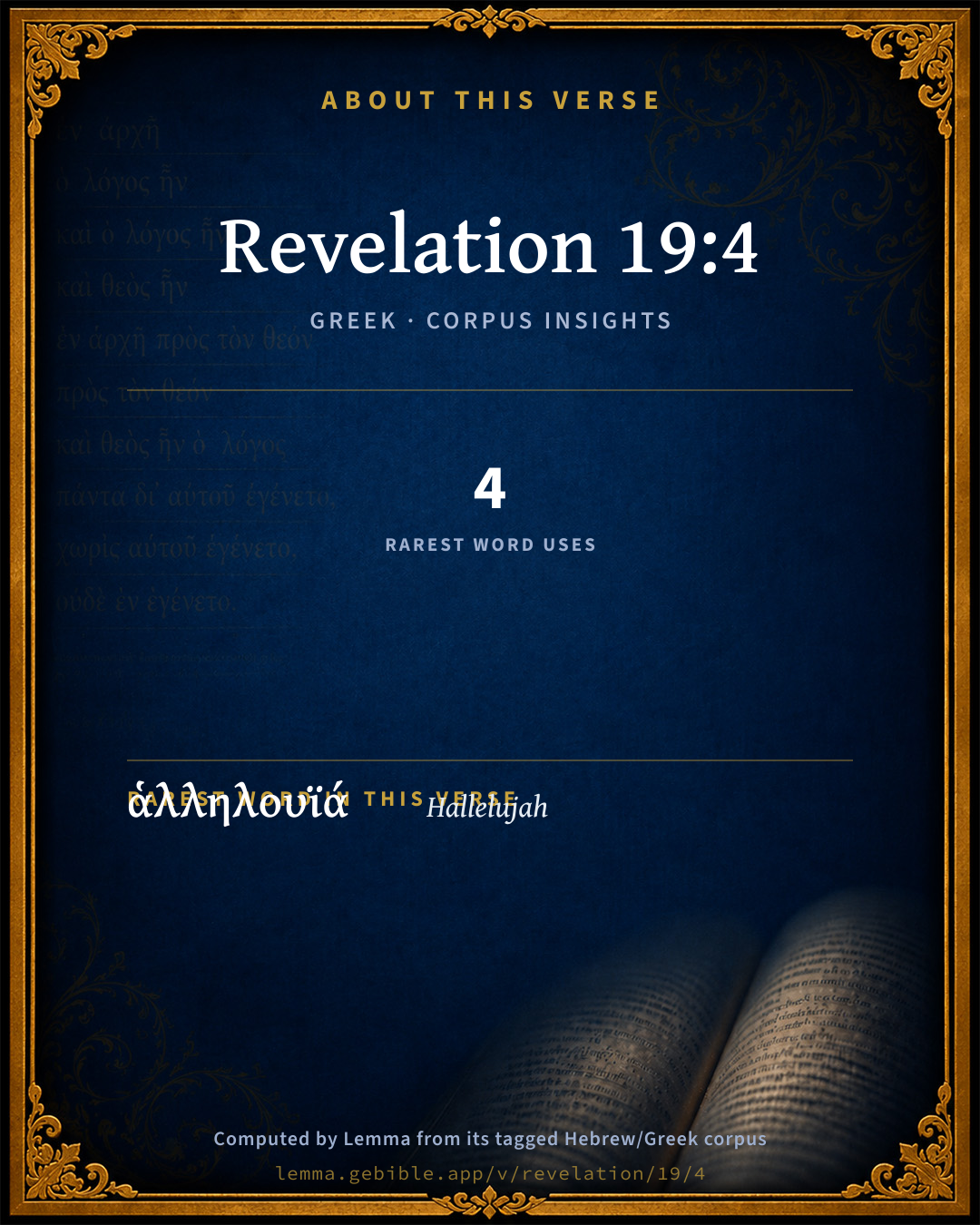
Revelation, in the Revelation, opens this verse with 23 words (15 distinct Greek lemmas). Its most distinctive word is allēlouïa (“Hallelujah”). A historical commentator’s framing appears above. Read the whole chapter for the surrounding context.
Discussion questions
- How does “Hallelujah” (allēlouïa) shape what this verse is saying?
- How does Revelation 19:1, which shares the word «Hallelujah», read alongside this verse?
- What does the repetition of “four” (2× in this one verse) do in this verse?
- These translations render this verse differently. What is at stake in choosing one wording over another?
- Compare how Joseph Benson's Commentary and Tyndale Open Study Notes read this verse. Where do they agree or differ?
Things to notice
- These translations choose different wording for 15 words in this verse.
- “four” occurs 2× in this single verse.
- 15 distinct Greek lemmas span 23 words in this verse.
Commentary
Notes on Revelation 19:4 from classic Christian and Jewish commentators (each source and its license shown beneath its notes). The classic Christian expositions comment on the surrounding passage and are grouped to its opening verse, so a note may address several verses; the Jewish commentaries on the Tanakh (Rashi and others) are per-verse, so they appear only where the commentator wrote on this verse.
Lemma curates 59 commentaries, every one of them public domain or Creative Commons licensed, each selected and text-cleaned for this edition rather than reprinted as found. About our sources →
Joseph Benson's Commentary
Joseph Benson's Commentary on the Old and New Testaments (1811–1818) — public domain. Text from a community e-Sword module.
Tyndale Open Study Notes
Tyndale Open Resources
Tyndale Open Study Notes — © Tyndale Open Resources, licensed CC BY-SA 4.0. Text via the HelloAO Bible API.
Meyer's Critical & Exegetical Commentary
Heinrich August Wilhelm Meyer
Meyer — Critical and Exegetical Commentary on the New Testament — English translation by Peter Christie, edited by Frederick Crombie (T&T Clark, 1880) — public domain. Text from a community e-Sword module.
Expositor's Greek Testament
ed. W. Robertson Nicoll
The Expositor's Greek Testament, edited by W. Robertson Nicoll (1897–1910) — public domain. Text from a community e-Sword module.
Jamieson, Fausset & Brown
Robert Jamieson, A. R. Fausset & David Brown
Jamieson, Fausset & Brown — Commentary Critical and Explanatory on the Whole Bible (1871) — public domain (CC PDM 1.0). Text via the HelloAO Bible API.
Adam Clarke's Commentary
Adam Clarke's Commentary on the Bible (1810–1826) — public domain. Text from a community e-Sword/MySword module.
Ellicott's Commentary for English Readers
A Bible Commentary for English Readers, edited by Charles John Ellicott (1878–1897) — public domain. Text from a community e-Sword module.
The Cambridge Bible for Schools and Colleges
gen. ed. J. J. S. Perowne
The Cambridge Bible for Schools and Colleges (gen. ed. J. J. S. Perowne; Cambridge University Press, 1878–1918) — public domain. Text from a community e-Sword module.
John Gill's Exposition
John Gill's Exposition of the Whole Bible (1746–1763) — public domain (CC PDM 1.0). Text via the HelloAO Bible API.
Trapp's Complete Commentary
John Trapp
John Trapp, A Commentary or Exposition upon All the Books of the Old and New Testament (1647–1656) — public domain. Text from a community e-Sword module.
Albert Barnes' Notes on the Bible
Albert Barnes' Notes on the Bible (1834–1885) — public domain. Text from a community e-Sword/MySword module.
Matthew Poole's English Annotations
Matthew Poole's English Annotations on the Holy Bible (1683–1685) — public domain. Text from a community e-Sword/MySword module.
Whedon's Commentary on the Bible
Daniel D. Whedon
Daniel D. Whedon (gen. ed.), Commentary on the Old and New Testaments (1874–1909) — public domain. Text from a community e-Sword module.
The Pulpit Commentary
The Pulpit Commentary (1880–1919), ed. H.D.M. Spence-Jones & Joseph S. Exell — public domain. Text from a community e-Sword module.
John Wesley's Explanatory Notes
John Wesley, Explanatory Notes Upon the Whole Bible (1754–1765) — public domain. Text via the GEBible commentary corpus.
Scofield Reference Notes
C. I. Scofield
The Scofield Reference Bible (1917 edition), notes by C. I. Scofield — public domain. Text from a community e-Sword module.
Burkitt's Expository Notes on the New Testament
William Burkitt
William Burkitt's Expository Notes on the New Testament (1700–1703) — public domain. Text from a community e-Sword module.
The People's New Testament
B. W. Johnson
B. W. Johnson's The People's New Testament with Notes (1889–1891) — public domain. Electronic text from the Christian Classics Ethereal Library (CCEL) ThML edition.
Cambridge Greek Testament for Schools and Colleges
Cambridge Greek Testament for Schools and Colleges (Cambridge University Press, 1896; 21 vols, various authors incl. Carr, Maclear, Plummer, Farrar, Lumby, Moule, M. R. James, Simcox) — public domain. Text from a community e-Sword module.